

IEC 62386-102:2014
(Main)Digital addressable lighting interface - Part 102: General requirements - Control gear
General Information
- Abstract
IEC 62386-102:2014 is applicable to control gear in a bus system for control by digital signals of electronic lighting equipment. This electronic lighting equipment should be in line with the requirments of IEC 61347, with the addition of d.c. supplies. This second edition cancels and replaces the first edition published in 2009. This edition constitutes a technical revision. This edition includes the following significant technical changes with respect to the previous edition:
a) elimination of all non-control gear relevant definitions,
b) improvement of the requirements for control gear by clarifying the description,
c) improvement of the test command iterations to increase the compatibility,
d) addition of new commands, and
e) the deletion of the requirements for:
1) timing;
2) control devices. The requirements for timing are now in Part 101 and the requirments for control devices are in Part 103.
This publication is to be read in conjunction with IEC 62386-101:2014
- Status
- Published
- Publication Date
- 27-Sep-2018
- Technical Committee
- SC 34C - Auxiliaries for lamps
- Drafting Committee
- WG 11 - TC 34/WG 11
- Current Stage
- DELPUB - Deleted Publication
- Start Date
- 16-Nov-2022
- Completion Date
- 30-Nov-2020
Buy Documents
IEC 62386-102:2014 - Digital addressable lighting interface - Part 102: General requirements - Control gear Released:11/7/2014

IEC 62386-102:2014+AMD1:2018 CSV - Digital addressable lighting interface - Part 102: General requirements - Control gear Released:9/28/2018
Overview
IEC 62386-102:2014, titled Digital Addressable Lighting Interface – Part 102: General Requirements – Control Gear, is an international standard developed by the International Electrotechnical Commission (IEC). This standard specifies the general requirements for control gear used in digital addressable lighting interfaces (DALI) bus systems for electronically controlling lighting equipment. It is designed for devices compliant with IEC 61347 and includes provisions for direct current (d.c.) supplies.
The second edition of this standard, published in 2014 and revised with an amendment in 2018, updates and replaces the first edition from 2009. It introduces technical revisions focused on clarity, compatibility, and expanded command functionalities while relocating requirements for timing and control devices to other parts of IEC 62386 (Parts 101 and 103 respectively).
Key Highlights of IEC 62386-102:2014 include:
- Defining general and electrical specifications for control gear in digital lighting systems
- Establishing transmission protocol structures and command handling
- Specifying dimming curves, fading behaviors, and memory operations
- Providing a framework for status reporting, failure modes, and device addressing
Key Topics
Control Gear Compatibility
Ensures control gear operates seamlessly within a DALI bus system, adhering to defined electrical and communication protocols.Transmission Protocol
Utilizes a 16-bit forward frame encoding protocol with structured address and opcode bytes to manage commands and data transfer effectively.Dimming and Fading Control
Defines precise handling of dimming curves, target level calculation, and fading characteristics including fade time, rate, and extended fade behaviors essential for smooth lighting transitions.Command Sets and Iterations
Includes an extensive suite of commands such as ON/OFF, level control, step adjustments, recalls of max/min levels, and manufacturer-specific commands, with guidelines for handling repeated commands to improve device compatibility.Memory Management
Details memory banks usage, including reading, writing, and bank selection to enable configuration storage and device state retention.Failure and Status Reporting
Specifies mechanisms for control gear to report failure states (e.g., device failure, lamp failure), operating statuses (such as lamp ON), and error conditions to facilitate diagnostics and maintenance.Addressing and Identification
Provides methods for assigning short addresses within the system, including random allocation, direct addressing, and device identification, enabling flexible and scalable lighting networks.
Applications
IEC 62386-102:2014 is vital for manufacturers, designers, and integrators involved in digital lighting control systems and smart lighting infrastructures. It is applicable in:
Commercial and Industrial Lighting Systems
Enables robust control of lighting installations in office buildings, factories, and warehouses with digital interfaces to improve energy efficiency and system reliability.Smart Building Automation
Assists integrators in creating interoperable lighting solutions that interface with building management systems for dynamic lighting adjustments.Theatrical and Architectural Lighting
Supports precise dimming and control requirements essential for ambiance and performance lighting using addressable control gear.LED and Electronic Lighting Equipment
Defines control parameters for modern LED drivers and other electronic gear to ensure consistent and standards-compliant digital communication.
Related Standards
For comprehensive implementation of DALI systems, practitioners often refer to complementary IEC 62386 parts, including:
IEC 62386-101:2014 – General Requirements – System
Covers overall system architecture, timing, and basic operational requirements applicable alongside Part 102.IEC 62386-103 – Control Devices
Defines requirements for control devices which send commands to control gear, enhancing interoperability across lighting control components.IEC 61347 – Lamp Control Gear
Specifies safety and performance requirements for electronic lamp control devices, forming the baseline for devices compliant with IEC 62386-102.
By adhering to IEC 62386-102:2014, stakeholders ensure that control gear deployed in lighting control networks is compliant with international best practices, provides reliable and flexible control capabilities, and supports the evolving needs of modern digital lighting infrastructures. This standard is essential for achieving interoperability, energy efficiency, and scalable lighting solutions in the era of smart lighting technology.
Relations
- Effective Date
- 05-Sep-2023
- Effective Date
- 05-Sep-2023
- Effective Date
- 05-Sep-2023
Buy Documents
IEC 62386-102:2014 - Digital addressable lighting interface - Part 102: General requirements - Control gear Released:11/7/2014
IEC 62386-102:2014+AMD1:2018 CSV - Digital addressable lighting interface - Part 102: General requirements - Control gear Released:9/28/2018
Get Certified
Connect with accredited certification bodies for this standard

IMQ S.p.A. (Certification)
Italian electrical product certification.

SLG Prüf- und Zertifizierungs GmbH
German testing and certification body.

UL Solutions
Global safety science company with testing, inspection and certification.
Sponsored listings
Frequently Asked Questions
IEC 62386-102:2014 is a standard published by the International Electrotechnical Commission (IEC). Its full title is "Digital addressable lighting interface - Part 102: General requirements - Control gear". This standard covers: IEC 62386-102:2014 is applicable to control gear in a bus system for control by digital signals of electronic lighting equipment. This electronic lighting equipment should be in line with the requirments of IEC 61347, with the addition of d.c. supplies. This second edition cancels and replaces the first edition published in 2009. This edition constitutes a technical revision. This edition includes the following significant technical changes with respect to the previous edition: a) elimination of all non-control gear relevant definitions, b) improvement of the requirements for control gear by clarifying the description, c) improvement of the test command iterations to increase the compatibility, d) addition of new commands, and e) the deletion of the requirements for: 1) timing; 2) control devices. The requirements for timing are now in Part 101 and the requirments for control devices are in Part 103. This publication is to be read in conjunction with IEC 62386-101:2014
IEC 62386-102:2014 is applicable to control gear in a bus system for control by digital signals of electronic lighting equipment. This electronic lighting equipment should be in line with the requirments of IEC 61347, with the addition of d.c. supplies. This second edition cancels and replaces the first edition published in 2009. This edition constitutes a technical revision. This edition includes the following significant technical changes with respect to the previous edition: a) elimination of all non-control gear relevant definitions, b) improvement of the requirements for control gear by clarifying the description, c) improvement of the test command iterations to increase the compatibility, d) addition of new commands, and e) the deletion of the requirements for: 1) timing; 2) control devices. The requirements for timing are now in Part 101 and the requirments for control devices are in Part 103. This publication is to be read in conjunction with IEC 62386-101:2014
IEC 62386-102:2014 is classified under the following ICS (International Classification for Standards) categories: 29.140.50 - Lighting installation systems; 29.140.99 - Other standards related to lamps. The ICS classification helps identify the subject area and facilitates finding related standards.
IEC 62386-102:2014 has the following relationships with other standards: It is inter standard links to IEC 62386-102:2014/AMD1:2018, IEC 62386-102:2009, IEC 62386-102:2022. Understanding these relationships helps ensure you are using the most current and applicable version of the standard.
IEC 62386-102:2014 is available in PDF format for immediate download after purchase. The document can be added to your cart and obtained through the secure checkout process. Digital delivery ensures instant access to the complete standard document.
Standards Content (Sample)
IEC 62386-102 ®
Edition 2.0 2014-11
INTERNATIONAL
STANDARD
NORME
INTERNATIONALE
colour
inside
Digital addressable lighting interface –
Part 102: General requirements – Control gear
Interface d’éclairage adressable numérique –
Partie 102: Exigences générales – Appareillages de commande
IEC 62386-102:2014-11(en-fr)
All rights reserved. Unless otherwise specified, no part of this publication may be reproduced or utilized in any form
or by any means, electronic or mechanical, including photocopying and microfilm, without permission in writing from
either IEC or IEC's member National Committee in the country of the requester. If you have any questions about IEC
copyright or have an enquiry about obtaining additional rights to this publication, please contact the address below or
your local IEC member National Committee for further information.
Droits de reproduction réservés. Sauf indication contraire, aucune partie de cette publication ne peut être reproduite
ni utilisée sous quelque forme que ce soit et par aucun procédé, électronique ou mécanique, y compris la photocopie
et les microfilms, sans l'accord écrit de l'IEC ou du Comité national de l'IEC du pays du demandeur. Si vous avez des
questions sur le copyright de l'IEC ou si vous désirez obtenir des droits supplémentaires sur cette publication, utilisez
les coordonnées ci-après ou contactez le Comité national de l'IEC de votre pays de résidence.
IEC Central Office Tel.: +41 22 919 02 11
3, rue de Varembé Fax: +41 22 919 03 00
CH-1211 Geneva 20 info@iec.ch
Switzerland www.iec.ch
About the IEC
The International Electrotechnical Commission (IEC) is the leading global organization that prepares and publishes
International Standards for all electrical, electronic and related technologies.
About IEC publications
The technical content of IEC publications is kept under constant review by the IEC. Please make sure that you have the
latest edition, a corrigenda or an amendment might have been published.
IEC Catalogue - webstore.iec.ch/catalogue Electropedia - www.electropedia.org
The stand-alone application for consulting the entire The world's leading online dictionary of electronic and
bibliographical information on IEC International Standards, electrical terms containing more than 30 000 terms and
Technical Specifications, Technical Reports and other definitions in English and French, with equivalent terms in 14
documents. Available for PC, Mac OS, Android Tablets and additional languages. Also known as the International
iPad. Electrotechnical Vocabulary (IEV) online.
IEC publications search - www.iec.ch/searchpub IEC Glossary - std.iec.ch/glossary
The advanced search enables to find IEC publications by a More than 55 000 electrotechnical terminology entries in
variety of criteria (reference number, text, technical English and French extracted from the Terms and Definitions
committee,…). It also gives information on projects, replaced clause of IEC publications issued since 2002. Some entries
and withdrawn publications. have been collected from earlier publications of IEC TC 37,
77, 86 and CISPR.
IEC Just Published - webstore.iec.ch/justpublished
Stay up to date on all new IEC publications. Just Published IEC Customer Service Centre - webstore.iec.ch/csc
details all new publications released. Available online and If you wish to give us your feedback on this publication or
also once a month by email. need further assistance, please contact the Customer Service
Centre: csc@iec.ch.
A propos de l'IEC
La Commission Electrotechnique Internationale (IEC) est la première organisation mondiale qui élabore et publie des
Normes internationales pour tout ce qui a trait à l'électricité, à l'électronique et aux technologies apparentées.
A propos des publications IEC
Le contenu technique des publications IEC est constamment revu. Veuillez vous assurer que vous possédez l’édition la
plus récente, un corrigendum ou amendement peut avoir été publié.
Catalogue IEC - webstore.iec.ch/catalogue Electropedia - www.electropedia.org
Application autonome pour consulter tous les renseignements
Le premier dictionnaire en ligne de termes électroniques et
bibliographiques sur les Normes internationales,
électriques. Il contient plus de 30 000 termes et définitions en
Spécifications techniques, Rapports techniques et autres
anglais et en français, ainsi que les termes équivalents dans
documents de l'IEC. Disponible pour PC, Mac OS, tablettes
14 langues additionnelles. Egalement appelé Vocabulaire
Android et iPad.
Electrotechnique International (IEV) en ligne.
Recherche de publications IEC - www.iec.ch/searchpub
Glossaire IEC - std.iec.ch/glossary
Plus de 55 000 entrées terminologiques électrotechniques, en
La recherche avancée permet de trouver des publications IEC
en utilisant différents critères (numéro de référence, texte, anglais et en français, extraites des articles Termes et
comité d’études,…). Elle donne aussi des informations sur les Définitions des publications IEC parues depuis 2002. Plus
projets et les publications remplacées ou retirées. certaines entrées antérieures extraites des publications des
CE 37, 77, 86 et CISPR de l'IEC.
IEC Just Published - webstore.iec.ch/justpublished
Service Clients - webstore.iec.ch/csc
Restez informé sur les nouvelles publications IEC. Just
Published détaille les nouvelles publications parues. Si vous désirez nous donner des commentaires sur cette
Disponible en ligne et aussi une fois par mois par email. publication ou si vous avez des questions contactez-nous:
csc@iec.ch.
IEC 62386-102 ®
Edition 2.0 2014-11
INTERNATIONAL
STANDARD
NORME
INTERNATIONALE
colour
inside
Digital addressable lighting interface –
Part 102: General requirements – Control gear
Interface d’éclairage adressable numérique –
Partie 102: Exigences générales – Appareillages de commande
INTERNATIONAL
ELECTROTECHNICAL
COMMISSION
COMMISSION
ELECTROTECHNIQUE
PRICE CODE
INTERNATIONALE
CODE PRIX XH
ICS 29.140, 29.140.50 ISBN 978-2-8322-1906-5
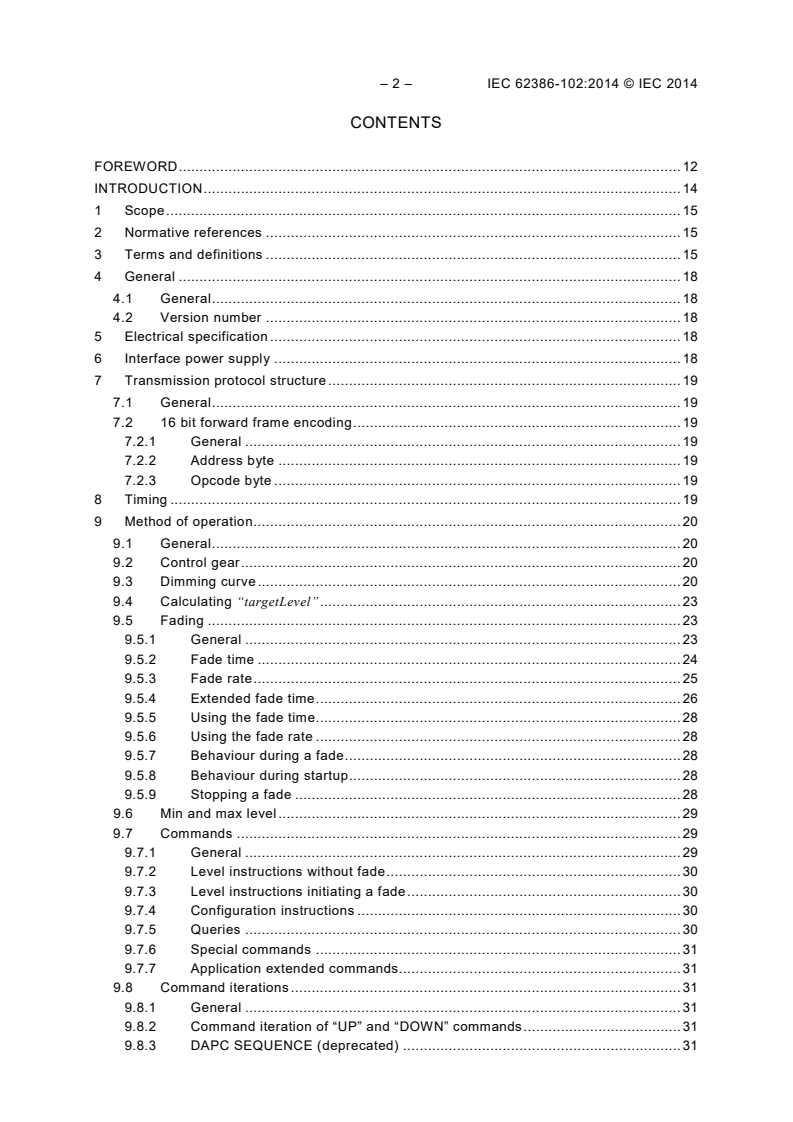
– 2 – IEC 62386-102:2014 © IEC 2014
CONTENTS
FOREWORD . 12
INTRODUCTION . 14
1 Scope . 15
2 Normative references . 15
3 Terms and definitions . 15
4 General . 18
4.1 General . 18
4.2 Version number . 18
5 Electrical specification . 18
6 Interface power supply . 18
7 Transmission protocol structure . 19
7.1 General . 19
7.2 16 bit forward frame encoding . 19
7.2.1 General . 19
7.2.2 Address byte . 19
7.2.3 Opcode byte . 19
8 Timing . 19
9 Method of operation . 20
9.1 General . 20
9.2 Control gear . 20
9.3 Dimming curve . 20
9.4 Calculating “targetLevel” . 23
9.5 Fading . 23
9.5.1 General . 23
9.5.2 Fade time . 24
9.5.3 Fade rate . 25
9.5.4 Extended fade time . 26
9.5.5 Using the fade time . 28
9.5.6 Using the fade rate . 28
9.5.7 Behaviour during a fade . 28
9.5.8 Behaviour during startup . 28
9.5.9 Stopping a fade . 28
9.6 Min and max level . 29
9.7 Commands . 29
9.7.1 General . 29
9.7.2 Level instructions without fade . 30
9.7.3 Level instructions initiating a fade . 30
9.7.4 Configuration instructions . 30
9.7.5 Queries . 30
9.7.6 Special commands . 31
9.7.7 Application extended commands. 31
9.8 Command iterations . 31
9.8.1 General . 31
9.8.2 Command iteration of “UP” and “DOWN” commands . 31
9.8.3 DAPC SEQUENCE (deprecated) . 31
9.9 Modes of operation . 32
9.9.1 General . 32
9.9.2 Operating mode 0x00: standard mode . 32
9.9.3 Operating mode 0x01 to 0x7F: reserved . 32
9.9.4 Operating mode 0x80 to 0xFF: manufacturer specific modes . 32
9.10 Memory banks . 33
9.10.1 General . 33
9.10.2 Memory map . 33
9.10.3 Selecting a memory bank location . 34
9.10.4 Memory bank reading . 34
9.10.5 Memory bank writing . 34
9.10.6 Memory bank 0 . 35
9.10.7 Memory bank 1 . 37
9.10.8 Manufacturer specific memory banks . 39
9.10.9 Reserved memory banks . 39
9.11 Reset . 39
9.11.1 Reset operation . 39
9.11.2 Reset memory bank operation . 39
9.12 System failure . 39
9.13 Power on . 40
9.14 Assigning short addresses . 41
9.14.1 General . 41
9.14.2 Random address allocation . 41
9.14.3 Identification of a device . 42
9.14.4 Direct address allocation . 43
9.15 Failure state behaviour . 43
9.16 Status information . 43
9.16.1 General . 43
9.16.2 Bit 0: Control gear failure . 43
9.16.3 Bit 1: Lamp failure . 44
9.16.4 Bit 2: Lamp on . 44
9.16.5 Bit 3: Limit error . 44
9.16.6 Bit 4: Fade running . 44
9.16.7 Bit 5: Reset state . 44
9.16.8 Bit 6: Missing short address . 44
9.16.9 Bit 7: Power cycle seen . 45
9.17 Non-volatile memory . 45
9.18 Device types and features . 45
9.19 Using scenes . 46
10 Declaration of variables . 47
11 Definition of commands . 49
11.1 General . 49
11.2 Overview Sheets . 49
11.3 Level instructions . 55
11.3.1 DAPC (level) . 55
11.3.2 OFF . 55
11.3.3 UP . 55
11.3.4 DOWN . 55
11.3.5 STEP UP . 55
– 4 – IEC 62386-102:2014 © IEC 2014
11.3.6 STEP DOWN . 56
11.3.7 RECALL MAX LEVEL . 56
11.3.8 RECALL MIN LEVEL . 56
11.3.9 STEP DOWN AND OFF . 57
11.3.10 ON AND STEP UP . 57
11.3.11 ENABLE DAPC SEQUENCE . 57
11.3.12 GO TO LAST ACTIVE LEVEL . 58
11.3.13 GO TO SCENE (sceneNumber) . 58
11.4 Configuration instructions . 58
11.4.1 General . 58
11.4.2 RESET . 58
11.4.3 STORE ACTUAL LEVEL IN DTR0 . 58
11.4.4 SAVE PERSISTENT VARIABLES . 58
11.4.5 SET OPERATING MODE (DTR0) . 59
11.4.6 RESET MEMORY BANK (DTR0) . 59
11.4.7 IDENTIFY DEVICE . 59
11.4.8 SET MAX LEVEL (DTR0) . 60
11.4.9 SET MIN LEVEL (DTR0) . 60
11.4.10 SET SYSTEM FAILURE LEVEL (DTR0) . 60
11.4.11 SET POWER ON LEVEL (DTR0) . 61
11.4.12 SET FADE TIME (DTR0) . 61
11.4.13 SET FADE RATE (DTR0) . 61
11.4.14 SET EXTENDED FADE TIME (DTR0) . 61
11.4.15 SET SCENE (DTR0, sceneX) . 62
11.4.16 REMOVE FROM SCENE (sceneX) . 62
11.4.17 ADD TO GROUP (group) . 62
11.4.18 REMOVE FROM GROUP (group) . 62
11.4.19 SET SHORT ADDRESS (DTR0) . 62
11.4.20 ENABLE WRITE MEMORY . 63
11.5 Queries . 63
11.5.1 General . 63
11.5.2 QUERY STATUS . 63
11.5.3 QUERY CONTROL GEAR PRESENT . 63
11.5.4 QUERY CONTROL GEAR FAILURE . 63
11.5.5 QUERY LAMP FAILURE . 63
11.5.6 QUERY LAMP POWER ON . 63
11.5.7 QUERY LIMIT ERROR . 63
11.5.8 QUERY RESET STATE . 63
11.5.9 QUERY MISSING SHORT ADDRESS . 63
11.5.10 QUERY VERSION NUMBER . 64
11.5.11 QUERY CONTENT DTR0 . 64
11.5.12 QUERY DEVICE TYPE . 64
11.5.13 QUERY NEXT DEVICE TYPE . 64
11.5.14 QUERY PHYSICAL MINIMUM . 64
11.5.15 QUERY POWER FAILURE . 64
11.5.16 QUERY CONTENT DTR1 . 64
11.5.17 QUERY CONTENT DTR2 . 64
11.5.18 QUERY OPERATING MODE . 65
11.5.19 QUERY LIGHT SOURCE TYPE . 65
11.5.20 QUERY ACTUAL LEVEL . 65
11.5.21 QUERY MAX LEVEL . 65
11.5.22 QUERY MIN LEVEL . 66
11.5.23 QUERY POWER ON LEVEL . 66
11.5.24 QUERY SYSTEM FAILURE LEVEL . 66
11.5.25 QUERY FADE TIME/FADE RATE . 66
11.5.26 QUERY EXTENDED FADE TIME . 66
11.5.27 QUERY MANUFACTURER SPECIFIC MODE . 66
11.5.28 QUERY SCENE LEVEL (sceneX) . 66
11.5.29 QUERY GROUPS 0-7 . 66
11.5.30 QUERY GROUPS 8-15 . 66
11.5.31 QUERY RANDOM ADDRESS (H) . 67
11.5.32 QUERY RANDOM ADDRESS (M) . 67
11.5.33 QUERY RANDOM ADDRESS (L) . 67
11.5.34 READ MEMORY LOCATION (DTR1, DTR0) . 67
11.6 Application extended commands . 67
11.6.1 General . 67
11.6.2 QUERY EXTENDED VERSION NUMBER . 67
11.7 Special commands . 68
11.7.1 General . 68
11.7.2 TERMINATE . 68
11.7.3 DTR0 (data) . 68
11.7.4 INITIALISE (device) . 68
11.7.5 RANDOMISE . 68
11.7.6 COMPARE . 69
11.7.7 WITHDRAW . 69
11.7.8 SEARCHADDRH (data) . 69
11.7.9 SEARCHADDRM (data) . 69
11.7.10 SEARCHADDRL (data) . 69
11.7.11 PROGRAM SHORT ADDRESS (data) . 70
11.7.12 VERIFY SHORT ADDRESS (data) . 70
11.7.13 QUERY SHORT ADDRESS . 70
11.7.14 ENABLE DEVICE TYPE (data) . 70
11.7.15 DTR1 (data) . 71
11.7.16 DTR2 (data) . 71
11.7.17 WRITE MEMORY LOCATION (DTR1, DTR0, data) . 71
11.7.18 WRITE MEMORY LOCATION – NO REPLY (DTR1, DTR0, data) . 71
11.7.19 PING . 72
12 Test procedures . 72
12.1 General notes on test. 72
12.1.1 Abbreviations. 72
12.1.2 Test execution . 72
12.1.3 Data transmission . 72
12.1.4 Test setup . 73
12.1.5 Test output . 73
12.1.6 Fade time measurements based on light output . 73
12.1.7 Description of test scheme for fast fade times on PWM dimmer . 74
12.1.8 Test notation . 75
12.1.9 Test execution limitation . 75
– 6 – IEC 62386-102:2014 © IEC 2014
12.1.10 Test results . 75
12.1.11 Exception handling . 75
12.1.12 Unexpected answer . 75
12.2 Preamble . 77
12.2.1 Test preamble . 77
12.3 Physical operational parameters . 94
12.3.1 Polarity test . 94
12.3.2 Maximum and minimum system voltage . 94
12.3.3 Overvoltage protection test . 95
12.3.4 Current rating test. 96
12.3.5 Transmitter voltages . 97
12.3.6 Transmitter rising and falling edges . 99
12.3.7 Transmitter bit timing . 101
12.3.8 Transmitter frame timing . 103
12.3.9 Receiver start-up behavior . 104
12.3.10 Receiver threshold . 105
12.3.11 Receiver bit timing . 106
12.3.12 Extended receiver bit timing . 110
12.3.13 Receiver forward frame violation. 112
12.3.14 Receiver settling timing . 112
12.3.15 Receiver frame timing FF-FF send twice . 113
12.4 Configuration instructions . 115
12.4.1 RESET . 115
12.4.2 RESET: timeout / command in-between . 119
12.4.3 Send-twice timeout . 121
12.4.4 Commands in-between . 129
12.4.5 STORE ACTUAL LEVEL IN DTR0 . 135
12.4.6 SAVE PERSISTENT VARIABLES . 136
12.4.7 SET OPERATING MODE . 136
12.4.8 SET MAX LEVEL . 137
12.4.9 SET MIN LEVEL . 137
12.4.10 SET SYSTEM FAILURE LEVEL . 138
12.4.11 SET POWER ON LEVEL . 139
12.4.12 SET FADE TIME . 143
12.4.13 SET FADE RATE . 143
12.4.14 SET SCENE / REMOVE FROM SCENE . 144
12.4.15 ADD TO GROUP / REMOVE FROM GROUP . 145
12.4.16 SET SHORT ADDRESS . 146
12.4.17 SET EXTENDED FADE TIME . 147
12.4.18 Reset/Power-on values . 148
12.4.19 DTR0 / DTR1 / DTR2 . 154
12.5 Memory banks . 154
12.5.1 READ MEMORY LOCATION on Memory Bank 0 . 154
12.5.2 READ MEMORY LOCATION on Memory Bank 1 . 159
12.5.3 READ MEMORY LOCATION on other Memory Banks . 161
12.5.4 Memory bank writing . 163
12.5.5 ENABLE WRITE MEMORY: writeEnableState . 168
12.5.6 ENABLE WRITE MEMORY: timeout / command in-between . 171
12.5.7 RESET MEMORY BANK: timeout / command in-between . 172
12.5.8 RESET MEMORY BANK . 175
12.6 Level instructions . 176
12.6.1 Level instructions: Basic behaviour . 176
12.6.2 FADE TIME: possible values . 181
12.6.3 FADE TIME: transitions . 182
12.6.4 FADE TIME: fading to 0 . 184
12.6.5 FADE TIME: small steps fading . 186
12.6.6 FADE TIME: extended fade time . 189
12.6.7 FADE RATE: possible values . 191
12.6.8 FADE RATE: transitions . 194
12.6.9 FADE RATE: extended fade time . 195
12.6.10 FADE TIME/FADE RATE: stop fading by setting MIN/MAX levels . 196
12.6.11 FADE TIME/FADE RATE: stop fading . 201
12.6.12 FADE TIME/FADE RATE: stop fading when a command is sent, check
timing . 204
12.6.13 FADE TIME/FADE RATE: stop fading during startup . 210
12.6.14 Level instructions: combined instructions . 211
12.6.15 Power On Level - System Failure Level combined . 213
12.6.16 ENABLE DAPC SEQUENCE . 218
12.6.17 GO TO LAST ACTIVE LEVEL . 219
12.6.18 GO TO SCENE . 221
12.6.19 Power on: level control commands. 222
12.6.20 Logarithmic dimming curve . 224
12.6.21 Dimming curve: DAPC . 225
12.6.22 Dimming curve: UP / DOWN . 226
12.6.23 Dimming curve: STEP UP / STEP DOWN . 227
12.6.24 FADE TIME/EXTENDED FADE TIME: light output behaviour . 228
12.6.25 EXTENDED FADE TIME: light output behaviour . 229
12.6.26 Behaviour during a fade . 230
12.7 Special commands . 232
12.7.1 INITIALISE – timer . 232
12.7.2 TERMINATE . 234
12.7.3 INITIALISE - device addressing . 234
12.7.4 RANDOMISE . 235
12.7.5 COMPARE . 236
12.7.6 WITHDRAW . 237
12.7.7 SEARCHADDRH / SEARCHADDRM / SEARCHADDRL . 238
12.7.8 PROGRAM SHORT ADDRESS . 239
12.7.9 VERIFY SHORT ADDRESS . 241
12.7.10 QUERY SHORT ADDRESS . 242
12.7.11 IDENTIFY DEVICE . 244
12.7.12 IDENTIFY DEVICE THROUGH RECALL MIN/MAX LEVEL . 246
12.8 Queries and reserved commands . 250
12.8.1 QUERY STATUS - lampFailure/lampOn . 250
12.8.2 QUERY STATUS - lampOn . 253
12.8.3 QUERY STATUS - limitError/lampOn . 254
12.8.4 QUERY STATUS - powerCycleSeen . 258
12.8.5 QUERY CONTROL GEAR PRESENT . 259
12.8.6 QUERY VERSION NUMBER . 259
– 8 – IEC 62386-102:2014 © IEC 2014
12.8.7 PING . 260
12.8.8 Broadcast unaddressed . 260
12.8.9 Reserved commands: standard commands . 262
12.8.10 Reserved commands: special commands . 262
12.8.11 Application extended commands. 263
12.8.12 Not supported device types . 264
12.8.13 Removed functionality . 264
12.9 Cross contamination . 266
12.9.1 DTR0 . 266
12.9.2 NVM variables . 266
12.9.3 Random address generation . 268
12.9.4 Addressing 1 . 269
12.9.5 Addressing 2 . 270
12.9.6 Addressing 3 . 272
12.10 General subsequences . 273
12.10.1 GetVersionNumber . 273
12.10.2 GetExtendedVersionNumber . 273
12.10.3 GetSupportedDeviceTypes . 274
12.10.4 GetSupportedLightSources . 274
12.10.5 WaitForPowerOnPhaseToFinish . 276
12.10.6 WaitForLampOn . 276
12.10.7 WaitForLampOnAddressed . 277
12.10.8 WaitForLampLevel . 277
12.10.9 WaitForFadeToFinish . 277
12.10.10 SetShortAddress . 278
12.10.11 GetRandomAddress. 278
12.10.12 GetLimitedRandomAddress . 279
12.10.13 SetSearchAddress . 279
12.10.14 ReadMemBankMultibyteLocation . 279
12.10.15 FindImplementedMemoryBank . 280
12.10.16 FindAllImplementedMemoryBanks . 280
12.10.17 GetNumberOfLogicalUnits . 280
12.10.18 GetIndexOfLogicalUnit . 281
12.10.19 ConnectLamps . 281
12.10.20 DisconnectLamps . 281
12.10.21 PowerCycle . 282
12.10.22 PowerCycleAndWaitForBusPower . 282
12.10.23 PowerCycleAndWaitForDecoder .
...
IEC 62386-102 ®
Edition 2.1 2018-09
CONSOLIDATED VERSION
INTERNATIONAL
STANDARD
NORME
INTERNATIONALE
colour
inside
Digital addressable lighting interface –
Part 102: General requirements – Control gear
Interface d’éclairage adressable numérique –
Partie 102: Exigences générales – Appareillages de commande
All rights reserved. Unless otherwise specified, no part of this publication may be reproduced or utilized in any form
or by any means, electronic or mechanical, including photocopying and microfilm, without permission in writing from
either IEC or IEC's member National Committee in the country of the requester. If you have any questions about IEC
copyright or have an enquiry about obtaining additional rights to this publication, please contact the address below or
your local IEC member National Committee for further information.
Droits de reproduction réservés. Sauf indication contraire, aucune partie de cette publication ne peut être reproduite
ni utilisée sous quelque forme que ce soit et par aucun procédé, électronique ou mécanique, y compris la photocopie
et les microfilms, sans l'accord écrit de l'IEC ou du Comité national de l'IEC du pays du demandeur. Si vous avez des
questions sur le copyright de l'IEC ou si vous désirez obtenir des droits supplémentaires sur cette publication, utilisez
les coordonnées ci-après ou contactez le Comité national de l'IEC de votre pays de résidence.
IEC Central Office Tel.: +41 22 919 02 11
3, rue de Varembé info@iec.ch
CH-1211 Geneva 20 www.iec.ch
Switzerland
About the IEC
The International Electrotechnical Commission (IEC) is the leading global organization that prepares and publishes
International Standards for all electrical, electronic and related technologies.
About IEC publications
The technical content of IEC publications is kept under constant review by the IEC. Please make sure that you have the
latest edition, a corrigenda or an amendment might have been published.
IEC Catalogue - webstore.iec.ch/catalogue Electropedia - www.electropedia.org
The stand-alone application for consulting the entire The world's leading online dictionary of electronic and
bibliographical information on IEC International Standards, electrical terms containing 21 000 terms and definitions in
Technical Specifications, Technical Reports and other English and French, with equivalent terms in 16 additional
documents. Available for PC, Mac OS, Android Tablets and languages. Also known as the International Electrotechnical
iPad. Vocabulary (IEV) online.
IEC publications search - webstore.iec.ch/advsearchform IEC Glossary - std.iec.ch/glossary
The advanced search enables to find IEC publications by a 67 000 electrotechnical terminology entries in English and
variety of criteria (reference number, text, technical French extracted from the Terms and Definitions clause of
committee,…). It also gives information on projects, replaced IEC publications issued since 2002. Some entries have been
and withdrawn publications. collected from earlier publications of IEC TC 37, 77, 86 and
CISPR.
IEC Just Published - webstore.iec.ch/justpublished
Stay up to date on all new IEC publications. Just Published IEC Customer Service Centre - webstore.iec.ch/csc
details all new publications released. Available online and If you wish to give us your feedback on this publication or
also once a month by email. need further assistance, please contact the Customer Service
Centre: sales@iec.ch.
A propos de l'IEC
La Commission Electrotechnique Internationale (IEC) est la première organisation mondiale qui élabore et publie des
Normes internationales pour tout ce qui a trait à l'électricité, à l'électronique et aux technologies apparentées.
A propos des publications IEC
Le contenu technique des publications IEC est constamment revu. Veuillez vous assurer que vous possédez l’édition la
plus récente, un corrigendum ou amendement peut avoir été publié.
Catalogue IEC - webstore.iec.ch/catalogue Electropedia - www.electropedia.org
Application autonome pour consulter tous les renseignements
Le premier dictionnaire en ligne de termes électroniques et
bibliographiques sur les Normes internationales,
électriques. Il contient 21 000 termes et définitions en anglais
Spécifications techniques, Rapports techniques et autres
et en français, ainsi que les termes équivalents dans 16
documents de l'IEC. Disponible pour PC, Mac OS, tablettes
langues additionnelles. Egalement appelé Vocabulaire
Android et iPad.
Electrotechnique International (IEV) en ligne.
Recherche de publications IEC -
Glossaire IEC - std.iec.ch/glossary
webstore.iec.ch/advsearchform
67 000 entrées terminologiques électrotechniques, en anglais
La recherche avancée permet de trouver des publications IEC et en français, extraites des articles Termes et Définitions des
en utilisant différents critères (numéro de référence, texte, publications IEC parues depuis 2002. Plus certaines entrées
comité d’études,…). Elle donne aussi des informations sur les antérieures extraites des publications des CE 37, 77, 86 et
projets et les publications remplacées ou retirées. CISPR de l'IEC.
IEC Just Published - webstore.iec.ch/justpublished Service Clients - webstore.iec.ch/csc
Restez informé sur les nouvelles publications IEC. Just Si vous désirez nous donner des commentaires sur cette
Published détaille les nouvelles publications parues. publication ou si vous avez des questions contactez-nous:
Disponible en ligne et aussi une fois par mois par email. sales@iec.ch.
IEC 62386-102 ®
Edition 2.1 2018-09
CONSOLIDATED VERSION
INTERNATIONAL
STANDARD
NORME
INTERNATIONALE
colour
inside
Digital addressable lighting interface –
Part 102: General requirements – Control gear
Interface d’éclairage adressable numérique –
Partie 102: Exigences générales – Appareillages de commande
INTERNATIONAL
ELECTROTECHNICAL
COMMISSION
COMMISSION
ELECTROTECHNIQUE
INTERNATIONALE
ICS 29.140.50; 29.140.99 ISBN 978-2-8322-5316-8
IEC 62386-102 ®
Edition 2.1 2018-09
CONSOLIDATED VERSION
REDLINE VERSION
VERSION REDLINE
colour
inside
Digital addressable lighting interface –
Part 102: General requirements – Control gear
Interface d’éclairage adressable numérique –
Partie 102: Exigences générales – Appareillages de commande
– 2 – IEC 62386-102:2014+AMD1:2018 CSV
© IEC 2018
CONTENTS
FOREWORD. 9
INTRODUCTION . 11
1 Scope . 13
2 Normative references . 13
3 Terms and definitions . 13
4 General . 16
4.1 General . 16
4.2 Version number . 16
5 Electrical specification . 17
6 Interface power supply . 17
7 Transmission protocol structure . 17
7.1 General . 17
7.2 16 bit forward frame encoding . 17
7.2.1 General . 17
7.2.2 Address byte . 17
7.2.3 Opcode byte . 18
8 Timing . 18
9 Method of operation . 18
9.1 General . 18
9.2 Control gear . 18
9.2.1 General . 18
9.2.2 Control gear phases . 18
9.3 Dimming curve . 19
9.4 Calculating “targetLevel” . 22
9.5 Fading . 22
9.5.1 General . 22
9.5.2 Fade time . 23
9.5.3 Fade rate . 25
9.5.4 Extended fade time . 26
9.5.5 Using the fade time . 28
9.5.6 Using the fade rate. 28
9.5.7 Behaviour System response to changes during a fade . 29
9.5.8 Behaviour System response to changes during standby and startup . 29
9.5.9 Stopping a fade . 29
9.6 Min and max level . 29
9.7 Commands . 30
9.7.1 General . 30
9.7.2 Level instructions without fade . 31
9.7.3 Level instructions initiating a fade . 31
9.7.4 Configuration instructions . 31
9.7.5 Queries . 31
9.7.6 Special commands . 31
9.7.7 Application extended commands . 31
9.8 Command iterations . 31
9.8.1 General . 31
© IEC 2018
9.8.2 Command iteration of “UP” and “DOWN” commands . 32
9.8.3 DAPC SEQUENCE (deprecated) . 33
9.9 Modes of operation . 33
9.9.1 General . 33
9.9.2 Operating mode 0x00: standard mode . 33
9.9.3 Operating mode 0x01 to 0x7F: reserved . 33
9.9.4 Operating mode 0x80 to 0xFF: manufacturer specific modes . 33
9.10 Memory banks . 34
9.10.1 General . 34
9.10.2 Memory map . 34
9.10.3 Selecting a memory bank location . 35
9.10.4 Memory bank reading . 35
9.10.5 Memory bank writing . 35
9.10.6 Memory bank 0 . 36
9.10.7 Memory bank 1 . 38
9.10.8 Manufacturer specific memory banks . 40
9.10.9 Reserved memory banks . 40
9.11 Reset . 40
9.11.1 Reset operation . 40
9.11.2 Reset memory bank operation . 40
9.12 System failure . 40
9.13 Power on . 41
9.14 Assigning short addresses . 42
9.14.1 General . 42
9.14.2 Random address allocation . 42
9.14.3 Identification of a device . 43
9.14.4 Direct address allocation . 44
9.15 Failure state behaviour . 44
9.16 Status information . 44
9.16.1 General . 44
9.16.2 Bit 0: Control gear failure . 44
9.16.3 Bit 1: lamp failure . 45
9.16.4 Bit 2: lamp on . 47
9.16.5 Bit 3: limit error . 47
9.16.6 Bit 4: fade running . 47
9.16.7 Bit 5: reset state . 47
9.16.8 Bit 6: missing short address . 47
9.16.9 Bit 7: power cycle seen . 47
9.17 Non-volatile memory . 48
9.18 Device types and features . 48
9.19 Using scenes . 49
10 Declaration of variables . 50
11 Definition of commands . 52
11.1 General . 52
11.2 Overview sheets . 52
11.3 Level instructions . 57
11.3.1 DAPC (level) . 57
11.3.2 OFF . 57
11.3.3 UP . 57
– 4 – IEC 62386-102:2014+AMD1:2018 CSV
© IEC 2018
11.3.4 DOWN . 57
11.3.5 STEP UP . 57
11.3.6 STEP DOWN . 58
11.3.7 RECALL MAX LEVEL . 58
11.3.8 RECALL MIN LEVEL . 58
11.3.9 STEP DOWN AND OFF . 59
11.3.10 ON AND STEP UP . 59
11.3.11 ENABLE DAPC SEQUENCE . 59
11.3.12 GO TO LAST ACTIVE LEVEL . 60
11.3.14 CONTINUOUS UP . 60
11.3.15 CONTINUOUS DOWN . 60
11.3.13 GO TO SCENE (sceneNumber) . 60
11.4 Configuration instructions . 60
11.4.1 General . 60
11.4.2 RESET . 61
11.4.3 STORE ACTUAL LEVEL IN DTR0 . 61
11.4.4 SAVE PERSISTENT VARIABLES . 61
11.4.5 SET OPERATING MODE (DTR0) . 61
11.4.6 RESET MEMORY BANK (DTR0) . 61
11.4.7 IDENTIFY DEVICE . 62
11.4.8 SET MAX LEVEL (DTR0) . 62
11.4.9 SET MIN LEVEL (DTR0) . 63
11.4.10 SET SYSTEM FAILURE LEVEL (DTR0) . 63
11.4.11 SET POWER ON LEVEL (DTR0) . 63
11.4.12 SET FADE TIME (DTR0) . 63
11.4.13 SET FADE RATE (DTR0) . 63
11.4.14 SET EXTENDED FADE TIME (DTR0) . 64
11.4.15 SET SCENE (DTR0, sceneX) . 64
11.4.16 REMOVE FROM SCENE (sceneX) . 64
11.4.17 ADD TO GROUP (group) . 64
11.4.18 REMOVE FROM GROUP (group) . 65
11.4.19 SET SHORT ADDRESS (DTR0) . 65
11.4.20 ENABLE WRITE MEMORY . 65
11.5 Queries . 65
11.5.1 General . 65
11.5.2 QUERY STATUS. 65
11.5.3 QUERY CONTROL GEAR PRESENT . 65
11.5.4 QUERY CONTROL GEAR FAILURE . 65
11.5.5 QUERY LAMP FAILURE . 66
11.5.6 QUERY LAMP POWER ON . 66
11.5.7 QUERY LIMIT ERROR . 66
11.5.8 QUERY RESET STATE . 66
11.5.9 QUERY MISSING SHORT ADDRESS . 66
11.5.10 QUERY VERSION NUMBER . 66
11.5.11 QUERY CONTENT DTR0 . 66
11.5.12 QUERY DEVICE TYPE . 66
11.5.13 QUERY NEXT DEVICE TYPE . 66
11.5.14 QUERY PHYSICAL MINIMUM . 67
11.5.15 QUERY POWER FAILURE . 67
© IEC 2018
11.5.16 QUERY CONTENT DTR1 . 67
11.5.17 QUERY CONTENT DTR2 . 67
11.5.18 QUERY OPERATING MODE . 67
11.5.19 QUERY LIGHT SOURCE TYPE . 67
11.5.20 QUERY ACTUAL LEVEL . 68
11.5.21 QUERY MAX LEVEL . 68
11.5.22 QUERY MIN LEVEL . 68
11.5.23 QUERY POWER ON LEVEL . 68
11.5.24 QUERY SYSTEM FAILURE LEVEL . 69
11.5.25 QUERY FADE TIME/FADE RATE . 69
11.5.26 QUERY EXTENDED FADE TIME . 69
11.5.27 QUERY MANUFACTURER SPECIFIC MODE . 69
11.5.28 QUERY SCENE LEVEL (sceneX) . 69
11.5.29 QUERY GROUPS 0-7 . 69
11.5.30 QUERY GROUPS 8-15 . 69
11.5.31 QUERY RANDOM ADDRESS (H) . 69
11.5.32 QUERY RANDOM ADDRESS (M) . 70
11.5.33 QUERY RANDOM ADDRESS (L) . 70
11.5.34 READ MEMORY LOCATION (DTR1, DTR0) . 70
11.6 Application extended commands. 70
11.6.1 General . 70
11.6.2 QUERY EXTENDED VERSION NUMBER . 70
11.7 Special commands . 71
11.7.1 General . 71
11.7.2 TERMINATE . 71
11.7.3 DTR0 (data) . 71
11.7.4 INITIALISE (device) . 71
11.7.5 RANDOMISE . 71
11.7.6 COMPARE . 72
11.7.7 WITHDRAW . 72
11.7.8 SEARCHADDRH (data) . 72
11.7.9 SEARCHADDRM (data) . 72
11.7.10 SEARCHADDRL (data) . 73
11.7.11 PROGRAM SHORT ADDRESS (data) . 73
11.7.12 VERIFY SHORT ADDRESS (data) . 73
11.7.13 QUERY SHORT ADDRESS . 73
11.7.14 ENABLE DEVICE TYPE (data) . 73
11.7.15 DTR1 (data) . 74
11.7.16 DTR2 (data) . 74
11.7.17 WRITE MEMORY LOCATION (DTR1, DTR0, data) . 74
11.7.18 WRITE MEMORY LOCATION – NO REPLY (DTR1, DTR0, data) . 75
11.7.19 PING . 75
12 Test procedures . 75
Void
Annex A (informative) Examples of algorithms . 288
A.1 Random address allocation . 288
A.2 One single control gear connected to the control device . 288
A.3 Using application extended commands . 289
Annex B (normative) High resolution dimmer . 290
– 6 – IEC 62386-102:2014+AMD1:2018 CSV
© IEC 2018
Bibliography . 292
Figure 1 – IEC 62386 graphical overview . 11
Figure 2 – Control gear directly operating a light source . 18
Figure 3 – Dimming curve . 20
Figure 4 – Level over time, fading up and down . 23
Figure 5 – Timing and response when receiving a executing command iteration . 32
Figure 6 – Fading from MIN LEVEL to MAX LEVEL .
Figure 7 – Fading from MAX LEVEL to off .
Figure 8 – Normal fading for a PWM dimmer .
Figure 9 – Fading from MAX LEVEL to off for a PWM dimmer .
Figure 10 – Current rating test .
Figure 11 – Correlation between “lampFailure”, “lampOn”, and “fadeRunning” bits . 46
Figure B.1 – Level behaviour in cases of off-grid starting points . 131
Table 1 – 16-bit command frame encoding . 17
Table 2 – Dimming curve tolerance (%, rounded to two decimals) . 20
Table 3 – Dimming curve . 21
Table 4 – Fade times . 24
Table 5 – Fade rates . 26
Table 6 – Extended fade time – base value . 27
Table 7 – Extended fade time – multiplier . 27
Table 8 – Basic memory map of memory banks . 34
Table 9 – Memory map of memory bank 0 . 37
Table 10 – Memory map of memory bank 1 . 39
Table 11 – Power on timing . 42
Table 12 – Control gear status . 44
Table 13 – Scenes . 49
Table 14 – Declaration of variables . 50
Table 15 – Standard commands . 52
Table 16 – Special commands. 56
Table 17 – Light source type encoding . 68
Table 18 – Device addressing with “INITIALISE” . 71
Table 19 – Unexpected outcome .
Table 20 – Parameters for test sequence CheckFactoryDefault102 .
Table 21 – Parameters for test sequence CheckFactoryDefault201 .
Table 22 – Parameters for test sequence CheckFactoryDefault202 .
Table 23 – Parameters for test sequence CheckFactoryDefault203 .
Table 24 – Parameters for test sequence CheckFactoryDefault204 .
Table 25 – Parameters for test sequence CheckFactoryDefault205 .
Table 26 – Parameters for test sequence CheckFactoryDefault206 .
Table 27 – Parameters for test sequence CheckFactoryDefault207 .
Table 28 – Parameters for test sequence CheckFactoryDefault208 .
© IEC 2018
Table 29 – Parameters for test sequence CheckFactoryDefault209 .
Table 30 – Parameters for test sequence Maximum and minimum system voltage .
Table 31 – Parameters for test sequence Transmitter voltages .
Table 32 – Parameters for test sequence Transmitter rising and falling edges .
Table 33 – Parameters for test sequence Transmitter rising and falling edges .
Table 34 – Parameters for test sequence Transmitter bit timing .
Table 35 – Parameters for test sequence Receiver frame timing .
Table 36 – Parameters for test sequence Receiver start-up behavior .
Table 37 – Parameters for test sequence Receiver bit timing .
Table 38 – Parameters for test sequence Extended receiver bit timing .
Table 39 – Parameters for test sequence Receiver frame violation and recovering after
frame size violation .
Table 40 – Parameters for test sequence Receiver frame timing .
Table 41 – Parameters for test sequence RESET .
Table 42 – Parameters for test sequence Send twice timeout .
Table 43 – Parameters for test sequence Commands in-between .
Table 44 – Parameters for test sequence SET MAX LEVEL .
Table 45 – Parameters for test sequence SET MIN LEVEL .
Table 46 – Parameters for test sequence SET SYSTEM FAILURE LEVEL .
Table 47 – Parameters for test sequence SET POWER ON LEVEL .
Table 48 – Parameters for test sequence SET FADE TIME .
Table 49 – Parameters for test sequence SET FADE RATE .
Table 50 – Parameters for test sequence SET SCENE / REMOVE FROM SCENE .
Table 51 – Parameters for test sequence ADD TO GROUP / REMOVE FROM GROUP .
Table 52 – Parameters for test sequence SET SHORT ADDRESS .
Table 53 – Parameters for test sequence SET EXTENDED FADE TIME .
Table 54 – Parameters for test sequence Reset/Power-on values .
Table 55 – Parameters for test sequence DTR0 / DTR1 / DTR2 .
Table 56 – Parameters for test sequence READ MEMORY LOCATION on Memory
Bank 0 .
Table 57 – Parameters for test sequence READ MEMORY LOCATION on Memory
Bank 1 .
Table 58 – Parameters for test sequence Memory bank writing .
Table 59 – Parameters for test sequence ENABLE WRITE MEMORY: writeEnableState .
Table 60 – Parameters for test sequence ENABLE WRITE MEMORY: timeout /
command in-between .
Table 61 – Parameters for test sequence RESET MEMORY BANK: timeout / command
in-between .
Table 62 – Parameters for test sequence RESET MEMORY BANK .
Table 63 – Parameters for test sequence Level instructions: Basic behaviour.
Table 64 – Parameters for test sequence FADE TIME: possible values .
Table 65 – Parameters for test sequence FADE TIME: transitions .
Table 66 – Parameters for test sequence FADE TIME: fading to 0 .
Table 67 – Parameters for test sequence FADE TIME: small steps fading .
Table 68 – Parameters for test sequence FADE TIME: extended fade time .
– 8 – IEC 62386-102:2014+AMD1:2018 CSV
© IEC 2018
Table 69 – Parameters for test sequence FADE RATE: possible values .
Table 70 – Parameters for test sequence FADE RATE: possible values .
Table 71 – Parameters for test sequence FADE RATE: transitions .
Table 72 – Parameters for test sequence FADE RATE: extended fade time .
Table 73 – Parameters for test sequence FADE TIME/FADE RATE: stop fading by
setting MIN/MAX levels .
Table 74 – Parameters for test sequence FADE TIME/FADE RATE: stop fading .
Table 75 – Parameters for test sequence FADE TIME/FADE RATE: stop fading when a
command is sent, check timing .
Table 76 – Parameters for test sequence FADE TIME/FADE RATE: stop fading during
startup .
Table 77 – Parameters for test sequence Level instructions: combined instructions .
Table 78 – Parameters for test sequence PowerOnLevel and SystemFailureLevel .
Table 79 – Parameters for test sequence ENABLE DAPC SEQUENCE .
Table 80 – Parameters for test sequence GO TO LAST ACTIVE LEVEL .
Table 81 – Parameters for test sequence GO TO SCENE .
Table 82 – Parameters for test sequence Power on: level control commands .
Table 83 – Parameters for test sequence Logarithmic dimming curve .
Table 84 – Parameters for test sequence Dimming curve: DAPC .
Table 85 – Parameters for test sequence FADE TIME/EXTENDED FADE TIME: light
output behaviour .
Table 86 – Parameters for test sequence Behaviour during a fade .
Table 87 – Parameters for test sequence INITIALISE – device addressing .
Table 88 – Parameters for test sequence COMPARE .
Table 89 – Parameters for test sequence WITHDRAW .
Table 90 – Parameters for test sequence PROGRAM SHORT ADDRESS .
Table 91 – Parameters for test sequence VERIFY SHORT ADDRESS .
Table 92 – Parameters for test sequence QUERY SHORT ADDRESS .
Table 93 – Parameters for test sequence IDENTIFY DEVICE .
Table 94 – Parameters for test sequence IDENTIFY DEVICE THROUGH RECALL
MIN/MAX LEVEL .
Table 95 – Parameters for test sequence QUERY STATUS – lampFailure/lampOn .
Table 96 – Parameters for test sequence QUERY STATUS – lampOn .
Table 97 – Parameters for test sequence QUERY STATUS – limitError/lampOn .
Table 98 – Parameters for test sequence QUERY STATUS – powerCycleSeen .
Table 99 – Parameters for test sequence QUERY CONTROL GEAR PRESENT .
Table 100 – Parameters for test sequence Broadcast unaddressed .
Table 101 – Parameters for test sequence Reserved commands: standard commands .
Table 102 – Parameters for test sequence Reserved commands: special commands .
Table 103 – Parameters for test sequence Addressing 2 .
© IEC 2018
INTERNATIONAL ELECTROTECHNICAL COMMISSION
____________
DIGITAL ADDRESSABLE LIGHTING INTERFACE –
Part 102: General requirements –
Control gear
FOREWORD
1) The International Electrotechnical Commission (IEC) is a worldwide organization for standardization comprising
all national electrotechnical committees (IEC National Committees). The object of IEC is to promote
international co-operation on all questions concerning standardization in the electrical and electronic fields. To
this end and in addition to other activities, IEC publishes International Standards, Technical Specifications,
Technical Reports, Publicly Available Specifications (PAS) and Guides (hereafter referred to as “IEC
Publication(s)”). Their preparation is entrusted to technical committees; any IEC National Committee interested
in the subject dealt with may participate in this preparatory work. International, governmental and non-
governmental organizations liaising with the IEC also participate in this prepar
...