

IEC 61730-2:2004
(Main)Photovoltaic (PV) module safety qualification - Part 2: Requirements for testing
General Information
- Abstract
Describes the testing requirements for photovoltaic modules in order to provide safe electrical and mechanical operation during their expected lifetime. Addresses the prevention of electrical shock, fire hazards, and personal injury due to mechanical and environmental stresses. Outlines the requirements of testing and is to be used in conjunction with IEC 61215 or IEC 61646.
- Status
- Published
- Publication Date
- 22-Nov-2012
- Technical Committee
- TC 82 - Solar photovoltaic energy systems
- Drafting Committee
- WG 2 - TC 82/WG 2
- Current Stage
- DELPUB - Deleted Publication
- Start Date
- 18-Aug-2016
- Completion Date
- 28-Aug-2026
Buy Documents
IEC 61730-2:2004 - Photovoltaic (PV) module safety qualification - Part 2: Requirements for testing Released:10/14/2004
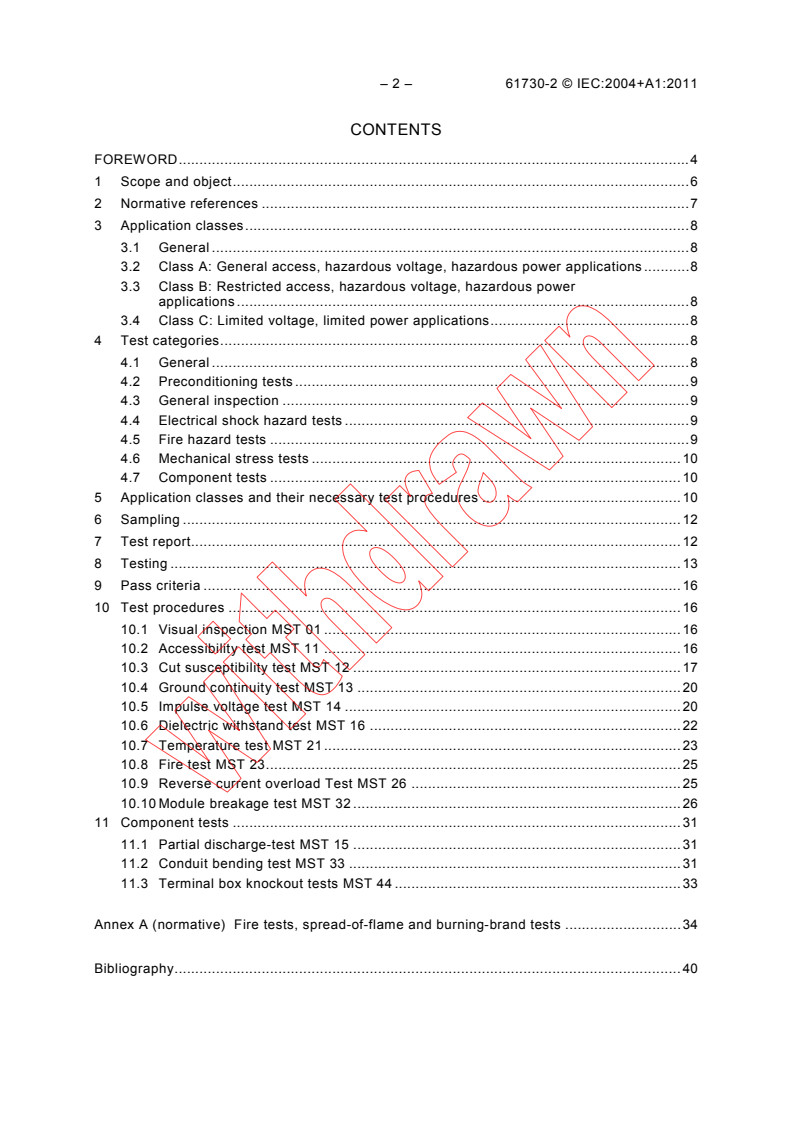
IEC 61730-2:2004+AMD1:2011 CSV - Photovoltaic (PV) module safety qualification - Part 2: Requirements for testing Released:11/23/2012
Overview
IEC 61730-2:2004 is an international standard developed by the International Electrotechnical Commission (IEC) that specifies the testing requirements for photovoltaic (PV) modules to ensure their safe electrical and mechanical operation throughout their expected lifetime. This standard aims to prevent hazards related to electrical shock, fire, and injuries due to mechanical or environmental stresses. It complements IEC 61730-1, which addresses construction requirements, and is intended for use alongside performance standards such as IEC 61215 and IEC 61646 to enable a comprehensive assessment of PV modules.
This standard covers a wide range of safety tests, organized into a structured test sequence, facilitating the evaluation of PV modules for various application classes. IEC 61730-2 excludes modules with integrated AC inverters (AC modules) and does not cover specific requirements for marine or vehicle applications. Its test methods ensure modules meet stringent safety criteria, making them reliable and safe for use in general electrical systems.
Key Topics
Application Classes
IEC 61730-2 defines application classes based on access and voltage levels:- Class A: General access, hazardous voltage, and power
- Class B: Restricted access, hazardous voltage, and power
- Class C: Limited voltage and power
These classes guide the selection of appropriate test procedures for safety evaluation.
Test Categories and Procedures
The standard details different categories of tests to ensure module safety:- Preconditioning Tests: Prepare modules for environmental and mechanical testing.
- Electrical Shock Hazard Tests: Evaluate protection against electric shock through accessibility and dielectric tests.
- Fire Hazard Tests: Assess fire resistance, flame spread, and burning brand exposure.
- Mechanical Stress Tests: Include impact, bending, and breakage tests to confirm mechanical durability.
- Component Tests: Target specific elements such as terminal boxes and connectors.
Coordinated Testing with Performance Standards
The test sequence is optimized to align with IEC 61215 and IEC 61646, enabling simultaneous safety and performance testing on the same module samples, increasing testing efficiency and reliability.Pass Criteria and Reporting
The standard specifies clear criteria for test pass/fail outcomes and requires detailed test reports to document results and compliance for certification and quality assurance.
Applications
IEC 61730-2:2004 is essential for manufacturers, testing laboratories, and certification bodies involved in the development and assessment of photovoltaic modules. Key applications include:
- Ensuring safe installation of solar PV systems by minimizing risks of electrical shock and fire hazards.
- Protecting end users and maintenance personnel from injuries caused by mechanical failures or environmental stressors.
- Assisting manufacturers in product design validation and qualification to meet international safety benchmarks.
- Supporting certification processes and compliance for market acceptance worldwide.
- Acting as a reference for system designers to select modules suitable for different application environments and voltage classes.
Related Standards
- IEC 61730-1: Specifies the construction requirements for photovoltaic modules focused on safety aspects.
- IEC 61215: Defines performance testing and reliability qualification for crystalline silicon PV modules.
- IEC 61646: Applies to thin-film PV modules performance testing, complementary to IEC 61215.
- IEC 60060-1: Provides impulse voltage test methods referenced in electrical testing under IEC 61730-2.
- Other regional or national electrical safety and building codes may supplement this standard but should be used in conjunction with IEC 61730-2 for international consistency.
Implementing IEC 61730-2:2004 helps ensure photovoltaic modules adhere to rigorous safety requirements, promoting confidence in solar energy systems by safeguarding users and infrastructure against electrical, fire, and mechanical hazards over the operational lifetime.
Relations
- Effective Date
- 05-Sep-2023
- Revised
IEC 61730-2:2016 - Photovoltaic (PV) module safety qualification - Part 2: Requirements for testing - Effective Date
- 05-Sep-2023
Buy Documents
IEC 61730-2:2004 - Photovoltaic (PV) module safety qualification - Part 2: Requirements for testing Released:10/14/2004
IEC 61730-2:2004+AMD1:2011 CSV - Photovoltaic (PV) module safety qualification - Part 2: Requirements for testing Released:11/23/2012
Get Certified
Connect with accredited certification bodies for this standard

DNV
DNV is an independent assurance and risk management provider.

Lloyd's Register
Lloyd's Register is a global professional services organisation specialising in engineering and technology.
DNV Energy Systems
Energy and renewable energy certification.
Sponsored listings
Frequently Asked Questions
IEC 61730-2:2004 is a standard published by the International Electrotechnical Commission (IEC). Its full title is "Photovoltaic (PV) module safety qualification - Part 2: Requirements for testing". This standard covers: Describes the testing requirements for photovoltaic modules in order to provide safe electrical and mechanical operation during their expected lifetime. Addresses the prevention of electrical shock, fire hazards, and personal injury due to mechanical and environmental stresses. Outlines the requirements of testing and is to be used in conjunction with IEC 61215 or IEC 61646.
Describes the testing requirements for photovoltaic modules in order to provide safe electrical and mechanical operation during their expected lifetime. Addresses the prevention of electrical shock, fire hazards, and personal injury due to mechanical and environmental stresses. Outlines the requirements of testing and is to be used in conjunction with IEC 61215 or IEC 61646.
IEC 61730-2:2004 is classified under the following ICS (International Classification for Standards) categories: 27.160 - Solar energy engineering. The ICS classification helps identify the subject area and facilitates finding related standards.
IEC 61730-2:2004 has the following relationships with other standards: It is inter standard links to IEC 61730-2:2004/AMD1:2011, IEC 61730-2:2016. Understanding these relationships helps ensure you are using the most current and applicable version of the standard.
IEC 61730-2:2004 is available in PDF format for immediate download after purchase. The document can be added to your cart and obtained through the secure checkout process. Digital delivery ensures instant access to the complete standard document.
Standards Content (Sample)
IEC 61730-2
Edition 1.0 2004-10
INTERNATIONAL
STANDARD
NORME
INTERNATIONALE
Photovoltaic (PV) module safety qualification –
Part 2: Requirements for testing
Qualification pour la sûreté de fonctionnement des modules photovoltaïques (PV) –
Partie 2: Exigences pour les essais
All rights reserved. Unless otherwise specified, no part of this publication may be reproduced or utilized in any form or by
any means, electronic or mechanical, including photocopying and microfilm, without permission in writing from either IEC or
IEC's member National Committee in the country of the requester.
If you have any questions about IEC copyright or have an enquiry about obtaining additional rights to this publication,
please contact the address below or your local IEC member National Committee for further information.
Droits de reproduction réservés. Sauf indication contraire, aucune partie de cette publication ne peut être reproduite
ni utilisée sous quelque forme que ce soit et par aucun procédé, électronique ou mécanique, y compris la photocopie
et les microfilms, sans l'accord écrit de la CEI ou du Comité national de la CEI du pays du demandeur.
Si vous avez des questions sur le copyright de la CEI ou si vous désirez obtenir des droits supplémentaires sur cette
publication, utilisez les coordonnées ci-après ou contactez le Comité national de la CEI de votre pays de résidence.
IEC Central Office
3, rue de Varembé
CH-1211 Geneva 20
Switzerland
Email: inmail@iec.ch
Web: www.iec.ch
About the IEC
The International Electrotechnical Commission (IEC) is the leading global organization that prepares and publishes
International Standards for all electrical, electronic and related technologies.
About IEC publications
The technical content of IEC publications is kept under constant review by the IEC. Please make sure that you have the
latest edition, a corrigenda or an amendment might have been published.
ƒ Catalogue of IEC publications: www.iec.ch/searchpub
The IEC on-line Catalogue enables you to search by a variety of criteria (reference number, text, technical committee,…).
It also gives information on projects, withdrawn and replaced publications.
ƒ IEC Just Published: www.iec.ch/online_news/justpub
Stay up to date on all new IEC publications. Just Published details twice a month all new publications released. Available
on-line and also by email.
ƒ Electropedia: www.electropedia.org
The world's leading online dictionary of electronic and electrical terms containing more than 20 000 terms and definitions
in English and French, with equivalent terms in additional languages. Also known as the International Electrotechnical
Vocabulary online.
ƒ Customer Service Centre: www.iec.ch/webstore/custserv
If you wish to give us your feedback on this publication or need further assistance, please visit the Customer Service
Centre FAQ or contact us:
Email: csc@iec.ch
Tel.: +41 22 919 02 11
Fax: +41 22 919 03 00
A propos de la CEI
La Commission Electrotechnique Internationale (CEI) est la première organisation mondiale qui élabore et publie des
normes internationales pour tout ce qui a trait à l'électricité, à l'électronique et aux technologies apparentées.
A propos des publications CEI
Le contenu technique des publications de la CEI est constamment revu. Veuillez vous assurer que vous possédez
l’édition la plus récente, un corrigendum ou amendement peut avoir été publié.
ƒ Catalogue des publications de la CEI: www.iec.ch/searchpub/cur_fut-f.htm
Le Catalogue en-ligne de la CEI vous permet d’effectuer des recherches en utilisant différents critères (numéro de référence,
texte, comité d’études,…). Il donne aussi des informations sur les projets et les publications retirées ou remplacées.
ƒ Just Published CEI: www.iec.ch/online_news/justpub
Restez informé sur les nouvelles publications de la CEI. Just Published détaille deux fois par mois les nouvelles
publications parues. Disponible en-ligne et aussi par email.
ƒ Electropedia: www.electropedia.org
Le premier dictionnaire en ligne au monde de termes électroniques et électriques. Il contient plus de 20 000 termes et
définitions en anglais et en français, ainsi que les termes équivalents dans les langues additionnelles. Egalement appelé
Vocabulaire Electrotechnique International en ligne.
ƒ Service Clients: www.iec.ch/webstore/custserv/custserv_entry-f.htm
Si vous désirez nous donner des commentaires sur cette publication ou si vous avez des questions, visitez le FAQ du
Service clients ou contactez-nous:
Email: csc@iec.ch
Tél.: +41 22 919 02 11
Fax: +41 22 919 03 00
IEC 61730-2
Edition 1.0 2004-10
INTERNATIONAL
STANDARD
NORME
INTERNATIONALE
Photovoltaic (PV) module safety qualification –
Part 2: Requirements for testing
Qualification pour la sûreté de fonctionnement des modules photovoltaïques (PV) –
Partie 2: Exigences pour les essais
INTERNATIONAL
ELECTROTECHNICAL
COMMISSION
COMMISSION
ELECTROTECHNIQUE
PRICE CODE
INTERNATIONALE
W
CODE PRIX
ICS 27.160 ISBN 2-8318-7682-6
– 2 – 61730-2 © IEC:2004
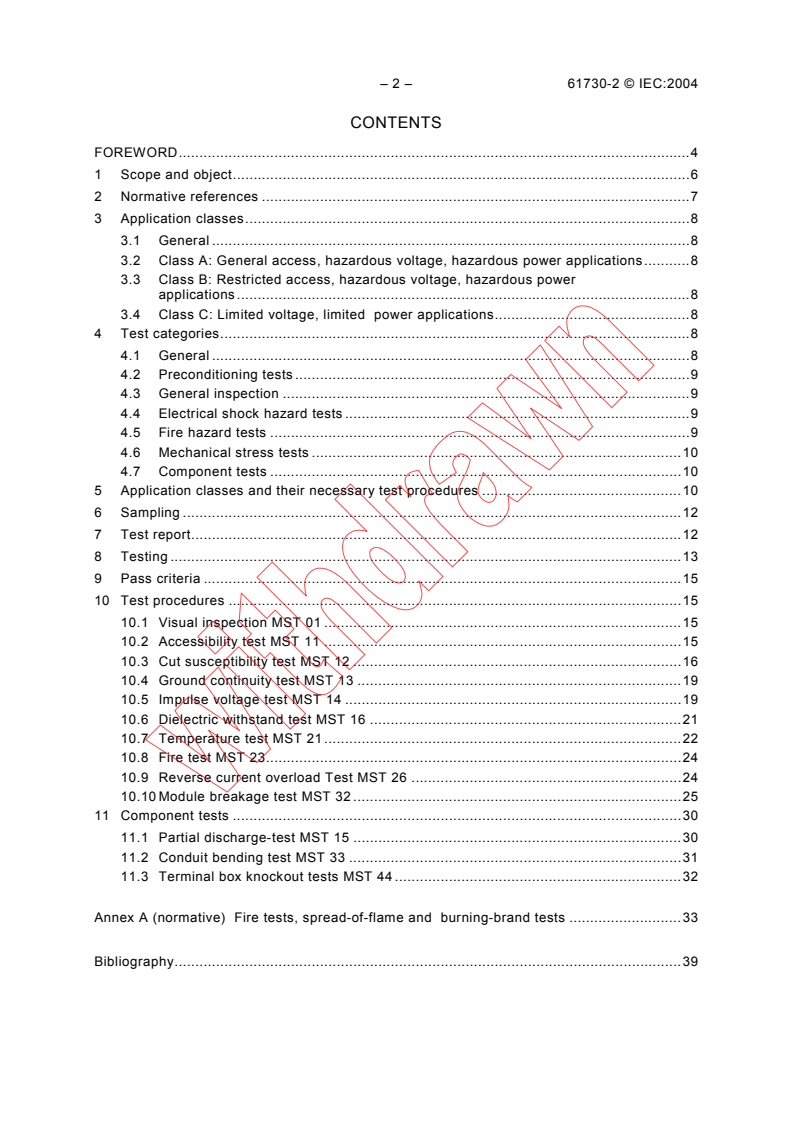
CONTENTS
FOREWORD.4
1 Scope and object.6
2 Normative references .7
3 Application classes.8
3.1 General .8
3.2 Class A: General access, hazardous voltage, hazardous power applications.8
3.3 Class B: Restricted access, hazardous voltage, hazardous power
applications .8
3.4 Class C: Limited voltage, limited power applications.8
4 Test categories.8
4.1 General .8
4.2 Preconditioning tests .9
4.3 General inspection .9
4.4 Electrical shock hazard tests .9
4.5 Fire hazard tests .9
4.6 Mechanical stress tests .10
4.7 Component tests .10
5 Application classes and their necessary test procedures .10
6 Sampling .12
7 Test report.12
8 Testing .13
9 Pass criteria .15
10 Test procedures .15
10.1 Visual inspection MST 01 .15
10.2 Accessibility test MST 11 .15
10.3 Cut susceptibility test MST 12 .16
10.4 Ground continuity test MST 13 .19
10.5 Impulse voltage test MST 14 .19
10.6 Dielectric withstand test MST 16 .21
10.7 Temperature test MST 21.22
10.8 Fire test MST 23.24
10.9 Reverse current overload Test MST 26 .24
10.10 Module breakage test MST 32 .25
11 Component tests .30
11.1 Partial discharge-test MST 15 .30
11.2 Conduit bending test MST 33 .31
11.3 Terminal box knockout tests MST 44 .32
Annex A (normative) Fire tests, spread-of-flame and burning-brand tests .33
Bibliography.39
61730-2 © IEC:2004 – 3 –
Figure 1 – Test sequences.14
Figure 2 – Cut susceptibility test .18
Figure 3 – Wave-form of the impulse voltage according to IEC 60060-1.21
Figure 4 – Impactor.27
Figure 5 – Impact test frame 1 .28
Figure 6 – Impact test frame 2 .29
Figure 7 – Test fixture assembly .31
Figure A.1 – Test apparatus for fire test.34
Figure A.2 – Burning brand construction .37
Table 1 – Preconditioning tests.9
Table 2 – General inspection test.9
Table 3 – Electrical shock hazard tests .9
Table 4 – Fire hazard tests .10
Table 5 – Mechanical stress tests .10
Table 6 – Component tests .10
Table 7 – Required tests, depending on the application class .11
Table 8 – Impulse voltage versus maximum system voltage.20
Table 9 – Component temperature limits.23
Table 10 – Bending loads .31
– 4 – 61730-2 © IEC:2004
INTERNATIONAL ELECTROTECHNICAL COMMISSION
____________
PHOTOVOLTAIC (PV) MODULE SAFETY QUALIFICATION –
Part 2: Requirements for testing
FOREWORD
1) The International Electrotechnical Commission (IEC) is a worldwide organization for standardization comprising
all national electrotechnical committees (IEC National Committees). The object of IEC is to promote
international co-operation on all questions concerning standardization in the electrical and electronic fields. To
this end and in addition to other activities, IEC publishes International Standards, Technical Specifications,
Technical Reports, Publicly Available Specifications (PAS) and Guides (hereafter referred to as “IEC
Publication(s)”). Their preparation is entrusted to technical committees; any IEC National Committee interested
in the subject dealt with may participate in this preparatory work. International, governmental and non-
governmental organizations liaising with the IEC also participate in this preparation. IEC collaborates closely
with the International Organization for Standardization (ISO) in accordance with conditions determined by
agreement between the two organizations.
2) The formal decisions or agreements of IEC on technical matters express, as nearly as possible, an international
consensus of opinion on the relevant subjects since each technical committee has representation from all
interested IEC National Committees.
3) IEC Publications have the form of recommendations for international use and are accepted by IEC National
Committees in that sense. While all reasonable efforts are made to ensure that the technical content of IEC
Publications is accurate, IEC cannot be held responsible for the way in which they are used or for any
misinterpretation by any end user.
4) In order to promote international uniformity, IEC National Committees undertake to apply IEC Publications
transparently to the maximum extent possible in their national and regional publications. Any divergence
between any IEC Publication and the corresponding national or regional publication shall be clearly indicated in
the latter.
5) IEC provides no marking procedure to indicate its approval and cannot be rendered responsible for any
equipment declared to be in conformity with an IEC Publication.
6) All users should ensure that they have the latest edition of this publication.
7) No liability shall attach to IEC or its directors, employees, servants or agents including individual experts and
members of its technical committees and IEC National Committees for any personal injury, property damage or
other damage of any nature whatsoever, whether direct or indirect, or for costs (including legal fees) and
expenses arising out of the publication, use of, or reliance upon, this IEC Publication or any other IEC
Publications.
8) Attention is drawn to the Normative references cited in this publication. Use of the referenced publications is
indispensable for the correct application of this publication.
9) Attention is drawn to the possibility that some of the elements of this IEC Publication may be the subject of
patent rights. IEC shall not be held responsible for identifying any or all such patent rights.
International Standard IEC 61730-2 has been prepared by IEC technical committee 82: Solar
photovoltaic energy systems.
The text of this standard is based on the following documents:
FDIS Report on voting
82/357/FDIS 82/366/RVD
Full information on the voting for the approval of this standard can be found in the report on
voting indicated in the above table.
This publication has been drafted in accordance with the ISO/IEC Directives, Part 2.
61730-2 © IEC:2004 – 5 –
IEC 61730 consists of the following parts, under the general title Photovoltaic (PV) module
safety qualification:
Part 1: Requirements for construction
Part 2: Requirements for testing
The committee has decided that the contents of this publication will remain unchanged until
the maintenance result date indicated on the IEC web site under "http://webstore.iec.ch" in
the data related to the specific publication. At this date, the publication will be
• reconfirmed;
• withdrawn;
• replaced by a revised edition, or
• amended.
– 6 – 61730-2 © IEC:2004
PHOTOVOLTAIC (PV) MODULE SAFETY QUALIFICATION –
Part 2: Requirements for testing
1 Scope and object
This part of IEC 61730 describes the testing requirements for photovoltaic (PV) modules in
order to provide safe electrical and mechanical operation during their expected lifetime.
Specific topics are provided to assess the prevention of electrical shock, fire hazards, and
personal injury due to mechanical and environmental stresses. IEC 61730-1 pertains to the
particular requirements of construction. This part of IEC 61730 outlines the requirements of
testing.
This standard attempts to define the basic requirements for various application classes of
photovoltaic modules, but it cannot be considered to encompass all national or regional
building codes. The specific requirements for marine and vehicle applications are not covered.
This standard is not applicable to modules with integrated AC inverters (AC modules).
This standard is designed so that its test sequence can co-ordinate with those of IEC 61215
or IEC 61646, so that a single set of samples may be used to perform both the safety and
performance evaluation of a photovoltaic module design.
The test-sequences of this standard are arranged in an optimal way so that tests of
IEC 61215 or IEC 61646 can be used as basic preconditioning tests.
NOTE 1 The sequence of tests required in this standard may not test for all possible safety aspects associated
with the use of PV modules in all possible applications. This standard utilizes the best sequence of tests available
at the time of its writing. There are some issues, such as the potential danger of electric shock posed by a broken
module in a high voltage system, that should be addressed by the systems design, location, restrictions on access
and maintenance procedures.
The object of this document is to provide the testing sequence intended to verify the safety of
PV modules whose construction has been assessed by IEC 61730-1. The test sequence and
pass criteria are designed to detect the potential breakdown of internal and external
components of PV modules that would result in fire, electric shock and personal injury. The
standard defines the basic safety test requirements and additional tests that are a function of
the module end-use applications.
Test categories include general inspection, electrical shock hazard, fire hazard, mechanical
stress, and environmental stress.
NOTE 2 The additional testing requirements outlined in relevant ISO standards, or the national or local codes
which govern the installation and use of these modules in their intended locations, should be considered in addition
to the requirements contained within this document.
61730-2 © IEC:2004 – 7 –
2 Normative references
The following referenced documents are indispensable for the application of this document.
For dated references, only the edition cited applies. For undated references, the latest edition
of the referenced document (including any amendments) applies.
IEC 60060-1, High-voltage test techniques – Part 1: General definitions and test requirements
IEC 60068-1, Environmental testing – Part 1: General and guidance
IEC 60410, Sampling plans and procedures for inspection by attributes
IEC 60664-1:1992, Insulation co-ordination for equipment within low-voltage systems – Part 1
Principles, requirements and tests
Amendment 2 (2002)
IEC 60904-2, Photovoltaic devices – Part 2: Requirements for reference solar cells
IEC 60904-6, Photovoltaic devices – Part 6: Requirements for reference solar modules
IEC 61032:1997, Protection of persons and equipment by enclosures – Probes for verification
IEC 61140, Protection against electric shock – Common aspects for installation and
equipment
IEC 61215:2004, Crystalline silicon terrestrial photovoltaic (PV) modules – Design
qualification and type approval
IEC 61646:1996, Thin-film terrestrial photovoltaic (PV) modules – Design qualification and
type approval
IEC 61730-1:2004, Photovoltaic (PV) module safety qualification – Part 1: Requirements for
construction
ISO/IEC 17025, General requirements for the competence of testing and calibration
laboratories
ANSI/UL 514C, Non-metallic outlet boxes, flush device boxes and covers
ANSI/UL 790, Tests for Fire Resistance of Roof Covering Materials
ANSI/UL 1703, Flat – Plate Photovoltaic Modules and Panels
ANSI Z97.1, American National Standard for Safety Glazing Materials Used in Buildings –
Safety Performance Specifications and Methods of Test
– 8 – 61730-2 © IEC:2004
3 Application classes
3.1 General
Photovoltaic modules may be installed in many different applications. Therefore, it is
important to evaluate the potential hazards associated with those applications and to evaluate
the construction of the module accordingly.
Relevant safety requirements and necessary tests shall be performed to verify the
conformance to the requirements of that application class. This clause defines those
application classes and construction qualities required for each class.
Application classes for PV-modules are defined as follows:
3.2 Class A: General access, hazardous voltage, hazardous power applications
Modules rated for use in this application class may be used in systems operating at greater
than 50 V DC or 240 W, where general contact access is anticipated. Modules qualified for
safety through IEC 61730-1 and this part of IEC 61730 within this application class are
considered to meet the requirements for safety class II.
3.3 Class B: Restricted access, hazardous voltage, hazardous power applications
Modules rated for use in this application class are restricted to systems protected from public
access by fences, location, etc. Modules evaluated within this application class provide
protection by basic insulation, are considered to meet the requirements for safety class 0.
3.4 Class C: Limited voltage, limited power applications
Modules rated for use in this application class are restricted to systems operating at less than
50 V DC and 240 W, where general contact access is anticipated. Modules qualified for safety
through IEC 61730-1 and this part of IEC 61730 within this application class are considered to
meet the requirements for safety class III.
NOTE Safety classes are defined within IEC 61140.
4 Test categories
4.1 General
The following hazards might influence the lifetime and the safety of PV modules. In
accordance with these hazards, test procedures and criteria are described. The specific tests
to which a module will be subjected will depend on the end use application for which the
minimum tests are specified in Clause 5.
NOTE Module safety tests are labelled MST.
Tables 1 to 6 show the origin of the required tests. For some tests, the third column shows for
information the origin of the tests, but the appropriate test requirements are given in Clauses
10 and 11. The rest of the tests are based on or identical to IEC 61215/IEC 61646, and
references to the relevant Clauses are given in the last two columns. Some of the
IEC 61215/IEC 61646-based tests were modified for IEC 61730-2 and are included in Clauses
10 and 11.
61730-2 © IEC:2004 – 9 –
4.2 Preconditioning tests
Table 1 – Preconditioning tests
According to
References in
Test Title
Standards
IEC 61215 IEC 61646
MST 51 Thermal cycling (TC50 or TC200) 10.11 10.11
MST 52 Humidity freeze (HF10) 10.12 10.12
MST 53 Damp heat (DH1000) 10.13 10.13
MST 54 UV preconditioning test 10.10 10.10
4.3 General inspection
Table 2 – General inspection test
According to
References in
Test Title
Standards
IEC 61215 IEC 61646
MST 01 Visual inspection 10.1 10.1
4.4 Electrical shock hazard tests
These tests are designed to assess the risk to personnel due to shock or injury because of
contact with parts of a module that are electrically energised as a result of design,
construction, or faults caused by environment or operation.
Table 3 – Electrical shock hazard tests
According to
References in
Test Title
Standards
IEC 61215 IEC 61646
MST 11 Accessibility test ANSI/UL 1703
MST 12 Cut susceptibility test (not required for glass ANSI/UL 1703
surfaces)
MST 13 Ground continuity test ANSI/UL 1703
(not required unless metal framed)
MST 14 Impulse voltage test IEC 60664-1
MST 16 Dielectric withstand test 10.3* 10.3*
MST 17 Wet leakage current test 10.15 10.20
MST 42 Robustness of terminations test 10.14 10.14
* The pass/fail criteria differ from those given in IEC 61215 and IEC 61646.
4.5 Fire hazard tests
These tests assess the potential fire hazard due to the operation of a module or failure of its
components.
– 10 – 61730-2 © IEC:2004
Table 4 – Fire hazard tests
According to
References in
Test Title
Standards
IEC 61215 IEC 61646
MST 21 Temperature test ANSI/UL 1703
MST 22 Hot-spot test 10.9 10.9
MST 23 Fire test ANSI/UL 790
MST 25 Bypass diode thermal test 10.18
MST 26 Reverse current overload test ANSI/UL 1703
4.6 Mechanical stress tests
These tests are to minimise potential injury due to mechanical failure.
Table 5 – Mechanical stress tests
According to
References in
Test Title
Standards
IEC 61215 IEC 61646
MST 32 Module breakage test ANSI Z97.1
MST 34 Mechanical load test 10.16 10.16
4.7 Component tests
Table 6 – Component tests
According to
References in
Test Title
Standards
IEC 61215 IEC 61646
MST 15 Partial discharge test IEC 60664-1
MST 33 Conduit bending ANSI/UL 514C
MST 44 Terminal box knock out test ANSI/UL 514C
5 Application classes and their necessary test procedures
The specific tests to which a module will be subjected, depending on the application class
defined in IEC 61730-1, is described in Table 7. The order in which the tests are carried out
shall be in accordance with Figure 1.
Some tests shall be carried out as preconditioning tests.
NOTE This test sequence has been designed so that IEC 61730-2 can be performed in conjunction with
IEC 61215 or IEC 61646. In this way, the environmental stress tests in IEC 61215 or IEC 61646 can serve as the
preconditioning tests for IEC 61730-2.
61730-2 © IEC:2004 – 11 –
Table 7 – Required tests, depending on the application class
Application class
Tests
A B C
Preconditioning tests:
X X X MST 51 Thermal cycling (T50 or T200)
X X X MST 52 Humidity freeze (10HF)
X X X MST 53 Damp heat (DH1000)
X X X MST 54 UV resistance
General inspection test:
X X X MST 01 Visual inspection
Electrical shock hazard tests:
X X - MST 11 Accessibility test
X X - MST 12 Cut susceptibility test
X X X MST 13 Ground continuity test
X X* - MST 14 Impulse voltage test
X X* - MST 16 Dielectric withstand test
X X - MST 17 Wet leakage current test
X X X MST 42 Robustness of terminations test
Fire hazard tests:
X X X MST 21 Temperature test
X X X MST 22 Hot spot test
X** - - MST 23 Fire test
X X - MST 26 Reverse current overload test
Mechanical stress tests:
X - X MST 32 Module breakage test
X X X MST 34 Mechanical load test
Component tests:
X - - MST 15 Partial discharge test
X X - MST 33 Conduit bending
X X X MST 44 Terminal box knockout test
X Test required.
- Test needs not be carried out.
* Different test levels for application classes A and B.
** Minimum fire resistance class C is necessary for building roof-mounted modules.
– 12 – 61730-2 © IEC:2004
6 Sampling
Six modules and a laminate (a module without frame) for safety testing (plus spares as
desired) and additional modules as required for the fire-test shall be taken at random from a
production batch or batches, in accordance with the procedure given in IEC 60410. The
modules shall have been manufactured from specified materials and components in
accordance with the relevant drawings and process sheets and have been subjected to the
manufacturer's normal inspection, quality control and production acceptance procedures. The
modules shall be complete in every detail and shall be accompanied by the manufacturer's
handling, mounting and connection instructions, including the maximum permissible system
voltage.
When the modules to be tested are prototypes of a new design and not from production, this
fact shall be noted in the test report (see Clause 7).
7 Test report
The results shall be laid down in a test report according to ISO/IEC 17025. The results shall
be reported, normally in a test report and shall include all the information requested by the
client and necessary to the interpretation of the test and all information required by the
method used:
a) a title;
b) name and address of the test laboratory and location where the tests were carried out;
c) unique identification of the certification or report and of each page;
d) name and address of client, where appropriate;
e) description and identification of the item tested;
f) characterization and condition of the test item;
g) date of receipt of test item and date(s) of test, where appropriate;
h) identification of test method used;
i) reference to sampling procedure, where relevant;
j) any deviations from, additions to or exclusions from the test method, and any other
information relevant to a specific tests, such as environmental conditions;
k) measurements, examinations and derived results supported by tables, graphs, sketches
and photographs as appropriate including maximum systems voltage, safety class,
mounting technique and any failures observed;
l) a statement indicating whether the impulse voltage test was performed on module or
laminate;
m) a statement of the estimated uncertainty of the test results (where relevant);
n) a signature and title, or equivalent identification of the person(s) accepting responsibility
for the content of the certificate or report, and the date of issue;
o) where relevant, a statement to the effect that the results relate only to the items tested;
p) a statement that the certificate or report shall not be reproduced except in full, without the
written approval of the laboratory.
A copy of this report shall be kept by the manufacturer for reference purposes.
—————————
If the module is only used with frame and the frame is an essential part to fulfil the isolation requirement, the
laminate can be replaced by a module.
61730-2 © IEC:2004 – 13 –
8 Testing
The modules shall be divided into groups and subjected to the safety tests shown in Figure 1,
carried out in the order specified. The modules shall be selected such that the preconditioning
tests of 4.2 are met. Each box in Figure 1 refers to the corresponding subclause in this part of
IEC 61730.
NOTE Spare modules may be included in the safety test program provided that they have been appropriately
environmentally tested to meet the necessary prerequisites.
Test procedures and criteria, including initial and final measurements where necessary, are
detailed in Clauses 10 and 11. Some tests are identical to tests in IEC 61215/IEC 61646 and
are detailed in Clause 4 instead. In carrying out these tests, the tester shall strictly observe
the manufacturer's handling, mounting, and connection instructions.
– 14 – 61730-2 © IEC:2004
Module safety test MST
IEC 61730
7 modules or
6 modules and 1 laminate
IEC 61215
Module performance test MPT
IEC 61646
The numbers in each box are references to final
Visual inspection
10.2 17
measurements, that are to be performed after
MST 01
MST or MPT (if required). In this example:
01 = Module safety test MST 01
10.2 = Performance test (IEC 61215, IEC 61646)
Component tests
17 = Module safety test MST 17 Performance test
10.2 (IEC 61215,
IEC 61646)
11 pieces
of foil
1 module 1 module 3 modules
Number of 1 module
1 laminate
modules depends
1 piece
on the module size
of
Dielectric withstand
junction
Control
test
box
MST 16
Test on
Ground continuity 6 knock
test
outs
MST 13
Partial discharge
test
Fire test Module breakage test
Accessibility
MSTMST 1 155
MST 23
MST 32
test
MST 11
Conduit bending
test
Wet leakage current
MSTMST 3 333
test
MST 17
Terminal box
knock out test
1 m1 modulodulee 1 m1 modulodulee
1 module
MSTMST 4 444
1 laminate (module)
DDamamp heatp Heat t Teestst Thermal cycling test
UV-resistance test
1000 h1 000 h 200 cycles
MST 54
MSTMST 5 533 MST 51a
01 10.2 16
01 10.2 16 01 10.2 16
Thermal cycling test Wet leakage current
Bypass diode
test
50 cycles
thermal test
MST 17
MST 51b
MST 25
01 10.2 16
17 17
0101 1616
Mechanical load
Humidity freeze test laminate
Temperature
test (module)
MST 52
MST 34 test
MSTMST 2 211
01 10.2 17
01 10.2 16
Robustness of Hot-spot Impulse voltage Reverse current
terminations test test overload test
test
MST 42
MST 22 MSTMST 1 144 MSTMST 2 266
01 10.2 16 17 01 16 17
01 16
Cut susceptibility
test
MST 12
01 13 17
Accessibility test
MST 11
Visual inspection
MST 01
IEC 1357/04
Figure 1 – Test sequences
61730-2 © IEC:2004 – 15 –
9 Pass criteria
The module product under evaluation shall be judged to have passed the safety qualification
test, if the test samples meet all of the criteria of each individual test.
If any module does not meet these test criteria, the module product under evaluation shall be
deemed not to have met the safety test requirements.
NOTE The nature of the failure will determine the extent of re-testing requirements.
10 Test procedures
10.1 Visual inspection MST 01
10.1.1 Purpose
To detect any visual defects in the module.
10.1.2 Procedure
This test is identical with 10.1 from IEC 61215/IEC 61646 with the additional inspection
criteria of
– any other conditions which may affect safety;
– markings not consistent with Clause 11 of IEC 61730-1.
Make note of and/or photograph the nature and position of any cracks, bubbles or
delaminations, etc. which may worsen and adversely affect the module safety in subsequent
tests. Visual conditions other than the major defects listed below are acceptable for the
purpose of safety test approval.
10.1.3 Pass criteria
For the purpose of the safety test approval, the following are considered to be major visual
defects:
a) broken, cracked, or torn external surfaces;
b) bent or misaligned external surfaces, including superstrates, substrates, frames and
junction boxes to the extent that the safety of the module would be impaired;
c) bubbles or delaminations forming a continuous path between any part of the electrical
circuit and the edge of the module, or which exhibited significant growth during the testing
and would, if testing were continued, reach such a condition;
d) evidence of any molten or burned encapsulant, back sheet, diode or active PV component;
e) loss of mechanical integrity to the extent that the safety of the installation and operation of
the module would be impaired;
f) markings not complying with Clause 12 of IEC 61730-1.
10.2 Accessibility test MST 11
10.2.1 Purpose
To determine if uninsulated electrical connections represent a shock hazard to personnel.
– 16 – 61730-2 © IEC:2004
10.2.2 Apparatus
The apparatus is as follows:
a) A cylindrical test fixture Type 11 according to Figure 7 of IEC 61032.
b) An ohmmeter or continuity tester.
10.2.3 Procedure
The procedure is as follows:
a) Mount and wire the test module as recommended by the manufacturer.
b) Attach the ohmmeter or continuity tester to the module electric circuit and to the test
fixture.
c) Remove all covers, plugs and connections from the module that can be removed without
using a tool.
d) Probe with the test fixture in and around all electrical connectors, plugs, junction boxes
and any other areas where the electrical circuit of the module may be accessible.
e) Monitor the ohmmeter or continuity tester during the probing to determine if the test fixture
makes electrical contact to the module electric circuitry.
10.2.4 Final measurements
None.
10.2.5 Requirements
At no time during the test shall there be less than 1 MΩ resistance between the test fixture
and the module electric circuit.
10.2.6 Pass criteria
At no time during the test shall the probe contact any live electrical part. This test is
performed at the beginning and the end of the sequence according to Figure 1, but also can
be used at any time during the test sequence if there is any reason to believe that active
electric circuitry has been exposed by one of the other tests.
10.3 Cut susceptibility test MST 12
10.3.1 Purpose
To determine whether any front and rear surfaces of the module made of polymeric materials
are capable of withstanding routine handling during installation and maintenance without
exposing personnel to the danger of electric shock. This test is derived from ANSI/UL 1703.
10.3.2 Apparatus
A test fixture as shown in Figure 2, designed to draw a defined shaped object, a 0,64 mm ±
0,05 mm thick carbon steel blade (for example the back of a hacksaw blade) over the surface
of the module with an applied force of 8,9 N ± 0,5 N.
61730-2 © IEC:2004 – 17 –
10.3.3 Procedure
The procedure is as follows:
a) Position the module horizontally with the front surface facing upward.
b) The test fixture is to be placed on the surface for 1 min and then drawn across the surface
of the module at a speed of (150 ± 30) mm/s.
Repeat the procedure five times in different directions.
c) Repeat a) and b) for the rear surface of the module.
10.3.4 Final measurements
Repeat MST 01, MST 13, MST 16 and MST 17.
10.3.5 Pass criteria
The pass criteria are as follows:
a) No visual evidence that the superstrate or substrate surfaces have been cut, exposing the
active circuitry of the module.
b) MST 13, MST 16, MST 17 shall meet the same requirements as for the initial
measurements.
– 18 – 61730-2 © IEC:2004
A
140°
B
Q
Test point
carbon steel strip
(i.e. hacksaw
blade)
90°
C
IEC 1358/04
Key
A 150 mm from axis to center of weight.
B 170 mm from axis to test point.
C Test point – 0,64 mm thick steel strip.
Q Total force exerted at test point Q: 8,9 N
Figure 2 – Cut susceptibility test
61730-2 © IEC:2004 – 19 –
10.4 Ground continuity test MST 13
10.4.1 Purpose
To demonstrate that there is a conductive path between all exposed conductive surfaces of
the module, so that the exposed conductive surfaces can be adequately grounded in a PV
system. This test is required only if the module has exposed conductive parts such as a metal
frame or a metallic junction box.
10.4.2 Apparatus
The apparatus is as follows:
a) A constant current supply capable of producing a current that is 2,5 times the maximum
over-current protection rating of the module under test. See MST 26.
b) A suitable voltmeter.
NOTE According to IEC 61730-1 the maximum over-current protection rating has to be provided by the
manufacturer.
10.4.3 Procedure
The procedure is as follows:
a) Select the manufacturer’s designated grounding point and recommended grounding
connection. Attach to one terminal of the constant current supply.
b) Select an adjacent (connected) exposed conductive component with the greatest physical
displacement from the grounding point, and attach to the other terminal of the current
supply.
c) Attach the voltmeter to the two conductive components attached to the current supply in
proximity to the current leads.
d) Apply a current 2,5 times ± 10 % of the maximum over-current protection rating of the
module for a minimum of 2 min.
e) Measure the applied current and the resultant voltage drop.
f) Reduce the current to zero.
g) Repeat the test on one additional frame component.
10.4.4 Final measurements
None.
10.4.5 Pass criteria
The resistance between the selected exposed conductive component and each other
conductive component of the module shall be less than 0,1 Ω.
10.5 Impulse voltage test MST 14
10.5.1 Purpose
To verify the capability of the solid insulation of the module to withstand over-voltages of
atmospheric origin. It also covers over-voltages due to switching of low-voltage equipment.
NOTE If the PV module is not going to be sold without frame, the impulse voltage test should be done with the
module framed.
– 20 – 61730-2 © IEC:2004
10.5.2 Apparatus
The apparatus is as follows:
a) Impulse voltage generator.
b) Oscilloscope.
10.5.3 Procedures
For the purposes of test reproducibility, this test is conducted under the conditions of room
temperature and relative humidity of less than 75 %. The procedure is as follows:
a) Cover the whole module with a copper foil. Connect the foil to the negative terminal of the
impulse voltage generator.
b) Connect the shorted output terminals of the module to the positive terminal of the impulse
voltage generator.
Specification of the foil:
1) Thickness copper 0,03 mm to 0,05 mm.
2) Conducting glue (conductivity <1 Ω, measuring area: 625 mm ).
3) Total thickness 0,05 mm to 0,07 mm.
c) With no illumination, apply the surge impulse voltage given in Table 8 with a waveform as
shown in Figure 3 by the impulse voltage generator. The waveform of the pulse shall be
observed by an oscilloscope and the rise time and the pulse duration shall be checked for
each test.
NOTE 1 According to 2.2.2.1.1 of IEC 60664-1, modules belong to the over-voltage category III. The test-
level has been reduced by one step because systems are normally equipped with over-voltage protection
devices. On the other hand, to verify reinforced insulation (as required for application class A and safety class
II), the level for application class A has been increased by one step.
Table 8 – Impulse voltage versus maximum system voltage
Impulse voltage
Maximum system voltage
Application class A Application class B
V
V V
100 1 500 800
150 2 500 1 500
300 4 000 2 500
600 6 000 4 000
1 000 8 000 6 000
NOTE 2 Linear interpolation is allowed for intermediate values of maximum system voltage.
d) Three successive pulses shall be applied.
e) Change the polarity of the terminals of the pulse generator and apply three successive
pulses.
61730-2 © IEC:2004 – 21 –
10.5.4 Final measurement
Repeat MST 01 visual inspection.
10.5.5 Pass criteria
The pass criteria are as follows:
a) No evidence of dielectric breakdown or surface tracking of the module is observed during
the test.
b) No evidence of major visual defects as defined in 10.1.
Voltage
1,0
B
0,9
0,5
0,3
A
Time
T’
T
T
T
T = 1,2 μs ± 30 %
T = 50 μs ± 20 %
IEC 1359/04
NOTE The parameter 0 is the start point of the impulse voltage. In a diagram with linear time scale this is the
intersection point of the time axis and the line defined by points A and B.
Figure 3 – Wave-form of the impulse voltage according to IEC 60060-1
10.6 Dielectric withstand test MST 16
10.6.1 Purpose
To determine whether or not the module is sufficiently well insu
...
IEC 61730-2 ®
Edition 1.1 2012-11
INTERNATIONAL
STANDARD
NORME
INTERNATIONALE
colour
inside
Photovoltaic (PV) module safety qualification –
Part 2: Requirements for testing
Qualification pour la sûreté de fonctionnement des modules photovoltaïques (PV) –
Partie 2: Exigences pour les essais
All rights reserved. Unless otherwise specified, no part of this publication may be reproduced or utilized in any form
or by any means, electronic or mechanical, including photocopying and microfilm, without permission in writing from
either IEC or IEC's member National Committee in the country of the requester.
If you have any questions about IEC copyright or have an enquiry about obtaining additional rights to this publication,
please contact the address below or your local IEC member National Committee for further information.
Droits de reproduction réservés. Sauf indication contraire, aucune partie de cette publication ne peut être reproduite ni
utilisée sous quelque forme que ce soit et par aucun procédé, électronique ou mécanique, y compris la photocopie et les
microfilms, sans l'accord écrit de la CEI ou du Comité national de la CEI du pays du demandeur.
Si vous avez des questions sur le copyright de la CEI ou si vous désirez obtenir des droits supplémentaires sur cette
publication, utilisez les coordonnées ci-après ou contactez le Comité national de la CEI de votre pays de résidence.
IEC Central Office Tel.: +41 22 919 02 11
3, rue de Varembé Fax: +41 22 919 03 00
CH-1211 Geneva 20 info@iec.ch
Switzerland www.iec.ch
About the IEC
The International Electrotechnical Commission (IEC) is the leading global organization that prepares and publishes
International Standards for all electrical, electronic and related technologies.
About IEC publications
The technical content of IEC publications is kept under constant review by the IEC. Please make sure that you have the
latest edition, a corrigenda or an amendment might have been published.
Useful links:
IEC publications search - www.iec.ch/searchpub Electropedia - www.electropedia.org
The advanced search enables you to find IEC publications The world's leading online dictionary of electronic and
by a variety of criteria (reference number, text, technical electrical terms containing more than 30 000 terms and
committee,…). definitions in English and French, with equivalent terms in
It also gives information on projects, replaced and additional languages. Also known as the International
withdrawn publications. Electrotechnical Vocabulary (IEV) on-line.
IEC Just Published - webstore.iec.ch/justpublished Customer Service Centre - webstore.iec.ch/csc
Stay up to date on all new IEC publications. Just Published If you wish to give us your feedback on this publication
details all new publications released. Available on-line and or need further assistance, please contact the
also once a month by email. Customer Service Centre: csc@iec.ch.
A propos de la CEI
La Commission Electrotechnique Internationale (CEI) est la première organisation mondiale qui élabore et publie des
Normes internationales pour tout ce qui a trait à l'électricité, à l'électronique et aux technologies apparentées.
A propos des publications CEI
Le contenu technique des publications de la CEI est constamment revu. Veuillez vous assurer que vous possédez
l’édition la plus récente, un corrigendum ou amendement peut avoir été publié.
Liens utiles:
Recherche de publications CEI - www.iec.ch/searchpub Electropedia - www.electropedia.org
La recherche avancée vous permet de trouver des Le premier dictionnaire en ligne au monde de termes
publications CEI en utilisant différents critères (numéro de électroniques et électriques. Il contient plus de 30 000
référence, texte, comité d’études,…). termes et définitions en anglais et en français, ainsi que
Elle donne aussi des informations sur les projets et les les termes équivalents dans les langues additionnelles.
publications remplacées ou retirées. Egalement appelé Vocabulaire Electrotechnique
International (VEI) en ligne.
Just Published CEI - webstore.iec.ch/justpublished
Service Clients - webstore.iec.ch/csc
Restez informé sur les nouvelles publications de la CEI.
Just Published détaille les nouvelles publications parues. Si vous désirez nous donner des commentaires sur
Disponible en ligne et aussi une fois par mois par email. cette publication ou si vous avez des questions
contactez-nous: csc@iec.ch.
IEC 61730-2 ®
Edition 1.1 2012-11
INTERNATIONAL
STANDARD
NORME
INTERNATIONALE
colour
inside
Photovoltaic (PV) module safety qualification –
Part 2: Requirements for testing
Qualification pour la sûreté de fonctionnement des modules photovoltaïques (PV) –
Partie 2: Exigences pour les essais
INTERNATIONAL
ELECTROTECHNICAL
COMMISSION
COMMISSION
ELECTROTECHNIQUE
INTERNATIONALE
ICS 27.160 ISBN 978-2-88912-882-2
– 2 – 61730-2 © IEC:2004+A1:2011
CONTENTS
FOREWORD . 4
1 Scope and object . 6
2 Normative references . 7
3 Application classes . 8
3.1 General . 8
3.2 Class A: General access, hazardous voltage, hazardous power applications . 8
3.3 Class B: Restricted access, hazardous voltage, hazardous power
applications . 8
3.4 Class C: Limited voltage, limited power applications . 8
4 Test categories . 8
4.1 General . 8
4.2 Preconditioning tests . 9
4.3 General inspection . 9
4.4 Electrical shock hazard tests . 9
4.5 Fire hazard tests . 9
4.6 Mechanical stress tests . 10
4.7 Component tests . 10
5 Application classes and their necessary test procedures . 10
6 Sampling . 12
7 Test report. 12
8 Testing . 13
9 Pass criteria . 16
10 Test procedures . 16
10.1 Visual inspection MST 01 . 16
10.2 Accessibility test MST 11 . 16
10.3 Cut susceptibility test MST 12 . 17
10.4 Ground continuity test MST 13 . 20
10.5 Impulse voltage test MST 14 . 20
10.6 Dielectric withstand test MST 16 . 22
10.7 Temperature test MST 21 . 23
10.8 Fire test MST 23 . 25
10.9 Reverse current overload Test MST 26 . 25
10.10 Module breakage test MST 32 . 26
11 Component tests . 31
11.1 Partial discharge-test MST 15 . 31
11.2 Conduit bending test MST 33 . 31
11.3 Terminal box knockout tests MST 44 . 33
Annex A (normative) Fire tests, spread-of-flame and burning-brand tests . 34
Bibliography . 40
61730-2 © IEC:2004+A1:2011 – 3 –
Figure 1 – Test sequences . 15
Figure 2 – Cut susceptibility test . 19
Figure 3 – Wave-form of the impulse voltage according to IEC 60060-1 . 22
Figure 4 – Impactor . 28
Figure 5 – Impact test frame 1 . 29
Figure 6 – Impact test frame 2 . 30
Figure 7 – Test fixture assembly . 32
Figure A.1 – Test apparatus for fire test . 35
Figure A.2 – Burning brand construction . 38
Table 1 – Preconditioning tests . 9
Table 2 – General inspection test. 9
Table 3 – Electrical shock hazard tests . 9
Table 4 – Fire hazard tests . 10
Table 5 – Mechanical stress tests . 10
Table 6 – Component tests . 10
Table 7 – Required tests, depending on the application class . 11
Table 8 – Impulse voltage versus maximum system voltage . 21
Table 9 – Component temperature limits . 24
Table 10 – Bending loads . 32
– 4 – 61730-2 © IEC:2004+A1:2011
INTERNATIONAL ELECTROTECHNICAL COMMISSION
____________
PHOTOVOLTAIC (PV) MODULE SAFETY QUALIFICATION –
Part 2: Requirements for testing
FOREWORD
1) The International Electrotechnical Commission (IEC) is a worldwide organization for standardization comprising
all national electrotechnical committees (IEC National Committees). The object of IEC is to promote
international co-operation on all questions concerning standardization in the electrical and electronic fields. To
this end and in addition to other activities, IEC publishes International Standards, Technical Specifications,
Technical Reports, Publicly Available Specifications (PAS) and Guides (hereafter referred to as “IEC
Publication(s)”). Their preparation is entrusted to technical committees; any IEC National Committee interested
in the subject dealt with may participate in this preparatory work. International, governmental and non-
governmental organizations liaising with the IEC also participate in this preparation. IEC collaborates closely
with the International Organization for Standardization (ISO) in accordance with conditions determined by
agreement between the two organizations.
2) The formal decisions or agreements of IEC on technical matters express, as nearly as possible, an international
consensus of opinion on the relevant subjects since each technical committee has representation from all
interested IEC National Committees.
3) IEC Publications have the form of recommendations for international use and are accepted by IEC National
Committees in that sense. While all reasonable efforts are made to ensure that the technical content of IEC
Publications is accurate, IEC cannot be held responsible for the way in which they are used or for any
misinterpretation by any end user.
4) In order to promote international uniformity, IEC National Committees undertake to apply IEC Publications
transparently to the maximum extent possible in their national and regional publications. Any divergence
between any IEC Publication and the corresponding national or regional publication shall be clearly indicated in
the latter.
5) IEC itself does not provide any attestation of conformity. Independent certification bodies provide conformity
assessment services and, in some areas, access to IEC marks of conformity. IEC is not responsible for any
services carried out by independent certification bodies.
6) All users should ensure that they have the latest edition of this publication.
7) No liability shall attach to IEC or its directors, employees, servants or agents including individual experts and
members of its technical committees and IEC National Committees for any personal injury, property damage or
other damage of any nature whatsoever, whether direct or indirect, or for costs (including legal fees) and
expenses arising out of the publication, use of, or reliance upon, this IEC Publication or any other IEC
Publications.
8) Attention is drawn to the Normative references cited in this publication. Use of the referenced publications is
indispensable for the correct application of this publication.
9) Attention is drawn to the possibility that some of the elements of this IEC Publication may be the subject of
patent rights. IEC shall not be held responsible for identifying any or all such patent rights.
This consolidated version of IEC 61730-2 consists of the first edition (2004) [documents
82/357/FDIS and 82/366/RVD] and its amendment 1 (2011) [documents 82/660/FDIS and
82/678/RVD]. It bears the edition number 1.1.
The technical content is therefore identical to the base edition and its amendment and
has been prepared for user convenience. A vertical line in the margin shows where the
base publication has been modified by amendment 1. Additions and deletions are
displayed in red, with deletions being struck through.
61730-2 © IEC:2004+A1:2011 – 5 –
International Standard IEC 61730-2 has been prepared by IEC technical committee 82: Solar
photovoltaic energy systems.
This publication has been drafted in accordance with the ISO/IEC Directives, Part 2.
IEC 61730 consists of the following parts, under the general title Photovoltaic (PV) module
safety qualification:
Part 1: Requirements for construction
Part 2: Requirements for testing
The committee has decided that the contents of the base publication and its amendments will
remain unchanged until the stability date indicated on the IEC web site under
"http://webstore.iec.ch" in the data related to the specific publication. At this date, the
publication will be
• reconfirmed,
• withdrawn,
• replaced by a revised edition, or
• amended.
IMPORTANT – The “colour inside” logo on the cover page of this publication indicates
that it contains colours which are considered to be useful for the correct understanding
of its contents. Users should therefore print this publication using a colour printer.
– 6 – 61730-2 © IEC:2004+A1:2011
PHOTOVOLTAIC (PV) MODULE SAFETY QUALIFICATION –
Part 2: Requirements for testing
1 Scope and object
This part of IEC 61730 describes the testing requirements for photovoltaic (PV) modules in
order to provide safe electrical and mechanical operation during their expected lifetime.
Specific topics are provided to assess the prevention of electrical shock, fire hazards, and
personal injury due to mechanical and environmental stresses. IEC 61730-1 pertains to the
particular requirements of construction. This part of IEC 61730 outlines the requirements of
testing.
This standard attempts to define the basic requirements for various application classes of
photovoltaic modules, but it cannot be considered to encompass all national or regional
building codes. The specific requirements for marine and vehicle applications are not covered.
This standard is not applicable to modules with integrated AC inverters (AC modules).
This standard is designed so that its test sequence can co-ordinate with those of IEC 61215
or IEC 61646, so that a single set of samples may be used to perform both the safety and
performance evaluation of a photovoltaic module design.
The test-sequences of this standard are arranged in an optimal way so that tests of
IEC 61215 or IEC 61646 can be used as basic preconditioning tests.
NOTE 1 The sequence of tests required in this standard may not test for all possible safety aspects associated
with the use of PV modules in all possible applications. This standard utilizes the best sequence of tests available
at the time of its writing. There are some issues, such as the potential danger of electric shock posed by a broken
module in a high voltage system, that should be addressed by the systems design, location, restrictions on access
and maintenance procedures.
The object of this document is to provide the testing sequence intended to verify the safety of
PV modules whose construction has been assessed by IEC 61730-1. The test sequence and
pass criteria are designed to detect the potential breakdown of internal and external
components of PV modules that would result in fire, electric shock and personal injury. The
standard defines the basic safety test requirements and additional tests that are a function of
the module end-use applications.
Test categories include general inspection, electrical shock hazard, fire hazard, mechanical
stress, and environmental stress.
NOTE 2 The additional testing requirements outlined in relevant ISO standards, or the national or local codes
which govern the installation and use of these modules in their intended locations, should be considered in addition
to the requirements contained within this document.
61730-2 © IEC:2004+A1:2011 – 7 –
2 Normative references
The following referenced documents are indispensable for the application of this document.
For dated references, only the edition cited applies. For undated references, the latest edition
of the referenced document (including any amendments) applies.
IEC 60060-1, High-voltage test techniques – Part 1: General definitions and test requirements
IEC 60068-1, Environmental testing – Part 1: General and guidance
IEC 60410, Sampling plans and procedures for inspection by attributes
IEC 60664-1:1992, Insulation co-ordination for equipment within low-voltage systems – Part 1
Principles, requirements and tests
Amendment 2 (2002)
IEC 60904-2, Photovoltaic devices – Part 2: Requirements for reference solar cells devices
IEC 60904-6, Photovoltaic devices – Part 6: Requirements for reference solar modules
IEC 61032:1997, Protection of persons and equipment by enclosures – Probes for verification
IEC 61140, Protection against electric shock – Common aspects for installation and
equipment
IEC 61215:2004, Crystalline silicon terrestrial photovoltaic (PV) modules – Design
qualification and type approval
IEC 61646:1996, Thin-film terrestrial photovoltaic (PV) modules – Design qualification and
type approval
IEC 61730-1:2004, Photovoltaic (PV) module safety qualification – Part 1: Requirements for
construction
ISO/IEC 17025, General requirements for the competence of testing and calibration
laboratories
ANSI/UL 514C, Non-metallic outlet boxes, flush device boxes and covers
ANSI/UL 790, Tests for Fire Resistance of Roof Covering Materials
ANSI/UL 1703, Flat – Plate Photovoltaic Modules and Panels
ANSI Z97.1, American National Standard for Safety Glazing Materials Used in Buildings –
Safety Performance Specifications and Methods of Test
– 8 – 61730-2 © IEC:2004+A1:2011
3 Application classes
3.1 General
Photovoltaic modules may be installed in many different applications. Therefore, it is
important to evaluate the potential hazards associated with those applications and to evaluate
the construction of the module accordingly.
Relevant safety requirements and necessary tests shall be performed to verify the
conformance to the requirements of that application class. This clause defines those
application classes and construction qualities required for each class.
Application classes for PV-modules are defined as follows:
3.2 Class A: General access, hazardous voltage, hazardous power applications
Modules rated for use in this application class may be used in systems operating at greater
than 50 V DC or 240 W, where general contact access is anticipated. Modules qualified for
safety through IEC 61730-1 and this part of IEC 61730 within this application class are
considered to meet the requirements for safety class II.
3.3 Class B: Restricted access, hazardous voltage, hazardous power applications
Modules rated for use in this application class are restricted to systems protected from public
access by fences, location, etc. Modules evaluated within this application class provide
protection by basic insulation, are considered to meet the requirements for safety class 0.
3.4 Class C: Limited voltage, limited power applications
Modules rated for use in this application class are restricted to systems operating at less than
50 V DC and 240 W, where general contact access is anticipated. Modules qualified for safety
through IEC 61730-1 and this part of IEC 61730 within this application class are considered to
meet the requirements for safety class III.
NOTE Safety classes are defined within IEC 61140.
4 Test categories
4.1 General
The following hazards might influence the lifetime and the safety of PV modules. In
accordance with these hazards, test procedures and criteria are described. The specific tests
to which a module will be subjected will depend on the end use application for which the
minimum tests are specified in Clause 5.
NOTE Module safety tests are labelled MST.
Tables 1 to 6 show the origin of the required tests. For some tests, the third column shows for
information the origin of the tests, but the appropriate test requirements are given in Clauses
10 and 11. The rest of the tests are based on or identical to IEC 61215/IEC 61646, and
references to the relevant Clauses are given in the last two columns. Some of the
IEC 61215/IEC 61646-based tests were modified for IEC 61730-2 and are included in Clauses
10 and 11.
61730-2 © IEC:2004+A1:2011 – 9 –
4.2 Preconditioning tests
Table 1 – Preconditioning tests
According to
References in
Test Title
Standards
IEC 61215 IEC 61646
MST 51 Thermal cycling (TC50 or TC200) 10.11 10.11
MST 52 Humidity freeze (HF10) 10.12 10.12
MST 53 Damp heat (DH1000) 10.13 10.13
MST 54 UV preconditioning test 10.10 10.10
4.3 General inspection
Table 2 – General inspection test
According to
References in
Test Title
Standards
IEC 61215 IEC 61646
MST 01 Visual inspection 10.1 10.1
4.4 Electrical shock hazard tests
These tests are designed to assess the risk to personnel due to shock or injury because of
contact with parts of a module that are electrically energised as a result of design,
construction, or faults caused by environment or operation.
Table 3 – Electrical shock hazard tests
According to
References in
Test Title
Standards
IEC 61215 IEC 61646
MST 11 Accessibility test ANSI/UL 1703
MST 12 Cut susceptibility test (not required for glass ANSI/UL 1703
surfaces)
MST 13 Ground continuity test ANSI/UL 1703
(not required unless metal framed)
MST 14 Impulse voltage test IEC 60664-1
MST 16 Dielectric withstand test 10.3* 10.3*
MST 17 Wet leakage current test 10.15 10.20
MST 42 Robustness of terminations test 10.14 10.14
* The pass/fail criteria differ from those given in IEC 61215 and IEC 61646.
4.5 Fire hazard tests
These tests assess the potential fire hazard due to the operation of a module or failure of its
components.
– 10 – 61730-2 © IEC:2004+A1:2011
Table 4 – Fire hazard tests
According to
References in
Test Title
Standards
IEC 61215 IEC 61646
MST 21 Temperature test ANSI/UL 1703
MST 22 Hot-spot test 10.9 10.9
MST 23 Fire test ANSI/UL 790
MST 25 Bypass diode thermal test 10.18 10.18
MST 26 Reverse current overload test ANSI/UL 1703
4.6 Mechanical stress tests
These tests are to minimise potential injury due to mechanical failure.
Table 5 – Mechanical stress tests
According to
References in
Test Title
Standards
IEC 61215 IEC 61646
MST 32 Module breakage test ANSI Z97.1
MST 34 Mechanical load test 10.16 10.16
4.7 Component tests
Table 6 – Component tests
According to
References in
Test Title
Standards
IEC 61215 IEC 61646
MST 15 Partial discharge test IEC 60664-1
MST 33 Conduit bending ANSI/UL 514C
MST 44 Terminal box knock out test ANSI/UL 514C
5 Application classes and their necessary test procedures
The specific tests to which a module will be subjected, depending on the application class
defined in IEC 61730-1, is described in Table 7. The order in which the tests are carried out
shall be in accordance with Figure 1.
Some tests shall be carried out as preconditioning tests.
NOTE This test sequence has been designed so that IEC 61730-2 can be performed in conjunction with
IEC 61215 or IEC 61646. In this way, the environmental stress tests in IEC 61215 or IEC 61646 can serve as the
preconditioning tests for IEC 61730-2.
61730-2 © IEC:2004+A1:2011 – 11 –
Table 7 – Required tests, depending on the application class
Application class
Tests
A B C
Preconditioning tests:
X X X MST 51 Thermal cycling (T50 or T200)
X X X MST 52 Humidity freeze (10HF)
X X X MST 53 Damp heat (DH1000)
X X X MST 54 UV resistance pre-conditioning
General inspection test:
X X X MST 01 Visual inspection
Electrical shock hazard tests:
X X - MST 11 Accessibility test
X X - MST 12 Cut susceptibility test
X X X MST 13 Ground continuity test
X X* - MST 14 Impulse voltage test
X X* - MST 16 Dielectric withstand test
X X - MST 17 Wet leakage current test
X X X MST 42 Robustness of terminations test
Fire hazard tests:
X X X MST 21 Temperature test
X X X MST 22 Hot spot test
X** - - MST 23 Fire test
X X - MST 26 Reverse current overload test
Mechanical stress tests:
X - X MST 32 Module breakage test
X X X MST 34 Mechanical load test
Component tests:
X - - MST 15 Partial discharge test
X X - MST 33 Conduit bending
X X X MST 44 Terminal box knockout test
X Test required.
- Test needs not be carried out.
* Different test levels for application classes A and B.
** Minimum fire resistance class C is necessary for building roof-mounted modules.
– 12 – 61730-2 © IEC:2004+A1:2011
6 Sampling
Six modules and a laminate (a module without frame) for safety testing (plus spares as
desired) and additional modules as required for the fire-test shall be taken at random from a
production batch or batches, in accordance with the procedure given in IEC 60410. The
modules shall have been manufactured from specified materials and components in
accordance with the relevant drawings and process sheets and have been subjected to the
manufacturer's normal inspection, quality control and production acceptance procedures. The
modules shall be complete in every detail and shall be accompanied by the manufacturer's
handling, mounting and connection instructions, including the maximum permissible system
voltage.
When the modules to be tested are prototypes of a new design and not from production, this
fact shall be noted in the test report (see Clause 7).
7 Test report
The results shall be laid down in a test report according to ISO/IEC 17025. The results shall
be reported, normally in a test report and shall include all the information requested by the
client and necessary to the interpretation of the test and all information required by the
method used:
a) a title;
b) name and address of the test laboratory and location where the tests were carried out;
c) unique identification of the certification or report and of each page;
d) name and address of client, where appropriate;
e) description and identification of the item tested;
f) characterization and condition of the test item;
g) date of receipt of test item and date(s) of test, where appropriate;
h) identification of test method used;
i) reference to sampling procedure, where relevant;
j) any deviations from, additions to or exclusions from the test method, and any other
information relevant to a specific tests, such as environmental conditions;
k) measurements, examinations and derived results supported by tables, graphs, sketches
and photographs as appropriate including maximum systems voltage, safety class,
mounting technique and any failures observed;
l) a statement indicating whether the impulse voltage test was performed on module or
laminate;
m) a statement of the estimated uncertainty of the test results (where relevant);
n) a signature and title, or equivalent identification of the person(s) accepting responsibility
for the content of the certificate or report, and the date of issue;
o) where relevant, a statement to the effect that the results relate only to the items tested;
p) a statement that the certificate or report shall not be reproduced except in full, without the
written approval of the laboratory.
A copy of this report shall be kept by the manufacturer for reference purposes.
—————————
If the module is only used with frame and the frame is an essential part to fulfil the isolation requirement, the
laminate can be replaced by a module.
61730-2 © IEC:2004+A1:2011 – 13 –
8 Testing
The modules shall be divided into groups and subjected to the safety tests shown in Figure 1,
carried out in the order specified. The modules shall be selected such that the preconditioning
tests of 4.2 are met. Each box in Figure 1 refers to the corresponding subclause in this part of
IEC 61730.
NOTE Spare modules may be included in the safety test program provided that they have been appropriately
environmentally tested to meet the necessary prerequisites.
Test procedures and criteria, including initial and final measurements where necessary, are
detailed in Clauses 10 and 11. Some tests are identical to tests in IEC 61215/IEC 61646 and
are detailed in Clause 4 instead. In carrying out these tests, the tester shall strictly observe
the manufacturer's handling, mounting, and connection instructions.
– 14 – 61730-2 © IEC:2004+A1:2011
Module safety test MST
IEC 61730
7 modules or
6 modules and 1 laminate
IEC 61215
Module performance test MPT
IEC 61646
The numbers in each box are references to final
Visual inspection
10.2 17
measurements, that are to be performed after
MST 01
MST or MPT (if required). In this example:
01 = Module safety test MST 01
10.2 = Performance test (IEC 61215, IEC 61646)
Component tests
17 = Module safety test MST 17 Performance test
10.2 (IEC 61215,
IEC 61646)
11 pieces
of foil
1 module 1 module 3 modules
Number of 1 module
1 laminate
modules depends
1 piece
on the module size
of
Dielectric withstand
junction
Control
test
box
MST 16
Test on
Ground continuity 6 knock
test
outs
MST 13
Partial discharge
test
Fire test Module breakage test
Accessibility
MSTMST 1 155
MST 23 MST 32
test
MST 11
Conduit bending
test
Wet leakage current
MSTMST 3 333
test
MST 17
Terminal box
knock out test
1 m1 modulodulee
1 module 1 m1 modulodulee
MSTMST 4 444
1 laminate (module)
Thermal cycling test
DamDamp Heatp heat Tteesst t
UV-resistance test
1000 h1 000 h 200 cycles
MST 54
MSTMST 5 533 MST 51a
01 10.2 16 01 10.2 01 10.2 16
Thermal cycling test Wet leakage current
Bypass diode
50 cycles test
thermal test
MST 51b MST 17
MST 25
01 10.2 16
17 17
0101 1616
Mechanical load
Humidity freeze test laminate
Temperature
test (module)
MST 52
MST 34 test
MSTMST 2 211
01 10.2 16 01 10.2 17
Robustness of Hot-spot Impulse voltage Reverse current
terminations test
test test overload test
MST 42 MST 22 MSTMST 1 144 MSTMST 2 266
10.2 17
01 16 01 16 17 01 16
Cut susceptibility
test
MST 12
01 13 17
Accessibility test
MST 11
Visual inspection
MST 01
IEC 1357/04
61730-2 © IEC:2004+A1:2011 – 15 –
Indicates change from
Edition 1 are near the red
bar
IEC 61730 Module safety test MST
7 modules or
6 modules and 1 laminate
IEC 61215
Module performance test MPT
IEC 61646
The numbers in each box are references to final
Visual inspection
01 17
measurements, that are to be performed after
MST 01
MST or MPT (if required). In this example:
01 = Module safety test MST 01
17 = Module safety test MST 17
Component tests
Performance test
(IEC 61215,
IEC 61646)
11 pieces
of foil
1 module 1 module 3 modules
Number of 1 module
1 laminate
modules depends
1 piece
on the module size
of
Dielectric withstand
junction
Control
test
box
MST 16
Test on
Ground continuity
6 knock
test
outs
MST 13
Partial discharge
test
Fire test Module breakage test
Accessibility
MSTMST 1 155
MST 23 MST 32
test
MST 11
Conduit bending
test
Wet leakage current
MSTMST 3 333
test
MST 17
Terminal box
knock out test
1 m1 modulodulee
1 module 1 m1 modulodulee
MSTMST 4 444
1 laminate (module)
DamDamp Heatp heat t Tesest t Thermal cycling test
UV pre-conditioning test
1000 h1 000 h 200 cycles
MST 54
MSTMST 5 533 MST 51a
01 01 16 01 16
Thermal cycling test Wet leakage current
Bypass diode
50 cycles test
thermal test
MST 51b MST 17
laminate
MST 25
01 16
(module)
0101 1616 17 17
Mechanical load Impulse voltage
Humidity freeze test
Hot-spot
test test
MST 52
test
MST 34 MST 14
MST 22
01 16 01 17 01 16
01 16 17
Robustness of
terminations test
Temperature
MST 42
test
01 MSTMST 2 211
Reverse current
overload test
MSTMST 2 266
Cut susceptibility
test 17
MST 12
01 13 16 17
Ground continuity
test
MST 13
Accessibility test
MST 11
Visual inspection
MST 01
IEC 2549/11
Figure 1 – Test sequences
– 16 – 61730-2 © IEC:2004+A1:2011
9 Pass criteria
The module product under evaluation shall be judged to have passed the safety qualification
test, if the test samples meet all of the criteria of each individual test.
If any module does not meet these test criteria, the module product under evaluation shall be
deemed not to have met the safety test requirements.
NOTE The nature of the failure will determine the extent of re-testing requirements.
10 Test procedures
10.1 Visual inspection MST 01
10.1.1 Purpose
To detect any visual defects in the module.
10.1.2 Procedure
This test is identical with 10.1 from IEC 61215/IEC 61646 with the additional inspection
criteria of
– any other conditions which may affect safety;
– markings not consistent with Clause 11 of IEC 61730-1.
Make note of and/or photograph the nature and position of any cracks, bubbles or
delaminations, etc. which may worsen and adversely affect the module safety in subsequent
tests. Visual conditions other than the major defects listed below are acceptable for the
purpose of safety test approval.
10.1.3 Pass criteria
For the purpose of the safety test approval, the following are considered to be major visual
defects:
a) broken, cracked, or torn external surfaces;
b) bent or misaligned external surfaces, including superstrates, substrates, frames and
junction boxes to the extent that the safety of the module would be impaired;
c) bubbles or delaminations forming a continuous path between any part of the electrical
circuit and the edge of the module, or which exhibited significant growth during the testing
and would, if testing were continued, reach such a condition;
d) evidence of any molten or burned encapsulant, back sheet, diode or active PV component;
e) loss of mechanical integrity to the extent that the safety of the installation and operation of
the module would be impaired;
f) markings not complying with Clause 12 of IEC 61730-1.
10.2 Accessibility test MST 11
10.2.1 Purpose
To determine if uninsulated electrical connections represent a shock hazard to personnel.
61730-2 © IEC:2004+A1:2011 – 17 –
10.2.2 Apparatus
The apparatus is as follows:
a) A cylindrical test fixture Type 11 according to Figure 7 of IEC 61032.
b) An ohmmeter or continuity tester.
10.2.3 Procedure
The procedure is as follows:
a) Mount and wire the test module as recommended by the manufacturer.
b) Attach the ohmmeter or continuity tester to the module electric circuit and to the test
fixture.
c) Remove all covers, plugs and connections from the module that can be removed without
using a tool.
d) Probe with the test fixture in and around all electrical connectors, plugs, junction boxes
and any other areas where the electrical circuit of the module may be accessible.
e) Monitor the ohmmeter or continuity tester during the probing to determine if the test fixture
makes electrical contact to the module electric circuitry.
10.2.4 Final measurements
None.
10.2.5 Requirements
At no time during the test shall there be less than 1 MΩ resistance between the test fixture
and the module electric circuit.
10.2.6 Pass criteria
At no time during the test shall the probe contact any live electrical part. This test is
performed at the beginning and the end of the sequence according to Figure 1, but also can
be used at any time during the test sequence if there is any reason to believe that active
electric circuitry has been exposed by one of the other tests.
10.3 Cut susceptibility test MST 12
10.3.1 Purpose
To determine whether any front and rear surfaces of the module made of polymeric materials
are capable of withstanding routine handling during installation and maintenance without
exposing personnel to the danger of electric shock. This test is derived from ANSI/UL 1703.
10.3.2 Apparatus
A test fixture as shown in Figure 2, designed to draw a defined shaped object, a 0,64 mm ±
0,05 mm thick carbon steel blade (for example the back of a hacksaw blade) over the surface
of the module with an applied force of 8,9 N ± 0,5 N.
– 18 – 61730-2 © IEC:2004+A1:2011
10.3.3 Procedure
The procedure is as follows:
a) Position the module horizontally with the front surface facing upward.
b) The test fixture is to be placed on the surface for 1 min and then drawn across the surface
of the module at a speed of (150 ± 30) mm/s.
Repeat the procedure five times in different directions.
c) Repeat a) and b) for the rear surface of the module.
10.3.4 Final measurements
Repeat MST 01, MST 13, MST 16 and MST 17.
10.3.5 Pass criteria
The pass criteria are as follows:
a) No visual evidence that the superstrate or substrate surfaces have been cut, exposing the
active circuitry of the module.
b) MST 13, MST 16, MST 17 shall meet the same requirements as for the initial
measurements.
61730-2 © IEC:2004+A1:2011 – 19 –
A
140°
B
Q
Test point
carbon steel strip
(i.e. hacksaw
blade)
90°
C
IEC 1358/04
Key
A 150 mm from axis to center of weight.
B 170 mm from axis to test point.
C Test point – 0,64 mm thick steel strip.
Q Total force exerted at test point Q: 8,9 N
Figure 2 – Cut susceptibility test
– 20 – 61730-2 © IEC:2004+A1:2011
10.4 Ground continuity test MST 13
10.4.1 Purpose
To demonstrate that there is a conductive path between all exposed conductive surfaces of
the module, so that the exposed conductive surfaces can be adequately grounded in a PV
system. This test is required only if the module has exposed conductive parts such as a metal
frame or a metallic junction box.
10.4.2 Apparatus
The apparatus is as follows:
a) A constant current supply capable of producing a current that is 2,5 times the maximum
over-current protection rating of the module under test. See MST 26.
b) A suitable voltmeter.
NOTE According to IEC 61730-1 the maximum over-current protection rating has to be provided by the
manufacturer.
10.4.3 Procedure
The procedure is as follows:
a) Select the manufacturer’s designated grounding point and recommended grounding
connection. Attach to one terminal of the constant current supply.
b) Select an adjacent (connected) exposed conductive component with the greatest physical
displacement from the grounding point, and attach to the other terminal of the current
supply.
c) Attach the voltmeter to the two conductive components attached to the current supply in
proximity to the current leads.
d) Apply a current 2,5 times ± 10 % of the maximum over-current protection rating of the
module for a minimum of 2 min.
e) Measure the applied current and the resultant voltage drop.
f) Reduce the current to zero.
g) Repeat the test on one additional frame component.
10.4.4 Final measurements
None.
10.4.5 Pa
...