

IEC 62498-2:2010
(Main)Railway applications - Environmental conditions for equipment - Part 2: Fixed electrical installations
General Information
- Abstract
IEC 62498-2:2010 deals with the environmental influences on fixed electrical installations for traction power supply and equipment essential to operate a railway:
- in open air;
- in covered areas;
- in tunnels;
- within enclosures placed in the above-mentioned areas.
Such influences include altitude, temperature and humidity, air movement, rain, snow, hail, ice, sand, solar radiation, lightning, pollution, vibration, shocks, EMC and earthquakes. The contents of the corrigendum of November 2010 have been included in this copy.
- Status
- Published
- Publication Date
- 26-Aug-2010
- Technical Committee
- TC 9 - Electrical equipment and systems for railways
- Drafting Committee
- WG 44 - TC 9/WG 44
- Current Stage
- PPUB - Publication issued
- Start Date
- 27-Aug-2010
- Completion Date
- 31-Aug-2010
Overview
IEC 62498-2:2010, published by the International Electrotechnical Commission (IEC), is a critical standard that addresses the environmental conditions impacting fixed electrical installations used in railway applications. Specifically, it deals with the environmental influences on traction power supply systems and essential operating equipment installed in various railway environments including open air, covered areas, tunnels, and enclosed spaces within these areas.
This standard provides comprehensive guidelines on managing the diverse and often harsh environmental factors-such as altitude, temperature, humidity, air movement, precipitation, solar radiation, pollution, vibration, electromagnetic compatibility (EMC), and seismic events-that fixed electrical installations are exposed to in rail transport settings. It is essential for manufacturers, engineers, and railway infrastructure planners aiming to ensure equipment reliability, safety, and longevity in the railway industry.
Key Topics
Environmental Conditions Covered
- Altitude effects on electrical installations
- Temperature and humidity ranges for operational reliability
- Air movement including wind and surrounding airflow considerations
- Precipitation types such as rain, snow, hail, and ice accretion on conductors
- Impact of solar radiation and UV exposure
- Pollution types affecting electrical performance and insulation
- Vibrations and shocks from railway operations and external sources
- Electromagnetic compatibility to mitigate interference and ensure safety
- Lightning protection and fire safety in installations
- Environmental factors specific to tunnels, including ventilation and limited air flow
- Earthquake resilience requirements for fixed electrical infrastructure
Scope Limitations
The standard excludes equipment related to escalators, lifts, fire protection systems, lighting on platforms, ticket machines, ventilation systems, cranes, underground mines, cable cars, funicular railways, nuclear radiation, signalling, and telecommunications systems.Classification of Areas
- Open Air: Installations exposed directly to weather without protection
- Covered Areas: Protected from precipitation but exposed to humidity and wind
- Tunnels: Enclosed underground or below-ground passages
- Cubicles/Enclosures: Fully enclosed spaces that exclude direct open-air environmental effects
Testing and Specification
While IEC 62498-2:2010 guides environmental conditions to consider, it does not specify detailed testing requirements for equipment. Project-specific conditions outside the scope of this standard should be clearly defined during specification to address unique local environments.
Applications
Railway Fixed Electrical Installations
This standard is directly applicable to the design, installation, and maintenance of traction power supply systems vital for locomotive operations and other fixed electrical equipment critical to railway infrastructure functioning reliably under various environmental stresses.Infrastructure Planning and Risk Mitigation
Railway operators and engineering firms use IEC 62498-2 to understand and plan for environmental impacts that affect electrical equipment performance, ensuring optimal durability and safety in diverse environments including exposed outdoor stations, covered platforms, and tunnels.Design Compliance and Safety Assessment
Manufacturers and system integrators design electrical components and protective enclosures that meet the environmental criteria defined by the standard, enhancing product robustness against vibration, pollution, temperature extremes, lightning, and seismic events.Cross-Referencing with Other Railway Standards
IEC 62498-2 serves as a foundational reference for environmental conditions when applying related railway standards such as those for insulation coordination (IEC 62497 series), electromagnetic compatibility (IEC 62236-5), and signaling equipment environmental requirements (IEC 62498-3).
Related Standards
IEC 62498 Series - Environmental conditions for railway equipment
- Part 1: General considerations (overall guidance on railway environmental conditions)
- Part 3: Equipment for signalling and telecommunications (focus on specialized railway communication equipment)
IEC 62497-1 and 62497-2
- Insulation coordination for railway electrical equipment including clearance, creepage distances, and overvoltage protection.
IEC 62236-5
- Covers electromagnetic compatibility for fixed power supply installations in railway applications ensuring immunity and emission standards are met.
IEC 60529
- Degrees of protection by enclosures (IP code) relevant for protective housing of electrical equipment exposed to environmental factors.
IEC 60721 Series
- Classification of environmental conditions in nature, essential for understanding temperature, humidity, precipitation, wind, and air pressure relevant to railway installations.
By adhering to IEC 62498-2:2010, railway operators, equipment manufacturers, and infrastructure designers can effectively manage the impact of environmental conditions on critical fixed electrical installations, supporting safer and more reliable railway operations worldwide. This standard is instrumental for designing railway systems capable of withstanding varying climatic and environmental challenges encountered across diverse global railway settings.
Relations
- Effective Date
- 05-Sep-2023
Get Certified
Connect with accredited certification bodies for this standard

IRIS Certification (UNIFE)
International Railway Industry Standard certification.

TÜV SÜD Rail GmbH
TÜV SÜD railway certification services.

Bureau Veritas Railway Certification
Railway and transportation certification.
Sponsored listings
Frequently Asked Questions
IEC 62498-2:2010 is a standard published by the International Electrotechnical Commission (IEC). Its full title is "Railway applications - Environmental conditions for equipment - Part 2: Fixed electrical installations". This standard covers: IEC 62498-2:2010 deals with the environmental influences on fixed electrical installations for traction power supply and equipment essential to operate a railway: - in open air; - in covered areas; - in tunnels; - within enclosures placed in the above-mentioned areas. Such influences include altitude, temperature and humidity, air movement, rain, snow, hail, ice, sand, solar radiation, lightning, pollution, vibration, shocks, EMC and earthquakes. The contents of the corrigendum of November 2010 have been included in this copy.
IEC 62498-2:2010 deals with the environmental influences on fixed electrical installations for traction power supply and equipment essential to operate a railway: - in open air; - in covered areas; - in tunnels; - within enclosures placed in the above-mentioned areas. Such influences include altitude, temperature and humidity, air movement, rain, snow, hail, ice, sand, solar radiation, lightning, pollution, vibration, shocks, EMC and earthquakes. The contents of the corrigendum of November 2010 have been included in this copy.
IEC 62498-2:2010 is classified under the following ICS (International Classification for Standards) categories: 45.060.01 - Railway rolling stock in general. The ICS classification helps identify the subject area and facilitates finding related standards.
IEC 62498-2:2010 has the following relationships with other standards: It is inter standard links to IEC 62498-2:2010/COR1:2010. Understanding these relationships helps ensure you are using the most current and applicable version of the standard.
IEC 62498-2:2010 is available in PDF format for immediate download after purchase. The document can be added to your cart and obtained through the secure checkout process. Digital delivery ensures instant access to the complete standard document.
Standards Content (Sample)
IEC 62498-2 ®
Edition 1.0 2010-08
INTERNATIONAL
STANDARD
NORME
INTERNATIONALE
Railway applications – Environmental conditions for equipment –
Part 2: Fixed electrical installations
Applications ferroviaires – Conditions d'environnement pour le matériel –
Partie 2: Installations électriques fixes
All rights reserved. Unless otherwise specified, no part of this publication may be reproduced or utilized in any form or by
any means, electronic or mechanical, including photocopying and microfilm, without permission in writing from either IEC or
IEC's member National Committee in the country of the requester.
If you have any questions about IEC copyright or have an enquiry about obtaining additional rights to this publication,
please contact the address below or your local IEC member National Committee for further information.
Droits de reproduction réservés. Sauf indication contraire, aucune partie de cette publication ne peut être reproduite
ni utilisée sous quelque forme que ce soit et par aucun procédé, électronique ou mécanique, y compris la photocopie
et les microfilms, sans l'accord écrit de la CEI ou du Comité national de la CEI du pays du demandeur.
Si vous avez des questions sur le copyright de la CEI ou si vous désirez obtenir des droits supplémentaires sur cette
publication, utilisez les coordonnées ci-après ou contactez le Comité national de la CEI de votre pays de résidence.
IEC Central Office
3, rue de Varembé
CH-1211 Geneva 20
Switzerland
Email: inmail@iec.ch
Web: www.iec.ch
About the IEC
The International Electrotechnical Commission (IEC) is the leading global organization that prepares and publishes
International Standards for all electrical, electronic and related technologies.
About IEC publications
The technical content of IEC publications is kept under constant review by the IEC. Please make sure that you have the
latest edition, a corrigenda or an amendment might have been published.
ƒ Catalogue of IEC publications: www.iec.ch/searchpub
The IEC on-line Catalogue enables you to search by a variety of criteria (reference number, text, technical committee,…).
It also gives information on projects, withdrawn and replaced publications.
ƒ IEC Just Published: www.iec.ch/online_news/justpub
Stay up to date on all new IEC publications. Just Published details twice a month all new publications released. Available
on-line and also by email.
ƒ Electropedia: www.electropedia.org
The world's leading online dictionary of electronic and electrical terms containing more than 20 000 terms and definitions
in English and French, with equivalent terms in additional languages. Also known as the International Electrotechnical
Vocabulary online.
ƒ Customer Service Centre: www.iec.ch/webstore/custserv
If you wish to give us your feedback on this publication or need further assistance, please visit the Customer Service
Centre FAQ or contact us:
Email: csc@iec.ch
Tel.: +41 22 919 02 11
Fax: +41 22 919 03 00
A propos de la CEI
La Commission Electrotechnique Internationale (CEI) est la première organisation mondiale qui élabore et publie des
normes internationales pour tout ce qui a trait à l'électricité, à l'électronique et aux technologies apparentées.
A propos des publications CEI
Le contenu technique des publications de la CEI est constamment revu. Veuillez vous assurer que vous possédez
l’édition la plus récente, un corrigendum ou amendement peut avoir été publié.
ƒ Catalogue des publications de la CEI: www.iec.ch/searchpub/cur_fut-f.htm
Le Catalogue en-ligne de la CEI vous permet d’effectuer des recherches en utilisant différents critères (numéro de référence,
texte, comité d’études,…). Il donne aussi des informations sur les projets et les publications retirées ou remplacées.
ƒ Just Published CEI: www.iec.ch/online_news/justpub
Restez informé sur les nouvelles publications de la CEI. Just Published détaille deux fois par mois les nouvelles
publications parues. Disponible en-ligne et aussi par email.
ƒ Electropedia: www.electropedia.org
Le premier dictionnaire en ligne au monde de termes électroniques et électriques. Il contient plus de 20 000 termes et
définitions en anglais et en français, ainsi que les termes équivalents dans les langues additionnelles. Egalement appelé
Vocabulaire Electrotechnique International en ligne.
ƒ Service Clients: www.iec.ch/webstore/custserv/custserv_entry-f.htm
Si vous désirez nous donner des commentaires sur cette publication ou si vous avez des questions, visitez le FAQ du
Service clients ou contactez-nous:
Email: csc@iec.ch
Tél.: +41 22 919 02 11
Fax: +41 22 919 03 00
IEC 62498-2 ®
Edition 1.0 2010-08
INTERNATIONAL
STANDARD
NORME
INTERNATIONALE
Railway applications – Environmental conditions for equipment –
Part 2: Fixed electrical installations
Applications ferroviaires – Conditions d'environnement pour le matériel –
Partie 2: Installations électriques fixes
INTERNATIONAL
ELECTROTECHNICAL
COMMISSION
COMMISSION
ELECTROTECHNIQUE
PRICE CODE
INTERNATIONALE
Q
CODE PRIX
ICS 45.060 ISBN 978-2-88912-096-3
– 2 – 62498-2 © IEC:2010
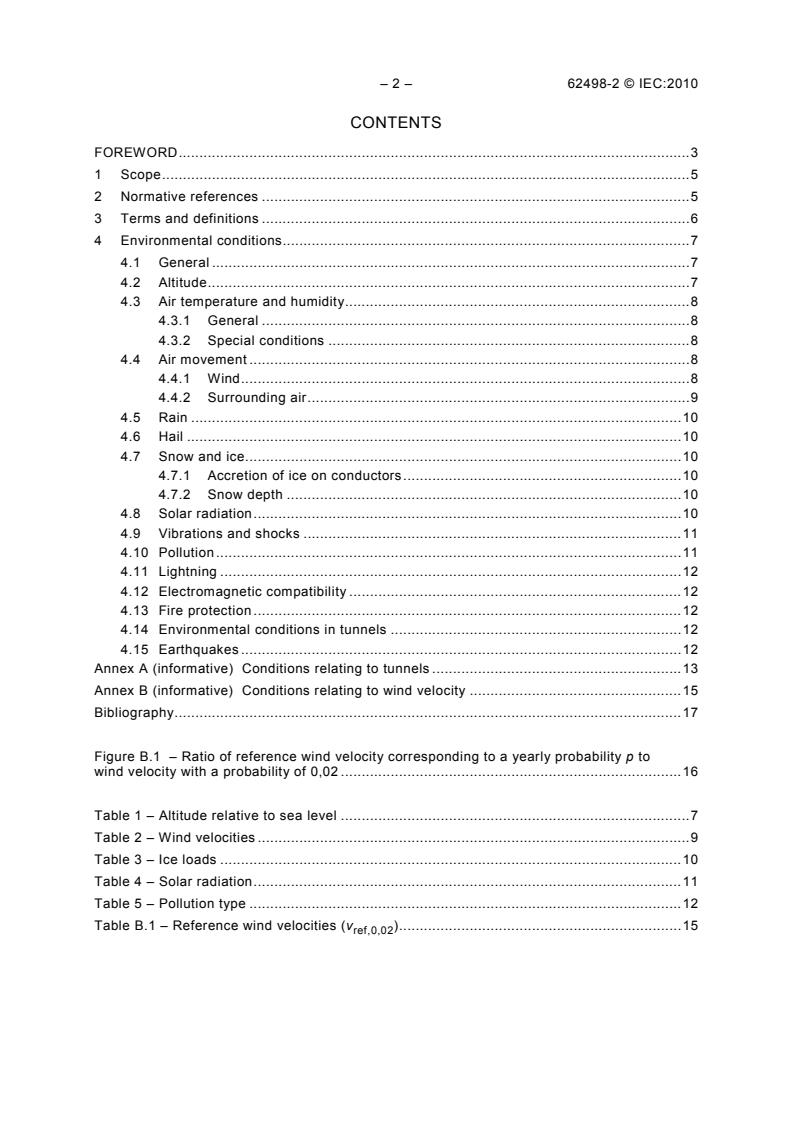
CONTENTS
FOREWORD.3
1 Scope.5
2 Normative references .5
3 Terms and definitions .6
4 Environmental conditions.7
4.1 General .7
4.2 Altitude.7
4.3 Air temperature and humidity.8
4.3.1 General .8
4.3.2 Special conditions .8
4.4 Air movement .8
4.4.1 Wind.8
4.4.2 Surrounding air.9
4.5 Rain .10
4.6 Hail .10
4.7 Snow and ice.10
4.7.1 Accretion of ice on conductors.10
4.7.2 Snow depth .10
4.8 Solar radiation.10
4.9 Vibrations and shocks .11
4.10 Pollution.11
4.11 Lightning .12
4.12 Electromagnetic compatibility .12
4.13 Fire protection .12
4.14 Environmental conditions in tunnels .12
4.15 Earthquakes .12
Annex A (informative) Conditions relating to tunnels .13
Annex B (informative) Conditions relating to wind velocity .15
Bibliography.17
Figure B.1 – Ratio of reference wind velocity corresponding to a yearly probability p to
wind velocity with a probability of 0,02 .16
Table 1 – Altitude relative to sea level .7
Table 2 – Wind velocities .9
Table 3 – Ice loads .10
Table 4 – Solar radiation.11
Table 5 – Pollution type .12
Table B.1 – Reference wind velocities (v ).15
ref,0,02
62498-2 © IEC:2010 – 3 –
INTERNATIONAL ELECTROTECHNICAL COMMISSION
____________
RAILWAY APPLICATIONS –
ENVIRONMENTAL CONDITIONS FOR EQUIPMENT –
Part 2: Fixed electrical installations
FOREWORD
1) The International Electrotechnical Commission (IEC) is a worldwide organization for standardization comprising
all national electrotechnical committees (IEC National Committees). The object of IEC is to promote
international co-operation on all questions concerning standardization in the electrical and electronic fields. To
this end and in addition to other activities, IEC publishes International Standards, Technical Specifications,
Technical Reports, Publicly Available Specifications (PAS) and Guides (hereafter referred to as “IEC
Publication(s)”). Their preparation is entrusted to technical committees; any IEC National Committee interested
in the subject dealt with may participate in this preparatory work. International, governmental and non-
governmental organizations liaising with the IEC also participate in this preparation. IEC collaborates closely
with the International Organization for Standardization (ISO) in accordance with conditions determined by
agreement between the two organizations.
2) The formal decisions or agreements of IEC on technical matters express, as nearly as possible, an international
consensus of opinion on the relevant subjects since each technical committee has representation from all
interested IEC National Committees.
3) IEC Publications have the form of recommendations for international use and are accepted by IEC National
Committees in that sense. While all reasonable efforts are made to ensure that the technical content of IEC
Publications is accurate, IEC cannot be held responsible for the way in which they are used or for any
misinterpretation by any end user.
4) In order to promote international uniformity, IEC National Committees undertake to apply IEC Publications
transparently to the maximum extent possible in their national and regional publications. Any divergence
between any IEC Publication and the corresponding national or regional publication shall be clearly indicated in
the latter.
5) IEC itself does not provide any attestation of conformity. Independent certification bodies provide conformity
assessment services and, in some areas, access to IEC marks of conformity. IEC is not responsible for any
services carried out by independent certification bodies.
6) All users should ensure that they have the latest edition of this publication.
7) No liability shall attach to IEC or its directors, employees, servants or agents including individual experts and
members of its technical committees and IEC National Committees for any personal injury, property damage or
other damage of any nature whatsoever, whether direct or indirect, or for costs (including legal fees) and
expenses arising out of the publication, use of, or reliance upon, this IEC Publication or any other IEC
Publications.
8) Attention is drawn to the Normative references cited in this publication. Use of the referenced publications is
indispensable for the correct application of this publication.
9) Attention is drawn to the possibility that some of the elements of this IEC Publication may be the subject of
patent rights. IEC shall not be held responsible for identifying any or all such patent rights.
International Standard IEC 62498-2 has been prepared by IEC technical committee 9:
Electrical equipment and systems for railways.
This standard is based on EN 50125-2.
The text of this standard is based on the following documents:
FDIS Report on voting
9/1403/FDIS 9/1452/RVD
Full information on the voting for the approval of this standard can be found in the report on
voting indicated in the above table.
This publication has been drafted in accordance with the ISO/IEC Directives, Part 2.
– 4 – 62498-2 © IEC:2010
A list of all parts of IEC 62498 series, under the general title Railway applications –
Environmental conditions for equipment, can be found on the IEC website.
The committee has decided that the contents of this publication will remain unchanged until
the stability date indicated on the IEC web site under "http://webstore.iec.ch" in the data
related to the specific publication. At this date, the publication will be
• reconfirmed,
• withdrawn,
• replaced by a revised edition, or
• amended.
The contents of the corrigendum of November 2010 have been included in this copy.
62498-2 © IEC:2010 – 5 –
RAILWAY APPLICATIONS –
ENVIRONMENTAL CONDITIONS FOR EQUIPMENT –
Part 2: Fixed electrical installations
1 Scope
This part of IEC 62498 takes into account environmental conditions to be considered in the
railways.
This Standard deals with the environmental influences on fixed electrical installations for
traction power supply and equipment essential to operate a railway
– in open air;
– in covered areas;
– in tunnels;
– within enclosures placed in the above-mentioned areas.
Escalators, lifts, fire protection, lighting in tunnels and on platforms, ticket machines,
ventilation systems and non-essential functions are not included.
Such influences include altitude, temperature and humidity, air movement, rain, snow, hail,
ice, sand, solar radiation, lightning, pollution, vibration, shocks, EMC and earthquakes.
This standard does not specify the test requirements for equipment.
In case of environmental conditions not covered by the standard, the data to be adopted for a
specific project should be clearly stipulated when preparing a specification.
This standard is not intended to apply to cranes, installations in underground mines,
suspended cable cars and funicular railways.
Nuclear radiation is excluded.
Signalling and telecommunications systems are not considered in this standard.
2 Normative references
The following referenced documents are indispensable for the application of this document.
For dated references, only the edition cited applies. For undated references, the latest edition
of the referenced document (including any amendments) applies.
IEC 60529, Degrees of protection provided by enclosures (IP code)
IEC 60721-2-1:1982, Classification of environmental conditions – Part 2-1 : Environmental
conditions appearing in nature – Temperature and humidity
IEC 60721-2-2, Classification of environmental conditions – Part 2-2: Environmental
conditions appearing in nature – Precipitation and wind
– 6 – 62498-2 © IEC:2010
IEC 60721-2-3, Classification of environmental conditions – Part 2-3: Environmental
conditions appearing in nature – Air pressure
IEC 60721-3-3, Classification of environmental conditions – Part 3-3: Classification of groups
of environmental parameters and their severities – Stationary use at weatherprotected
locations
IEC 60721-3-4, Classification of environmental conditions – Part 3: Classification of groups of
environmental parameters and their severities – Section 4: Stationary use at non-
weatherprotected locations
IEC 62236-5, Railway applications – Electromagnetic compatibility – Part 5: Emission and
immunity of fixed power supply installations and apparatus
IEC 62497-1, Railway applications – Insulation coordination – Part 1: Basic requirements –
Clearances and creepage distances for all electrical and electronic equipment
IEC 62497-2, Railway applications – Insulation coordination – Part 2: Overvoltages and
related protection
IEC 62498-3:2010, Railway applications – Environmental conditions for equipment – Part 3:
Equipment for signalling and telecommunications
3 Terms and definitions
For the purposes of this document, the following terms and definitions apply.
3.1
covered area
protected from precipitation, but open to the effects of humidity and wind
NOTE 1 Some constructions may be affected by solar radiation.
NOTE 2 Tunnels are excluded from this definition.
3.2
cubicle
closed space where the direct open air influences are excluded
3.3
environment
the surrounding objects, region or circumstances which may influence the behaviour of the
system and/or may be influenced by the system
3.4
environmental conditions
conditions which are brought about because of the environment
3.5
environmental protection
provisions to avoid the interaction of the system with the environment
3.6
open air
not protected from direct environmental influences
62498-2 © IEC:2010 – 7 –
3.7
tunnel
artificial underground passage through a hill or below the normal ground level or under sea
level
4 Environmental conditions
4.1 General
The purchaser shall specify clearly in his specification the class to consider. Otherwise the
class mentioned in the product standard shall apply where available. Where no other
specifications are specified, the normal requirements in this standard shall be used.
Installations shall function, or be capable of functioning, under all specified conditions.
The environmental conditions are considered for normal operation. More severe conditions
may be specified for the equipment to withstand, when not operating, without suffering
damage. An example of such a condition is wind velocity high enough to cause dewirements
but not tearing down the overhead contact line.
Microclimates surrounding components may need special requirements which are covered by
product standards.
Special conditions are classified with a suffix X.
The severities specified are those which have a low probability of being exceeded. All
specified values are either maximum or minimum limits. These values can be reached, but do
not occur permanently. Depending on the situation there are different frequencies of
occurrence related to a certain period of time. Such frequencies of occurrence have not been
included in this standard, but should be considered for any environmental parameter, if
relevant. In this case they shall be specified by the infrastructure manager.
NOTE Some environmental conditions vary in relation to each other, so combined conditions should be taken into
account. As an example, combined condition of temperature, wind, snow and ice is possible.
4.2 Altitude
Altitude related to sea level is relevant for air pressure. Air pressure shall be considered in
accordance with IEC 60721-2-3.
The different classes of altitude above sea level in open air at which the equipment shall
perform as specified are given in Table 1.
Table 1 – Altitude relative to sea level
Altitude range relative to
sea level
Classes
m
A1 up to 1 400
A2 up to 1 000
A3 up to 1 200
AX more than 1 400
NOTE In class A2, installations under sea level are included.
Using A X class, the maximum altitude shall be specified by the purchaser.
– 8 – 62498-2 © IEC:2010
4.3 Air temperature and humidity
4.3.1 General
For air temperature and humidity in open air, values are to be agreed between purchaser and
supplier, as appropriate to the local conditions based on past data records. Unless otherwise
specified, the climates according to Table 2 of IEC 60721-2-1 shall be used, excluding the
first and the last two climates.
These values are illustrated in Figure 2 to Figure 7 of IEC 60721-2-1.
For weather-protected areas, information is given in IEC 60721-3-3.
In principle, air temperatures are measured in the shade.
The values of humidity can be 100 %.
4.3.2 Special conditions
When considering the temperature of an object, the effects of thermal radiation from the
ground, or due to the proximity of other large objects, has to be taken into account.
In open air
The temperatures in railway surroundings, e.g. during summer on large expanses of ballast
such as are to be found in large stations, can be higher than outside the area itself.
In covered areas
Maximum temperatures in covered areas should be not less than those specified for open air.
Special attention should be given to installations under transparent roofs which are subject to
solar radiation. Conditions depend on the cover material.
In cubicles
Depending on the cubicle, the maximum ambient temperature should be specified up to 30 K
higher than those specified in open air .
Temperatures inside a cubicle shall be measured in free space away from the vicinity of the
heat emitting elements. Cubicles in covered areas or with other screening above should have
modified values. Temperature and humidity in cubicles are a function of the design of the
enclosure and will depend on the ventilation arrangements.
If the equipment is to be installed in a controlled climatic environment and is required to
operate only under these conditions, the temperature range shall be agreed between
purchaser and supplier.
The effect of condensation and also temperature changes and extremes of temperature shall
not lead to any malfunction or failure.
4.4 Air movement
4.4.1 Wind
Wind velocity should be agreed between infrastructure manager and operator on a regional
basis regarding
62498-2 © IEC:2010 – 9 –
– the maximum velocity to be considered when assessing facility strength;
– velocity to be considered when assessing operational aspects.
Wind velocity should be referred either
– to a height of 10 m above ground, or
– to a height of 500 m above ground (gradient velocity).
The averaging period is 10 min and the reference values have a yearly probability of
occurrence of 0,02 (equivalent to a return period of 50 years).
NOTE For other probabilities the corresponding wind velocities can be taken from Figure B.1 of EN 1991-1-4, in
Annex B.
Wind action on structures is greatly influenced by details of the local landscape, tall buildings
and height above the ground. The greater the roughness of the ground surface, the more the
wind action close to this surface is reduced; thus there may be considerable differences
between wind near the ground surface and that at greater heights above the ground surface.
Wind action depending on the surface is classified into four categories. Relatively open terrain
with trees and other obstacles is most frequently experienced in Central Europe and is
recommended as the basis for reference wind velocities.
Variation of the 10 min mean values with height h can be calculated by
α
⎛ h ⎞
v = v (1)
⎜ ⎟
h 10
⎝ ⎠
where
ν is the wind velocity at 10 m height in m/s,
ν is the wind velocity at height h in m/s at m,
h
α is the roughness parameter depending on the terrain category which is in the range of
α = 0,10 to 0,50.
Reference information on setting wind velocities is given in Annex B.
4.4.2 Surrounding air
The relative movement of surrounding air shall be defined where necessary, e. g. for
calculating the current capacity of an overhead contact line or cooling devices within cubicles.
For calculating the current capacity of an overhead contact line, three classes of wind velocity
in Table 2 should be adopted.
Table 2 – Wind velocities
Class Wind velocity
m/s
SW 1 0,6
SW 2 1,0
SW 3 2,0
SW X lower than 0,6
Using SW X class, the minimum wind velocity shall be specified by the purchaser.
– 10 – 62498-2 © IEC:2010
Pressure pulses (e. g. due to passing trains) should be taken into account, where applicable.
4.5 Rain
The normal rain rate to be taken into account shall be 6 mm/min.
If necessary other values can be selected from IEC 60721-2-2.
The effect of rain shall be considered depending on the equipment installation together with
wind and other air movements and, if applicable, with negative temperatures of the surface hit
by the rain (forming of ice shells).
4.6 Hail
Where applicable consideration shall be given to the effect of hail. The maximum diameter of
the hail stones to be considered should be specified either by agreement between the
infrastructure manager and the operator on a regional basis, or according to IEC 60721-2-2.
NOTE In Europe the maximum diameter of the hail stones is taken as 15 mm.
4.7 Snow and ice
4.7.1 Accretion of ice on conductors
Equipment required to be operated mechanically with exposed moving parts under iced up
conditions shall have the capability to operate properly under the conditions specified by the
infrastructure manager.
The values of ice accretion on conductors and its gravity should be specified by the
infrastructure manager to consider the wind pressure, vertical load and sag with the loads on.
NOTE As a reference, an example of specifying ice loads on conductors is given in Table 3.
Table 3 – Ice loads
Class Ice load
N/m
I 0 (no ice) 0
I 1 (low) 3,5
I 2 (medium) 7
I 3 (heavy) 15
These values are used for conductors in the usual diameters between 10 mm and 20 mm.
4.7.2 Snow depth
Snow loads should be considered depending on the snow fall severity. Snow depth shall be
considered for the access to cubicle doors and the height of live parts above ground.
Equipment required to be operated mechanically with exposed moving parts under iced up
conditions shall have the capability to operate properly under the conditions specified by the
infrastructure manager.
4.8 Solar radiation
The value for the thermal effect is valid for radiation perpendicular to the surface.
62498-2 © IEC:2010 – 11 –
Equipment exposed to solar radiation shall remain unaffected.
Depending on the latitude and according to class 4K 3 of IEC 60721-3-4, the thermal effect of
solar radiation shall be taken as given in Table 4.
Table 4 – Solar radiation
Class Solar radiation
W/m²
R 1 (low) 700
R 2 (high) 1 120
R X
Using R X class, the applied solar radiation shall be specified by the purchaser.
In open air the effect of UV-radiation shall be considered, this applies especially for synthetic
materials.
The maximum duration shall be taken as 10 h per day, unless otherwise stated.
4.9 Vibrations and shocks
Vibrations and shocks have to be considered only when the equipment is situated so close to
the track that it can be influenced by passing vehicles. Specification of vibrations and shocks
should be agreed according to IEC 60721-3-3 and IEC 60721-3-4 between purchaser and
supplier.
If necessary, compare with 4.13 of IEC 62498-3.
4.10 Pollution
The effects of pollution shall be considered in the design of equipment including the selection
of materials under the following aspects:
– decrease of the withstand voltage on the insulation. IEC 62497-1 defines requirements on
the effect of pollution on the insulation;
– corrosive effects of polluted air and rain;
– for the design of ventilation provisions.
The effects of the following kinds of pollution shall be considered:
– chemical active substances;
– biological active substances;
– mechanical active substances.
NOTE Stones coming from the ballast belong to mechanical substances. Salt, sand and other contamination can
occur due to adjacent roads. Salt applied to city streets for ice problems may affect the track of inner city metros.
Salt problems at or close to level crossings and salt contamination of insulators in coastal
areas shall be considered.
Table 5 gives the level of pollution for outdoor areas.
– 12 – 62498-2 © IEC:2010
Table 5 – Pollution type
Pollution levels Chemical active Biological active Mechanical active
substances substances substances
Low 4C1 4B1 4S1
Medium 4C2 4B1 4S2
High 4C3 4B1 4S3
Definitions of classes for chemical, biological and mechanical active substances are given in
IEC 60721-3-4.
4.11 Lightning
Consideration shall be given to the effects of lightning. See IEC 62497-1 and IEC 62497-2.
4.12 Electromagnetic compatibility
The electromagnetic conditions encountered by apparatus are complex and many are of a
transient nature. It is not possible therefore to define a comprehensive set of EMC-parameters.
For further information see IEC 62236-5.
4.13 Fire protection
Two classes of fire protection are defined as follows:
– F 0 for non safety related equipment (not installed in tunnels, passenger stations, etc.)
not capable of developing toxic gases;
– F 1 for fire restricted areas that have requirements of non-toxicity and limited opacity of
smoke, self-extinguishing equipment, and poor energy contribution to external fires.
4.14 Environmental conditions in tunnels
Environmental conditions relating to tunnels are dealt with in Annex A.
4.15 Earthquakes
If it is necessary to consider the effect of earthquakes, the infrastructure manager should
specify the values in consideration of facility characteristics.
62498-2 © IEC:2010 – 13 –
Annex A
(informative)
Conditions relating to tunnels
A.1 General
Environmental conditions in tunnels regarding temperature, humidity, dynamic air movements
and pollution are different for each location depending on various parameters such as the
number of tracks, tunnel design, gradient, train frequency, etc. Therefore, it is necessary to
define the conditions for each tunnel.
The various aspects discussed in Clauses A.2 to A.8 should be considered. Tunnels that are
not close to the surface of the ground are generally designed to be a close fit to the
dimensions of the swept gauge of the rolling stock. When the track is nearer to the surface it
is often found to be more appropriate to use a cut and cover technique of construction that
results in a rectangular section of tunnel. In such cases there is often more than one track per
tunnel. Examples are urban mass transit systems with tunnels below streets and buildings,
and main line services that also run below the street level in urban areas as well as through
tunnels in high ground.
A.2 Temperature
Temperature is influenced by air movement due to the piston effect of the train and by forced
ventilation, where it is necessary. The tunnel walls are likely to maintain a fairly constant
temperature in the mid-range of average ambient conditions for the region. The resulting
temperatures in the tunnel are principally due to the frequency of trains, the number of
passengers, as well as the forced ventilation system.
Cut and cover tunnels tend towards the range of ambient temperatures in the open air
surrounding the tunnel, especially at the end of a tunnel. The effect of trains passing in
opposite directions will cause a degree of turbulence and buffeting. Humidity also may be
greater.
Temperatures in the first and the last 2 000 m sections of long tunnel are more or less
affected by the temperature in open air.
Temperature conditions are to be agreed between the infrastructure manager and supplier .
Typical values are given in notes.
NOTE 1 (in Europe)
For tunnels less than 2 000 m long, as well as in the first and last 1 000 m sections of longer tunnels, the same
assumptions should be made as in open air.
Within the middle section of long tunnels the minimum temperatures may be assumed to be 20 K higher than those
in open air and the maximum temperature may be reduced by 5 K as well.
NOTE 2 (In Japan)
For tunnels less than 200 m long, as well as in the first and last 100 m sections of longer tunnels, the same
assumptions should be made as in open air. Within the middle section of long tunnels the minimum temperatures
may be assumed to be 15 K to 45 K higher than those in open air and the maximum temperature may be reduced
by 15 K as well.
– 14 – 62498-2 © IEC:2010
A.3 Humidity
Humidity will tend to be low unless the tunnel walls allow a significant amount of moisture to
ingress. Nevertheless, it is often impossible to maintain dry conditions and in some cases a
degree of flooding can be expected. Cable ducts alongside and below tracks are especially
vulnerable to flooding.
A.4 Dynamic air movements
Special conditions for local air pressure, vibrations and shocks may exist due to the effect of
wind, vehicle movement, fans, etc. In this case, the relevant data shall be exchanged between
the appropriate interested parties engaged with the project.
A.5 Dust
Another important factor is dust that comes from various sources:
– dust containing metal particles and iron oxide is created by the effect of brake shoes on
the surface of wheels and also by the wear of metal wheels on the rail. This type of dust
can lead to an explosive mixture which could be a problem in the presence of arcing.
Other forms of braking and careful driving, particularly by the use of automatic systems,
can lead to a reduction of brake dust. Carbon and copper particles appear from the use of
pantographs;
– dust will also arrive from the presence of small flakes sloughed off the surface of human
skin;
– some freight systems use closed containers, but there are also open containers, or
wagons, which may be a cause of dust;
– dust from construction sites provide a concrete dust which may influence electrical
equipment in fixed installations;
– diesel traffic fumes can contaminate the surface of electrical insulation thereby enhancing
the retention of dust.
A.6 Direct discharge toilets
Debris from direct discharge toilets can lead to contamination of insulation at track level.
A.7 Vermin
Debris such as particles of consumable can encourage the presence of vermin. This can lead
to damage from building of nests and destruction of insulation materials.
A.8 Environmental protection
Taken together the factors in this annex may lead to significant IP ratings (refer to IEC 60529)
for the enclosures of equipment located in running tunnels or immediately adjacent.
62498-2 © IEC:2010 – 15 –
Annex B
(informative)
Conditions relating to wind velocity
B.1 Central Europe
For the variation of wind velocity with a height above ground, wind action depending on the
surface is classified into four categories. Relatively open terrain with trees and other
obstacles is most frequently experienced in Central Europe and is recommended as the basis
for reference wind velocities.
Variation of the 10 min mean values with height h can be calculated by
α
⎛ h ⎞
v = v ⎜ ⎟ (1)
h 10
⎝ ⎠
where
ν is the wind velocity at 10 m height in m/s,
ν is the wind velocity at height h in m/s at m,
h
α is the roughness parameter depending on the terrain category which is
α = 0,28 for town centres,
α = 0,20 for suburban districts and forest areas,
α = 0,16 for open terrain with obstacles,
α = 0,12 for flat land and coast.
The wind velocities which shall be taken into account when assessing operational aspects are
listed in Table B.1 . The Class has to be selected according to the local conditions. The data
apply to ”open terrain with obstacles” 10 m above ground.
Table B.1 – Reference wind velocities (v )
ref,0,02
Class Wind velocity
m/s
W 1 (low) 24,0
W 2 (normal) 27,5
W 3 (heavy) 32,0
W 4 (special) 36,0
W 4 class: the maximum wind velocity shall be specified by the purchaser.
Values for wind velocities for all countries in Europe are given in EN 1991-1-4.
Different values are possible and are to be agreed between purchaser and supplier.
As far as calculation of wind actions based on specified wind velocities is concerned,
reference should be made to relevant design standards.
– 16 – 62498-2 © IEC:2010
Data in Table B.1 refer to a return period of 50 years corresponding to a yearly probability of
0,02.
The wind velocities for differing probabilities can be obtained by multiplying the data in Table
B.1 by the ratio v /v taken from Figure B.1.
ref,p ref,0,02
0,005
0,01
0,02
p
0,05
0,1
0,2
0,5
0,6 0,7 0,8 0,9 1,0 1,1
v v
ref, p/ ref, 0,02
IEC 1860/10
Figure B.1 – Ratio of reference wind velocity corresponding to a yearly probability p to
wind velocity with a probability of 0,02
NOTE 1 The wind velocity value for construction purposes is usually higher than the value for operation of the
railway system.
NOTE 2 At wind velocity W 4 the equipment may be out of service but without suffering permanent damage.
B.2 Japan
In Japan, the roughness parameter α in the formula (1) is given as follows:
α = 0,25 – 0,50 for town centres,
α = 0,17 – 0,25 for suburban districts,
α = 0,10 – 0,14 for flat land and coast.
B.3 China
In China, the roughness parameter α in the formula (1) is listed as below:
α = 0,30 for town centers with dense and high building groups,
α = 0,22 for town centers with dense building groups,
α = 0,16 for suburban districts and forests,
α = 0,12 for offings, islands, lakeshores, coasts, deserts.
62498-2 © IEC:2010 – 17 –
Bibliography
IEC 60721-3-2, Classification of environmental conditions – Part 3: Classification of groups of
environmental parameters and their severities – Section 2: Transportation
IEC 60913, Electric traction overhead lines
IEC 61992-1, Railway applications – Fixed installations – DC switchgear – Part 1: General
IEC 61992-4, Railway applications – Fixed installations – DC switchgear – Part 4: Outdoor d.c.
disconnectors, switch-disconnectors and earthing switches
IEC 62498-1, Railway applications – Environmental conditions for equipment – Part 1:
Equipment on board rolling stock
ISO 4354, Wind actions on structures
EN 1991-1-4:2005 Eurocode 1: Actions on structures – Part 1-4: General actions – Wind
actions
SHOREI, Ordinance Stipulating Technical Standards On Railways – The Ministry of Land,
Infrastructure, Transport and Tourism Ordinance No. 151 : 2001 (Japan)
KAISHAKU KIJUN, Circular Notice For Stipulating Technical Standards On Railways – Director of the
Railway Bureau, Ministry of Land, Infrastructure, Transport and Tourism Notice No. 157 : 2001
(Japan)
SHOREI, Ordinance Stipulating Technical Standards On Electrical Equipments – The Ministry
of Economy, Trade and Industry Ordinance No. 52 : 1997, and No. 189 : 2000 (Japan)
Specification for design and construction of contact line in Shinkansen:2005, Railway
Electrical Engineering Association of Japan
Specification for design and construction of contact line (in conventional line):2005, Railway
Electrical Engineering Association of Japan
Specification for design and construction of railway substation:2002, Railway Electrical
Engineering Association of Japan
Guidebook for wind power supply:2005, The New Energy and Industrial Technology
Development Organization (JAPAN)
____________
– 18 – 62498-2 © CEI:2010
SOMMAIRE
AVANT-PROPOS.19
1 Domaine d’application .21
2 Références normatives.21
3 Termes et définitions .22
4 Conditions d'environnement .23
4.1 Généralités.23
4.2 Altitude.23
4.3 Température de l'air et humidité .24
4.3.1 Généralités.24
4.3.2 Conditions particulières .24
4.4 Mouvement d'air.25
4.4.1 Vent .25
4.4.2 Air environnant .26
4.5 Pluie.26
4.6 Grêle.26
4.7 Neige et glace .26
4.7.1 Accrétion de glace sur les conducteurs.26
4.7.2 Epaisseur de neige.27
4.8 Rayonnement solaire.27
4.9 Vibrations et chocs.28
4.10 Pollution.28
4.11 Foudre .28
4.12 Compatibilité électromagnétique.28
4.13 Protection contre le feu .28
4.14 Conditions d'environnement dans les tunnels .29
4.15 Tremblements de terre .29
Annexe A (informative) Conditions relatives aux tunnels .30
Annexe B (informative) Conditions relatives à la vitesse du vent.32
Bibliographie.
...