

IEC 60512-1:2018
(Main)Connectors for electrical and electronic equipment - Tests and measurements - Part 1: Generic specification
- Abstract
IEC 60512-1:2018 is intended to be used as a basis for tests and measurements specifications for electrical connectors. It provides guidance and reference for tests and measurements within the IEC 60512 series. It includes the description and the practice of the various phases of tests and measurements (preparation, tests and measurements, requirements, documentation), in addition to basic terms and definitions applicable to any part of the IEC 60512 series. This standard shall be used in conjunction with IEC 60512-1-101 and relevant part(s) of series IEC 60512. Part 60512-1-100 provides the list of the existing test and measuring methods published within series IEC 60512. Detail tests and measurements specifications are applicable to electrical connectors and their components (e.g. connector inserts, connector housings, locking mechanisms, contacts and terminations) within the scope of technical committee 48. They may also be used for similar devices when specified in a detail product specification. Detail tests and measurements specifications are used in conjunction with detail product specifications which prescribe the tests to be used, the required degree of severity for each of them and the permissible performance limits. The detail product specification also specifies the deviations in procedures, which may be required when applying a test to the type of connector or its component under consideration, and it further specifies any special procedures which may be required. This fifth edition cancels and replaces the fourth edition, published in 2001. It constitutes a technical revision. This edition includes the following main technical changes with respect to the previous edition:
– in Clause 3, only terms relating to the testing are defined, and IEC 61076-1 is referred to for terms of connectors.
– Clause 4 (Numbering of tests and measurement specification) is added.
– Subclause 5.1.2 (Calibration) is added.
– in Clause 6 (Test), test procedure follows IEC 60068-1.
Key words: Connectors, Test Specification
- Status
- Published
- Publication Date
- 21-Oct-2018
- Technical Committee
- SC 48B - Electrical connectors
- Drafting Committee
- WG 5 - Test methods
- Current Stage
- PPUB - Publication issued - 60 Publication
- Start Date
- 22-Oct-2018
- Due Date
- 28-Sep-2018
- Completion Date
- 28-Sep-2018
Buy Documents
IEC 60512-1:2018 RLV - Connectors for electrical and electronic equipment - Tests and measurements - Part 1: Generic specification Released:10/22/2018
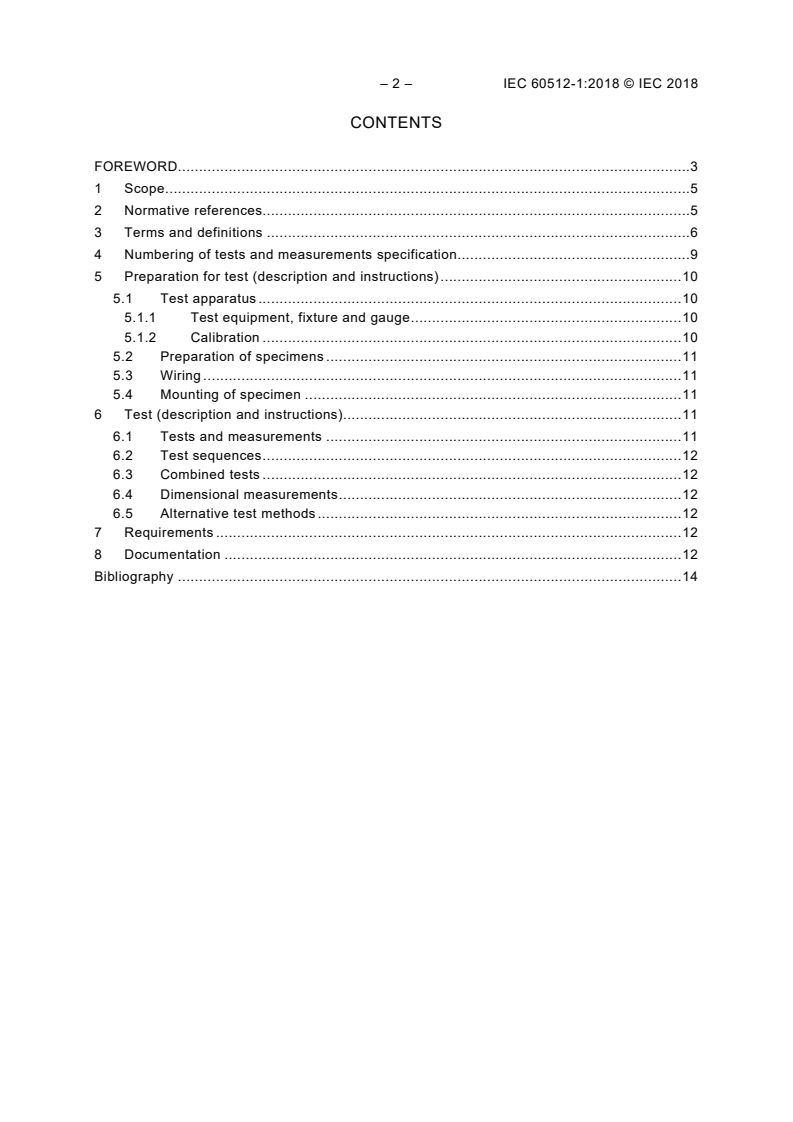
IEC 60512-1:2018 - Connectors for electrical and electronic equipment - Tests and measurements - Part 1: Generic specification Released:10/22/2018
Overview
IEC 60512-1:2018 - Connectors for electrical and electronic equipment - Tests and measurements - Part 1: Generic specification - is the fifth-edition, generic test-specification that establishes the foundation for testing electrical connectors. It provides guidance and a common framework for preparing, performing and documenting tests and measurements across the IEC 60512 series. The standard is intended to be used with IEC 60512-1-100 (list of methods) and IEC 60512-1-101 (blank detail specification) and applies to connector components within the scope of IEC TC 48 (e.g., connector inserts, housings, locking mechanisms, contacts and terminations).
Key topics and technical requirements
The standard defines the structure and practice of connector testing without prescribing specific severity levels (those are set in detail product specifications). Important technical topics covered include:
- Test phases and documentation: preparation, tests and measurements, pass/fail requirements, and required documentation.
- Terms and definitions: basic testing-related terms; connector-specific terms are referenced to IEC 61076-1.
- Numbering of tests: standardised scheme for test and measurement identification (Clause 4).
- Test apparatus and calibration: requirements for test equipment, fixtures, gauges and calibration routines (Subclause 5.1.2).
- Specimen preparation: wiring, mounting and conditioning of specimens before testing.
- Standard test procedures: test sequences, combined tests, repetition of dimensional measurements and alternative methods (Clause 6 aligns test procedures with IEC 60068-1).
- Non-conformance classification: classification criteria for major and minor non-conforming components.
- Integration with detail product specifications: how to select tests, set degrees of severity and permissible performance limits; specify procedure deviations or special procedures when needed.
Practical applications
IEC 60512-1:2018 is a foundation document that enables consistent, repeatable connector testing across industries. Typical practical applications include:
- Creating or updating connector test specifications in product standards, datasheets and procurement documents.
- Defining test programs for connector qualification, production verification and engineering validation.
- Guiding laboratory setup, equipment calibration and test documentation for compliance testing.
- Supporting interoperability and quality assurance for components such as housings, contacts, terminations and locking mechanisms.
Who should use this standard
- Connector designers and manufacturers
- Test engineers and qualification laboratories
- Product specification authors and quality managers
- Procurement and compliance teams specifying connector performance and acceptance criteria
Related standards
- IEC 60512-1-100 - List of available test and measuring methods (series index)
- IEC 60512-1-101 - Blank detail specification (template for detail tests)
- IEC 60068-1 - Environmental testing general guidance (test procedure alignment)
- IEC 61076-1 - Connector product terminology and generic product requirements
Keywords: IEC 60512-1:2018, Connectors, Test Specification, tests and measurements, connector testing, calibration, IEC 60068-1, IEC 61076-1.
Relations
- Revises
IEC 60512-1:2001 - Connectors for electronic equipment - Tests and measurements - Part 1: General - Effective Date
- 05-Sep-2023
Buy Documents
IEC 60512-1:2018 RLV - Connectors for electrical and electronic equipment - Tests and measurements - Part 1: Generic specification Released:10/22/2018
IEC 60512-1:2018 - Connectors for electrical and electronic equipment - Tests and measurements - Part 1: Generic specification Released:10/22/2018
Frequently Asked Questions
IEC 60512-1:2018 is a standard published by the International Electrotechnical Commission (IEC). Its full title is "Connectors for electrical and electronic equipment - Tests and measurements - Part 1: Generic specification". This standard covers: IEC 60512-1:2018 is intended to be used as a basis for tests and measurements specifications for electrical connectors. It provides guidance and reference for tests and measurements within the IEC 60512 series. It includes the description and the practice of the various phases of tests and measurements (preparation, tests and measurements, requirements, documentation), in addition to basic terms and definitions applicable to any part of the IEC 60512 series. This standard shall be used in conjunction with IEC 60512-1-101 and relevant part(s) of series IEC 60512. Part 60512-1-100 provides the list of the existing test and measuring methods published within series IEC 60512. Detail tests and measurements specifications are applicable to electrical connectors and their components (e.g. connector inserts, connector housings, locking mechanisms, contacts and terminations) within the scope of technical committee 48. They may also be used for similar devices when specified in a detail product specification. Detail tests and measurements specifications are used in conjunction with detail product specifications which prescribe the tests to be used, the required degree of severity for each of them and the permissible performance limits. The detail product specification also specifies the deviations in procedures, which may be required when applying a test to the type of connector or its component under consideration, and it further specifies any special procedures which may be required. This fifth edition cancels and replaces the fourth edition, published in 2001. It constitutes a technical revision. This edition includes the following main technical changes with respect to the previous edition: – in Clause 3, only terms relating to the testing are defined, and IEC 61076-1 is referred to for terms of connectors. – Clause 4 (Numbering of tests and measurement specification) is added. – Subclause 5.1.2 (Calibration) is added. – in Clause 6 (Test), test procedure follows IEC 60068-1. Key words: Connectors, Test Specification
IEC 60512-1:2018 is intended to be used as a basis for tests and measurements specifications for electrical connectors. It provides guidance and reference for tests and measurements within the IEC 60512 series. It includes the description and the practice of the various phases of tests and measurements (preparation, tests and measurements, requirements, documentation), in addition to basic terms and definitions applicable to any part of the IEC 60512 series. This standard shall be used in conjunction with IEC 60512-1-101 and relevant part(s) of series IEC 60512. Part 60512-1-100 provides the list of the existing test and measuring methods published within series IEC 60512. Detail tests and measurements specifications are applicable to electrical connectors and their components (e.g. connector inserts, connector housings, locking mechanisms, contacts and terminations) within the scope of technical committee 48. They may also be used for similar devices when specified in a detail product specification. Detail tests and measurements specifications are used in conjunction with detail product specifications which prescribe the tests to be used, the required degree of severity for each of them and the permissible performance limits. The detail product specification also specifies the deviations in procedures, which may be required when applying a test to the type of connector or its component under consideration, and it further specifies any special procedures which may be required. This fifth edition cancels and replaces the fourth edition, published in 2001. It constitutes a technical revision. This edition includes the following main technical changes with respect to the previous edition: – in Clause 3, only terms relating to the testing are defined, and IEC 61076-1 is referred to for terms of connectors. – Clause 4 (Numbering of tests and measurement specification) is added. – Subclause 5.1.2 (Calibration) is added. – in Clause 6 (Test), test procedure follows IEC 60068-1. Key words: Connectors, Test Specification
IEC 60512-1:2018 is classified under the following ICS (International Classification for Standards) categories: 31.220.10 - Plug-and-socket devices. Connectors. The ICS classification helps identify the subject area and facilitates finding related standards.
IEC 60512-1:2018 has the following relationships with other standards: It is inter standard links to IEC 60512-1:2001. Understanding these relationships helps ensure you are using the most current and applicable version of the standard.
IEC 60512-1:2018 is available in PDF format for immediate download after purchase. The document can be added to your cart and obtained through the secure checkout process. Digital delivery ensures instant access to the complete standard document.
Standards Content (Sample)
IEC 60512-1 ®
Edition 5.0 2018-10
REDLINE VERSION
INTERNATIONAL
STANDARD
colour
inside
Connectors for electrical and electronic equipment – Tests and measurements –
Part 1: General Generic specification
All rights reserved. Unless otherwise specified, no part of this publication may be reproduced or utilized in any form
or by any means, electronic or mechanical, including photocopying and microfilm, without permission in writing from
either IEC or IEC's member National Committee in the country of the requester. If you have any questions about IEC
copyright or have an enquiry about obtaining additional rights to this publication, please contact the address below or
your local IEC member National Committee for further information.
IEC Central Office Tel.: +41 22 919 02 11
3, rue de Varembé info@iec.ch
CH-1211 Geneva 20 www.iec.ch
Switzerland
About the IEC
The International Electrotechnical Commission (IEC) is the leading global organization that prepares and publishes
International Standards for all electrical, electronic and related technologies.
About IEC publications
The technical content of IEC publications is kept under constant review by the IEC. Please make sure that you have the
latest edition, a corrigenda or an amendment might have been published.
IEC Catalogue - webstore.iec.ch/catalogue Electropedia - www.electropedia.org
The stand-alone application for consulting the entire The world's leading online dictionary of electronic and
bibliographical information on IEC International Standards, electrical terms containing 21 000 terms and definitions in
Technical Specifications, Technical Reports and other English and French, with equivalent terms in 16 additional
documents. Available for PC, Mac OS, Android Tablets and languages. Also known as the International Electrotechnical
iPad. Vocabulary (IEV) online.
IEC publications search - webstore.iec.ch/advsearchform IEC Glossary - std.iec.ch/glossary
The advanced search enables to find IEC publications by a 67 000 electrotechnical terminology entries in English and
variety of criteria (reference number, text, technical French extracted from the Terms and Definitions clause of
committee,…). It also gives information on projects, replaced IEC publications issued since 2002. Some entries have been
and withdrawn publications. collected from earlier publications of IEC TC 37, 77, 86 and
CISPR.
IEC Just Published - webstore.iec.ch/justpublished
Stay up to date on all new IEC publications. Just Published IEC Customer Service Centre - webstore.iec.ch/csc
details all new publications released. Available online and If you wish to give us your feedback on this publication or
also once a month by email. need further assistance, please contact the Customer Service
Centre: sales@iec.ch.
IEC 60512-1 ®
Edition 5.0 2018-10
REDLINE VERSION
INTERNATIONAL
STANDARD
colour
inside
Connectors for electrical and electronic equipment – Tests and measurements –
Part 1: General Generic specification
INTERNATIONAL
ELECTROTECHNICAL
COMMISSION
ICS 31.220.10 ISBN 978-2-8322-6157-6
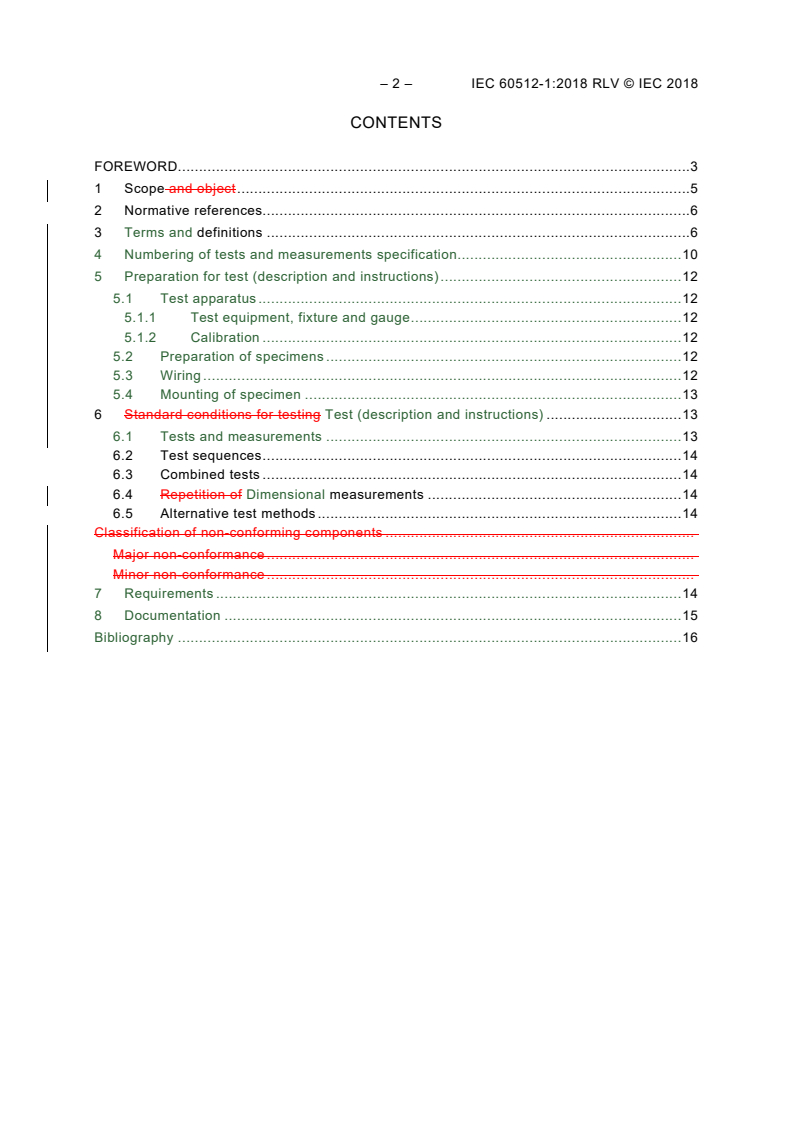
– 2 – IEC 60512-1:2018 RLV © IEC 2018
CONTENTS
FOREWORD . 3
1 Scope and object . 5
2 Normative references. 6
3 Terms and definitions . 6
4 Numbering of tests and measurements specification . 10
5 Preparation for test (description and instructions) . 12
5.1 Test apparatus . 12
5.1.1 Test equipment, fixture and gauge . 12
5.1.2 Calibration . 12
5.2 Preparation of specimens . 12
5.3 Wiring . 12
5.4 Mounting of specimen . 13
6 Standard conditions for testing Test (description and instructions) . 13
6.1 Tests and measurements . 13
6.2 Test sequences . 14
6.3 Combined tests . 14
6.4 Repetition of Dimensional measurements . 14
6.5 Alternative test methods . 14
Classification of non-conforming components .
Major non-conformance .
Minor non-conformance .
7 Requirements . 14
8 Documentation . 15
Bibliography . 16
INTERNATIONAL ELECTROTECHNICAL COMMISSION
____________
CONNECTORS FOR ELECTRICAL AND ELECTRONIC EQUIPMENT –
TESTS AND MEASUREMENTS –
Part 1: General Generic specification
FOREWORD
1) The International Electrotechnical Commission (IEC) is a worldwide organization for standardization comprising
all national electrotechnical committees (IEC National Committees). The object of IEC is to promote
international co-operation on all questions concerning standardization in the electrical and electronic fields. To
this end and in addition to other activities, IEC publishes International Standards, Technical Specifications,
Technical Reports, Publicly Available Specifications (PAS) and Guides (hereafter referred to as “IEC
Publication(s)”). Their preparation is entrusted to technical committees; any IEC National Committee interested
in the subject dealt with may participate in this preparatory work. International, governmental and non-
governmental organizations liaising with the IEC also participate in this preparation. IEC collaborates closely
with the International Organization for Standardization (ISO) in accordance with conditions determined by
agreement between the two organizations.
2) The formal decisions or agreements of IEC on technical matters express, as nearly as possible, an international
consensus of opinion on the relevant subjects since each technical committee has representation from all
interested IEC National Committees.
3) IEC Publications have the form of recommendations for international use and are accepted by IEC National
Committees in that sense. While all reasonable efforts are made to ensure that the technical content of IEC
Publications is accurate, IEC cannot be held responsible for the way in which they are used or for any
misinterpretation by any end user.
4) In order to promote international uniformity, IEC National Committees undertake to apply IEC Publications
transparently to the maximum extent possible in their national and regional publications. Any divergence
between any IEC Publication and the corresponding national or regional publication shall be clearly indicated in
the latter.
5) IEC itself does not provide any attestation of conformity. Independent certification bodies provide conformity
assessment services and, in some areas, access to IEC marks of conformity. IEC is not responsible for any
services carried out by independent certification bodies.
6) All users should ensure that they have the latest edition of this publication.
7) No liability shall attach to IEC or its directors, employees, servants or agents including individual experts and
members of its technical committees and IEC National Committees for any personal injury, property damage or
other damage of any nature whatsoever, whether direct or indirect, or for costs (including legal fees) and
expenses arising out of the publication, use of, or reliance upon, this IEC Publication or any other IEC
Publications.
8) Attention is drawn to the Normative references cited in this publication. Use of the referenced publications is
indispensable for the correct application of this publication.
9) Attention is drawn to the possibility that some of the elements of this IEC Publication may be the subject of
patent rights. IEC shall not be held responsible for identifying any or all such patent rights.
This redline version of the official IEC Standard allows the user to identify the changes
made to the previous edition. A vertical bar appears in the margin wherever a change
has been made. Additions are in green text, deletions are in strikethrough red text.
– 4 – IEC 60512-1:2018 RLV © IEC 2018
International Standard IEC 60512-1 has been prepared by subcommittee 48B: Electrical
connectors, of IEC technical committee 48: Electrical connectors and mechanical structures
for electrical and electronic equipment.
This fifth edition cancels and replaces the fourth edition, published in 2001. It constitutes a
technical revision.
This edition includes the following main technical changes with respect to the previous edition:
– in Clause 3, only terms relating to the testing are defined, and IEC 61076-1 is referred to
for terms of connectors.
– Clause 4 (Numbering of tests and measurement specification) is added.
– Subclause 5.1.2 (Calibration) is added.
– in Clause 6 (Test), test procedure follows IEC 60068-1.
This standard shall be used in conjunction with IEC 60512-1-101 and relevant part(s) of series
IEC 60512. Part 60512-1-100 provides the list of the existing test and measuring methods
published within series IEC 60512.
The text of this International Standard is based on the following documents:
FDIS Report on voting
48B/2667/FDIS 48B/2684/RVD
Full information on the voting for the approval of this International Standard can be found in
the report on voting indicated in the above table.
This document has been drafted in accordance with the ISO/IEC Directives, Part 2.
Future standards in this series will carry the new general title as cited above. Titles of existing
standards in this series will be updated at the time of the next edition.
A list of all parts in the IEC 60512 series, published under the general title Connectors for
electrical and electronic equipment – Tests and measurements, can be found on the IEC
website.
The committee has decided that the contents of this document will remain unchanged until the
stability date indicated on the IEC website under "http://webstore.iec.ch" in the data related to
the specific document. At this date, the document will be
• reconfirmed,
• withdrawn,
• replaced by a revised edition, or
• amended.
IMPORTANT – The “colour inside” logo on the cover page of this publication indicates
that it contains colours which are considered to be useful for the correct understanding
of its contents. Users should therefore print this publication using a colour printer.
CONNECTORS FOR ELECTRICAL AND ELECTRONIC EQUIPMENT –
TESTS AND MEASUREMENTS –
Part 1: General Generic specification
1 General
1 Scope and object
This part of IEC 60512 is intended to be used as a basic specification. It contains basic test
methods and procedures which, when required by the detail specification, are used for testing
connectors within the scope of technical committee 48. They may also be used for similar
devices when specified in a detail specification.
The object of this standard is to establish test methods and measurement procedures for use
in specifications for connectors.
This standard is to be used in conjunction with the generic, sectional and detail specification
which will select and prescribe the tests to be used, the required degree of severity for each
of them and the permissible performance limits. The detail specification will also specify the
deviations in procedure, which may be inevitable when applying a test to the type of
component under consideration, and it will further specify any special procedures which may
be required.
In the event of conflict between this basic specification and any individual component
specification, the requirements of the component specification will apply.
NOTE 1 RF connectors will not be dealt with by this technical committee as they will be covered by technical
committee 46, together with r.f. cables.
NOTE 2 Sockets for components such as crystals or electronic tubes will be considered in co-operation with the
relevant technical committee.
NOTE 3 Safety requirements for switches will not be developed by this technical committee as they are covered
by subcommittee 23J.
This part of IEC 60512 is intended to be used as a basis for tests and measurements
specifications for electrical connectors. It provides guidance and reference for tests and
measurements within the IEC 60512 series.
It includes the description and the practice of the various phases of tests and measurements
(preparation, tests and measurements, requirements, documentation), in addition to basic
terms and definitions applicable to any part of the IEC 60512 series.
This document is used in conjunction with IEC 60512-1-101 to establish uniform detail tests
and measurements specifications.
Detail tests and measurements specifications are applicable to electrical connectors and their
components (e.g. connector inserts, connector housings, locking mechanisms, contacts and
terminations) within the scope of technical committee 48. They may also be used for similar
devices when specified in a detail product specification.
Detail tests and measurements specifications are used in conjunction with detail product
specifications which prescribe the tests to be used, the required degree of severity for each of
them and the permissible performance limits. The detail product specification also specifies
– 6 – IEC 60512-1:2018 RLV © IEC 2018
the deviations in procedures, which may be required when applying a test to the type of
connector or its component under consideration, and it further specifies any special
procedures which may be required.
NOTE RF and fibre optical connectors are not dealt with by subcommittee 48B, however, hybrid connectors which
additionally employ RF and/or fibre optic contacts, are handled by SC 48B in cooperation with TC 46 and/or TC 86.
2 Normative references
The following documents are referred to in the text in such a way that some or all of their
content constitutes requirements of this document. For dated references, only the edition
cited applies. For undated references, the latest edition of the referenced document (including
any amendments) applies.
IEC 60068-1:1988 2013, Environmental testing – Part 1: General and guidance
IEC 60352-1:1997, Solderless connections – Part 1: Wrapped connections – General
requirements, test methods and practical guidance
IEC 60352-2:2006, Solderless connections – Part 2: Crimped connections – General
requirements, test methods and practical guidance
IEC 60352-2:2006/AMD1:2013
IEC 60352-3:1993, Solderless connections – Part 3: Solderless accessible insulation
displacement connections – General requirements, test methods and practical guidance
IEC 60352-4:1994, Solderless connections – Part 4: Solderless non-accessible insulation
displacement connections – General requirements, test methods and practical guidance
IEC 60352-4:1994/AMD1:2000
IEC 60352-5:2012, Solderless connections – Part 5: Press-in connections – General
requirements, test methods and practical guidance
IEC 60352-6:1997, Solderless connections – Part 6: Insulation piercing connections – General
requirements, test methods and practical guidance
IEC 60352-7:2002, Solderless connections – Part 7: Spring clamp connections – General
requirements, test methods and practical guidance
IEC 60352-8:2011, Solderless connections – Part 8: Compression mount connections –
General requirements, test methods and practical guidance
IEC 60512-1-100, Connectors for electronic equipment – Tests and measurements –
Part 1-100: General – Applicable publications
IEC 60512-1-101, Connectors for electronic equipment – Tests and measurements –
Part 1-101:Blank detail specification
IEC 61076-1, Connectors for electronic equipment – Product requirements – Part 1:Generic
specification
3 Terms and definitions
For the purposes of this document, the terms and definitions given in IEC 61076-1 as well as
the following apply.
ISO and IEC maintain terminological databases for use in standardization at the following
addresses:
• IEC Electropedia: available at http://www.electropedia.org/
• ISO Online browsing platform: available at http://www.iso.org/obp
1.3.1
family
group of electromechanical components which predominantly display a particular physical
characteristic and/or fulfil a specific function
Example – Family: connectors
1.3.2
sub-family
group of electromechanical components derived by further subdivision of a family and having
similar application features
Example – Sub-family: rectangular connectors
1.3.3
type and style
the definitions for "type" and "style", referring to a particular component, are given in the
detail specification
Examples – Type: rectangular multipole connectors with blade contacts.
Style: rectangular multipole connectors with blade contacts, housing and contact
configuration.
1.3.4
basic specification
specification which is applicable to all electromechanical components or a large group thereof
1.3.5
generic specification
specification which is applicable to a family of electromechanical components
1.3.6
sectional specification
specification which is applicable to a sub-family of electromechanical components
1.3.7
blank detail specification
while not being in themselves a specification level, blank detail specifications may be
provided for the guidance of those concerned with the preparation of detail specifications
1.3.8
detail specification
specification which is derived from a sectional specification. It covers a particular component
or a group of related components. It describes that component or group of components,
including all necessary values and characteristics, and gives the inspection requirements and
appropriate references to the generic or sectional specification
1.3.9
inspection (test) lot
specified quantity of identical electromechanical components presented together for testing in
accordance with the relevant test schedule
– 8 – IEC 60512-1:2018 RLV © IEC 2018
1.3.10
test specimen
single electromechanical component to be tested in accordance with the procedure laid down
in this standard
1.3.11
test
complete series of operations covered by any one heading and normally consisting of the
following:
– pre-conditioning (where required);
– initial measurement (where required);
– conditioning;
– recovery (where required);
– final examination and measurements
3.1
ambient temperature
temperature of the air in free air conditions at such a distance from the specimen that the
effect of the dissipation is negligible
Note 1 to entry: In practice, the ambient temperature is taken as the average of temperatures measured at a
number of points in a horizontal plane situated between 0 mm and 50 mm below the specimen at half the distance
between the specimen and the wall of the chamber, or at 1 m distance from the specimen, whichever is less.
Suitable precautions should be taken to avoid heat radiation affecting these measurements.
[SOURCE: IEC 60068-1: 2013, 3.9.2]
3.2
combined test
test during which a specimen is subjected simultaneously to two or more environmental
influences
Note 1 to entry: Tests with simultaneous influence of a) temperature and humidity; b) temperature, humidity and
specific (including chemically active) medium; and c) temperature and solar radiation are not related to combined
tests.
Note 2 to entry: Combined tests, as a rule, are used to provide simultaneous climatic and mechanical influences.
Note 3 to entry: Measurements are usually taken at the start and at the end of the test.
[SOURCE: IEC 60068-1:2013, 3.14]
3.3
conditioning
exposure of a specimen to environmental conditions, including electrical load, in order to
determine the effect of such conditions on the specimen
[SOURCE: IEC 60068-1:2013, 3.3, modified: title changed to "conditioning" from original
"testing".]
3.4
free air conditions
conditions within an infinite space where the movement of the air is affected only by the heat-
dissipating specimen itself
3.5
lower limiting temperature
LLT
minimum temperature of a connector as defined by the climatic category assigned by the
manufacturer in which a connector is intended to operate
Note 1 to entry: The LLT of a connector is covered by the climatic category as defined in IEC 60068-1, together
with the ULT and the duration of the damp heat test.
[SOURCE: IEC 61984:2008, 3.16]
3.6
maximum continuous operating temperature
COT
max
maximum ambient temperature at which the connector can be fully (on all poles) and
continuously (without interruption) loaded at its rated current, without mechanical and/or
electrical deterioration, i.e. without exceeding its upper limiting temperature (ULT)
3.7
minimum continuous operating temperature
COT
min
minimum ambient temperature at which the connector can be still continuously operated
within its ratings, without mechanical and/or electrical deterioration
3.8
pre-conditioning
treatment of a specimen for the purpose with the object of removing, or partly counteracting,
the effects of its previous history
Note 1 to entry: Where pre-conditioning is called for, it is the first process in the test procedure.
Note 2 to entry: Pre-conditioning may be affected by subjecting the specimen to climatic, electrical, or any other
conditions required by the relevant specification in order that the properties of the specimen may be stabilized
before measurement and test.
[SOURCE: IEC 60068-1:2013, 3.2]
3.9
rated current
current value assigned by the manufacturer, which the connector can carry continuously
(without interruption) and simultaneously through all its contacts wired with the largest
specified conductor, preferably at an ambient temperature of 40 °C, without the upper limiting
temperature being exceeded
Note 1 to entry: If other ambient temperature values are used for the definition of the rated current, the
manufacturer should state in the technical documentation, the ambient temperature on which the rating is based,
with reference, if appropriate, to the derating curve defined in IEC 60512, test 5b.
[SOURCE IEC 61984:2008, 3.27]
3.10
rated temperature
temperature value assigned by the manufacturer, which is based on maximum continuous
operating temperature (COT ) and minimum continuous operating temperature (COT )
max min
3.11
rated voltage
value of voltage assigned by the manufacturer to the connector and to which operation and
performance characteristics are referred
Note 1 to entry: A connector may have more than one rated voltage value.
– 10 – IEC 60512-1:2018 RLV © IEC 2018
Note 2 to entry: Rated voltage is based on clearance and creepage distance, refer IEC 60664-1.
[SOURCE: IEC 61984:2008, 3.27]
3.12
recovery
treatment of a specimen, after conditioning, in order to stabilize its that the properties of the
specimen may be stabilized before measurement
[SOURCE: IEC 60068-1:2013, 3.4]
3.13
sequence of tests
sequence in which the specimen is exposed successively to two or more test environments
Note 1 to entry: The durations of intervals between the exposures to different test environments are such that
they normally have no significant effect on the specimen.
Note 2 to entry: Pre-conditioning and recovery periods are usually performed between the different exposures.
Note 3 to entry: Measurements are usually taken before and after each exposure, the final measurement of one
test being the initial measurement of the next.
[SOURCE: IEC 60068-1: 2013,3.16]
3.14
specimen
connector(s), mated set of connectors, component(s) and/or connector assembly(ies) to be
tested
Note 1 to entry: The detail product specification describes what is intended as a specimen.
3.15
thermal stability
state when the temperatures of all parts of the specimen are within 3 K, or as otherwise
prescribed by the relevant specification, of their final temperature
Note 1 to entry: Stability is defined as when three consecutive values of temperature raise, taken at 5 min
intervals, do not differ by more than 3 K of each other.
[SOURCE: IEC 60068-1:2013, 3.11]
3.16
upper limiting temperature
ULT
maximum temperature in the connector as outcome (sum) of the ambient temperature and the
temperature rise due to current flow, at which the connector is intended to be still operable
Note 1 to entry: At ambient temperature equal to ULT, the available temperature rise due to current flow is zero,
thus the current carrying capacity of the connector is zero.
Note 2 to entry: The ULT of a connector is covered by the climatic category as defined in IEC 60068-1, together
with the LLT and the duration of the damp heat test.
[SOURCE: IEC 61984:2008, 3.15]
4 Numbering of tests and measurements specification
The former test method standards were published in booklets, with several related tests in
one document, while the present test method standards are published as individual
documents.
The individual tests in the former booklets were identified by test number (e.g. test 1a, 1b, 1c
etc.).
The present test method standards are assigned a specification number as IEC 60512 with
two dash numbers (e.g. IEC 60512-1-1). The first dash number denotes the part which
constitutes a group of tests and measurements of similar kind (see list of existing parts below).
and the second dash number denotes the test within that part. The second dash number
(-1,-2,-3, etc.) corresponds to alphabet (a, b, c, etc.) letter used in the former booklet-
published standards, for example: IEC 60512-1-1 identifies IEC 60512, test 1a. This test
number 1a corresponds to 1a of the old 60512 booklet.
The new, individual test method standards are published with numbers and titles such as the
following:
IEC 60512-4-1
Connectors for electrical and electronic equipment –
Tests and measurements –
Part 4-1: Voltage stress tests – Test 4a: Voltage proof
In order to avoid confusion with numbers, the letters l (lowercase L as in Lima) and o
(lowercase O as in Oscar) shall not be used.
If necessary, a further part may be added for a new test group.
The current denomination of the existing parts of IEC 60512 is as follows:
Part 1: General examination
Part 2: Electrical continuity and contact resistance tests
Part 3: Insulation tests
Part 4: Voltage stress tests
Part 5: Current-carrying capacity tests
Part 6: Dynamic stress tests
Part 7: Impact tests (free connectors)
Part 8: Static load tests (fixed connectors)
Part 9: Endurance tests
Part 10: Overload tests
Part 11: Climatic tests
Part 12: Soldering tests
Part 13: Mechanical operation tests
Part 14: Sealing tests
Part 15: Connector tests (mechanical)
Part 16: Mechanical tests on contacts and terminations
Part 17: Cable clamping tests
Part 18: Explosion hazard tests
Part 19: Chemical resistance tests
Part 20: Fire hazard tests
Part 21: RF resistance tests
Part 22: Capacitance tests
Part 23: Screening and filtering tests
– 12 – IEC 60512-1:2018 RLV © IEC 2018
Part 24: Magnetic interference tests
Part 25: Signal integrity tests
Part 26: Measurement setup, test and reference arrangement and measurements
for connectors according to IEC 60603-7
Part 27: Signal integrity tests up to 500 MHz on IEC 60603-7 series connectors
Part 28: Signal integrity tests up to 1 000 MHz on IEC 60603-7 and IEC 61076-3 series
connectors
Part 29: Signal integrity tests up to 500 MHz on M12 style connectors
Part 99: Test schedule for engaging and separating connectors under electrical load
5 Preparation for test (description and instructions)
5.1 Test apparatus
5.1.1 Test equipment, fixture and gauge
Details of equipment, fixture, gauge, etc., relating to the test shall be described.
5.1.2 Calibration
All test equipment shall be calibrated, at least, at the interval specified by the manufacturer or
at an interval related to its intended function and use, determined by the testing laboratory.
Measurement standards used in the calibration of test equipment shall be calibrated and
traceable to national standards and shall be used for calibration purposes only. The
calibration (or verification) interval shall be in accordance with the manufacturer’s
specifications. The calibration (or verification) shall be repeated whenever the standard has
been subjected to some form of abuse that may affect the fitness of a standard.
The tolerances, i.e., the calibration acceptance criteria, required for the measurement shall be
considered when selecting test equipment for measurements. The precision and accuracy
tolerances provided by the test equipment manufacturer for use in calibration may be
accepted.
See Bibliography for detailed information related to calibration systems and measurement
uncertainty.
5.2 Preparation of specimens
Unless otherwise specified, the specimens shall be provided in the “as manufactured”
condition. Care shall be taken to ensure that no part of the surface to be tested becomes
contaminated, particularly by contact with fingers, during the preparation and handling of the
specimen.
Specimens shall be equipped with their normal accessories, mounted as specified in the detail
product specification.
5.3 Wiring
Where wiring of test specimens is required, the detail product specification shall contain
information suitable to comply with the selected methods of test.
If specimens are not delivered with wire conductors already assembled, the wire conductors
shall be connected to the associated parts in accordance with the manufacturer’s instructions
and using the manufacturer’s recommended tooling. lf no specific manufacturer’s instructions
are provided, then refer to IEC 60352 series, or related specifications.
5.4 Mounting of specimen
When mounting is required in a test, unless otherwise specified, the connectors shall be
rigidly mounted on a metal plate, a printed board or to specified accessories, whichever is
applicable, using the normal mounting method, fixing devices or panel cut-out as laid down in
the detail product specification.
6 Standard conditions for testing Test (description and instructions)
6.1 Tests and measurements
Unless otherwise specified, all tests shall be carried out under standard atmospheric
conditions for testing tests and measurements (15 °C to 35 °C ambient temperature, 25 % to
75 % RH, 86 kPa to 106 kPa atmospheric pressure) as specified in IEC 60068-1.
The ambient temperature and relative humidity at which the measurements are made shall be
stated in the test report.
The test shall be carried out with specimens as received from the supplier. In no case shall
the contact parts be cleaned or otherwise prepared prior to test, unless explicitly required.
In cases of dispute about the test results, the test shall be carried out at one of the referee
conditions of IEC 60068-1.
The test shall be carried out with specimens in the “as manufactured condition” unless
otherwise specified in the detail specification. In no case shall the contact parts be cleaned or
otherwise prepared prior to test, unless explicitly required.
A test normally consists of the following:
a) pre-conditioning (where required)
before measurements are made, the test specimens shall be pre-conditioned under
standard atmospheric conditions for testing, for a time as specified in the detail product
specification;
b) initial measurement (where required)
before a test is made, initial measurements (usually serving as reference for subsequent
test failure criteria) shall be done in accordance with the detail product specification;
c) tests
the specimens shall be subjected to environmental conditions, such as temperature,
humidity, vibration, shock, etc., for a specified period of time according to the detail
product specification.
In addition to environmental conditions, the specimens shall be subjected to the tests
(e.g. mechanical operation tests, electrical overload tests, soldering tests, etc.) according to
the relevant part(s) of IEC 60512 under test conditions and severity, as specified in the detail
product specification;
d) recovery (where required)
after the conditioning period and before making the final measurement, the specimens
shall be allowed to stabilize for a specified period or recovery time at ambient temperature
and humidity, at which the measurements are to be made unless otherwise specified in the
detail product specification;
e) final examination and measurements
after recovery time, the final measurement shall be performed in accordance with the
detail product specification.
– 14 – IEC 60512-1:2018 RLV © IEC 2018
3 Testing
6.2 Test sequences
The test sequences are as described in the sectional or detail product specifications. The test
numbers used in this document have no significance with respect to test sequence; they are
given to identify a test for reference purposes. In order to avoid duplication and costly
measurements, the sectional or detail product specification will also select and prescribe
those measurements to be performed out of a list of measurements contained in the various
test method documents.
6.3 Combined tests
Combined tests are specified. Additional combinations of tests should shall be avoided,
unless essential to a specific application.
6.4 Repetition of Dimensional measurements
Repetition of identical dimensional measurements is to shall be avoided unless required to
prove that all aspects of manufacturing, tooling or processes are satisfactory (for example,
parts produced from multi cavity tooling).
6.5 Alternative test methods
The test methods given in this document are shall be the preferred methods but they are not
necessarily the only ones which can may be used. In case of dispute, however, the specified
method shall be used as the referee method.
Where approval procedures are involved and alternative methods are employed, it is the
responsibility of the manufacturer to satisfy the authority granting approval that any
alternative methods which he may use proposed will give results equivalent to those obtained
by the methods specified.
4 Classification of non-conforming components
4.1 Major non-conformance
A major non-conformance is any non-conformance of a component with specified
requirements that:
a) is likely to result in premature major failure of the component, and/or
b) reduces materially its ability to perform its intended function.
4.2 Minor non-conformance
A minor non-conformance is a shortcoming that does not reduce materially the ability of a
component to perform its intended function, or is a minor departure from specifications,
having little or no effect on the ability of a component to perform its intended function, for
example, scratches, surface finish, minor corrosion, discoloration, etc.
A minor non-conformance is not a cause for rejection but it shall be recorded in the test report.
7 Requirements
Requirements shall be specified in the detail product specification.
8 Documentation
Documentation shall contain the following details:
a) title of test;
b) specimen description, including fixturing if applicable (photographs are recommended);
c) test equipment used;
d) test and procedure number;
e) test condition and severity;
f) values and observations;
g) name and address of test laboratory;
h) name of responsible person or staff and date of test.
Test equipment identification with date of last and next calibration as well as the temperature
and humidity of laboratory room where the measurements were taken shall be available upon
request.
– 16 – IEC 60512-1:2018 RLV © IEC 2018
Bibliography
IEC 61984:2008, Connectors – Safety requirements and tests
IEC Guide 115, Application of uncertainty of measurement to conformity assessment activities
in the electrotechnical sector
ISO/IEC Guide 98-3:2008, Uncertainty of measurement – Part 3: Guide to the expression of
uncertainty in measurement (GUM:1995)
ISO/IEC 17025, General requirements for the competence of testing and calibration
laboratories
IECEE CTL-OP 111, Requirements for Traceability of Calibrations and Calibration Intervals
ISO 3534-2:2006, Statistics – Vocabulary and symbols – Part 2: Applied statistics
ISO 5725-1, Accuracy (trueness and precision) of measurement methods and results – Part 1:
General principles and definitions
ISO 5725-2, Accuracy (trueness and precision) of measurement methods and results – Part 2:
Basic method for the determination of repeatability and reproducibility of a standard
measurement method
___________
IEC 60512-1 ®
Edition 5.0 2018-10
INTERNATIONAL
STANDARD
NORME
INTERNATIONALE
Connectors for electrical and electronic equipment – Tests and measurements –
Part 1: Generic specification
Connecteurs pour équipements électriques et électroniques –
Essais et mesures –
Partie 1: Spécification générique
– 2 – IEC 60512-1:2018 © IEC 2018
CONTENTS
FOREWORD . 3
1 Scope . 5
2 Normative references. 5
3 Terms and definitions . 6
4 Numbering of tests and measurements specification . 9
5 Preparation for test (description and instructions) . 10
5.1 Test apparatus . 10
5.1.1 Test equipment, fixture and gauge . 10
5.1.2 Calibration . 10
5.2 Preparation of specimens . 11
5.3 Wiring . 11
5.4 Mounting of specimen . 11
6 Test (description and instructions). 11
6.1 Tests and measurements . 11
6.2 Test sequences . 12
6.3 Combined tests . 12
6.4 Dimensional measurements . 12
6.5 Alternative test methods . 12
7 Requirements . 12
8 Documentation . 12
Bibliography . 14
INTERNATIONAL ELECTROTECHNICAL COMMISSION
____________
CONNECTORS FOR ELECTRICAL AND ELECTRONIC EQUIPMENT –
TESTS AND MEASUREMENTS –
Part 1: Generic specification
FOREWORD
1) The International Electrotechnical Commission (IEC) is a worldwide organization for standardization comprising
all national electrotechnical committees (IEC National Committees). The object of IEC is to promote
international co-operation on all questions concerning standardization in the electrical and electronic fields. To
this end and in addition to other activities, IEC publishes International Standards, Technical Specifications,
Technical Reports, Publicly Available Specifications (PAS) and Guides (hereafter referred to as “IEC
Publication(s)”). Their preparation is entrusted to technical committees; any IEC National Committee interested
in the subject dealt with may participate in this preparatory work. International, governmental and non-
governmental organizations liaising with the IEC also participate in this preparation. IEC collaborates closely
with the International Organization for Standardization (ISO) in accordance with conditions determined by
agreement between the two organizations.
2) The formal decisions or agreements of IEC on technical matters express, as nearly as possible, an international
consensus of opinion on the relevant subjects since each technical committee has representation from all
interested IEC National Committees.
3) IEC Publications have the form of recommendations for international use and are accepted by IEC National
Committees in that sense. While all reasonable efforts are made to ensure that the technical content of IEC
Publications is accurate, IEC cannot be held responsible for
...
IEC 60512-1 ®
Edition 5.0 2018-10
INTERNATIONAL
STANDARD
NORME
INTERNATIONALE
Connectors for electrical and electronic equipment – Tests and measurements –
Part 1: Generic specification
Connecteurs pour équipements électriques et électroniques –
Essais et mesures –
Partie 1: Spécification générique
All rights reserved. Unless otherwise specified, no part of this publication may be reproduced or utilized in any form
or by any means, electronic or mechanical, including photocopying and microfilm, without permission in writing from
either IEC or IEC's member National Committee in the country of the requester. If you have any questions about IEC
copyright or have an enquiry about obtaining additional rights to this publication, please contact the address below or
your local IEC member National Committee for further information.
Droits de reproduction réservés. Sauf indication contraire, aucune partie de cette publication ne peut être reproduite
ni utilisée sous quelque forme que ce soit et par aucun procédé, électronique ou mécanique, y compris la photocopie
et les microfilms, sans l'accord écrit de l'IEC ou du Comité national de l'IEC du pays du demandeur. Si vous avez des
questions sur le copyright de l'IEC ou si vous désirez obtenir des droits supplémentaires sur cette publication, utilisez
les coordonnées ci-après ou contactez le Comité national de l'IEC de votre pays de résidence.
IEC Central Office Tel.: +41 22 919 02 11
3, rue de Varembé info@iec.ch
CH-1211 Geneva 20 www.iec.ch
Switzerland
About the IEC
The International Electrotechnical Commission (IEC) is the leading global organization that prepares and publishes
International Standards for all electrical, electronic and related technologies.
About IEC publications
The technical content of IEC publications is kept under constant review by the IEC. Please make sure that you have the
latest edition, a corrigenda or an amendment might have been published.
IEC Catalogue - webstore.iec.ch/catalogue Electropedia - www.electropedia.org
The stand-alone application for consulting the entire The world's leading online dictionary of electronic and
bibliographical information on IEC International Standards, electrical terms containing 21 000 terms and definitions in
Technical Specifications, Technical Reports and other English and French, with equivalent terms in 16 additional
documents. Available for PC, Mac OS, Android Tablets and languages. Also known as the International Electrotechnical
iPad. Vocabulary (IEV) online.
IEC publications search - webstore.iec.ch/advsearchform IEC Glossary - std.iec.ch/glossary
The advanced search enables to find IEC publications by a 67 000 electrotechnical terminology entries in English and
variety of criteria (reference number, text, technical French extracted from the Terms and Definitions clause of
committee,…). It also gives information on projects, replaced IEC publications issued since 2002. Some entries have been
and withdrawn publications. collected from earlier publications of IEC TC 37, 77, 86 and
CISPR.
IEC Just Published - webstore.iec.ch/justpublished
Stay up to date on all new IEC publications. Just Published IEC Customer Service Centre - webstore.iec.ch/csc
details all new publications released. Available online and If you wish to give us your feedback on this publication or
also once a month by email. need further assistance, please contact the Customer Service
Centre: sales@iec.ch.
A propos de l'IEC
La Commission Electrotechnique Internationale (IEC) est la première organisation mondiale qui élabore et publie des
Normes internationales pour tout ce qui a trait à l'électricité, à l'électronique et aux technologies apparentées.
A propos des publications IEC
Le contenu technique des publications IEC est constamment revu. Veuillez vous assurer que vous possédez l’édition la
plus récente, un corrigendum ou amendement peut avoir été publié.
Catalogue IEC - webstore.iec.ch/catalogue Electropedia - www.electropedia.org
Application autonome pour consulter tous les renseignements
Le premier dictionnaire en ligne de termes électroniques et
bibliographiques sur les Normes internationales,
électriques. Il contient 21 000 termes et définitions en anglais
Spécifications techniques, Rapports techniques et autres
et en français, ainsi que les termes équivalents dans 16
documents de l'IEC. Disponible pour PC, Mac OS, tablettes
langues additionnelles. Egalement appelé Vocabulaire
Android et iPad.
Electrotechnique International (IEV) en ligne.
Recherche de publications IEC -
Glossaire IEC - std.iec.ch/glossary
webstore.iec.ch/advsearchform
67 000 entrées terminologiques électrotechniques, en anglais
La recherche avancée permet de trouver des publications IEC et en français, extraites des articles Termes et Définitions des
en utilisant différents critères (numéro de référence, texte, publications IEC parues depuis 2002. Plus certaines entrées
comité d’études,…). Elle donne aussi des informations sur les antérieures extraites des publications des CE 37, 77, 86 et
projets et les publications remplacées ou retirées. CISPR de l'IEC.
IEC Just Published - webstore.iec.ch/justpublished Service Clients - webstore.iec.ch/csc
Restez informé sur les nouvelles publications IEC. Just Si vous désirez nous donner des commentaires sur cette
Published détaille les nouvelles publications parues. publication ou si vous avez des questions contactez-nous:
Disponible en ligne et aussi une fois par mois par email. sales@iec.ch.
IEC 60512-1 ®
Edition 5.0 2018-10
INTERNATIONAL
STANDARD
NORME
INTERNATIONALE
Connectors for electrical and electronic equipment – Tests and measurements –
Part 1: Generic specification
Connecteurs pour équipements électriques et électroniques –
Essais et mesures –
Partie 1: Spécification générique
INTERNATIONAL
ELECTROTECHNICAL
COMMISSION
COMMISSION
ELECTROTECHNIQUE
INTERNATIONALE
ICS 31.220.10 ISBN 978-2-8322-6075-3
– 2 – IEC 60512-1:2018 © IEC 2018
CONTENTS
FOREWORD . 3
1 Scope . 5
2 Normative references. 5
3 Terms and definitions . 6
4 Numbering of tests and measurements specification . 9
5 Preparation for test (description and instructions) . 10
5.1 Test apparatus . 10
5.1.1 Test equipment, fixture and gauge . 10
5.1.2 Calibration . 10
5.2 Preparation of specimens . 11
5.3 Wiring . 11
5.4 Mounting of specimen . 11
6 Test (description and instructions). 11
6.1 Tests and measurements . 11
6.2 Test sequences . 12
6.3 Combined tests . 12
6.4 Dimensional measurements . 12
6.5 Alternative test methods . 12
7 Requirements . 12
8 Documentation . 12
Bibliography . 14
INTERNATIONAL ELECTROTECHNICAL COMMISSION
____________
CONNECTORS FOR ELECTRICAL AND ELECTRONIC EQUIPMENT –
TESTS AND MEASUREMENTS –
Part 1: Generic specification
FOREWORD
1) The International Electrotechnical Commission (IEC) is a worldwide organization for standardization comprising
all national electrotechnical committees (IEC National Committees). The object of IEC is to promote
international co-operation on all questions concerning standardization in the electrical and electronic fields. To
this end and in addition to other activities, IEC publishes International Standards, Technical Specifications,
Technical Reports, Publicly Available Specifications (PAS) and Guides (hereafter referred to as “IEC
Publication(s)”). Their preparation is entrusted to technical committees; any IEC National Committee interested
in the subject dealt with may participate in this preparatory work. International, governmental and non-
governmental organizations liaising with the IEC also participate in this preparation. IEC collaborates closely
with the International Organization for Standardization (ISO) in accordance with conditions determined by
agreement between the two organizations.
2) The formal decisions or agreements of IEC on technical matters express, as nearly as possible, an international
consensus of opinion on the relevant subjects since each technical committee has representation from all
interested IEC National Committees.
3) IEC Publications have the form of recommendations for international use and are accepted by IEC National
Committees in that sense. While all reasonable efforts are made to ensure that the technical content of IEC
Publications is accurate, IEC cannot be held responsible for the way in which they are used or for any
misinterpretation by any end user.
4) In order to promote international uniformity, IEC National Committees undertake to apply IEC Publications
transparently to the maximum extent possible in their national and regional publications. Any divergence
between any IEC Publication and the corresponding national or regional publication shall be clearly indicated in
the latter.
5) IEC itself does not provide any attestation of conformity. Independent certification bodies provide conformity
assessment services and, in some areas, access to IEC marks of conformity. IEC is not responsible for any
services carried out by independent certification bodies.
6) All users should ensure that they have the latest edition of this publication.
7) No liability shall attach to IEC or its directors, employees, servants or agents including individual experts and
members of its technical committees and IEC National Committees for any personal injury, property damage or
other damage of any nature whatsoever, whether direct or indirect, or for costs (including legal fees) and
expenses arising out of the publication, use of, or reliance upon, this IEC Publication or any other IEC
Publications.
8) Attention is drawn to the Normative references cited in this publication. Use of the referenced publications is
indispensable for the correct application of this publication.
9) Attention is drawn to the possibility that some of the elements of this IEC Publication may be the subject of
patent rights. IEC shall not be held responsible for identifying any or all such patent rights.
International Standard IEC 60512-1 has been prepared by subcommittee 48B: Electrical
connectors, of IEC technical committee 48: Electrical connectors and mechanical structures
for electrical and electronic equipment.
This fifth edition cancels and replaces the fourth edition, published in 2001. It constitutes a
technical revision.
This edition includes the following main technical changes with respect to the previous edition:
– in Clause 3, only terms relating to the testing are defined, and IEC 61076-1 is referred to
for terms of connectors.
– Clause 4 (Numbering of tests and measurement specification) is added.
– Subclause 5.1.2 (Calibration) is added.
– in Clause 6 (Test), test procedure follows IEC 60068-1.
– 4 – IEC 60512-1:2018 © IEC 2018
This standard shall be used in conjunction with IEC 60512-1-101 and relevant part(s) of series
IEC 60512. Part 60512-1-100 provides the list of the existing test and measuring methods
published within series IEC 60512.
The text of this International Standard is based on the following documents:
FDIS Report on voting
48B/2667/FDIS 48B/2684/RVD
Full information on the voting for the approval of this International Standard can be found in
the report on voting indicated in the above table.
This document has been drafted in accordance with the ISO/IEC Directives, Part 2.
Future standards in this series will carry the new general title as cited above. Titles of existing
standards in this series will be updated at the time of the next edition.
A list of all parts in the IEC 60512 series, published under the general title Connectors for
electrical and electronic equipment – Tests and measurements, can be found on the IEC
website.
The committee has decided that the contents of this document will remain unchanged until the
stability date indicated on the IEC website under "http://webstore.iec.ch" in the data related to
the specific document. At this date, the document will be
• reconfirmed,
• withdrawn,
• replaced by a revised edition, or
• amended.
CONNECTORS FOR ELECTRICAL AND ELECTRONIC EQUIPMENT –
TESTS AND MEASUREMENTS –
Part 1: Generic specification
1 Scope
This part of IEC 60512 is intended to be used as a basis for tests and measurements
specifications for electrical connectors. It provides guidance and reference for tests and
measurements within the IEC 60512 series.
It includes the description and the practice of the various phases of tests and measurements
(preparation, tests and measurements, requirements, documentation), in addition to basic
terms and definitions applicable to any part of the IEC 60512 series.
This document is used in conjunction with IEC 60512-1-101 to establish uniform detail tests
and measurements specifications.
Detail tests and measurements specifications are applicable to electrical connectors and their
components (e.g. connector inserts, connector housings, locking mechanisms, contacts and
terminations) within the scope of technical committee 48. They may also be used for similar
devices when specified in a detail product specification.
Detail tests and measurements specifications are used in conjunction with detail product
specifications which prescribe the tests to be used, the required degree of severity for each of
them and the permissible performance limits. The detail product specification also specifies
the deviations in procedures, which may be required when applying a test to the type of
connector or its component under consideration, and it further specifies any special
procedures which may be required.
NOTE RF and fibre optical connectors are not dealt with by subcommittee 48B, however, hybrid connectors which
additionally employ RF and/or fibre optic contacts, are handled by SC 48B in cooperation with TC 46 and/or TC 86.
2 Normative references
The following documents are referred to in the text in such a way that some or all of their
content constitutes requirements of this document. For dated references, only the edition
cited applies. For undated references, the latest edition of the referenced document (including
any amendments) applies.
IEC 60068-1:2013, Environmental testing – Part 1: General and guidance
IEC 60352-1:1997, Solderless connections – Part 1: Wrapped connections – General
requirements, test methods and practical guidance
IEC 60352-2:2006, Solderless connections – Part 2: Crimped connections – General
requirements, test methods and practical guidance
IEC 60352-2:2006/AMD1:2013
IEC 60352-3:1993, Solderless connections – Part 3: Solderless accessible insulation
displacement connections – General requirements, test methods and practical guidance
– 6 – IEC 60512-1:2018 © IEC 2018
IEC 60352-4:1994, Solderless connections – Part 4: Solderless non-accessible insulation
displacement connections – General requirements, test methods and practical guidance
IEC 60352-4:1994/AMD1:2000
IEC 60352-5:2012, Solderless connections – Part 5: Press-in connections – General
requirements, test methods and practical guidance
IEC 60352-6:1997, Solderless connections – Part 6: Insulation piercing connections – General
requirements, test methods and practical guidance
IEC 60352-7:2002, Solderless connections – Part 7: Spring clamp connections – General
requirements, test methods and practical guidance
IEC 60352-8:2011, Solderless connections – Part 8: Compression mount connections –
General requirements, test methods and practical guidance
IEC 60512-1-100, Connectors for electronic equipment – Tests and measurements –
Part 1-100: General – Applicable publications
IEC 60512-1-101, Connectors for electronic equipment – Tests and measurements –
Part 1-101:Blank detail specification
IEC 61076-1, Connectors for electronic equipment – Product requirements – Part 1:Generic
specification
3 Terms and definitions
For the purposes of this document, the terms and definitions given in IEC 61076-1 as well as
the following apply.
ISO and IEC maintain terminological databases for use in standardization at the following
addresses:
• IEC Electropedia: available at http://www.electropedia.org/
• ISO Online browsing platform: available at http://www.iso.org/obp
3.1
ambient temperature
temperature of the air in free air conditions at such a distance from the specimen that the
effect of the dissipation is negligible
Note 1 to entry: In practice, the ambient temperature is taken as the average of temperatures measured at a
number of points in a horizontal plane situated between 0 mm and 50 mm below the specimen at half the distance
between the specimen and the wall of the chamber, or at 1 m distance from the specimen, whichever is less.
Suitable precautions should be taken to avoid heat radiation affecting these measurements.
[SOURCE: IEC 60068-1: 2013, 3.9.2]
3.2
combined test
test during which a specimen is subjected simultaneously to two or more environmental
influences
Note 1 to entry: Tests with simultaneous influence of a) temperature and humidity; b) temperature, humidity and
specific (including chemically active) medium; and c) temperature and solar radiation are not related to combined
tests.
Note 2 to entry: Combined tests, as a rule, are used to provide simultaneous climatic and mechanical influences.
Note 3 to entry: Measurements are usually taken at the start and at the end of the test.
[SOURCE: IEC 60068-1:2013, 3.14]
3.3
conditioning
exposure of a specimen to environmental conditions in order to determine the effect of such
conditions on the specimen
[SOURCE: IEC 60068-1:2013, 3.3, modified: title changed to "conditioning" from original
"testing".]
3.4
free air conditions
conditions within an infinite space where the movement of the air is affected only by the heat-
dissipating specimen itself
3.5
lower limiting temperature
LLT
minimum temperature of a connector as defined by the climatic category assigned by the
manufacturer in which a connector is intended to operate
Note 1 to entry: The LLT of a connector is covered by the climatic category as defined in IEC 60068-1, together
with the ULT and the duration of the damp heat test.
[SOURCE: IEC 61984:2008, 3.16]
3.6
maximum continuous operating temperature
COT
max
maximum ambient temperature at which the connector can be fully (on all poles) and
continuously (without interruption) loaded at its rated current, without mechanical and/or
electrical deterioration, i.e. without exceeding its upper limiting temperature (ULT)
3.7
minimum continuous operating temperature
COT
min
minimum ambient temperature at which the connector can be still continuously operated
within its ratings, without mechanical and/or electrical deterioration
3.8
pre-conditioning
treatment of a specimen with the object of removing, or partly counteracting, the effects of its
previous history
Note 1 to entry: Where pre-conditioning is called for, it is the first process in the test procedure.
Note 2 to entry: Pre-conditioning may be affected by subjecting the specimen to climatic, electrical, or any other
conditions required by the relevant specification in order that the properties of the specimen may be stabilized
before measurement and test.
[SOURCE: IEC 60068-1:2013, 3.2]
3.9
rated current
current value assigned by the manufacturer, which the connector can carry continuously
(without interruption) and simultaneously through all its contacts wired with the largest
specified conductor, preferably at an ambient temperature of 40 °C, without the upper limiting
temperature being exceeded
– 8 – IEC 60512-1:2018 © IEC 2018
Note 1 to entry: If other ambient temperature values are used for the definition of the rated current, the
manufacturer should state in the technical documentation, the ambient temperature on which the rating is based,
with reference, if appropriate, to the derating curve defined in IEC 60512, test 5b.
[SOURCE IEC 61984:2008, 3.27]
3.10
rated temperature
temperature value assigned by the manufacturer, which is based on maximum continuous
operating temperature (COT ) and minimum continuous operating temperature (COT )
max min
3.11
rated voltage
value of voltage assigned by the manufacturer to the connector and to which operation and
performance characteristics are referred
Note 1 to entry: A connector may have more than one rated voltage value.
Note 2 to entry: Rated voltage is based on clearance and creepage distance, refer IEC 60664-1.
[SOURCE: IEC 61984:2008, 3.27]
3.12
recovery
treatment of a specimen, after conditioning, in order that the properties of the specimen may
be stabilized before measurement
[SOURCE: IEC 60068-1:2013, 3.4]
3.13
sequence of tests
sequence in which the specimen is exposed successively to two or more test environments
Note 1 to entry: The durations of intervals between the exposures to different test environments are such that
they normally have no significant effect on the specimen.
Note 2 to entry: Pre-conditioning and recovery periods are usually performed between the different exposures.
Note 3 to entry: Measurements are usually taken before and after each exposure, the final measurement of one
test being the initial measurement of the next.
[SOURCE: IEC 60068-1: 2013,3.16]
3.14
specimen
connector(s), mated set of connectors, component(s) and/or connector assembly(ies) to be
tested
Note 1 to entry: The detail product specification describes what is intended as a specimen.
3.15
thermal stability
state when the temperatures of all parts of the specimen are within 3 K, or as otherwise
prescribed by the relevant specification, of their final temperature
Note 1 to entry: Stability is defined as when three consecutive values of temperature raise, taken at 5 min
intervals, do not differ by more than 3 K of each other.
[SOURCE: IEC 60068-1:2013, 3.11]
3.16
upper limiting temperature
ULT
maximum temperature in the connector as outcome (sum) of the ambient temperature and the
temperature rise due to current flow, at which the connector is intended to be still operable
Note 1 to entry: At ambient temperature equal to ULT, the available temperature rise due to current flow is zero,
thus the current carrying capacity of the connector is zero.
Note 2 to entry: The ULT of a connector is covered by the climatic category as defined in IEC 60068-1, together
with the LLT and the duration of the damp heat test.
[SOURCE: IEC 61984:2008, 3.15]
4 Numbering of tests and measurements specification
The former test method standards were published in booklets, with several related tests in
one document, while the present test method standards are published as individual
documents.
The individual tests in the former booklets were identified by test number (e.g. test 1a, 1b, 1c
etc.).
The present test method standards are assigned a specification number as IEC 60512 with
two dash numbers (e.g. IEC 60512-1-1). The first dash number denotes the part which
constitutes a group of tests and measurements of similar kind (see list of existing parts below).
and the second dash number denotes the test within that part. The second dash number
(-1,-2,-3, etc.) corresponds to alphabet (a, b, c, etc.) letter used in the former booklet-
published standards, for example: IEC 60512-1-1 identifies IEC 60512, test 1a. This test
number 1a corresponds to 1a of the old 60512 booklet.
The new, individual test method standards are published with numbers and titles such as the
following:
IEC 60512-4-1
Connectors for electrical and electronic equipment –
Tests and measurements –
Part 4-1: Voltage stress tests – Test 4a: Voltage proof
In order to avoid confusion with numbers, the letters l (lowercase L as in Lima) and o
(lowercase O as in Oscar) shall not be used.
If necessary, a further part may be added for a new test group.
The current denomination of the existing parts of IEC 60512 is as follows:
Part 1: General examination
Part 2: Electrical continuity and contact resistance tests
Part 3: Insulation tests
Part 4: Voltage stress tests
Part 5: Current-carrying capacity tests
Part 6: Dynamic stress tests
Part 7: Impact tests (free connectors)
Part 8: Static load tests (fixed connectors)
Part 9: Endurance tests
– 10 – IEC 60512-1:2018 © IEC 2018
Part 10: Overload tests
Part 11: Climatic tests
Part 12: Soldering tests
Part 13: Mechanical operation tests
Part 14: Sealing tests
Part 15: Connector tests (mechanical)
Part 16: Mechanical tests on contacts and terminations
Part 17: Cable clamping tests
Part 18: Explosion hazard tests
Part 19: Chemical resistance tests
Part 20: Fire hazard tests
Part 21: RF resistance tests
Part 22: Capacitance tests
Part 23: Screening and filtering tests
Part 24: Magnetic interference tests
Part 25: Signal integrity tests
Part 26: Measurement setup, test and reference arrangement and measurements
for connectors according to IEC 60603-7
Part 27: Signal integrity tests up to 500 MHz on IEC 60603-7 series connectors
Part 28: Signal integrity tests up to 1 000 MHz on IEC 60603-7 and IEC 61076-3 series
connectors
Part 29: Signal integrity tests up to 500 MHz on M12 style connectors
Part 99: Test schedule for engaging and separating connectors under electrical load
5 Preparation for test (description and instructions)
5.1 Test apparatus
5.1.1 Test equipment, fixture and gauge
Details of equipment, fixture, gauge, etc., relating to the test shall be described.
5.1.2 Calibration
All test equipment shall be calibrated, at least, at the interval specified by the manufacturer or
at an interval related to its intended function and use, determined by the testing laboratory.
Measurement standards used in the calibration of test equipment shall be calibrated and
traceable to national standards and shall be used for calibration purposes only. The
calibration (or verification) interval shall be in accordance with the manufacturer’s
specifications. The calibration (or verification) shall be repeated whenever the standard has
been subjected to some form of abuse that may affect the fitness of a standard.
The tolerances, i.e., the calibration acceptance criteria, required for the measurement shall be
considered when selecting test equipment for measurements. The precision and accuracy
tolerances provided by the test equipment manufacturer for use in calibration may be
accepted.
See Bibliography for detailed information related to calibration systems and measurement
uncertainty.
5.2 Preparation of specimens
Unless otherwise specified, the specimens shall be provided in the “as manufactured”
condition. Care shall be taken to ensure that no part of the surface to be tested becomes
contaminated, particularly by contact with fingers, during the preparation and handling of the
specimen.
Specimens shall be equipped with their normal accessories, mounted as specified in the detail
product specification.
5.3 Wiring
Where wiring of test specimens is required, the detail product specification shall contain
information suitable to comply with the selected methods of test.
If specimens are not delivered with wire conductors already assembled, the wire conductors
shall be connected to the associated parts in accordance with the manufacturer’s instructions
and using the manufacturer’s recommended tooling. lf no specific manufacturer’s instructions
are provided, then refer to IEC 60352 series, or related specifications.
5.4 Mounting of specimen
When mounting is required in a test, unless otherwise specified, the connectors shall be
rigidly mounted on a metal plate, a printed board or to specified accessories, whichever is
applicable, using the normal mounting method, fixing devices or panel cut-out as laid down in
the detail product specification.
6 Test (description and instructions)
6.1 Tests and measurements
Unless otherwise specified, all tests shall be carried out under standard atmospheric
conditions for tests and measurements (15 °C to 35 °C ambient temperature, 25 % to 75 %
RH, 86 kPa to 106 kPa atmospheric pressure) as specified in IEC 60068-1.
The test shall be carried out with specimens in the “as manufactured condition” unless
otherwise specified in the detail specification. In no case shall the contact parts be cleaned or
otherwise prepared prior to test, unless explicitly required.
A test normally consists of the following:
a) pre-conditioning (where required)
before measurements are made, the test specimens shall be pre-conditioned under
standard atmospheric conditions for testing, for a time as specified in the detail product
specification;
b) initial measurement (where required)
before a test is made, initial measurements (usually serving as reference for subsequent
test failure criteria) shall be done in accordance with the detail product specification;
c) tests
the specimens shall be subjected to environmental conditions, such as temperature,
humidity, vibration, shock, etc., for a specified period of time according to the detail
product specification.
In addition to environmental conditions, the specimens shall be subjected to the tests
(e.g. mechanical operation tests, electrical overload tests, soldering tests, etc.) according to
the relevant part(s) of IEC 60512 under test conditions and severity, as specified in the detail
product specification;
– 12 – IEC 60512-1:2018 © IEC 2018
d) recovery (where required)
after the conditioning period and before making the final measurement, the specimens
shall be allowed to stabilize for a specified period or recovery time at ambient temperature
and humidity, at which the measurements are to be made unless otherwise specified in the
detail product specification;
e) final examination and measurements
after recovery time, the final measurement shall be performed in accordance with the
detail product specification.
6.2 Test sequences
The test sequences are as described in the sectional or detail product specifications. The test
numbers used in this document have no significance with respect to test sequence; they are
given to identify a test for reference purposes. In order to avoid duplication and costly
measurements, the sectional or detail product specification will also select and prescribe
those measurements to be performed out of a list of measurements contained in the various
test method documents.
6.3 Combined tests
Combined tests are specified. Additional combinations of tests shall be avoided, unless
essential to a specific application.
6.4 Dimensional measurements
Repetition of identical dimensional measurements shall be avoided unless required to prove
that all aspects of manufacturing, tooling or processes are satisfactory (for example, parts
produced from multi cavity tooling).
6.5 Alternative test methods
The test methods given in this document shall be the preferred methods but they are not
necessarily the only ones which may be used. In case of dispute, however, the specified
method shall be used as the referee method.
Where approval procedures are involved and alternative methods are employed, it is the
responsibility of the manufacturer to satisfy the authority granting approval that any
alternative methods proposed will give results equivalent to those obtained by the methods
specified.
7 Requirements
Requirements shall be specified in the detail product specification.
8 Documentation
Documentation shall contain the following details:
a) title of test;
b) specimen description, including fixturing if applicable (photographs are recommended);
c) test equipment used;
d) test and procedure number;
e) test condition and severity;
f) values and observations;
g) name and address of test laboratory;
h) name of responsible person or staff and date of test.
Test equipment identification with date of last and next calibration as well as the temperature
and humidity of laboratory room where the measurements were taken shall be available upon
request.
– 14 – IEC 60512-1:2018 © IEC 2018
Bibliography
IEC 61984:2008, Connectors – Safety requirements and tests
IEC Guide 115, Application of uncertainty of measurement to conformity assessment activities
in the electrotechnical sector
ISO/IEC Guide 98-3:2008, Uncertainty of measurement – Part 3: Guide to the expression of
uncertainty in measurement (GUM:1995)
ISO/IEC 17025, General requirements for the competence of testing and calibration
laboratories
IECEE CTL-OP 111, Requirements for Traceability of Calibrations and Calibration Intervals
ISO 3534-2:2006, Statistics – Vocabulary and symbols – Part 2: Applied statistics
ISO 5725-1, Accuracy (trueness and precision) of measurement methods and results – Part 1:
General principles and definitions
ISO 5725-2, Accuracy (trueness and precision) of measurement methods and results – Part 2:
Basic method for the determination of repeatability and reproducibility of a standard
measurement method
___________
– 16 – IEC 60512-1:2018 © IEC 2018
SOMMAIRE
AVANT-PROPOS . 17
1 Domaine d’application. 19
2 Références normatives . 19
3 Termes et définitions . 20
4 Numérotation des essais et spécification de mesure . 23
5 Préparation de l’essai (description et instructions) . 24
5.1 Appareillage d’essai . 24
5.1.1 Equipement d’essai, installation et gabarit . 24
5.1.2 Etalonnage . 25
5.2 Préparation des spécimens . 25
5.3 Câblage . 25
5.4 Fixation du spécimen . 25
6 Essai (description et instructions) . 25
6.1 Essais et mesures . 25
6.2 Séquences d’essais . 26
6.3 Essais combinés . 26
6.4 Mesures dimensionnelles . 26
6.5 Méthodes d’essai en variante . 27
7 Exigences . 27
8 Documentation . 27
Bibliographie . 28
COMMISSION ÉLECTROTECHNIQUE INTERNATIONALE
____________
CONNECTEURS POUR ÉQUIPEMENTS
ÉLECTRIQUES ET ÉLECTRONIQUES –
ESSAIS ET MESURES –
Partie 1: Spécification générique
AVANT-PROPOS
1) La Commission Electrotechnique Internationale (IEC) est une organisation mondiale de normalisation
composée de l'ensemble des comités électrotechniques nationaux (Comités nationaux de l’IEC). L’IEC a pour
objet de favoriser la coopération internationale pour toutes les questions de normalisation dans les domaines
de l'électricité et de l'électronique. A cet effet, l’IEC – entre autres activités – publie des Normes internationales,
des Spécifications techniques, des Rapports techniques, des Spécifications accessibles au public (PAS) et des
Guides (ci-après dénommés "Publication(s) de l’IEC"). Leur élaboration est confiée à des comités d'études, aux
travaux desquels tout Comité national intéressé par le sujet traité peut participer. Les organisations
internationales, gouvernementales et non gouvernementales, en liaison avec l’IEC, participent également aux
travaux. L’IEC collabore étroitement avec l'Organisation Internationale de Normalisation (ISO), selon des
conditions fixées par accord entre les deux organisations.
2) Les décisions ou accords officiels de l’IEC concernant les questions techniques représentent, dans la mesure
du possible, un accord international sur les sujets étudiés, étant donné que les Comités nationaux de l’IEC
intéressés sont représentés dans chaque comité d’études.
3) Les Publications de l’IEC se présentent sous la forme de recommandations internationales et sont agréées
comme telles par les Comités nationaux de l’IEC. Tous les efforts raisonnables sont entrepris afin que l’IEC
s'assure de l'exactitude du contenu technique de ses publications; l’IEC ne peut pas être tenue responsable de
l'éventuelle mauvaise utilisation ou interprétation qui en est faite par un quelconque utilisateur final.
4) Dans le but d'encourager l'uniformité internationale, les Comités nationaux de l’IEC s'engagent, dans toute la
mesure possible, à appliquer de façon transparente les Publications de l’IEC dans leurs publications nationales
et régionales. Toutes divergences entre toutes Publications de l’IEC et toutes publications nationales ou
régionales correspondantes doivent être indiquées en termes clairs dans ces dernières.
5) L’IEC elle-même ne fournit aucune attestation de conformité. Des organismes de certification indépendants
fournissent des services d'évaluation de conformité et, dans certains secteurs, accèdent aux marques de
conformité de l’IEC. L’IEC n'est responsable d'aucun des services effectués par les organismes de certification
indépendants.
6) Tous les utilisateurs doivent s'assurer qu'ils sont en possession de la dernière édition de cette publication.
7) Aucune responsabilité ne doit être imputée à l’IEC, à ses administrateurs, employés, auxiliaires ou mandataires,
y compris ses experts particuliers et les membres de ses comités d'études et des Comités nationaux de l’IEC,
pour tout préjudice causé en cas de dommages corporels et matériels, ou de tout autre dommage de quelque
nature que ce soit, directe ou indirecte, ou pour supporter les coûts (y compris les frais de justice) et les
dépenses découlant de la publication ou de l'utilisation de cette Publication de l’IEC ou de toute autre
Publication de l’IEC, ou au crédit qui lui est accordé.
8) L'attention est attirée sur les références normatives citées dans cette publication. L'utilisation de publications
référencées est obligatoire pour une application correcte de la présente publication.
9) L’attention est attirée sur le fait que certains des éléments de la présente Publication de l’IEC peuvent faire
l’objet de droits de brevet. L’IEC ne saurait être tenue pour responsable de ne pas avoir identifié de tels droits
de brevets et de ne pas avoir signalé leur existence.
La Norme internationale IEC 60512-1 a été établie par le sous-comité 48B: Connecteurs
électriques, du comité d'études 48 de l'IEC: Connecteurs électriques et structures
mécaniques pour les équipements électriques et électroniques.
Cette cinquième édition annule et remplace la quatrième édition, parue en 2001. Elle
constitue une révision technique.
Cette édition inclut les modifications techniques majeures suivantes par rapport à l’édition
précédente:
– dans l’Article 3, définition uniquement des termes relatifs aux essais, et référence à
l’IEC 61076-1 pour les termes relatifs aux connecteurs;
– 18 – IEC 60512-1:2018 © IEC 2018
– ajout de l’Article 4 (Numérotation des essais et spécification de mesure);
– ajout du paragraphe 5.1.2 (Etalonnage);
– dans l’Article 6 (Essais), mode opératoire calqué sur l’IEC 60068-1.
La présente norme doit être utilisée conjointement avec l’IEC 60512-1-101 et la ou les parties
pertinentes de la série IEC 60512. La Partie 60512-1-100 donne la liste des méthodes d’essai
et de mesure existantes, publiées dans la série IEC 60512.
Le texte de cette Norme internationale est issu des documents suivants:
FDIS Rapport de vote
48B/2667/FDIS 48B/2684/RVD
Le rapport de vote indiqué dans le tableau ci-dessus donne toute information sur le vote ayant
abouti à l'approbation de cette norme.
Ce document a été rédigé selon les Directives ISO/IEC, Partie
...