

IEC 61076-2-104:2026
(Main)Connectors for electrical and electronic equipment - Product requirements - Part 2-104: Circular connectors - Detail specification for circular connectors with M8 screw-locking or snap-locking
General Information
- Abstract
IEC 61076-2-104:2026 This part of IEC 61076 describes 3-way to 12-way circular connectors with M8 screw-locking or with nominal Æ 8 mm snap-locking, for connection of automation devices, for signal and power transmission up to 50 V AC / 60 V DC rated voltage and up to 4 A rated current.
- Status
- Published
- Publication Date
- 08-Feb-2026
- Technical Committee
- SC 48B - Electrical connectors
- Current Stage
- PPUB - Publication issued
- Start Date
- 09-Feb-2026
- Completion Date
- 27-Feb-2026
Buy Documents
IEC 61076-2-104:2026 - Connectors for electrical and electronic equipment - Product requirements - Part 2-104: Circular connectors - Detail specification for circular connectors with M8 screw-locking or snap-locking
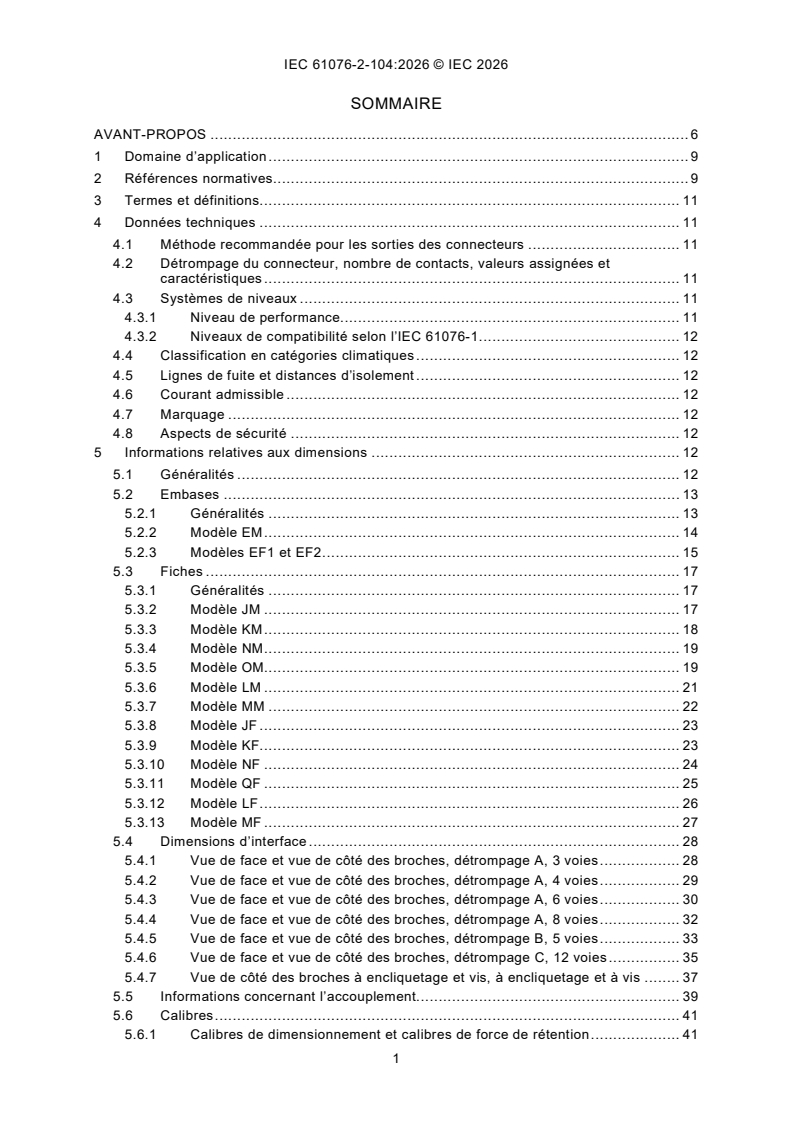
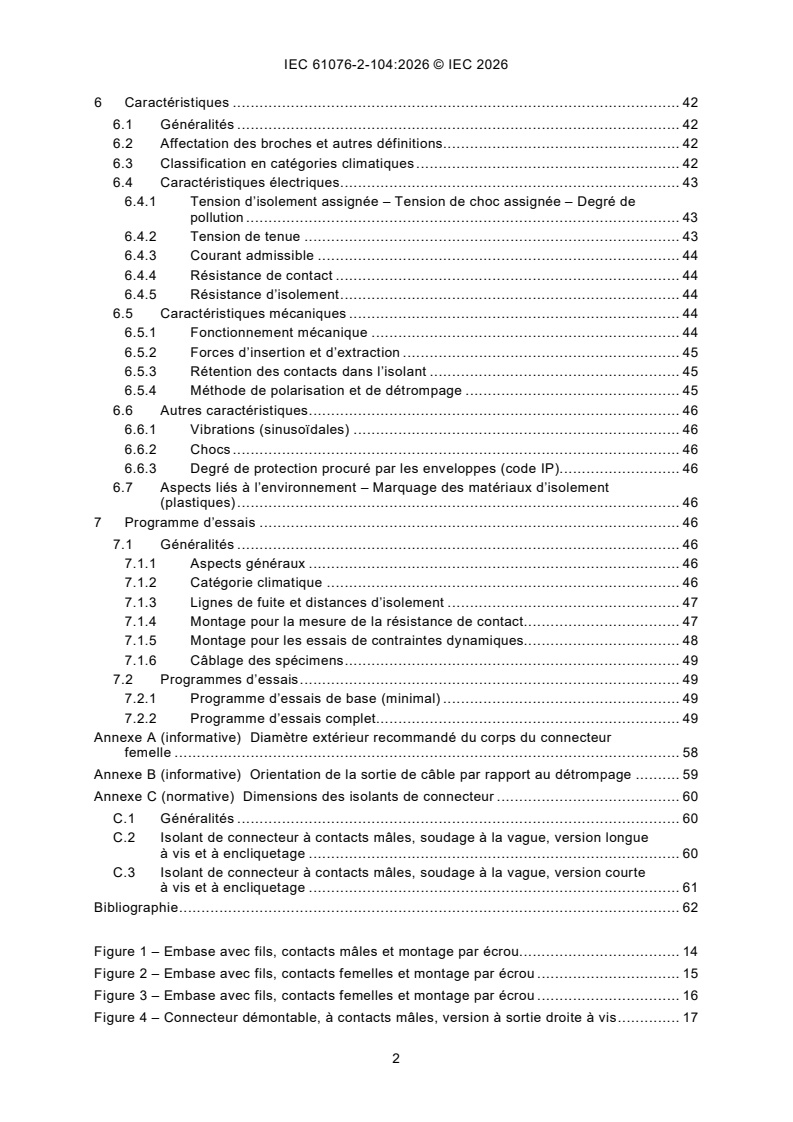
IEC 61076-2-104:2026 - Connecteurs pour équipements électriques et électroniques – Exigences de produit – Partie 2-104: Connecteurs circulaires – Spécification particuliere pour les connecteurs circulaires M8 a vis ou a encliquetage
Overview
IEC 61076-2-104:2026 is an international standard published by the International Electrotechnical Commission (IEC) that specifies product requirements for circular connectors. These connectors feature M8 screw-locking or snap-locking mechanisms and are designed for electrical and electronic equipment supporting signal and power transmission. The standard defines connectors ranging from 3-way to 12-way configurations, which are suitable for use in automation devices with rated voltages up to 50 V AC or 60 V DC and a current carrying capacity up to 4 A.
This standard establishes criteria for safety, performance, dimensions, marking, testing, and compatibility, helping manufacturers and users ensure consistent and reliable connection technology within industrial automation and related sectors.
Key Topics
Connector Types and Applications
- Circular connectors with M8 screw-locking or ∅8 mm snap-locking
- Suitable for automation devices and systems
- Available as fixed or free connectors, both rewirable and non-rewirable
Configurations and Electrical Ratings
- 3-way to 12-way contact configurations
- Rated up to 50 V AC / 60 V DC and 4 A current (depending on type)
- Multiple coding options to prevent mis-mating
Performance and Safety
- Detailed test requirements ensuring quality and long-term reliability
- Classification based on insulation, mechanical, and climatic criteria
- Observance of safe creepage and clearance distances in accordance with IEC 60664-1
Installation and Dimensions
- Standardized interface and body dimensions for compatibility
- Guidance for marking and orientation during assembly
- Connector styles detailed for both straight and right-angled cable entries, as well as flange and single-hole mounting options
Testing Requirements
- Includes schedules for mechanical, electrical, and environmental tests according to relevant IEC methods
Applications
IEC 61076-2-104:2026 connectors are widely used in environments requiring robust signal and power connections, particularly where compact or modular assemblies are essential. Common application scenarios include:
Industrial Automation:
- Connecting sensors, actuators, and field devices within control cabinets and on the shop floor
- Suitable for distributed control networks and modular systems needing quick and secure connections
Process Control and Instrumentation:
- Reliable interfacing for measurement equipment, programmable logic controllers (PLCs), and remote I/O modules
Robotics and Machinery:
- Supporting power and communication signals across moving and static equipment
Transportation and Building Technologies:
- Use in transportation systems, security, and building automation devices requiring standardized and ruggedized circular connectors
The standard ensures compatibility and interoperability in multi-vendor systems, minimizing installation errors and maintenance time. It supports the needs of equipment manufacturers, system integrators, and end-users by providing a clear basis for connector selection, integration, and quality assurance.
Related Standards
Compliance and integration with other international standards enhance the practical value of IEC 61076-2-104. Key related standards include:
- IEC 61076-1: Generic requirements, terminology, and definitions for connectors
- IEC 60512 Series: Test methods for electrical and electronic connectors, including mechanical operation and environmental testing
- IEC 60664-1: Principles and testing requirements for insulation coordination in low-voltage systems
- IEC 61984: Safety requirements and tests for connectors
- IEC 60050-581: Electrotechnical vocabulary for electromechanical components
Adherence to IEC 61076-2-104:2026 guarantees that circular connectors meet internationally recognized benchmarks for safety, quality, and performance in electrical and electronic equipment deployment.
For manufacturers, specifiers, and users, leveraging this standard ensures reliable automation solutions and future-proofs installations in dynamic industrial environments.
Relations
- Effective Date
- 05-Sep-2023
Buy Documents
IEC 61076-2-104:2026 - Connectors for electrical and electronic equipment - Product requirements - Part 2-104: Circular connectors - Detail specification for circular connectors with M8 screw-locking or snap-locking
IEC 61076-2-104:2026 - Connecteurs pour équipements électriques et électroniques – Exigences de produit – Partie 2-104: Connecteurs circulaires – Spécification particuliere pour les connecteurs circulaires M8 a vis ou a encliquetage
Frequently Asked Questions
IEC 61076-2-104:2026 is a standard published by the International Electrotechnical Commission (IEC). Its full title is "Connectors for electrical and electronic equipment - Product requirements - Part 2-104: Circular connectors - Detail specification for circular connectors with M8 screw-locking or snap-locking". This standard covers: IEC 61076-2-104:2026 This part of IEC 61076 describes 3-way to 12-way circular connectors with M8 screw-locking or with nominal Æ 8 mm snap-locking, for connection of automation devices, for signal and power transmission up to 50 V AC / 60 V DC rated voltage and up to 4 A rated current.
IEC 61076-2-104:2026 This part of IEC 61076 describes 3-way to 12-way circular connectors with M8 screw-locking or with nominal Æ 8 mm snap-locking, for connection of automation devices, for signal and power transmission up to 50 V AC / 60 V DC rated voltage and up to 4 A rated current.
IEC 61076-2-104:2026 is classified under the following ICS (International Classification for Standards) categories: 31.220.10 - Plug-and-socket devices. Connectors. The ICS classification helps identify the subject area and facilitates finding related standards.
IEC 61076-2-104:2026 has the following relationships with other standards: It is inter standard links to IEC 61076-2-104:2014. Understanding these relationships helps ensure you are using the most current and applicable version of the standard.
IEC 61076-2-104:2026 is available in PDF format for immediate download after purchase. The document can be added to your cart and obtained through the secure checkout process. Digital delivery ensures instant access to the complete standard document.
Standards Content (Sample)
IEC 61076-2-104 ®
Edition 3.0 2026-02
INTERNATIONAL
STANDARD
Connectors for electrical and electronic equipment - Product requirements -
Part 2-104: Circular connectors - Detail specification for circular connectors with
M8 screw-locking or snap-locking
ICS 31.220.10 ISBN 978-2-8327-1026-5
All rights reserved. Unless otherwise specified, no part of this publication may be reproduced or utilized in any form or
by any means, electronic or mechanical, including photocopying and microfilm, without permission in writing from either
IEC or IEC's member National Committee in the country of the requester. If you have any questions about IEC copyright
or have an enquiry about obtaining additional rights to this publication, please contact the address below or your local
IEC member National Committee for further information.
IEC Secretariat Tel.: +41 22 919 02 11
3, rue de Varembé info@iec.ch
CH-1211 Geneva 20 www.iec.ch
Switzerland
About the IEC
The International Electrotechnical Commission (IEC) is the leading global organization that prepares and publishes
International Standards for all electrical, electronic and related technologies.
About IEC publications
The technical content of IEC publications is kept under constant review by the IEC. Please make sure that you have the
latest edition, a corrigendum or an amendment might have been published.
IEC publications search - IEC Products & Services Portal - products.iec.ch
webstore.iec.ch/advsearchform Discover our powerful search engine and read freely all the
The advanced search enables to find IEC publications by a
publications previews, graphical symbols and the glossary.
variety of criteria (reference number, text, technical With a subscription you will always have access to up to date
committee, …). It also gives information on projects, content tailored to your needs.
replaced and withdrawn publications.
Electropedia - www.electropedia.org
IEC Just Published - webstore.iec.ch/justpublished The world's leading online dictionary on electrotechnology,
Stay up to date on all new IEC publications. Just Published containing more than 22 500 terminological entries in English
details all new publications released. Available online and and French, with equivalent terms in 25 additional languages.
once a month by email. Also known as the International Electrotechnical Vocabulary
(IEV) online.
IEC Customer Service Centre - webstore.iec.ch/csc
If you wish to give us your feedback on this publication or
need further assistance, please contact the Customer
Service Centre: sales@iec.ch.
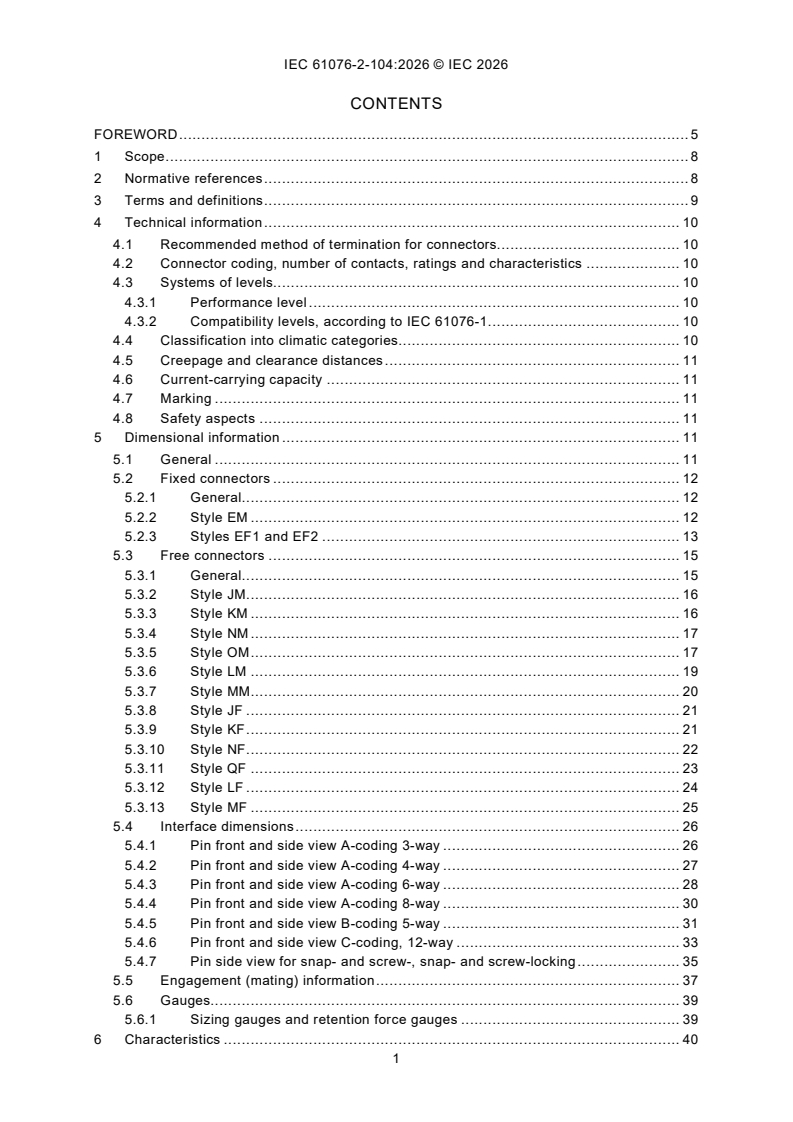
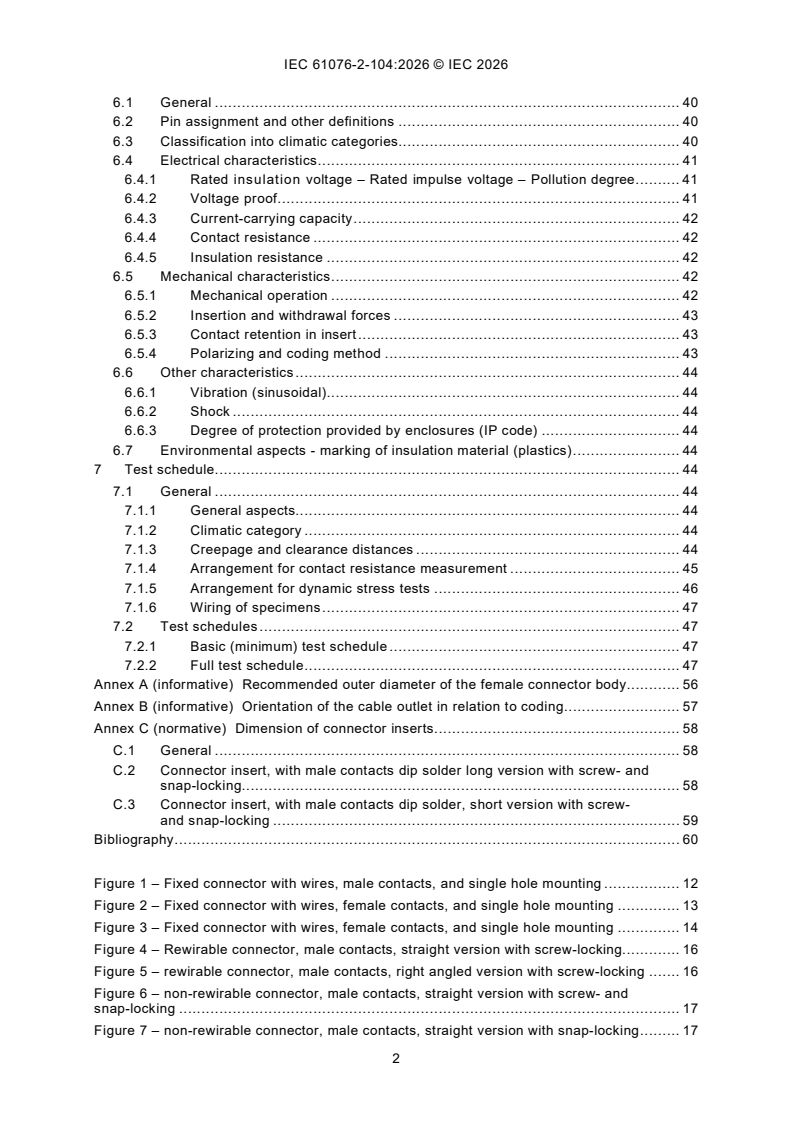
CONTENTS
FOREWORD . 5
1 Scope . 8
2 Normative references . 8
3 Terms and definitions . 9
4 Technical information . 10
4.1 Recommended method of termination for connectors. 10
4.2 Connector coding, number of contacts, ratings and characteristics . 10
4.3 Systems of levels. 10
4.3.1 Performance level . 10
4.3.2 Compatibility levels, according to IEC 61076-1 . 10
4.4 Classification into climatic categories . 10
4.5 Creepage and clearance distances . 11
4.6 Current-carrying capacity . 11
4.7 Marking . 11
4.8 Safety aspects . 11
5 Dimensional information . 11
5.1 General . 11
5.2 Fixed connectors . 12
5.2.1 General. 12
5.2.2 Style EM . 12
5.2.3 Styles EF1 and EF2 . 13
5.3 Free connectors . 15
5.3.1 General. 15
5.3.2 Style JM . 16
5.3.3 Style KM . 16
5.3.4 Style NM . 17
5.3.5 Style OM . 17
5.3.6 Style LM . 19
5.3.7 Style MM . 20
5.3.8 Style JF . 21
5.3.9 Style KF . 21
5.3.10 Style NF . 22
5.3.11 Style QF . 23
5.3.12 Style LF . 24
5.3.13 Style MF . 25
5.4 Interface dimensions . 26
5.4.1 Pin front and side view A-coding 3-way . 26
5.4.2 Pin front and side view A-coding 4-way . 27
5.4.3 Pin front and side view A-coding 6-way . 28
5.4.4 Pin front and side view A-coding 8-way . 30
5.4.5 Pin front and side view B-coding 5-way . 31
5.4.6 Pin front and side view C-coding, 12-way . 33
5.4.7 Pin side view for snap- and screw-, snap- and screw-locking . 35
5.5 Engagement (mating) information . 37
5.6 Gauges. 39
5.6.1 Sizing gauges and retention force gauges . 39
6 Characteristics . 40
6.1 General . 40
6.2 Pin assignment and other definitions . 40
6.3 Classification into climatic categories . 40
6.4 Electrical characteristics . 41
6.4.1 Rated insulation voltage – Rated impulse voltage – Pollution degree . 41
6.4.2 Voltage proof . 41
6.4.3 Current-carrying capacity . 42
6.4.4 Contact resistance . 42
6.4.5 Insulation resistance . 42
6.5 Mechanical characteristics . 42
6.5.1 Mechanical operation . 42
6.5.2 Insertion and withdrawal forces . 43
6.5.3 Contact retention in insert . 43
6.5.4 Polarizing and coding method . 43
6.6 Other characteristics . 44
6.6.1 Vibration (sinusoidal). 44
6.6.2 Shock . 44
6.6.3 Degree of protection provided by enclosures (IP code) . 44
6.7 Environmental aspects - marking of insulation material (plastics) . 44
7 Test schedule . 44
7.1 General . 44
7.1.1 General aspects. 44
7.1.2 Climatic category . 44
7.1.3 Creepage and clearance distances . 44
7.1.4 Arrangement for contact resistance measurement . 45
7.1.5 Arrangement for dynamic stress tests . 46
7.1.6 Wiring of specimens . 47
7.2 Test schedules . 47
7.2.1 Basic (minimum) test schedule . 47
7.2.2 Full test schedule . 47
Annex A (informative) Recommended outer diameter of the female connector body. 56
Annex B (informative) Orientation of the cable outlet in relation to coding . 57
Annex C (normative) Dimension of connector inserts . 58
C.1 General . 58
C.2 Connector insert, with male contacts dip solder long version with screw- and
snap-locking. 58
C.3 Connector insert, with male contacts dip solder, short version with screw-
and snap-locking . 59
Bibliography . 60
Figure 1 – Fixed connector with wires, male contacts, and single hole mounting . 12
Figure 2 – Fixed connector with wires, female contacts, and single hole mounting . 13
Figure 3 – Fixed connector with wires, female contacts, and single hole mounting . 14
Figure 4 – Rewirable connector, male contacts, straight version with screw-locking. 16
Figure 5 – rewirable connector, male contacts, right angled version with screw-locking . 16
Figure 6 – non-rewirable connector, male contacts, straight version with screw- and
snap-locking . 17
Figure 7 – non-rewirable connector, male contacts, straight version with snap-locking . 17
Figure 8 – non-rewirable connector, male contacts, angled version with snap-locking . 18
Figure 9 – Non-rewirable connector, male contacts, straight version with screw-locking . 19
Figure 10 – non-rewirable connector, male contacts, right angled version with screw-
locking . 20
Figure 11 – Rewirable connector, female contacts, straight version with screw-locking . 21
Figure 12 – rewirable connector, female contacts, right angled version, with screw-
locking . 21
Figure 13 – Non-rewirable connector, female contacts, straight version with snap-
locking . 22
Figure 14 – Non-rewirable connector, female contacts, right angled version with snap-
locking . 23
Figure 15 – Non-rewirable connector, female contacts, straight version, with screw-
locking . 24
Figure 16 – Non-rewirable connector, female contacts, right angled version, with
screw-locking . 25
Figure 17 – Pin front and side view A-coding, 3-way . 26
Figure 18 – Contact position A-coding, 3-way, front view . 26
Figure 19 – Pin front and side view A-coding, 4-way . 27
Figure 20 – Contact position A-coding, 4-way, front view . 28
Figure 21 – Pin front and side view A-coding, 6-ways . 28
Figure 22 – Contact position A-coding, 6-way, front view . 29
Figure 23 – Pin front and side view A-coding, 8-ways . 30
Figure 24 – Contact position A-coding, 8-way, front view . 31
Figure 25 – Pin front and side view B-coding, 5-ways . 31
Figure 26 – Contact position B-coding 5-way, front view . 32
Figure 27 – Pin front and side view C-coding, 12-ways . 33
Figure 28 – Contact position C-coding 12-way, front view . 34
Figure 29 – Pin side view snap- and screw-, snap- and screw-locking . 35
Figure 30 – Engagement (mating) information . 37
Figure 31 – Gauge information . 39
Figure 32 – Contact resistance arrangement . 45
Figure 33 – Dynamic stress test arrangement . 46
Figure A.1 – Diameter of the female connector body, coding variant A . 56
Figure A.2 – Shape of the female connector body, coding variant B . 56
Figure A.3 – Diameter of the female connector body, coding variant C . 56
Figure B.1 – Orientation of cable outlet in relation to the coding – Free connectors
according to Table 6 . 57
Figure C.1 – Connector insert, with male contacts, dip solder long version with screw-
and snap-locking . 58
Figure C.2 – Connector insert, with male contacts, dip solder short version with screw-
and snap-locking . 59
Table 1 – Ratings of connectors . 10
Table 2 – Styles of fixed connectors . 12
Table 3 – Dimensions of style EM, Figure 1 . 13
Table 4 – Dimensions of style EF1, Figure 2 . 14
Table 5 – Dimensions of style EF2, Figure 3 . 15
Table 6 – Styles of free connectors . 15
Table 7 – Dimensions of style JM, Figure 4 . 16
Table 8 – Dimensions of style KM, Figure 5 . 17
Table 9 – Dimensions of style NM, Figure 6 . 17
Table 10 – Dimensions of style OM, Figure 7 . 18
Table 11 – Dimensions of style PM, Figure 8 . 18
Table 12 – Dimensions of style LM, Figure 9 . 19
Table 13 – Dimensions of style MM, Figure 10. 20
Table 14 – Dimensions of style JF, Figure 11 . 21
Table 15 – Dimensions of style KF, Figure 12 . 22
Table 16 – Dimensions of style NF, Figure 13. 22
Table 17 – Dimensions of style QF, Figure 14 . 23
Table 18 – Dimensions of style LF, Figure 15 . 24
Table 19 – Dimensions of style MF, Figure 16 . 25
Table 20 – Pin front and side view A-coding, 3-way. 26
Table 21 – Dimensions for Figure 19 . 27
Table 22 – Dimensions for Figure 21 . 29
Table 23 – Dimensions for Figure 23 . 30
Table 24 – Dimensions for Figure 25 . 32
Table 25 – Dimensions for Figure 27 . 33
Table 26 – Dimensions for Figure 29 . 36
Table 27 – Connectors dimensions in mated and locked position . 38
Table 28 – Gauges . 40
Table 29 – Climatic category . 40
Table 30 – Rated insulation voltage – Rated impulse voltage – Pollution degree . 41
Table 31 – Voltage proof . 41
Table 32 – Current-carrying capacity . 42
Table 33 – Number of mechanical operations . 43
Table 34 – Insertion and withdrawal forces. 43
Table 35 – Number of test specimens . 47
Table 36 – Test group P . 48
Table 37 – Test group AP . 49
Table 38 – Test group BP . 51
Table 39 – Test group CP. 53
Table 40 – Test group DP. 54
Table 41 – Test group EP . 54
Table 42 – Test group NP. 55
Table C.1 – Dimensions of connector insert, Figure C.1 . 58
Table C.2 – Connector insert, with male contacts, dip solder short version with screw-
and snap locking . 59
INTERNATIONAL ELECTROTECHNICAL COMMISSION
____________
Connectors for electrical and electronic equipment -
Product requirements -
Part 2-104: Circular connectors - Detail specification for circular
connectors with M8 screw-locking or snap-locking
FOREWORD
1) The International Electrotechnical Commission (IEC) is a worldwide organization for standardization comprising
all national electrotechnical committees (IEC National Committees). The object of IEC is to promote international
co-operation on all questions concerning standardization in the electrical and electronic fields. To this end and
in addition to other activities, IEC publishes International Standards, Technical Specifications, Technical Reports,
Publicly Available Specifications (PAS) and Guides (hereafter referred to as "IEC Publication(s)"). Their
preparation is entrusted to technical committees; any IEC National Committee interested in the subject dealt with
may participate in this preparatory work. International, governmental and non-governmental organizations liaising
with the IEC also participate in this preparation. IEC collaborates closely with the International Organization for
Standardization (ISO) in accordance with conditions determined by agreement between the two organizations.
2) The formal decisions or agreements of IEC on technical matters express, as nearly as possible, an international
consensus of opinion on the relevant subjects since each technical committee has representation from all
interested IEC National Committees.
3) IEC Publications have the form of recommendations for international use and are accepted by IEC National
Committees in that sense. While all reasonable efforts are made to ensure that the technical content of IEC
Publications is accurate, IEC cannot be held responsible for the way in which they are used or for any
misinterpretation by any end user.
4) In order to promote international uniformity, IEC National Committees undertake to apply IEC Publications
transparently to the maximum extent possible in their national and regional publications. Any divergence between
any IEC Publication and the corresponding national or regional publication shall be clearly indicated in the latter.
5) IEC itself does not provide any attestation of conformity. Independent certification bodies provide conformity
assessment services and, in some areas, access to IEC marks of conformity. IEC is not responsible for any
services carried out by independent certification bodies.
6) All users should ensure that they have the latest edition of this publication.
7) No liability shall attach to IEC or its directors, employees, servants or agents including individual experts and
members of its technical committees and IEC National Committees for any personal injury, property damage or
other damage of any nature whatsoever, whether direct or indirect, or for costs (including legal fees) and
expenses arising out of the publication, use of, or reliance upon, this IEC Publication or any other IEC
Publications.
8) Attention is drawn to the Normative references cited in this publication. Use of the referenced publications is
indispensable for the correct application of this publication.
9) IEC draws attention to the possibility that the implementation of this document may involve the use of (a)
patent(s). IEC takes no position concerning the evidence, validity or applicability of any claimed patent rights in
respect thereof. As of the date of publication of this document, IEC had not received notice of (a) patent(s), which
may be required to implement this document. However, implementers are cautioned that this may not represent
the latest information, which may be obtained from the patent database available at https://patents.iec.ch. IEC
shall not be held responsible for identifying any or all such patent rights.
IEC 61076-2-104 has been prepared by subcommittee 48B: Electrical connectors, of IEC
technical committee 48: Electrical connectors and mechanical structures for electrical and
electronic equipment. It is an International Standard.
This third edition cancels and replaces the second edition published in 2014. This edition
constitutes a technical revision.
This edition includes the following significant technical changes with respect to the previous
edition:
a) The structure of this document has been adapted to the new IEC template for standards.
New subclauses have been added. Clause 5 and Clause 6 have been updated.
b) The mating face for a M8 12-pole connector has been added.
c) Annex B Orientation of cable outlet in relation to coding has been added.
d) The styles for connector inserts have been moved to the normative Annex C.
The text of this International Standard is based on the following documents:
Draft Report on voting
48B/3188/FDIS 48B/3194/RVD
Full information on the voting for its approval can be found in the report on voting indicated in
the above table.
The language used for the development of this International Standard is English.
This document was drafted in accordance with ISO/IEC Directives, Part 2, and developed in
accordance with ISO/IEC Directives, Part 1 and ISO/IEC Directives, IEC Supplement, available
at www.iec.ch/members_experts/refdocs. The main document types developed by IEC are
described in greater detail at www.iec.ch/publications.
A list of all parts of the IEC 61076 series, published under the general title Connectors for
electrical and electronic equipment - Product requirements, can be found on the IEC website.
The committee has decided that the contents of this document will remain unchanged until the
stability date indicated on the IEC website under webstore.iec.ch in the data related to the
specific document. At this date, the document will be
– reconfirmed,
– withdrawn, or
– revised.
IEC SC 48B – Electrical connectors IEC 61076-2-104 Ed 3
Specification available from:
IEC General secretariat or from the addresses shown on the inside
cover.
Electronic components of assessed quality in accordance with:
IEC 61076-1
Circular connectors M8 (screw-
locking) – diameter 8 mm (snap-
locking)
3 to 12 way
Male and female contacts
Male and female connectors
Rewirable – Non-rewirable
Free cable connectors straight and
right angled
Fixed connectors -flange mounting
and single hole mounting
Connector insert
1 Scope
This part of IEC 61076 describes 3-way to 12-way circular connectors with M8 screw-locking or
with nominal ∅ 8 mm snap-locking, for connection of automation devices, for signal and power
transmission up to 50 V AC / 60 V DC rated voltage and up to 4 A rated current.
These connectors are available as fixed or free connectors, either rewirable or non-rewirable.
Male connectors have round contacts ∅ 0,48 mm, ∅ 0,6 mm, ∅ 0,7 mm and ∅ 1,0 mm,
depending on the number of ways and coding, with all contacts being of the same size.
The different codings prevent the mating of differently coded male and female connectors.
NOTE M8 is the dimension of the thread of the screw locking mechanism of these circular connectors.
2 Normative references
The following documents are referred to in the text in such a way that some or all of their content
constitutes requirements of this document. For dated references, only the edition cited applies.
For undated references, the latest edition of the referenced document (including any
amendments) applies.
IEC 60050-581, International Electrotechnical Vocabulary (IEV) - Part 581: Electromechanical
components for electronic equipment
IEC 60068-1, Environmental testing - Part 1: General and guidance
IEC 60352-2, Solderless connections - Part 2: Crimped connections - General requirements,
test methods and practical guidance
IEC 60352-3, Solderless connections - Part 3: Accessible insulation displacement (ID)
connections - General requirements, test methods and practical guidance
IEC 60352-4, Solderless connections - Part 4: Non-accessible insulation displacement (ID)
connections - General requirements, test methods and practical guidance
IEC 60352-5, Solderless connections - Part 5: Press-in connections - General requirements,
test methods and practical guidance
IEC 60352-6, Solderless connections - Part 6: Insulation piercing connections - General
requirements, test methods and practical guidance
IEC 60352-7, Solderless connections - Part 7: Spring clamp connections - General
requirements, test methods and practical guidance
IEC 60352-9, Solderless connections - Part 9: Ultrasonically welded connections - General
requirements, test methods and practical guidance
IEC 60512 (all parts), Connectors for electrical and electronic equipment – Tests and
measurements
IEC 60512-1, Connectors for electrical and electronic equipment - Tests and measurements -
Part 1: General specification
IEC 60512-1-2, Connectors for electronic equipment - Tests and measurements - Part 1-2:
General examination - Test 1b: Examination of dimension and mass
IEC 60512-2-1, Connectors for electronic equipment - Tests and measurements - Part 2-1:
Electrical continuity and contact resistance tests - Test 2a: Contact resistance - Millivolt level
method
IEC 60512-3-1, Connectors for electronic equipment - Tests and measurements - Part 3-1:
Insulation tests - Test 3a: Insulation resistance
IEC 60512-4-1, Connectors for electronic equipment - Tests and measurements - Part 4-1:
Voltage stress tests - Test 4a: Voltage proof
IEC 60512-6-3, Connectors for electronic equipment - Tests and measurements - Part 6-3:
Dynamic stress tests - Test 6c: Shock
IEC 60512-6-4, Connectors for electronic equipment - Tests and measurements - Part 6-4:
Dynamic stress tests - Test 6d: Vibration (sinusoidal)
IEC 60512-9-1, Connectors for electronic equipment - Tests and measurements - Part 9-1:
Endurance tests - Test 9a: Mechanical operation
IEC 60512-13-2, Connectors for electronic equipment - Tests and measurements - Part 13-2:
Mechanical operation tests - Test 13b: Insertion and withdrawal forces
IEC 60512-13-5, Connectors for electronic equipment - Tests and measurements - Part 13-5:
Mechanical operation tests - Test 13e: Polarizing and keying method
IEC 60529:1989 + AMD1:1999 + AMD2:2013, Degrees of protection provided by enclosures
(IP code)
IEC 60664-1:2020, Insulation coordination for equipment within low-voltage supply systems -
Part 1: Principles, requirements and tests
IEC 60999-1, Connecting devices - Electrical copper conductors - Safety requirements for
screw-type and screwless-type clamping units - Part 1: General requirements and particular
2 2
requirements for clamping units for conductors from 0,2 mm up to 35 mm (included)
IEC 61076-1, Connectors for electronic equipment - Product requirements - Part 1: Generic
specification
IEC 61984:2008, Connectors - Safety requirements and tests
IEC 62197-1, Connectors for electronic equipment - Quality assessment requirements - Part 1:
Generic specification
3 Terms and definitions
For the purposes of this document, the terms and definitions given in IEC 60050-581,
IEC 61076-1, IEC 60512-1 and the following apply.
ISO and IEC maintain terminology databases for use in standardization at the following
addresses:
– IEC Electropedia: available at https://www.electropedia.org/
– ISO Online browsing platform: available at https://www.iso.org/obp
3.1
orientation
circular mounting position of the connector in relation to the polarization of the mating interface
4 Technical information
4.1 Recommended method of termination for connectors
The contact termination for rewirable connectors shall in accordance with the IEC 60352 series
or IEC 60999-1, as applicable, or shall be by soldering.
4.2 Connector coding, number of contacts, ratings and characteristics
Table 1 provides the coding of these connectors as a function of their style, number of contacts,
rated voltage and rated current.
Table 1 – Ratings of connectors
Coding Style Number of contacts Rated voltage Rated current
AC or DC A
3-way 3 50 V AC / 60 V DC 4
4-way 4 50 V AC / 60 V DC 4
A
6-way 6 32 V 1,5
8-way 8 32 V 1,5
B 5-way 5 32 V 3
C 12-way 12 32 V 1
NOTE The rated current refers to the interface. It refers to the maximum conductor cross section that can be
terminated.
Insulation resistance: 10 Ω min.
Contact spacing: see interface dimensions in 5.4
4.3 Systems of levels
4.3.1 Performance level
Connectors according to this document are classified by mating performance level (MPL).
See 6.5.1 for details.
4.3.2 Compatibility levels, according to IEC 61076-1
Connectors according to this document are intermateable and interoperable according to
IEC 61076-1 (level 3).
Interoperability is granted, provided that the same performance level as defined in 4.3.1 and
the same surface of contacts as defined in 6.2 is considered.
4.4 Classification into climatic categories
See 6.3.
4.5 Creepage and clearance distances
The creepage and clearance distances shall be dimensioned according to rated insulation
voltage values specified in Table 30 (see 6.4.1), in accordance with IEC 60664-1, and shall be
measured only in mated position according to IEC 60512-1-2 (see 4.8, connectors are without
breaking capacity (COC) unless otherwise specified by the manufacturer).
NOTE 1 Creepage distances can be dimensioned for pollution degree 2 for connectors IP54 or higher, see
IEC 61984:2008, 6.19.3.
The creepage and clearance distances that cover performance requirements in IEC 60664-1
may be reduced, based on IEC TR 63040.
NOTE 2 As indicated in IEC 60664-1, IEC TR 63040 provides an alternative and more precise dimensioning
procedure for clearances equal to or less than 2 mm.
In practice, reductions in creepage or clearance distances can occur due to the conductive
pattern of the printed board, or the wiring used, and should in such case duly be taken into
account.
NOTE 3 The permissible rated voltage depends on the application and the relevant specified safety requirements.
4.6 Current-carrying capacity
See 6.4.3.
4.7 Marking
The marking of the connector and the package shall be in accordance with IEC 61076-1.
4.8 Safety aspects
For safety aspects, IEC 61984 should be considered as guidance.
Connectors according to this document are COC per IEC 61984, unless otherwise specified by
the manufacturer.
5 Dimensional information
5.1 General
Throughout this document, dimensions are given in mm. Figures are shown in the first angle
projection. The shape of the connectors may deviate from those given in the following drawings
as long as the specified dimensions are not influenced.
Missing dimensions shall be chosen according to common characteristics and intended use.
For all connector styles with cables, the length L of the cable shall be agreed between
manufacturer and user.
Figure 1 to Figure 16, which illustrate each style, show the coding and connector interface as
examples only. Each example applies to all codings and polarities of the respective style.
Alternative installation situations are possible and shall be agreed between manufacturer and
user.
For interface dimensions for each coding see 5.4.
The interface dimensions of the female styles shall be chosen according to the common
characteristics of the male styles.
For reliable intermateability, the dimensions of the female connector body as detailed in
Annex A should be met.
For free connectors with right angled cable outlets, the direction of the coding in relation to the
cable outlet shall be specified to assure that the cable leaves the housing in the specified
direction. This is indicated by an arrow and described in Annex B.
See Annex C for several connector insert styles.
5.2 Fixed connectors
5.2.1 General
Table 2 shows the different styles of fixed connectors.
Table 2 – Styles of fixed connectors
Style Description
EM Fixed connector with wires, male contacts, single hole mounting.
EF Fixed connector with wires, female contacts, single hole mounting.
5.2.2 Style EM
Figure 1 shows a fixed connector with wires, male contacts, and single hole mounting.
NOTE Dimension for width across flats
Figure 1 – Fixed connector with wires, male contacts, and single hole mounting
Table 3 shows the dimensions of style EM, Figure 1.
Table 3 – Dimensions of style EM, Figure 1
Dimensions in millimetres
Letter Minimum Nominal Maximum
A 8,0 8,5 9,0
B - - 18
C - M8 × 0,5 -
D - - 3,2
E - - 11,5
F - 10 -
G 6 - -
H Ø8,2 Ø8,2 Ø8,3
K 7,1 7,1 7,2
5.2.3 Styles EF1 and EF2
Figure 2 shows a fixed connector with wires, female contacts, and single hole mounting.
NOTE Dimension for width across flats.
The wire length shall be agreed upon between the manufacturer and user.
Figure 2 – Fixed connector with wires, female contacts, and single hole mounting
Table 4 shows the dimensions of style EF1, Figure 2.
Table 4 – Dimensions of style EF1, Figure 2
Dimensions in millimetres
Letter Minimum Nominal Maximum
A 8,0 8,5 9,0
B - - 16,5
C - M8 × 0,5 -
D - - 3,2
E - - 11,5
F - 10 -
H Ø8,2 Ø8,2 Ø8,3
K 7,1 7,1 7,2
Figure 3 shows a fixed connector with wires, female contacts, and single hole mounting.
NOTE Dimension for width across flats.
The wire or cable length shall be agreed upon between the manufacturer and user.
Figure 3 – Fixed connector with wires, female contacts, and single hole mounting
Table 5 shows the dimensions of style EF2, Figure 3
Table 5 – Dimensions of style EF2, Figure 3
Dimensions in millimetres
Letter Minimum Nominal Maximum
A 8,0 8,5 9,0
B - - 16,5
C - M8 × 0,5 -
D - - 3,2
E - - 11,5
F - 10 -
H Ø8,2 Ø8,2 Ø8,3
K 7,1 7,1 7,2
NOTE The dimensions in Table 5 apply to both variants EF1 and EF2.
5.3 Free connectors
5.3.1 General
Table 6 shows the styles of free connectors.
Table 6 – Styles of free connectors
Style Description
a
JM
Rewirable connector, male contacts, straight version with screw-locking
a
KM
Rewirable connector, male contacts, right angled version with screw-locking
NM Non-rewirable connector, male contacts, straight version with screw- and snap-locking
OM Non-rewirable connector, male contacts, straight version with snap-locking
PM Non-rewirable connector, male contacts, right angled version with snap-locking
a
LM
Non-rewirable connector, male contacts, straight version with screw-locking
a
MM
Non-rewirable connector, male contacts, right angled version with screw-locking
a
JF
Rewirable connector, female contacts, straight version with screw-locking
a
KF
Rewirable connector, female contacts, right angled version with screw-locking
NF Non-rewirable connector, female contacts, straight version with snap locking
QF Non-rewirable connector, female contacts, right angled version with snap-locking
a
LF
Non-rewirable connector, female contacts, straight version with screw-locking
a
MF
Non-rewirable connector, female contacts, right angled version with screw-locking
a
Knurled ring or hexagonal ring upon agreement.
5.3.2 Style JM
Figure 4 shows a rewirable connector with male contacts, straight version with screw-locking.
NOTE 1 Cable outlet alternatively inside.
NOTE 2 Cable outlet diameter range upon agreement.
Figure 4 – Rewirable connector, male contacts, straight version with screw-locking
Table 7 shows the dimensions of style JM, Figure 4.
Table 7 – Dimensions of style JM, Figure 4
Dimensions in millimetres
A max. B max.
Ø14 45
5.3.3 Style KM
Figure 5 shows a rewirable connector, with male contacts, right angled version with screw-
locking.
NOTE 1 Cable outlet alternatively inside.
NOTE 2 Cable outlet diameter range upon agreement.
Figure 5 – rewirable connector, male contacts, right angled version with screw-locking
Table 8 shows the dimensions of style KM, Figure 5.
Table 8 – Dimensions of style KM, Figure 5
Dimensions in millimetres
A max. B max. C max. D max.
Ø14 44 7 20
5.3.4 Style NM
Figure 6 shows a non-rewirable connector with male contacts, straight version with screw- and
snap-locking.
The cable length shall be agreed upon between the manufacturer and user
Figure 6 – non-rewirable connector, male contac
...
IEC 61076-2-104 ®
Edition 3.0 2026-02
NORME
INTERNATIONALE
Connecteurs pour équipements électriques et électroniques - Exigences de
produit -
Partie 2-104: Connecteurs circulaires - Spécification particulière pour les
connecteurs circulaires M8 à vis ou à encliquetage
ICS 31.220.10 ISBN 978-2-8327-1467-6
Droits de reproduction réservés. Sauf indication contraire, aucune partie de cette publication ne peut être reproduite ni
utilisée sous quelque forme que ce soit et par aucun procédé, électronique ou mécanique, y compris la photocopie et
les microfilms, sans l'accord écrit de l'IEC ou du Comité national de l'IEC du pays du demandeur. Si vous avez des
questions sur le copyright de l'IEC ou si vous désirez obtenir des droits supplémentaires sur cette publication, utilisez
les coordonnées ci-après ou contactez le Comité national de l'IEC de votre pays de résidence.
IEC Secretariat Tel.: +41 22 919 02 11
3, rue de Varembé info@iec.ch
CH-1211 Geneva 20 www.iec.ch
Switzerland
A propos de l'IEC
La Commission Electrotechnique Internationale (IEC) est la première organisation mondiale qui élabore et publie des
Normes internationales pour tout ce qui a trait à l'électricité, à l'électronique et aux technologies apparentées.
A propos des publications IEC
Le contenu technique des publications IEC est constamment revu. Veuillez vous assurer que vous possédez l’édition la
plus récente, un corrigendum ou amendement peut avoir été publié.
Recherche de publications IEC - IEC Products & Services Portal - products.iec.ch
webstore.iec.ch/advsearchform Découvrez notre puissant moteur de recherche et consultez
La recherche avancée permet de trouver des publications gratuitement tous les aperçus des publications, symboles
IEC en utilisant différents critères (numéro de référence, graphiques et le glossaire. Avec un abonnement, vous aurez
texte, comité d’études, …). Elle donne aussi des toujours accès à un contenu à jour adapté à vos besoins.
informations sur les projets et les publications remplacées
ou retirées. Electropedia - www.electropedia.org
Le premier dictionnaire d'électrotechnologie en ligne au
IEC Just Published - webstore.iec.ch/justpublished monde, avec plus de 22 500 articles terminologiques en
Restez informé sur les nouvelles publications IEC. Just anglais et en français, ainsi que les termes équivalents
Published détaille les nouvelles publications parues. dans 25 langues additionnelles. Egalement appelé
Disponible en ligne et une fois par mois par email. Vocabulaire Electrotechnique International (IEV) en ligne.
Service Clients - webstore.iec.ch/csc
Si vous désirez nous donner des commentaires sur cette
publication ou si vous avez des questions contactez-
nous: sales@iec.ch.
SOMMAIRE
AVANT-PROPOS . 6
1 Domaine d’application . 9
2 Références normatives . 9
3 Termes et définitions. 11
4 Données techniques . 11
4.1 Méthode recommandée pour les sorties des connecteurs . 11
4.2 Détrompage du connecteur, nombre de contacts, valeurs assignées et
caractéristiques . 11
4.3 Systèmes de niveaux . 11
4.3.1 Niveau de performance. 11
4.3.2 Niveaux de compatibilité selon l’IEC 61076-1 . 12
4.4 Classification en catégories climatiques . 12
4.5 Lignes de fuite et distances d’isolement . 12
4.6 Courant admissible . 12
4.7 Marquage . 12
4.8 Aspects de sécurité . 12
5 Informations relatives aux dimensions . 12
5.1 Généralités . 12
5.2 Embases . 13
5.2.1 Généralités . 13
5.2.2 Modèle EM . 14
5.2.3 Modèles EF1 et EF2 . 15
5.3 Fiches . 17
5.3.1 Généralités . 17
5.3.2 Modèle JM . 17
5.3.3 Modèle KM . 18
5.3.4 Modèle NM . 19
5.3.5 Modèle OM. 19
5.3.6 Modèle LM . 21
5.3.7 Modèle MM . 22
5.3.8 Modèle JF . 23
5.3.9 Modèle KF. 23
5.3.10 Modèle NF . 24
5.3.11 Modèle QF . 25
5.3.12 Modèle LF . 26
5.3.13 Modèle MF . 27
5.4 Dimensions d’interface . 28
5.4.1 Vue de face et vue de côté des broches, détrompage A, 3 voies . 28
5.4.2 Vue de face et vue de côté des broches, détrompage A, 4 voies . 29
5.4.3 Vue de face et vue de côté des broches, détrompage A, 6 voies . 30
5.4.4 Vue de face et vue de côté des broches, détrompage A, 8 voies . 32
5.4.5 Vue de face et vue de côté des broches, détrompage B, 5 voies . 33
5.4.6 Vue de face et vue de côté des broches, détrompage C, 12 voies . 35
5.4.7 Vue de côté des broches à encliquetage et vis, à encliquetage et à vis . 37
5.5 Informations concernant l’accouplement. 39
5.6 Calibres . 41
5.6.1 Calibres de dimensionnement et calibres de force de rétention . 41
6 Caractéristiques . 42
6.1 Généralités . 42
6.2 Affectation des broches et autres définitions . 42
6.3 Classification en catégories climatiques . 42
6.4 Caractéristiques électriques . 43
6.4.1 Tension d’isolement assignée – Tension de choc assignée – Degré de
pollution . 43
6.4.2 Tension de tenue . 43
6.4.3 Courant admissible . 44
6.4.4 Résistance de contact . 44
6.4.5 Résistance d’isolement . 44
6.5 Caractéristiques mécaniques . 44
6.5.1 Fonctionnement mécanique . 44
6.5.2 Forces d’insertion et d’extraction . 45
6.5.3 Rétention des contacts dans l’isolant . 45
6.5.4 Méthode de polarisation et de détrompage . 45
6.6 Autres caractéristiques . 46
6.6.1 Vibrations (sinusoïdales) . 46
6.6.2 Chocs . 46
6.6.3 Degré de protection procuré par les enveloppes (code IP). 46
6.7 Aspects liés à l’environnement – Marquage des matériaux d’isolement
(plastiques) . 46
7 Programme d’essais . 46
7.1 Généralités . 46
7.1.1 Aspects généraux . 46
7.1.2 Catégorie climatique . 46
7.1.3 Lignes de fuite et distances d’isolement . 47
7.1.4 Montage pour la mesure de la résistance de contact. 47
7.1.5 Montage pour les essais de contraintes dynamiques. 48
7.1.6 Câblage des spécimens . 49
7.2 Programmes d’essais . 49
7.2.1 Programme d’essais de base (minimal) . 49
7.2.2 Programme d’essais complet. 49
Annexe A (informative) Diamètre extérieur recommandé du corps du connecteur
femelle . 58
Annexe B (informative) Orientation de la sortie de câble par rapport au détrompage . 59
Annexe C (normative) Dimensions des isolants de connecteur . 60
C.1 Généralités . 60
C.2 Isolant de connecteur à contacts mâles, soudage à la vague, version longue
à vis et à encliquetage . 60
C.3 Isolant de connecteur à contacts mâles, soudage à la vague, version courte
à vis et à encliquetage . 61
Bibliographie . 62
Figure 1 – Embase avec fils, contacts mâles et montage par écrou. 14
Figure 2 – Embase avec fils, contacts femelles et montage par écrou . 15
Figure 3 – Embase avec fils, contacts femelles et montage par écrou . 16
Figure 4 – Connecteur démontable, à contacts mâles, version à sortie droite à vis . 17
Figure 5 – Connecteur démontable, à contacts mâles, version à sortie coudée à vis . 18
Figure 6 – Connecteur non démontable, à contacts mâles, version à sortie droite à vis
et à encliquetage . 19
Figure 7 – Connecteur non démontable, à contacts mâles, version à sortie droite à
encliquetage . 19
Figure 8 – Connecteur non démontable, à contacts mâles, version à sortie coudée à
encliquetage . 20
Figure 9 – Connecteur non démontable, à contacts mâles, version à sortie droite à vis. 21
Figure 10 – Connecteur non démontable, à contacts mâles, version à sortie
coudée à vis . 22
Figure 11 – Connecteur démontable, à contacts femelles, version à sortie droite à vis. 23
Figure 12 – Connecteur démontable, à contacts femelles, version à sortie coudée à vis . 23
Figure 13 – Connecteur non démontable, à contacts femelles, version à sortie droite à
encliquetage . 24
Figure 14 – Connecteur non démontable, à contacts femelles, version à sortie coudée
à encliquetage . 25
Figure 15 – Connecteur non démontable, à contacts femelles, version à sortie
droite à vis . 26
Figure 16 – Connecteur non démontable, à contacts femelles, version à sortie
coudée à vis . 27
Figure 17 – Vue de face et vue de côté des broches, détrompage A, 3 voies . 28
Figure 18 – Vue de face de la position des contacts, détrompage A, 3 voies. 28
Figure 19 – Vue de face et vue de côté des broches, détrompage A, 4 voies . 29
Figure 20 – Vue de face de la position des contacts, détrompage A, 4 voies. 30
Figure 21 – Vue de face et vue de côté des broches, détrompage A, 6 voies . 30
Figure 22 – Vue de face de la position des contacts, détrompage A, 6 voies. 31
Figure 23 – Vue de face et vue de côté des broches, détrompage A, 8 voies . 32
Figure 24 – Vue de face de la position des contacts, détrompage A, 8 voies. 33
Figure 25 – Vue de face et vue de côté des broches, détrompage B, 5 voies . 33
Figure 26 – Vue de face de la position des contacts, détrompage B, 5 voies. 34
Figure 27 – Vue de face et vue de côté des broches, détrompage C, 12 voies . 35
Figure 28 – Position des contacts, détrompage C 12 voies, vue de face . 36
Figure 29 – Broches à encliquetage et vis, à encliquetage et à vis . 37
Figure 30 – Informations relatives à l’accouplement . 39
Figure 31 – Informations relatives aux calibres . 41
Figure 32 – Montage pour l’essai de la résistance de contact . 47
Figure 33 – Montage d’essai de contraintes dynamiques . 48
Figure A.1 – Diamètre du corps de connecteur femelle, variante de détrompage A . 58
Figure A.2 – Forme du corps du connecteur femelle, variante de détrompage B . 58
Figure A.3 – Diamètre du corps de connecteur femelle, variante de détrompage C . 58
Figure B.1 – Orientation de la sortie de câble en fonction du détrompage – Fiches
selon le Tableau 6 . 59
Figure C.1 – Isolant de connecteur à contacts mâles, soudage à la vague, version
longue à vis et à encliquetage. 60
Figure C.2 – Isolant de connecteur à contacts mâles, soudage à la vague, version
courte à vis et à encliquetage . 61
Tableau 1 – Caractéristiques assignées des connecteurs . 11
Tableau 2 – Modèles d’embases . 13
Tableau 3 – Dimensions du modèle EM, Figure 1 . 14
Tableau 4 – Dimensions du modèle EF1, Figure 2 . 15
Tableau 5 – Dimensions du modèle EF2, Figure 3 . 16
Tableau 6 – Modèles de fiches . 17
Tableau 7 – Dimensions du modèle JM, Figure 4 . 18
Tableau 8 – Dimensions du modèle KM, Figure 5 . 18
Tableau 9 – Dimensions du modèle NM, Figure 6 . 19
Tableau 10 – Dimensions du modèle OM, Figure 7 . 19
Tableau 11 – Dimensions du modèle PM, Figure 8 . 20
Tableau 12 – Dimensions du modèle LM, Figure 9 . 21
Tableau 13 – Dimensions du modèle MM, Figure 10 . 22
Tableau 14 – Dimensions du modèle JF, Figure 11 . 23
Tableau 15 – Dimensions du modèle KF, Figure 12. 24
Tableau 16 – Dimensions du modèle NF, Figure 13 . 24
Tableau 17 – Dimensions du modèle QF, Figure 14 . 25
Tableau 18 – Dimensions du modèle LF, Figure 15 . 26
Tableau 19 – Dimensions du modèle MF, Figure 16 . 27
Tableau 20 – Vue de face et vue de côté des broches, détrompage A, 3 voies . 28
Tableau 21 – Dimensions de la Figure 19 . 29
Tableau 22 – Dimensions de la Figure 21 . 31
Tableau 23 – Dimensions de la Figure 23 . 32
Tableau 24 – Dimensions de la Figure 25 . 34
Tableau 25 – Dimensions de la Figure 27 . 35
Tableau 26 – Dimensions de la Figure 29 . 38
Tableau 27 – Dimensions des connecteurs en position accouplée et verrouillée. 40
Tableau 28 – Calibres . 42
Tableau 29 – Catégorie climatique . 42
Tableau 30 – Tension d’isolement assignée – Tension de choc assignée – Degré de
pollution . 43
Tableau 31 – Tension de tenue . 43
Tableau 32 – Courant admissible . 44
Tableau 33 – Nombre de manœuvres mécaniques . 45
Tableau 34 – Forces d’insertion et d’extraction . 45
Tableau 35 – Nombre de spécimens . 49
Tableau 36 – Groupe d’essais P . 50
Tableau 37 – Groupe d’essais AP . 51
Tableau 38 – Groupe d’essais BP . 53
Tableau 39 – Groupe d’essais CP . 55
Tableau 40 – Groupe d’essais DP . 56
Tableau 41 – Groupe d’essais EP . 56
Tableau 42 – Groupe d’essais NP . 57
Tableau C.1 – Dimensions de l’isolant de connecteur, Figure C.1 . 60
Tableau C.2 – Isolant de connecteur à contacts mâles, soudage à la vague, version
courte à vis et à encliquetage . 61
COMMISSION ÉLECTROTECHNIQUE INTERNATIONALE
____________
Connecteurs pour équipements électriques et électroniques -
Exigences de produit -
Partie 2-104: Connecteurs circulaires - Spécification particulière pour
les connecteurs circulaires M8 à vis ou à encliquetage
AVANT-PROPOS
1) La Commission Électrotechnique Internationale (IEC) est une organisation mondiale de normalisation composée
de l’ensemble des comités électrotechniques nationaux (Comités nationaux de l’IEC). L’IEC a pour objet de
favoriser la coopération internationale pour toutes les questions de normalisation dans les domaines de
l’électricité et de l’électronique. À cet effet, l’IEC – entre autres activités – publie des Normes internationales,
des Spécifications techniques, des Rapports techniques, des Spécifications accessibles au public (PAS) et des
Guides (ci-après dénommés "Publication(s) de l’IEC"). Leur élaboration est confiée à des comités d’études, aux
travaux desquels tout Comité national intéressé par le sujet traité peut participer. Les organisations
internationales, gouvernementales et non gouvernementales, en liaison avec l’IEC, participent également aux
travaux. L’IEC collabore étroitement avec l’Organisation Internationale de Normalisation (ISO), selon des
conditions fixées par accord entre les deux organisations.
2) Les décisions ou accords officiels de l’IEC concernant les questions techniques représentent, dans la mesure du
possible, un accord international sur les sujets étudiés, étant donné que les Comités nationaux de l’IEC intéressés
sont représentés dans chaque comité d’études.
3) Les Publications de l’IEC se présentent sous la forme de recommandations internationales et sont agréées
comme telles par les Comités nationaux de l’IEC. Tous les efforts raisonnables sont entrepris afin que l’IEC
s’assure de l’exactitude du contenu technique de ses publications; l’IEC ne peut pas être tenue responsable de
l’éventuelle mauvaise utilisation ou interprétation qui en est faite par un quelconque utilisateur final.
4) Dans le but d’encourager l’uniformité internationale, les Comités nationaux de l’IEC s’engagent, dans toute la
mesure possible, à appliquer de façon transparente les Publications de l’IEC dans leurs publications nationales
et régionales. Toutes divergences entre toutes Publications de l’IEC et toutes publications nationales ou
régionales correspondantes doivent être indiquées en termes clairs dans ces dernières.
5) L’IEC elle-même ne fournit aucune attestation de conformité. Des organismes de certification indépendants
fournissent des services d’évaluation de conformité et, dans certains secteurs, accèdent aux marques de
conformité de l’IEC. L’IEC n’est responsable d’aucun des services effectués par les organismes de certification
indépendants.
6) Tous les utilisateurs doivent s’assurer qu’ils sont en possession de la dernière édition de cette publication.
7) Aucune responsabilité ne doit être imputée à l’IEC, à ses administrateurs, employés, auxiliaires ou mandataires,
y compris ses experts particuliers et les membres de ses comités d’études et des Comités nationaux de l’IEC,
pour tout préjudice causé en cas de dommages corporels et matériels, ou de tout autre dommage de quelque
nature que ce soit, directe ou indirecte, ou pour supporter les coûts (y compris les frais de justice) et les dépenses
découlant de la publication ou de l’utilisation de cette Publication de l’IEC ou de toute autre Publication de l’IEC,
ou au crédit qui lui est accordé.
8) L’attention est attirée sur les références normatives citées dans cette publication. L’utilisation de publications
référencées est obligatoire pour une application correcte de la présente publication.
9) L’IEC attire l’attention sur le fait que la mise en application du présent document peut entraîner l’utilisation d’un
ou de plusieurs brevets. L’IEC ne prend pas position quant à la preuve, à la validité et à l’applicabilité de tout
droit de propriété revendiqué à cet égard. À la date de publication du présent document, l’IEC n’avait pas reçu
notification qu’un ou plusieurs brevets pouvaient être nécessaires à sa mise en application. Toutefois, il y a lieu
d’avertir les responsables de la mise en application du présent document que des informations plus récentes
sont susceptibles de figurer dans la base de données de brevets, disponible à l’adresse https://patents.iec.ch.
L’IEC ne saurait être tenue pour responsable de ne pas avoir identifié de tels droits de brevet.
L’IEC 61076-2-104 a été établie par le sous-comité 48B: Connecteurs électriques, du comité
d’études 48 de l’IEC: Connecteurs électriques et structures mécaniques pour les équipements
électriques et électroniques. Il s’agit d’une Norme internationale.
Cette troisième édition annule et remplace la deuxième édition parue en 2014. Cette édition
constitue une révision technique.
Cette édition inclut les modifications techniques significatives suivantes par rapport à l’édition
précédente:
a) la structure du présent document a été adaptée au nouveau modèle IEC pour les normes.
De nouveaux paragraphes ont été ajoutés. L’Article 5 et l’Article 6 ont été mis à jour;
b) la face d’accouplement d’un connecteur M8 à 12 voies a été ajoutée;
c) l’Annexe B, Orientation de la sortie de câble par rapport au détrompage, a été ajoutée;
d) Les modèles des isolants de connecteur ont été déplacés à l’Annexe C normative.
La présente version bilingue (2026-08) correspond à la version anglaise monolingue publiée en
2026-02.
La version française de cette norme n'a pas été soumise au vote.
La langue employée pour l’élaboration de cette Norme internationale est l’anglais.
Ce document a été rédigé selon les Directives ISO/IEC, Partie 2, il a été développé selon les
Directives ISO/IEC, Partie 1 et les Directives ISO/IEC, Supplément IEC, disponibles sous
www.iec.ch/members_experts/refdocs. Les principaux types de documents développés par
l’IEC sont décrits plus en détail sous www.iec.ch/publications.
Une liste de toutes les parties de la série IEC 61076, publiées sous le titre général Connecteurs
pour équipements électriques et électroniques – Exigences de produit, se trouve sur le site
Web de l’IEC.
Le comité a décidé que le contenu de ce document ne sera pas modifié avant la date de stabilité
indiquée sur le site web de l’IEC sous webstore.iec.ch dans les données relatives au document
recherché. À cette date, le document sera:
– reconduit,
– supprimé, ou
– révisé.
IEC SC 48B – Connecteurs électriques IEC 61076-2-104 Éd. 3
Spécification disponible auprès:
du Secrétariat général de l’IEC ou aux adresses figurant en deuxième
de couverture.
Composants électroniques sous assurance de la qualité conformes à:
IEC 61076-1
Connecteurs circulaires M8 (à vis) –
diamètre 8 mm (à encliquetage)
3 à 12 voies
Contacts mâle et femelle
Connecteurs mâles et femelles
Démontable – Non démontable
Fiches pour câble à sortie droite et à
sortie coudée
Embases à montage à bride et à
montage par écrou
Isolant de connecteur
1 Domaine d’application
La présente partie de l’IEC 61076 décrit les connecteurs circulaires de 3 à 12 voies à vis M8
ou à encliquetage de 8 mm de ∅ nominal, destinés à la connexion d’appareils d’automatisme,
pour la transmission de signaux et de puissance, sous une tension assignée allant jusqu’à 50 V
en courant alternatif ou 60 V en courant continu et jusqu’à un courant assigné de 4 A.
Ces connecteurs sont disponibles sous forme d’embases ou de fiches, démontables ou non.
Les connecteurs mâles possèdent des contacts ronds, Ø 0,48 mm, Ø 0,6 mm, Ø 0,7 mm et
Ø 1,0 mm, suivant le nombre de voies et le détrompage, tous les contacts ayant la même taille.
Les différents détrompages empêchent l’accouplement de connecteurs mâle et femelle ayant
des détrompages différents.
NOTE M8 est la dimension du filetage du mécanisme à vis de ces connecteurs circulaires.
2 Références normatives
Les documents suivants sont cités dans le texte de sorte qu’ils constituent, pour tout ou partie
de leur contenu, des exigences du présent document. Pour les références datées, seule
l’édition citée s’applique. Pour les références non datées, la dernière édition du document de
référence s’applique (y compris les éventuels amendements).
IEC 60050-581, Vocabulaire Électrotechnique International - Partie 581: Composants
électromécaniques pour équipements électroniques
IEC 60068-1, Essais d’environnement - Partie 1: Généralités et lignes directrices
IEC 60352-2, Connexions sans soudure - Partie 2: Connexions serties - Exigences générales,
méthodes d’essai et guide pratique
IEC 60352-3, Connexions sans soudure - Partie 3: Connexions autodénudantes accessibles -
Règles générales, méthodes d’essai et guide pratique
IEC 60352-4, Connexions sans soudure - Partie 4: Connexions autodénudantes (CAD) non
accessibles sans soudure - Règles générales, méthodes d’essai et guide pratique
IEC 60352-5, Connexions sans soudure - Partie 5: Connexions insérées à force - Exigences
générales, méthodes d’essai et guide pratique
IEC 60352-6, Connexions sans soudure - Partie 6: Connexions à percement d’isolant -
Exigences générales, méthodes d’essai et guide pratique
IEC 60352-7, Connexions sans soudure - Partie 7: Connexions à ressort - Règles générales,
méthodes d’essai et guide pratique
IEC 60352-9, Connexions sans soudure - Partie 9: Connexions soudées par ultrasons -
Exigences générales, méthodes d’essai et guide pratique
IEC 60512 (toutes les parties), Connecteurs pour équipements électriques et électroniques -
Essais et mesures
IEC 60512-1, Connecteurs pour équipements électriques et électroniques - Essais et mesures
- Partie 1: Spécification générique
IEC 60512-1-2, Connecteurs pour équipements électroniques - Essais et mesures - Partie 1-2:
Examen général - Essai 1b: Examen de dimension et masse
IEC 60512-2-1, Connecteurs pour équipements électroniques - Essais et mesures - Partie 2-1:
Essais de continuité électrique et de résistance de contact - Essai 2a: Résistance de contact -
Méthode du niveau des millivolts
IEC 60512-3-1, Connecteurs pour équipements électroniques - Essais et mesures - Partie 3-1:
Essais d’isolement - Essai 3a: Résistance d’isolement
IEC 60512-4-1, Connecteurs pour équipements électroniques - Essais et mesures - Partie 4-1:
Essais de contrainte diélectrique - Essai 4a: Tension de tenue
IEC 60512-6-3, Connecteurs pour équipements électroniques - Essais et mesures - Partie 6-3:
Essais de contraintes dynamiques - Essai 6c: Chocs
IEC 60512-6-4, Connecteurs pour équipements électroniques - Essais et mesures - Partie 6-4:
Essais de contraintes dynamiques - Essai 6d: Vibrations (sinusoïdales)
IEC 60512-9-1, Connecteurs pour équipements électroniques - Essais et mesures - Partie 9-1:
Essais d’endurance - Essai 9a: Fonctionnement mécanique
IEC 60512-13-2, Connecteurs pour équipements électroniques - Essais et mesures -
Partie 13-2: Essais de fonctionnement mécanique - Essai 13b: Forces d’insertion et d’extraction
IEC 60512-13-5, Connecteurs pour équipements électroniques - Essais et mesures -
Partie 13-5: Essais de fonctionnement mécanique - Essai 13e: Méthode de polarisation et de
codage
IEC 60529:1989 + AMD1:1999 + AMD2:2013, Degrés de protection procurés par les
enveloppes (code IP)
IEC 60664-1:2020, Coordination de l’isolement des matériels dans les réseaux d’énergie
électrique à basse tension - Partie 1: Principes, exigences et essais
IEC 60999-1, Dispositifs de connexion - Conducteurs électriques en cuivre - Prescriptions de
sécurité pour organes de serrage à vis et sans vis - Partie 1: Prescriptions générales et
2 2
particulières pour les organes de serrage pour les conducteurs de 0,2 mm à 35 mm (inclus)
IEC 61076-1, Connecteurs pour équipements électroniques - Exigences de produit - Partie 1:
Spécification générique
IEC 61984:2008, Connecteurs - Exigences de sécurité et essais
IEC 62197-1, Connecteurs pour équipements électroniques - Exigences d’assurance de la
qualité - Partie 1: Spécification générique
3 Termes et définitions
Pour les besoins du présent document, les termes et définitions de l’IEC 60050-581,
l’IEC 61076-1 et l’IEC 60512-1, ainsi que les suivants, s’appliquent.
L’ISO et l’IEC tiennent à jour des bases de données terminologiques destinées à être utilisées
en normalisation, consultables aux adresses suivantes:
– IEC Electropedia: disponible à l’adresse https://www.electropedia.org/
– ISO Online browsing platform: disponible à l’adresse https://www.iso.org/obp
3.1
orientation
position de montage circulaire du connecteur par rapport au détrompage de l’interface
d’accouplement
4 Données techniques
4.1 Méthode recommandée pour les sorties des connecteurs
Les sorties de contact pour les connecteurs démontables doivent être conformes à la série
IEC 60352 ou à l’IEC 60999-1, suivant le cas, ou elles doivent être soudées.
4.2 Détrompage du connecteur, nombre de contacts, valeurs assignées et
caractéristiques
Le Tableau 1 indique le détrompage de ces connecteurs en fonction de leur modèle, de leur
nombre de contacts, de leur tension assignée et de leur courant assigné.
Tableau 1 – Caractéristiques assignées des connecteurs
Détrompage Modèle Nombre de contacts Tension assignée Courant assigné
En courant alternatif A
ou en courant continu
3 voies 50 V en courant
3 alternatif/60 V en 4
courant continu
4 voies 50 V en courant
A
4 alternatif/60 V en 4
courant continu
6 voies 6 32 V 1,5
8 voies 8 32 V 1,5
B 5 voies 5 32 V 3
C 12 voies 12 32 V 1
NOTE Le courant assigné fait référence à l’interface. Il fait référence à la section maximale du conducteur qui
peut être raccordé.
Résistance d’isolement: 10 Ω min.
Espacement des contacts: voir les dimensions de l’interface en 5.4.
4.3 Systèmes de niveaux
4.3.1 Niveau de performance
Les connecteurs conformes au présent document sont classés par niveau de performance
d’accouplement (MPL, Mating Performance Level). Voir 6.5.1 pour plus de détails.
4.3.2 Niveaux de compatibilité selon l’IEC 61076-1
Les connecteurs conformes au présent document peuvent être accouplés entre eux et sont
interopérables conformément à l’IEC 61076-1 (niveau 3).
L’interopérabilité est assurée sous réserve de prendre en compte le même niveau de
performance que celui défini au 4.3.1 et la même surface des contacts que celle définie au 6.2.
4.4 Classification en catégories climatiques
Voir 6.3.
4.5 Lignes de fuite et distances d’isolement
Les lignes de fuite et les distances d’isolement doivent être dimensionnées conformément aux
valeurs de la tension assignée d’isolement spécifiées dans le Tableau 30 (voir 6.4.1),
conformément à l’IEC 60664-1; elles doivent être mesurées uniquement en position accouplée
conformément à l’IEC 60512-1-2 (voir 4.8, les connecteurs n’ont pas de pouvoir de coupure
(COC) sauf spécification contraire du fabricant).
NOTE 1 Les lignes de fuites peuvent être dimensionnées pour le degré de pollution 2 pour des connecteurs IP54
ou plus, voir IEC 61984:2008, 6.19.3.
Les lignes de fuite et les distances d’isolement qui satisfont aux exigences de performances de
l’IEC 60664-1 peuvent être réduites, en s’appuyant sur l’IEC TR 63040.
NOTE 2 Comme cela est indiqué dans l’IEC 60664-1, l’IEC TR 63040 fournit une procédure de dimensionnement
alternative et plus précise pour les distances d’isolement inférieures ou égales à 2 mm.
Dans la pratique, les distances d’isolement ou les lignes de fuite peuvent être réduites en raison
des impressions conductrices de la carte de circuit imprimé ou du câblage utilisé et il convient
qu’elles soient dûment prises en compte.
NOTE 3 Les tensions assignées admissibles dépendent de l’application et des exigences de sécurité spécifiées
pertinentes.
4.6 Courant admissible
Voir 6.4.3.
4.7 Marquage
Le marquage du connecteur et de son emballage doit être conforme à l’IEC 61076-1.
4.8 Aspects de sécurité
Pour les aspects de sécurité, il convient de prendre en compte l’IEC 61984 qui fournit des
recommandations.
Les connecteurs conformes au présent document sont des connecteurs COC selon l’IEC 61984,
sauf spécification contraire du fabricant.
5 Informations relatives aux dimensions
5.1 Généralités
Dans le présent document, les dimensions sont exprimées en mm. Les figures sont
représentées en projection de premier dièdre. La forme des connecteurs peut varier par rapport
à celle donnée dans les dessins suivants, à condition que les dimensions spécifiées ne soient
pas affectées.
Les dimensions manquantes doivent être choisies en fonction des caractéristiques communes
et de l’utilisation prévue.
Pour tous les modèles de connecteurs avec câbles, la longueur L du câble doit être convenue
entre le fabricant et l’utilisateur.
Le détrompage et l’interface de chaque modèle de connecteur représenté de la Figure 1 à la
Figure 16 sont fournis à titre d’exemple uniquement. Chaque exemple s’applique à tous les
détrompages et à toutes les polarités du modèle correspondant.
D’autres situations d’installation sont possibles et doivent faire l’objet d’un accord entre le
fabricant et l’utilisateur.
Pour les dimensions des interfaces pour chaque détrompage, voir 5.4.
Les dimensions d’interface des modèles femelles doivent être choisies selon les
caractéristiques communes des modèles mâles.
Pour une compatibilité d’accouplement fiable, il convient que les dimensions du corps du
connecteur femelle décrites à l’Annexe A soient satisfaites.
Pour les fiches à sorties de câble coudées, la direction du détrompage en fonction de la sortie
de câble doit être spécifiée pour s’assurer que le câble quitte le boîtier dans la direction
spécifiée. Cela est indiqué par une flèche et décrit à l’Annexe B.
Voir l’Annexe C pour plusieurs modèles d’isolants de connecteur.
5.2 Embases
5.2.1 Généralités
Le Tableau 2 répertorie les différents modèles d’embases.
Tableau 2 – Modèles d’embases
Modèle Description
EM Embase avec fils, à contacts mâles et montage par écrou
EF Embase avec fils, à contacts femelles et montage par écrou
5.2.2 Modèle EM
La Figure 1 représente une embase avec fils, contacts mâles et montage par écrou.
NOTE Dimension de la largeur sur plats.
Anglais Français
Position free to flange Position libre par rapport à la bride
Sealing Étanchéité
Figure 1 – Embase avec fils, contacts mâles et montage par écrou
Le Tableau 3 indique les dimensions du modèle EM, Figure 1.
Tableau 3 – Dimensions du modèle EM, Figure 1
Dimensions en millimètres
Cote Valeur minimale Valeur nominale Valeur maximale
A 8,0 8,5 9,0
B – – 18
C – M8 × 0,5 –
D – – 3,2
E – – 11,5
F – 10 –
G 6 – –
H Ø 8,2 Ø 8,2 Ø 8,3
K 7,1 7,1 7,2
5.2.3 Modèles EF1 et EF2
La Figure 2 représente une embase avec fils, contacts femelles et montage par écrou.
NOTE Dimension de la largeur sur plats.
La longueur des conducteurs doit faire l’objet d’un accord entre le fabricant et l’utilisateur
Anglais Français
Position free to flange Position libre par rapport à la bride
Sealing Étanchéité
Fixing nut Écrou de fixation
Mounting hole Trou de montage
Figure 2 – Embase avec fils, contacts femelles et montage par écrou
Le Tableau 4 indique les dimensions du modèle EF1, Figure 2.
Tableau 4 – Dimensions du modèle EF1, Figure 2
Dimensions en millimètres
Cote Valeur minimale Valeur nominale Valeur maximale
A 8,0 8,5 9,0
B – – 16,5
C – M8 × 0,5 –
D – – 3,2
E – – 11,5
F – 10 –
H Ø 8,2 Ø 8,2 Ø 8,3
K 7,1 7,1 7,2
La Figure 3 représente une embase avec fils, contacts femelles et montage par écrou.
NOTE Dimension de la largeur sur plats.
La longueur des conducteurs ou du câble doit faire l’objet d’un accord entre le fabricant et l’utilisateur.
Anglais Français
Position free to flange Position libre par rapport à la bride
Sealing Étanchéité
Fixing nut Écrou de fixation
Mounting hole Trou de montage
Figure 3 – Embase avec fils, contacts femelles et montage par écrou
Le Tableau 5 indique les dimensions du modèle EF2, Figure 3
Tableau 5 – Dimensions du modèle EF2, Figure 3
Dimensions en millimètres
Cote Valeur minimale Valeur nominal
...