


IEC TS 60695-2-20:2004
(Main)Fire hazard testing - Part 2-20: Glowing/hot wire based test methods - Hot-wire coil ignitability - Apparatus, test method and guidance
General Information
- Abstract
Applicable to solid electrical insulating materials. It is intended to measure the time required to ignite the test specimen during the application of heat from an electrically heated coil as an ignition source. This test method is not valid for determining the ignition behaviour of complete items of equipment, since the dimensions of the insulating systems or combustible parts, the design and heat transfer to adjacent metallic or non-metallic parts, etc. greatly influence the ignitability of the electrical insulating materials used therein. In addition, it is not valid for determining fire behaviour and fire hazard of equipment. The data may be used for the preselection of a material as described in IEC 60695-1-30. The optional Performance Level Category (PLC) system described in Annex B is intended for the preselection of component materials for products. An alternative test for ignitability is IEC 60695-2-13. However, no correlation has been established between IEC 60695-2-20 and IEC 60695-2-13. The status of this publication has been reassigned from an International Standard to a Technical Specification, however, the structure and layout remains essentially the same. Every technical aspect of this test method has been reviewed in an attempt to improve both the repeatability and reproducibility. Annex A has been added for the determination of the test current Ic. Annex B has been added which introduces the concept of a Performance Level Category (PLC). Has the status of a basic safety publication in accordance with IEC Guide 104
- Status
- Withdrawn
- Publication Date
- 10-Feb-2004
- Withdrawal Date
- 26-Apr-2021
- Technical Committee
- TC 89 - Fire hazard testing
- Drafting Committee
- WG 12 - TC 89/WG 12
- Current Stage
- WPUB - Publication withdrawn
- Start Date
- 16-Jun-2006
- Completion Date
- 28-Aug-2026
Buy Documents
IEC TS 60695-2-20:2004 - Fire hazard testing - Part 2-20: Glowing/hot wire based test methods - Hot-wire coil ignitability - Apparatus, test method and guidance Released:2/11/2004
Relations
- Effective Date
- 05-Sep-2023
Buy Documents
IEC TS 60695-2-20:2004 - Fire hazard testing - Part 2-20: Glowing/hot wire based test methods - Hot-wire coil ignitability - Apparatus, test method and guidance Released:2/11/2004
Get Certified
Connect with accredited certification bodies for this standard

IMQ S.p.A. (Certification)
Italian electrical product certification.

SLG Prüf- und Zertifizierungs GmbH
German testing and certification body.

UL Solutions
Global safety science company with testing, inspection and certification.
Sponsored listings
Frequently Asked Questions
IEC TS 60695-2-20:2004 is a technical specification published by the International Electrotechnical Commission (IEC). Its full title is "Fire hazard testing - Part 2-20: Glowing/hot wire based test methods - Hot-wire coil ignitability - Apparatus, test method and guidance". This standard covers: Applicable to solid electrical insulating materials. It is intended to measure the time required to ignite the test specimen during the application of heat from an electrically heated coil as an ignition source. This test method is not valid for determining the ignition behaviour of complete items of equipment, since the dimensions of the insulating systems or combustible parts, the design and heat transfer to adjacent metallic or non-metallic parts, etc. greatly influence the ignitability of the electrical insulating materials used therein. In addition, it is not valid for determining fire behaviour and fire hazard of equipment. The data may be used for the preselection of a material as described in IEC 60695-1-30. The optional Performance Level Category (PLC) system described in Annex B is intended for the preselection of component materials for products. An alternative test for ignitability is IEC 60695-2-13. However, no correlation has been established between IEC 60695-2-20 and IEC 60695-2-13. The status of this publication has been reassigned from an International Standard to a Technical Specification, however, the structure and layout remains essentially the same. Every technical aspect of this test method has been reviewed in an attempt to improve both the repeatability and reproducibility. Annex A has been added for the determination of the test current Ic. Annex B has been added which introduces the concept of a Performance Level Category (PLC). Has the status of a basic safety publication in accordance with IEC Guide 104
Applicable to solid electrical insulating materials. It is intended to measure the time required to ignite the test specimen during the application of heat from an electrically heated coil as an ignition source. This test method is not valid for determining the ignition behaviour of complete items of equipment, since the dimensions of the insulating systems or combustible parts, the design and heat transfer to adjacent metallic or non-metallic parts, etc. greatly influence the ignitability of the electrical insulating materials used therein. In addition, it is not valid for determining fire behaviour and fire hazard of equipment. The data may be used for the preselection of a material as described in IEC 60695-1-30. The optional Performance Level Category (PLC) system described in Annex B is intended for the preselection of component materials for products. An alternative test for ignitability is IEC 60695-2-13. However, no correlation has been established between IEC 60695-2-20 and IEC 60695-2-13. The status of this publication has been reassigned from an International Standard to a Technical Specification, however, the structure and layout remains essentially the same. Every technical aspect of this test method has been reviewed in an attempt to improve both the repeatability and reproducibility. Annex A has been added for the determination of the test current Ic. Annex B has been added which introduces the concept of a Performance Level Category (PLC). Has the status of a basic safety publication in accordance with IEC Guide 104
IEC TS 60695-2-20:2004 is classified under the following ICS (International Classification for Standards) categories: 13.220.40 - Ignitability and burning behaviour of materials and products; 29.020 - Electrical engineering in general. The ICS classification helps identify the subject area and facilitates finding related standards.
IEC TS 60695-2-20:2004 has the following relationships with other standards: It is inter standard links to IEC TS 60695-2-20:2021. Understanding these relationships helps ensure you are using the most current and applicable version of the standard.
IEC TS 60695-2-20:2004 is available in PDF format for immediate download after purchase. The document can be added to your cart and obtained through the secure checkout process. Digital delivery ensures instant access to the complete standard document.
Standards Content (Sample)
SPÉCIFICATION CEI
TECHNIQUE IEC
TS 60695-2-20
TECHNICAL
Deuxième édition
SPECIFICATION
Second edition
2004-02
PUBLICATION FONDAMENTALE DE SÉCURITÉ
BASIC SAFETY PUBLICATION
Essais relatifs aux risques du feu –
Partie 2-20:
Méthodes d'essai au fil chauffant ou incandescent –
Allumabilité par bobine de fil chauffant –
Appareillage, méthode d'essai et lignes directrices
Fire hazard testing –
Part 2-20:
Glowing/hot wire based test methods –
Hot-wire coil ignitability –
Apparatus, test method and guidance
Numéro de référence
Reference number
CEI/IEC/TS 60695-2-20:2004
Numérotation des publications Publication numbering
Depuis le 1er janvier 1997, les publications de la CEI As from 1 January 1997 all IEC publications are
sont numérotées à partir de 60000. Ainsi, la CEI 34-1 issued with a designation in the 60000 series. For
devient la CEI 60034-1. example, IEC 34-1 is now referred to as IEC 60034-1.
Editions consolidées Consolidated editions
Les versions consolidées de certaines publications de la The IEC is now publishing consolidated versions of its
CEI incorporant les amendements sont disponibles. Par publications. For example, edition numbers 1.0, 1.1
exemple, les numéros d’édition 1.0, 1.1 et 1.2 indiquent and 1.2 refer, respectively, to the base publication,
respectivement la publication de base, la publication de the base publication incorporating amendment 1 and
base incorporant l’amendement 1, et la publication de the base publication incorporating amendments 1
base incorporant les amendements 1 et 2. and 2.
Informations supplémentaires Further information on IEC publications
sur les publications de la CEI
Le contenu technique des publications de la CEI est The technical content of IEC publications is kept
constamment revu par la CEI afin qu'il reflète l'état under constant review by the IEC, thus ensuring that
actuel de la technique. Des renseignements relatifs à the content reflects current technology. Information
cette publication, y compris sa validité, sont dispo- relating to this publication, including its validity, is
nibles dans le Catalogue des publications de la CEI available in the IEC Catalogue of publications
(voir ci-dessous) en plus des nouvelles éditions, (see below) in addition to new editions, amendments
amendements et corrigenda. Des informations sur les and corrigenda. Information on the subjects under
sujets à l’étude et l’avancement des travaux entrepris consideration and work in progress undertaken by the
par le comité d’études qui a élaboré cette publication, technical committee which has prepared this
ainsi que la liste des publications parues, sont publication, as well as the list of publications issued,
également disponibles par l’intermédiaire de: is also available from the following:
• Site web de la CEI (www.iec.ch) • IEC Web Site (www.iec.ch)
• Catalogue des publications de la CEI • Catalogue of IEC publications
Le catalogue en ligne sur le site web de la CEI The on-line catalogue on the IEC web site
(http://www.iec.ch/searchpub/cur_fut.htm) vous permet (http://www.iec.ch/searchpub/cur_fut.htm) enables
de faire des recherches en utilisant de nombreux you to search by a variety of criteria including text
critères, comprenant des recherches textuelles, par searches, technical committees and date of
comité d’études ou date de publication. Des publication. On-line information is also available
informations en ligne sont également disponibles sur on recently issued publications, withdrawn and
les nouvelles publications, les publications rempla- replaced publications, as well as corrigenda.
cées ou retirées, ainsi que sur les corrigenda.
• IEC Just Published • IEC Just Published
Ce résumé des dernières publications parues This summary of recently issued publications
(http://www.iec.ch/online_news/justpub/jp_entry.htm) (http://www.iec.ch/online_news/justpub/jp_entry.htm)
est aussi disponible par courrier électronique. is also available by email. Please contact the
Veuillez prendre contact avec le Service client Customer Service Centre (see below) for further
(voir ci-dessous) pour plus d’informations. information.
• Service clients • Customer Service Centre
Si vous avez des questions au sujet de cette If you have any questions regarding this
publication ou avez besoin de renseignements publication or need further assistance, please
supplémentaires, prenez contact avec le Service contact the Customer Service Centre:
clients:
Email: custserv@iec.ch Email: custserv@iec.ch
Tél: +41 22 919 02 11 Tel: +41 22 919 02 11
Fax: +41 22 919 03 00 Fax: +41 22 919 03 00
.
SPÉCIFICATION CEI
TECHNIQUE IEC
TS 60695-2-20
TECHNICAL
Deuxième édition
SPECIFICATION
Second edition
2004-02
PUBLICATION FONDAMENTALE DE SÉCURITÉ
BASIC SAFETY PUBLICATION
Essais relatifs aux risques du feu –
Partie 2-20:
Méthodes d'essai au fil chauffant ou incandescent –
Allumabilité par bobine de fil chauffant –
Appareillage, méthode d'essai et lignes directrices
Fire hazard testing –
Part 2-20:
Glowing/hot wire based test methods –
Hot-wire coil ignitability –
Apparatus, test method and guidance
IEC 2004 Droits de reproduction réservés Copyright - all rights reserved
Aucune partie de cette publication ne peut être reproduite ni No part of this publication may be reproduced or utilized in any
utilisée sous quelque forme que ce soit et par aucun procédé, form or by any means, electronic or mechanical, including
y compris la photocopie et les photocopying and microfilm, without permission in writing from
électronique ou mécanique,
microfilms, sans l'accord écrit de l'éditeur. the publisher.
International Electrotechnical Commission, 3, rue de Varembé, PO Box 131, CH-1211 Geneva 20, Switzerland
Telephone: +41 22 919 02 11 Telefax: +41 22 919 03 00 E-mail: inmail@iec.ch Web: www.iec.ch
CODE PRIX
Q
PRICE CODE
Commission Electrotechnique Internationale
International Electrotechnical Commission
МеждународнаяЭлектротехническаяКомиссия
Pour prix, voir catalogue en vigueur
For price, see current catalogue
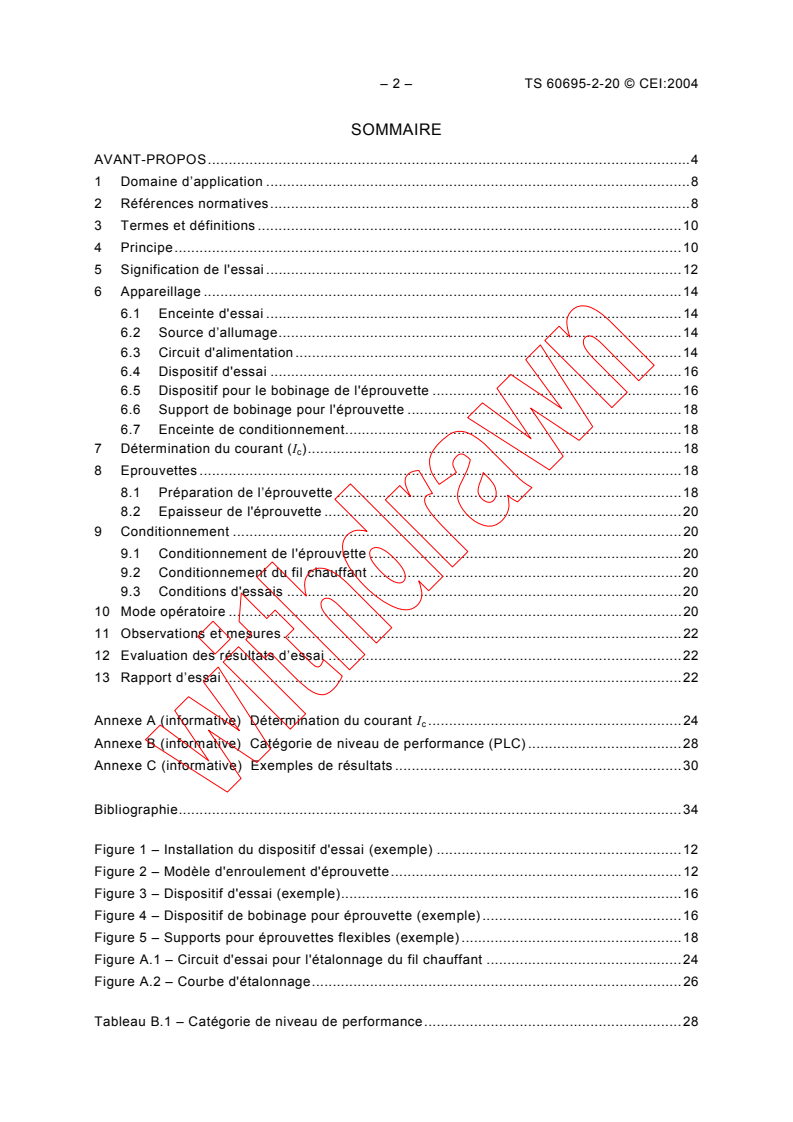
– 2 – TS 60695-2-20 © CEI:2004
SOMMAIRE
AVANT-PROPOS.4
1 Domaine d’application .8
2 Références normatives.8
3 Termes et définitions .10
4 Principe.10
5 Signification de l'essai .12
6 Appareillage .14
6.1 Enceinte d'essai .14
6.2 Source d’allumage.14
6.3 Circuit d'alimentation.14
6.4 Dispositif d'essai .16
6.5 Dispositif pour le bobinage de l'éprouvette .16
6.6 Support de bobinage pour l'éprouvette .18
6.7 Enceinte de conditionnement.18
7 Détermination du courant (I ).18
c
8 Eprouvettes .18
8.1 Préparation de l’éprouvette .18
8.2 Epaisseur de l'éprouvette .20
9 Conditionnement .20
9.1 Conditionnement de l'éprouvette .20
9.2 Conditionnement du fil chauffant .20
9.3 Conditions d'essais .20
10 Mode opératoire .20
11 Observations et mesures .22
12 Evaluation des résultats d’essai .22
13 Rapport d’essai .22
Annexe A (informative) Détermination du courant I .24
c
Annexe B (informative) Catégorie de niveau de performance (PLC) .28
Annexe C (informative) Exemples de résultats .30
Bibliographie.34
Figure 1 – Installation du dispositif d'essai (exemple) .12
Figure 2 – Modèle d'enroulement d'éprouvette.12
Figure 3 – Dispositif d'essai (exemple).16
Figure 4 – Dispositif de bobinage pour éprouvette (exemple).16
Figure 5 – Supports pour éprouvettes flexibles (exemple) .18
Figure A.1 – Circuit d'essai pour l'étalonnage du fil chauffant .24
Figure A.2 – Courbe d'étalonnage.26
Tableau B.1 – Catégorie de niveau de performance.28
TS 60695-2-20 © IEC:2004 – 3 –
CONTENTS
FOREWORD.5
1 Scope.9
2 Normative references .9
3 Terms and definitions .11
4 Principle .11
5 Significance of test .13
6 Apparatus.15
6.1 Test chamber .15
6.2 Ignition source.15
6.3 Supply circuit.15
6.4 Test fixture .17
6.5 Test specimen winding device .17
6.6 Test specimen winding support .19
6.7 Conditioning chamber.19
7 Determination of current (I ) .19
c
8 Test specimens .19
8.1 Test specimen preparation .19
8.2 Test specimen thickness .21
9 Conditioning .21
9.1 Test specimen conditioning .21
9.2 Heater wire conditioning.21
9.3 Test conditions.21
10 Test procedure .21
11 Observations and measurements.23
12 Evaluation of test results .23
13 Test report.23
Annex A (informative) Determination of current I .25
c
Annex B (informative) Performance level category (PLC) .29
Annex C (informative) Examples of results.31
Bibliography.35
Figure 1 – Test fixture arrangement (example).13
Figure 2 – Test specimen wrapping pattern.13
Figure 3 – Test fixture (example) .17
Figure 4 – Test specimen winding device (example) .17
Figure 5 – Supports for flexible test specimens (example) .19
Figure A.1 – Test circuit arrangement for heater wire calibration.25
Figure A.2 – Calibration curve.27
Table B.1 – Performance level category.29
– 4 – TS 60695-2-20 © CEI:2004
COMMISSION ÉLECTROTECHNIQUE INTERNATIONALE
____________
ESSAIS RELATIFS AUX RISQUES DU FEU –
Partie 2-20 : Méthodes d'essai au fil chauffant ou incandescent –
Allumabilité par bobine de fil chauffant –
Appareillage, méthode d’essai et lignes directrices
AVANT-PROPOS
1) La Commission Electrotechnique Internationale (CEI) est une organisation mondiale de normalisation
composée de l'ensemble des comités électrotechniques nationaux (Comités nationaux de la CEI). La CEI a
pour objet de favoriser la coopération internationale pour toutes les questions de normalisation dans les
domaines de l'électricité et de l'électronique. A cet effet, la CEI – entre autres activités – publie des Normes
internationales, des Spécifications techniques, des Rapports techniques, des Spécifications accessibles au
public (PAS) et des Guides (ci-après dénommés "Publication(s) de la CEI"). Leur élaboration est confiée à des
comités d'études, aux travaux desquels tout Comité national intéressé par le sujet traité peut participer. Les
organisations internationales, gouvernementales et non gouvernementales, en liaison avec la CEI, participent
également aux travaux. La CEI collabore étroitement avec l'Organisation Internationale de Normalisation (ISO),
selon des conditions fixées par accord entre les deux organisations.
2) Les décisions ou accords officiels de la CEI concernant les questions techniques représentent, dans la mesure
du possible, un accord international sur les sujets étudiés, étant donné que les Comités nationaux de la CEI
intéressés sont représentés dans chaque comité d’études.
3) Les Publications de la CEI se présentent sous la forme de recommandations internationales et sont agréées
comme telles par les Comités nationaux de la CEI. Tous les efforts raisonnables sont entrepris afin que la CEI
s'assure de l'exactitude du contenu technique de ses publications; la CEI ne peut pas être tenue responsable
de l'éventuelle mauvaise utilisation ou interprétation qui en est faite par un quelconque utilisateur final.
4) Dans le but d'encourager l'uniformité internationale, les Comités nationaux de la CEI s'engagent, dans toute la
mesure possible, à appliquer de façon transparente les Publications de la CEI dans leurs publications
nationales et régionales. Toutes divergences entre toutes Publications de la CEI et toutes publications
nationales ou régionales correspondantes doivent être indiquées en termes clairs dans ces dernières.
5) La CEI n’a prévu aucune procédure de marquage valant indication d’approbation et n'engage pas sa
responsabilité pour les équipements déclarés conformes à une de ses Publications.
6) Tous les utilisateurs doivent s'assurer qu'ils sont en possession de la dernière édition de cette publication.
7) Aucune responsabilité ne doit être imputée à la CEI, à ses administrateurs, employés, auxiliaires ou
mandataires, y compris ses experts particuliers et les membres de ses comités d'études et des Comités
nationaux de la CEI, pour tout préjudice causé en cas de dommages corporels et matériels, ou de tout autre
dommage de quelque nature que ce soit, directe ou indirecte, ou pour supporter les coûts (y compris les frais
de justice) et les dépenses découlant de la publication ou de l'utilisation de cette Publication de la CEI ou de
toute autre Publication de la CEI, ou au crédit qui lui est accordé.
8) L'attention est attirée sur les références normatives citées dans cette publication. L'utilisation de publications
référencées est obligatoire pour une application correcte de la présente publication.
9) L’attention est attirée sur le fait que certains des éléments de la présente Publication de la CEI peuvent faire
l’objet de droits de propriété intellectuelle ou de droits analogues. La CEI ne saurait être tenue pour
responsable de ne pas avoir identifié de tels droits de propriété et de ne pas avoir signalé leur existence.
La tâche principale des comités d’études de la CEI est l’élaboration des Normes
internationales. Exceptionnellement, un comité d’études peut proposer la publication d’une
spécification technique
• lorsqu’en dépit de maints efforts, l’accord requis ne peut être réalisé en faveur de la
publication d’une Norme internationale, ou
• lorsque le sujet en question est encore en cours de développement technique ou quand,
pour une raison quelconque, la possibilité d’un accord pour la publication d’une Norme
internationale peut être envisagée pour l’avenir mais pas dans l’immédiat.
Les spécifications techniques font l’objet d’un nouvel examen trois ans au plus tard après leur
publication afin de décider éventuellement de leur transformation en Normes internationales.
TS 60695-2-20 © IEC:2004 – 5 –
INTERNATIONAL ELECTROTECHNICAL COMMISSION
____________
FIRE HAZARD TESTING –
Part 2-20: Glowing/hot wire based test methods –
Hot-wire coil ignitability –
Apparatus, test method and guidance
FOREWORD
1) The International Electrotechnical Commission (IEC) is a worldwide organization for standardization comprising
all national electrotechnical committees (IEC National Committees). The object of IEC is to promote
international co-operation on all questions concerning standardization in the electrical and electronic fields. To
this end and in addition to other activities, IEC publishes International Standards, Technical Specifications,
Technical Reports, Publicly Available Specifications (PAS) and Guides (hereafter referred to as “IEC
Publication(s)”). Their preparation is entrusted to technical committees; any IEC National Committee interested
in the subject dealt with may participate in this preparatory work. International, governmental and non-
governmental organizations liaising with the IEC also participate in this preparation. IEC collaborates closely
with the International Organization for Standardization (ISO) in accordance with conditions determined by
agreement between the two organizations.
2) The formal decisions or agreements of IEC on technical matters express, as nearly as possible, an international
consensus of opinion on the relevant subjects since each technical committee has representation from all
interested IEC National Committees.
3) IEC Publications have the form of recommendations for international use and are accepted by IEC National
Committees in that sense. While all reasonable efforts are made to ensure that the technical content of IEC
Publications is accurate, IEC cannot be held responsible for the way in which they are used or for any
misinterpretation by any end user.
4) In order to promote international uniformity, IEC National Committees undertake to apply IEC Publications
transparently to the maximum extent possible in their national and regional publications. Any divergence
between any IEC Publication and the corresponding national or regional publication shall be clearly indicated in
the latter.
5) IEC provides no marking procedure to indicate its approval and cannot be rendered responsible for any
equipment declared to be in conformity with an IEC Publication.
6) All users should ensure that they have the latest edition of this publication.
7) No liability shall attach to IEC or its directors, employees, servants or agents including individual experts and
members of its technical committees and IEC National Committees for any personal injury, property damage or
other damage of any nature whatsoever, whether direct or indirect, or for costs (including legal fees) and
expenses arising out of the publication, use of, or reliance upon, this IEC Publication or any other IEC
Publications.
8) Attention is drawn to the Normative references cited in this publication. Use of the referenced publications is
indispensable for the correct application of this publication.
9) Attention is drawn to the possibility that some of the elements of this IEC Publication may be the subject of
patent rights. IEC shall not be held responsible for identifying any or all such patent rights.
The main task of IEC technical committees is to prepare International Standards. In
exceptional circumstances, a technical committee may propose the publication of a technical
specification when
• the required support cannot be obtained for the publication of an International Standard,
despite repeated efforts, or
• The subject is still under technical development or where, for any other reason, there is
the future but no immediate possibility of an agreement on an International Standard.
Technical specifications are subject to review within three years of publication to decide
whether they can be transformed into International Standards.
– 6 – TS 60695-2-20 © CEI:2004
La CEI 60695-2-20, qui est une spécification technique, a été établie par le comité d'études
89 de la CEI: Essais relatifs aux risques du feu.
Cette seconde édition annule et remplace la première édition publiée en 1995 dont elle
constitue une révision technique.
Le statut de la présente publication a été modifié et, de norme internationale, elle est
devenue spécification technique, toutefois sa structure et sa présentation restent
essentiellement les mêmes. Chaque aspect technique de la présente méthode d'essai a été
revu dans le but d'améliorer à la fois la répétabilité et la reproductibilité. L'annexe A a été
ajoutée pour la détermination du courant d'essai I . L'annexe B a été ajoutée pour introduire
c
le concept de catégorie de niveau de performance (Performance Level Category - PLC).
Elle a le statut de publication fondamentale de sécurité, conformément au Guide CEI 104.
Le texte de cette spécification technique est issu des documents suivants:
Projet d’enquête Rapport de vote
89/594/DTS 89/626/RVC
Le rapport de vote indiqué dans le tableau ci-dessus donne toute information sur le vote ayant
abouti à l'approbation de cette spécification technique.
Cette publication a été rédigée selon les Directives ISO/CEI, Partie 2
Le comité a décidé que le contenu de cette publication ne sera pas modifié avant 2009.
A cette date, la publication sera
• transformée en Norme internationale;
• reconduite;
• supprimée;
• remplacée par une édition révisée, ou
• amendée.
La CEI 60695-2, présentée sous le titre général Essais relatifs aux risques du feu – Partie 2:
Essais au fil incandescent/chauffant, comprend les parties suivantes:
Partie 2-10: Appareillage et méthode commune d’essai
Partie 2-11: Méthode d’essai d’inflammabilité pour produits finis
Partie 2-12: Méthode d’essai d’inflammabilité sur matériaux
Partie 2-13: Méthode d’essai d’allumabilité pour matériaux
Partie 2-20: Allumabilité par bobine de fil chauffant – Appareillage, méthode d’essai et lignes
directrices
TS 60695-2-20 © IEC:2004 – 7 –
IEC 60695-2-20, which is a technical specification, has been prepared by IEC technical
committee 89: Fire hazard testing.
This second edition cancels and replaces the first edition published in 1995, and constitutes
a technical revision.
The status of this publication has been reassigned from an International Standard to a
Technical Specification, however, the structure and layout remains essentially the same.
Every technical aspect of this test method has been reviewed in an attempt to improve both
the repeatability and reproducibility. Annex A has been added for the determination of the test
current I . Annex B has been added which introduces the concept of a Performance Level
c
Category (PLC).
It has the status of a basic safety publication in accordance with IEC Guide 104.
The text of this technical specification is based on the following documents:
Enquiry draft Report on voting
89/594/DTS 89/626/RVC
Full information on the voting for the approval of this technical specification can be found in
the report on voting indicated in the above table.
This publication has been drafted in accordance with the ISO/IEC Directives, Part 2.
The committee has decided that the contents of this publication will remain unchanged until
2009. At this date, the publication will be
• transformed into an International Standard;
• reconfirmed;
• withdrawn;
• replaced by a revised edition, or
• amended.
IEC 60695-2, under the general heading Fire hazard testing – Part 2: Glowing/hot-wire based
test methods, consists of the following parts:
Part 2-10: Glow-wire apparatus and common test procedure
Part 2-11: Glow-wire flammability test method for end-products
Part 2-12: Glow-wire flammability test method for materials
Part 2-13: Glow-wire ignitability test method for materials
Part 2-20: Hot-wire coil ignitability: Apparatus, test method and guidance
– 8 – TS 60695-2-20 © CEI:2004
ESSAIS RELATIFS AUX RISQUES DU FEU –
Partie 2-20: Méthodes d'essai à fil chauffant ou incandescent –
Allumabilité par bobine de fil chauffant –
Appareillage, méthode d’essai et lignes directrices
1 Domaine d’application
La présente spécification technique est applicable aux matériaux isolants électriques solides.
Elle est destinée à mesurer le temps nécessaire pour allumer une éprouvette exposée à la
chaleur libérée par une bobine chauffée électriquement et utilisée comme source d'allumage.
Cette méthode d'essai n'est pas valable pour la détermination du comportement à l’allumage
de parties entières d'appareils dans la mesure où les dimensions des systèmes isolants ou
des parties combustibles, leur conception et la transmission de la chaleur aux parties
métalliques ou non métalliques adjacentes, etc. influencent profondément l'allumabilité des
matériaux isolants électriques qui sont utilisés. Par ailleurs, cette méthode n'est pas valable
pour la détermination du comportement au feu et du risque d'incendie des matériels.
Les données peuvent être utilisées pour la préselection d'un matériau comme cela est décrit
dans la CEI 60695-1-30.
Le système de catégorie de niveau de performance (PLC) décrit à l'Annexe B mais qui est
facultatif est destiné à la présélection des matériaux des composants des produits.
La CEI 60695-2-13 constitue un autre essai pour la mesure de l’allumabilité. Toutefois,
aucune corrélation n'a été établie entre la CEI 60695-2-20 et la CEI 60695-2-13.
L’une des responsabilités d’un comité d’études est d’utiliser, à chaque fois qu’elles sont
applicables, les publications fondamentales de sécurité dans la préparation de ses
publications.
2 Références normatives
Les documents de référence suivants sont indispensables pour l'application du présent
document. Pour les références datées, seule l'édition citée s'applique. Pour les références
non datées, la dernière édition du document de référence s'applique (y compris les éventuels
amendements).
CEI 60695-1-30:2002, Essais relatifs aux risques du feu - Partie 1-30: Guide pour l’évaluation
des risques du feu des produits électrotechniques – Utilisation des procédures d’essais de
présélection
Guide CEI 104:1997, Elaboration des publications de sécurité et utilisation des publications
fondamentales de sécurité et des publications groupées de sécurité
ISO/CEI 13943:2000, Sécurité au feu - Vocabulaire
ISO 291:1997, Plastiques – Atmosphères normales de conditionnement et d'essai
ISO 293:1986, Plastiques – Moulage par compression des éprouvettes en matières
thermoplastiques
ISO 294 (toutes les parties), Plastiques – Moulage par injection des éprouvettes de matériaux
thermoplastiques
ISO 295:1991, Plastiques – Moulage par compression des éprouvettes en matières
thermodurcissables (disponible en anglais seulement)
TS 60695-2-20 © IEC:2004 – 9 –
FIRE HAZARD TESTING –
Part 2-20: Glowing/hot wire based test methods –
Hot-wire coil ignitability –
Apparatus, test method and guidance
1 Scope
This technical specification is applicable to solid electrical insulating materials. It is intended
to measure the time required to ignite the test specimen during the application of heat from an
electrically heated coil as an ignition source.
This test method is not valid for determining the ignition behaviour of complete items of
equipment, since the dimensions of the insulating systems or combustible parts, the design
and heat transfer to adjacent metallic or non-metallic parts, etc. greatly influence the
ignitability of the electrical insulating materials used therein. In addition, it is not valid for
determining fire behaviour and fire hazard of equipment.
The data may be used for the preselection of a material as described in IEC 60695-1-30.
The optional Performance Level Category (PLC) system described in Annex B is intended for
the preselection of component materials for products.
An alternative test for ignitability is IEC 60695-2-13. However, no correlation has been
established between IEC 60695-2-20 and IEC 60695-2-13.
One of the responsibilities of a technical committee is, wherever applicable, to make use of
basic safety publications in the preparation of its publications.
2 Normative references
The following referenced documents are indispensable for the application of this document.
For dated references, only the edition cited applies. For undated references, the latest edition
of the referenced document (including any amendments) applies.
IEC 60695-1-30:2002, Fire hazard testing – Part 1-30: Guidance for assessing the fire hazard
of electrotechnical products – Use of preselection testing procedures
IEC Guide 104: The preparation of safety publications and the use of basic safety publications
and group safety publications
ISO/IEC 13943:2000, Fire safety – Vocabulary
ISO 291:1997, Plastics – Standard atmospheres for conditioning and testing
ISO 293:1986, Plastics – Compression moulding test specimens of thermoplastic materials
ISO 294 (all parts), Plastics – Injection moulding of test specimens of thermoplastic materials
ISO 295:1991, Plastics – Compression moulding of test specimens of thermosetting materials
– 10 – TS 60695-2-20 © CEI:2004
3 Termes et définitions
Pour les besoins du présent document, les définitions de l’ISO/CEI 13943 ainsi que les
termes et définitions suivants s’appliquent:
3.1
combustion
réaction exothermique d'une substance avec un comburant
NOTE La combustion émet généralement des effluents accompagnés de flammes et/ou d'incandescence.
[ISO/CEI 13943, définition 23]
3.2
courant I
c
courant produisant une densité de puissance linéique de 0,26 W/mm ± 0,01 W/mm dans le fil
chauffant
3.3
environnement sans tirage
environnement dans lequel les résultats des expériences ne sont pas affectés de manière
significative par la vitesse de l'air local
3.4
allumage
démarrage d'une combustion avec flamme
3.5
fondu
condition qui existe lorsque l'éprouvette a fondu sans allumage et qu'elle n'est plus en contact
avec une quelconque partie du fil chauffant
4 Principe
Une éprouvette rectangulaire en forme de barre est placée horizontalement et soutenue à ses
extrémités comme cela est représenté à la Figure 1. La partie centrale est bobinée avec le fil
chauffant comme cela est représenté à la Figure 2. Une densité de puissance fixe est
appliquée à la bobine, qui chauffe rapidement et le comportement de l'éprouvette est observé.
Le temps nécessaire à l'allumage est enregistré et/ou une condition de fondu est enregistrée
comme M.
TS 60695-2-20 © IEC:2004 – 11 –
3 Terms and definitions
For the purposes of this document, the definitions taken from ISO/IEC 13943, together with
the following terms and definitions, apply:
3.1
combustion
exothermic reaction of a substance with an oxidizer
NOTE Combustion generally emits effluent accompanied by flames and/or visible light.
[ISO/IEC 13943, definition 23]
3.2
current I
c
current yielding a linear power density of 0,26 W/mm ± 0,01 W/mm through the heater wire
3.3
draught-free environment
environment in which the results of experiments are not significantly affected by the local air
speed
3.4
ignition
initiation of flaming combustion
3.5
melt through
condition existing where the test specimen has melted without ignition and is no longer in
contact with any part of the heater wire
4 Principle
A rectangular bar-shaped test specimen is supported horizontally at both ends as shown in
Figure 1. The centre portion is wrapped with a coil of heater wire as shown in Figure 2. A
fixed power density is applied to the coil, which rapidly heats up and the behaviour of the test
specimen is observed. The time to ignition is recorded and/or a melt through condition is
recorded as M.
– 12 – TS 60695-2-20 © CEI:2004
IEC 118/04
Figure 1 – Installation du dispositif d'essai (exemple)
Connexions électriques
35 mm ± 1 mm
IEC 119/04
Figure 2 – Modèle d'enroulement d'éprouvette
5 Signification de l'essai
Dans certaines conditions de fonctionnement ou lorsque des dysfonctionnements
apparaissent, il est possible que des composants électriques tels que les fils, les résistances
ou d'autres conducteurs deviennent anormalement chauds. Lorsque ce phénomène se
produit, il est possible qu'il entraîne un allumage des matériaux isolants.
La présente méthode d'essai évalue la résistance relative des matériaux isolants électriques
à l'allumage sous l'effet d'un fil chauffant.
Les essais réalisés sur un matériau dans les conditions spécifiées ici peuvent avoir une
valeur très importante pour la comparaison du comportement d'allumage relatif de différents
matériaux, en contrôlant les processus de fabrication ou en évaluant tout changement des
caractéristiques d'allumage. Les résultats obtenus grâce à la présente méthode dépendent de
la forme de l'éprouvette, de son environnement immédiat ainsi que des conditions d'allumage.
TS 60695-2-20 © IEC:2004 – 13 –
IEC 118/04
Figure 1 – Test fixture arrangement (example)
Electrical connections
35 mm ± 1 mm
IEC 119/04
Figure 2 – Test specimen wrapping pattern
5 Significance of test
Under certain conditions of operation, or when malfunctions occur, it is possible that electrical
components such as wires, resistors, or other conductors become abnormally hot. When this
happens ignition of insulating materials is a possible result.
This test method assesses the relative resistance of electrical insulating materials to ignition
by the effects of a hot wire.
Tests made on a material under the conditions specified herein can be of considerable value
when comparing the relative ignition behaviour of different materials, controlling
manufacturing processes or assessing any changes in ignition characteristics. The results
obtained from this method are dependent on the shape and environment surrounding the test
specimen, and on the conditions of ignition.
– 14 – TS 60695-2-20 © CEI:2004
6 Appareillage
L'appareillage comprend les éléments indiqués ci-après.
6.1 Enceinte d'essai
La hotte/enceinte du laboratoire doit avoir un volume intérieur d'au moins 0,5 m . L'enceinte
doit assurer un environnement sans tirage, tout en permettant une circulation thermique
normale de l'air au-delà de l'éprouvette. L'enceinte doit permettre d'observer le déroulement
de l'essai. Les surfaces intérieures des parois doivent être de couleur sombre. Pour des
raisons de sécurité et de commodité, il est souhaitable que l'enceinte (qui peut être
complètement fermée) soit équipée d'un dispositif d'extraction, comme un ventilateur aspirant,
pour éliminer les effluents du feu qui peuvent être toxiques. Le dispositif d'extraction doit être
à l'arrêt pendant l'essai et il doit être mis en marche immédiatement à la fin de l'essai. Un
registre à fermeture positive peut être nécessaire.
NOTE Qualitativement, il convient que l’enceinte d’essai soit dans un environnement dans lequel la flamme d'une
bougie n'est pas réellement affectée; quantitativement, il convient que l’enceinte d’essai soit dans un
environnement dans lequel la vitesse de l'air n'est pas supérieure à 0,1 m/s.
Avertissement – Il faut prendre des précautions pour préserver la santé du personnel qui
conduit les essais notamment par rapport
− aux risques du feu;
− à l'inhalation de fumées et/ou de produits toxiques;
− aux résidus toxiques.
6.2 Source d’allumage
Fil chauffant en NiCr (80/20), composé de 80 % de nickel et de 20 % de chrome ayant un
+0,02
diamètre de 0,5 mm mm et une longueur minimale de 250 mm. Ce fil chauffant est
bobiné autour de la partie centrale de l'éprouvette en faisant cinq tours.
NOTE Le fil chauffant NiCr (80/20) a une résistance nominale au froid d'environ 5,25 Ω/m.
6.3 Circuit d'alimentation
Un dispositif doit être prévu pour chauffer électriquement le fil chauffant. Le circuit
d'alimentation doit présenter les caractéristiques suivantes :
a) une puissance suffisante pour maintenir une densité de puissance linéique continue de
48 Hz à 62 Hz d'au moins 0,31 W/mm sur la longueur du fil chauffant avec un facteur de
puissance proche ou égal à l'unité;
NOTE 1 Dans un souci de sécurité, il convient d'utiliser un transformateur de séparation.
b) un dispositif permettant de régler le niveau de puissance de manière régulière et continue;
c) un dispositif permettant de mesurer le courant du fil chauffant avec une précision de
±2 %;
NOTE 2 Une option consiste à mesurer la densité de puissance de manière directe et à la maintenir
automatiquement.
d) la connexion électrique avec le fil chauffant doit être capable de transmettre la puissance
d'essai sans perte significative et ne doit pas affecter mécaniquement l'éprouvette au
cours de l'essai. Un montage type est représenté à la Figure 1.
NOTE 3 L'essai doit être réalisé dans un environnement sans tirage dans lequel
a) qualitativement, la flamme d'une bougie n'est pas réellement affectée ; et
b) quantitativement, la vitesse de l'air n'est pas supérieure à 0,1 m/s.
Le circuit d'alimentation doit être équipé d'un disjoncteur pour la puissance d'essai et de
minuteries pour enregistrer la durée d'application de la puissance d'essai.
TS 60695-2-20 © IEC:2004 – 15 –
6 Apparatus
The apparatus is composed of the elements listed below.
6.1 Test chamber
The laboratory fumehood/chamber shall have an inside volume of at least 0,5 m . The
chamber shall provide a draught-free environment whilst allowing normal thermal circulation
of air past the test specimen. The chamber shall permit observation of the test in progress.
The inside surfaces of the walls shall be of a dark colour. For safety and convenience, it is
desirable that this enclosure (which can be completely closed) be fitted with an extraction
device, such as an exhaust fan, to remove the fire effluent which may be toxic. The extraction
device shall be turned off during the test and turned on immediately after the test. A positive
closing damper may be needed.
NOTE Qualitatively, the test chamber should have an environment in which a wax candle flame remains
essentially undisturbed; quantitatively, it should have an environment in which the air speed is not greater than 0,1
m/s.
Warning note – Precautions must be taken to safeguard the health of personnel conducting
tests against:
− the risk of fire;
− the inhalation of smoke and/or toxic products;
− the toxic residues.
6.2 Ignition source
NiCr (80/20) heater wire, having a normal composition of 80 % nickel and 20 % chromium,
+0,02
having a diameter of 0,5 mm mm and a minimum length of 250 mm. This heater wire is
coiled around the centre portion of the test specimen by applying five turns.
NOTE NiCr (80/20) heater wire has a nominal cold resistance of approximately 5,25 Ω/m.
6.3 Supply circuit
A means for electrically energizing the heater wire shall be provided. The supply circuit shall
have the following capabilities:
a) sufficient capacity to maintain a continuous linear 48 Hz to 62 Hz power density of at least
0,31 W/mm over the length of the heater wire at or near unity power factor;
NOTE 1 An isolating transformer should be used for safety.
b) a means of adjusting the power level smoothly and continuously;
c) a means of measuring the heater wire current to within ± 2 %;
NOTE 2 Measuring the power density directly and maintaining it automatically is an option.
d) the electrical connection to the heater wire shall be capable of transmitting the test power
without significant loss and shall not mechanically affect the test specimen during the test.
A typical arrangement is shown in Figure 1.
NOTE 3 The test shall be conducted in a draught-f
...