

IEC 60079-29-2:2007
(Main)Explosive atmospheres - Part 29-2: Gas detectors - Selection, installation, use and maintenance of detectors for flammable gases and oxygen
General Information
- Abstract
This part of IEC 60079-29 gives guidance on, and recommended practice for, the selection, installation, safe use and maintenance of electrically operated group II apparatus intended for use in industrial and commercial safety applications for the detection and measurement of flammable gases complying with the requirements of IEC 60079-29-1.This first edition of IEC 60079-29-2 cancels and replaces the first edition of IEC 61779-6:1999 and constitutes a technical revision with many changes with respect to the previous edition.
- Status
- Published
- Publication Date
- 15-Aug-2007
- Technical Committee
- TC 31 - Equipment for explosive atmospheres
- Drafting Committee
- MT 60079-29 - TC 31/MT 60079-29
- Current Stage
- DELPUB - Deleted Publication
- Start Date
- 16-Mar-2015
- Completion Date
- 28-Aug-2026
Overview
IEC 60079-29-2:2007 is an international standard published by the International Electrotechnical Commission (IEC) focusing on safety in explosive atmospheres. It provides comprehensive guidance for the selection, installation, use, and maintenance of gas detectors specifically designed for detecting flammable gases and oxygen. The standard targets electrically operated gas detection apparatus intended for industrial and commercial safety applications, complying with the requirements detailed in IEC 60079-29-1.
This first edition cancels and replaces IEC 61779-6:1999, offering significant technical revisions to enhance safety and operational reliability. The standard addresses key aspects such as gas properties, sensor technologies, installation protocols, and operational safety measures critical for preventing hazardous events in explosive atmospheres.
Key Topics
Gas Properties and Detection Principles
- Understanding the properties and behaviors of flammable gases and vapors.
- Differentiating between gas and vapor detection.
- Oxygen deficiency causes and effects in confined environments.
Sensor Technologies
IEC 60079-29-2 details various sensor types commonly employed in gas detection including:
- Catalytic sensors – suited for many flammable gases but susceptible to poisoning.
- Thermal conductivity sensors – for gases differing in thermal conductivity from air.
- Infrared sensors – effective in detecting hydrocarbons and certain gases, with limitations based on interferences.
- Semiconductor and electrochemical sensors – used for specific applications and gases.
- Additional types such as Flame Ionization Detectors (FID), Flame Temperature Analyzers (FTA), Photo Ionization Detectors (PID), and paramagnetic oxygen detectors.
Selection Criteria for Gas Detectors
- Determining suitable detectors based on the types of gases to be monitored.
- Considering environmental factors, gas concentration ranges, and potential interferences.
- Use of transportable vs. fixed gas detection systems based on operational needs.
Installation and Maintenance Best Practices
- Proper placement of detectors considering gas release behaviors, ventilation, and environmental conditions.
- Ensuring access for calibration and routine maintenance.
- Implementation of safety features such as power supply redundancy and system integrity.
- Procedures for commissioning, including initial calibration and alarm configuration.
Use of Portable and Transportable Devices
- Operational safety guidelines for personnel.
- Inspection, field checks, and recalibration intervals.
- Handling sensor poisoning risks and mitigating accidental damage.
- Sampling techniques including measurements above liquids and dealing with condensation risks.
Applications
IEC 60079-29-2 is essential for professionals involved in hazardous area safety management across industries such as:
- Oil and gas production – monitoring flammable hydrocarbon gases.
- Chemical manufacturing – detecting toxic and explosive gas leaks.
- Mining operations – managing flammable atmospheres underground.
- Pharmaceutical and food processing – maintaining oxygen levels and detecting flammable vapors.
- Commercial facilities – such as warehouses and fuel storage sites requiring gas safety controls.
Adherence to this standard helps prevent explosions, protect personnel, and ensure compliance with international safety regulations.
Related Standards
- IEC 60079-29-1: Specifies performance requirements for flammable gas detectors.
- IEC 60079 series: Covers general and specific requirements for equipment used in explosive atmospheres.
- IEC 61779 series: Previous editions related to portable gas detectors, now superseded by IEC 60079-29-2.
- ISO/IEC 80079 series: Addresses safety requirements for non-electrical equipment in explosive atmospheres.
Following these standards ensures a harmonized approach to gas detection safety, ensuring reliable operation in hazardous environments and minimizing risks of ignition or oxygen deficiency.
Adopting the IEC 60079-29-2 guidelines is critical for organizations aiming to enhance flammable gas detection systems' performance, safety, and maintenance effectiveness in explosive atmospheres worldwide.
Relations
- Effective Date
- 05-Sep-2023
- Effective Date
- 25-Aug-2026
- Referred By
EN ISO 21049:2004 - Pumps - Shaft sealing systems for centrifugal and rotary pumps (ISO 21049:2004) - Effective Date
- 25-Aug-2026
- Effective Date
- 25-Aug-2026
- Effective Date
- 25-Aug-2026
- Effective Date
- 25-Aug-2026
- Effective Date
- 25-Aug-2026
- Effective Date
- 05-Sep-2023
Get Certified
Connect with accredited certification bodies for this standard

IMQ S.p.A. (Certification)
Italian electrical product certification.

SLG Prüf- und Zertifizierungs GmbH
German testing and certification body.

UL Solutions
Global safety science company with testing, inspection and certification.
Sponsored listings
Frequently Asked Questions
IEC 60079-29-2:2007 is a standard published by the International Electrotechnical Commission (IEC). Its full title is "Explosive atmospheres - Part 29-2: Gas detectors - Selection, installation, use and maintenance of detectors for flammable gases and oxygen". This standard covers: This part of IEC 60079-29 gives guidance on, and recommended practice for, the selection, installation, safe use and maintenance of electrically operated group II apparatus intended for use in industrial and commercial safety applications for the detection and measurement of flammable gases complying with the requirements of IEC 60079-29-1.This first edition of IEC 60079-29-2 cancels and replaces the first edition of IEC 61779-6:1999 and constitutes a technical revision with many changes with respect to the previous edition.
This part of IEC 60079-29 gives guidance on, and recommended practice for, the selection, installation, safe use and maintenance of electrically operated group II apparatus intended for use in industrial and commercial safety applications for the detection and measurement of flammable gases complying with the requirements of IEC 60079-29-1.This first edition of IEC 60079-29-2 cancels and replaces the first edition of IEC 61779-6:1999 and constitutes a technical revision with many changes with respect to the previous edition.
IEC 60079-29-2:2007 is classified under the following ICS (International Classification for Standards) categories: 29.260.20 - Electrical apparatus for explosive atmospheres. The ICS classification helps identify the subject area and facilitates finding related standards.
IEC 60079-29-2:2007 has the following relationships with other standards: It is inter standard links to IEC 61779-6:1999, EN ISO 10438-1:2007, EN ISO 21049:2004, EN ISO 10440-1:2007, EN ISO 13705:2012, EN ISO 10437:2003, EN ISO 13631:2002, IEC 60079-29-2:2015. Understanding these relationships helps ensure you are using the most current and applicable version of the standard.
IEC 60079-29-2:2007 is available in PDF format for immediate download after purchase. The document can be added to your cart and obtained through the secure checkout process. Digital delivery ensures instant access to the complete standard document.
Standards Content (Sample)
IEC 60079-29-2
Edition 1.0 2007-08
INTERNATIONAL
STANDARD
NORME
INTERNATIONALE
Explosive atmospheres –
Part 29-2: Gas detectors – Selection, installation, use and maintenance of
detectors for flammable gases and oxygen
Atmosphères explosives –
Partie 29-2: Détecteurs de gaz – Sélection, installation, utilisation et maintenance
des détecteurs de gaz inflammables et d’oxygène
All rights reserved. Unless otherwise specified, no part of this publication may be reproduced or utilized in any form or by
any means, electronic or mechanical, including photocopying and microfilm, without permission in writing from either IEC or
IEC's member National Committee in the country of the requester.
If you have any questions about IEC copyright or have an enquiry about obtaining additional rights to this publication,
please contact the address below or your local IEC member National Committee for further information.
Droits de reproduction réservés. Sauf indication contraire, aucune partie de cette publication ne peut être reproduite
ni utilisée sous quelque forme que ce soit et par aucun procédé, électronique ou mécanique, y compris la photocopie
et les microfilms, sans l'accord écrit de la CEI ou du Comité national de la CEI du pays du demandeur.
Si vous avez des questions sur le copyright de la CEI ou si vous désirez obtenir des droits supplémentaires sur cette
publication, utilisez les coordonnées ci-après ou contactez le Comité national de la CEI de votre pays de résidence.
IEC Central Office
3, rue de Varembé
CH-1211 Geneva 20
Switzerland
Email: inmail@iec.ch
Web: www.iec.ch
About the IEC
The International Electrotechnical Commission (IEC) is the leading global organization that prepares and publishes
International Standards for all electrical, electronic and related technologies.
About IEC publications
The technical content of IEC publications is kept under constant review by the IEC. Please make sure that you have the
latest edition, a corrigenda or an amendment might have been published.
ƒ Catalogue of IEC publications: www.iec.ch/searchpub
The IEC on-line Catalogue enables you to search by a variety of criteria (reference number, text, technical committee,…).
It also gives information on projects, withdrawn and replaced publications.
ƒ IEC Just Published: www.iec.ch/online_news/justpub
Stay up to date on all new IEC publications. Just Published details twice a month all new publications released. Available
on-line and also by email.
ƒ Electropedia: www.electropedia.org
The world's leading online dictionary of electronic and electrical terms containing more than 20 000 terms and definitions
in English and French, with equivalent terms in additional languages. Also known as the International Electrotechnical
Vocabulary online.
ƒ Customer Service Centre: www.iec.ch/webstore/custserv
If you wish to give us your feedback on this publication or need further assistance, please visit the Customer Service
Centre FAQ or contact us:
Email: csc@iec.ch
Tel.: +41 22 919 02 11
Fax: +41 22 919 03 00
A propos de la CEI
La Commission Electrotechnique Internationale (CEI) est la première organisation mondiale qui élabore et publie des
normes internationales pour tout ce qui a trait à l'électricité, à l'électronique et aux technologies apparentées.
A propos des publications CEI
Le contenu technique des publications de la CEI est constamment revu. Veuillez vous assurer que vous possédez
l’édition la plus récente, un corrigendum ou amendement peut avoir été publié.
ƒ Catalogue des publications de la CEI: www.iec.ch/searchpub/cur_fut-f.htm
Le Catalogue en-ligne de la CEI vous permet d’effectuer des recherches en utilisant différents critères (numéro de référence,
texte, comité d’études,…). Il donne aussi des informations sur les projets et les publications retirées ou remplacées.
ƒ Just Published CEI: www.iec.ch/online_news/justpub
Restez informé sur les nouvelles publications de la CEI. Just Published détaille deux fois par mois les nouvelles
publications parues. Disponible en-ligne et aussi par email.
ƒ Electropedia: www.electropedia.org
Le premier dictionnaire en ligne au monde de termes électroniques et électriques. Il contient plus de 20 000 termes et
définitions en anglais et en français, ainsi que les termes équivalents dans les langues additionnelles. Egalement appelé
Vocabulaire Electrotechnique International en ligne.
ƒ Service Clients: www.iec.ch/webstore/custserv/custserv_entry-f.htm
Si vous désirez nous donner des commentaires sur cette publication ou si vous avez des questions, visitez le FAQ du
Service clients ou contactez-nous:
Email: csc@iec.ch
Tél.: +41 22 919 02 11
Fax: +41 22 919 03 00
IEC 60079-29-2
Edition 1.0 2007-08
INTERNATIONAL
STANDARD
NORME
INTERNATIONALE
Explosive atmospheres –
Part 29-2: Gas detectors – Selection, installation, use and maintenance of
detectors for flammable gases and oxygen
Atmosphères explosives –
Partie 29-2: Détecteurs de gaz – Sélection, installation, utilisation et
maintenance des détecteurs de gaz inflammables et d’oxygène
INTERNATIONAL
ELECTROTECHNICAL
COMMISSION
COMMISSION
ELECTROTECHNIQUE
PRICE CODE
INTERNATIONALE
XD
CODE PRIX
ICS 29.260.20 ISBN 2-8318-9247-3
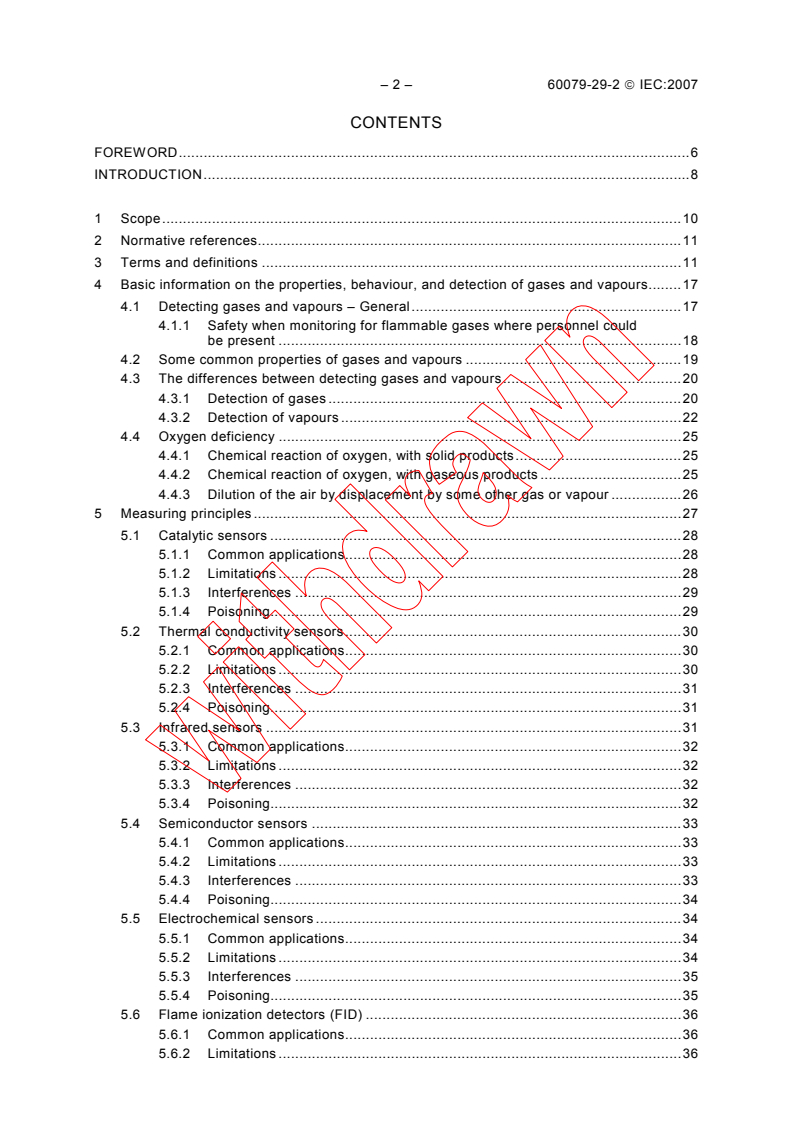
– 2 – 60079-29-2 © IEC:2007
CONTENTS
FOREWORD.6
INTRODUCTION.8
1 Scope.10
2 Normative references.11
3 Terms and definitions .11
4 Basic information on the properties, behaviour, and detection of gases and vapours.17
4.1 Detecting gases and vapours – General.17
4.1.1 Safety when monitoring for flammable gases where personnel could
be present .18
4.2 Some common properties of gases and vapours .19
4.3 The differences between detecting gases and vapours.20
4.3.1 Detection of gases .20
4.3.2 Detection of vapours .22
4.4 Oxygen deficiency .25
4.4.1 Chemical reaction of oxygen, with solid products.25
4.4.2 Chemical reaction of oxygen, with gaseous products .25
4.4.3 Dilution of the air by displacement by some other gas or vapour .26
5 Measuring principles .27
5.1 Catalytic sensors .28
5.1.1 Common applications.28
5.1.2 Limitations .28
5.1.3 Interferences .29
5.1.4 Poisoning.29
5.2 Thermal conductivity sensors.30
5.2.1 Common applications.30
5.2.2 Limitations .30
5.2.3 Interferences .31
5.2.4 Poisoning.31
5.3 Infrared sensors .31
5.3.1 Common applications.32
5.3.2 Limitations .32
5.3.3 Interferences .32
5.3.4 Poisoning.32
5.4 Semiconductor sensors .33
5.4.1 Common applications.33
5.4.2 Limitations .33
5.4.3 Interferences .33
5.4.4 Poisoning.34
5.5 Electrochemical sensors .34
5.5.1 Common applications.34
5.5.2 Limitations .34
5.5.3 Interferences .35
5.5.4 Poisoning.35
5.6 Flame ionization detectors (FID) .36
5.6.1 Common applications.36
5.6.2 Limitations .36
60079-29-2 © IEC:2007 – 3 –
5.6.3 Interferences .36
5.6.4 Poisoning.37
5.7 Flame temperature analysers (FTA).37
5.7.1 Common applications.37
5.7.2 Limitations .37
5.7.3 Interferences .37
5.7.4 Poisoning.37
5.8 Photo Ionisation Detector (PID).37
5.8.1 Common applications.38
5.8.2 Limitations .38
5.8.3 Interferences .38
5.8.4 Poisoning.38
5.9 Paramagnetic oxygen detector.39
5.9.1 Common applications.39
5.9.2 Limitations .39
5.9.3 Interference .39
5.9.4 Poisoning.39
6 Selection of apparatus .39
6.1 General .40
6.2 Selection criteria.40
6.2.1 General criteria.40
6.2.2 Gases to be detected by the apparatus .41
6.2.3 Intended application of the apparatus.43
6.2.4 Transportable apparatus .44
6.3 Miscellaneous factors affecting selection of apparatus .45
6.3.1 Electromagnetic immunity .45
6.3.2 Intended zone(s) of use .45
7 Behaviour of gas releases.45
7.1 Nature of a release .45
7.1.1 General .45
7.1.2 Release rate of gas or vapour .45
7.1.3 Flammable limits.46
7.1.4 Ventilation .46
7.1.5 Relative density of the released gas or vapour .47
7.1.6 Temperature and/or pressure.47
7.1.7 Other parameters to be considered .47
7.1.8 Outdoor sites and open structures.47
7.2 Buildings and enclosures .48
7.2.1 General .48
7.3 Unventilated buildings and enclosures .48
7.4 Ventilated buildings and enclosures .48
7.5 Natural ventilation.48
7.5.1 Mechanical ventilation.49
7.5.2 Environmental considerations .49
8 Design and installation of fixed gas detection systems.49
8.1 Basic considerations for the installation of fixed systems.50
8.2 Location of detection points .51
– 4 – 60079-29-2 © IEC:2007
8.2.1 General site considerations.51
8.2.2 Environmental conditions .52
8.3 Access for calibration and maintenance .54
8.4 Additional considerations for sample lines.55
8.5 Summary of considerations for the location of sensors or sampling points .55
8.6 Installation of sensors.56
8.7 Integrity and safety of fixed systems .57
8.7.1 General .57
8.7.2 Redundancy in fixed systems .57
8.7.3 Protection against loss of main power supply .57
8.8 Timing of installation during construction operations .58
8.9 Commissioning.58
8.9.1 Inspection.58
8.9.2 Initial gas calibration .58
8.9.3 Adjustment of alarm set points .59
8.10 Operating instructions, plans and records .59
9 Use of portable and transportable flammable gas detection apparatus.60
9.1 General .60
9.2 Initial and periodic check procedures for portable and transportable
instrumentation.61
9.2.1 Inspection and field-check (response check) .61
9.2.2 Routine checks and recalibration.62
9.2.3 Maintenance and recalibration.63
9.3 Guidance on the use of portable and transportable apparatus .64
9.3.1 Electrical safety in hazardous atmospheres .64
9.3.2 Safety of personnel.64
9.3.3 Spot tests and sampling.64
9.3.4 Sampling above liquids .65
9.3.5 Avoidance of condensation .65
9.3.6 Poisoning of sensors.65
9.3.7 Changes of temperature .65
9.3.8 Accidental damage .66
9.3.9 Minimalist operation, the “Read and run” concept .66
10 Training of operational personnel .66
10.1 General .66
10.2 General training – Basic limitations and safety .67
10.3 Operator training .68
10.4 Maintenance training .68
11 Maintenance, routine procedures and general administrative control .68
11.1 General .68
11.2 Operational checks.70
11.2.1 Fixed systems.70
11.2.2 Portable and transportable gas detection apparatus .71
11.3 Maintenance.71
11.3.1 General .71
11.3.2 Fixed apparatus .72
11.3.3 Portable and transportable gas detection apparatus .72
11.3.4 Off-site maintenance, general .72
60079-29-2 © IEC:2007 – 5 –
11.3.5 Maintenance procedures.72
11.4 Sensors.73
11.4.1 General .73
11.4.2 Flame arrestor .73
11.5 Flow systems.73
11.5.1 General .73
11.5.2 Filters, traps and flame arrestors.73
11.5.3 Flow system and sample chamber.73
11.5.4 Flow connections .73
11.5.5 Moving parts .73
11.5.6 Automatic sample-draw systems .74
11.5.7 Trouble signals .74
11.6 Readout devices.74
11.6.1 General .74
11.6.2 Other readouts.74
11.7 Alarms.74
11.8 Workshop calibration test and equipment.74
11.8.1 Calibration kits and test equipment.74
11.8.2 Conduct of workshop calibration testing .75
Annex A (normative) Measuring principles .77
Annex B (informative) Environmental parameters .97
Annex C (informative) Typical environmental and application check-list for flammable
gas detectors .98
Annex D (informative) Typical instrument maintenance record for flammable gas
detectors. 100
Bibliography . 102
Table 1 – Overview of gas detection apparatus with different measuring principles .27
Table A.1 – Overview of gas detection apparatus with different measuring principles .77
Table B.1 – Environmental parameters .97
– 6 – 60079-29-2 © IEC:2007
INTERNATIONAL ELECTROTECHNICAL COMMISSION
____________
EXPLOSIVE ATMOSPHERES –
Part 29-2: Gas detectors –
Selection, installation, use and maintenance of detectors for flammable
gases and oxygen
FOREWORD
1) The International Electrotechnical Commission (IEC) is a worldwide organization for standardization comprising
all national electrotechnical committees (IEC National Committees). The object of IEC is to promote
international co-operation on all questions concerning standardization in the electrical and electronic fields. To
this end and in addition to other activities, IEC publishes International Standards, Technical Specifications,
Technical Reports, Publicly Available Specifications (PAS) and Guides (hereafter referred to as “IEC
Publication(s)”). Their preparation is entrusted to technical committees; any IEC National Committee interested
in the subject dealt with may participate in this preparatory work. International, governmental and non-
governmental organizations liaising with the IEC also participate in this preparation. IEC collaborates closely
with the International Organization for Standardization (ISO) in accordance with conditions determined by
agreement between the two organizations.
2) The formal decisions or agreements of IEC on technical matters express, as nearly as possible, an international
consensus of opinion on the relevant subjects since each technical committee has representation from all
interested IEC National Committees.
3) IEC Publications have the form of recommendations for international use and are accepted by IEC National
Committees in that sense. While all reasonable efforts are made to ensure that the technical content of IEC
Publications is accurate, IEC cannot be held responsible for the way in which they are used or for any
misinterpretation by any end user.
4) In order to promote international uniformity, IEC National Committees undertake to apply IEC Publications
transparently to the maximum extent possible in their national and regional publications. Any divergence
between any IEC Publication and the corresponding national or regional publication shall be clearly indicated in
the latter.
5) IEC itself does not provide any attestation of conformity. Independent certification bodies provide conformity
assessment services and, in some areas, access to IEC marks of conformity. IEC is not responsible for any
services carried out by independent certification bodies.
6) All users should ensure that they have the latest edition of this publication.
7) No liability shall attach to IEC or its directors, employees, servants or agents including individual experts and
members of its technical committees and IEC National Committees for any personal injury, property damage or
other damage of any nature whatsoever, whether direct or indirect, or for costs (including legal fees) and
expenses arising out of the publication, use of, or reliance upon, this IEC Publication or any other IEC
Publications.
8) Attention is drawn to the Normative references cited in this publication. Use of the referenced publications is
indispensable for the correct application of this publication.
9) Attention is drawn to the possibility that some of the elements of this IEC Publication may be the subject of
patent rights. IEC shall not be held responsible for identifying any or all such patent rights.
International Standard IEC 60079-29-2 has been prepared by IEC technical committee 31:
Equipment for explosive atmospheres.
This first edition of IEC 60079-29-2 cancels and replaces the first edition of IEC 61779-6:1999
and constitutes a technical revision.
The main changes with respect to the previous edition are listed below:
– Introduction was modified to provide a reference table for application of the particular
document sections to specific job related functions.
– Clause 4 (Basic information on the properties, behaviour, and detection of gases and
vapours) was added for user guidance on characteristics of gases and vapours.
60079-29-2 © IEC:2007 – 7 –
– Clause 5 (Measuring principles), Clause 6 (Selection of apparatus), Clause 7
(Behaviour of gas releases), Clause 8 (Design and installation of fixed gas detection
systems), Clause 9 (Use of portable and transportable flammable gas detection
apparatus), Clause 10 (Training of operational personnel), and Clause 11
(Maintenance, routine procedures and general administrative control) were modified to
reflect the text from EN 50073 and Chapter 14 of SAI Global Limited publication HB13.
– Annex A (Flammable limits (LFL and UFL) of certain flammable gases and vapours)
was removed and replaced by a detailed review of Measuring Principles.
– Annex B (Environmental parameters) was added to provide a summary of the minimum
required environmental parameters for gas detection apparatus.
This part of IEC 60079-29 is to be used in conjunction with the following standards:
– IEC 60079-0, Electrical apparatus for explosive gas atmospheres – Part 0: General
requirements
– IEC 60079-29-1, Explosive atmospheres – Part 29-1: Gas detectors – Performance
requirements of detectors for flammable gases.
The text of this standard is based on the following documents:
FDIS Report on voting
31/696/FDIS 31/712/RVD
Full information on the voting for the approval of this standard can be found in the report on
voting indicated in the above table.
This publication has been drafted in accordance with the ISO/IEC Directives, Part 2.
A list of all parts of the IEC 60079 series, under the general title: Explosives atmospheres, can
be found on the IEC website.
The committee has decided that the contents of this publication will remain unchanged until the
maintenance result date indicated on the IEC web site under "http://webstore.iec.ch" in the data
related to the specific publication. At this date, the publication will be
• reconfirmed,
• withdrawn,
• replaced by a revised edition, or
• amended.
– 8 – 60079-29-2 © IEC:2007
INTRODUCTION
Flammable gas detection apparatus may be used whenever there is the possibility of a hazard
to life or property caused by the accumulation of a flammable gas-air mixture. Such apparatus
can provide a means of reducing the hazard by detecting the presence of a flammable gas and
issuing suitable audible or visual warnings. Gas detectors may also be used to initiate
precautionary steps (for example plant shutdown, evacuation, and operation of fire
extinguishing procedures).
Apparatus may be used to monitor a gas atmosphere below the lower flammable limit in
circumstances where accumulation of gas may result in a concentration of the gas/air mixture
to potentially explosive levels. Performance requirements for gas detecting apparatus for such
purposes are set out in IEC 60079-29-1.
However performance capability alone cannot ensure that the use of such apparatus will
properly safeguard life or property where flammable gases may be present. The level of safety
obtained depends heavily upon correct selection, installation, calibration and periodic
maintenance of the apparatus, combined with knowledge of the limitations of the detection
technique required. This cannot be achieved without responsible informed management.
An additional hazard to life is the toxicity of some gases and of the vapours of all liquids except
water. It is not generally appreciated that all flammable vapours are potentially toxic at
concentration levels which are very small fractions of their respective lower flammable limits.
Apparatus covered by the IEC 60079-29-1 is not specifically intended for toxic protection, and
additional personal protection precautions will normally be needed where personnel could be
exposed to toxic vapours.
Portable apparatus covered by the IEC 60079-29-1 and the IEC 60079-29-2 commonly have
additional detectors for specific toxic gases and also for oxygen deficiency. Users are
cautioned that even mild oxygen deficiency may be due to toxic concentrations of some other
gas or vapour, which may not be detectable or adequately detected by the apparatus in use.
General requirements for the handbook or manual of any particular flammable gas detection
apparatus are specified in IEC 60079-29-1. This standard provides some necessary
background knowledge on the points mentioned above.
This standard has been specifically written to cover all the functions necessary to go from the
need for gas detection all the way through ongoing maintenance of a successful gas detection
operation. Different clauses are appropriate for different tasks within this range of operations.
Each clause has been written as stand-alone as far as practicable. This meant that some
information is repeated in different clauses but with a different emphasis.
The following table gives a broad suggestion as to the most relevant clauses to the typically
tasks to be performed.
60079-29-2 © IEC:2007 – 9 –
Function (Clause) 3 4 5 6 7 8 9 10 11 Annex A Annex B
Authorities + +++ +++ + + - - - + - -
General management + +++ +++ + + - - + + - +
Selection +++ +++ + +++ +++ + ++ - + +++ +++
Design engineering /
+++ +++ + +++ +++ +++ - - - +++ +++
management
Installation engineering /
+++ +++ + ++ +++ +++ - - - +++ +++
management
Installation, technical ++ +++ ++ ++ ++ ++ - - - + ++
Commissioning +++ +++ ++ + ++ +++ - ++ + - -
Operations management ++ +++ ++ + + ++ ++ +++ +++ + +++
Operation training +++ +++ + + + +++ +++ +++ +++ +++ +++
Servicing / Calibration +++ +++ - - - ++ ++ + +++ ++ ++
Repair ++ +++ ++ - - + + + +++ ++ -
“+++” Essential
“++” Advisable
“+” Useful
“-“ Not applicable
NOTE It should be noted that Clause 5 is a simplified version of Annex A.
This standard makes recommendations how to establish maintenance and calibration intervals.
In certain countries there are general or industry-specific regulations that are mandatory and
those shall be followed as a minimum requirement.
Definitions
Basic information properties of gas and
vapours
Measuring principles
Selection of apparatus
Behaviour of gas releases
Design and installation of fixed gas detection
systems
Use of portable and transportable flammable
gas detection apparatus
Training of operational personnel
Maintenance, routines procedures
General administrative control
Measuring principles (full detail) (normative)
Environmental parameters (informative)
– 10 – 60079-29-2 © IEC:2007
EXPLOSIVE ATMOSPHERES –
Part 29-2: Gas detectors –
Selection, installation, use and maintenance of detectors for flammable
gases and oxygen
1 Scope
This part of IEC 60079-29 gives guidance on, and recommended practice for, the selection,
installation, safe use and maintenance of electrically operated group II apparatus intended for
use in industrial and commercial safety applications for the detection and measurement of
flammable gases complying with the requirements of IEC 60079-29-1.
This standard is applicable for oxygen measurement for the purpose of inertisation where
explosion protection is provided by the exclusion of oxygen instead of measuring the
combustible gases or vapours present.
This standard is a compilation of practical knowledge to assist the user, and applies to
apparatus, instruments and systems that indicate the presence of a flammable or potentially
explosive mixture of gas or vapour with air by using an electrical signal from a gas sensor to
produce a meter reading, to activate a visual or audible pre-set alarm or other device, or any
combination of these.
Such apparatus may be used as a means of reducing the risk whenever there is the possibility
of a risk to life or property specifically due to the accumulation of a combustible gas-air
mixture, by providing such warnings. It may also be used to initiate specific safety precautions
(e.g. plant shutdown, evacuation, fire extinguishing procedures).
This standard is applicable to all new permanent installations and, where reasonably
practicable, to existing permanent installations. It is also applicable to temporary installations,
whether new or existing.
Similarly it is applicable to the safe use of portable or transportable apparatus, irrespective of
the age or complexity of such apparatus. Since much modern apparatus of this type also
includes oxygen deficiency detection and/or specific toxic gas sensors, some additional
guidance is given for these topics.
NOTE When in classified areas, the apparatus should be so installed and used that it is not capable of itself
igniting a combustible gas-air mixture. It should therefore comply with the requirements of IEC 60079-10.
For the purposes of this standard, except where specifically stated otherwise, flammable gases
shall include flammable vapours.
This standard applies only to group II apparatus (i.e. apparatus intended for use in industrial
and commercial safety applications, involving areas classified in accordance with
IEC 60079-10).
For the purposes of this standard, apparatus includes
a) fixed apparatus;
b) transportable apparatus; and
c) portable apparatus.
60079-29-2 © IEC:2007 – 11 –
This standard is not intended to cover, but may provide useful information, for the following:
a) apparatus intended only for the detection of non-flammable toxic gases;
b) apparatus of laboratory or scientific type intended only for analysis or measurement
purposes;
c) apparatus intended for underground mining applications (group I apparatus);
d) apparatus intended only for process control applications;
e) apparatus intended for applications in explosives processing and manufacture;
f) apparatus intended for the detection of a potentially flammable atmosphere resulting from
dust or mist in air;
g) open path apparatus not used for point measurement.
2 Normative references
The following referenced documents are indispensable for the application of this document. For
dated references, only the edition cited applies. For undated references, the latest edition of
the referenced document (including any amendments) applies.
IEC 60050-426, International Electrotechnical Vocabulary (IEV) – Chapter 426: Electrical
apparatus for explosive atmospheres
IEC 60079-0, Electrical apparatus for explosive gas atmospheres – Part 0: General
requirements
IEC 60079-10, Electrical apparatus for explosive gas atmospheres – Part 10: Classification of
hazardous areas
IEC 60079-20, Electrical apparatus for explosive gas atmospheres – Part 20: Data for
flammable gases and vapours, relating to the use of electrical apparatus
IEC 60079-29-1, Explosive atmosphere – Part 29-1: Gas detectors – Performance
requirements
3 Terms and definitions
For the purposes of this document, the terms and definitions given in IEC 60050(426) and
IEC 60079-0, as well as the following apply. Also, since this is intended as a stand-alone
standard, certain definitions within IEC 60079-29-1 are repeated below for the convenience of
the reader.
3.1
alarm setpoint
fixed or adjustable setting of the apparatus that is intended to pre-set the level of concentration
at which the apparatus will automatically initiate an indication, alarm or other output function
3.2
ambient air
the normal atmosphere surrounding the apparatus
3.3
aspirated apparatus
apparatus that samples the gas by drawing it to the gas sensor – for example by means of a
hand-operated or electric pump
– 12 – 60079-29-2 © IEC:2007
3.4
catalytic sensor
sensor, the operation of which depends upon the oxidation of gases on an electrically heated
catalytic element
3.5
clean air
air that is free of flammable gases and interfering or contaminating substances
3.6
concentration
the amount of the gas or vapour of interest in a specified amount of the background gas or air,
expressed in suitable units
NOTE Typical units include volume fraction (v/v) (see 3.57); molar (moles per mole – m/m); percentage of the LFL
of a particular substance; parts per million by volume (ppm); parts per billion by volume (ppb).
3.7
continuous duty apparatus
gas detecting apparatus that is powered for long periods of time, but may have either
continuous or intermittent sensing
3.8
continuous or quasi-continuous sensing
mode of operation in which power is applied continuously to the sensing element and readings
are taken continuously or at regular and frequent intervals
3.9
diffusion apparatus
apparatus in which the transfer of gas from the atmosphere to the gas sensor takes place by
random molecular movement, i.e. under conditions in which there is no aspirated flow
3.10
dose
the total amount of substance absorbed or trapped, proportional to the concentration and the
duration of exposure
3.11
drift
variation in the apparatus indication with time at any fixed gas volume fraction (including clean
air) under constant ambient conditions
3.12
electrochemical sensor
sensor, the operation of which depends upon changes of the electrical parameters of
electrodes placed in an electrolyte due to redox reactions of the gas on the surface of the
electrodes
3.13
explosion protected apparatus
apparatus incorporating a type of protection covered by the IEC 60079 series of standards
3.14
explosive gas atmosphere
mixture with air, under normal atmospheric conditions, of flammable substances in the form of
gas or vapour, in which, after ignition, permits self-sustaining flame propagation
60079-29-2 © IEC:2007 – 13 –
NOTE 1 This definition specifically excludes dusts and fibres in suspension in air. Mists are not covered by this
standard.
NOTE 2 Although a mixture that has a concentration above the upper flammable limit (see 3.54) is not an
explosive atmosphere, in certain cases for area classification purposes, it is advisable to consider it as an explosive
gas atmosphere.
NOTE 3 Normal atmospheric conditions include variations above and below reference levels of 101,3 kPa and
20 °C provided the variations have a negligible effect on the explosive properties of the flammable materials.
3.15
explosive range
range of gas or vapour mixtures with air, with concentrations between the lower and upper
explosive (flammable) limits
3.16
field check with gas (response check)
application of test gas to the sensor to check the response signal or the generation of an
alarm, without adjustments of zero, sensitivity, or alarm level
3.17
firedamp
flammable gas, consisting mainly of methane, found naturally in mines
3.18
fixed apparatus
apparatus that is intended to have all its parts permanently installed
3.19
flame ionisation detector
FID
sensor, the operation of which depends upon the ionization of the gas being detected in a
hydrogen flame
3.20
flame temperature analyser
FTA
sensor, the operation of which depends upon the change of temperature of a flame by the gas
being detected
3.21
flammable gas
gas or vapour which, when mixed with air in a certain proportion, will form an explosive
atmosphere
NOTE For the purposes of this standard, the term "flammable gas" includes flammable vapours.
...