

IEC 60118-4:2014
(Main)Electroacoustics - Hearing aids - Part 4: Induction-loop systems for hearing aid purposes - System performance requirements
General Information
- Abstract
IEC 60118-4:2014 is applicable to audio-frequency induction-loop systems producing an alternating magnetic field at audio frequencies and intended to provide an input signal for hearing aids operating with an induction pick-up coil (telecoil). Throughout this standard, it is assumed that the hearing aids used with it conform to all relevant parts of IEC 60118. This standard specifies requirements for the field strength in audio-frequency induction loops for hearing aid purposes, which will give adequate signal-to-noise ratio without overloading the hearing aid. The standard also specifies the minimum frequency response requirements for acceptable intelligibility. Methods for measuring the magnetic field strength are specified, and information is given on appropriate measuring equipment (see Annex B), information that should be provided to the operator and users of the system (see Annex C), and other important considerations. This standard does not specify requirements for loop driver amplifiers or associated microphone or audio signal sources, which are dealt with in IEC 62489-1, or for the field strength produced by equipment, such as telephone handsets, within the scope of ITU-T P.370. This third edition cancels and replaces the second edition published in 2006. This edition constitutes a technical revision which includes the following significant technical changes with respect to the previous edition: Addition of Annexes G, H and I where more information is provided about practical considerations and methods of measurement.
- Status
- Published
- Publication Date
- 08-Nov-2017
- Technical Committee
- TC 29 - Electroacoustics
- Drafting Committee
- MT 20 - TC 29/MT 20
- Current Stage
- PPUB - Publication issued
- Start Date
- 11-Dec-2014
- Completion Date
- 15-Jan-2015
Buy Documents
IEC 60118-4:2014 - Electroacoustics - Hearing aids - Part 4: Induction-loop systems for hearing aid purposes - System performance requirements Released:12/11/2014

IEC 60118-4:2014+AMD1:2017 CSV - Electroacoustics - Hearing aids - Part 4: Induction-loop systems for hearing aid purposes - System performance requirements Released:11/9/2017
Overview
IEC 60118-4:2014 is an international standard published by the International Electrotechnical Commission (IEC) focusing on electroacoustics for hearing aids, specifically addressing induction-loop systems. These systems produce an alternating magnetic field at audio frequencies to transmit signals directly to hearing aids equipped with induction pick-up coils (telecoils). This standard sets system performance requirements ensuring effective and reliable audio signal transmission with optimal intelligibility and minimal interference.
The standard applies to audio-frequency induction-loop systems, assuming that hearing aids comply with related IEC 60118 parts. It defines requirements related to magnetic field strength, frequency response, and noise levels to maintain a good signal-to-noise ratio without overloading hearing aids. IEC 60118-4:2014 also includes detailed measurement methods, information on appropriate testing equipment, and guidance for operators and users.
Key Topics
Magnetic Field Strength Requirements
Specifies minimum and maximum magnetic field strength levels to provide adequate signal clarity and avoid hearing aid overload.Frequency Response Specifications
Defines the minimum frequency response range necessary to ensure acceptable speech intelligibility for hearing aid users.Measurement Methods and Equipment
Details standardized approaches to measuring magnetic field strength using simulated speech signals, pink noise, sinusoidal signals, and combined test signals. Annex B guides proper selection and calibration of meters and signal sources.System Setup and Commissioning
Provides a comprehensive procedure for installing, testing, and commissioning induction-loop systems to meet performance criteria and environmental suitability.Background Magnetic Noise and Interference
Establishes limits on magnetic background noise levels at installation sites and methods to assess and mitigate interference.Small-Volume System Considerations
Addresses special installation requirements for systems in confined spaces such as help points, ticket counters, and disabled refuge areas, focusing on effective coverage and signal quality.Information Provision
Annex C outlines the necessary information to provide to system operators and hearing aid users to ensure proper use and maintenance of induction-loop systems.
Applications
IEC 60118-4:2014 is critical for designing, installing, and maintaining audio-frequency induction-loop systems used in:
- Public venues like theaters, auditoriums, conference rooms, and places of worship where hearing aid users need direct audio access.
- Transportation hubs such as airports and train stations to assist passengers with hearing impairments.
- Public service counters including banks, ticket offices, and customer service points requiring clear communication.
- Emergency and safety installations like disabled refuge call points ensuring accessibility for users with hearing aids.
- Private and institutional spaces where tailored induction-loop solutions are necessary to enhance sound clarity for hearing aid wearers.
Adherence to IEC 60118-4 ensures superior system performance, compliance with international best practices, and enhanced user satisfaction for people relying on hearing aid telecoils.
Related Standards
- IEC 60118 (Series) – Covers various electroacoustic characteristics and testing methods for hearing aids and their components, providing the foundational requirements assumed in IEC 60118-4.
- IEC 62489-1 – Specifies requirements for loop driver amplifiers, microphones, and audio signal sources related to induction-loop systems, complementing the scope of IEC 60118-4.
- ITU-T P.370 – Pertains to field strength produced by telecommunication equipment such as telephone handsets, situated outside IEC 60118-4’s scope but relevant for overall electromagnetic compatibility considerations.
Keywords: IEC 60118-4, induction-loop systems, hearing aids, system performance requirements, magnetic field strength, frequency response, hearing aid telecoil, audio-frequency induction loops, hearing accessibility, electroacoustics standard.
Relations
- Effective Date
- 25-Aug-2026
- Effective Date
- 05-Sep-2023
- Effective Date
- 05-Sep-2023
Buy Documents
IEC 60118-4:2014 - Electroacoustics - Hearing aids - Part 4: Induction-loop systems for hearing aid purposes - System performance requirements Released:12/11/2014
IEC 60118-4:2014+AMD1:2017 CSV - Electroacoustics - Hearing aids - Part 4: Induction-loop systems for hearing aid purposes - System performance requirements Released:11/9/2017
Get Certified
Connect with accredited certification bodies for this standard

BSMI (Bureau of Standards, Metrology and Inspection)
Taiwan's standards and inspection authority.
Sponsored listings
Frequently Asked Questions
IEC 60118-4:2014 is a standard published by the International Electrotechnical Commission (IEC). Its full title is "Electroacoustics - Hearing aids - Part 4: Induction-loop systems for hearing aid purposes - System performance requirements". This standard covers: IEC 60118-4:2014 is applicable to audio-frequency induction-loop systems producing an alternating magnetic field at audio frequencies and intended to provide an input signal for hearing aids operating with an induction pick-up coil (telecoil). Throughout this standard, it is assumed that the hearing aids used with it conform to all relevant parts of IEC 60118. This standard specifies requirements for the field strength in audio-frequency induction loops for hearing aid purposes, which will give adequate signal-to-noise ratio without overloading the hearing aid. The standard also specifies the minimum frequency response requirements for acceptable intelligibility. Methods for measuring the magnetic field strength are specified, and information is given on appropriate measuring equipment (see Annex B), information that should be provided to the operator and users of the system (see Annex C), and other important considerations. This standard does not specify requirements for loop driver amplifiers or associated microphone or audio signal sources, which are dealt with in IEC 62489-1, or for the field strength produced by equipment, such as telephone handsets, within the scope of ITU-T P.370. This third edition cancels and replaces the second edition published in 2006. This edition constitutes a technical revision which includes the following significant technical changes with respect to the previous edition: Addition of Annexes G, H and I where more information is provided about practical considerations and methods of measurement.
IEC 60118-4:2014 is applicable to audio-frequency induction-loop systems producing an alternating magnetic field at audio frequencies and intended to provide an input signal for hearing aids operating with an induction pick-up coil (telecoil). Throughout this standard, it is assumed that the hearing aids used with it conform to all relevant parts of IEC 60118. This standard specifies requirements for the field strength in audio-frequency induction loops for hearing aid purposes, which will give adequate signal-to-noise ratio without overloading the hearing aid. The standard also specifies the minimum frequency response requirements for acceptable intelligibility. Methods for measuring the magnetic field strength are specified, and information is given on appropriate measuring equipment (see Annex B), information that should be provided to the operator and users of the system (see Annex C), and other important considerations. This standard does not specify requirements for loop driver amplifiers or associated microphone or audio signal sources, which are dealt with in IEC 62489-1, or for the field strength produced by equipment, such as telephone handsets, within the scope of ITU-T P.370. This third edition cancels and replaces the second edition published in 2006. This edition constitutes a technical revision which includes the following significant technical changes with respect to the previous edition: Addition of Annexes G, H and I where more information is provided about practical considerations and methods of measurement.
IEC 60118-4:2014 is classified under the following ICS (International Classification for Standards) categories: 17.140.50 - Electroacoustics. The ICS classification helps identify the subject area and facilitates finding related standards.
IEC 60118-4:2014 has the following relationships with other standards: It is inter standard links to EN ISO 22259:2021, IEC 60118-4:2014/AMD1:2017, IEC 60118-4:2006. Understanding these relationships helps ensure you are using the most current and applicable version of the standard.
IEC 60118-4:2014 is available in PDF format for immediate download after purchase. The document can be added to your cart and obtained through the secure checkout process. Digital delivery ensures instant access to the complete standard document.
Standards Content (Sample)
IEC 60118-4 ®
Edition 3.0 2014-12
INTERNATIONAL
STANDARD
NORME
INTERNATIONALE
colour
inside
Electroacoustics – Hearing aids –
Part 4: Induction-loop systems for hearing aid purposes – System performance
requirements
Électroacoustique – Appareils de correction auditive –
Partie 4: Systèmes de boucles d'induction utilisées à des fins de correction
auditive – Exigences de performances système
All rights reserved. Unless otherwise specified, no part of this publication may be reproduced or utilized in any form
or by any means, electronic or mechanical, including photocopying and microfilm, without permission in writing from
either IEC or IEC's member National Committee in the country of the requester. If you have any questions about IEC
copyright or have an enquiry about obtaining additional rights to this publication, please contact the address below or
your local IEC member National Committee for further information.
Droits de reproduction réservés. Sauf indication contraire, aucune partie de cette publication ne peut être reproduite
ni utilisée sous quelque forme que ce soit et par aucun procédé, électronique ou mécanique, y compris la photocopie
et les microfilms, sans l'accord écrit de l'IEC ou du Comité national de l'IEC du pays du demandeur. Si vous avez des
questions sur le copyright de l'IEC ou si vous désirez obtenir des droits supplémentaires sur cette publication, utilisez
les coordonnées ci-après ou contactez le Comité national de l'IEC de votre pays de résidence.
IEC Central Office Tel.: +41 22 919 02 11
3, rue de Varembé Fax: +41 22 919 03 00
CH-1211 Geneva 20 info@iec.ch
Switzerland www.iec.ch
About the IEC
The International Electrotechnical Commission (IEC) is the leading global organization that prepares and publishes
International Standards for all electrical, electronic and related technologies.
About IEC publications
The technical content of IEC publications is kept under constant review by the IEC. Please make sure that you have the
latest edition, a corrigenda or an amendment might have been published.
IEC Catalogue - webstore.iec.ch/catalogue Electropedia - www.electropedia.org
The stand-alone application for consulting the entire The world's leading online dictionary of electronic and
bibliographical information on IEC International Standards, electrical terms containing more than 30 000 terms and
Technical Specifications, Technical Reports and other definitions in English and French, with equivalent terms in 14
documents. Available for PC, Mac OS, Android Tablets and additional languages. Also known as the International
iPad. Electrotechnical Vocabulary (IEV) online.
IEC publications search - www.iec.ch/searchpub IEC Glossary - std.iec.ch/glossary
The advanced search enables to find IEC publications by a More than 55 000 electrotechnical terminology entries in
variety of criteria (reference number, text, technical English and French extracted from the Terms and Definitions
committee,…). It also gives information on projects, replaced clause of IEC publications issued since 2002. Some entries
and withdrawn publications. have been collected from earlier publications of IEC TC 37,
77, 86 and CISPR.
IEC Just Published - webstore.iec.ch/justpublished
Stay up to date on all new IEC publications. Just Published IEC Customer Service Centre - webstore.iec.ch/csc
details all new publications released. Available online and If you wish to give us your feedback on this publication or
also once a month by email. need further assistance, please contact the Customer Service
Centre: csc@iec.ch.
A propos de l'IEC
La Commission Electrotechnique Internationale (IEC) est la première organisation mondiale qui élabore et publie des
Normes internationales pour tout ce qui a trait à l'électricité, à l'électronique et aux technologies apparentées.
A propos des publications IEC
Le contenu technique des publications IEC est constamment revu. Veuillez vous assurer que vous possédez l’édition la
plus récente, un corrigendum ou amendement peut avoir été publié.
Catalogue IEC - webstore.iec.ch/catalogue Electropedia - www.electropedia.org
Application autonome pour consulter tous les renseignements
Le premier dictionnaire en ligne de termes électroniques et
bibliographiques sur les Normes internationales,
électriques. Il contient plus de 30 000 termes et définitions en
Spécifications techniques, Rapports techniques et autres
anglais et en français, ainsi que les termes équivalents dans
documents de l'IEC. Disponible pour PC, Mac OS, tablettes
14 langues additionnelles. Egalement appelé Vocabulaire
Android et iPad.
Electrotechnique International (IEV) en ligne.
Recherche de publications IEC - www.iec.ch/searchpub
Glossaire IEC - std.iec.ch/glossary
Plus de 55 000 entrées terminologiques électrotechniques, en
La recherche avancée permet de trouver des publications IEC
en utilisant différents critères (numéro de référence, texte, anglais et en français, extraites des articles Termes et
comité d’études,…). Elle donne aussi des informations sur les Définitions des publications IEC parues depuis 2002. Plus
projets et les publications remplacées ou retirées. certaines entrées antérieures extraites des publications des
CE 37, 77, 86 et CISPR de l'IEC.
IEC Just Published - webstore.iec.ch/justpublished
Service Clients - webstore.iec.ch/csc
Restez informé sur les nouvelles publications IEC. Just
Published détaille les nouvelles publications parues. Si vous désirez nous donner des commentaires sur cette
Disponible en ligne et aussi une fois par mois par email. publication ou si vous avez des questions contactez-nous:
csc@iec.ch.
IEC 60118-4 ®
Edition 3.0 2014-12
INTERNATIONAL
STANDARD
NORME
INTERNATIONALE
colour
inside
Electroacoustics – Hearing aids –
Part 4: Induction-loop systems for hearing aid purposes – System performance
requirements
Électroacoustique – Appareils de correction auditive –
Partie 4: Systèmes de boucles d'induction utilisées à des fins de correction
auditive – Exigences de performances système
INTERNATIONAL
ELECTROTECHNICAL
COMMISSION
COMMISSION
ELECTROTECHNIQUE
PRICE CODE
INTERNATIONALE
CODE PRIX XA
ICS 17.140.50 ISBN 978-2-8322-1984-3
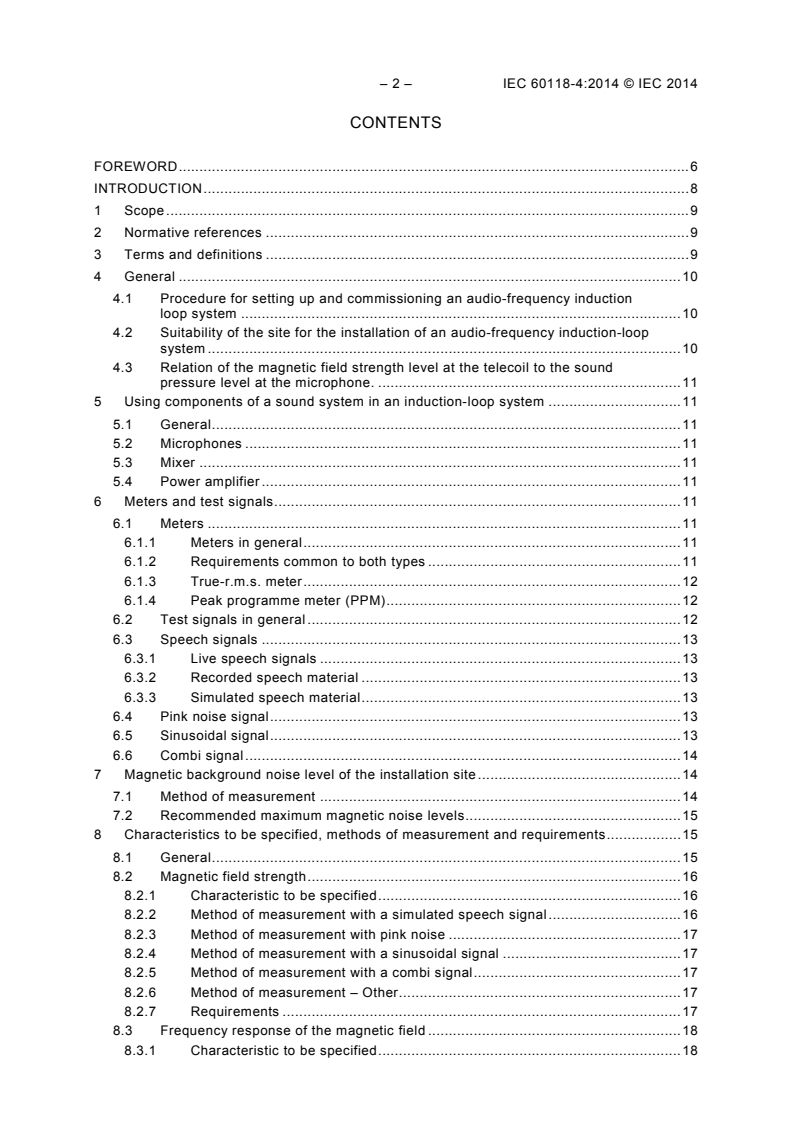
– 2 – IEC 60118-4:2014 © IEC 2014
CONTENTS
FOREWORD . 6
INTRODUCTION . 8
1 Scope . 9
2 Normative references . 9
3 Terms and definitions . 9
4 General . 10
4.1 Procedure for setting up and commissioning an audio-frequency induction
loop system . 10
4.2 Suitability of the site for the installation of an audio-frequency induction-loop
system . 10
4.3 Relation of the magnetic field strength level at the telecoil to the sound
pressure level at the microphone. . 11
5 Using components of a sound system in an induction-loop system . 11
5.1 General . 11
5.2 Microphones . 11
5.3 Mixer . 11
5.4 Power amplifier . 11
6 Meters and test signals . 11
6.1 Meters . 11
6.1.1 Meters in general . 11
6.1.2 Requirements common to both types . 11
6.1.3 True-r.m.s. meter . 12
6.1.4 Peak programme meter (PPM) . 12
6.2 Test signals in general . 12
6.3 Speech signals . 13
6.3.1 Live speech signals . 13
6.3.2 Recorded speech material . 13
6.3.3 Simulated speech material . 13
6.4 Pink noise signal . 13
6.5 Sinusoidal signal . 13
6.6 Combi signal . 14
7 Magnetic background noise level of the installation site . 14
7.1 Method of measurement . 14
7.2 Recommended maximum magnetic noise levels . 15
8 Characteristics to be specified, methods of measurement and requirements . 15
8.1 General . 15
8.2 Magnetic field strength . 16
8.2.1 Characteristic to be specified . 16
8.2.2 Method of measurement with a simulated speech signal . 16
8.2.3 Method of measurement with pink noise . 17
8.2.4 Method of measurement with a sinusoidal signal . 17
8.2.5 Method of measurement with a combi signal . 17
8.2.6 Method of measurement – Other . 17
8.2.7 Requirements . 17
8.3 Frequency response of the magnetic field . 18
8.3.1 Characteristic to be specified . 18
8.3.2 Method of measurement with a simulated speech signal . 18
8.3.3 Method of measurement with pink noise . 18
8.3.4 Method of measurement with a sinusoidal signal . 18
8.3.5 Method of measurement with combi signal . 19
8.3.6 Method of measurement – Other . 19
8.3.7 Requirements . 19
8.4 Useful magnetic field volume . 19
8.4.1 Characteristic to be specified . 19
8.4.2 Methods of measurement . 19
8.4.3 Requirements . 19
9 Small-volume systems . 19
9.1 Inapplicability of the 'useful magnetic field volume' concept . 19
9.2 Disabled refuge and similar call-points . 20
9.3 Requirements for disabled refuge and similar call-points . 22
9.4 Counter systems . 22
9.5 Requirements for counter systems . 24
10 Setting up (commissioning) the system . 24
10.1 Procedure . 24
10.2 Magnetic noise level due to the system . 24
10.2.1 Explanation of term . 24
10.2.2 Method of measurement with a speech signal . 24
10.2.3 Method of measurement with pink noise . 25
10.2.4 Method of measurement with a sinusoidal signal . 25
10.2.5 Method of measurement with a combi signal . 25
10.2.6 Method of measurement – Other (no input signal) . 25
10.2.7 Requirements . 25
10.3 Amplifier overload at 1,6 kHz . 25
10.3.1 Explanation of term . 25
10.3.2 Methods of test . 25
10.4 Requirements . 25
Annex A (informative) Systems for small useful magnetic field volumes . 27
A.1 Overview. 27
A.2 Body-worn audio systems . 27
A.3 Small volume, defined seating, mainly in households . 27
A.4 Specific locations such as help and information points, ticket and bank
counters, etc. . 27
Annex B (informative) Measuring equipment . 30
B.1 Overview. 30
B.2 Signal sources . 30
B.2.1 Real speech . 30
B.2.2 Simulated speech . 30
B.2.3 Pink noise . 30
B.2.4 Sine wave . 30
B.3 Magnetic field strength level meter . 31
B.3.1 General recommendations . 31
B.3.2 Peak-programme meter (PPM) type . 31
B.3.3 True r.m.s. meter type . 31
B.4 Field strength level meter calibrator . 32
B.5 Spectrum analyzer . 32
– 4 – IEC 60118-4:2014 © IEC 2014
Annex C (informative) Provision of information. 33
C.1 General . 33
C.2 Information to be provided to the hearing aid user . 33
C.3 Information to be provided to system installers and by them to users . 34
C.4 Information to be provided by the manufacturer of the amplifying equipment . 34
Annex D (informative) Measuring speech signals . 35
Annex E (informative) Basic theory and practice of audio-frequency induction-loop
systems . 36
E.1 Properties of the loop and its magnetic field . 36
E.2 Directional response of the telecoil of a hearing aid . 37
E.3 Supplying the loop current . 42
E.4 Signal sources and cables . 43
E.4.1 Microphones . 43
E.4.2 Other signal sources . 44
E.4.3 Cables . 44
E.5 Care of the system . 44
E.6 Magnetic units . 44
Annex F (informative) Effects of metal in the building structure on the magnetic field . 45
Annex G (informative) Calibration of field-strength meters . 47
Annex H (informative) Effect of the aspect ratio of the loop on the magnetic field
strength . 49
H.1 Overview. 49
H.2 Effect of aspect ratio on field patterns . 49
Annex I (informative) Overspill of magnetic field from an induction-loop system . 51
I.1 General . 51
I.2 Examples of overspill issues . 51
I.3 Addressing overspill issues . 51
Bibliography . 53
Figure 1 – Flow chart for the operations in this standard . 10
Figure 2 – Measurement points for disabled refuge and similar call-points . 21
Figure 3 – Measurement points for a counter system . 23
Figure A.1 – Field pattern of a vertical loop . 28
Figure A.2 – Contour plot of field strength of vertical loop . 29
Figure C.1 – Graphical symbol: inductive coupling . 33
Figure E.1 – Perspective view of a loop, showing the magnetic field vector paths . 37
Figure E.2 – Strengths of the components of the magnetic field due to current in a
horizontal rectangular loop at points in a plane above or below the loop plane . 38
Figure E.3 – Field patterns of the vertical component of the magnetic field of a
horizontal loop . 39
Figure E.4 – Field patterns of the vertical component of the magnetic field of a vertical
loop 0,75 m square . 40
Figure E.5 – Perspective view of the variation of the vertical field strength level at an
optimum height above a horizontal rectangular loop . 41
Figure E.6 – Directional response of the magnetic pick-up coil (telecoil) of a hearing aid . 42
Figure F.1 – Magnetic field pattern of a 10 m by 14 m loop, 1,2 m above its plane . 45
Figure F.2 – Magnetic field pattern of a 10 m by 14 m loop, 1,2 m above its plane,
showing the effect of metal (iron) in the floor . 46
Figure G.1 – Triple Helmholtz coil for calibration of meters . 47
Figure H.1 – Variation of the current required to produce a specified magnetic field
strength at a specific point with the dimensions and aspect ratio of the loop . 49
Figure H.2 – Square and rectangular loops . 50
Table 1 – Application of signals . 12
Table 2 – Specification of the combi signal . 14
Table 3 – Magnetic field strengths typically produced by different test signals, with an
amplifier having peak-detecting AGC . 17
– 6 – IEC 60118-4:2014 © IEC 2014
INTERNATIONAL ELECTROTECHNICAL COMMISSION
____________
ELECTROACOUSTICS –
HEARING AIDS –
Part 4: Induction-loop systems for hearing aid purposes –
System performance requirements
FOREWORD
1) The International Electrotechnical Commission (IEC) is a worldwide organization for standardization comprising
all national electrotechnical committees (IEC National Committees). The object of IEC is to promote
international co-operation on all questions concerning standardization in the electrical and electronic fields. To
this end and in addition to other activities, IEC publishes International Standards, Technical Specifications,
Technical Reports, Publicly Available Specifications (PAS) and Guides (hereafter referred to as “IEC
Publication(s)”). Their preparation is entrusted to technical committees; any IEC National Committee interested
in the subject dealt with may participate in this preparatory work. International, governmental and non-
governmental organizations liaising with the IEC also participate in this preparation. IEC collaborates closely
with the International Organization for Standardization (ISO) in accordance with conditions determined by
agreement between the two organizations.
2) The formal decisions or agreements of IEC on technical matters express, as nearly as possible, an international
consensus of opinion on the relevant subjects since each technical committee has representation from all
interested IEC National Committees.
3) IEC Publications have the form of recommendations for international use and are accepted by IEC National
Committees in that sense. While all reasonable efforts are made to ensure that the technical content of IEC
Publications is accurate, IEC cannot be held responsible for the way in which they are used or for any
misinterpretation by any end user.
4) In order to promote international uniformity, IEC National Committees undertake to apply IEC Publications
transparently to the maximum extent possible in their national and regional publications. Any divergence
between any IEC Publication and the corresponding national or regional publication shall be clearly indicated in
the latter.
5) IEC itself does not provide any attestation of conformity. Independent certification bodies provide conformity
assessment services and, in some areas, access to IEC marks of conformity. IEC is not responsible for any
services carried out by independent certification bodies.
6) All users should ensure that they have the latest edition of this publication.
7) No liability shall attach to IEC or its directors, employees, servants or agents including individual experts and
members of its technical committees and IEC National Committees for any personal injury, property damage or
other damage of any nature whatsoever, whether direct or indirect, or for costs (including legal fees) and
expenses arising out of the publication, use of, or reliance upon, this IEC Publication or any other IEC
Publications.
8) Attention is drawn to the Normative references cited in this publication. Use of the referenced publications is
indispensable for the correct application of this publication.
9) Attention is drawn to the possibility that some of the elements of this IEC Publication may be the subject of
patent rights. IEC shall not be held responsible for identifying any or all such patent rights.
International Standard IEC 60118-4 has been prepared by IEC technical committee 29:
Electroacoustics.
This third edition cancels and replaces the second edition published in 2006. This edition
constitutes a technical revision.
This edition includes the following significant technical changes with respect to the previous
edition: Addition of Annexes G, H and I where more information is provided about practical
considerations and methods of measurement.
The text of this standard is based on the following documents:
FDIS Report on voting
29/855/FDIS 29/861/RVD
Full information on the voting for the approval of this standard can be found in the report on
voting indicated in the above table.
This publication has been drafted in accordance with the ISO/IEC Directives, Part 2.
A list of all parts of the IEC 60118 series, published under the general title Electroacoustics –
Hearing aids, can be found on the IEC website.
The committee has decided that the contents of this publication will remain unchanged until
the stability date indicated on the IEC web site under "http://webstore.iec.ch" in the data
related to the specific publication. At this date, the publication will be
• reconfirmed,
• withdrawn,
• replaced by a revised edition, or
• amended.
IMPORTANT – The 'colour inside' logo on the cover page of this publication indicates
that it contains colours which are considered to be useful for the correct
understanding of its contents. Users should therefore print this document using a
colour printer.
– 8 – IEC 60118-4:2014 © IEC 2014
INTRODUCTION
Audio-frequency induction-loop systems are widely used to provide a means for hearing aid
users, whose hearing aids are fitted with induction pick-up coils, generally known as 'telecoils',
to minimise the problems of listening when at a distance from a source of sound, shielded
from the person speaking by a protective window, and/or in a background noise. Background
noise and distance are two of the main causes of hearing aid users being unable to hear
satisfactorily in other than face-to-face quiet conditions. Induction-loop systems have been
widely installed in churches, theatres and cinemas, for the benefit of hearing-impaired people.
The use of induction-loop systems has been extended to many transient communication
situations such as ticket offices, bank counters, drive-in/drive-through service locations,
lifts/elevators etc. The widespread provision of telephone handsets that provide inductive
coupling to hearing aids is another significant application, where ITU-T Recommendation
P370 [1] applies.
Transmission of an audio-frequency signal via an induction-loop system can often establish
an acceptable signal-to-noise ratio in conditions where a purely acoustical transmission would
be significantly degraded by reverberation and background noise.
One form of audio frequency induction-loop system comprises a cable installed in the form of
a loop usually around the perimeter of a room or area in which a group of hearing impaired
persons wish to listen. The cable is connected via an amplifier to a microphone system or
other source of audio signal, such as a radio receiver, CD player etc. The amplifier produces
an audio-frequency electric current in the induction loop cable, causing a magnetic field to be
produced inside the loop. The design and implementation of the induction loop is determined
by the construction of the building in which it is installed, particularly by the presence of large
amounts of iron, steel or aluminium in the structure. In addition the layout and position of
electrical cables and equipment may generate high levels of background audio frequency
magnetic fields that may interfere with the reception of the loop signal.
Another form of induction-loop system employs a small loop, intended for communication with
a hearing-aid user in its immediate vicinity. Examples are: neck loops, ticket-counter systems,
self-contained 'portable' systems and chairs incorporating induction loops. (See Annex A)
The pick-up device for an audio-frequency induction-loop system is usually a personal hearing
aid, of a type fitted with a pick-up coil (telecoil); however, special induction loop receivers may
be used in certain applications.
_____________
Numbers in square brackets refer to the Bibliography.
ELECTROACOUSTICS –
HEARING AIDS –
Part 4: Induction-loop systems for hearing aid purposes –
System performance requirements
1 Scope
This part of IEC 60118 is applicable to audio-frequency induction-loop systems producing an
alternating magnetic field at audio frequencies and intended to provide an input signal for
hearing aids operating with an induction pick-up coil (telecoil). Throughout this standard, it is
assumed that the hearing aids used with it conform to all relevant parts of IEC 60118.
This standard specifies requirements for the field strength in audio-frequency induction loops
for hearing aid purposes, which will give adequate signal-to-noise ratio without overloading
the hearing aid. The standard also specifies the minimum frequency response requirements
for acceptable intelligibility.
Methods for measuring the magnetic field strength are specified, and information is given on
appropriate measuring equipment (see Annex B), information that should be provided to the
operator and users of the system (see Annex C), and other important considerations.
This standard does not specify requirements for loop driver amplifiers or associated
microphone or audio signal sources, which are dealt with in IEC 62489-1, or for the field
strength produced by equipment, such as telephone handsets, within the scope of ITU-T
P.370.
2 Normative references
The following documents, in whole or in part, are normatively referenced in this document and
are indispensable for its application. For dated references, only the edition cited applies. For
undated references, the latest edition of the referenced document (including any
amendments) applies.
IEC 60268-3:2013, Sound system equipment – Part 3: Amplifiers
IEC 60268-10:1991, Sound system equipment – Part 10: Peak programme level meters
IEC 61672-1:2013, Electroacoustics – Sound level meters – Part 1: Specifications
IEC 62489-1:2010, Electroacoustics – Audio-frequency induction-loop systems for assisted
hearing – Part 1: Methods of measuring and specifying the performance of system
components
3 Terms and definitions
For the purposes of this document, the following terms and definitions apply.
3.1
reference magnetic field strength level
level of 0 dB referred to a magnetic field strength of 400 mA/m
– 10 – IEC 60118-4:2014 © IEC 2014
Note 1 to entry: This is measured as specified in 8.2.
3.2
useful magnetic field volume
volume (of 3-dimensional space) within which the system provides hearing-aid users with a
signal of acceptable quality (see 8.4)
Note 1 to entry: In the first edition of this standard, the concept of 'specified magnetic field area' was defined,
because that edition did not consider the very important 'height' dimension (the perpendicular distance between the
hearing aid pick-up coil and the plane of the loop). See Annex E.
Note 2 to entry: The base area of the useful magnetic field volume is often different from the plan area of the
induction loop.
3.3
telecoil
inductor with an open magnetic circuit, intended for detecting the magnetic fields of audio-
frequency induction-loop systems
4 General
4.1 Procedure for setting up and commissioning an audio-frequency induction loop
system
The flow chart in Figure 1 shows the sequence of operations detailed in this standard.
Redo if 0 dB is
not achieved
If adjustment
is made in
8.3, repeat
both 8.2 and
8.3
Clause 10 and
8.2 8.3 8.4
4.2 and 7
subclauses
Magnetic field Frequency Useful magnetic
Suitability Setting up –
strength response field volume
of the site commissioning
the system
Adjustments made on system
Adjustments made on amplifier
including microphone etc.
IEC
Figure 1 – Flow chart for the operations in this standard
4.2 Suitability of the site for the installation of an audio-frequency induction-loop
system
It may not be possible to obtain acceptable conditions for an induction-loop system in all
places where it is desirable. It is therefore essential, in the planning stage, to examine a
proposed location with respect to the following conditions:
• the magnetic noise level from electric installations, e.g. heating systems in the floor or roof,
the electrical control of lighting systems (especially in theatres), (see Clause 7);
• the influence of magnetizable and electrically-conducting materials in the structure in
which the loop is intended to be installed;
• the presence of other induction-loop systems in the neighbourhood, the signals of which
may interfere with that of the planned loop system.
NOTE Techniques exist to reduce the magnetic field strength outside an induction loop, but previously-installed
systems may not be so designed.
4.3 Relation of the magnetic field strength level at the telecoil to the sound pressure
level at the microphone.
An acoustic input sound pressure level of 70 dB and a long-term average magnetic field
strength level (L ) of −12 dB ref. 400 mA/m, i.e. 100 mA/m, at the telecoil in a hearing
eq,60 s
aid are assumed to give the same acoustic output level.
5 Using components of a sound system in an induction-loop system
5.1 General
It may seem economically attractive to derive signals for an induction-loop system from a
sound system serving the same space, but it may not be technically straightforward.
5.2 Microphones
Microphones for a sound system may not be positioned at the optimum places to obtain a
signal as free as possible from ambient acoustic noise and reverberation. It is essential to
listen to the signal, preferably with high-quality headphones, to assess its suitability. This
should be done for all microphone signals that the sound system can produce in different
modes or configurations.
5.3 Mixer
The signal for the induction-loop system shall be taken from the mixer at a point where the
level of that signal is controlled independently from the signal level in the chain leading to the
loudspeakers of the sound system.
5.4 Power amplifier
It is possible that a suitable signal can be obtained from the output of a power amplifier, but
such a signal can be satisfactory only if it is applied to an induction-loop amplifier provided
with an input of appropriate sensitivity and impedance, and with automatic gain control of a
range sufficient to accommodate changes in the signal level in the sound system.
In general, it is not advisable to attempt to derive from a sound system a signal suitable for
connection directly to an induction loop. Such an interconnection must be individually
designed to suit the electrical characteristics of the sound system and the loop system.
6 Meters and test signals
6.1 Meters
6.1.1 Meters in general
For historical reasons, two types of magnetic field strength meter are in use, and it is not
practicable to disallow the use of either of them. The results of measurements with the two
types of meters are exactly equal only for sinusoidal signals but in most cases the differences
are not so large as to cause serious problems. Indications are given in this standard of
differences that may be expected in some cases. In case of doubt, the result of measurement
with the meter specified in 6.1.3 shall be definitive.
6.1.2 Requirements common to both types
The meter shall have a frequency response flat within ± 1 dB from 50 Hz to 10 kHz, falling at
an ultimate rate of at least 6 dB/octave outside this range. A-weighting shall also be provided.
The frequency response in A-weighted mode shall conform, within the frequency band 100 Hz
to 5 kHz, to those for a Class 2 meter specified in IEC 61672-1. Other features can also be
provided, such as other weighting characteristics.
– 12 – IEC 60118-4:2014 © IEC 2014
6.1.3 True-r.m.s. meter
This meter was derived from the IEC sound level meter specified in IEC 61672-1 by replacing
the microphone by a magnetic pick-up coil and an amplifier with frequency response
correction. This meter has a true-r.m.s. detector and a 125 ms averaging time constant in 'F'
mode.
A useful additional feature is a peak-hold indication.
6.1.4 Peak programme meter (PPM)
This meter was derived from the PPM Type II specified in IEC 60268-10 by adding a magnetic
pick-up coil, usually together with a modern display (preferably a 'bar' type) in place of the
original moving-coil pointer instrument.
It shall have dynamic responses conforming to the relevant requirements of IEC 60268-10, i.e.
an attack time-constant of approximately 5 ms and a release time-constant of approximately
1,0 s.
6.2 Test signals in general
It is possible to use several different types of test signal for the setting-up and measurement
of the frequency mid-band value (in case of doubt, the average value over the octave band
centred on 1 kHz) and the frequency response of the magnetic field strength. However, some
signals are not suitable for some purposes, and the suitability depends on the amplitude
characteristic of the amplifier in the system (see IEC 62489-1). Table 1 shows the range of
applications of the specified test signals. The test signal specified by the amplifier
manufacturer shall be used, unless the use of a different signal can be justified.
Table 1 – Application of signals
Clause number and Sine wave Pink noise Simulated Reference Combi Other
measurement in this speech speech
standard
(unless otherwise
specified)
IEC 62489-1
Amplitude Y N N N Y N
characteristic
7.1 Magnetic noise Y (no
N N N N N
level signal)
8.2 Magnetic field
Y Y Y Y Y N
strength
8.3 Frequency See Note to
Y Y N Y N
response 8.3.2
10.1 Commissioning Y (real
N N N Y N
the system signals)
The use of a wideband signal and wideband meter to determine the achievement of the
reference magnetic field strength requires a special procedure to prevent serious errors. First
the magnetic background noise level shall be measured, to ensure sufficient signal to noise
ratio, followed by the frequency response of the wanted magnetic field, after making any
adjustments to the amplifier controls so as to achieve the flattest possible response. The
achievement of the reference magnetic field strength can then be determined.
The frequency-response controls are set to achieve the flattest possible response, otherwise
it is possible that the reference magnetic field strength is not achieved at 1 kHz. Particularly in
rooms with metal reinforcement, this may cause considerable errors. Also, if the signal-to-
noise ratio is not sufficient, particularly if there are strong components in the noise, this
method may not be accurate.
6.3 Speech signals
6.3.1 Live speech signals
Live speech is suitable only for use as a test signal for the final verification (commissioning)
of the operation of an induction-loop system. However, live speech is an essential element in
the subjective assessment of loop systems.
6.3.2 Recorded speech material
Speech that has been recorded under controlled conditions and evaluated both subjectively
and objectively may be used for test purposes. See also B.2.1.
6.3.3 Simulated speech material
6.3.3.1 General
Simulated or synthetic speech material contains the features of speech in terms of its
amplitude, frequency components and temporal characteristics, but has no recognizable
intelligibility.
6.3.3.2 ITU-T P.50
ITU-T P.50 [2] is accompanied by a CD containing a standardized form of synthetic speech.
See also B.2.2.
6.3.3.3 Reference speech signal
The ISTS (International Speech Test Signal) [3] is recommended for making objective
measurements. It was developed by EHIMA (European Hearing Instrument Manufacturers'
Association) is derived from 21 female speakers in six different mother tongues (American
English, Arabic, Chinese, French, German and Spanish) and is based on natural recordings
but is largely non-intelligible because of segmentation and remixing. This was then analysed
a
...
IEC 60118-4 ®
Edition 3.1 2017-11
CONSOLIDATED VERSION
INTERNATIONAL
STANDARD
NORME
INTERNATIONALE
colour
inside
Electroacoustics – Hearing aids –
Part 4: Induction-loop systems for hearing aid purposes – System performance
requirements
Électroacoustique – Appareils de correction auditive –
Partie 4: Systèmes de boucles d'induction utilisées à des fins de correction
auditive – Exigences de performances système
All rights reserved. Unless otherwise specified, no part of this publication may be reproduced or utilized in any form
or by any means, electronic or mechanical, including photocopying and microfilm, without permission in writing from
either IEC or IEC's member National Committee in the country of the requester. If you have any questions about IEC
copyright or have an enquiry about obtaining additional rights to this publication, please contact the address below or
your local IEC member National Committee for further information.
Droits de reproduction réservés. Sauf indication contraire, aucune partie de cette publication ne peut être reproduite
ni utilisée sous quelque forme que ce soit et par aucun procédé, électronique ou mécanique, y compris la photocopie
et les microfilms, sans l'accord écrit de l'IEC ou du Comité national de l'IEC du pays du demandeur. Si vous avez des
questions sur le copyright de l'IEC ou si vous désirez obtenir des droits supplémentaires sur cette publication, utilisez
les coordonnées ci-après ou contactez le Comité national de l'IEC de votre pays de résidence.
IEC Central Office Tel.: +41 22 919 02 11
3, rue de Varembé Fax: +41 22 919 03 00
CH-1211 Geneva 20 info@iec.ch
Switzerland www.iec.ch
About the IEC
The International Electrotechnical Commission (IEC) is the leading global organization that prepares and publishes
International Standards for all electrical, electronic and related technologies.
About IEC publications
The technical content of IEC publications is kept under constant review by the IEC. Please make sure that you have the
latest edition, a corrigenda or an amendment might have been published.
IEC Catalogue - webstore.iec.ch/catalogue Electropedia - www.electropedia.org
The stand-alone application for consulting the entire The world's leading online dictionary of electronic and
bibliographical information on IEC International Standards, electrical terms containing 20 000 terms and definitions in
Technical Specifications, Technical Reports and other English and French, with equivalent terms in 16 additional
documents. Available for PC, Mac OS, Android Tablets and languages. Also known as the International Electrotechnical
iPad. Vocabulary (IEV) online.
IEC publications search - www.iec.ch/searchpub IEC Glossary - std.iec.ch/glossary
The advanced search enables to find IEC publications by a 65 000 electrotechnical terminology entries in English and
variety of criteria (reference number, text, technical French extracted from the Terms and Definitions clause of
committee,…). It also gives information on projects, replaced IEC publications issued since 2002. Some entries have been
and withdrawn publications. collected from earlier publications of IEC TC 37, 77, 86 and
CISPR.
IEC Just Published - webstore.iec.ch/justpublished
Stay up to date on all new IEC publications. Just Published IEC Customer Service Centre - webstore.iec.ch/csc
details all new publications released. Available online and If you wish to give us your feedback on this publication or
also once a month by email. need further assistance, please contact the Customer Service
Centre: csc@iec.ch.
A propos de l'IEC
La Commission Electrotechnique Internationale (IEC) est la première organisation mondiale qui élabore et publie des
Normes internationales pour tout ce qui a trait à l'électricité, à l'électronique et aux technologies apparentées.
A propos des publications IEC
Le contenu technique des publications IEC est constamment revu. Veuillez vous assurer que vous possédez l’édition la
plus récente, un corrigendum ou amendement peut avoir été publié.
Catalogue IEC - webstore.iec.ch/catalogue Electropedia - www.electropedia.org
Application autonome pour consulter tous les renseignements
Le premier dictionnaire en ligne de termes électroniques et
bibliographiques sur les Normes internationales,
électriques. Il contient 20 000 termes et définitions en anglais
Spécifications techniques, Rapports techniques et autres
et en français, ainsi que les termes équivalents dans 16
documents de l'IEC. Disponible pour PC, Mac OS, tablettes
langues additionnelles. Egalement appelé Vocabulaire
Android et iPad.
Electrotechnique International (IEV) en ligne.
Recherche de publications IEC - www.iec.ch/searchpub
Glossaire IEC - std.iec.ch/glossary
La recherche avancée permet de trouver des publications IEC
65 000 entrées terminologiques électrotechniques, en anglais
en utilisant différents critères (numéro de référence, texte,
et en français, extraites des articles Termes et Définitions des
comité d’études,…). Elle donne aussi des informations sur les
publications IEC parues depuis 2002. Plus certaines entrées
projets et les publications remplacées ou retirées.
antérieures extraites des publications des CE 37, 77, 86 et
CISPR de l'IEC.
IEC Just Published - webstore.iec.ch/justpublished
Restez informé sur les nouvelles publications IEC. Just Service Clients - webstore.iec.ch/csc
Published détaille les nouvelles publications parues. Si vous désirez nous donner des commentaires sur cette
Disponible en ligne et aussi une fois par mois par email. publication ou si vous avez des questions contactez-nous:
csc@iec.ch.
IEC 60118-4 ®
Edition 3.1 2017-11
CONSOLIDATED VERSION
INTERNATIONAL
STANDARD
NORME
INTERNATIONALE
colour
inside
Electroacoustics – Hearing aids –
Part 4: Induction-loop systems for hearing aid purposes – System performance
requirements
Électroacoustique – Appareils de correction auditive –
Partie 4: Systèmes de boucles d'induction utilisées à des fins de correction
auditive – Exigences de performances système
INTERNATIONAL
ELECTROTECHNICAL
COMMISSION
COMMISSION
ELECTROTECHNIQUE
INTERNATIONALE
ICS 17.140.50 ISBN 978-2-8322-5060-0
IEC 60118-4 ®
Edition 3.1 2017-11
CONSOLIDATED VERSION
REDLINE VERSION
VERSION REDLINE
colour
inside
Electroacoustics – Hearing aids –
Part 4: Induction-loop systems for hearing aid purposes – System performance
requirements
Électroacoustique – Appareils de correction auditive –
Partie 4: Systèmes de boucles d'induction utilisées à des fins de correction
auditive – Exigences de performances système
– 2 – IEC 60118-4:2014+AMD1:2017 CSV
© IEC 2017
CONTENTS
FOREWORD . 6
INTRODUCTION . 8
1 Scope . 9
2 Normative references . 9
3 Terms and definitions . 9
4 General . 10
4.1 Procedure for setting up and commissioning an audio-frequency induction
loop system . 10
4.2 Suitability of the site for the installation of an audio-frequency induction-loop
system . 11
4.3 Relation of the magnetic field strength level at the telecoil to the sound
pressure level at the microphone. . 11
5 Using components of a sound system in an induction-loop system . 11
5.1 General . 11
5.2 Microphones . 11
5.3 Mixer . 11
5.4 Power amplifier . 11
6 Meters and test signals . 12
6.1 Meters . 12
6.1.1 Meters in general . 12
6.1.2 Requirements common to both types . 12
6.1.3 True-r.m.s. meter . 12
6.1.4 Peak programme meter (PPM) . 12
6.2 Test signals in general . 12
6.3 Speech signals . 13
6.3.1 Live speech signals . 13
6.3.2 Recorded speech material . 13
6.3.3 Simulated speech material . 13
6.4 Pink noise signal . 14
6.5 Sinusoidal signal . 14
6.6 Combi signal . 14
7 Magnetic background noise level of the installation site . 15
7.1 Method of measurement . 15
7.2 Recommended maximum magnetic noise levels . 15
8 Characteristics to be specified, methods of measurement and requirements . 16
8.1 General . 16
8.2 Magnetic field strength . 17
8.2.1 Characteristic to be specified . 17
8.2.2 Method of measurement with a simulated speech signal . 17
8.2.3 Method of measurement with pink noise . 17
8.2.4 Method of measurement with a sinusoidal signal . 17
8.2.5 Method of measurement with a combi signal . 17
8.2.6 Method of measurement – Other . 17
8.2.7 Requirements . 17
8.3 Frequency response of the magnetic field . 18
8.3.1 Characteristic to be specified . 18
© IEC 2017
8.3.2 Method of measurement with a simulated speech signal . 18
8.3.3 Method of measurement with pink noise . 18
8.3.4 Method of measurement with a sinusoidal signal . 19
8.3.5 Method of measurement with combi signal . 19
8.3.6 Method of measurement – Other . 19
8.3.7 Requirements . 19
8.4 Useful magnetic field volume . 19
8.4.1 Characteristic to be specified . 19
8.4.2 Methods of measurement . 20
8.4.3 Requirements . 20
9 Small-volume systems . 20
9.1 Inapplicability of the 'useful magnetic field volume' concept Definition of
measurement points . 20
9.2 Disabled refuge and similar call-points . 20
9.3 Requirements for disabled refuge and similar call-points .
9.43 Counter systems . 22
9.4 Useful magnetic field volume method . 24
9.5 Requirements for counter systems . 24
10 Setting up (commissioning) the system . 24
10.1 Procedure . 24
10.2 Requirements . 25
10.3 Amplifier overload at the upper bound of maximum power bandwidth . 25
10.3.1 Explanation . 25
10.3.2 Methods of test . 25
10.3.3 Requirements . 26
10.24 Magnetic noise level due to the system. 26
10.24.1 Explanation of term . 26
10.24.2 Method of measurement with a speech signal . 26
10.24.3 Method of measurement with pink noise . 26
10.24.4 Method of measurement with a sinusoidal signal . 26
10.24.5 Method of measurement with a combi signal . 26
10.24.6 Method of measurement – Other (no input signal) . 27
10.24.7 Requirements . 27
10.3 Amplifier overload at 1,6 kHz .
10.3.1 Explanation of term .
10.3.2 Methods of test .
10.4 Requirements .
Annex A (informative) Systems for small useful magnetic field volumes . 29
A.1 Overview. 29
A.2 Body-worn audio systems . 29
A.3 Small volume, defined seating, mainly in households . 29
A.4 Specific locations such as help and information points, ticket and bank
counters, etc. . 29
Annex B (informative) Measuring equipment . 32
B.1 Overview. 32
B.2 Signal sources . 32
B.2.1 Real speech . 32
B.2.2 Simulated speech . 32
B.2.3 Pink noise . 32
– 4 – IEC 60118-4:2014+AMD1:2017 CSV
© IEC 2017
B.2.4 Sine wave . 32
B.3 Magnetic field strength level meter . 33
B.3.1 General recommendations . 33
B.3.2 Peak-programme meter (PPM) type . 33
B.3.3 True r.m.s. meter type . 33
B.4 Field strength level meter calibrator . 34
B.5 Spectrum analyzer . 34
Annex C (informative) Provision of information. 35
C.1 General . 35
C.2 Information to be provided to the hearing aid user . 35
C.3 Information to be provided to system installers and by them to users . 36
C.4 Information to be provided by the manufacturer of the amplifying equipment . 36
Annex D (informative) Measuring speech signals . 37
Annex E (informative) Basic theory and practice of audio-frequency induction-loop
systems . 38
E.1 Properties of the loop and its magnetic field . 38
E.2 Directional response of the telecoil of a hearing aid . 39
E.3 Supplying the loop current . 44
E.4 Signal sources and cables . 45
E.4.1 Microphones . 45
E.4.2 Other signal sources . 46
E.4.3 Cables . 46
E.5 Care of the system . 46
E.6 Magnetic units . 46
Annex F (informative) Effects of metal in the building structure on the magnetic field . 47
Annex G (informative) Calibration of field-strength meters . 49
Annex H (informative) Effect of the aspect ratio of the loop on the magnetic field
strength . 51
H.1 Overview. 51
H.2 Effect of aspect ratio on field patterns . 51
Annex I (informative) Overspill of magnetic field from an induction-loop system . 54
I.1 General . 54
I.2 Examples of overspill issues . 54
I.3 Addressing overspill issues . 54
Bibliography . 56
Figure 1 – Flow chart for the operations in this standard . 10
Figure 2 – Measurement points for disabled refuge and similar call-points . 21
Figure 3 – Measurement points for a counter system . 23
Figure A.1 – Field pattern of a vertical loop . 30
Figure A.2 – Contour plot of field strength of vertical loop . 31
Figure C.1 – Graphical symbol: inductive coupling . 35
Figure E.1 – Perspective view of a loop, showing the magnetic field vector paths . 39
Figure E.2 – Strengths of the components of the magnetic field due to current in a
horizontal rectangular loop at points in a plane above or below the loop plane . 40
Figure E.3 – Field patterns of the vertical component of the magnetic field of a
horizontal loop . 41
© IEC 2017
Figure E.4 – Field patterns of the vertical component of the magnetic field of a vertical
loop 0,75 m square . 42
Figure E.5 – Perspective view of the variation of the vertical field strength level at an
optimum height above a horizontal rectangular loop . 43
Figure E.6 – Directional response of the magnetic pick-up coil (telecoil) of a hearing
aid . 44
Figure F.1 – Magnetic field pattern of a 10 m by 14 m loop, 1,2 m above its plane . 47
Figure F.2 – Magnetic field pattern of a 10 m by 14 m loop, 1,2 m above its plane,
showing the effect of metal (iron) in the floor . 48
Figure G.1 – Triple Helmholtz coil for calibration of meters . 49
Figure H.1 – Variation of the current required to produce a specified magnetic field
strength at a specific point with the dimensions and aspect ratio of the loop . 51
Figure H.2 – Square and rectangular loops . 53
Table 1 – Application of signals . 13
Table 2 – Specification of the combi signal . 15
Table 3 – Magnetic field strengths typically produced by different test signals, with an
amplifier having peak-detecting AGC . 18
Table 4 – Programme material and test frequency . 26
Table D.1 – Typical variation of the measured RMS voltage of a speech signal with
averaging time . 37
– 6 – IEC 60118-4:2014+AMD1:2017 CSV
© IEC 2017
INTERNATIONAL ELECTROTECHNICAL COMMISSION
____________
ELECTROACOUSTICS –
HEARING AIDS –
Part 4: Induction-loop systems for hearing aid purposes –
System performance requirements
FOREWORD
1) The International Electrotechnical Commission (IEC) is a worldwide organization for standardization comprising
all national electrotechnical committees (IEC National Committees). The object of IEC is to promote
international co-operation on all questions concerning standardization in the electrical and electronic fields. To
this end and in addition to other activities, IEC publishes International Standards, Technical Specifications,
Technical Reports, Publicly Available Specifications (PAS) and Guides (hereafter referred to as “IEC
Publication(s)”). Their preparation is entrusted to technical committees; any IEC National Committee interested
in the subject dealt with may participate in this preparatory work. International, governmental and non-
governmental organizations liaising with the IEC also participate in this preparation. IEC collaborates closely
with the International Organization for Standardization (ISO) in accordance with conditions determined by
agreement between the two organizations.
2) The formal decisions or agreements of IEC on technical matters express, as nearly as possible, an international
consensus of opinion on the relevant subjects since each technical committee has representation from all
interested IEC National Committees.
3) IEC Publications have the form of recommendations for international use and are accepted by IEC National
Committees in that sense. While all reasonable efforts are made to ensure that the technical content of IEC
Publications is accurate, IEC cannot be held responsible for the way in which they are used or for any
misinterpretation by any end user.
4) In order to promote international uniformity, IEC National Committees undertake to apply IEC Publications
transparently to the maximum extent possible in their national and regional publications. Any divergence
between any IEC Publication and the corresponding national or regional publication shall be clearly indicated in
the latter.
5) IEC itself does not provide any attestation of conformity. Independent certification bodies provide conformity
assessment services and, in some areas, access to IEC marks of conformity. IEC is not responsible for any
services carried out by independent certification bodies.
6) All users should ensure that they have the latest edition of this publication.
7) No liability shall attach to IEC or its directors, employees, servants or agents including individual experts and
members of its technical committees and IEC National Committees for any personal injury, property damage or
other damage of any nature whatsoever, whether direct or indirect, or for costs (including legal fees) and
expenses arising out of the publication, use of, or reliance upon, this IEC Publication or any other IEC
Publications.
8) Attention is drawn to the Normative references cited in this publication. Use of the referenced publications is
indispensable for the correct application of this publication.
9) Attention is drawn to the possibility that some of the elements of this IEC Publication may be the subject of
patent rights. IEC shall not be held responsible for identifying any or all such patent rights.
This consolidated version of the official IEC Standard and its amendment has been prepared
for user convenience.
IEC 60118-4 edition 3.1 contains the third edition (2014-12) [documents 29/855/FDIS and 29/861/
RVD] and its amendment 1 (2017-11) [documents 29/952/CDV and 29/961/RVC].
In this Redline version, a vertical line in the margin shows where the technical content is
modified by amendment 1. Additions are in green text, deletions are in strikethrough red text. A
separate Final version with all changes accepted is available in this publication.
© IEC 2017
International Standard IEC 60118-4 has been prepared by IEC technical committee 29:
Electroacoustics.
This third edition constitutes a technical revision.
This edition includes the following significant technical changes with respect to the previous
edition: Addition of Annexes G, H and I where more information is provided about practical
considerations and methods of measurement.
This publication has been drafted in accordance with the ISO/IEC Directives, Part 2.
A list of all parts of the IEC 60118 series, published under the general title Electroacoustics –
Hearing aids, can be found on the IEC website.
The committee has decided that the contents of the base publication and its amendment will
remain unchanged until the stability date indicated on the IEC web site under
"http://webstore.iec.ch" in the data related to the specific publication. At this date,
the publication will be
• reconfirmed,
• withdrawn,
• replaced by a revised edition, or
• amended.
IMPORTANT – The 'colour inside' logo on the cover page of this publication indicates
that it contains colours which are considered to be useful for the correct
understanding of its contents. Users should therefore print this document using a
colour printer.
– 8 – IEC 60118-4:2014+AMD1:2017 CSV
© IEC 2017
INTRODUCTION
Audio-frequency induction-loop systems are widely used to provide a means for hearing aid
users, whose hearing aids are fitted with induction pick-up coils, generally known as 'telecoils',
to minimise the problems of listening when at a distance from a source of sound, shielded
from the person speaking by a protective window, and/or in a background noise. Background
noise and distance are two of the main causes of hearing aid users being unable to hear
satisfactorily in other than face-to-face quiet conditions. Induction-loop systems have been
widely installed in churches, theatres and cinemas, for the benefit of hearing-impaired people.
The use of induction-loop systems has been extended to many transient communication
situations such as ticket offices, bank counters, drive-in/drive-through service locations,
lifts/elevators etc. The widespread provision of telephone handsets that provide inductive
coupling to hearing aids is another significant application, where ITU-T Recommendation
P370 [1] applies.
Transmission of an audio-frequency signal via an induction-loop system can often establish
an acceptable signal-to-noise ratio in conditions where a purely acoustical transmission would
be significantly degraded by reverberation and background noise.
One form of audio frequency induction-loop system comprises a cable installed in the form of
a loop usually around the perimeter of a room or area in which a group of hearing impaired
persons wish to listen. The cable is connected via an amplifier to a microphone system or
other source of audio signal, such as a radio receiver, CD player etc. The amplifier produces
an audio-frequency electric current in the induction loop cable, causing a magnetic field to be
produced inside the loop. The design and implementation of the induction loop is determined
by the construction of the building in which it is installed, particularly by the presence of large
amounts of iron, steel or aluminium in the structure. In addition the layout and position of
electrical cables and equipment may generate high levels of background audio frequency
magnetic fields that may interfere with the reception of the loop signal.
Another form of induction-loop system employs a small loop, intended for communication with
a hearing-aid user in its immediate vicinity. Examples are: neck loops, ticket-counter systems,
self-contained 'portable' systems and chairs incorporating induction loops. (See Annex A)
The pick-up device for an audio-frequency induction-loop system is usually a personal hearing
aid, of a type fitted with a pick-up coil (telecoil); however, special induction loop receivers may
be used in certain applications.
_____________
Numbers in square brackets refer to the Bibliography.
© IEC 2017
ELECTROACOUSTICS –
HEARING AIDS –
Part 4: Induction-loop systems for hearing aid purposes –
System performance requirements
1 Scope
This part of IEC 60118 is applicable to audio-frequency induction-loop systems producing an
alternating magnetic field at audio frequencies and intended to provide an input signal for
hearing aids operating with an induction pick-up coil (telecoil). Throughout this standard, it is
assumed that the hearing aids used with it conform to all relevant parts of IEC 60118.
This standard specifies requirements for the field strength in audio-frequency induction loops
for hearing aid purposes, which will give adequate signal-to-noise ratio without overloading
the hearing aid. The standard also specifies the minimum frequency response requirements
for acceptable intelligibility.
Methods for measuring the magnetic field strength are specified, and information is given on
appropriate measuring equipment (see Annex B), information that should be provided to the
operator and users of the system (see Annex C), and other important considerations.
This standard does not specify requirements for loop driver amplifiers or associated
microphone or audio signal sources, which are dealt with in IEC 62489-1, or for the field
strength produced by equipment, such as telephone handsets, within the scope of ITU-T
P.370.
2 Normative references
The following documents, in whole or in part, are normatively referenced in this document and
are indispensable for its application. For dated references, only the edition cited applies. For
undated references, the latest edition of the referenced document (including any
amendments) applies.
IEC 60268-3:2013, Sound system equipment – Part 3: Amplifiers
IEC 60268-10:1991, Sound system equipment – Part 10: Peak programme level meters
IEC 61672-1:2013, Electroacoustics – Sound level meters – Part 1: Specifications
IEC 62489-1:2010, Electroacoustics – Audio-frequency induction-loop systems for assisted
hearing – Part 1: Methods of measuring and specifying the performance of system
components
3 Terms and definitions
For the purposes of this document, the following terms and definitions apply.
– 10 – IEC 60118-4:2014+AMD1:2017 CSV
© IEC 2017
3.1
reference magnetic field strength level
level of 0 dB referred to a magnetic field strength of 400 mA/m
Note 1 to entry: This is measured as specified in 8.2.
3.2
useful magnetic field volume
volume (of 3-dimensional space) within which the system provides hearing-aid users with a
signal of acceptable quality (see 8.4)
Note 1 to entry: In the first edition of this standard, the concept of 'specified magnetic field area' was defined,
because that edition did not consider the very important 'height' dimension (the perpendicular distance between the
hearing aid pick-up coil and the plane of the loop). See Annex E.
Note 2 to entry: The base area of the useful magnetic field volume is often different from the plan area of the
induction loop.
3.3
telecoil
inductor with an open magnetic circuit, intended for detecting the magnetic fields of audio-
frequency induction-loop systems
3.4
automatic gain control
AGC
process or device by which the gain of an amplifier is controlled by the level of the output
signal so as to reduce changes in this level as compared with the changes in the input signal
Note 1 to entry: Frequently, automatic gain control is used to keep the output signal level nearly constant.
Note 2 to entry: There is a consistent but more general definition in IEC 60118-7, but this standard may have a
limited future, so the IEV definition is preferred.
4 General
4.1 Procedure for setting up and commissioning an audio-frequency induction loop
system
The flow chart in Figure 1 shows the sequence of operations detailed in this standard.
Redo if 0 dB is
not achieved
If adjustment
is made in
8.3, repeat
both 8.2 and
8.3
Clause 10 and
8.2 8.3 8.4
4.2 and 7 subclauses
Magnetic field Frequency Useful magnetic
Suitability Setting up –
strength response
field volume
of the site
commissioning
the system
Adjustments made on system
Adjustments made on amplifier
including microphone etc.
IEC
Figure 1 – Flow chart for the operations in this standard
© IEC 2017
4.2 Suitability of the site for the installation of an audio-frequency induction-loop
system
It may not be possible to obtain acceptable conditions for an induction-loop system in all
places where it is desirable. It is therefore essential, in the planning stage, to examine a
proposed location with respect to the following conditions:
• the magnetic noise level from electric installations, e.g. heating systems in the floor or roof,
the electrical control of lighting systems (especially in theatres), (see Clause 7);
• the influence of magnetizable and electrically-conducting materials in the structure in
which the loop is intended to be installed;
• the presence of other induction-loop systems in the neighbourhood, the signals of which
may interfere with that of the planned loop system.
NOTE Techniques exist to reduce the magnetic field strength outside an induction loop, but previously-installed
systems may not be so designed.
4.3 Relation of the magnetic field strength level at the telecoil to the sound pressure
level at the microphone.
An acoustic input sound pressure level of 70 dB and a long-term average magnetic field
strength level (L ) of −12 dB ref. 400 mA/m, i.e. 100 mA/m, at the telecoil in a hearing
eq,60 s
aid are assumed to give the same acoustic output level.
5 Using components of a sound system in an induction-loop system
5.1 General
It may seem economically attractive to derive signals for an induction-loop system from a
sound system serving the same space, but it may not be technically straightforward.
5.2 Microphones
Microphones for a sound system may not be positioned at the optimum places to obtain a
signal as free as possible from ambient acoustic noise and reverberation. It is essential to
listen to the signal, preferably with high-quality headphones, to assess its suitability. This
should be done for all microphone signals that the sound system can produce in different
modes or configurations.
5.3 Mixer
The signal for the induction-loop system shall be taken from the mixer at a point where the
level of that signal is controlled independently from the signal level in the chain leading to the
loudspeakers of the sound system.
5.4 Power amplifier
It is possible that a suitable signal can be obtained from the output of a power amplifier, but
such a signal can be satisfactory only if it is applied to an induction-loop amplifier provided
with an input of appropriate sensitivity and impedance, and with automatic gain control of a
range sufficient to accommodate changes in the signal level in the sound system.
In general, it is not advisable to attempt to derive from a sound system a signal suitable for
connection directly to an induction loop. Such an interconnection must be individually
designed to suit the electrical characteristics of the sound system and the loop system.
– 12 – IEC 60118-4:2014+AMD1:2017 CSV
© IEC 2017
6 Meters and test signals
6.1 Meters
6.1.1 Meters in general
For historical reasons, two types of magnetic field strength meter are in use, and it is not
practicable to disallow the use of either of them. The results of measurements with the two
types of meters are exactly equal only for sinusoidal signals but in most cases the differences
are not so large as to cause serious problems. Indications are given in this standard of
differences that may be expected in some cases. In case of doubt, the result of measurement
with the meter specified in 6.1.3 shall be definitive.
6.1.2 Requirements common to both types
The meter shall have a frequency response flat within ± 1 dB from 50 Hz to 10 kHz, falling at
an ultimate rate of at least 6 dB/octave outside this range. A-weighting shall also be provided.
The frequency response in A-weighted mode shall conform, within the frequency band 100 Hz
to 5 kHz, to those for a Class 2 meter specified in IEC 61672-1. Other features can also be
provided, such as other weighting characteristics.
6.1.3 True-r.m.s. meter
This meter was derived from the IEC sound level meter specified in IEC 61672-1 by replacing
the microphone by a magnetic pick-up coil and an amplifier with frequency response
correction. This meter has a true-r.m.s. detector and a 125 ms averaging time constant in 'F'
mode.
A useful additional feature is a peak-hold indication.
6.1.4 Peak programme meter (PPM)
This meter was derived from the PPM Type II specified in IEC 60268-10 by adding a magnetic
pick-up coil, usually together with a modern display (preferably a 'bar' type) in place of the
original moving-coil pointer instrument.
It shall have dynamic responses conforming to the relevant requirements of IEC 60268-10, i.e.
an attack time-constant of approximately 5 ms and a release time-constant of approximately
1,0 s.
6.2 Test signals in general
It is possible to use several different types of test signal for the setting-up and measurement
of the frequency mid-band value (in case of doubt, the average value over the octave band
centred on 1 kHz) and the frequency response of the magnetic field strength. However, some
signals are not suitable for some purposes, and the suitability depends on the amplitude
characteristic of the amplifier in the system (see IEC 62489-1). Table 1 shows the range of
applications of the specified test signals. The test signal specified by the amplifier
manufacturer shall be used, unless the use of a different signal can be justified.
©
...