

IEC TR 63340-1:2025
(Main)Electronic displays for special applications - Part 1: General introduction
General Information
- Abstract
IEC TR 63340-1:2025, which is a Technical Report, provides related information for future standardizations of various display applications. This document includes overview of display applications, and the possible strategies to standardize these application fields.
- Status
- Published
- Publication Date
- 08-Jan-2025
- Technical Committee
- TC 110 - Electronic displays
- Drafting Committee
- PT 63340 - TC 110/PT 63340
- Current Stage
- PPUB - Publication issued
- Start Date
- 09-Jan-2025
- Completion Date
- 24-Jan-2025
Overview - IEC TR 63340-1:2025 (Electronic displays for special applications - Part 1: General introduction)
IEC TR 63340-1:2025 is a Technical Report from IEC TC 110 that provides an informative, high-level framework for future standardization of electronic displays for special applications. Rather than setting normative requirements, this TR gathers background, rationale and possible strategies to identify and prioritize application fields that may need specific standards. It clarifies the difference between application‑based standardization and technology‑based standardization, and explains how to harmonize measurement and test methods across sectors.
Key topics and technical focus
- Scope and purpose: Overview of display application domains and the intent to support future standards development across those domains.
- Application vs technology approaches: Discussion of standardization driven by use‑context (what users need to adopt) versus by new display technologies (how to measure new features).
- Significance of application standardization: Why harmonized requirements matter for industry, trade and user safety-especially where displays form critical HMIs.
- Threshold values and evolution: Principles for stipulating performance thresholds (e.g., visibility, luminance, colour, constancy) and mechanisms for updating requirements as technology advances.
- Measurement and test method harmonization: Guidance on aligning test methods between function‑based and technology‑based standards to avoid conflicting procedures.
- Collaboration models: How IEC TC 110 can work with related technical committees (TCs), joint working groups (JWGs) and application‑specific TCs (for example, medical imaging committees).
- Inventory and prioritization method: Use of inventory tables to extract and evaluate candidate applications; five prioritized application candidates are presented as examples.
- Strategies for standardization: Possible flows and schemes to propose and develop application‑level standards.
Practical applications and intended users
This TR is useful for:
- Standards developers and technical committees (IEC TC 110, related TCs)
- Display manufacturers and component suppliers
- System integrators and OEMs in automotive, medical, security, gaming, education and industrial automation
- Regulators and procurement bodies seeking harmonized performance criteria
- Test labs and certification bodies preparing harmonized test protocols
By clarifying contexts of use, threshold‑setting approaches and collaboration practices, the TR supports consistent, application‑focused standards that improve product interoperability, safety and market clarity.
Related standards and references
- IEC 63340 series (other parts addressing specific applications)
- IEC/TC 110 - Electronic displays (parent committee)
- Example liaison: IEC/TC 62/SC 62B (medical imaging) and ISO/IEC Guide 2 (definition of standardization)
Keywords: IEC TR 63340-1:2025, electronic displays, display standardization, application-based standardization, measurement and test methods, threshold values, human–machine interfaces, medical displays, automotive displays.
Frequently Asked Questions
IEC TR 63340-1:2025 is a technical report published by the International Electrotechnical Commission (IEC). Its full title is "Electronic displays for special applications - Part 1: General introduction". This standard covers: IEC TR 63340-1:2025, which is a Technical Report, provides related information for future standardizations of various display applications. This document includes overview of display applications, and the possible strategies to standardize these application fields.
IEC TR 63340-1:2025, which is a Technical Report, provides related information for future standardizations of various display applications. This document includes overview of display applications, and the possible strategies to standardize these application fields.
IEC TR 63340-1:2025 is classified under the following ICS (International Classification for Standards) categories: 31.120 - Electronic display devices. The ICS classification helps identify the subject area and facilitates finding related standards.
IEC TR 63340-1:2025 is available in PDF format for immediate download after purchase. The document can be added to your cart and obtained through the secure checkout process. Digital delivery ensures instant access to the complete standard document.
Standards Content (Sample)
IEC TR 63340-1 ®
Edition 1.0 2025-01
TECHNICAL
REPORT
colour
inside
Electronic displays for special applications –
Part 1: General introduction
All rights reserved. Unless otherwise specified, no part of this publication may be reproduced or utilized in any form
or by any means, electronic or mechanical, including photocopying and microfilm, without permission in writing from
either IEC or IEC's member National Committee in the country of the requester. If you have any questions about IEC
copyright or have an enquiry about obtaining additional rights to this publication, please contact the address below or
your local IEC member National Committee for further information.
IEC Secretariat Tel.: +41 22 919 02 11
3, rue de Varembé info@iec.ch
CH-1211 Geneva 20 www.iec.ch
Switzerland
About the IEC
The International Electrotechnical Commission (IEC) is the leading global organization that prepares and publishes
International Standards for all electrical, electronic and related technologies.
About IEC publications
The technical content of IEC publications is kept under constant review by the IEC. Please make sure that you have the
latest edition, a corrigendum or an amendment might have been published.
IEC publications search - webstore.iec.ch/advsearchform IEC Products & Services Portal - products.iec.ch
The advanced search enables to find IEC publications by a Discover our powerful search engine and read freely all the
variety of criteria (reference number, text, technical publications previews, graphical symbols and the glossary.
committee, …). It also gives information on projects, replaced With a subscription you will always have access to up to date
and withdrawn publications. content tailored to your needs.
IEC Just Published - webstore.iec.ch/justpublished
Electropedia - www.electropedia.org
Stay up to date on all new IEC publications. Just Published
The world's leading online dictionary on electrotechnology,
details all new publications released. Available online and once
containing more than 22 500 terminological entries in English
a month by email.
and French, with equivalent terms in 25 additional languages.
Also known as the International Electrotechnical Vocabulary
IEC Customer Service Centre - webstore.iec.ch/csc
(IEV) online.
If you wish to give us your feedback on this publication or need
further assistance, please contact the Customer Service
Centre: sales@iec.ch.
IEC TR 63340-1 ®
Edition 1.0 2025-01
TECHNICAL
REPORT
colour
inside
Electronic displays for special applications –
Part 1: General introduction
INTERNATIONAL
ELECTROTECHNICAL
COMMISSION
ICS 31.120 ISBN 978-2-8327-0126-3
– 2 – IEC TR 63340-1:2025 © IEC 2025
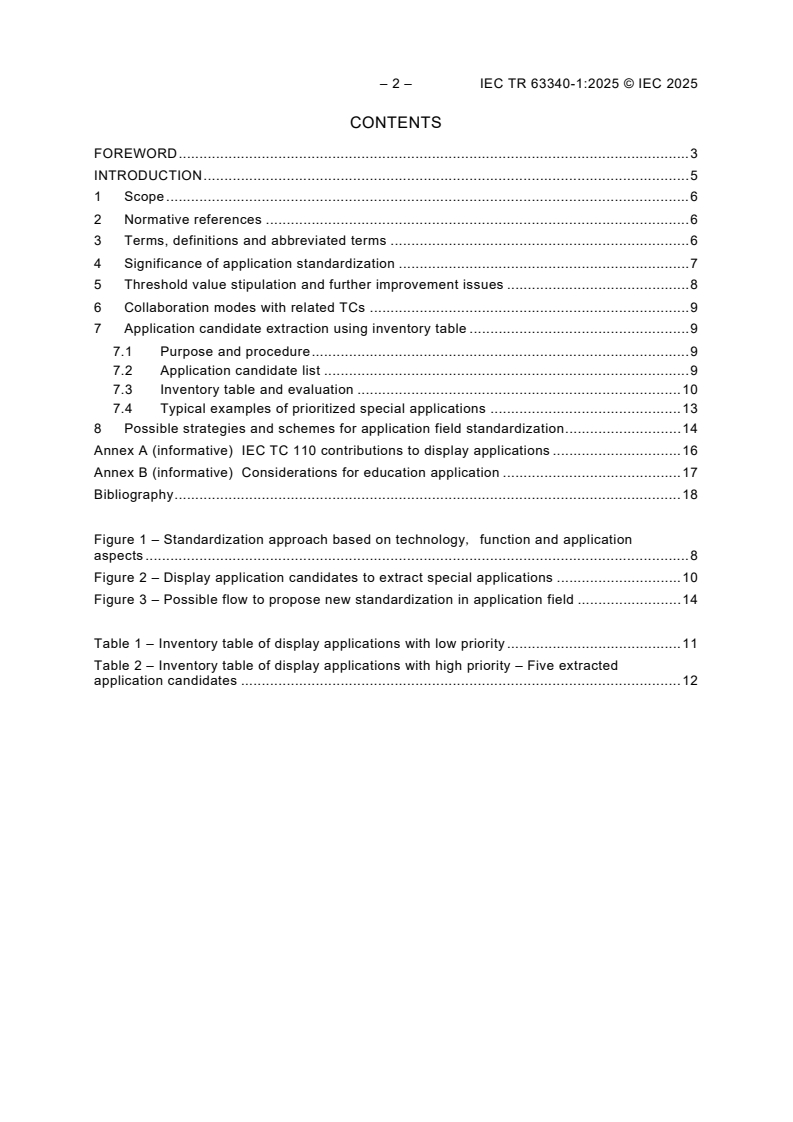
CONTENTS
FOREWORD . 3
INTRODUCTION . 5
1 Scope . 6
2 Normative references . 6
3 Terms, definitions and abbreviated terms . 6
4 Significance of application standardization . 7
5 Threshold value stipulation and further improvement issues . 8
6 Collaboration modes with related TCs . 9
7 Application candidate extraction using inventory table . 9
7.1 Purpose and procedure . 9
7.2 Application candidate list . 9
7.3 Inventory table and evaluation . 10
7.4 Typical examples of prioritized special applications . 13
8 Possible strategies and schemes for application field standardization . 14
Annex A (informative) IEC TC 110 contributions to display applications . 16
Annex B (informative) Considerations for education application . 17
Bibliography . 18
Figure 1 – Standardization approach based on technology, function and application
aspects . 8
Figure 2 – Display application candidates to extract special applications . 10
Figure 3 – Possible flow to propose new standardization in application field . 14
Table 1 – Inventory table of display applications with low priority . 11
Table 2 – Inventory table of display applications with high priority – Five extracted
application candidates . 12
INTERNATIONAL ELECTROTECHNICAL COMMISSION
____________
ELECTRONIC DISPLAYS FOR SPECIAL APPLICATIONS –
Part 1: General introduction
FOREWORD
1) The International Electrotechnical Commission (IEC) is a worldwide organization for standardization comprising
all national electrotechnical committees (IEC National Committees). The object of IEC is to promote international
co-operation on all questions concerning standardization in the electrical and electronic fields. To this end and
in addition to other activities, IEC publishes International Standards, Technical Specifications, Technical Reports,
Publicly Available Specifications (PAS) and Guides (hereafter referred to as "IEC Publication(s)"). Their
preparation is entrusted to technical committees; any IEC National Committee interested in the subject dealt with
may participate in this preparatory work. International, governmental and non-governmental organizations liaising
with the IEC also participate in this preparation. IEC collaborates closely with the International Organization for
Standardization (ISO) in accordance with conditions determined by agreement between the two organizations.
2) The formal decisions or agreements of IEC on technical matters express, as nearly as possible, an international
consensus of opinion on the relevant subjects since each technical committee has representation from all
interested IEC National Committees.
3) IEC Publications have the form of recommendations for international use and are accepted by IEC National
Committees in that sense. While all reasonable efforts are made to ensure that the technical content of IEC
Publications is accurate, IEC cannot be held responsible for the way in which they are used or for any
misinterpretation by any end user.
4) In order to promote international uniformity, IEC National Committees undertake to apply IEC Publications
transparently to the maximum extent possible in their national and regional publications. Any divergence between
any IEC Publication and the corresponding national or regional publication shall be clearly indicated in the latter.
5) IEC itself does not provide any attestation of conformity. Independent certification bodies provide conformity
assessment services and, in some areas, access to IEC marks of conformity. IEC is not responsible for any
services carried out by independent certification bodies.
6) All users should ensure that they have the latest edition of this publication.
7) No liability shall attach to IEC or its directors, employees, servants or agents including individual experts and
members of its technical committees and IEC National Committees for any personal injury, property damage or
other damage of any nature whatsoever, whether direct or indirect, or for costs (including legal fees) and
expenses arising out of the publication, use of, or reliance upon, this IEC Publication or any other IEC
Publications.
8) Attention is drawn to the Normative references cited in this publication. Use of the referenced publications is
indispensable for the correct application of this publication.
9) IEC draws attention to the possibility that the implementation of this document may involve the use of (a)
patent(s). IEC takes no position concerning the evidence, validity or applicability of any claimed patent rights in
respect thereof. As of the date of publication of this document, IEC had not received notice of (a) patent(s), which
may be required to implement this document. However, implementers are cautioned that this may not represent
the latest information, which may be obtained from the patent database available at https://patents.iec.ch. IEC
shall not be held responsible for identifying any or all such patent rights.
IEC TR 63340-1 has been prepared by IEC technical committee 110: Electronic displays. It is
a Technical Report.
The text of this Technical Report is based on the following documents:
Draft Report on voting
110/1709/DTR 110/1728/RVDTR
Full information on the voting for its approval can be found in the report on voting indicated in
the above table.
The language used for the development of this Technical Report is English.
– 4 – IEC TR 63340-1:2025 © IEC 2025
This document was drafted in accordance with ISO/IEC Directives, Part 2, and developed in
accordance with ISO/IEC Directives, Part 1 and ISO/IEC Directives, IEC Supplement, available
at www.iec.ch/members_experts/refdocs. The main document types developed by IEC are
described in greater detail at www.iec.ch/publications.
A list of all parts in the IEC 63340 series, published under the general title Electronic displays
for special applications, can be found on the IEC website.
The committee has decided that the contents of this document will remain unchanged until the
stability date indicated on the IEC website under webstore.iec.ch in the data related to the
specific document. At this date, the document will be
• reconfirmed,
• withdrawn, or
• revised.
IMPORTANT – The "colour inside" logo on the cover page of this document indicates
that it contains colours which are considered to be useful for the correct understanding
of its contents. Users should therefore print this document using a colour printer.
INTRODUCTION
This document intends to gather related information for future standardizations of various
display applications, and to clarify the relationship to normative aspects of the standardization
in these application fields. Because a Technical Report (TR) is entirely informative, this
document does not intend to formulate strong strategies. This document provides possibilities
and candidates of strategies to extract application fields for standardization. The relation and
difference between application-based standardization and technology-based standardization
are discussed in Clause 4. In the application-based standardization, how to adopt something to
others is analyzed with clarifying "context of use" and "an optimum degree". Therefore,
requirements, required threshold values, or specifications are important. In addition, by
technology developments these requirements become advanced more, and Clause 5 explains
how to update these requirements in standards. There are some applications for which technical
committees (TCs) have already been established, and the collaboration modes with related TCs
are explained in Clause 6. In Clause 7, five application candidates have been extracted using
inventory tables, and the key criteria is the public and societal natures. Clause 8 explains
possible strategies and schemes for application-based standardization. The necessities of each
application standardization are described in other TRs.
– 6 – IEC TR 63340-1:2025 © IEC 2025
ELECTRONIC DISPLAYS FOR SPECIAL APPLICATIONS –
Part 1: General introduction
1 Scope
This part of IEC 63340, which is a Technical Report, provides related information for future
standardizations of various display applications. This document includes overview of display
applications, and the possible strategies to standardize these application fields.
2 Normative references
There are no normative references in this document.
3 Terms, definitions and abbreviated terms
3.1 Terms and definitions
For the purposes of this document, the following terms and definitions apply.
ISO and IEC maintain terminology databases for use in standardization at the following
addresses:
• IEC Electropedia: available at https://www.electropedia.org/
• ISO Online browsing platform: available at https://www.iso.org/obp
3.1.1
standardization
activity of establishing, with regard to actual or potential problems, provisions for common and
repeated use, aimed at the achievement of the optimum degree of order in a given context
Note 1 to entry: In particular, the activity consists of the processes of formulating, issuing and implementing
standards.
Note 2 to entry: Important benefits of standardization are improvement of the suitability of products, processes and
services for their intended purposes, prevention of barriers to trade and facilitation of technological cooperation.
[SOURCE: ISO/IEC GUIDE 2:2004, 1.1]
3.2 Abbreviated terms
HMI human–machine interfaces
JWG joint working group
PT project team
SDG Sustainable Development Goals
SDO standards development organization
TC technical committee
TR technical report
WG working group
4 Significance of application standardization
According to ISO/IEC GUIDE 2:2004 [1] , 1.1, the term "standardization" is defined as "activity
of establishing, with regard to actual or potential problems, provisions for common and repeated
use, aimed at the achievement of the optimum degree of order in a given context". For this
activity, it is necessary to clarify "a given context", "an optimum degree", "problems" and so on.
In the field of display industry, these depend on how and where to use displays, and what to be
shown on displays. It is significant to consider applications of displays.
Electronic displays have become essential components of human–machine interfaces (HMI)
and consequently the production volumes of these displays have increased steadily to meet the
increasing demand. Further growth is expected due to the expansion of application of displays,
being pushed by smart house, smart office, connected industries, remote office, drone, security
camera, and others. Automotive, gaming and e-sports applications, where the market is growing
rapidly, demand a special requirement for it.
In addition, in the field of display applications, related users and industries exist, and the
standardization activities need to hear their opinions. A key will be how to meet the expectations
and demands of related industries, and how to contribute to them. Application standardization
has an aspect of communications with related industries. Through these communications, it is
essential to clarify specific points to be mainly contributed by display industry.
Regarding the contributions from display industry, because many related industries use
electronic displays, the harmonization among the related industries is important. For example,
if different industries adopt different test methods without any specific reasons, it will cause
confusion. The specific points on how to contribute to their harmonization are described in
Annex A.
In some specific application industries, such as medical equipment, if these industries need to
standardize some requirements or threshold values in the relevant application TCs, the related
TC of display industry would contribute to them. For example, the appropriateness of the
threshold values can be commented on, and appropriate test methods to obtain the test results
can be suggested.
NOTE 1 An example would be a standardization of medical image display systems in IEC/TC 62/SC 62B. Evaluation
methods, acceptance and constancy tests, and performance criteria for diagnostic imaging equipment in medical
practices are being standardized. This standardization aims at establishing the performance criteria for medical
displays.
NOTE 2 How measurement and evaluation methods will be harmonized across different industries is described in
Clause 8.
The definition of standardization (3.1) suggests an approach based on a set of rules (“context”,
“degree”, “problems”) that must be adhered to. On the other hand, a technology-based approach
exists. When a new technology appears, the definition and measurement methods can be
standardized, as shown in Figure 1.
Generally speaking, regarding the application-based approach, the adoption of something by
users is analyzed. For this analysis, clarifying "context of use" and "optimum degree" is key.
This means that requirements, required threshold values, or specifications are important.
Generally, specifications include blank detail specifications which can be effective for
stipulating specific measurement and test conditions to each application.
___________
Numbers in square brackets refer to the Bibliography.
– 8 – IEC TR 63340-1:2025 © IEC 2025
In order to obtain values, measurement and test methods can apply, but it can be noted that
between the application-based standardization and the technology-based standardization, the
start line of considering measurement and test methods would be different. Therefore, it is
crucial that these are harmonized in the function-based standardization. In addition, in many
cases, thanks to the technology developments, application demands and requirements become
more advanced, which means that these are not static, but dynamic based on applications and
technologies. How to update the requirements in standards is explained in Clause 5.
Regarding measurement and test methods, in the technology-based standardization, many
possibilities or variations of methods can be considered and therefore meaningless
developments of measurement and test methods are avoided. However, in application-based
standardization, measurement and test methods are based on actual or potential problems of
markets. Some methods in the technology-based standardization are not necessary in some
applications. It is important to gather contexts of use and demands of each application.
Figure 1 – Standardization approach based on technology,
function and application aspects
5 Threshold value stipulation and further improvement issues
There are some concerns regarding the standardization including threshold values. If the
requirements or thresholds specific to each application are stipulated, there can be some
problems, for example, the thresholds can prevent further improvement.
Meaningless stipulation of requirements or thresholds can be avoided, but in application-based
standardizations, they are sometimes necessary in order to keep adaptability. Generally, in
...