

IEC 60444-11:2010
(Main)Measurement of quartz crystal unit parameters - Part 11: Standard method for the determination of the load resonance frequency fL and the effective load capacitance CLeff using automatic network analyzer techniques and error correction
General Information
- Abstract
IEC 60444-11:2010 defines the standard method of measuring load resonance frequency fL at the nominal value of CL, and the determination of the effective load capacitance CLeff at the nominal frequency for crystals with the figure of merit M > 4.
- Status
- Published
- Publication Date
- 06-Oct-2010
- Technical Committee
- TC 49 - Piezoelectric, dielectric and electrostatic devices and associated materials for frequency control, selection and detection
- Drafting Committee
- WG 11 - TC 49/WG 11
Buy Documents

IEC 60444-11:2010 - Measurement of quartz crystal unit parameters - Part 11: Standard method for the determination of the load resonance frequency f<sub>L</sub> and the effective load capacitance C<sub>Leff</sub> using automatic network analyzer techniques and error correction Released:10/7/2010
Overview
IEC 60444-11:2010 establishes a standardized method for measuring the load resonance frequency (fL) and effective load capacitance (CLeff) of quartz crystal units using automatic network analyzer techniques with error correction. This procedure applies to crystals exhibiting a figure of merit ( M > 4 ), ensuring precise characterization up to frequencies of approximately 200 MHz. Unlike earlier techniques, this method eliminates the reliance on physical load capacitors, offering enhanced accuracy, reproducibility, and alignment with application conditions.
Ensuring consistency and reliability in these key measurements is critical for the development and quality assurance of frequency control components essential in modern electronics.
Key Topics
Load Resonance Frequency (fL) Determination
- Measures the frequency where a quartz crystal unit exhibits maximum or minimum admittance under load conditions.
- Conducted at the nominal load capacitance, crucial for aligning the performance of the crystal with application specifications.
Effective Load Capacitance (CLeff)
- Defines the equivalent capacitance seen by the crystal at the nominal frequency.
- Important for oscillator circuit design and ensuring stable frequency characteristics.
Automatic Network Analyzer Techniques
- Utilizes advanced measurement equipment for automation and increased precision.
- Avoids the inaccuracies associated with physical load capacitors and extends the frequency range of measurement up to ~200 MHz.
Error Correction Methods
- Incorporates calibration and correction strategies to mitigate measurement errors due to equipment or environmental factors.
- Enhances accuracy and repeatability across different testing setups.
Measurement Principles
- The method combines the error-corrected approach from IEC 60444-5:1995 with automated measurement to determine both fL and CLeff in a single sequence.
Applications
Quartz crystal unit parameter measurements play a central role in various sectors of electronics, particularly where frequency accuracy and stability are critical:
- Oscillator Design: Proper specification of fL and CLeff ensures that the oscillator circuit operates at the intended frequency, minimizing drift and unwanted variations.
- Quality Control: Manufacturers of quartz crystals benefit from standardized measurement to assure product quality and consistency, essential for high-reliability applications.
- Network Equipment: Precise characterization supports the use of crystal units in communication equipment, network infrastructure, and timing modules.
- Research and Development: Laboratories and engineers rely on reproducible and accurate measurements during the development of new crystal technologies and oscillator designs.
Adopting this IEC standard helps organizations streamline crystal unit measurements, reduce uncertainties, and improve overall performance in end-product applications.
Related Standards
- IEC 60122-1: Provides generic specifications for quartz crystal units, including calculation of the figure of merit.
- IEC 60444-4: Describes earlier measurement methods based on physical load capacitors, applicable up to 30 MHz.
- IEC 60444-5: Offers foundational techniques for determining equivalent electrical parameters using automatic network analyzer methods with error correction.
These standards collectively lay the groundwork for accurate, reproducible quartz crystal parameter measurement, supporting the needs of engineers and manufacturers in frequency control and timekeeping applications.
Keywords: IEC 60444-11, quartz crystal measurement, load resonance frequency, effective load capacitance, automatic network analyzer, frequency control, standard method, error correction.
Relations
- Effective Date
- 05-Sep-2023
Buy Documents
IEC 60444-11:2010 - Measurement of quartz crystal unit parameters - Part 11: Standard method for the determination of the load resonance frequency f<sub>L</sub> and the effective load capacitance C<sub>Leff</sub> using automatic network analyzer techniques and error correction Released:10/7/2010
Frequently Asked Questions
IEC 60444-11:2010 is a standard published by the International Electrotechnical Commission (IEC). Its full title is "Measurement of quartz crystal unit parameters - Part 11: Standard method for the determination of the load resonance frequency f<sub>L</sub> and the effective load capacitance C<sub>Leff</sub> using automatic network analyzer techniques and error correction". This standard covers: IEC 60444-11:2010 defines the standard method of measuring load resonance frequency fL at the nominal value of CL, and the determination of the effective load capacitance CLeff at the nominal frequency for crystals with the figure of merit M > 4.
IEC 60444-11:2010 defines the standard method of measuring load resonance frequency fL at the nominal value of CL, and the determination of the effective load capacitance CLeff at the nominal frequency for crystals with the figure of merit M > 4.
IEC 60444-11:2010 is classified under the following ICS (International Classification for Standards) categories: 31.140 - Piezoelectric devices. The ICS classification helps identify the subject area and facilitates finding related standards.
IEC 60444-11:2010 has the following relationships with other standards: It is inter standard links to IEC 60444-11:2026. Understanding these relationships helps ensure you are using the most current and applicable version of the standard.
IEC 60444-11:2010 is available in PDF format for immediate download after purchase. The document can be added to your cart and obtained through the secure checkout process. Digital delivery ensures instant access to the complete standard document.
Standards Content (Sample)
IEC 60444-11 ®
Edition 1.0 2010-10
INTERNATIONAL
STANDARD
NORME
INTERNATIONALE
colour
inside
Measurement of quartz crystal unit parameters –
Part 11: Standard method for the determination of the load resonance frequency
f and the effective load capacitance C using automatic network analyzer
L Leff
techniques and error correction
Mesure des paramètres des résonateurs à quartz –
Partie 11: Méthode normalisée pour la détermination de la fréquence de
résonance à la charge f et de la capacité de charge efficace C utilisant des
L Leff
analyseurs automatiques de réseaux et correction des erreurs
All rights reserved. Unless otherwise specified, no part of this publication may be reproduced or utilized in any form or by
any means, electronic or mechanical, including photocopying and microfilm, without permission in writing from either IEC or
IEC's member National Committee in the country of the requester.
If you have any questions about IEC copyright or have an enquiry about obtaining additional rights to this publication,
please contact the address below or your local IEC member National Committee for further information.
Droits de reproduction réservés. Sauf indication contraire, aucune partie de cette publication ne peut être reproduite
ni utilisée sous quelque forme que ce soit et par aucun procédé, électronique ou mécanique, y compris la photocopie
et les microfilms, sans l'accord écrit de la CEI ou du Comité national de la CEI du pays du demandeur.
Si vous avez des questions sur le copyright de la CEI ou si vous désirez obtenir des droits supplémentaires sur cette
publication, utilisez les coordonnées ci-après ou contactez le Comité national de la CEI de votre pays de résidence.
IEC Central Office
3, rue de Varembé
CH-1211 Geneva 20
Switzerland
Email: inmail@iec.ch
Web: www.iec.ch
About the IEC
The International Electrotechnical Commission (IEC) is the leading global organization that prepares and publishes
International Standards for all electrical, electronic and related technologies.
About IEC publications
The technical content of IEC publications is kept under constant review by the IEC. Please make sure that you have the
latest edition, a corrigenda or an amendment might have been published.
ƒ Catalogue of IEC publications: www.iec.ch/searchpub
The IEC on-line Catalogue enables you to search by a variety of criteria (reference number, text, technical committee,…).
It also gives information on projects, withdrawn and replaced publications.
ƒ IEC Just Published: www.iec.ch/online_news/justpub
Stay up to date on all new IEC publications. Just Published details twice a month all new publications released. Available
on-line and also by email.
ƒ Electropedia: www.electropedia.org
The world's leading online dictionary of electronic and electrical terms containing more than 20 000 terms and definitions
in English and French, with equivalent terms in additional languages. Also known as the International Electrotechnical
Vocabulary online.
ƒ Customer Service Centre: www.iec.ch/webstore/custserv
If you wish to give us your feedback on this publication or need further assistance, please visit the Customer Service
Centre FAQ or contact us:
Email: csc@iec.ch
Tel.: +41 22 919 02 11
Fax: +41 22 919 03 00
A propos de la CEI
La Commission Electrotechnique Internationale (CEI) est la première organisation mondiale qui élabore et publie des
normes internationales pour tout ce qui a trait à l'électricité, à l'électronique et aux technologies apparentées.
A propos des publications CEI
Le contenu technique des publications de la CEI est constamment revu. Veuillez vous assurer que vous possédez
l’édition la plus récente, un corrigendum ou amendement peut avoir été publié.
ƒ Catalogue des publications de la CEI: www.iec.ch/searchpub/cur_fut-f.htm
Le Catalogue en-ligne de la CEI vous permet d’effectuer des recherches en utilisant différents critères (numéro de référence,
texte, comité d’études,…). Il donne aussi des informations sur les projets et les publications retirées ou remplacées.
ƒ Just Published CEI: www.iec.ch/online_news/justpub
Restez informé sur les nouvelles publications de la CEI. Just Published détaille deux fois par mois les nouvelles
publications parues. Disponible en-ligne et aussi par email.
ƒ Electropedia: www.electropedia.org
Le premier dictionnaire en ligne au monde de termes électroniques et électriques. Il contient plus de 20 000 termes et
définitions en anglais et en français, ainsi que les termes équivalents dans les langues additionnelles. Egalement appelé
Vocabulaire Electrotechnique International en ligne.
ƒ Service Clients: www.iec.ch/webstore/custserv/custserv_entry-f.htm
Si vous désirez nous donner des commentaires sur cette publication ou si vous avez des questions, visitez le FAQ du
Service clients ou contactez-nous:
Email: csc@iec.ch
Tél.: +41 22 919 02 11
Fax: +41 22 919 03 00
IEC 60444-11 ®
Edition 1.0 2010-10
INTERNATIONAL
STANDARD
NORME
INTERNATIONALE
colour
inside
Measurement of quartz crystal unit parameters –
Part 11: Standard method for the determination of the load resonance frequency
f and the effective load capacitance C using automatic network analyzer
L Leff
techniques and error correction
Mesure des paramètres des résonateurs à quartz –
Partie 11: Méthode normalisée pour la détermination de la fréquence de
résonance à la charge f et de la capacité de charge efficace C utilisant des
L Leff
analyseurs automatiques de réseaux et correction des erreurs
INTERNATIONAL
ELECTROTECHNICAL
COMMISSION
COMMISSION
ELECTROTECHNIQUE
PRICE CODE
INTERNATIONALE
N
CODE PRIX
ICS 31.140 ISBN 978-2-88912-210-3
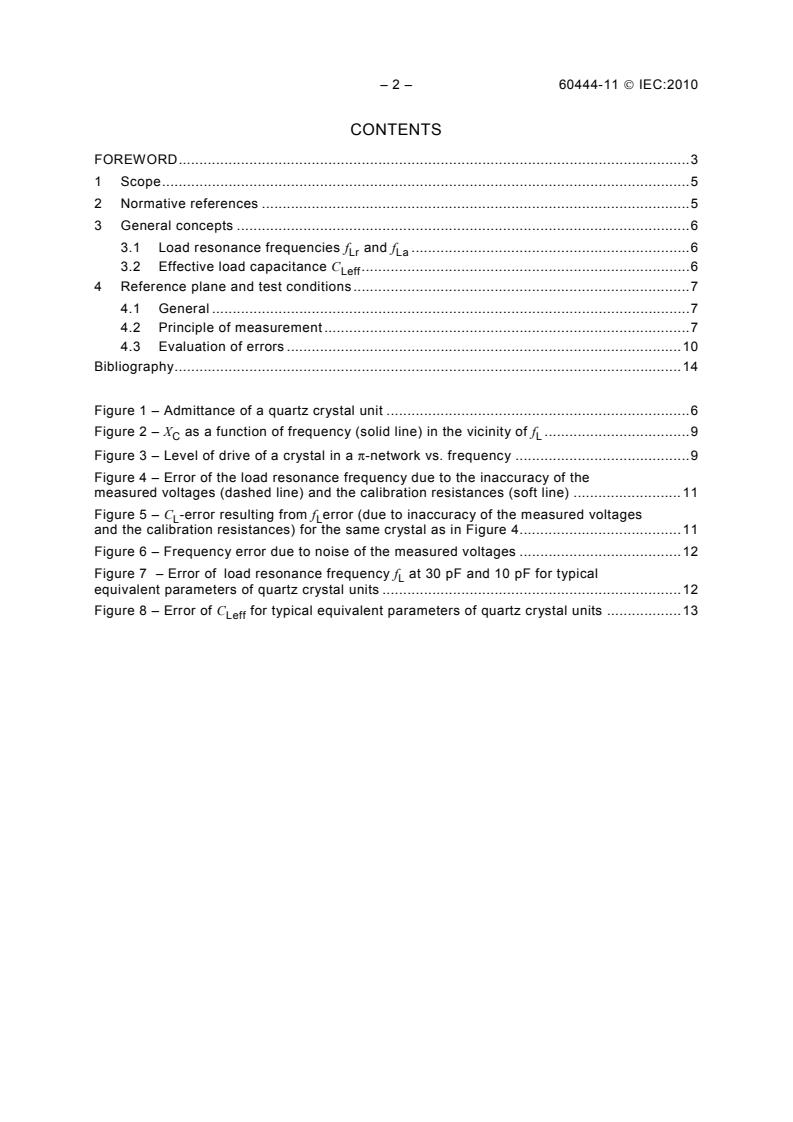
– 2 – 60444-11 © IEC:2010
CONTENTS
FOREWORD.3
1 Scope.5
2 Normative references .5
3 General concepts .6
3.1 Load resonance frequencies f and f .6
Lr La
3.2 Effective load capacitance C .6
Leff
4 Reference plane and test conditions.7
4.1 General .7
4.2 Principle of measurement .7
4.3 Evaluation of errors .10
Bibliography.14
Figure 1 – Admittance of a quartz crystal unit .6
Figure 2 – X as a function of frequency (solid line) in the vicinity of f .9
C L
Figure 3 – Level of drive of a crystal in a π-network vs. frequency .9
Figure 4 – Error of the load resonance frequency due to the inaccuracy of the
measured voltages (dashed line) and the calibration resistances (soft line) .11
Figure 5 – C -error resulting from f error (due to inaccuracy of the measured voltages
L L
and the calibration resistances) for the same crystal as in Figure 4.11
Figure 6 – Frequency error due to noise of the measured voltages .12
Figure 7 – Error of load resonance frequency f at 30 pF and 10 pF for typical
L
equivalent parameters of quartz crystal units .12
Figure 8 – Error of C for typical equivalent parameters of quartz crystal units .13
Leff
60444-11 © IEC:2010 – 3 –
INTERNATIONAL ELECTROTECHNICAL COMMISSION
____________
MEASUREMENT OF QUARTZ CRYSTAL UNIT PARAMETERS –
Part 11: Standard method for the determination of the load resonance
frequency f and the effective load capacitance C using automatic
L Leff
network analyzer techniques and error correction
FOREWORD
1) The International Electrotechnical Commission (IEC) is a worldwide organization for standardization comprising
all national electrotechnical committees (IEC National Committees). The object of IEC is to promote
international co-operation on all questions concerning standardization in the electrical and electronic fields. To
this end and in addition to other activities, IEC publishes International Standards, Technical Specifications,
Technical Reports, Publicly Available Specifications (PAS) and Guides (hereafter referred to as “IEC
Publication(s)”). Their preparation is entrusted to technical committees; any IEC National Committee interested
in the subject dealt with may participate in this preparatory work. International, governmental and non-
governmental organizations liaising with the IEC also participate in this preparation. IEC collaborates closely
with the International Organization for Standardization (ISO) in accordance with conditions determined by
agreement between the two organizations.
2) The formal decisions or agreements of IEC on technical matters express, as nearly as possible, an international
consensus of opinion on the relevant subjects since each technical committee has representation from all
interested IEC National Committees.
3) IEC Publications have the form of recommendations for international use and are accepted by IEC National
Committees in that sense. While all reasonable efforts are made to ensure that the technical content of IEC
Publications is accurate, IEC cannot be held responsible for the way in which they are used or for any
misinterpretation by any end user.
4) In order to promote international uniformity, IEC National Committees undertake to apply IEC Publications
transparently to the maximum extent possible in their national and regional publications. Any divergence
between any IEC Publication and the corresponding national or regional publication shall be clearly indicated in
the latter.
5) IEC itself does not provide any attestation of conformity. Independent certification bodies provide conformity
assessment services and, in some areas, access to IEC marks of conformity. IEC is not responsible for any
services carried out by independent certification bodies.
6) All users should ensure that they have the latest edition of this publication.
7) No liability shall attach to IEC or its directors, employees, servants or agents including individual experts and
members of its technical committees and IEC National Committees for any personal injury, property damage or
other damage of any nature whatsoever, whether direct or indirect, or for costs (including legal fees) and
expenses arising out of the publication, use of, or reliance upon, this IEC Publication or any other IEC
Publications.
8) Attention is drawn to the Normative references cited in this publication. Use of the referenced publications is
indispensable for the correct application of this publication.
9) Attention is drawn to the possibility that some of the elements of this IEC Publication may be the subject of
patent rights. IEC shall not be held responsible for identifying any or all such patent rights.
International Standard IEC 60444-11 has been prepared by IEC technical committee 49:
Piezoelectric, dielectric and electrostatic devices and associated materials for frequency
control, selection and detection.
The text of this standard is based on the following documents:
CDV Report on voting
49/852/CDV 49/883/RVC
Full information on the voting for the approval of this standard can be found in the report on
voting indicated in the above table.
This publication has been drafted in accordance with the ISO/IEC Directives, Part 2.
– 4 – 60444-11 © IEC:2010
A list of all parts of the IEC 60444 series under the general title Measurement of quartz crystal
unit parameters can be found on the IEC website.
The committee has decided that the contents of this amendment and the base publication will
remain unchanged until the stability date indicated on the IEC web site under
"http://webstore.iec.ch" in the data related to the specific publication. At this date, the
publication will be
• reconfirmed,
• withdrawn,
• replaced by a revised edition, or
• amended.
IMPORTANT – The 'colour inside' logo on the cover page of this publication indicates
that it contains colours which are considered to be useful for the correct
understanding of its contents. Users should therefore print this document using a
colour printer.
60444-11 © IEC:2010 – 5 –
MEASUREMENT OF QUARTZ CRYSTAL UNIT PARAMETERS –
Part 11: Standard method for the determination of the load resonance
frequency f and the effective load capacitance C using automatic
L Leff
network analyzer techniques and error correction
1 Scope
This part of IEC 60444 defines the standard method of measuring load resonance frequency
f at the nominal value of C , and the determination of the effective load capacitance C at
L L Leff
the nominal frequency for crystals with the figure of merit M > 4.
M, according to Table 1 of IEC 60122-1:2002, is expressed in the following equation:
Q 1
M = = (1)
r ωC0R1
This gives good results in a frequency range up to 200 MHz. This method allows the
calculation of load resonance frequency offset Δf , frequency pulling range Δf and pulling
L L1,L2
sensitivity S as described in 2.2.31 of IEC 60122-1:2002. In contrary to the simple method of
IEC 60444-4, this measurement technique avoids the use of physical load capacitors, and
allows higher accuracy, better reproducibility and correlation to the application. It extends the
upper frequency limit from 30MHz by the method of IEC 60444-4 to 200MHz approximately.
This method is based on the error-corrected measurement technique of IEC 60444-5:1995,
and therefore allows the measurement of f and C together with the determination of the
L Leff
equivalent crystal parameters in one sequence without changing the test fixture.
With this method the frequency f is searched where the reactance X of the crystal has the
L C
opposite value of the reactance of the load capacitance.
XC = −XCL = (2)
ωLCL
Furthermore this method allows to determine the effective load capacitance C at the
Leff
nominal frequency f .
nom
2 Normative references
The following referenced documents are indispensable for the application of this document.
For dated references, only the edition cited applies. For undated references, the latest edition
of the referenced document (including any amendments) applies.
IEC 60122-1:2002, Quartz crystal units of assessed quality – Part 1: Generic specification
IEC/TR 60444-4, Measurement of quartz crystal unit parameters by zero phase technique in a
π-network – Part 4: Method for the measurement of the load resonance frequency f , load
L
resonance resistance R and the calculation of other derived values of quartz crystal units, up
L
to 30 MHz
IEC 60444-5:1995, Measurement of quartz crystal units parameters – Part 5: Methods for the
determination of equivalent electrical parameters using automatic network analyzer
techniques and error correction
– 6 – 60444-11 © IEC:2010
3 General concepts
3.1 Load resonance frequencies f and f
Lr La
As can be seen in Figure 1, there are two intersection frequencies where XX=− , f with
CCL
Lr
high admittance (low impedance) and f with low admittance (high impedance).
La
The load resonant frequency f is one of the two frequencies of a crystal unit in association
L
with a series or with a parallel load capacitance, at which the electrical admittance
(respectively impedance) of the combination is resistive. The load resonance frequency f is
L
the lower of the two frequencies.
f can be calculated by:
In a first approximation
L
LCC()+C
11 0 L
≈π2 (3)
fC++CC
L10L
f
f
m
f
s
ω ⋅ C
Conductance
f
γ
f
a
ω ⋅ C
L
f f
La
Lγ
R
2R R
γ
IEC 2353/10
Figure 1 – Admittance of a quartz crystal unit
3.2 Effective load capacitance C
Leff
C is defined by the reactance of the crystal at the nominal frequency
Leff
Susceptance
60444-11 © IEC:2010 – 7 –
C Leff = (4)
ω nom XC(ω nom)
4 Reference plane and test conditions
4.1 General
Reference plane: as in 8.4 of IEC 60444-5:1995.
Test conditions: crystal case not grounded.
Level of drive: the output level of the generator is set, such that at its (series) resonance
frequency, the crystal under test is measured at the nominal drive level.
The measurement at the load resonance frequency using the method described below leads
to a level of drive, which is remarkably lower than at the (series) resonance frequency due to
the relative high reactance value. Therefore a correction measurement is performed, for
details see 4.2.
4.2 Principle of measurement
The principles of measurement are the following.
a) Calibration
Due to the high impedance measurements with this method special care has to be taken in
the calibration of the test set-up.
Similar to IEC 60444-5:1995, use the following three known calibration elements:
1) short-circuit (0 Ω) or resistor with low resistance;
2) resistor of 25 Ω or 50 Ω nominal;
3) open circuit (infinite resistance) or capacitor of 10 pF nominal;
where Z is the impedance of calibration element 1
Z is the impedance of calibration element 2
Z is the impedance of calibration element 3
V is the measured voltage with calibration element 1
V is the measured voltage with calibration element 2
V is the measured voltage with calibration element 3
The following parameters are then used for the measurement of quartz crystal units:
R is the termination impedance of the π-network
T
V is the error-corrected “short” voltage
s
V is the error-corrected “open” voltage
o
b) Calibration with three known calibration elements:
1) short-circuit calibration;
2) calibration load (25 Ω or 50 Ω);
3) open circuit calibration (or calibration capacitor of 10 pF);
Z1Z 2(V1− V 2) + Z 2Z3(V 2 − V 3) + Z 3Z1(V 3 − V1)
RT = (5)
Z1(V 2 −V 3) + Z 2(V 3 − V1) + Z 3(V 2 − V 2)
– 8 – 60444-11 © IEC:2010
V 3Z1Z 2(V1− V 2) + V1Z 2Z 3(V 2 − V 3) + V 2Z 3Z1(V 3 − V1)
VS = (6)
Z1Z 2(V1− V 2) + Z 2Z3(V 2 − V 3) + Z 3Z1(V 3 − V1)
Z1V1(V 2 −V 3) + Z 2V 2(V 3 − V1) + Z3V 3(V1− V 2)
V 0 = (7)
Z1(V 2 − V 3) + Z 2(V 3 − V1) + Z 3(V1− V 2)
NOTE If Z is taken as infinite number (ideal open circuit), the above Equations (5), (6) and (7) result is not
allowed divisions of infinite by infinite.
c) Measurement of a quartz crystal unit impedance Z
c
From the measured voltage with a quartz crystal unit V , the impedance Z of the quartz
c c
crystal unit is calculated with:
(V S−V C)
ZC = R T (8)
(V C−V 0)
d) Measurement procedure for f
L
At load resonance frequency, the impedance of a quartz crystal unit is
Z =+RjX (9)
CL L c
For the determination of the load resonance frequency, the frequency f the lower
L
frequency is searched for which Equation (2) is fulfilled, i.e.
XX+= 0 (10)
CCL
With network analyzers, the frequency f is easily determined by using «marker search».
L
functions.
e) Evaluation of R
L
The computation of the load resonance resistance R from the real part of Z at the load
L c
resonance frequency f by the formula:
L
RR==ωωReZ (11)
() ()()
Lc L c L
may result in excessive inaccuracy, because – especially for low frequency crystals – the
angle of the voltage V is close to 90°.
c
X
CL
Only for < 10 this method yields reasonable results.
R
L
In all other cases, the R should be computed from the equation given in IEC 60122-1:
L
⎛⎞C
RR=+1 (12)
⎜⎟
L1
C
⎝⎠L
f) Measurement procedure for C
Leff
The reactance X ( ω ) is measured at the nominal frequency and the effective load
c nom
capacity C is then calculated with the following equation:
Leff
CLeff = (13)
ω nom XC(ω nom)
60444-11 © IEC:2010 – 9 –
Figure 2 shows X as a function of frequency (solid line) in the vicinity of f .
L
C .
780 1 -5
X =
C
770 ω ⋅ C -10
L
760 -15
750 -20
740 -25
X
CL
730 -30
720 -35
710 -40
700 -45
-500 -400 -300 -200 -100 100 200
Δ frequency (ppm)
f
S f
f
LL
X (Ω)
C
V
c
IEC 2354/10
Figure 2 – X as a function of frequency (solid line) in the vicinity of f
C L
g) Level of drive
At the resonance frequency f , the level of drive P of a quartz crystal unit in a π-network is
r
given by the voltage V across the crystal
xr
100 %
10 %
1 %
-500 -400 -300 -200 -100 100 200 300
f f
s L
df/f (ppm)
nom
P {f }/P {f }
eff L max s
IEC 2355/10
Figure 3 – Level of drive of a crystal in a π-network vs. frequency
with
V
xr
P = (14)
R
r
and
Vg Rr
VXr = (15)
Rr + RT
X (Ω)
P {f }/P {f } C
eff L max s
V
C
– 10 – 60444-11 © IEC:2010
Rr + RT
Vg = PRr (16)
Rr
At load resonance frequency f , the impedance Z of a quartz crystal unit is given by the
L L
load resonance resistance R and the modulus of the reactance of the load capacitor X :
L L
|Z | = RX+ (17)
LL
L
and therefore the drive level is
V
xr
P =
Z
L
22 2
XX11++R+R +RR+R −
() ()
CL()CL L T L()L T
V =⋅PR⋅
(18)
gL 1
RX+
LCL
In order to get the same level of drive at the load frequency f as at the series resonance
L
frequency f , it is necessary to increase the output power of the generator by the ratio:
s
2 2
(RL + RT) + XCL
⎡VgL⎤ Rr
ABS = (19)
⎢ ⎥
Vgr RL Rr + RT
⎣ ⎦
NOTE If the required power cannot be reached by the generator, a second measurement at resonance frequency
⎛⎞V
gL
f is performed with a by factor ABS lower level and the difference of both series resonance measurements
⎜⎟
r
⎜⎟
V
gr
⎝⎠
is added to the load resonance frequency f .
L
4.3 Evaluation of errors
a) General comments
According to the application of quartz crystal units in oscillators, the measurement
accuracy of the load resonance frequency f is presented here. The accuracy of the load
L
capacitance C can be calculated then from the frequency accuracy and the equivalent
Leff
parameters of the crystal C and C from the relation
0 1
ff− C
Ls 1
= (20)
f 2()CC+
s0L
b) Accuracy of measurement
The accuracy of the measurement is given by the calibration resistors and the measured
voltages. In order to achieve an accuracy of the voltages of 1 %, it may be necessary to
calibrate the test equipment in the whole power range.
60444-11 © IEC:2010 – 11 –
Typ. frequency error: at CL 10 pF (S = -75,45 ppm/pF): ±16,1 ppm (equiv.: ±0,21 pF)
-35,30
-35,40
Impedance error of test head and
-35,50
calibration s tandards : ±0,5 %
-35,60
-35,70
-35,80
Resolution of V : ±0,05 dB
-35,90 c
-36,00
0 5
-20 -15 -10 -5 10 15 20
df/f (ppm)
nom
V Max. frequency error
c
IEC 2356/10
NOTE Example for a quartz crystal 11 MHz in HC-49/U package.
Figure 4 – Error of the load resonance frequency due to the inaccuracy of the measured
voltages (dashed line) and the calibration resistances (soft line)
10,30
10,20
10,10
10,00
9,90
9,80
9,70
-20 -15 -10 -5 10 15 20
df/f (ppm)
nom
IEC 2357/10
Figure 5 – C -error resulting from f error (due to inaccuracy of the measured voltages
L L
and the calibration resistances) for the same crystal as in Figure 4
c) Reproducibility
Since the determination of the load frequency is based on a voltage measurement, the
reproducibility of the f measurement is influenced by noise.
L
Depending on the level of the expected voltage the measured noise is directly proportional
to the evaluated frequency.
To increase the accuracy it is recommended to use smaller bandwidths of intermediate
frequency (IF) filters of the used measurement equipment and the use of an averaged
signal.
C (pF)
L
V (dB)
m
– 12 – 60444-11 © IEC:2010
frequency error caused by m easured noise
Frequency error caused by measured noise
-29,00
-29,0
-29,20
-29,0
--29,29,400
-29,0
-29,60
r
-29,0 Frequency error
-29,80
-30,0
-30,00
-20 -15 -10 -5 10 15 20
-20 -15 -10 -5 0 5 10 15 20
df/f (ppm)
df/f [ppm ]
V (dB)
C
Theoretical signal
theoretical signal measured amplitude
Error
V [dB]
Signal noise ±0,05 dB
c
signal noise ±0,05dB error
IEC 2358/10
Figure 6 – Frequency error due to noise of the measured voltages
1,00
0,80
Fund.
0,60
0,40
0,20
2 rd
3 overtone
0,00
1 10 100
Frequency (MHz)
C tolerance at f {30 pF} ± (pF)
df error at 30 pF ± (ppm) L nom
IEC 2359/10
Figure 7 – Error of load resonance frequency f at 30 pF and 10 pF
L
for typical equivalent parameters of quartz crystal units
V (dB)
C
df error ± (ppm) VDUT[dB]
dC at f ± (pF)
L
60444-11 © IEC:2010 – 13 –
0,25
0,20
Fund.
15 0,15
0,10
0,05
rd
3 overtone
0 0,00
1 10 100
Frequency (MHz)
C tolerance at f {10 pF} ± (pF)
df error at 10 pF ± (ppm)
L nom
IEC 2360/10
Figure 8 – Error of C for typical equivalent parameters of quartz crystal units
Leff
d) Comparison with the method of IEC 60444-4
The inaccuracy of the measurement of the load resonance frequency f according to
L
IEC 60444-4 is mainly given by the inaccuracy of the physical load capacitors which often
show a large dependence on frequency.
Comparison measurements ([1] , [2], [5]) with quartz crystal units between 4 MHz and
155 MHz showed an inaccuracy of 1 % of C .
Leff
The corresponding frequency inaccuracy can be calculated with the formula (20).
The inaccuracy for fundamental quartz crystal units with high C is less than 5 ppm with
the standard method presented here and up to 20 ppm wi
...