


IEC 62321-3-2:2013
(Main)Determination of certain substances in electrotechnical products - Part 3-2: Screening - Total bromine in polymers and electronics by Combustion - Ion Chromatography
Determination of certain substances in electrotechnical products - Part 3-2: Screening - Total bromine in polymers and electronics by Combustion - Ion Chromatography
IEC 62321-3-2:2013 specifies the screening analysis of the total bromine (Br) in homogeneous materials found in polymers and electronics by using the analytical technique of combustion ion chromatography (C-IC).
It has the status of a horizontal standard in accordance with IEC Guide 108.
Détermination de certaines substances dans les produits électrotechniques - Partie 3-2: Méthodes d'essai - Brome total dans les polymères et les produits électriques par Combustion - Chromatographie d'ionisation
La CEI 62321-3-2:2013 définit l'analyse par détection du brome total (Br) dans des matériaux homogènes que l'on trouve dans les polymères et les produits électroniques en utilisant la technique analytique de combustion de la chromatographie d'ionisation (C-IC).
Elle a le statut de norme horizontale conformément au Guide IEC 108.
General Information
- Status
- Published
- Publication Date
- 18-Jun-2013
- Technical Committee
- TC 111 - Environmental standardization for electrical and electronic products and systems
- Drafting Committee
- WG 3 - TC 111/WG 3
- Current Stage
- DELPUB - Deleted Publication
- Start Date
- 30-Jun-2020
- Completion Date
- 13-Feb-2026
Relations
- Effective Date
- 05-Sep-2023
Overview
IEC 62321-3-2:2013 is an international standard published by the International Electrotechnical Commission (IEC) that specifies a screening method for determining total bromine content in polymers and electronics. The method employs combustion followed by ion chromatography (C-IC) to analyze homogeneous materials used in electrotechnical products. As a horizontal standard according to IEC Guide 108, IEC 62321-3-2:2013 provides a globally harmonized test procedure to evaluate bromine levels, which is critical for environmental and regulatory compliance in the electronics industry.
The standard forms part of the IEC 62321 series, which addresses the determination of hazardous substances in electrotechnical products, helping manufacturers and regulators ensure products meet global safety and environmental requirements.
Key Topics
Scope and Purpose
IEC 62321-3-2:2013 targets the screening analysis of total bromine (Br) in polymers and electronics, recognizing brominated compounds as important fire retardants but also as substances of environmental concern.Analytical Principle
The method involves complete sample combustion followed by ion chromatography to quantify bromine ions released during combustion. This approach accurately measures total bromine content in homogeneous materials.Test Procedure
Steps include:- Sample preparation and homogeneous sampling
- Oxygen bomb or oxygen flask combustion to convert bromine to bromide ions
- Collection and absorption of combustion gases into a solution
- Ion chromatography analysis for bromine quantification
- Calibration using known standards and blank tests to ensure accuracy
Quality Control and Precision
The standard details limits of detection (LOD) and quantification (LOQ), calibration criteria, measurement precision, and quality assurance practices to maintain reliable results.Safety and Compliance
The standard emphasizes laboratory safety and regulatory compliance, noting the responsibility of users to apply correct safety protocols during sample combustion and chemical handling.
Applications
Environmental Compliance
Ensures that electrotechnical products comply with global and regional regulations restricting brominated substances, such as RoHS and WEEE directives, which aim to reduce hazardous materials in electrical and electronic equipment.Product Screening and Verification
Enables manufacturers to screen raw materials and finished products for bromine content, assisting in quality control and supplier verification processes.Research and Development
Supports R&D by providing validated testing methods for material characterization related to flame retardants and environmental impact assessments.Certification and Reporting
Facilitates verification of bromine content for certification purposes and reporting against environmental standards.
Related Standards
IEC 62321-3-2:2013 is part of the broader IEC 62321 series, which covers methods for determining various hazardous substances in electrotechnical products, including lead, cadmium, mercury, hexavalent chromium, and others. Key related parts include:
- IEC 62321-1: Description of general terms and methods for determining restricted substances
- IEC 62321-4: Determination of lead and cadmium by atomic absorption spectrometry
- IEC 62321-5: Determination of mercury by CV-AAS and CV-AFS
- IEC 62321-6: Determination of hexavalent chromium
- IEC 62321-7-1 and 7-2: Determination of phthalates and other organic compounds
Together, these standards provide comprehensive methods for chemical substance analysis, enabling a unified approach to product safety and environmental impact evaluation.
Keywords: IEC 62321-3-2, total bromine, polymers, electronics, combustion ion chromatography, C-IC, electrotechnical products, environmental compliance, hazardous substances, brominated flame retardants, IEC standards, product screening, bromine testing, RoHS compliance, quality control, ion chromatography, analytical method.
Get Certified
Connect with accredited certification bodies for this standard

TÜV Rheinland
TÜV Rheinland is a leading international provider of technical services.

TÜV SÜD
TÜV SÜD is a trusted partner of choice for safety, security and sustainability solutions.

BSI Group
BSI (British Standards Institution) is the business standards company that helps organizations make excellence a habit.
Sponsored listings
Frequently Asked Questions
IEC 62321-3-2:2013 is a standard published by the International Electrotechnical Commission (IEC). Its full title is "Determination of certain substances in electrotechnical products - Part 3-2: Screening - Total bromine in polymers and electronics by Combustion - Ion Chromatography". This standard covers: IEC 62321-3-2:2013 specifies the screening analysis of the total bromine (Br) in homogeneous materials found in polymers and electronics by using the analytical technique of combustion ion chromatography (C-IC). It has the status of a horizontal standard in accordance with IEC Guide 108.
IEC 62321-3-2:2013 specifies the screening analysis of the total bromine (Br) in homogeneous materials found in polymers and electronics by using the analytical technique of combustion ion chromatography (C-IC). It has the status of a horizontal standard in accordance with IEC Guide 108.
IEC 62321-3-2:2013 is classified under the following ICS (International Classification for Standards) categories: 13.020.01 - Environment and environmental protection in general; 43.040.10 - Electrical and electronic equipment. The ICS classification helps identify the subject area and facilitates finding related standards.
IEC 62321-3-2:2013 has the following relationships with other standards: It is inter standard links to IEC 62321-3-2:2020. Understanding these relationships helps ensure you are using the most current and applicable version of the standard.
IEC 62321-3-2:2013 is available in PDF format for immediate download after purchase. The document can be added to your cart and obtained through the secure checkout process. Digital delivery ensures instant access to the complete standard document.
Standards Content (Sample)
IEC 62321-3-2 ®
Edition 1.0 2013-06
INTERNATIONAL
STANDARD
NORME
INTERNATIONALE
HORIZONTAL STANDARD
NORME HORIZONTALE
Determination of certain substances in electrotechnical products –
Part 3-2: Screening – Total bromine in polymers and electronics by Combustion –
Ion Chromatography
Détermination de certaines substances dans les produits électrotechniques –
Partie 3-2: Méthodes d'essai – Brome total dans les polymères et les produits
électriques par Combustion – Chromatographie d'Ionisation
All rights reserved. Unless otherwise specified, no part of this publication may be reproduced or utilized in any form
or by any means, electronic or mechanical, including photocopying and microfilm, without permission in writing from
either IEC or IEC's member National Committee in the country of the requester.
If you have any questions about IEC copyright or have an enquiry about obtaining additional rights to this publication,
please contact the address below or your local IEC member National Committee for further information.
Droits de reproduction réservés. Sauf indication contraire, aucune partie de cette publication ne peut être reproduite ni
utilisée sous quelque forme que ce soit et par aucun procédé, électronique ou mécanique, y compris la photocopie et les
microfilms, sans l'accord écrit de la CEI ou du Comité national de la CEI du pays du demandeur.
Si vous avez des questions sur le copyright de la CEI ou si vous désirez obtenir des droits supplémentaires sur cette
publication, utilisez les coordonnées ci-après ou contactez le Comité national de la CEI de votre pays de résidence.
IEC Central Office Tel.: +41 22 919 02 11
3, rue de Varembé Fax: +41 22 919 03 00
CH-1211 Geneva 20 info@iec.ch
Switzerland www.iec.ch
About the IEC
The International Electrotechnical Commission (IEC) is the leading global organization that prepares and publishes
International Standards for all electrical, electronic and related technologies.
About IEC publications
The technical content of IEC publications is kept under constant review by the IEC. Please make sure that you have the
latest edition, a corrigenda or an amendment might have been published.
Useful links:
IEC publications search - www.iec.ch/searchpub Electropedia - www.electropedia.org
The advanced search enables you to find IEC publications The world's leading online dictionary of electronic and
by a variety of criteria (reference number, text, technical electrical terms containing more than 30 000 terms and
committee,…). definitions in English and French, with equivalent terms in
It also gives information on projects, replaced and additional languages. Also known as the International
withdrawn publications. Electrotechnical Vocabulary (IEV) on-line.
IEC Just Published - webstore.iec.ch/justpublished Customer Service Centre - webstore.iec.ch/csc
Stay up to date on all new IEC publications. Just Published If you wish to give us your feedback on this publication
details all new publications released. Available on-line and or need further assistance, please contact the
also once a month by email. Customer Service Centre: csc@iec.ch.
A propos de la CEI
La Commission Electrotechnique Internationale (CEI) est la première organisation mondiale qui élabore et publie des
Normes internationales pour tout ce qui a trait à l'électricité, à l'électronique et aux technologies apparentées.
A propos des publications CEI
Le contenu technique des publications de la CEI est constamment revu. Veuillez vous assurer que vous possédez
l’édition la plus récente, un corrigendum ou amendement peut avoir été publié.
Liens utiles:
Recherche de publications CEI - www.iec.ch/searchpub Electropedia - www.electropedia.org
La recherche avancée vous permet de trouver des Le premier dictionnaire en ligne au monde de termes
publications CEI en utilisant différents critères (numéro de électroniques et électriques. Il contient plus de 30 000
référence, texte, comité d’études,…). termes et définitions en anglais et en français, ainsi que
Elle donne aussi des informations sur les projets et les les termes équivalents dans les langues additionnelles.
publications remplacées ou retirées. Egalement appelé Vocabulaire Electrotechnique
International (VEI) en ligne.
Just Published CEI - webstore.iec.ch/justpublished
Service Clients - webstore.iec.ch/csc
Restez informé sur les nouvelles publications de la CEI.
Just Published détaille les nouvelles publications parues. Si vous désirez nous donner des commentaires sur
Disponible en ligne et aussi une fois par mois par email. cette publication ou si vous avez des questions
contactez-nous: csc@iec.ch.
IEC 62321-3-2 ®
Edition 1.0 2013-06
INTERNATIONAL
STANDARD
NORME
INTERNATIONALE
HORIZONTAL STANDARD
NORME HORIZONTALE
Determination of certain substances in electrotechnical products –
Part 3-2: Screening – Total bromine in polymers and electronics by Combustion –
Ion Chromatography
Détermination de certaines substances dans les produits électrotechniques –
Partie 3-2: Méthodes d'essai – Brome total dans les polymères et les produits
électriques par Combustion – Chromatographie d'Ionisation
INTERNATIONAL
ELECTROTECHNICAL
COMMISSION
COMMISSION
ELECTROTECHNIQUE
INTERNATIONALE
ICS 13.020; 43.040.10 ISBN 978-2-83220-840-3
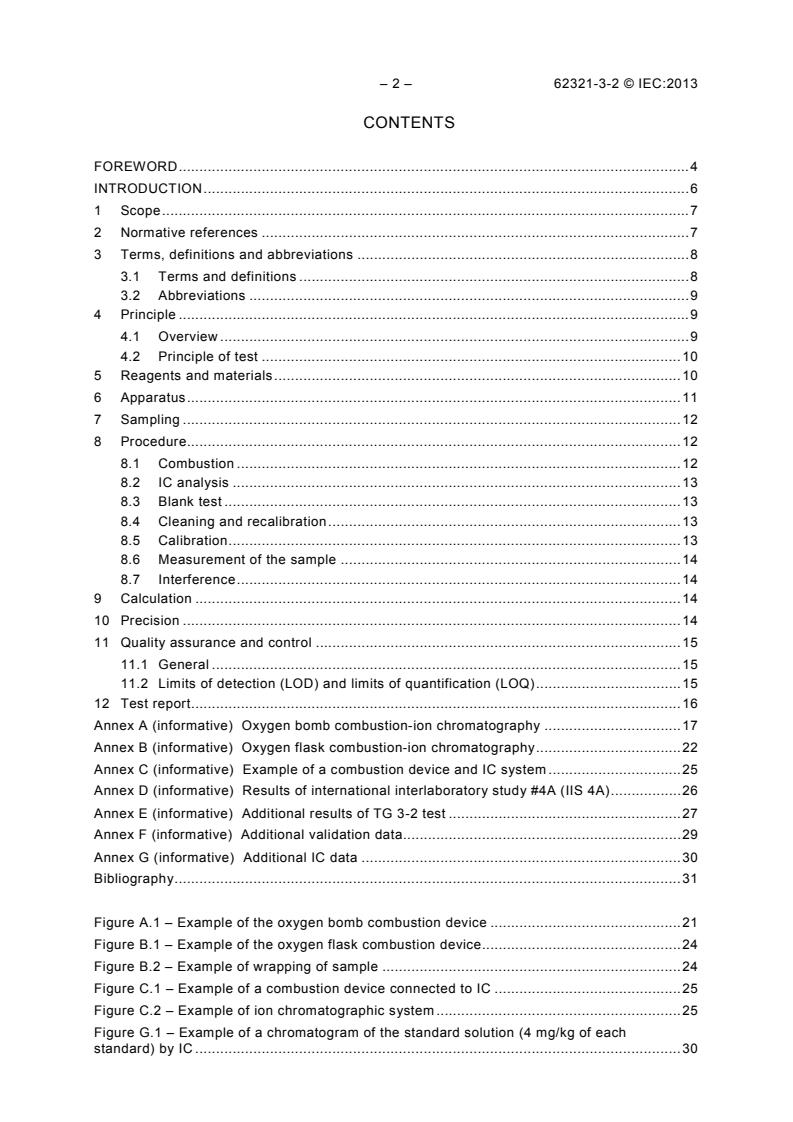
– 2 – 62321-3-2 © IEC:2013
CONTENTS
FOREWORD . 4
INTRODUCTION . 6
1 Scope . 7
2 Normative references . 7
3 Terms, definitions and abbreviations . 8
3.1 Terms and definitions . 8
3.2 Abbreviations . 9
4 Principle . 9
4.1 Overview . 9
4.2 Principle of test . 10
5 Reagents and materials . 10
6 Apparatus . 11
7 Sampling . 12
8 Procedure. 12
8.1 Combustion . 12
8.2 IC analysis . 13
8.3 Blank test . 13
8.4 Cleaning and recalibration . 13
8.5 Calibration . 13
8.6 Measurement of the sample . 14
8.7 Interference . 14
9 Calculation . 14
10 Precision . 14
11 Quality assurance and control . 15
11.1 General . 15
11.2 Limits of detection (LOD) and limits of quantification (LOQ) . 15
12 Test report . 16
Annex A (informative) Oxygen bomb combustion-ion chromatography . 17
Annex B (informative) Oxygen flask combustion-ion chromatography . 22
Annex C (informative) Example of a combustion device and IC system . 25
Annex D (informative) Results of international interlaboratory study #4A (IIS 4A) . 26
Annex E (informative) Additional results of TG 3-2 test . 27
Annex F (informative) Additional validation data. 29
Annex G (informative) Additional IC data . 30
Bibliography . 31
Figure A.1 – Example of the oxygen bomb combustion device . 21
Figure B.1 – Example of the oxygen flask combustion device. 24
Figure B.2 – Example of wrapping of sample . 24
Figure C.1 – Example of a combustion device connected to IC . 25
Figure C.2 – Example of ion chromatographic system . 25
Figure G.1 – Example of a chromatogram of the standard solution (4 mg/kg of each
standard) by IC . 30
62321-3-2 © IEC:2013 – 3 –
Table 1 – Tested concentration ranges for bromine by C-IC in various materials . 7
Table 2 – Acceptance criteria of items for quality control . 15
Table 3 – Student’s t values used for calculation of method detection limit (*MDL=
t × s ) . 16
n–1
Table D.1 – Mean results and recovery rates for total bromine obtained in the IIS4A
study using C-IC . 26
Table D.2 – Statistical total bromine data for IIS 4A results using C-IC . 26
Table E.1 – Mean results and recovery rates for total bromine obtained in the TG 3-2
internal test study by using C-IC . 27
Table E.2 – Mean results and recovery rates for total bromine obtained in the TG 3-2
internal test study by using Oxygen bomb-IC . 28
Table F.1 – General conditions for the combustion furnace and the absorption solution . 29
Table F.2 – Additional information – Difference in sample sizes and measured bromine
values in solder paste with burning aid (WO powder) . 29
Table F.3 – Additional information – Difference in combustion temperatures and
powder) . 29
measured bromine values in solder paste with burning aid (WO
Table G.1 – Typical operating conditions for IC . 30
Table G.2 – Example of calibration solutions for IC . 30
– 4 – 62321-3-2 © IEC:2013
INTERNATIONAL ELECTROTECHNICAL COMMISSION
____________
DETERMINATION OF CERTAIN SUBSTANCES
IN ELECTROTECHNICAL PRODUCTS –
Part 3-2: Screening – Total bromine in polymers and electronics
by Combustion – Ion Chromatography
FOREWORD
1) The International Electrotechnical Commission (IEC) is a worldwide organization for standardization comprising
all national electrotechnical committees (IEC National Committees). The object of IEC is to promote
international co-operation on all questions concerning standardization in the electrical and electronic fields. To
this end and in addition to other activities, IEC publishes International Standards, Technical Specifications,
Technical Reports, Publicly Available Specifications (PAS) and Guides (hereafter referred to as “IEC
Publication(s)”). Their preparation is entrusted to technical committees; any IEC National Committee interested
in the subject dealt with may participate in this preparatory work. International, governmental and non-
governmental organizations liaising with the IEC also participate in this preparation. IEC collaborates closely
with the International Organization for Standardization (ISO) in accordance with conditions determined by
agreement between the two organizations.
2) The formal decisions or agreements of IEC on technical matters express, as nearly as possible, an international
consensus of opinion on the relevant subjects since each technical committee has representation from all
interested IEC National Committees.
3) IEC Publications have the form of recommendations for international use and are accepted by IEC National
Committees in that sense. While all reasonable efforts are made to ensure that the technical content of IEC
Publications is accurate, IEC cannot be held responsible for the way in which they are used or for any
misinterpretation by any end user.
4) In order to promote international uniformity, IEC National Committees undertake to apply IEC Publications
transparently to the maximum extent possible in their national and regional publications. Any divergence
between any IEC Publication and the corresponding national or regional publication shall be clearly indicated in
the latter.
5) IEC itself does not provide any attestation of conformity. Independent certification bodies provide conformity
assessment services and, in some areas, access to IEC marks of conformity. IEC is not responsible for any
services carried out by independent certification bodies.
6) All users should ensure that they have the latest edition of this publication.
7) No liability shall attach to IEC or its directors, employees, servants or agents including individual experts and
members of its technical committees and IEC National Committees for any personal injury, property damage or
other damage of any nature whatsoever, whether direct or indirect, or for costs (including legal fees) and
expenses arising out of the publication, use of, or reliance upon, this IEC Publication or any other IEC
Publications.
8) Attention is drawn to the Normative references cited in this publication. Use of the referenced publications is
indispensable for the correct application of this publication.
9) Attention is drawn to the possibility that some of the elements of this IEC Publication may be the subject of
patent rights. IEC shall not be held responsible for identifying any or all such patent rights.
International Standard IEC 62321-3-2 has been prepared by IEC technical committee 111:
Environmental standardization for electrical and electronic products and systems.
It has the status of a horizontal standard in accordance with IEC Guide 108.
The first edition of IEC 62321:2008 was a 'stand alone' standard that included an introduction,
an overview of test methods, a mechanical sample preparation as well as various test method
clauses.
This first edition of IEC 62321-3-2 introduces a new clause in the IEC 62321 series.
Future parts in the IEC 62321 series will gradually replace the corresponding clauses in
IEC 62321:2008. Until such time as all parts are published, however, IEC 62321:2008 remains
valid for those clauses not yet re-published as a separate part.
62321-3-2 © IEC:2013 – 5 –
The text of this standard is based on the following documents:
FDIS Report on voting
111/300/FDIS 111/310/RVD
Full information on the voting for the approval of this standard can be found in the report on
voting indicated in the above table.
This publication has been drafted in accordance with the ISO/IEC Directives, Part 2.
A list of all parts in the IEC 62321 series can be found on the IEC website under the general
title: Determination of certain substances in electrotechnical products.
The committee has decided that the contents of this publication will remain unchanged until
the stability date indicated on the IEC web site under "http://webstore.iec.ch" in the data
related to the specific publication. At this date, the publication will be
• reconfirmed,
• withdrawn,
• replaced by a revised edition, or
• amended.
– 6 – 62321-3-2 © IEC:2013
INTRODUCTION
The widespread use of electrotechnical products has drawn increased attention to their impact
on the environment. In many countries all over the world this has resulted in the adaptation of
regulations affecting wastes, substances and energy use of electrotechnical products.
The use of certain substances (e.g. lead (Pb), cadmium (Cd) and polybrominated diphenyl
ethers (PBDE’s)) in electrotechnical products, is a source of concern in current and proposed
regional legislation.
The purpose of the IEC 62321 series is therefore to provide test methods that will allow the
electrotechnical industry to determine the levels of certain substances of concern in
electrotechnical products on a consistent global basis.
WARNING – Persons using this International Standard should be familiar with normal
laboratory practice. This standard does not purport to address all of the safety
problems, if any, associated with its use. It is the responsibility of the user to establish
appropriate safety and health practices and to ensure compliance with any national
regulatory conditions
62321-3-2 © IEC:2013 – 7 –
DETERMINATION OF CERTAIN SUBSTANCES
IN ELECTROTECHNICAL PRODUCTS –
Part 3-2: Screening – Total bromine in polymers and electronics
by Combustion – Ion Chromatography
1 Scope
Part 3-2 of IEC 62321 specifies the screening analysis of the total bromine (Br) in
homogeneous materials found in polymers and electronics by using the analytical technique
of combustion ion chromatography (C-IC).
This test method has been evaluated for ABS (acrylonitrile butadiene styrene), EMC (epoxy
molding compound), and PE (polyethylene) within the concentration ranges as specified in
Table 1.
The use of this method for other types of materials or concentration ranges outside those
specified below has not been evaluated.
Table 1 – Tested concentration ranges for bromine by C-IC in various materials
Substance/element Bromine
Medium/material tested
Parameter
Unit of
ABS EMC PE
measure
mg/kg
Concentration or
124 to 890 195 to 976 96
concentration range tested
This standard does not purport to address all of the safety concerns, if any, associated with
its use. It is the responsibility of the user of this standard to establish appropriate safety and
health practices and determine the applicability of regulatory limitations prior to use.
2 Normative references
The following documents, in whole or in part, are normatively referenced in this document and
are indispensable for its application. For dated references, only the edition cited applies. For
undated references, the latest edition of the referenced document (including any
amendments) applies.
IEC 60754-1:2011, Test on gases evolved during combustion of materials from cables – Part
1: Determination of the halogen acid gas content
IEC 62321-1, Determination of certain substances in electrotechnical products – Part 1:
Introduction and overview
IEC 62321-2, Determination of certain substances in electrotechnical products – Part 2:
Disassembly, disjointment and mechanical sample preparation
___________
To be published.
– 8 – 62321-3-2 © IEC:2013
IEC 62321-3-1, Determination of certain substances in electrotechnical products – Part 3-1:
Screening –Lead, mercury, cadmium, total chromium and total bromine in electrotechnical
products using X-ray fluorescence spectrometry
ISO 3696, Water for analytical laboratory use – Specification and test methods
ISO 8466-1, Water quality – Calibration and evaluation of analytical methods and estimation
of performance characteristics – Part 1: Statistical evaluation of the linear calibration function
ISO/DIS 10304-1:2006, Water quality – Determination of dissolved anions by liquid
chromatography of ions – Part 1: Determination of bromide, chloride, fluoride, nitrate, nitrite,
phosphate and sulfate
3 Terms, definitions and abbreviations
3.1 Terms and definitions
For the purposes of this document, the terms and definitions given in IEC 62321-1 as well as
the following, apply.
3.1.1
accuracy
closeness of agreement between a test result and an accepted reference value
Note 1 to entry: The term accuracy, when applied to a set of test results, involves a combination of random
components and a common systematic error or bias component.
[ISO 5725-1:1995, definition 3.6] [1]
3.1.2
laboratory control sample
a known matrix spiked with compound(s) representative of the target analytes, used to
document laboratory performance
[Based on US EPA SW-846] [2]
3.1.3
repeatability limit
value less than or equal to which the absolute difference between two test results obtained
under repeatability conditions may be expected to be with a probability of 95 %
Note 1 to entry: The symbol used is r.
[ISO 5725-1:1994, definition 3.16]
3.1.4
reproducibility limit
value less than or equal to which the absolute difference between two test results obtained
under reproducibility conditions may be expected to be with a probability of 95 %
Note 1 to entry: The symbol used is R.
[ISO 5725-1:1994, definition 3.20 ]
___________
To be published.
62321-3-2 © IEC:2013 – 9 –
3.1.5
test sample
sample prepared from the laboratory sample and from which test portions will be taken
[ISO 6206:1979, definition 3.2.13] [3]
3.1.6
test portion
the quantity of material drawn from the test sample (or from the laboratory sample if both are
the same) and on which the test or observation is actually carried out
[ISO 6206:1979, definition 3.2.14]
3.2 Abbreviations
ABS Acrylonitrile butadiene styrene
CCV Continuing calibration verification
CD Conductivity detector
C-IC Combustion – Ion chromatography
EMC Epoxy molding compound
IC Ion chromatography
IS Internal standard
IUPAC International Union of Pure and Applied Chemistry
KRISS Korea Research Institute of Standards and Science
LCS Laboratory control sample
LOD Limit of detection
LOQ Limit of quantification
MDL Method detection limit
PBBs Polybrominated biphenyls
PBDEs Polybrominated diphenyl ethers
PE Polyethylene
PP Polypropylene
XRF X-Ray fluorescence spectroscopy
US EPA United States Environmental Protection Agency
4 Principle
4.1 Overview
The concept of 'screening' has been developed to reduce the amount of testing. Executed as
a predecessor to any other test analysis, the main objective of screening is to quickly
determine whether the screened part or section of a product:
– contains a certain substance at a concentration significantly higher than its value or values
chosen as criterion, and therefore may be deemed unacceptable;
– contains a certain substance at a concentration significantly lower than its value or values
chosen as criterion, and therefore may be deemed acceptable;
contains a certain substance at a concentration so close to the value or values chosen as
criterion that when all possible errors of measurement and safety factors are considered, no
conclusive decision can be made about the acceptable absence or presence of a certain
– 10 – 62321-3-2 © IEC:2013
substance and, therefore, a follow-up action may be required, including further analysis using
verification testing procedures.
This test method is designed specifically to screen for bromine (Br) in polymers and
electronics in electrotechnical products. C-IC provides information on the total quantity of
bromine present in the sample, but does not identify compounds or valence states of the
bromine. Therefore, special attention shall be paid when screening for bromine, where the
result will reflect only the total bromine present. The presence of brominated flame retardants
PBB or PBDE shall be confirmed by a verification test procedure. When applying this method
to electronics “as received”, which, by the nature of their design, are not uniform, care shall
be taken in interpreting the results.
4.2 Principle of test
A sample of known weight or volume is placed into a sample boat and introduced at a
controlled rate into a high-temperature combustion tube. There the sample is combusted in an
oxygen-rich pyrohydrolytic environment. The gaseous by-products of the combusted sample
are trapped in an absorption medium where the hydrogen bromide (HBr) formed during the
-
combustion disassociates into its respective ion, Br . An aliquot of known volume of the
absorbing solution is then manually or automatically injected into an ion chromatograph (IC)
by means of a sample injection valve. The halide anions, including bromide, are separated
into individual elution bands on the separation column of the IC. The conductivity of the eluent
is reduced with an anion suppression device prior to the ion chromatograph’s conductivity
detector, where the anions of interest are measured. Quantification of the bromine in the
original combusted sample is achieved by calibrating the system with a series of standards
containing known amounts of bromide and then analysing unknown samples under the same
conditions as the standards. The combined system of pyrohydrolytic combustion followed by
ion chromatographic detection is referred to as combustion-ion chromatography (C-IC).
5 Reagents and materials
WARNING – All recognized health and safety precautions shall be in effect when
carrying out the operations specified in this International Standard. Failure to heed the
directions contained in this International Standard, or those of the manufacturer of the
devices used, may result in injury or equipment damage.
Use only reagents of recognized analytical grade. Weigh the reagents with an accuracy of
± 1 % of the nominal mass, unless stated otherwise. The reagents listed in 5 b) and 5 g) to 5
k) may be considered representative examples for the preparation of eluents (5 i)).
a) Water, complying with grade 1 as defined in ISO 3696.
b) Hydrogen peroxide, a mass fraction of 30 %, (H O ).
2 2
Hydrogen peroxide is very caustic, thus the operator shall wear goggles and gloves and
shall work under a fume hood when handling this reagent. As this method uses a gas
(oxygen) at a high temperature and under high pressure, precautions shall be taken by the
operator.
c) Quartz wool, fine grade or other suitable medium.
d) Argon, carrier gas of minimum 99,9 %.
Purification scrubbers to ensure the removal of containments are recommended such as
moisture (molecular sieve) and hydrocarbon trap filters (activated charcoal or equivalent)
are recommended.
e) Oxygen, combustion gas of minimum 99,6 %.
f) Burning aids, tungsten oxide (WO ) or iron oxide (Fe O ) etc. Minimum particle size of
3 3 4
burning aids should be less than 50 µm.
g) Blank solution, fill a volumetric flask (e.g. 100 ml flask) with water (5 a)).
h) Calibration standard solutions
62321-3-2 © IEC:2013 – 11 –
Certified calibration standards from commercial sources, or calibration standards prepared
in the laboratory, containing the elements of interest at the concentrations of interest are
used. Depending on the concentrations expected in the sample, use the standard solution
to prepare, e.g. 5 to 10 calibration solutions distributed as evenly as possible over the
expected working range.
NOTE 1 The solution is either prepared from a primary standard or calibrated by some other means.
NOTE 2 Many standard reference solutions which can be used to prepare standard solutions are
commercially available.
i) Eluents
Eluents are used as a solvent in separating materials in elution. The choice of eluent
depends on the chosen column and detector (seek advice from column supplier). Eluent
preparation is carried out as specified in 5.10 of ISO 10304-1:2006:
1) sodium hydrogen carbonate, NaHCO ;
2) sodium carbonate, Na CO ;
2 3
3) sodium hydroxide, NaOH;
4) potassium hydroxide, KOH.
j) Internal standard (IS) solution (optional)
An internal standard can be used to correct for analytical errors.
The internal standard used in the absorption solution should not contain any of the sample
components, and should be selected based on the condition of column and mobile phase
(e.g. phosphate, citric acid, oxalic acid, methane sulfonic acid, etc.)
k) Absorption solution, used for quantifying bromine – 3 ml of H O (5 b)) are poured into a
2 2
1 000 ml volumetric flask and water is added to the scale and mixed. This solution
contains 900 mg/kg of H O .
2 2
l) Reference materials – Reference material can be used to ensure recovery rates of
bromine fall within 90 % to 110 %. Certified reference material is the best one for that
purpose. If certified reference material is not available, a reference material can be
prepared by mixing certain amounts of bromine compounds. It can be made by mixing
certain amounts of bromine compounds, diluting with cellulose or aluminium oxides to
obtain a suitable concentration, and then pulverizing the mixture to homogenize.
6 Apparatus
The following apparatuses shall be used:
a) balance; analytical, with sensitivity to 0,000 1 g (0,1 mg);
b) scissors;
c) combustion system – in general, it consists of the following components (see Figure C.1):
1) auto sampler (optional) – auto sampler is capable of accurately delivering 1 mg to
100 mg of sample into the sample boat. The auto sampler may be used as long as the
accuracy and performance of the method are not degraded;
2) sample boat – boat is made of quartz, nickel, ceramics, platinum or stainless steel;
3) sample introduction system – the system provides a sampling port for the introduction
the sample into the sample boat and is connected to the inlet of the pyrohydrolytic
combustion tube. The system is swept by a humidified inert carrier gas and shall be
capable of allowing the quantitative delivery of the material to be analyzed into the
pyrohydrolytic oxidation zone at a controlled and repeatable rate;
4) electric furnace – it can be heated 900 °C to 1 100 °C and have the quartz tube
installed inside of the device and connected to the equipment for injecting sample.
Therefore, it is designed so that the combustion gas of the sample can be discharged
without loss;
– 12 – 62321-3-2 © IEC:2013
5) pyrohydrolytic combustion tube – pyrohydrolytic combustion tube is made of quartz
and constructed such that when the sample is combusted in the presence of humidified
oxygen, the by-products of combustion are swept into the humidified pyrohydrolytic
combustion zone. The inlet end shall allow for the stepwise introduction and
advancement of a sample boat into the heated zone and shall have a side arm for the
introduction of the humidified carrier gas and oxygen. The pyrohydrolytic combustion
tube must be of ample volume, and have a heated zone with quartz wool or other
suitable medium providing sufficient surface area so that the complete pyrohydrolytic
combustion of the sample is ensured. If the sample contains bromine of high
concentration, a trap column should be installed between the absorption tube and the
combustion tube.
6) water supply device – this device is capable of delivering grade 1 water (5 a) to the
combustion tube at a controlled rate sufficient to provide a pyrohydrolytic environment;
7) absorption tube – a glass pipe size is capable of maintaining about one-half of the total
volume by putting 10 ml to 20 ml of the absorption solution. This has the configuration
that the discharge gas pipe of the heating furnace is submerged in the absorption
solution to absorb the discharged gas. Further, it has the configuration that the
absorption solution of ion chromatograph can be injected through the connecting
device. For preventing contamination from other samples, the absorption tube should
be washed after sample analysis.
d) ion chromatographic system – in general, it consists of the following components (see
Figure C.2):
1) eluent reservoir;
2) IC pump;
3) sample injection system – incorporating a sample loop of appropriate volume (e.g. 0,02
ml) or auto sampler device;
4) precolumn or guard column;
5) separation column;
6) suppressor;
7) conductivity detector (CD);
8) recording device, e.g. computer, integrator.
7 Sampling
Sampling shall be carried out as described in IEC 62321-2. It should be done randomly and
the collected segments should represent the entire sample.
a) Solid sample
The sample shall be cut into small pieces (approximately less than 3 mm × 3 mm) using
scissors (6 b)).
b) Liquid sample
For sampling of liquid sample, sampling should be performed after rinsing the inside of the
pipette a few times with the sample liquid.
8 Procedure
8.1 Combustion
General combustion procedures by using electric furnace are described in Clause 7 (Test
procedure) of IEC 60754-1:2011.
a) After a sample boat is heated sufficiently in the electric furnace to remove the
contaminants, 1 mg to 100 mg of samples are weighed with precision of 0,1 mg and
loaded into the sample boat. If samples are difficult to combust (e.g. flux, solder paste),
62321-3-2 © IEC:2013 – 13 –
burning aids (e.g. WO ) have to be used. Generally a 5 to 1 ratio of burning aids to sample
is sufficient. If any burning aid is being used apply approximately 100 mg of it in a thin
layer over the surface of the sample boat, evenly spread the weighed sample on it, and
then cover the sample with approximately 300 mg of the burning aid.
b) It is then heated in the combustion furnace for 10 min to 20 min together with argon,
oxygen and the water by using the sample injection device located at the center of the
quartz tube of the combustion furnace. An example of combustion conditions is described
in Table F.1. If the combustion boat shows evidence of soot generation or unburned
sample particles, the combustion shall be judged to be insufficient and the procedure shall
be repeated. The contaminated area shall be cleaned thoroughly before repeating the
procedure.
c) Upon completion of combustion operations, wash the tubing at the combustion gas
discharge outlet, and pour all washing solutions into the absorbing bottle for measuring.
d) For the blank test, perform a similar operation without inserting the sample or the
combustion boat, and use this absorption solution obtained as the blank solution.
NOTE If the combustion furnace and IC are connected and operated automatically, the absorption solution
absorbing the combustibles can be injected into the IC.
8.2 IC analysis
The general rules on ion chromatographic analysis as set out in ISO 10304-1 shall be
followed:
a) set up the IC according to the instrument manufacturer’s instructions. Typical operating
conditions for IC are shown in Table G.1;
b) run the eluent and wait for a stable baseline;
c) perform the calibration as described in 8.5. Measure the samples, calibration (5 h)) and
blank solution (5 g)) as described in 8.5.
Operating conditions should be selected and stabilized according to the device manufacturer.
8.3 Blank test
Blank test is performed by quantifying the blank solution (5 g)) which is prepared by following
exactly the same procedure described above but without actual sample. A blank solution (5 g))
which does not contain bromine (lower than 0,05 mg/l) can be used as a method blank sample.
8.4 Cleaning and recalibration
Clean any coke or soot as per the manufacturer’s instructions. After any cleaning or
adjustment, assemble the apparatus and check for leaks. Run a check standard to determine
if the instrument needs to be recalibrated.
8.5 Calibration
A calibration curve shall be developed for quantitative analysis. The calibration curve is
prepared by using a standard solution of bromide.
When the analytical system is first evaluated and at intervals afterwards, establish a
calibration function (e.g. as specified in ISO 8466-1) for the measurement. An example is
shown in Table G.2.
The following calibration solutions are prepared from the stock solution of the bromine
(1 000 mg/l). The volumes indicated in Table G.2 are placed in a 1 000 ml volumetric flask
with a pipette and filled with water (5 a)) up to the mark and 0,5 ml to 8 ml of 1 000 mg/l
bromine standard solution are added to the mark and mixed. This solution contains 0,5 mg/l to
8,0 mg/l of bromine:
a) prepare the calibration standard solutions (5 h));
– 14 – 62321-3-2 © IEC:2013
b) inject the calibration standard solutions (5 h)) directly to IC;
c) identify the peaks for particular anions by comparing the retention times with those of the
calibration standard solutions (5 h)). Deviation of retention times shall not exceed ± 10 %
within a batch;
d) at least five calibration solutions shall be prepared in equidistant concentration steps.
Quantification is made on the basis of the measurement of the peak areas or heights. For
example, proceed as follows for the range of 0,5 mg/l to 8,0 mg/l.
8.6 Measurement of the sample
After development of the calibration curve, the laboratory reagent blank and the sample
solution are measured. If the sample concentration is above the range of the concentration
curve, the solution shall be diluted with water (5 a))to the range of the calibration curve and
measured again. Measurement precision is checked with standard calibration solutions at
regular intervals (such as once every 10 samples). If necessary, a calibration curve is
developed again.
The obtained chromatogram should exhibit the same separation of the halide ions, including
the bromide ion, as shown in Figure G.1 which gives an example of a chromatogram of a
standard solution (4 mg/l) by IC.
8.7 Interference
Substances that co-elute with the anions of interest will interfere. An anion of high
concentration can interfere with other constituents if their retention times are close enough to
affect the resolution of their peaks. Additional information on checked inferences is specified
in Annex B of ISO/DIS 10304-1:2006.
9 Calculation
Concentration of bromine contained in the samples (peak area or peak height of bromine ion)
is calculated from the following equation:
Br (mg/l) = [(A-Y) × Va ] / (S × Vi × D)
where
A is the peak area or peak height of bromine anion standard component;
Va is the volume of the absorption solution, ml;
D is the dilution factor of the volume method, mass of the sample specimen/volume of the
test specimen having the dilution medium added thereto, g/ml;
S is the slope of the calibration curve;
slope of the standard curve with (area or height of the anion standard component; y axis)
and (concentration of the standard sample; × axis, mg/l);
Vi is the volume of the sample injected into the sample boat, ml;
Y is the y intercept of the calibration curve;
y the intercept of the standard curve with (area or height of the anion standard component;
y axis) and (concentration of the standard sample; × axis, mg/l).
10 Precision
When the values of two independent single test results, obtained using the same method on
identical test material in the same laboratory by the same operator using the same equipment
within a short interval of time, lie within the range of the mean values cited below, the
absolute difference between the two test results obtained will not exceed the repeatability limit
62321-3-2 © IEC:2013 – 15 –
r deduced by statistical analysis on the international interlaboratory study (IIS 4A) results in
more than 5 % of cases.
Mean bromine value (mg/l): 94,8 896,2
r (mg/l): 18,97 137,49
See Annex D for supporting data.
11 Quality assurance and control
11.1 General
The following parameters in Table 2 are taken for the quality control.
Table 2 – Acceptance criteria of items for quality control
Concentration of mg/kg
Parameters Acceptance criteria
in test sample
Calibration curve R > 0,995
Initial calibration verification e.g. 1 mg/l for Br Recovery: 90 % to 110 %
Continuing calibration verification
e.g. 1 mg/l for Br Recovery: 90 % to 110 %
(CCV)
Method blank < MDL
Laboratory control sample (LCS) Middle of calibration range Recovery: 80 % to 120 %
Laboratory control sample
Middle of calibration range
Relative deviation < 20 %
duplicate
NOTE 1 Initial calibration verification is performed whenever a calibration curve is established, using a standard
from a source different from calibration standard.
One method blank should be analysed at once per batch. A blank matrix which does not
contain bromine can be used as a method blank sample.
Two laboratory control samples (LCS) per batch should be analysed by spiking bromine in the
blank matrix. Alternatively, a certified reference material containing bromine can be tested in
duplicate.
After every tenth sample run and at the end of each sample set, analyse a continuing
calibration verification (CCV) standard. The per cent recovery for bromine shall be between
90 % and 110 %. If the per cent recovery for bromine in the CCV standard falls outside of this
range, the CCV standard should be re-analysed within 12 h. If the recovery is still out of range
after re-analysis of the CCV standard, the analysis is stopped and maintenance shall be
performed on the system to return it to optimal operating conditions. All samples loaded
before the last successful CCV standard may be reported, but all samples after the last
successful CCV standard shall be re-analysed with a new calibration.
11.2 Limits of detection (LOD) and limits of quantification (LOQ)
In its simplest form, a limit of detection (LOD) or method detection limit (MDL) is typically
described as the lowest amount or concentration of analyte in a test sample that can be
reliably diffe
...
Questions, Comments and Discussion
Ask us and Technical Secretary will try to provide an answer. You can facilitate discussion about the standard in here.
Loading comments...