


EN IEC 60645-6:2022/prA1:2025
(Amendment)Amendment 1 - Electroacoustics - Audiometric equipment - Part 6: Instruments for the measurement of otoacoustic emissions
Amendment 1 - Electroacoustics - Audiometric equipment - Part 6: Instruments for the measurement of otoacoustic emissions
Akustik - Audiometer - Teil 6: Geräte zur Messung von otoakustischen Emissionen
électroacoustique - équipements audiométriques - Partie 6: Instruments pour la mesure des émissions otoacoustiques
Elektroakustika - Avdiometrična oprema - 6. del: Instrumenti za merjenje ušesnoakustičnih emisij - Dopolnilo A1
General Information
- Status
- Not Published
- Publication Date
- 18-Jul-2027
- Technical Committee
- CLC/SR 29 - Electroacoustics
- Current Stage
- 4060 - Enquiry results established and sent to TC, SR, BTTF - Enquiry
- Start Date
- 20-Mar-2026
- Completion Date
- 20-Mar-2026
Relations
- Effective Date
- 21-Oct-2025
Overview
The EN IEC 60645-6:2022/prA1:2025 Amendment 1 standard, developed by CLC under IEC Technical Committee 29 on Electroacoustics, updates the requirements for audiometric equipment, specifically instruments used for the measurement of otoacoustic emissions (OAEs). This amendment replaces references to the now-withdrawn IEC 60645-3:2020 on short-duration audio test signals with the updated normative content in IEC 60645-7:2025, which also covers auditory evoked potentials. Importantly, the amendment clarifies existing stimulus level acceptance limits without introducing technical changes, ensuring consistency and alignment with the latest electroacoustic testing methodologies.
Key Topics
- Otoacoustic Emissions (OAE) Measurement: Focuses on equipment specifications used for both Transient Evoked Otoacoustic Emissions (TEOAE) and Distortion Product Otoacoustic Emissions (DPOAE) assessments.
- Normative References Update: Replaces IEC 60645-3:2020 with IEC 60645-7:2025 as the normative source for short-duration test signals required for OAE measurement.
- Stimulus Signal Specifications: Manufacturers must specify characteristics of short-duration signals, such as clicks used in TEOAE, according to IEC 60645-7:2025.
- Level Acceptance Limits: Clarifies that acceptance limits for DPOAE primary tone stimulus levels are ±1.5 dB, refining measurement precision.
- General Acoustic Stimulus System Requirements: Refers to clauses in IEC 60645-1:2017 and IEC 60645-7:2025 to ensure interoperable and standardized stimulus systems across audiometric instruments.
Applications
- Audiological Assessments: The standard supports reliable clinical measurement of otoacoustic emissions, critical for newborn hearing screening, early detection of cochlear pathologies, and auditory function monitoring.
- Hearing Device Calibration: Enables consistent calibration and verification of audiometric devices, ensuring accurate stimulus presentation and response measurement.
- Research and Development: Provides frameworks for manufacturers and researchers developing next-generation otoacoustic emission instruments with compliance to internationally recognized electroacoustic standards.
- Regulatory Compliance: Assists national and international regulators and certification bodies in evaluating conformity of audiometric equipment to harmonized safety and performance requirements.
- Healthcare Facilities: Helps audiologists and technicians implement standardized procedures for otoacoustic emission testing that improve diagnostic reliability and patient outcomes.
Related Standards
- IEC 60645-1:2017 – Electroacoustics – Audiometric equipment – Part 1: Equipment for pure-tone and speech audiometry, relevant for general acoustic stimulus system requirements.
- IEC 60645-7:2025 – Electroacoustics – Audiometric equipment – Part 7: Instruments for the measurement of auditory evoked potentials, now including normative content on short-duration test signals.
- EN IEC 60645-3:2020 – Electroacoustics – Audiometric equipment – Part 3: Test signals of short duration (withdrawn and replaced by Part 7).
- ISO/IEC Directives – Governs the development and drafting of IEC standards, ensuring international consensus and consistency in technical documentation.
Keywords: EN IEC 60645-6 Amendment 1, otoacoustic emissions measurement, audiometric equipment, electroacoustics standard, IEC 60645-7, short-duration test signals, DPOAE, TEOAE, audiology standardization, hearing assessment instruments, audiometric calibration.

Get Certified
Connect with accredited certification bodies for this standard

BSMI (Bureau of Standards, Metrology and Inspection)
Taiwan's standards and inspection authority.
Sponsored listings
Frequently Asked Questions
EN IEC 60645-6:2022/prA1:2025 is a draft published by CLC. Its full title is "Amendment 1 - Electroacoustics - Audiometric equipment - Part 6: Instruments for the measurement of otoacoustic emissions". This standard covers: Amendment 1 - Electroacoustics - Audiometric equipment - Part 6: Instruments for the measurement of otoacoustic emissions
Amendment 1 - Electroacoustics - Audiometric equipment - Part 6: Instruments for the measurement of otoacoustic emissions
EN IEC 60645-6:2022/prA1:2025 is classified under the following ICS (International Classification for Standards) categories: 17.140.50 - Electroacoustics. The ICS classification helps identify the subject area and facilitates finding related standards.
EN IEC 60645-6:2022/prA1:2025 has the following relationships with other standards: It is inter standard links to EN IEC 60645-6:2022. Understanding these relationships helps ensure you are using the most current and applicable version of the standard.
EN IEC 60645-6:2022/prA1:2025 is associated with the following European legislation: EU Directives/Regulations: 2014/35/EU; Standardization Mandates: M/511. When a standard is cited in the Official Journal of the European Union, products manufactured in conformity with it benefit from a presumption of conformity with the essential requirements of the corresponding EU directive or regulation.
EN IEC 60645-6:2022/prA1:2025 is available in PDF format for immediate download after purchase. The document can be added to your cart and obtained through the secure checkout process. Digital delivery ensures instant access to the complete standard document.
Standards Content (Sample)
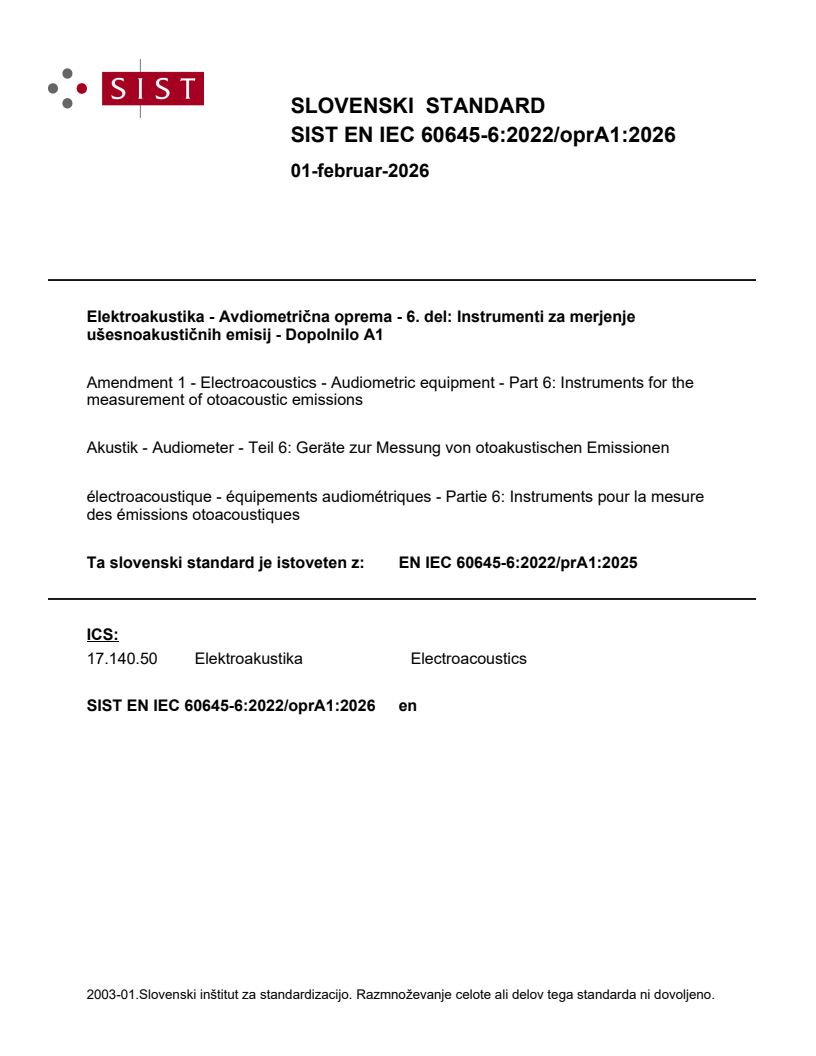
SLOVENSKI STANDARD
01-februar-2026
Elektroakustika - Avdiometrična oprema - 6. del: Instrumenti za merjenje
ušesnoakustičnih emisij - Dopolnilo A1
Amendment 1 - Electroacoustics - Audiometric equipment - Part 6: Instruments for the
measurement of otoacoustic emissions
Akustik - Audiometer - Teil 6: Geräte zur Messung von otoakustischen Emissionen
électroacoustique - équipements audiométriques - Partie 6: Instruments pour la mesure
des émissions otoacoustiques
Ta slovenski standard je istoveten z: EN IEC 60645-6:2022/prA1:2025
ICS:
17.140.50 Elektroakustika Electroacoustics
2003-01.Slovenski inštitut za standardizacijo. Razmnoževanje celote ali delov tega standarda ni dovoljeno.
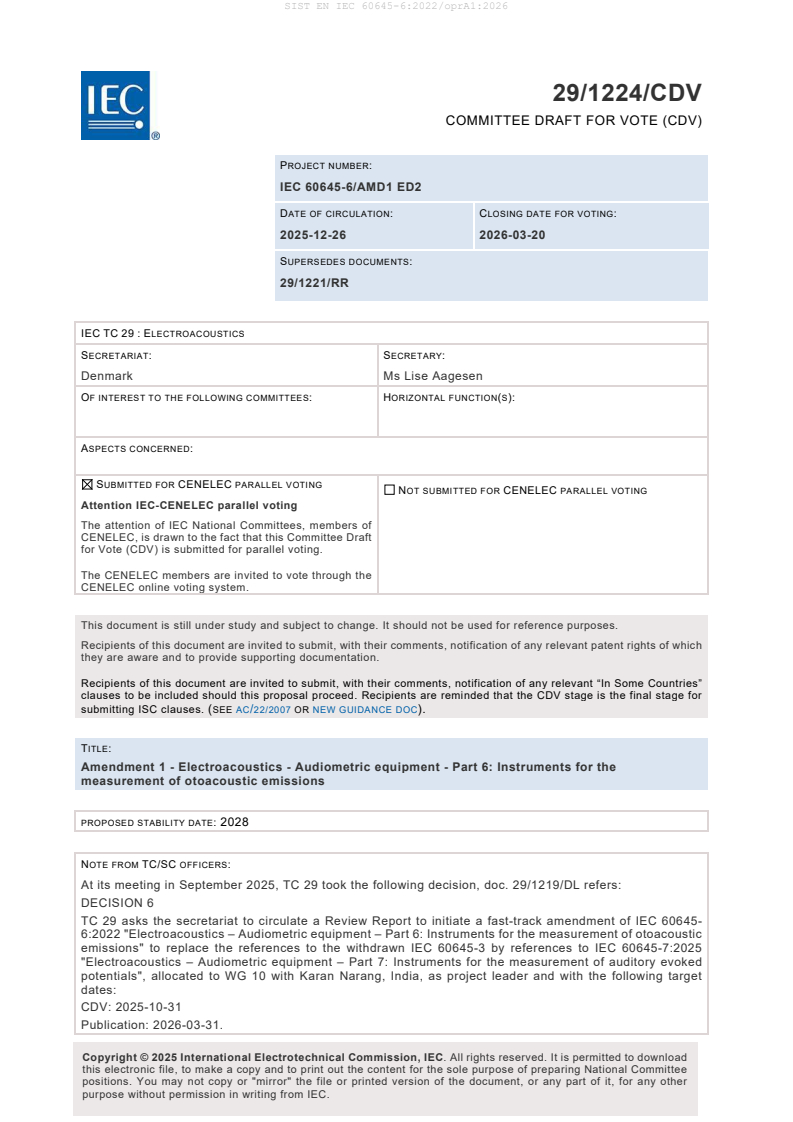
29/1224/CDV
COMMITTEE DRAFT FOR VOTE (CDV)
PROJECT NUMBER:
IEC 60645-6/AMD1 ED2
DATE OF CIRCULATION: CLOSING DATE FOR VOTING:
2025-12-26 2026-03-20
SUPERSEDES DOCUMENTS:
29/1221/RR
IEC TC 29 : ELECTROACOUSTICS
SECRETARIAT: SECRETARY:
Denmark Ms Lise Aagesen
OF INTEREST TO THE FOLLOWING COMMITTEES: HORIZONTAL FUNCTION(S):
ASPECTS CONCERNED:
SUBMITTED FOR CENELEC PARALLEL VOTING
NOT SUBMITTED FOR CENELEC PARALLEL VOTING
Attention IEC-CENELEC parallel voting
The attention of IEC National Committees, members of
CENELEC, is drawn to the fact that this Committee Draft
for Vote (CDV) is submitted for parallel voting.
The CENELEC members are invited to vote through the
CENELEC online voting system.
This document is still under study and subject to change. It should not be used for reference purposes.
Recipients of this document are invited to submit, with their comments, notification of any relevant patent rights of which
they are aware and to provide supporting documentation.
Recipients of this document are invited to submit, with their comments, notification of any relevant “In Some Countries”
clauses to be included should this proposal proceed. Recipients are reminded that the CDV stage is the final stage for
submitting ISC clauses. (SEE AC/22/2007 OR NEW GUIDANCE DOC).
TITLE:
Amendment 1 - Electroacoustics - Audiometric equipment - Part 6: Instruments for the
measurement of otoacoustic emissions
PROPOSED STABILITY DATE: 2028
NOTE FROM TC/SC OFFICERS:
At its meeting in September 2025, TC 29 took the following decision, doc. 29/1219/DL refers:
DECISION 6
TC 29 asks the secretariat to circulate a Review Report to initiate a fast-track amendment of IEC 60645-
6:2022 "Electroacoustics – Audiometric equipment – Part 6: Instruments for the measurement of otoacoustic
emissions" to replace the references to the withdrawn IEC 60645-3 by references to IEC 60645-7:2025
Part 7: Instruments for the measurement of auditory evoked
"Electroacoustics – Audiometric equipment –
potentials", allocated to WG 10 with Karan Narang, India, as project leader and with the following target
dates:
CDV: 2025-10-31
Publication: 2026-03-31.
this electronic file, to make a copy and to print out the content for the sole purpose of preparing National Committee
positions. You may not copy or "mirror" the file or printed version of the document, or any part of it, for any other
purpose without permission in writing from IEC.
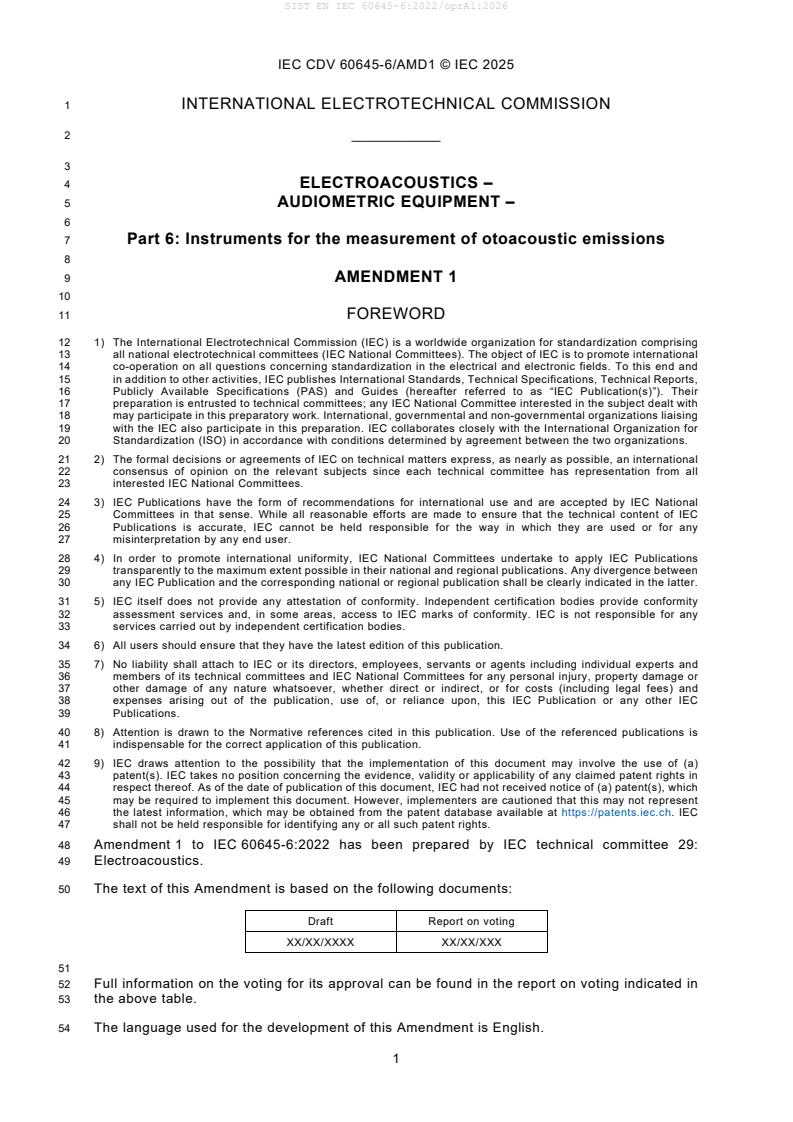
IEC CDV 60645-6/AMD1 © IEC 2025
1 INTERNATIONAL ELECTROTECHNICAL COMMISSION
2 ____________
4 ELECTROACOUSTICS –
5 AUDIOMETRIC EQUIPMENT –
7 Part 6: Instruments for the measurement of otoacoustic emissions
9 AMENDMENT 1
11 FOREWORD
12 1) The International Electrotechnical Commission (IEC) is a worldwide organization for standardization comprising
13 all national electrotechnical committees (IEC National Committees). The object of IEC is to promote international
14 co-operation on all questions concerning standardization in the electrical and electronic fields. To this end and
15 in addition to other activities, IEC publishes International Standards, Technical Specifications, Technical Reports,
16 Publicly Available Specifications (PAS) and Guides (hereafter referred to as “IEC Publication(s)”). Their
17 preparation is entrusted to technical committees; any IEC National Committee interested in the subject dealt with
18 may participate in this preparatory work. International, governmental and non-governmental organizations liaising
19 with the IEC also participate in this preparation. IEC collaborates closely with the International Organization for
20 Standardization (ISO) in accordance with conditions determined by agreement between the two organizations.
21 2) The formal decisions or agreements of IEC on technical matters express, as nearly as possible, an international
22 consensus of opinion on the relevant subjects since each technical committee has representation from all
23 interested IEC National Committees.
24 3) IEC Publications have the form of recommendations for international use and are accepted by IEC National
25 Committees in that sense. While all reasonable efforts are made to ensure that the technical content of IEC
26 Publications is accurate, IEC cannot be held responsible for the way in which they are used or for any
27 misinterpretation by any end user.
28 4) In order to promote international uniformity, IEC National Committees undertake to apply IEC Publications
29 transparently to the maximum extent possible in their national and regional publications. Any divergence between
30 any IEC Publication and the corresponding national or regional publication shall be clearly indicated in the
...
Questions, Comments and Discussion
Ask us and Technical Secretary will try to provide an answer. You can facilitate discussion about the standard in here.
Loading comments...