


EN 50241-1:1999
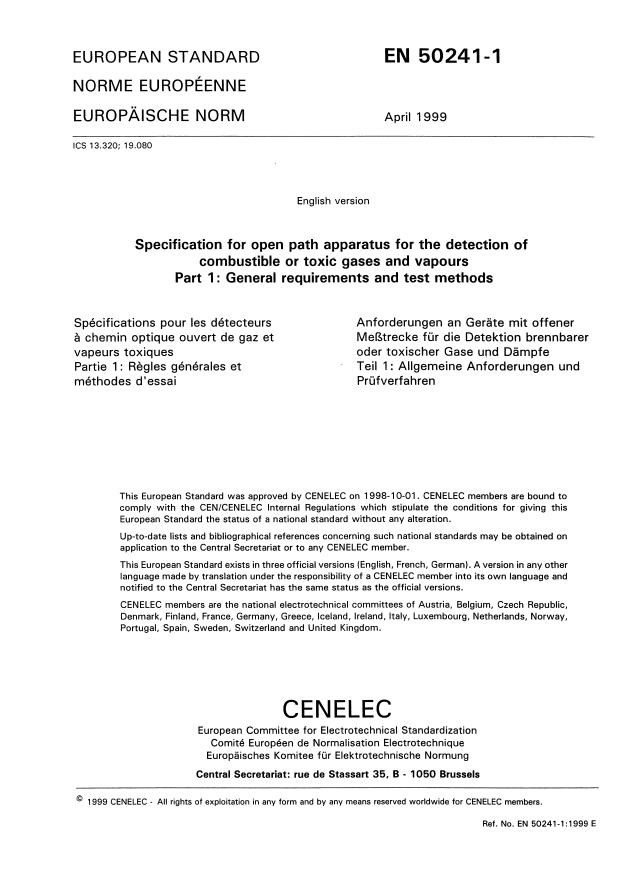
(Main)Specification for open path apparatus for the detection of combustible or toxic gases and vapours - Part 1: General requirements and test methods
General Information
- Abstract
This European Standard specifies general requirements for the construction and testing of apparatus for the detection and measuring of combustible or toxic gases or vapours in ambient air by measuring the spectral absorption by the gases or vapours over extended optical paths, ranging typically from one meter to a few kilometers. Such apparatus measures the integral concentration of the absorbing gas over the optical path in units such as LEL meter for combustible gases and ppm meter for toxic gases. NOTE 1: Actual values of concentration can only be deduced where it can be established that the concentration is uniform over the optical path, as for example in very short optical paths (<100 mm). In such cases, the apparatus is within the scope of EN 50054 - EN 50058 and prEN 45544-1 to prEN 45544-4. Apparatus falling within the scope of this European Standard is classified as follows by the following types. Type 1: an optical transmitter and receiver, located at either end of a path through the atmosphere to be monitored. Type 2: an optical transceiver (i.e. combined transmitter and receiver) and a suitable reflector, which may be a topographic feature or a retroreflector, located at either end of a path through the atmosphere to be monitored. This European Standard does not apply to any of the following: 1. Apparatus intended to provide range resolution of gas concentration (e.g. LIDAR), 2. Apparatus consisting of a passive optical receiver without a dedicated optical source, 3. Apparatus intended to measure the local volumetric concentration of gas (point sensors), 4. Apparatus intended for the detection of dusts or mists in air, 5. Apparatus for cross stack monitoring, 6. Apparatus intended for the detection of explosives and vapours, and 7. Apparatus intended for quantitative and simultaneous multicomponent analysis, e.g. FTIR. This European Standard covering general requirements and test methods is supplemented by the following European Standard concerning specific requirements of performance: EN 50241-2: Performance requirements for apparatus for the detection of combustible gases. This European Standard is applicable to apparatus which is intended for use in both hazardous and non hazardous areas. Apparatus for use in hazardous areas which may contain potentially combustible atmospheres is required to be designed for safe operation, see 4.1.2. This European Standard applies to transportable, and fixed apparatus intended for commercial and industrial applications. NOTE 2: This European Standard and EN 50241-2 as referenced above are intended to provide for the supply of apparatus giving a level of performance suitable for general purpose applications. However, for specific applications a prospective purchaser or an appropriate authority may additionally require apparatus to be submitted to particular tests or approval. Such tests or approval are to be regarded as additional to and separate from the provisions from the European Standards
- Status
- Withdrawn
- Publication Date
- 25-Apr-1999
- Withdrawal Date
- 30-Sep-1999
- Technical Committee
- CLC/TC 31 - Electrical apparatus for explosive atmospheres - General requirements
- Drafting Committee
- CLC/SC 31-9 - Electrical apparatus for the detection and measurement of combustible gases to be used in industrial
- Parallel Committee
- IEC/SC 31L - IEC_SC_31L
- Current Stage
- 9960 - Withdrawal effective - Withdrawal
- Start Date
- 01-Apr-2013
- Completion Date
- 01-Apr-2013
- Directive
- Not Harmonized94/9/EC - Equipment and protective systems intended for use in potentially explosive atmospheres (ATEX)OJ Ref: C 168/6, C 97/, C 97/01, C 40/01 OJ Date: 12-Feb-2013

Relations
- Effective Date
- 29-Jan-2023
- Effective Date
- 29-Jan-2023
Get Certified
Connect with accredited certification bodies for this standard

CIS Institut d.o.o.
Personal Protective Equipment (PPE) certification body. Notified Body NB-2890 for EU Regulation 2016/425 PPE.
IMP NDT d.o.o.
Non-destructive testing services. Radiography, ultrasonic, magnetic particle, penetrant, visual inspection.
Inštitut za kovinske materiale in tehnologije
Institute of Metals and Technology. Materials testing, metallurgical analysis, NDT.
Sponsored listings
Frequently Asked Questions
EN 50241-1:1999 is a standard published by CLC. Its full title is "Specification for open path apparatus for the detection of combustible or toxic gases and vapours - Part 1: General requirements and test methods". This standard covers: This European Standard specifies general requirements for the construction and testing of apparatus for the detection and measuring of combustible or toxic gases or vapours in ambient air by measuring the spectral absorption by the gases or vapours over extended optical paths, ranging typically from one meter to a few kilometers. Such apparatus measures the integral concentration of the absorbing gas over the optical path in units such as LEL meter for combustible gases and ppm meter for toxic gases. NOTE 1: Actual values of concentration can only be deduced where it can be established that the concentration is uniform over the optical path, as for example in very short optical paths (<100 mm). In such cases, the apparatus is within the scope of EN 50054 - EN 50058 and prEN 45544-1 to prEN 45544-4. Apparatus falling within the scope of this European Standard is classified as follows by the following types. Type 1: an optical transmitter and receiver, located at either end of a path through the atmosphere to be monitored. Type 2: an optical transceiver (i.e. combined transmitter and receiver) and a suitable reflector, which may be a topographic feature or a retroreflector, located at either end of a path through the atmosphere to be monitored. This European Standard does not apply to any of the following: 1. Apparatus intended to provide range resolution of gas concentration (e.g. LIDAR), 2. Apparatus consisting of a passive optical receiver without a dedicated optical source, 3. Apparatus intended to measure the local volumetric concentration of gas (point sensors), 4. Apparatus intended for the detection of dusts or mists in air, 5. Apparatus for cross stack monitoring, 6. Apparatus intended for the detection of explosives and vapours, and 7. Apparatus intended for quantitative and simultaneous multicomponent analysis, e.g. FTIR. This European Standard covering general requirements and test methods is supplemented by the following European Standard concerning specific requirements of performance: EN 50241-2: Performance requirements for apparatus for the detection of combustible gases. This European Standard is applicable to apparatus which is intended for use in both hazardous and non hazardous areas. Apparatus for use in hazardous areas which may contain potentially combustible atmospheres is required to be designed for safe operation, see 4.1.2. This European Standard applies to transportable, and fixed apparatus intended for commercial and industrial applications. NOTE 2: This European Standard and EN 50241-2 as referenced above are intended to provide for the supply of apparatus giving a level of performance suitable for general purpose applications. However, for specific applications a prospective purchaser or an appropriate authority may additionally require apparatus to be submitted to particular tests or approval. Such tests or approval are to be regarded as additional to and separate from the provisions from the European Standards
This European Standard specifies general requirements for the construction and testing of apparatus for the detection and measuring of combustible or toxic gases or vapours in ambient air by measuring the spectral absorption by the gases or vapours over extended optical paths, ranging typically from one meter to a few kilometers. Such apparatus measures the integral concentration of the absorbing gas over the optical path in units such as LEL meter for combustible gases and ppm meter for toxic gases. NOTE 1: Actual values of concentration can only be deduced where it can be established that the concentration is uniform over the optical path, as for example in very short optical paths (<100 mm). In such cases, the apparatus is within the scope of EN 50054 - EN 50058 and prEN 45544-1 to prEN 45544-4. Apparatus falling within the scope of this European Standard is classified as follows by the following types. Type 1: an optical transmitter and receiver, located at either end of a path through the atmosphere to be monitored. Type 2: an optical transceiver (i.e. combined transmitter and receiver) and a suitable reflector, which may be a topographic feature or a retroreflector, located at either end of a path through the atmosphere to be monitored. This European Standard does not apply to any of the following: 1. Apparatus intended to provide range resolution of gas concentration (e.g. LIDAR), 2. Apparatus consisting of a passive optical receiver without a dedicated optical source, 3. Apparatus intended to measure the local volumetric concentration of gas (point sensors), 4. Apparatus intended for the detection of dusts or mists in air, 5. Apparatus for cross stack monitoring, 6. Apparatus intended for the detection of explosives and vapours, and 7. Apparatus intended for quantitative and simultaneous multicomponent analysis, e.g. FTIR. This European Standard covering general requirements and test methods is supplemented by the following European Standard concerning specific requirements of performance: EN 50241-2: Performance requirements for apparatus for the detection of combustible gases. This European Standard is applicable to apparatus which is intended for use in both hazardous and non hazardous areas. Apparatus for use in hazardous areas which may contain potentially combustible atmospheres is required to be designed for safe operation, see 4.1.2. This European Standard applies to transportable, and fixed apparatus intended for commercial and industrial applications. NOTE 2: This European Standard and EN 50241-2 as referenced above are intended to provide for the supply of apparatus giving a level of performance suitable for general purpose applications. However, for specific applications a prospective purchaser or an appropriate authority may additionally require apparatus to be submitted to particular tests or approval. Such tests or approval are to be regarded as additional to and separate from the provisions from the European Standards
EN 50241-1:1999 is classified under the following ICS (International Classification for Standards) categories: 13.320 - Alarm and warning systems; 19.080 - Electrical and electronic testing. The ICS classification helps identify the subject area and facilitates finding related standards.
EN 50241-1:1999 has the following relationships with other standards: It is inter standard links to EN 60079-29-4:2010, EN 50241-1:1999/A1:2004. Understanding these relationships helps ensure you are using the most current and applicable version of the standard.
EN 50241-1:1999 is associated with the following European legislation: EU Directives/Regulations: 94/9/EC. When a standard is cited in the Official Journal of the European Union, products manufactured in conformity with it benefit from a presumption of conformity with the essential requirements of the corresponding EU directive or regulation.
EN 50241-1:1999 is available in PDF format for immediate download after purchase. The document can be added to your cart and obtained through the secure checkout process. Digital delivery ensures instant access to the complete standard document.
Standards Content (Sample)
SLOVENSKI SIST EN 50241-1:2000
prva izdaja
STANDARD
april 2000
Specifikacije naprav z odprto merilno potjo za odkrivanje vnetljivih ali
strupenih plinov in hlapov - 1. del: Splošne zahteve in preskusne metode
Specification for open path apparatus for the detection of combustible or toxic
gases and vapours - P
...