


prEN IEC 63203-403-1:2025
(Main)Wearable electronic devices and technologies - Part 403-1: Test method of surface electromyography sensors onto forearm and hand for wearable applications
Wearable electronic devices and technologies - Part 403-1: Test method of surface electromyography sensors onto forearm and hand for wearable applications
Tragbare elektronische Geräte und Technologien - Teil 403-1: Prüfverfahren für Oberflächen-Elektromyographie-Sensoren an Unterarm und Hand für tragbare Anwendungen
Technologies et dispositifs électroniques prêts-à-porter - Partie 403-1: Méthode d'essai des capteurs d’électromyographie de surface sur l'avant-bras et la main pour les applications prêtes-à-porter
Nosljive elektronske naprave in tehnologije - 403-1. del: Preskusna metoda površinskih elektromiografskih senzorjev na podlahti in roki za nosljive aplikacije
General Information
- Status
- Not Published
- Publication Date
- 23-Nov-2026
- Technical Committee
- CLC/SR 124 - Wearable Electronic Devices and Technologies
- Drafting Committee
- IEC/TC 124 - Wearable electronic devices and technologies
- Current Stage
- 4060 - Enquiry results established and sent to TC, SR, BTTF - Enquiry
- Start Date
- 25-Jul-2025
- Completion Date
- 25-Jul-2025
Overview
The standard prEN IEC 63203-403-1:2025, developed by the International Electrotechnical Commission (IEC), defines test methods specifically for surface electromyography (sEMG) sensors used on the forearm and hand in wearable electronic devices and technologies. This document focuses on assessing the quality of sEMG signals captured from muscle contractions in these body regions, aiming to support applications such as virtual reality, gaming, UAV/robot control, and home automation. It is important to note that this standard does not cover sEMG sensors intended for medical applications.
This standard provides a comprehensive framework for evaluating sEMG sensor performance under controlled test conditions, ensuring the reliability, signal quality, and proper sensor placement for wearable applications.
Key Topics
Test Methodology for sEMG Sensors
Specifies procedures for quantifying the quality of electrical signals generated by muscles in the forearm and hand, which wearable devices use to interpret movement intentions.Sensor Classification
Details types of sEMG sensors based on:- Conductive medium: dry, semi-dry, wet electrodes.
- Channel configuration: single, multi-single, and multi (high-density) channels.
- Electrode fixation: adhesive (tape, gel) or band/clamp (armband).
Test Conditions
Defines environment parameters such as temperature, humidity, and noise isolation to ensure consistent testing validity. Subjects must have intact upper limbs and be free from muscle or nerve disorders; proper skin preparation and posture guidelines are included.Measurement Procedures
Includes performance tests such as:- Baseline noise measurement (detecting signal noise when muscles are relaxed).
- Signal-to-noise ratio (SNR) evaluation for signal clarity.
- Distinguishability test to differentiate between muscle activations.
- Repeatability test to confirm consistency across measurements.
Standards Terminology
Covers essential definitions including electrode, sEMG sensor, sEMG signal, passive vs. active sensor, and palpation methods for sensor placement.Annexes for Practical Implementation
Provides guidance on:- Specific muscle groups and movements for wrist and finger sensor placement.
- Feature extraction techniques for sEMG signal processing.
- Confusion matrix construction for evaluating classifier performance in interpreting sEMG signals.
Applications
Wearable Control Interfaces
sEMG sensors evaluated by this test standard enable intuitive control in augmented reality, virtual reality, and gaming systems by accurately capturing muscle signals from forearm and hand movements.Human-Machine Interaction
This standard supports the development of wearable devices that control UAVs, robots, and home automation systems by translating detected muscle activity into actionable commands.Ergonomic and User Comfort Assessments
By defining sensor placement and signal quality criteria, it helps manufacturers design wearables that maintain user comfort without compromising signal accuracy during natural hand and arm movements.Non-Medical Gesture Recognition Devices
Devices using gestures for control can rely on validated sEMG sensor performance to provide reliable operation in everyday environments.
Related Standards
While prEN IEC 63203-403-1:2025 focuses explicitly on testing surface electromyography sensors for wearable applications on the forearm and hand, it operates within a broader ecosystem of standards concerning wearable electronics and biosignal acquisition, including:
IEC 63203 Series
Covers various aspects of wearable electronic devices and biosensor technologies.ISO/IEC Standard Glossaries
For harmonized terminology and definitions related to electronic components and wearable devices (e.g., IEC Electropedia, ISO OBP).Standards on Electromyography Sensors in Medical Contexts
Although this standard excludes medical applications, other IEC or ISO standards may apply for clinical diagnostic sEMG devices.
Keywords: Wearable electronic devices, surface electromyography, sEMG sensors, forearm sensor testing, hand muscle sensors, wearable applications, signal-to-noise ratio, baseline noise, sEMG sensor classification, sensor placement, active sEMG sensor, passive sEMG sensor, electromyography standards, gesture control, virtual reality interfaces, human-machine interaction, wearable technology standards.

Frequently Asked Questions
prEN IEC 63203-403-1:2025 is a draft published by CLC. Its full title is "Wearable electronic devices and technologies - Part 403-1: Test method of surface electromyography sensors onto forearm and hand for wearable applications". This standard covers: Wearable electronic devices and technologies - Part 403-1: Test method of surface electromyography sensors onto forearm and hand for wearable applications
Wearable electronic devices and technologies - Part 403-1: Test method of surface electromyography sensors onto forearm and hand for wearable applications
prEN IEC 63203-403-1:2025 is classified under the following ICS (International Classification for Standards) categories: 31.020 - Electronic components in general. The ICS classification helps identify the subject area and facilitates finding related standards.
prEN IEC 63203-403-1:2025 is available in PDF format for immediate download after purchase. The document can be added to your cart and obtained through the secure checkout process. Digital delivery ensures instant access to the complete standard document.
Standards Content (Sample)
SLOVENSKI STANDARD
01-julij-2025
Nosljive elektronske naprave in tehnologije - 403-1. del: Preskusna metoda
površinskih elektromiografskih senzorjev na podlahti in roki za nosljive aplikacije
Wearable electronic devices and technologies - Part 403-1: Test method of surface
electromyography sensors onto forearm and hand for wearable applications
Technologies et dispositifs électroniques prêts-à-porter - Partie 403-1: Méthode d'essai
des capteurs d’électromyographie de surface sur l'avant-bras et la main pour les
applications prêtes-à-porter
Ta slovenski standard je istoveten z: prEN IEC 63203-403-1:2025
ICS:
31.020 Elektronske komponente na Electronic components in
splošno general
2003-01.Slovenski inštitut za standardizacijo. Razmnoževanje celote ali delov tega standarda ni dovoljeno.
124/316/CDV
COMMITTEE DRAFT FOR VOTE (CDV)
PROJECT NUMBER:
IEC 63203-403-1 ED1
DATE OF CIRCULATION: CLOSING DATE FOR VOTING:
2025-05-02 2025-07-25
SUPERSEDES DOCUMENTS:
124/258/CD, 124/315/CC
IEC TC 124 : WEARABLE ELECTRONIC DEVICES AND TECHNOLOGIES
SECRETARIAT: SECRETARY:
Korea, Republic of Mr Jae Yeong Park
OF INTEREST TO THE FOLLOWING COMMITTEES: HORIZONTAL FUNCTION(S):
TC 62,SC 62A,SC 62D
ASPECTS CONCERNED:
SUBMITTED FOR CENELEC PARALLEL VOTING NOT SUBMITTED FOR CENELEC PARALLEL VOTING
Attention IEC-CENELEC parallel voting
The attention of IEC National Committees, members of
CENELEC, is drawn to the fact that this Committee Draft
for Vote (CDV) is submitted for parallel voting.
The CENELEC members are invited to vote through the
CENELEC online voting system.
This document is still under study and subject to change. It should not be used for reference purposes.
Recipients of this document are invited to submit, with their comments, notification of any relevant patent rights of
which they are aware and to provide supporting documentation.
Recipients of this document are invited to submit, with their comments, notification of any relevant “In Some
Countries” clauses to be included should this proposal proceed. Recipients are reminded that the CDV stage is
the final stage for submitting ISC clauses. (SEE AC/22/2007 OR NEW GUIDANCE DOC).
TITLE:
Wearable electronic devices and technologies - Part 403-1: Test method of surface
electromyography sensors onto forearm and hand for wearable applications
PROPOSED STABILITY DATE: 2030
NOTE FROM TC/SC OFFICERS:
In accordance with 124/302/RM, Decision #3, TC 124 agreed to proceed this project to CDV.
download this electronic file, to make a copy and to print out the content for the sole purpose of preparing National
Committee positions. You may not copy or "mirror" the file or printed version of the document, or any part of it, for
any other purpose without permission in writing from IEC.
IEC CDV 63203-403-1 © IEC 2025 – 2 – 124/316/CDV
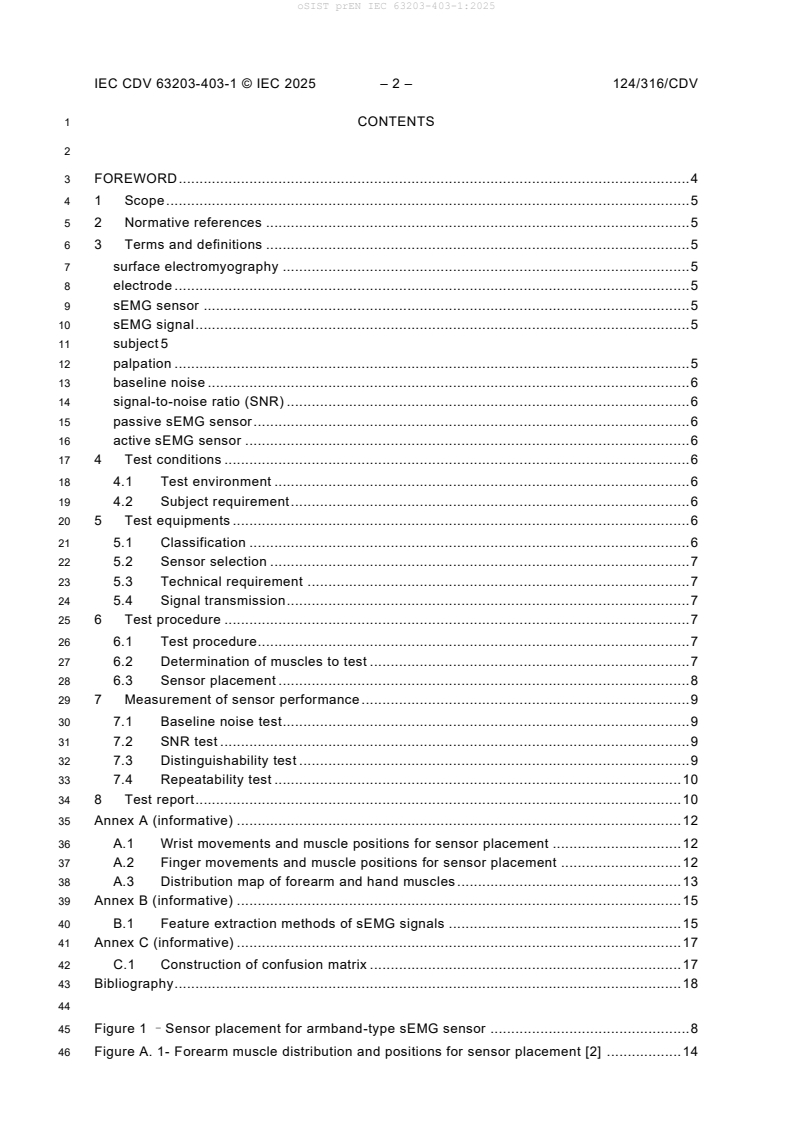
1 CONTENTS
3 FOREWORD . 4
4 1 Scope . 5
5 2 Normative references . 5
6 3 Terms and definitions . 5
7 surface electromyography . 5
8 electrode . 5
9 sEMG sensor . 5
10 sEMG signal . 5
11 subject 5
12 palpation . 5
13 baseline noise . 6
14 signal-to-noise ratio (SNR) . 6
15 passive sEMG sensor . 6
16 active sEMG sensor . 6
17 4 Test conditions . 6
18 4.1 Test environment . 6
19 4.2 Subject requirement . 6
20 5 Test equipments . 6
21 5.1 Classification . 6
22 5.2 Sensor selection . 7
23 5.3 Technical requirement . 7
24 5.4 Signal transmission . 7
25 6 Test procedure . 7
26 6.1 Test procedure. 7
27 6.2 Determination of muscles to test . 7
28 6.3 Sensor placement . 8
29 7 Measurement of sensor performance . 9
30 7.1 Baseline noise test. 9
31 7.2 SNR test . 9
32 7.3 Distinguishability test . 9
33 7.4 Repeatability test . 10
34 8 Test report . 10
35 Annex A (informative) . 12
36 A.1 Wrist movements and muscle positions for sensor placement . 12
37 A.2 Finger movements and muscle positions for sensor placement . 12
38 A.3 Distribution map of forearm and hand muscles . 13
39 Annex B (informative) . 15
40 B.1 Feature extraction methods of sEMG signals . 15
41 Annex C (informative) . 17
42 C.1 Construction of confusion matrix . 17
43 Bibliography . 18
45 Figure 1 –Sensor placement for armband-type sEMG sensor . 8
46 Figure A. 1- Forearm muscle distribution and positions for sensor placement [2] . 14
IEC CDV 63203-403-1 © IEC 2025 – 3 – 124/316/CDV
47 Figure A. 2– Hand muscle distribution and positions for sensor placement [2] . 14
48 Figure A. 3 – Feature extraction with sliding window technique . 15
50 Table 1 Classification of sEMG sensors . 7
51 Table A. 1 – Wrist movements and related muscles . 12
52 Table A. 2 - Finger movements and related muscles . 12
53 Table A. 3 - Time-domain feature extraction methods for sEMG signals . 15
54 Table A. 4 - Confusion matrix for a N-category classifier . 17
IEC CDV 63203-403-1 © IEC 2025 – 4 – 124/316/CDV
57 INTERNATIONAL ELECTROTECHNICAL COMMISSION
58 ____________
60 WEARABLE ELECTRONIC DEVICES AND TECHNOLOGIES -
62 Part 403-1: TEST METHOD OF SURFACE ELECTROMYOGRAPHY
63 SENSORS ONTO FOREARM AND HAND FOR WEARABLE APPLICATIONS
65 FOREWORD
66 1) The International Electrotechnical Commission (IEC) is a worldwide organization for standardization comprising
67 all national electrotechnical committees (IEC National Committees). The object of IEC is to promote international
68 co-operation on all questions concerning standardization in the electrical and electronic fields. To this end and
69 in addition to other activities, IEC publishes International Standards, Technical Specifications, Technical Reports,
70 Publicly Available Specifications (PAS) and Guides (hereafter referred to as “IEC Publication(s)”). Their
71 preparation is entrusted to technical committees; any IEC National Committee interested in the subject dealt with
72 may participate in this preparatory work. International, governmental and non-governmental organizations liaising
73 with the IEC also participate in this preparation. IEC collaborates closely with the International Organization for
74 Standardization (ISO) in accordance with conditions determined by agreement between the two organizations.
75 2) The formal decisions or agreements of IEC on technical matters express, as nearly as possible, an international
76 consensus of opinion on the relevant subjects since each technical committee has representation from all
77 interested IEC National Committees.
78 3) IEC Publications have the form of recommendations for international use and are accepted by IEC National
79 Committees in that sense. While all reasonable efforts are made to ensure that the technical content of IEC
80 Publications is accurate, IEC cannot be held responsible for the way in which they are used or for any
81 misinterpretation by any end user.
82 4) In order to promote international uniformity, IEC National Committees undertake to apply IEC Publications
83 transparently to the maximum extent possible in their national and regional publications. Any divergence between
84 any IEC Publication and the corresponding national or regional publication shall be clearly indicated in the latter.
85 5) IEC itself does not provide any attestation of conformity. Independent certification bodies provide conformity
86 assessment services and, in some areas, access to IEC marks of conformity. IEC is not responsible for any
87 services carried out by independent certification bodies.
88 6) All users should ensure that they have the latest edition of this publication.
89 7) No liability shall attach to IEC or its directors, employees, servants or agents including individual experts and
90 members of its technical committees and IEC National Committees for any personal injury, property damage or
91 other damage of any nature whatsoever, whether direct or indirect, or for costs (including legal fees) and
92 expenses arising out of the publication, use of, or reliance upon, this IEC Publication or any other IEC
93 Publications.
94 8) Attention is drawn to the Normative references cited in this publication. Use of the referenced publications is
95 indispensable for the correct application of this publication.
96 9) Attention is drawn to the possibility that some of the elements of this IEC Publication may be the subject of patent
97 rights. IEC shall not be held responsible for identifying any or all such patent rights.
98 IEC 63203-40X-X has been prepared by Working Group 4: Devices and Systems, of IEC technical committee 124:
99 Wearable electronic devices and technologies. It is an International Standard.
IEC CDV 63203-403-1 © IEC 2025 – 5 – 124/316/CDV
101 WEARABLE ELECTRONIC DEVICES AND TECHNOLOGIES -
103 Part 403-1: Test Method of Surface Electromyography Sensors onto
104 Forearm and Hand for Wearable Applications
105 1 Scope
106 This document specifies test methods for sEMG sensors by evaluating the quality of sEMG
107 signals obtained from contracting muscles of forearm and hand for wearable applications. It is
108 applicable to sEMG sensors that are used to decipher movement intentions and use them as
109 control signals in situations such as virtual reality, game/UAV/robot control, and home
110 automation. It is not applicable to sEMG sensors intended for medical applications.
111 2 Normative references
112 There are no normative references in this document.
113 3 Terms and definitions
114 For the purposes of this document, the following terms and definitions apply.
115 ISO and IEC maintain terminological databases for use in standardization at the following
116 addresses:
117 • IEC Electropedia: available at http://www.electropedia.org/
118 • ISO Online browsing platform: available at http://www.iso.org/obp
119 3.1
120 surface electromyography
121 sEMG
122 technique in which electrodes are placed on the skin over muscles to detect the electrical
123 activity of the muscles
124 3.2
125 electrode
126 part of the sensor that transfer the electric potential on the skin to the electric circuit of the
127 sensor
128 3.3
129 sEMG sensor
130 device that produces a signal by measuring the electrical potential difference between the
131 electrodes
132 3.4
133 sEMG signal
134 electrical signals of muscles detected by sensors that are placed on the skin above those
135 muscles
136 3.5
137 subject
138 person or animal that is being tested or studied. In this document, it is the person being tested
139 3.6
140 palpation
141 act of examining part of the body by touching it
IEC CDV 63203-403-1 © IEC 2025 – 6 – 124/316/CDV
142 3.7
143 baseline noise
144 electrical signal acquired from sEMG sensors attached to the skin when targeted muscles are
145 relaxed as much as possible
146 3.8
147 signal-to-noise ratio (SNR)
148 ratio, generally expressed in decibels, of the power of the wanted signal to that of the coexistent
149 noise at a specified point in a transmission channel under specified conditions (Source: IEC
150 702-08-61:1992)
151 3.9
152 passive sEMG sensor
153 sEMG sensor that that produces raw signals which may require further amplification or signal
154 processing
155 3.10
156 active sEMG sensor
157 sEMG sensor that is equipped with amplifier or signal processing circuit
158 4 Test conditions
159 4.1 Test environment
160 The test is carried out under the environmental operating range (ambient temperature, relative
161 humidity, atmospheric pressure) specified by the manufacturer. It is recommended to have the
162 test conducted in an environment that is isolated from power line sources, and other external
163 noise sources (such as vibrations from a machine, and crowded place).
164 4.2 Subject requirement
165 The requirements for subjects are as follows.
166 a) The test methods in this document apply to subjects with intact upper limbs.
167 b) The subjects should be healthy and free from muscle or nerve-related disorders.
168 c) Subjects shall wear loose clothes that allow their forearms and hands to be exposed easily.
169 d) The subject shall clean their forearm to remove the oil and skin debris before the test, or
170 the experimenter can choose not to clean the skin and record the testing condition. It is also
171 recommended to shave excessive hairs on the forearm.
172 e) The subjects shall maintain the posture they are comfortable with during the test, or the
173 experimenter can choose whether the subject should maintain the posture or move the
174 upper arm in specific sequence and record the testing condition.
175 5 Test equipments
176 5.1 Classification
177 The classification of the sEMG sensors is shown in Table 1.
178 a) Based on the conductive medium, the type of sEMG sensor is classified into dry, semi-dry
179 and wet.
180 b) Based on the channel configuration, the type of sEMG sensor can be classified into single,
181 multi-singles, and multi type.
182 c) Based on the electrode fixation method, the type of sEMG sensor can be classified to
183 adhesive and band/clamp.
184 To maintain the low impedance between the skin and electrode to avoid noise or motion artifacts,
185 active sEMG sensor is recommended. Active sEMG sensors use amplifier or feedback
186 mechanisms to create virtual low impedance between the skin and electrode. Passive sEMG
IEC CDV 63203-403-1 © IEC 2025 – 7 – 124/316/CDV
187 sensors, in contrast, are not equipped with such mechanism, therefore the conductive medium
188 is usually used to lower the impedance.
189 Table 1 Classification of sEMG sensors
Property Type Sub-type Examples
Dry Metal, carbon
Metal/sponge with pre-application of some
Conductive medium Semi-dry
water
Wet Ag-AgCl with gel, conductive paste
Single One differential pair of electrodes with ground*
The device has multiple single channels but not
Multi-singles
mechanically constrained each other
Channel configuration
Low density Armband type, multiple channels in one sheet
Multi type
Four or more closely spaced electrodes
high density
configured on a two-dimensional space
adhesive Double sided tape, gel
Electrode fixation
Band/clamp Armband
190 5.2 Sensor selection
191 The sEMG sensor shall be selected based on the application purposes and scenario. It is
192 recommended to use the sEMG sensor with dry electrodes. For different channel configurations,
193 the type of sEMG sensor shall be determined as follows:
194 a) For the purpose of acquiring sEMG signals of a specific muscle or multiple target muscles,
195 a single sEMG sensor or multi-singles sEMG sensor shall be used, and the sEMG sensor
196 shall be placed on the target muscles.
197 b) For the purpose of acquiring sEMG signals of muscle groups, single sEMG senor, multi-
198 singles sEMG sensor, and multi type sEMG sensor can be used.
199 5.3 Technical requirement
200 The sampling rate of the sEMG sensor should be at least 100 Hz. The sEMG sensor should
201 have built-in algorithms, circuit, or other methods to filter out the noise beyond 20 Hz-450 Hz
202 (if applicable) and the 50 Hz or 60 Hz electrical
...
Questions, Comments and Discussion
Ask us and Technical Secretary will try to provide an answer. You can facilitate discussion about the standard in here.
Loading comments...