

EN 60756:1993
(Main)Non-broadcast video tape recorders - Time base stability
General Information
- Abstract
Specifies the time base errors of the monochrome as well as of the colour composite video signal reproduced from two head helical-scan domestic video recorders, recording one field on each track. This standard gives characteristics and maximum figures of the time base errors to make it possible to design the horizontal flywheel of television receivers so as to ensure stability on the screen.
- Status
- Published
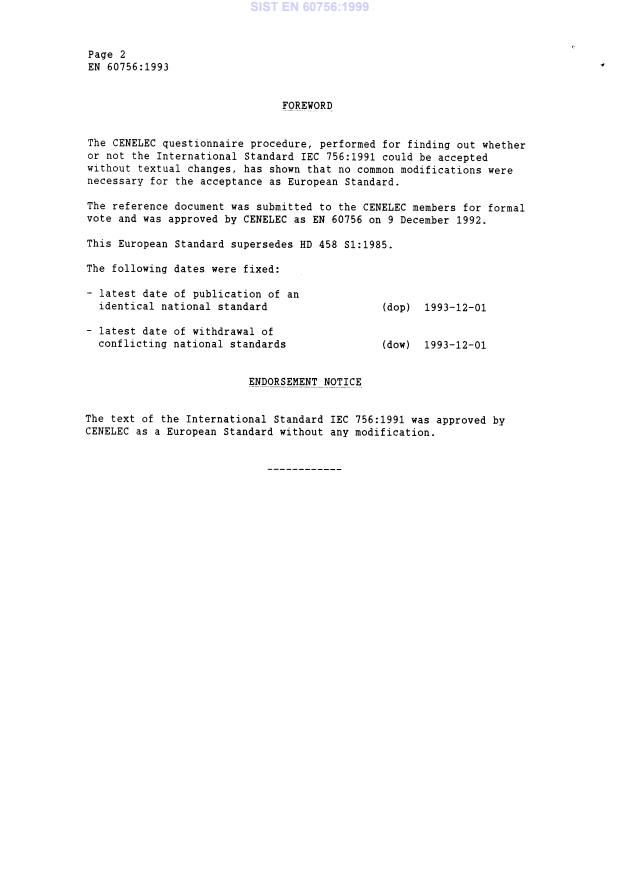
- Publication Date
- 13-Jan-1993
- Withdrawal Date
- 30-Nov-1993
- Technical Committee
- CLC/TC 100X - Audio, video and multimedia systems and equipment and related sub-systems
- Drafting Committee
- IEC/TC 100 - IEC_TC_100
- Parallel Committee
- IEC/TC 100 - IEC_TC_100
- Current Stage
- 9093 - Decision to confirm - Review Enquiry
- Start Date
- 27-Apr-2026
- Completion Date
- 25-Aug-2026

Overview
EN 60756:1993 (IEC 60756:1991) defines time base stability requirements for non‑broadcast (domestic) two‑head helical‑scan video tape recorders that record one field per track. The standard specifies measurable time‑base errors in the reproduced monochrome and colour composite video signal so television receiver horizontal flywheels can be designed to ensure acceptable picture stability.
Key topics and technical requirements
- Scope: Time base errors for two‑head helical‑scan domestic video recorders (one field per track), applicable to CCIR Systems 525/60 and 625/50.
- Definitions: Gap (loss of video during each field), phase step (from head path/angle differences), deviation of line frequency, deviation/jitter of colour carrier, relative displacement.
- Measurement methods:
- Gap timing and duration measured with an oscilloscope.
- Phase step measured visually on a monitor (horizontal displacement of a vertical bar before/after track switch).
- Mean line frequency by counter/frequency discriminator; jitter via frequency discriminator or line‑period measurement and weighted by the standard weighting curve.
- Colour carrier mean by frequency counter; jitter measurement methods noted as under consideration.
- Test arrangement for synchronizing distortion uses a sync separator and an integrating RC network (time constant 15 µs) feeding an oscilloscope.
- Limits and characteristics:
- Gap: Centre located 3–15 lines before vertical sync; duration < 5 lines; unwanted signal during gap < 60% of sync amplitude. For switched‑head machines, no gap or specified overlap (≥2 lines).
- Phase step: Maximum ±6 µs (525/60) and ±15 µs (625/50); phase‑error limits defined.
- Line frequency mean deviation: ≤ ±4% (monochrome), ≤ ±0.5% (colour) from nominal; peak‑to‑peak jitter limits ±0.3% (525/60) and ±0.2% (625/50) (weighted).
- Colour carrier deviation: ±50 Hz (NTSC), ±150 Hz (PAL), ±1 kHz (SECAM).
- Weighting curves: Provide frequency response of typical TV horizontal flywheels (specified gains, resonant frequency 160 Hz, damping) to convert jitter into visible horizontal displacement.
- Trick‑modes: Defines acceptable time‑base behaviour for slow/fast/stop playback (“trick” modes), including limits on mean line and field frequency deviations and artificial vertical sync pulse parameters.
Applications and users
- Manufacturers of domestic video tape recorders (design and compliance testing)
- Television receiver and monitor designers (horizontal flywheel design and tolerance setting)
- Test laboratories and quality assurance teams performing time‑base and jitter measurements
- Archivists and video restoration specialists concerned with playback stability in varied speed modes
Related standards
- IEC 60756:1991 - original IEC text upon which EN 60756:1993 is based
- References to CCIR/television systems: 525/60 (NTSC) and 625/50 (PAL/SECAM)
Keywords: EN 60756:1993, time base stability, non‑broadcast video tape recorders, line frequency jitter, phase step, gap, colour carrier deviation, horizontal flywheel, trick‑mode testing.
Relations
- Effective Date
- 03-Feb-2026
- Effective Date
- 03-Feb-2026
- Effective Date
- 03-Feb-2026
- Effective Date
- 03-Feb-2026
Frequently Asked Questions
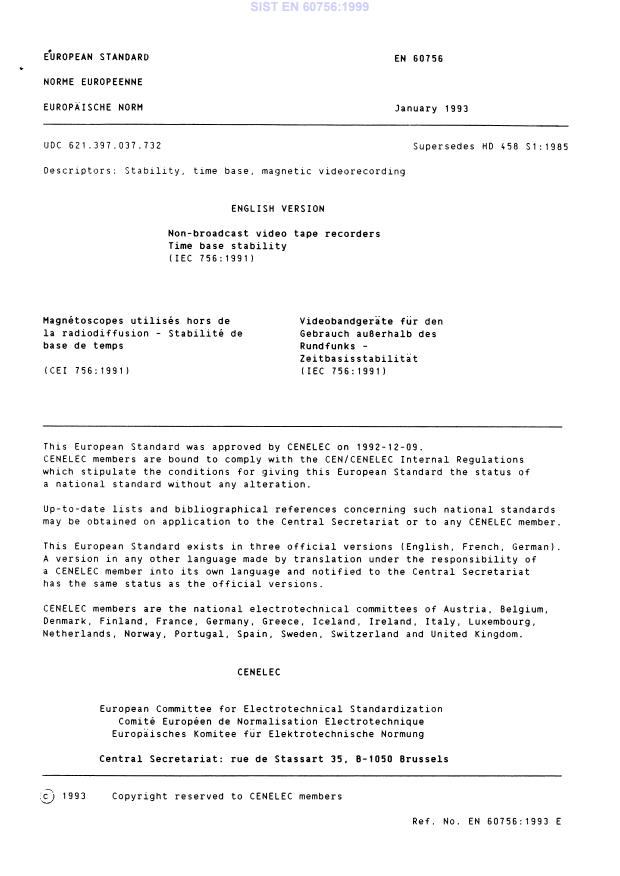
EN 60756:1993 is a standard published by CLC. Its full title is "Non-broadcast video tape recorders - Time base stability". This standard covers: Specifies the time base errors of the monochrome as well as of the colour composite video signal reproduced from two head helical-scan domestic video recorders, recording one field on each track. This standard gives characteristics and maximum figures of the time base errors to make it possible to design the horizontal flywheel of television receivers so as to ensure stability on the screen.
Specifies the time base errors of the monochrome as well as of the colour composite video signal reproduced from two head helical-scan domestic video recorders, recording one field on each track. This standard gives characteristics and maximum figures of the time base errors to make it possible to design the horizontal flywheel of television receivers so as to ensure stability on the screen.
EN 60756:1993 has the following relationships with other standards: It is inter standard links to EN 61146-3:1997, EN 60774-1:1994, EN 61237-2:1995, EN 60774-3:1993. Understanding these relationships helps ensure you are using the most current and applicable version of the standard.
EN 60756:1993 is available in PDF format for immediate download after purchase. The document can be added to your cart and obtained through the secure checkout process. Digital delivery ensures instant access to the complete standard document.
Standards Content (Sample)
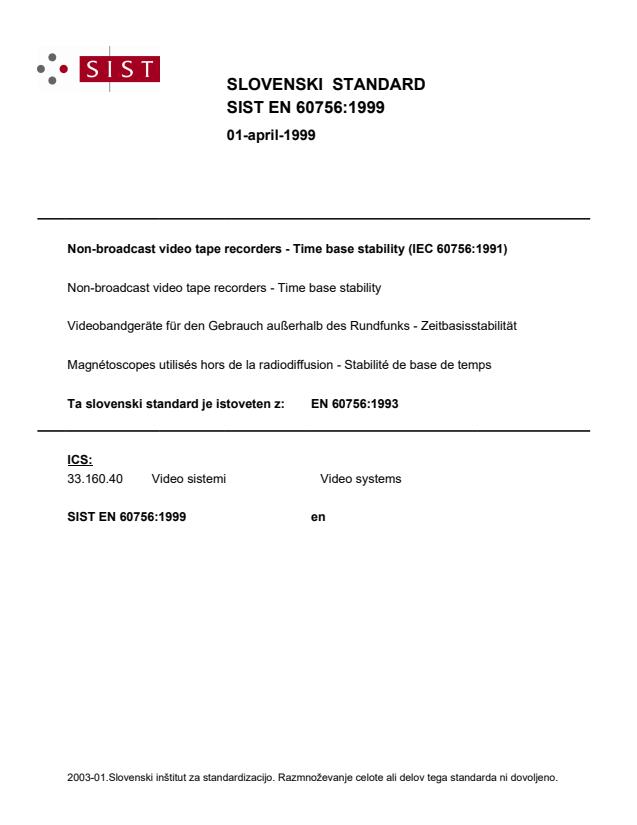
SLOVENSKI STANDARD
01-april-1999
Non-broadcast video tape recorders - Time base stability (IEC 60756:1991)
Non-broadcast video tape recorders - Time base stability
Videobandgeräte für den Gebrauch außerhalb des Rundfunks - Zeitbasisstabilität
Magnétoscopes utilisés hors de la radiodiffusion - Stabilité de base de temps
Ta slovenski standard je istoveten z: EN 60756:1993
ICS:
33.160.40 Video sistemi Video systems
2003-01.Slovenski inštitut za standardizacijo. Razmnoževanje celote ali delov tega standarda ni dovoljeno.
NORME CEI
INTERNATIONALE IEC
INTERNATIONAL
Deuxième édition
STANDARD
Second edition
1991-04
Magnétoscopes utilisés hors de la
radiodiffusion –
Stabilité de base de temps
Non-broadcast video tape recorders –
Time base stability
© IEC 1991 Droits
de reproduction réservés — Copyright - all rights reserved
Aucune partie de cette publication ne peut être reproduite ni
No part of this publication may be reproduced or utilized in
utilisée sous quelque forme que ce soit et par aucun any form or by any means, electronic or mechanical,
procédé, électronique ou mécanique, y compris la photo-
including photocopying and microfilm, without permission in
copie et les microfilms, sans l'accord écrit de l'éditeur.
writing from the publisher.
International Electrotechnical Commission
3, rue de Varembé Geneva, Switzerland
Telefax: +41 22 919 0300 e-mail: inmail@iec.ch IEC web site http: //www.iec.ch
CODE PRIX
Commission Electrotechnique Internationale
PRICE CODE
International Electrotechnical Commission
IEC Me ,ayHapoiaHaa 3neKrporexHHVecttaR
HOMHCCHH
Pour prix, voir catalogue en vigueur
• •
For price, see current catalogue
756©IEC - 3 -
CONTENTS
Page
FOREWORD 5
Clause
1 Scope and object 7
2 Definitions concerning time base stability 7
2.1 Gap 7
2.2 Phase step 7
2.3 Deviation of line frequency 7
2.4 Deviation of colour carrier frequency 7
2.5 Relative displacement 9
3 Measurement of time base errors 9
Gap 9
3.1
3.2 Phase step 9
3.3 Deviation of line frequency
3.4 Deviation of colour carrier frequency 9
4 Maximum values of time base errors 9
4.1 Gap 9
4.2 11
Phase step
4.3 Deviation of line frequency 11
4.4 Deviation of colour carrier frequency 11
5 Weighting curves
5.1 Weighting curve for CCIR System 525/60 13
5.2 Weighting curve for CCIR System 625/50 13
6 Time base stability at playback speeds different from the nominal value 15
6.1 Signal transitions 15
6.2 Horizontal synchronizing signal 17
6.3 Vertical synchronizing signal 17
FIGURES
1 Signal transitions (one field) - One head is used per scan 19
2 Signal transition (one field) - More than one head is used per scan 21
3 Test arrangement for checking the distortion of the synchronizing
signal due to signal transitions during playback in "trick"-mode 21
756©IEC - 5 -
INTERNATIONAL ELECTROTECHNICAL COMMISSION
NON-BROADCAST VIDEO TAPE RECORDERS -
TIME BASE STABILITY
FOREWORD
1) The formal decisions or agreements of the IEC on technical matters, prepared by Technical Committees on
which all the National Committees having a special interest therein are represented, express, as nearly as
possible, an international consensus of opinion on the subjects dealt with.
2) They have the form of recommendations for international use and they are accepted by the National
Committees in that sense.
3) In order to promote international unification, the IEC expresses the wish that all National Committees
should adopt the text of the IEC recommendation for their national rules in so far as national conditions will
permit. Any divergence between the IEC recommendation and the corresponding national rules should, as
far as possible, be clearly indicated in the latter.
This International Standard has been prepared by Sub-Committee 60B: Video recording,
of IEC Technical Committee No. 60: Recording.
It forms the second edition of IEC 756 and supersedes the first edition issued in 1983.
The text of this standard is based on the first edition and the following documents:
Six Months' Rule Report on Voting
60B(CO)102
60B(CO)117
Full information on the voting for the approval of this standard can be found in the Voting
Report indicated in the above table.
756©IEC - 7 -
NON-BROADCAST VIDEO TAPE RECORDERS -
TIME BASE STABILITY
1 Scope and object
This International Standard specifies the time base errors of the monochrome as well as of
the colour composite video signal reproduced from two head helical-scan domestic video
recorders, recording one field on each track. This standard gives characteristics and
maximum figures of the time base errors to make it possible to design the horizontal
flywheel of television receivers so as to ensure acceptable stability on the screen.
2 Definitions concerning time base stability
2.1
Gap
Loss of video signal during a ce rtain period of each field.
2.2 Phase step
2.2.1 Due to a difference between the length of the head path and the length of the
recorded track, a phase step occurs at the end of the gap respectively at the time of
switching from one track to the next. The sign of the phase step depends on the sign of
the difference of lengths.
2.2.2 Due to a deviation of the angle between the two video heads from the theoretical
value of 180°, a phase step occurs at the end of the gap respectively at the time of
switching from one track to the next. The sign of the phase step alternates from one field
to the next.
2.3 Deviation of line frequency
2.3.1 The mean value of the line frequency is determined by the source to which the
recorder is locked. If the frequency of this source deviates from the frequency of the
source used during recording, the mean value of the line frequency of the playback signal
will differ from its original value. If the machine is not locked to an external reference, the
deviation will depend on the difference between head speed during recording and that
during playback.
2.3.2 Because neither head nor tape velocities are constant, a jitter of the line frequency
occurs containing various frequency components which depend on mechanical parts of the
tape deck and varying tape properties.
2.4
Deviation of colour carrier frequency
2.4.1 Depending on the modulation system used in the colour signal processing, a
deviation of the mean value of the colour carrier frequency from its original value may
occur.
756©IEC - 9 -
2.4.2 Depending on the modulation system used in the colour signal processing the jitter
of the colour carrier frequency will be a certain percentage of the jitter of the line
frequency.
2.5 Relative displacement
Relative displacement is defined as the ratio of the horizontal displacement of a picture
element to the line interval.
3 Measurement of time base errors
3.1 Gap
The timing of the gap relative to the vertical sync pulse, the gap duration and signals
during the gap shall be measured with an oscilloscope.
3.2 Phase step
The phase step due to a difference of lengths and the phase step due to a deviation of
angles are superimposed and shall be measured on the screen of a monitor or of a
television set. This shall be done by measuring the horizontal deviation of a ve rtical bar at
the end of the gap with respect to the horizontal position of the ve rtical bar at the
beginning of the gap respectively before and after the time of switching from one track to
the next.
3.3 Deviation of line frequency
3.3.1 The mean value of the line frequency shall be measured by a counter or a fre-
quency discriminator having a long time constant with respect to the line frequency.
3.3.2 The jitter of the line frequency shall be measured by a frequency discriminator or
by measuring the line period. The jitter shall be determined by the percentage of
peak-to-peak deviation from the average value
H(PP)/fH and weighted by a weighting
&f
curve due to the fact that the reaction of the horizontal flywheel of television receivers
depends on the frequency of the jitter.
3.4
Deviation of colour carrier frequency
3.4.1 The mean value of the colour carrier frequency shall be measured by a frequency
counter.
3.4.2 The method of measuring the jitter of the colour carrier frequency is under con-
sideration.
4 Maximum values of time base errors
4.1
Gap
The centre of the gap should lie three to 15 lines before the leading edge of the ve
rtical
sync pulse. The duration of the gap should be less than five lines. The signal during the
gap shall be a constant level between black level and white level upon which an unwanted
756 ©IEC - 11 -
signal (e.g. noise) may be superimposed. The peak-to-peak amplitude of the unwanted
signal shall be less than 60 % of the sync amplitude.
For machines with switched video heads, the f
...