


EN 61029-2-1:2012
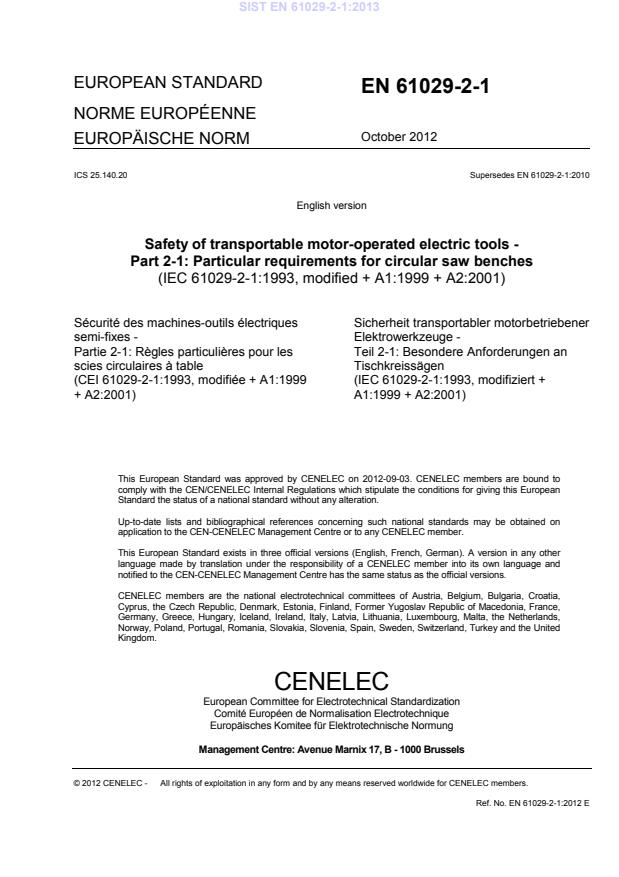
(Main)Safety of transportable motor-operated electric tools - Part 2-1: Particular requirements for circular saw benches
Safety of transportable motor-operated electric tools - Part 2-1: Particular requirements for circular saw benches
Applies to transportable circular saws intended for cutting wood and similar materials with a blade diameter not exceeding 260 mm.
Sicherheit transportabler motorbetriebener Elektrowerkzeuge - Teil 2-1: Besondere Anforderungen an Tischkreissägen
Sécurité des machines-outils électriques semi-fixes - Partie 2-1: Règles particulières pour les scies circulaires à table
S'applique aux scies circulaires semi-fixes, destinées à couper du bois et des matériaux similaires et ayant un diamètre de lame maximal de 260 mm.
Varnost premičnih električnih orodij - 2-1. del: Posebne zahteve za krožne žage z delovno mizo
Ta mednarodni standard se uporablja za premične krožne žage, namenjene rezanju lesa in podobnih materialov, katerih premer rezila je manjši od 260 mm, kot je določeno v točki 2.101.
General Information
- Status
- Withdrawn
- Publication Date
- 11-Oct-2012
- Withdrawal Date
- 02-Sep-2015
- Technical Committee
- CLC/TC 116 - Safety of hand-held motor-operated electric tools
- Drafting Committee
- IEC/TC 116 - Safety of hand-held motor-operated electric tools
- Current Stage
- 9960 - Withdrawal effective - Withdrawal
- Start Date
- 21-Aug-2019
- Completion Date
- 21-Aug-2019
- Directive
- Harmonized Standard2006/42/EC - Directive 2006/42/EC of the European Parliament and of the Council of 17 May 2006 on machinery, and amending Directive 95/16/EC (recast)OJ Ref: C 99/1, C 99/1, C 99/1, C 99/1, C 99/1, C 99/1, C, OJ Date: 11-Apr-2014
Relations
- Effective Date
- 29-Jan-2023
- Effective Date
- 28-Jan-2023

Get Certified
Connect with accredited certification bodies for this standard

National Aerospace and Defense Contractors Accreditation Program (NADCAP)
Global cooperative program for special process quality in aerospace.
CARES (UK Certification Authority for Reinforcing Steels)
UK certification for reinforcing steels and construction.
DVS-ZERT GmbH
German welding certification society.
Sponsored listings
Frequently Asked Questions
EN 61029-2-1:2012 is a standard published by CLC. Its full title is "Safety of transportable motor-operated electric tools - Part 2-1: Particular requirements for circular saw benches". This standard covers: Applies to transportable circular saws intended for cutting wood and similar materials with a blade diameter not exceeding 260 mm.
Applies to transportable circular saws intended for cutting wood and similar materials with a blade diameter not exceeding 260 mm.
EN 61029-2-1:2012 is classified under the following ICS (International Classification for Standards) categories: 25.140.20 - Electric tools. The ICS classification helps identify the subject area and facilitates finding related standards.
EN 61029-2-1:2012 has the following relationships with other standards: It is inter standard links to EN 61029-2-1:2010, EN 62841-3-1:2014. Understanding these relationships helps ensure you are using the most current and applicable version of the standard.
EN 61029-2-1:2012 is associated with the following European legislation: EU Directives/Regulations: 2006/42/EC. When a standard is cited in the Official Journal of the European Union, products manufactured in conformity with it benefit from a presumption of conformity with the essential requirements of the corresponding EU directive or regulation.
EN 61029-2-1:2012 is available in PDF format for immediate download after purchase. The document can be added to your cart and obtained through the secure checkout process. Digital delivery ensures instant access to the complete standard document.
Standards Content (Sample)
2003-01.Slovenski inštitut za standardizacijo. Razmnoževanje celote ali delov tega standarda ni dovoljeno.Sicherheit transportabler motorbetriebener Elektrowerkzeuge - Teil 2-1: Besondere Anforderungen an TischkreissägenSécurité des machines outils électrique semi-fixes - Partie 2-1: Règles particulières pour les scies circulaires à tableSafety of transportable motor-operated electric tools - Part 2-1: Particular requirements for circular saw benches25.140.20Electric tools25.080.60Strojne žageSawing machinesICS:Ta slovenski standard je istoveten z:EN 61029-2-1:2012SIST EN 61029-2-1:2013en01-marec-2013SIST EN 61029-2-1:2013SLOVENSKI
STANDARD
EUROPEAN STANDARD EN 61029-2-1 NORME EUROPÉENNE
EUROPÄISCHE NORM October 2012
CENELEC European Committee for Electrotechnical Standardization Comité Européen de Normalisation Electrotechnique Europäisches Komitee für Elektrotechnische Normung
Management Centre: Avenue Marnix 17, B - 1000 Brussels
© 2012 CENELEC -
All rights of exploitation in any form and by any means reserved worldwide for CENELEC members.
Ref. No. EN 61029-2-1:2012 E
ICS 25.140.20 Supersedes EN 61029-2-1:2010
English version
Safety of transportable motor-operated electric tools -
Part 2-1: Particular requirements for circular saw benches (IEC 61029-2-1:1993, modified + A1:1999 + A2:2001)
Sécurité des machines-outils électriques semi-fixes -
Partie 2-1: Règles particulières pour les scies circulaires à table (CEI 61029-2-1:1993, modifiée + A1:1999 + A2:2001)
Sicherheit transportabler motorbetriebener Elektrowerkzeuge -
Teil 2-1: Besondere Anforderungen an Tischkreissägen (IEC 61029-2-1:1993, modifiziert + A1:1999 + A2:2001)
This European Standard was approved by CENELEC on 2012-09-03. CENELEC members are bound to comply with the CEN/CENELEC Internal Regulations which stipulate the conditions for giving this European Standard the status of a national standard without any alteration.
Up-to-date lists and bibliographical references concerning such national standards may be obtained on application to the CEN-CENELEC Management Centre or to any CENELEC member.
This European Standard exists in three official versions (English, French, German). A version in any other language made by translation under the responsibility of a CENELEC member into its own language and notified to the CEN-CENELEC Management Centre has the same status as the official versions.
CENELEC members are the national electrotechnical committees of Austria, Belgium, Bulgaria, Croatia, Cyprus, the Czech Republic, Denmark, Estonia, Finland, Former Yugoslav Republic of Macedonia, France, Germany, Greece, Hungary, Iceland, Ireland, Italy, Latvia, Lithuania, Luxembourg, Malta, the Netherlands, Norway, Poland, Portugal, Romania, Slovakia, Slovenia, Spain, Sweden, Switzerland, Turkey and the United Kingdom.
Normative references . 28Annex ZD (informative)
Dust measurement . 29Annex ZZ (informative)
Coverage of Essential Requirements of Directive 2006/42/EC . 31
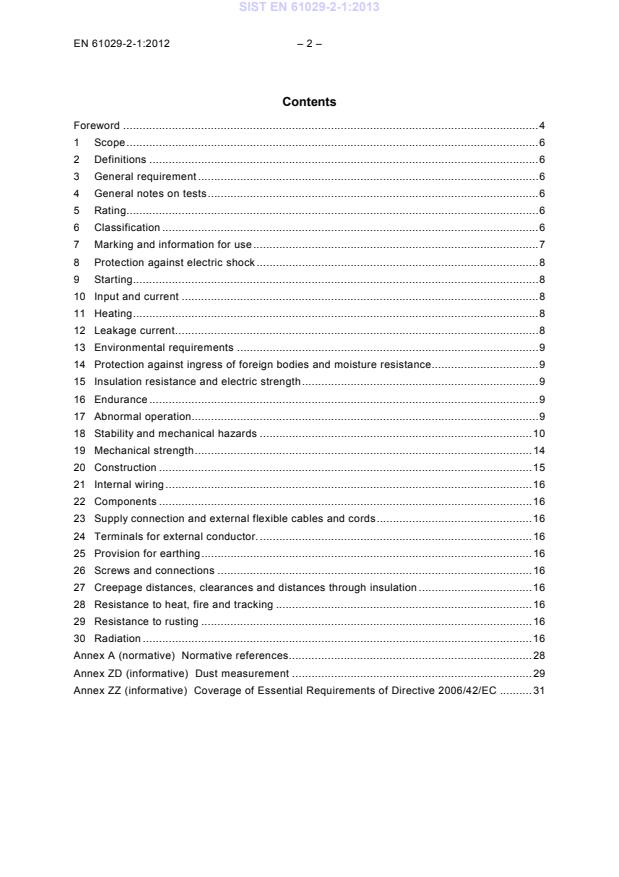
– 3 – EN 61029-2-1:2012 Figures Figure Z101 – Example of circular saw bench . 17Figure Z102 – Riving knife mounted guard . 17Figure Z103 – Example of ribbing on guard side walls . 18Figure Z104 – Saw blade guard − Stability test
.................................................................... 19Figure Z105 – Test probe ...................................................................................................... 21Figure Z106 – Riving knife adjustment ................................................................................... 21Figure Z107 – Riving knife testing – Strength of riving knife mounting .................................... 22Figure Z108 – Riving knife testing – Resiliency of riving knife ................................................ 23Figure Z109 – Dimensions of the saw table ........................................................................... 24Figure Z110 – Dimension of the slot in the table .................................................................... 25Figure Z111 – Guiding surfaces of the rip fence ..................................................................... 25Figure Z112 – Flange characteristics ..................................................................................... 26Figure Z113 – Examples for push-stick and push block handle .............................................. 27Figure ZD.101 – Orientation of tool and operator ................................................................... 30 Tables Table Z101 – Noise test conditions for circular saw benches.................................................... 9Table ZD.101 – Conditions for dust measurements ................................................................ 29 SIST EN 61029-2-1:2013
– change of Subclause 13.1 into Annex ZD. Attention is drawn to the possibility that some of the elements of this document may be the subject of patent rights. CENELEC [and/or CEN] shall not be held responsible for identifying any or all such patent rights. This European Standard is divided into two parts: Part 1 General requirements, which are common to most transportable motor, operated tools (for the purpose of this European Standard referred to simply as tools) which could come within the scope of this European Standard. Part 2 Requirements for particular types of tool which either supplement or modify the requirements given in Part 1 to account for the particular hazards and characteristics of these specific tools. Compliance with the relevant clauses of Part 1 together with this Part 2 provides one means of conforming to the specified essential health and safety requirements of the Directive. This European Standard follows the overall requirements of EN ISO 12100. For noise and vibration, this European Standard covers the requirements for their measurement, the provision of information arising from these measurements and the provision of information about the personal protective equipment required. Specific requirements for the reduction of the risk arising from noise and vibration through the design of the tool are not given as this reflects the current state of the art.
Warning: Other requirements arising from other EU Directives can be applicable to the products falling within the scope of this standard. SIST EN 61029-2-1:2013
– 5 – EN 61029-2-1:2012 This Part 2-1 is to be used in conjunction with EN 61029-1:2009. This Part 2-1 supplements or modifies the corresponding clauses of EN 61029-1, so as to convert it into the European Standard: “Safety requirements for transportable circular saw benches". Where a particular subclause of Part 1 is not mentioned in this Part 2-1, that subclause applies as far as is reasonable. Where this Part 2-1 states "addition", "modification" or "replacement", the relevant text of Part 1 is to be adapted accordingly. Clauses, subclauses, notes, tables and figures which are additional to those in Part 1 are numbered starting from 101. Clauses, subclauses, notes, tables and figures which are additional to those in IEC 61029-2-1 are prefixed “Z”. NOTE In this European Standard, the following print types are used: - requirements proper: in roman type;
- test specifications: in italic type;
- explanatory matter: in smaller roman type. This document has been prepared under a mandate given to CENELEC by the European Commission and the European Free Trade Association, and supports essential requirements of EU Directive. For the relationship with EU Directive 2006/42/EC, see informative Annex ZZ, which is an integral part of this document. Endorsement notice The text of the International Standard IEC 61029-2-1:1993 was approved by CENELEC as a European Standard with agreed common modifications. SIST EN 61029-2-1:2013
– 7 – EN 61029-2-1:2012 7 Marking and information for use This clause of Part 1 is applicable except as follows: 7.1 Addition: Circular saw benches shall be marked with – maximum and minimum saw blade diameter; – rated no-load speed; – thickness of riving knife; – maximum cutting capacity; – indication of direction of rotation of the saw blade; – saw blade bore diameter. If the upper guard is made of non-transparent material, an indication of the cutting line in alignment with the plane of the saw blade shall be marked on the guard. Circular saw benches for which different no-load speeds can be selected shall be marked, close to the means of adjustment, with details of the method of changing the speed and the resultant no-load speed. This may be done by means of diagrams, etc. Where a machine is designed to operate at more than one spindle speed, the following requirements shall apply: – on machines where a speed change is achieved by changing the position of the drive belts on the drive pulleys, the selected speed shall be indicated on the same side of the machine as the start control by a diagram showing the relevant speed selected for each combination of pulleys; – on machines where a speed change is achieved by an electronic control circuit, the selected speed shall be indicated on the machine at the selecting device (e.g. variable speed control dial provided with numerical speed settings). 7.6 Addition: The direction of rotation of the saw blade shall be indicated on a fixed part of the tool in the vicinity of the spindle axis by an arrow raised or sunk, which is visible when changing the saw blade, or by any other means not less visible and indelible. 7.13 Addition: The substance of the following instructions shall also be given: c) Safety precautions Z101) warning not to use saw blades which are damaged or deformed; Z102) instruction to replace table insert when worn; Z103) instruction to use only saw blades recommended by the manufacturer, which conform to EN 847-1, if intended for wood and similar materials; Z104) instruction that, when changing the saw blade, the width of the groove cut of the saw blades shall not be less than and the thickness of the body of the saw blade shall not be more than the thickness of the riving knife; Z105) instruction that the selection of the saw blade shall be suitable for the material to be cut; SIST EN 61029-2-1:2013
i) hearing protection to reduce the risk of induced hearing loss;
ii) eye protection;
iii) respiratory protection to reduce the risk of inhalation of harmful dust;
iv) gloves for handling saw blades and rough material (recommendation that saw blades should be carried in a holder wherever practicable). Z107) instruction to connect circular saws to a dust-collecting device when sawing wood; Z108) warning not to use high speed steel (HS) saw blades; Z109) instruction to store the push-stick or push block always with the machine when not in use. e) Safe operation Z101) instruction to use push-sticks or push blocks to feed the workpiece past the saw blade; Z102) information about use and correct adjustment of the riving knife; Z103) information about use and correct adjustment of the upper saw blade guard; Z104) warning not to rebate or groove unless suitable guarding, such as a tunnel guard, is fitted above the saw table; Z105) warning not to use saws for slotting (stopped groove); Z106) for tools with variable speed: a table giving guidance on spindle speed selection for different materials to be sawn; Z107) instruction to use only saw blades for which the maximum possible speed is not less than the maximum spindle speed of the tool and the material to be cut; Z108) instruction to use only transportation devices and do never use guards for handling or transportation when transporting the machine; Z109) instruction to cover the upper part of the saw blade during transportation, for example by the guard; Z110) information regarding the range of saw blade outside diameter, thickness and bore diameter which may be used with the tool; Z111) instruction how to support long workpieces. 8 Protection against electric shock
This clause of Part 1 is applicable. 9 Starting This clause of Part 1 is applicable. 10 Input and current This clause of Part 1 is applicable. 11 Heating This clause of Part 1 is applicable. 12 Leakage current This clause of Part 1 is applicable. SIST EN 61029-2-1:2013
– 9 – EN 61029-2-1:2012 13 Environmental requirements This clause of Part 1 is applicable except as follows: 13.2.1 Addition: The major sound sources of tools are: - the saw blade; - gears; - the motor / the fan. NOTE
For general information concerning the reduction of noise, see EN ISO 11688-1. 13.2.4 Replacement of paragraphs 1, 2 and 3: Circular saw benches are tested under load under the conditions shown in Table Z101. Table Z101 – Noise test conditions for circular saw benches Orientation Cutting a horizontal piece of chipboard 800 mm × 400 mm × 19 mm
Tool bit New saw blade as recommended by the manufacturer for cutting chipboard Feed force Just sufficient to cut at a brisk pace
((3 ± 1) m/min) Depth of cut Saw blade adjusted for a 22 mm depth of cut Test cycle Cutting off approximately 10 mm wide strips (set by rip fence) across the 400 mm width of the chipboard Test position Saws supplied with an own stand are to be used standing on a reflecting plane. Other saws to be used on a bench above reflecting plane as shown in Figure 12 of Part 1. Test time Five cuts, measurement starting 100 mm behind front edge up to end of the workpiece
13.3 This subclause is not applicable. 14 Protection against ingress of foreign bodies and moisture resistance This clause of Part 1 is applicable. 15 Insulation resistance and electric strength This clause of Part 1 is applicable. 16 Endurance This clause of Part 1 is applicable. 17 Abnormal operation This clause of Part 1 is applicable except as follows: 17.1 Addition: Circular saw benches shall be considered to be machines in which moving parts are liable to be jammed, if equipped with an induction motor. SIST EN 61029-2-1:2013
Addition: Circular saw benches shall be equipped with a guarding system, which cannot be removed without the aid of a tool. This requirement does not apply to a top guard fixed to a riving knife. 18.1.101 Guarding above the saw table 18.1.101.1 Circular saw benches shall have a top guard for the crown and the front of the saw blade that may be an adjustable guard, a self-closing guard or a combination of these. An adjustable guard when adjusted shall remain in any position necessary to give the required protection. - For riving knife mounted guards:
For all intended saw blade diameters and all positions of the saw blade, the guard shall cover the top and sides of the exposed saw teeth above a straight line between the guard mounting point on the riving knife and the first cutting tooth at the top of the table with the saw blade in the vertical position (an example is shown in Figure Z102). The maximum external width except a dust extraction port, if any, shall be 40 mm. - For other top guards:
When mounted separately from the riving knife, but integral with the machine, the support for the top guard shall not be in line with the riving knife.
The guard shall be capable of screening the top and both sides of the saw blade horizontally between the riving knife and the table at the front of the saw blade, shall be adjustable from a position 5 mm above the maximum height of cut down to the table and shall remain parallel with the table. The maximum external width shall be 50 mm.
For tools that have the facility to tilt the saw blade, either an auxiliary guard shall be provided, or the tool guard shall be capable of being fitted with an extension piece for use during angled cutting. The guards or extension pieces shall be exchangeable without the aid of a tool. 18.1.101.2 The top guard shall be constructed from soft material (e.g. aluminium or plastic) which will minimize damage to the saw blade should contact occur. The guard shall be designed to bear against the smooth sides of the saw blade in order to minimize the risk of damage to the guard. Either - the guard side walls shall have a thickness of minimum 6 mm or - the guard side walls shall be equipped with internal ribs on at least the lowest 3 mm of the side walls providing a total thickness of minimum 6 mm (see Figure Z103). If one side wall of a self-closing guard is made longer for bevelling, the 6 mm requirement does not apply to the additional side wall portion. 18.1.101.3 Void 18.1.101.4 Void SIST EN 61029-2-1:2013
– 11 – EN 61029-2-1:2012 18.1.101.5 A self-closing guard shall automatically a) open by contact with the workpiece to be cut as it is moved towards the saw blade; b) remain in contact with the upper surface of the workpiece as it is cut, to screen both sides of the saw blade at least down to the root of the teeth and at least between the upper surface of the workpiece and the riving knife; c) return to the initial position, in contact with the top of the table, after the workpiece has moved past the guard. Compliance with 18.101.1, 18.101.2 and 18.101.5 is checked by inspection and by measurement. 18.1.101.Z1 The guard and its supporting system shall have sufficient stability to reduce the risk of the saw blade making contact with the guard. Compliance is checked, with no saw blade fitted, by the following test (see Figures Z104 a) and Z104 b)). - For riving knife mounted saw blade guards:
While the guard is subjected to a load of 5 N at the front edge of the guard as defined in Figure Z104 a), the maximum deflection shall not be more than 15 mm. - For separately from riving knife mounted saw blade guards:
While the guard is subjected to a load of 20 N at the front edge of the guard as defined in Figure Z104 b), the maximum allowable deflection shall not be more than 8 mm. 18.1.102 Guarding below the saw table 18.1.102.1 Access to dangerous moving parts under the table shall not be possible at any depth of cut and any angle of inclination of the saw blade. Compliance with 18.1.102.1 is checked by using the test probe in Figure Z105. 18.1.102.2 Void 18.1.103 Riving knife 18.1.103.1 Circular saw benches shall be equipped with a riving knife. 18.1.103.2 The riving knife shall be rigidly fixed and be in alignment with the plane of the saw blade (tolerance ± 0,2 mm) and disposed to it so as to pass freely through the cutting groove. The position of the riving knife shall not change relative to the saw blade when the depth of cut is adjusted. 18.1.103.3 The riving knife and its holder shall be so designed as to allow the adjustment of the riving knife, for all saw blade diameters resulting in cutting capacities between 100 % and 95 % of the maximum cutting capacity, to comply with the following conditions: a) above the saw table the radial distance between the riving knife and the toothed rim of the saw blade shall not at any point exceed 5 mm as shown at Figure Z106, at any depth of cut; b) the tip of the riving knife shall not be lower than 5 mm from the tooth peak, as shown at Figure Z106. The leading edge of the riving knife shall be chamfered to provide a lead-in and the riving knife shall be of constant thickness (within ± 0,2 mm) throughout its working length. SIST EN 61029-2-1:2013
– 13 – EN 61029-2-1:2012 18.1.105.2 The workpiece guiding part of the rip fence shall be adjustable parallel with the saw blade so that its out-feed end can be positioned forward to a point in line with the front edge of the riving knife, and rearwards to a point at the table level which is in line with the first cutting tooth of the largest saw blade for which the tool is designed when adjusted to the maximum depth of cut. Material of the guiding surface that may come in contact with the saw blade shall be made from a material that can easily be cut such as aluminium, plastic or wood. The rip fence shall be provided with two guiding surfaces, one for large depths of cut and one for small depths of cut, so that the saw blade cannot come in contact with the fence when the saw blade is tilted for 45°. The height of the lower guiding surface shall be not more than 12 mm (see also Figure Z111).
Compliance is checked by inspection and measurement. 18.1.105.Z1 Cross-cutting fence The saw may be provided with a cross-cutting fence. The fixing arrangement shall ensure that the fence cannot rise or swing out of position. The distance between the end of the cross-cutting fence closest to the saw blade and the saw blade shall not exceed 15 mm. If contact between the cross-cutting fence and the saw blade cannot be avoided, the part close to the saw blade shall be made of a material that can easily be cut such as aluminium, wood or plastic. The minimum height of the guiding surface of the fence shall be 30 mm or the maximum cutting capacity, whichever is the smaller. Where the fence passes beneath the saw blade top guard the maximum height of the fence shall not exceed 12 mm. Compliance is checked by inspection and measurement. 18.1.106 Flanges The outer diameter of the contact surface shall be not less than 0,2 times the saw blade diameter. The overlap a of the clamping area of the two flanges shall be at least 1,5 mm wide as specified in Figure Z112. Compliance is checked by inspection and measurement. 18.1.107 Dust outlet Connection ports for external dust collection equipment, if any, shall be directed away from the operator. Compliance is checked by inspection. It shall not be possible to gain access to the saw blade through the dust outlet opening. Compliance is checked by applying the test probe of Figure Z105. SIST EN 61029-2-1:2013
...
Questions, Comments and Discussion
Ask us and Technical Secretary will try to provide an answer. You can facilitate discussion about the standard in here.
Loading comments...