


EN 61817:2001
(Main)Household portable appliances for cooking, grilling and similar use - Methods for measuring performance
General Information
- Abstract
Specifies methods for measuring the performance of electric household portable appliances for cooking, grilling and similar use. It defines the main performance characteristics of these appliances which are of interest to the user, and specifies methods of measuring them. For performance of microwave ovens, see EN 60705; for electric cooking ranges, hobs, ovens and grills for household use, see EN 60350. The colour shade chart is provided with the printed standard. For the electronic version, this colour shade chart (EN 61817-CHAR) can be ordered separately, to ensure accurate colour reproduction.
- Status
- Withdrawn
- Publication Date
- 28-Nov-2001
- Withdrawal Date
- 31-Oct-2004
- Technical Committee
- CLC/TC 59X - Consumer information related to household electrical appliances
- Drafting Committee
- IEC/SC 59L - IEC_SC_59L
- Parallel Committee
- IEC/SC 59G - IEC_SC_59G
- Current Stage
- 9960 - Withdrawal effective - Withdrawal
- Start Date
- 23-Mar-2023
- Completion Date
- 25-Aug-2026

Relations
- Effective Date
- 10-Feb-2026
- Effective Date
- 09-Feb-2026
- Effective Date
- 28-Jan-2023
Frequently Asked Questions
EN 61817:2001 is a standard published by CLC. Its full title is "Household portable appliances for cooking, grilling and similar use - Methods for measuring performance". This standard covers: Specifies methods for measuring the performance of electric household portable appliances for cooking, grilling and similar use. It defines the main performance characteristics of these appliances which are of interest to the user, and specifies methods of measuring them. For performance of microwave ovens, see EN 60705; for electric cooking ranges, hobs, ovens and grills for household use, see EN 60350. The colour shade chart is provided with the printed standard. For the electronic version, this colour shade chart (EN 61817-CHAR) can be ordered separately, to ensure accurate colour reproduction.
Specifies methods for measuring the performance of electric household portable appliances for cooking, grilling and similar use. It defines the main performance characteristics of these appliances which are of interest to the user, and specifies methods of measuring them. For performance of microwave ovens, see EN 60705; for electric cooking ranges, hobs, ovens and grills for household use, see EN 60350. The colour shade chart is provided with the printed standard. For the electronic version, this colour shade chart (EN 61817-CHAR) can be ordered separately, to ensure accurate colour reproduction.
EN 61817:2001 is classified under the following ICS (International Classification for Standards) categories: 97.040.50 - Small kitchen appliances. The ICS classification helps identify the subject area and facilitates finding related standards.
EN 61817:2001 has the following relationships with other standards: It is inter standard links to ISO 7724-1:1984, EN 14432:2006, EN 61817:2001/A1:2004. Understanding these relationships helps ensure you are using the most current and applicable version of the standard.
EN 61817:2001 is available in PDF format for immediate download after purchase. The document can be added to your cart and obtained through the secure checkout process. Digital delivery ensures instant access to the complete standard document.
Standards Content (Sample)
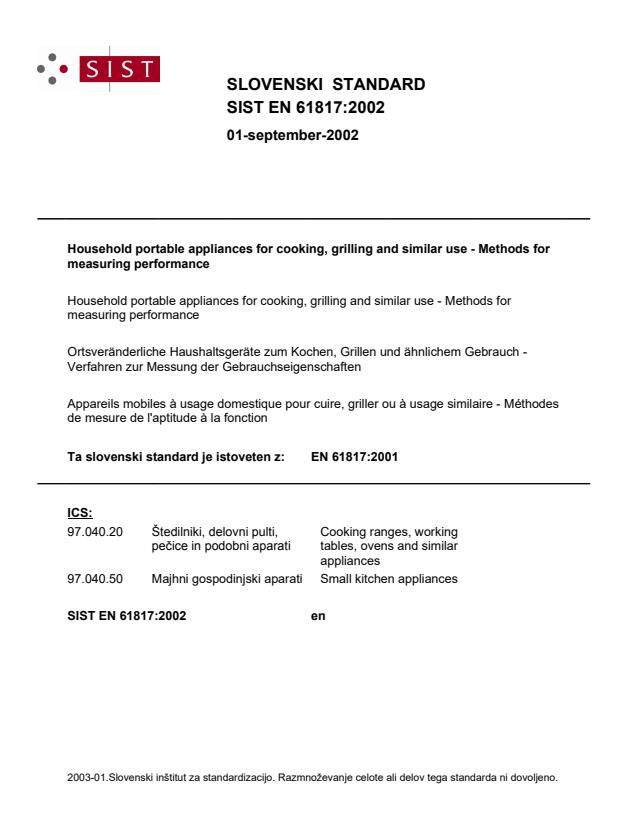
2003-01.Slovenski inštitut za standardizacijo. Razmnoževanje celote ali delov tega standarda ni dovoljeno.Household portable appliances for cooking, grilling and similar use - Methods for measuring performanceOrtsveränderliche Haushaltsgeräte zum Kochen, Grillen und ähnlichem Gebrauch - Verfahren zur Messung der GebrauchseigenschaftenAppareils mobiles à usage domestique pour cuire, griller ou à usage similaire - Méthodes de mesure de l'aptitude à la fonctionHousehold portable appliances for cooking, grilling and similar use - Methods for measuring performance97.040.50Majhni gospodinjski aparatiSmall kitchen appliances97.040.20Cooking ranges, working tables, ovens and similar appliancesICS:Ta slovenski standard je istoveten z:EN 61817:2001SIST EN 61817:2002en01-september-2002SIST EN 61817:2002SLOVENSKI
STANDARD
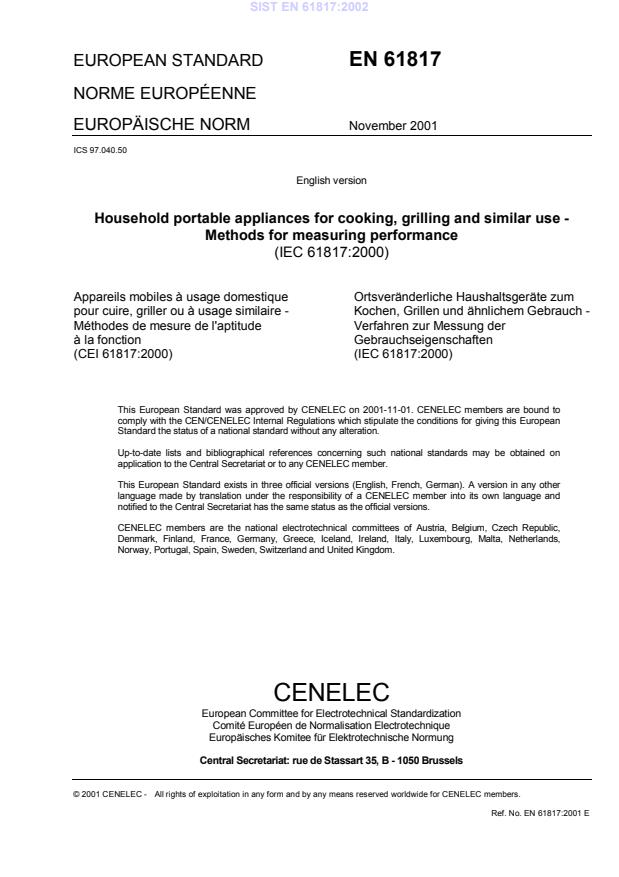
EUROPEAN STANDARDEN 61817NORME EUROPÉENNEEUROPÄISCHE NORMNovember 2001CENELECEuropean Committee for Electrotechnical StandardizationComité Européen de Normalisation ElectrotechniqueEuropäisches Komitee für Elektrotechnische NormungCentral Secretariat: rue de Stassart 35, B - 1050 Brussels© 2001 CENELEC -All rights of exploitation in any form and by any means reserved worldwide for CENELEC members.Ref. No. EN 61817:2001 EICS 97.040.50English versionHousehold portable appliances for cooking, grilling and similar use -Methods for measuring performance(IEC 61817:2000)Appareils mobiles à usage domestiquepour cuire, griller ou à usage similaire -Méthodes de mesure de l'aptitudeà la fonction(CEI 61817:2000)Ortsveränderliche Haushaltsgeräte zumKochen, Grillen und ähnlichem Gebrauch -Verfahren zur Messung derGebrauchseigenschaften(IEC 61817:2000)This European Standard was approved by CENELEC on 2001-11-01. CENELEC members are bound tocomply with the CEN/CENELEC Internal Regulations which stipulate the conditions for giving this EuropeanStandard the status of a national standard without any alteration.Up-to-date lists and bibliographical references concerning such national standards may be obtained onapplication to the Central Secretariat or to any CENELEC member.This European Standard exists in three official versions (English, French, German). A version in any otherlanguage made by translation under the responsibility of a CENELEC member into its own language andnotified to the Central Secretariat has the same status as the official versions.CENELEC members are the national electrotechnical committees of Austria, Belgium, Czech Republic,Denmark, Finland, France, Germany, Greece, Iceland, Ireland, Italy, Luxembourg, Malta, Netherlands,Norway, Portugal, Spain, Sweden, Switzerland and United Kingdom.SIST EN 61817:2002
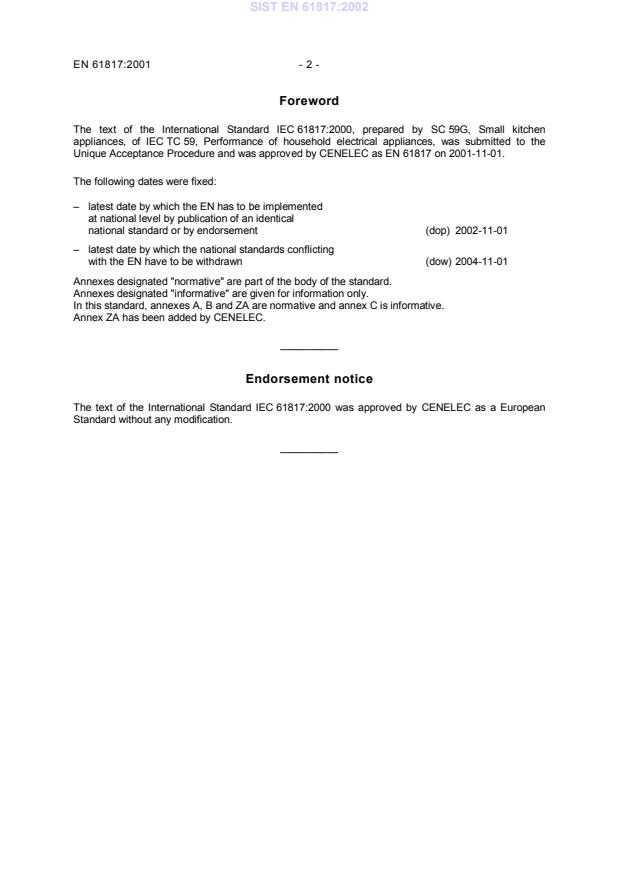
- 3 -EN 61817:2001Annex ZA(normative)Normative references to international publicationswith their corresponding European publicationsThis European Standard incorporates by dated or undated reference, provisions from otherpublications. These normative references are cited at the appropriate places in the text and thepublications are listed hereafter. For dated references, subsequent amendments to or revisions of anyof these publications apply to this European Standard only when incorporated in it by amendment orrevision. For undated references the latest edition of the publication referred to applies (includingamendments).NOTEWhen an international publication has been modified by common modifications, indicated by (mod), the relevantEN/HD applies.PublicationYearTitleEN/HDYearISO 7724-11984Paints and varnishes - ColorimetryPart 1: Principles--ISO/CIE 105261999CIE standard illuminants for colorimetry--ISO/CIE 105271991CIE standard colorimetric observers--CIE 15.21986Colorimetry--SIST EN 61817:2002
NORMEINTERNATIONALECEIIECINTERNATIONALSTANDARD61817Première éditionFirst edition2000-10Appareils mobiles à usage domestiquepour cuire, griller ou à usage similaire –Méthodes de mesure de l'aptitude à la fonctionHousehold portable appliancesfor cooking, grilling and similar use –Methods for measuring performance Commission Electrotechnique Internationale International Electrotechnical CommissionPour prix, voir catalogue en vigueurFor price, see current catalogueÓ IEC 2000
Droits de reproduction réservés
¾
Copyright - all rights reservedAucune partie de cette publication ne peut être reproduite niutilisée sous quelque forme que ce soit et par aucun procédé,électronique ou mécanique, y compris la photocopie et lesmicrofilms, sans l'accord écrit de l'éditeur.No part of this publication may be reproduced or utilized inany form or by any means, electronic or mechanical,including photocopying and microfilm, without permission inwriting from the publisher.International Electrotechnical Commission3, rue de Varembé
Geneva, SwitzerlandTelefax: +41 22 919 0300e-mail: inmail@iec.ch IEC web site
http://www.iec.chCODE PRIXPRICE CODEUSIST EN 61817:2002
61817 © IEC:2000– 3 –CONTENTSPageFOREWORD…………………………………………………………………………………………………5Clause1Scope.72Normative references.73Definitions.94List of measurements.135General conditions for the measurements.156Dimensions and mass.177Function measurements.198Other characteristics.41Annex A (normative) Colour measuring instrument.53Annex B (normative) Shade chart.55Annex C (informative) Addresses of suppliers.57Bibliography…………………….59Figure 1 – Internal dimensions of ovens.43Figure 2 – Positions for temperature-recording device.45Figure 3 – Shape of the nozzle for extruding pastry.47Figure 4– Position of pastry strips on the baking sheet.47Figure 5 – Frying pan.49Figure 6 – Steel saucepan.51Figure A.1 – Colour measuring instrument.53SIST EN 61817:2002
61817 © IEC:2000– 5 –INTERNATIONAL ELECTROTECHNICAL COMMISSION____________HOUSEHOLD PORTABLE APPLIANCESFOR COOKING, GRILLING AND SIMILAR USE –METHODS FOR MEASURING PERFORMANCEFOREWORD1)The IEC (International Electrotechnical Commission) is a worldwide organization for standardization comprisingall national electrotechnical committees (IEC National Committees). The object of the IEC is to promoteinternational co-operation on all questions concerning standardization in the electrical and electronic fields. Tothis end and in addition to other activities, the IEC publishes International Standards. Their preparation isentrusted to technical committees; any IEC National Committee interested in the subject dealt with mayparticipate in this preparatory work. International, governmental and non-governmental organizations liaisingwith the IEC also participate in this preparation. The IEC collaborates closely with the InternationalOrganization for Standardization (ISO) in accordance with conditions determined by agreement between thetwo organizations.2)The formal decisions or agreements of the IEC on technical matters express, as nearly as possible, aninternational consensus of opinion on the relevant subjects since each technical committee has representationfrom all interested National Committees.3)The documents produced have the form of recommendations for international use and are published in the formof standards, technical specifications, technical reports or guides and they are accepted by the NationalCommittees in that sense.4)In order to promote international unification, IEC National Committees undertake to apply IEC InternationalStandards transparently to the maximum extent possible in their national and regional standards. Anydivergence between the IEC Standard and the corresponding national or regional standard shall be clearlyindicated in the latter.5)The IEC provides no marking procedure to indicate its approval and cannot be rendered responsible for anyequipment declared to be in conformity with one of its standards.6)Attention is drawn to the possibility that some of the elements of this International Standard may be the subjectof patent rights. The IEC shall not be held responsible for identifying any or all such patent rights.International Standard IEC 61817 has been prepared by subcommittee 59G: Small kitchenappliances, of IEC technical committee 59: Performance of household electrical appliances.The text of this standard is based on the following documents:FDISReport on voting59G/107/FDIS59G/108/RVDFull information on the voting for the approval of this standard can be found in the report onvoting indicated in the above table.This publication has been drafted in accordance with the ISO/IEC Directives, Part 3.Annexes A and B form an integral part of this standard.Annex C is for information only.The committee has decided that the contents of this publication will remain unchanged until2003. At this date, the publication will be·reconfirmed;·withdrawn;·replaced by a revised edition, or·amended.SIST EN 61817:2002
61817 © IEC:2000– 7 –HOUSEHOLD PORTABLE APPLIANCESFOR COOKING, GRILLING AND SIMILAR USE –METHODS FOR MEASURING PERFORMANCE1 ScopeThis International Standard specifies methods for measuring the performance of electrichousehold portable appliances for cooking, grilling and similar use.This standard defines the main performance characteristics of such appliances which are ofinterest to the user, and specifies methods of measurement.This standard is concerned neither with safety nor performance requirements.Taking into account the lower grade of accuracy and repeatability, due to the variations intime, origin of test materials and ingredients and to the influence of the subjective judgementof test operators, the described test methods may be applied more reliably for comparativetesting of a number of appliances at approximately the same time, in the same laboratory, bythe same operator and with the same utensils, rather than for testing of a single appliance indifferent laboratories.This standard does not apply to microwave ovens, electric cooking ranges, hobs, ovens andgrills for household use, nor to appliances designed exclusively for commercial or industrialuse.2 Normative referencesThe following normative documents contain provisions which, through reference in this text,constitute provisions of this international standard. For dated references, subsequentamendments to, or revisions of, any of these publications do not apply. However parties toagreements based on this international standard are encouraged to investigate the possibilityof applying the most recent editions of the normative documents indicated below. For undatedreferences, the latest edition of the normative document referred to applies. Members of ISOand IEC maintain registers of currently valid International Standards.ISO 7724 (all parts), Paints and varnishes – ColorimetryISO/CIE 10526:1999, CIE standard colorimetric illuminantsISO/CIE 10527:1991, CIE standard colorimetric observersCIE 15.2:1986, ColorimetrySIST EN 61817:2002
61817 © IEC:2000– 9 –3 DefinitionsFor the purposes of this International Standard, the following definitions apply.3.1grilling/contact grillingcooking and/or browning food by means of radiated heatNOTE 1
In the case of contact grilling the food is cooked on one side or both by direct contact with the heatingplates.NOTE 2
Grilling /contact grilling performed outdoors is called barbecuing.NOTE 3
Barbecues, stone grills and raclette/griddle functions are covered by grilling/contact grilling.3.2roastingcooking and browning food (typically joints of meat, game or poultry) by dry convected heat,radiant heat or forced hot air3.3toastingbrowning flour-based products by means of radiated heat3.4bakingcooking and browning food (typically flour based items such as cakes and bread) by dryconvected heat, radiant heat or forced hot airNOTE
In some cases the food will expand and become more solidified, causing its mass/weight to be reduced.3.5simmeringcooking food immersed in liquid by first bringing to a boil and then reducing the heat tomaintain a point below boiling, indicated by slight movement of the liquid.NOTE
Simmering is normally used for long slow cooking.3.6steamingcooking food gently by means of steam produced from boiling water3.7shallow frying (Italian soffritto) (French rissoler)cooking and/or browning food by means of conducted heat using a small amount of cookingagent e.g. fat or oil3.8gratinéefinish, by browning, a pre-cooked food normally covered in breadcrumbs or cheese3.9dehydratingpreparing food for preservation by removal of waterNOTE
By dehydration the weight of the food will be considerably reduced.SIST EN 61817:2002
61817 © IEC:2000– 11 –3.10boilingcooking food in water-based liquid at 100 °C or bringing food/liquid to 100 °C and maintaininga bubble formation to complete the cooking3.11meltingconverting a solid food, normally fat, sugar, or chocolate, into a liquid by gently heating3.12portable applianceappliance intended to be moved while in operation or having a mass of less than 18 kgNOTE
Portable appliances are normally provided with a supply cord and a plug for connection to the supply.3.13hobappliance or part of an appliance which incorporates one or more cooking zones3.14cooking zonepart of the hob or area marked on the surface of a hob on which pans are placed for heating3.15hotplatepart attached to the surface of a hob which forms a cooking zone3.16solid hotplatehotplate with closed surface usually constructed from cast iron with an integrated heatingelement3.17tubular hotplatehotplate, the surface of which is formed by the configuration of a tubular sheathed heatingelement in a substantially flat plane3.18glass ceramic hobhob in which the heating elements are located beneath a glass ceramic surface3.19induction cooking zonecooking zone on which the pan is heated by means of eddy currentsNOTE 1
The eddy currents are induced in the bottom of the pan by the electromagnetic field of a coil.NOTE 2
The hob surface may be of glass ceramic.SIST EN 61817:2002
61817 © IEC:2000– 13 –3.20grillappliance or part of an appliance in which food is cooked by radiant heat3.21ovenappliance or compartment of a cooking range in which food is cooked by radiation, by naturalconvection, by forced-air circulation or by a combination of these heating methods3.22oven with forced air circulationoven with heat transmission to the food by circulating airNOTE
An oven with forced air circulation may also operate as a conventional oven, however, a supplementary setof heating elements may be necessary for that purpose.3.23oven with catalytic liningoven in which cleaning is achieved by breaking down certain depositions on a special coating3.24shelfopen grid which allows free movement of air and radiated heat, used to supportfood/container3.25baking sheetsolid sheet of metal, glass or other material4 List of measurements4.1 Dimensions and massThe following measurements are carried out:– overall dimensions (see 6.1);– length of the flexible cord (see 6.2);– mass of the appliance (see 6.3);– oven, backing sheets and grill grid/shelves dimensions (see 6.4, 6.5, 6.6).4.2 FunctionsThe following tests are carried out:– grilling/contact grilling (see 7.1);– roasting (see 7.2);– toasting (see 7.3),– baking (see 7.4);– heat distribution (see 7.5);– simmering (see 7.6);– steaming (see 7.7).SIST EN 61817:2002
61817 © IEC:2000– 15 –– shallow frying (see 7.8);– gratinée (see 7.9);– dehydrating (see 7.10);– boiling (see 7.11);– melting (see 7.12).4.3 Other Characteristics– cleaning (see 8.1);– user instructions (see 8.2).5 General conditions for the measurementsUnless otherwise specified, the measurements are made under the following conditions.5.1 GeneralThe settings, accessories and quantities of ingredients used are those recommended by themanufacturer. In the absence of the manufacturer's recommendations, the quantities quotedare used. The ingredients specified have been selected primarily to ensure uniform andreproducible results.Unless otherwise stated, the appliance is operated in accordance with the manufacturer’sinstructions.5.2 Test roomThe tests are carried out in a substantially draught-free room in which the ambienttemperature is maintained at 20 °C ± 5 °C.5.3 Ambient temperatureThe ambient temperature and the temperature of all utensils and ingredients are maintainedat 20 °C ± 5 °C unless otherwise specified.5.4 VoltageThe appliance is supplied at rated voltage ±1 %.If the appliance has a rated voltage range, the tests are carried out at the nominal voltage ofthe country where the appliance is intended to be used.5.5 InstrumentationThe temperature measuring instruments including thermocouples shall have an accuracy of0,5 °C within the temperature range of 0 °C to 100 °C and an accuracy of 2 °C within thetemperature range 100 °C to 300 °C.The energy measuring meter shall have an accuracy of 1 %.5.6 Positioning the applianceAppliances are positioned at a distance of at least 30 cm away from side walls on a dull blackpainted wooden support.SIST EN 61817:2002
61817 © IEC:2000– 17 –5.7 PreheatingThe appliance is initially at room temperature. However, if preheating is specified, theappliance is preheated in accordance with the instructions for use. If no instructions are given,the appliance is considered to be preheated after the thermostat has switched off for the firsttime.5.8 Setting of controlsThe control is set to give the temperature specified for the test. However, if the temperaturecannot be attained due to the construction of the control, the nearest setting related to thespecified temperature is chosen.5.9 EquipmentWhen appropriate, an electric food mixer may be used when mixing ingredients. Theappliance is supplied at rated voltage.6 Dimensions and mass6.1 Overall dimensionsThe overall dimensions – height, width and depth – of the appliance including knobs, handlesetc., are measured and indicated in millimetres, the doors, if any, being closed.6.2 Length of the flexible cordThe distance between the entry points into the appliance and the plug, including any cordguard, are measured and indicated in metres, to the nearest 0,05 m.6.3 Mass of the applianceThe mass of the appliance, with the flexible cord and the plug attached, is determined andexpressed in kilograms, rounded to the nearest kilogram.6.4 Internal dimensions of ovenThe height, width and depth within the oven are measured as shown in figure 1 and stated inmillimetres.The usable volume is calculated from these three dimensions and stated in litres.6.5 Dimensions of baking sheetsThe usable area of a baking sheet is measured. If the baking sheet is not flat, this area ismeasured 5 mm above the surface of the shelf.The surface area is calculated and stated in square centimetres, rounded to the nearest10 cm2.6.6 Dimensions of grill grids/shelvesThe usable width and depth of the shelf for the grill grid are measured.The surface area is calculated and expressed in square centimetres rounded to the nearest10 cm2.SIST EN 61817:2002
61817 © IEC:2000– 19 –7 Function measurements7.1 Grilling / Contact grillingThe purpose of this test is to determine the uniformity of cooking and browning of meat.NOTE
This test is applicable for comparative testing only.7.1.1 Ingredients2,5 kg minced beef, fat content 10 % to 20 %This quantity is sufficient for 20 burgers.7.1.2 ProcedureForm the minced beef into burgers using a ring mould, each burger weighing 125 g andhaving a diameter of 75 mm. Compress the burger so that its height is approximately 35 mm.Distribute the burgers evenly over the grill grid allowing approximately 15 mm between eachburger and between the burgers and the edges.Preheat the grill on maximum setting in accordance with the instructions for use. If noinstructions are given, preheat the grill for 5 min. For contact grills preheat for 5 minutes withthe plates closed where applicable.Place the grill grid and the grill pan under the grill element in the position recommended in theinstructions for use. If no instructions are given, place the grill grid so that the top of theburgers is approximately 50 mm to 75 mm below the grill element. The door is in the openposition unless otherwise specified in the instructions for use. For other grills follow themanufacturer’s instructions. Where no instructions are given, place food directly on thecooking surface or in the cooking container supplied, where applicable, or close to the contactgrill plates.Grill the burgers as recommended in the instructions for use.
If no instructions are given, grillone side for 12 min to 15 min turn the burgers over and grill the other side for 10 min to15 min.7.1.3 AssessmentThe grill grid is removed from the oven and the temperature is measured at the centre of fiveburgers using a temperature measuring probe. The burgers are selected from the four cornersand the centre of the grill grid. The difference between the maximum and minimum centretemperature is stated. The measurement shall be performed within 2 min.The browning of each burger is assessed as follows:heavily charred
–Alightly charred
–Bmedium dark
–Cmedium light
–Dgrey
–ESIST EN 61817:2002
61817 © IEC:2000– 21 –7.2 RoastingThe purpose of this test is to evaluate the cooking uniformity of a thick, brick-shaped item offood.7.2.1 Roasting an evenly shaped piece of food – meatloafA rectangular container suitable for fulfilling the following dimensional requirements is usedfor the appliance being tested.– length to width ratio 2 – 2,5 to 1;– depth: 75 mm ± 15 mm;– area at the top of the food load: 225 cm² ± 40 cm²;– height of the food load: 45 mm ± 3 mm.The nominal mass of the food load is 900 g. If this does not correspond to the requirementslisted above, the mass is adapted accordingly.7.2.1.1 Ingredients115 g eggs, whites and yolks blended800 g minced lean beef (maximum 20 % fat content)2 g table saltclingfilm to cover the top surface of the load.7.2.1.2 ProcedureBeat the eggs and mix in the beef and salt. Carefully pack the mixture in the containeravoiding air pockets. Compact the mixture by using another container and ensure the surfaceis flat. Cover with clingfilm and place in the refrigerator at 5 °C ± 2 °C for 24 h.Turn out the chilled mixture into a container. A roasting container is normally supplied with theappliance, or if such a container is not supplied, place in a container of a suitable size for theappliance being tested.Cook according to the manufacturer’s instructions for this type of load. If such instructions arenot available, the temperature sett
...