


prEN IEC 62828-3:2025
(Main)Reference conditions and procedures for testing industrial and process measurement transmitters - Part 3: Specific procedures for temperature transmitters
Reference conditions and procedures for testing industrial and process measurement transmitters - Part 3: Specific procedures for temperature transmitters
Referenzbedingungen und Testmethoden für Industrie- und Prozessmessgrößenumformer - Teil 3: Spezielle Testmethoden für Temperaturmessumformer
Conditions de référence et procédures pour l'essai des transmetteurs de mesure industrielle et de processus - Partie 3: Procédures spécifiques pour les transmetteurs de température
Referenčni pogoji in postopki za preskušanje industrijskih in procesnih merilnih oddajnikov - 3. del: Posebni postopki za oddajnike temperature
General Information
- Status
- Not Published
- Publication Date
- 29-Nov-2026
- Technical Committee
- CLC/TC 65X - Industrial-process measurement, control and automation
- Current Stage
- 4060 - Enquiry results established and sent to TC, SR, BTTF - Enquiry
- Start Date
- 01-Aug-2025
- Completion Date
- 01-Aug-2025
Relations
- Effective Date
- 04-Jun-2024
Overview
prEN IEC 62828-3:2025 is a draft European and International standard developed by the IEC and CLC, specifying reference conditions and procedures for testing industrial and process measurement transmitters, with a focus on temperature transmitters. This document provides detailed methodologies and test setups to evaluate the accuracy, performance, and reliability of temperature transmitters used in industrial environments and process control applications. The standard addresses both contact-based (RTD and TC) and non-contact (radiation) temperature transmitters, ensuring consistency and comparability of test results across the industry.
By establishing uniform testing procedures, prEN IEC 62828-3:2025 enables manufacturers, integrators, and users to verify product conformity, assess transmitter performance, and facilitate the selection of suitable devices for critical temperature measurement tasks.
Key Topics
- Reference Test Conditions: Defines environmental, electrical, and mechanical conditions required for consistent testing, aligning with IEC 62828-1.
- Test Procedures: Details methods for testing the key performance aspects of temperature transmitters, addressing both contact (RTD, thermocouple) and radiation (non-contact) devices.
- Device Types Covered: Applies to industrial temperature transmitters both with integrated sensing elements and those designed for remote sensor connections.
- Measurement Accuracy: Specifies test cycles, data acquisition, and analysis to assess transmitter accuracy under controlled reference conditions.
- Specialized Methods for Radiation Transmitters: Includes additional requirements and test scenarios for devices measuring temperature by detecting emitted radiation, such as blackbody source references.
- Performance Criteria: Explores error analysis, short-term stability, size-of-source effect, noise equivalent temperature difference, and other critical attributes.
- Test Reporting: Sets guidelines for consistent documentation of procedures, results, and error evaluation, facilitating transparent product comparison.
Applications
prEN IEC 62828-3:2025 is highly relevant across numerous industrial sectors where precise temperature measurement and control are essential:
- Process Industries: Chemical, petrochemical, and pharmaceutical plants use standardized temperature transmitters to ensure process stability and regulatory compliance.
- Power Generation: Reliable monitoring of critical temperatures in turbines, boilers, and reactors to maintain efficiency and safety.
- Food and Beverage Processing: Accurate temperature control for cooking, pasteurization, and storage processes to guarantee product quality.
- Manufacturing & Machinery Control: Ensuring equipment operates within specified temperature ranges by using calibrated sensors and transmitters for condition monitoring.
- Environmental Monitoring: Non-contact (radiation) temperature transmitters are often deployed for remote sensing in harsh or hard-to-reach environments.
By adhering to prEN IEC 62828-3:2025, organizations can improve product reliability, reduce downtime, and ensure conformance with international quality systems.
Related Standards
prEN IEC 62828-3:2025 is part of a broader series designed to harmonize testing procedures for process measurement transmitters. Key related documents include:
- IEC 62828-1: General procedures for all types of transmitters
- IEC 60751: Industrial platinum resistance thermometers (RTDs) - for sensor specifics
- IEC 60584-1: Thermocouples - EMF specifications and tolerances
- IEC TS 62492-1 and IEC TS 62492-2: Technical data and verification methods for radiation temperature transmitters
- IEC 61298 Series: Legacy general and specific requirements for process measurement and control devices
- IEC 62828-2/4/5: Specific procedures for pressure, level, and flow transmitters, respectively
These standards together provide a comprehensive framework for the evaluation and deployment of measurement solutions in industrial automation, supporting best practices and interoperability on a global scale.
Keywords: temperature transmitters, industrial measurement, process control, RTD, thermocouple, radiation temperature transmitter, accuracy testing, IEC 62828-3, standard test procedures, instrumentation standards, industrial automation.

Get Certified
Connect with accredited certification bodies for this standard

DVS-ZERT GmbH
German welding certification society.
BSMI (Bureau of Standards, Metrology and Inspection)
Taiwan's standards and inspection authority.
CARES (UK Certification Authority for Reinforcing Steels)
UK certification for reinforcing steels and construction.
Sponsored listings
Frequently Asked Questions
prEN IEC 62828-3:2025 is a draft published by CLC. Its full title is "Reference conditions and procedures for testing industrial and process measurement transmitters - Part 3: Specific procedures for temperature transmitters". This standard covers: Reference conditions and procedures for testing industrial and process measurement transmitters - Part 3: Specific procedures for temperature transmitters
Reference conditions and procedures for testing industrial and process measurement transmitters - Part 3: Specific procedures for temperature transmitters
prEN IEC 62828-3:2025 is classified under the following ICS (International Classification for Standards) categories: 17.200.20 - Temperature-measuring instruments; 25.040.40 - Industrial process measurement and control. The ICS classification helps identify the subject area and facilitates finding related standards.
prEN IEC 62828-3:2025 has the following relationships with other standards: It is inter standard links to EN IEC 62828-3:2018. Understanding these relationships helps ensure you are using the most current and applicable version of the standard.
prEN IEC 62828-3:2025 is available in PDF format for immediate download after purchase. The document can be added to your cart and obtained through the secure checkout process. Digital delivery ensures instant access to the complete standard document.
Standards Content (Sample)
SLOVENSKI STANDARD
01-julij-2025
Referenčni pogoji in postopki za preskušanje industrijskih in procesnih merilnih
oddajnikov - 3. del: Posebni postopki za oddajnike temperature
Reference conditions and procedures for testing industrial and process measurement
transmitters - Part 3: Specific procedures for temperature transmitters
Referenzbedingungen und Testmethoden für Industrie- und
Prozessmessgrößenumformer - Teil 3: Spezielle Testmethoden für
Temperaturmessumformer
Conditions de référence et procédures pour l'essai des transmetteurs de mesure
industrielle et de processus - Partie 3: Procédures spécifiques pour les transmetteurs de
température
Ta slovenski standard je istoveten z: prEN IEC 62828-3:2025
ICS:
17.200.20 Instrumenti za merjenje Temperature-measuring
temperature instruments
25.040.40 Merjenje in krmiljenje Industrial process
industrijskih postopkov measurement and control
2003-01.Slovenski inštitut za standardizacijo. Razmnoževanje celote ali delov tega standarda ni dovoljeno.
65B/1287/CDV
COMMITTEE DRAFT FOR VOTE (CDV)
PROJECT NUMBER:
IEC 62828-3 ED2
DATE OF CIRCULATION: CLOSING DATE FOR VOTING:
2025-05-09 2025-08-01
SUPERSEDES DOCUMENTS:
65B/1268/CD, 65B/1283/CC
IEC SC 65B : MEASUREMENT AND CONTROL DEVICES
SECRETARIAT: SECRETARY:
United States of America Mr Wallie Zoller
OF INTEREST TO THE FOLLOWING COMMITTEES: HORIZONTAL FUNCTION(S):
ASPECTS CONCERNED:
SUBMITTED FOR CENELEC PARALLEL VOTING NOT SUBMITTED FOR CENELEC PARALLEL VOTING
Attention IEC-CENELEC parallel voting
The attention of IEC National Committees, members of
CENELEC, is drawn to the fact that this Committee Draft
for Vote (CDV) is submitted for parallel voting.
The CENELEC members are invited to vote through the
CENELEC online voting system.
This document is still under study and subject to change. It should not be used for reference purposes.
Recipients of this document are invited to submit, with their comments, notification of any relevant patent rights of
which they are aware and to provide supporting documentation.
Recipients of this document are invited to submit, with their comments, notification of any relevant “In Some
Countries” clauses to be included should this proposal proceed. Recipients are reminded that the CDV stage is
the final stage for submitting ISC clauses. (SEE AC/22/2007 OR NEW GUIDANCE DOC).
TITLE:
Reference conditions and procedures for testing industrial and process measurement
transmitters - Part 3: Specific procedures for temperature transmitters
PROPOSED STABILITY DATE: 2030
NOTE FROM TC/SC OFFICERS:
electronic file, to make a copy and to print out the content for the sole purpose of preparing National Committee positions.
You m ay not copy or "mirror" the file or printed version of the document, or any part of it, for any other purpose without
permission in writing from IEC.
2 IEC CDV 62828-3 ED2 © IEC 2025
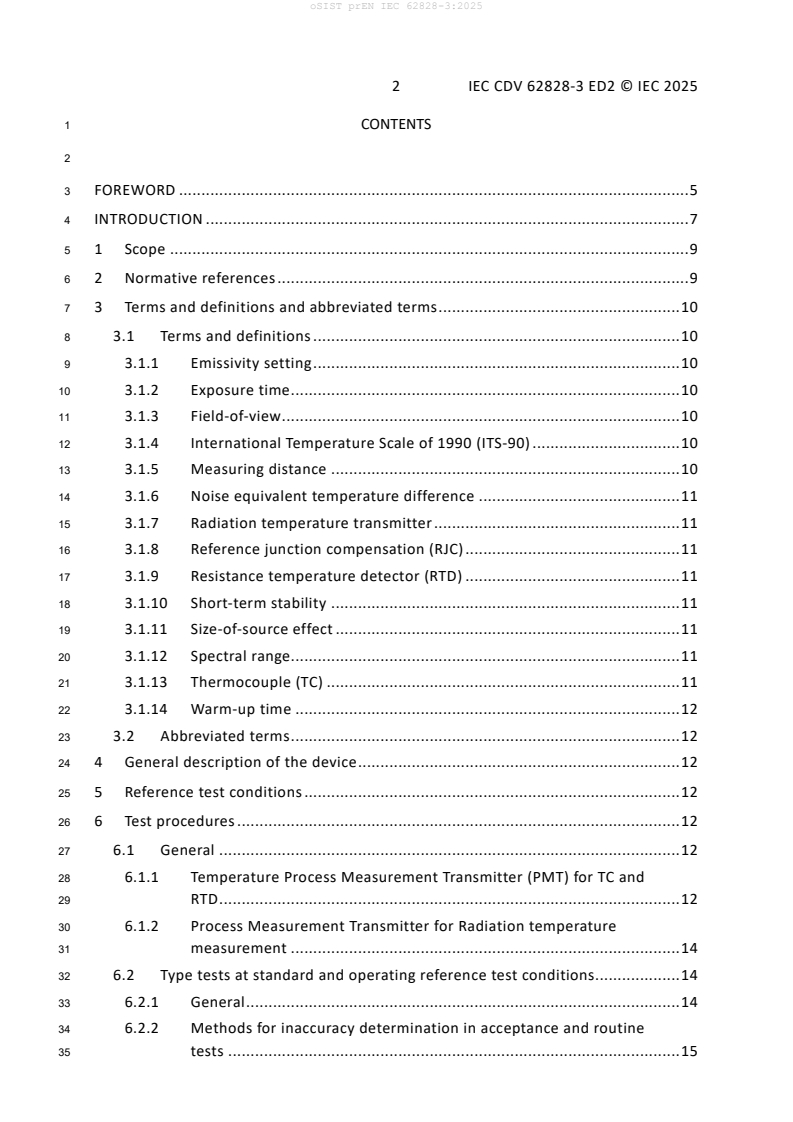
1 CONTENTS
3 FOREWORD . 5
4 INTRODUCTION . 7
5 1 Scope . 9
6 2 Normative references . 9
7 3 Terms and definitions and abbreviated terms . 10
8 3.1 Terms and definitions . 10
9 3.1.1 Emissivity setting . 10
10 3.1.2 Exposure time . 10
11 3.1.3 Field-of-view . 10
12 3.1.4 International Temperature Scale of 1990 (ITS-90) . 10
13 3.1.5 Measuring distance . 10
14 3.1.6 Noise equivalent temperature difference . 11
15 3.1.7 Radiation temperature transmitter . 11
16 3.1.8 Reference junction compensation (RJC) . 11
17 3.1.9 Resistance temperature detector (RTD) . 11
18 3.1.10 Short-term stability . 11
19 3.1.11 Size-of-source effect . 11
20 3.1.12 Spectral range. 11
21 3.1.13 Thermocouple (TC) . 11
22 3.1.14 Warm-up time . 12
23 3.2 Abbreviated terms . 12
24 4 General description of the device . 12
25 5 Reference test conditions . 12
26 6 Test procedures . 12
27 6.1 General . 12
28 6.1.1 Temperature Process Measurement Transmitter (PMT) for TC and
29 RTD . 12
30 6.1.2 Process Measurement Transmitter for Radiation temperature
31 measurement . 14
32 6.2 Type tests at standard and operating reference test conditions . 14
33 6.2.1 General . 14
34 6.2.2 Methods for inaccuracy determination in acceptance and routine
35 tests . 15
IEC CDV 62828-3 ED2 © IEC 2025 3
36 6.2.3 Specific test procedures for radiation temperature transmitter . 16
37 7 Test report . 20
38 7.1 General . 20
39 7.2 Total probable error (TPE) . 20
40 Annex A . 21
41 A.1 Temperature PMT (Contact thermometers) . 21
42 A.2 Temperature PMT (Radiation temperature transmitter) . 21
43 Annex B . 23
44 B.1 Properties of temperature transmitter classes . 23
45 B.1.1 Contact temperature transmitter . 23
46 B.1.2 Radiation (Non-contact) temperature transmitter . 25
47 Annex C . 27
48 C.1 Determination of the Inaccuracy . 27
49 C.2 Determination of the Noise equivalent temperature difference (NETD) . 27
50 C.3 Field-of-view (target size) . 28
51 C.4 Determination of the Size-of-Source-Effect (SSE) . 28
52 C.5 Influence of the internal instrument or ambient temperature
53 (temperature parameter) . 29
54 C.6 Short-term stability . 30
55 C.7 Exposure time . 31
56 C.8 Warm-Up time . 32
57 Annex D . 34
58 Bibliography . 36
60 Figure 1 Schematic example of test set-up for temperature measurement
61 transmitters . 13
62 Figure 2 Examples of terminals connection for RTD and TC . 13
63 Figure 3 Schematic example of a test set-up for radiation temperature
64 transmitters . 14
65 Figure 4 Example of measured error plot . 16
66 Figure 5 Relative signal to a signal at a defined aperture size (source size) of
67 100 mm in diameter for two infrared radiation temperature transmitters A and
68 B versus the source diameter . 17
69 Figure 6 Demonstration of the exposure time . 19
4 IEC CDV 62828-3 ED2 © IEC 2025
70 Figure 7 Possible arrangement for determining the exposure time with two
71 reference sources . 32
72 Figure 8 Example of warm-up time . 33
IEC CDV 62828-3 ED2 © IEC 2025 5
75 INTERNATIONAL ELECTROTECHNICAL COMMISSION
76 ____________
78 REFERENCE CONDITIONS AND PROCEDURES FOR TESTING
79 INDUSTRIAL AND PROCESS MEASUREMENT TRANSMITTERS
80 Part 3: Specific procedures for temperature transmitters
83 FOREWORD
84 1) The International Electrotechnical Commission (IEC) is a worldwide organization for standardization comprising all national
85 electrotechnical committees (IEC National Committees). The object of IEC is to promote international co-operation on all
86 questions concerning standardization in the electrical and electronic fields. To this end and in addition to other activities,
87 IEC publishes International Standards, Technical Specifications, Technical Reports, Publicly Available Specifications (PAS)
88 and Guides (hereafter referred to as “IEC Publication(s)”). Their preparation is entrusted to technical committees; any IEC
89 National Committee interested in the subject dealt with may participate in this preparatory work. International,
90 governmental and non-governmental organizations liaising with the IEC also participate in this preparation. IEC
91 collaborates closely with the International Organization for Standardization (ISO) in accordance with conditions
92 determined by agreement between the two organizations.
93 2) The formal decisions or agreements of IEC on technical matters express, as nearly as possible, an international consensus
94 of opinion on the relevant subjects since each technical committee has representation from all interested IEC National
95 Committees.
96 3) IEC Publications have the form of recommendations for international use and are accepted by IEC National Committees in
97 that sense. While all reasonable efforts are made to ensure that the technical content of IEC Publications is accurate, IEC
98 cannot be held responsible for the way in which they are used or for any misinterpretation by any end user.
99 4) In order to promote international uniformity, IEC National Committees undertake to apply IEC Publications transparently
100 to the maximum extent possible in their national and regional publications. Any divergence between any IEC Publication
101 and the corresponding national or regional publication shall be clearly indicated in the latter.
102 5) IEC itself does not provide any attestation of conformity. Independent certification bodies provide conformity assessment
103 services and, in some areas, access to IEC marks of conformity. IEC is not responsible for any services carried out by
104 independent certification bodies.
105 6) All users should ensure that they have the latest edition of this publication.
106 7) No liability shall attach to IEC or its directors, employees, servants or agents including individual experts and members of
107 its technical committees and IEC National Committees for any personal injury, property damage or other damage of any
108 nature whatsoever, whether direct or indirect, or for costs (including legal fees) and expenses arising out of the
109 publication, use of, or reliance upon, this IEC Publication or any other IEC Publications.
110 8) Attention is drawn to the Normative references cited in this publication. Use of the referenced publications is
111 indispensable for the correct application of this publication.
112 9) Attention is drawn to the possibility that some of the elements of this IEC Publication may be the subject of patent rights.
113 IEC shall not be held responsible for identifying any or all such patent rights.
114 IEC 62828-3 has been prepared by subcommittee 65B: Measurement and control devices, of IEC
115 Technical Committee 65: Industrial-process measurement, control and automation. It is an
116 International Standard.
117 This 62828-3 edition cancels and replaces the 62828-3 edition published in 2018.
118 The IEC 62828 series cancels and replaces the IEC 60770 series and proposes revisions for the IEC 61298
119 series.
120 In IEC 61298, all parts related to PMT’s will be deleted, leaving all the requirements regarding all
121 devices but PMT’s.
6 IEC CDV 62828-3 ED2 © IEC 2025
122 The text of this International Standard is based on the following documents:
Draft Report on voting
65B/1110A/FDIS 65B/1114/RVD
124 Full information on the voting for its approval can be found in the report on voting indicated in the
125 above table.
126 The language used for the development of this International Standard is English.
127 This document was drafted in accordance with ISO/IEC Directives, Part 2, and developed in accordance
128 with ISO/IEC Directives, Part 1 and ISO/IEC Directives, IEC Supplement, available at
129 www.iec.ch/members_experts/refdocs. The main document types developed by IEC are described in
130 greater detail at www.iec.ch/publications.
131 A list of all parts in the IEC 62828 series, published under the general title Reference conditions and
132 procedures for testing industrial and process measurement transmitters, can be found on the IEC
133 website.
134 The committee has decided that the contents of this document will remain unchanged until the stability
135 date indicated on the IEC website under webstore.iec.ch in the data related to the specific document.
136 At this date, the document will be
137 • reconfirmed,
138 • withdrawn,
139 • replaced by a revised edition, or
140 • amended.
IEC CDV 62828-3 ED2 © IEC 2025 7
145 INTRODUCTION
146 The introduction is an optional/conditional element of the text.
147 For rules on the drafting of the introduction, refer to the ISO/IEC Directives, Part
148 2:2021, Clause 13.
149 If patent rights have been identified, register the relevant declarations in the IEC
150 patents database (https://patents.iec.ch) and include the notice below in the
151 introduction. If the document is not affected by patent declarations, delete the
152 text below.
153 For rules on patents, see ISO/IEC Directives, Part 1.
154 The International Electrotechnical Commission (IEC) draws attention to the fact that it is claimed
155 that compliance with this document may involve the use of a patent. IEC takes no position
156 concerning the evidence, validity, and scope of this patent right.
157 The holder of this patent right has assured IEC that s/he is willing to negotiate licences under
158 reasonable and non-discriminatory terms and conditions with applicants throughout the world.
159 In this respect, the statement of the holder of this patent right is registered with IEC. Information
160 may be obtained from the patent database available at patents.iec.ch/.
161 Attention is drawn to the possibility that some of the elements of this document may be the
162 subject of patent rights other than those in the patent database. IEC shall not be held
163 responsible for identifying any or all such patent rights.
164 Most of the current IEC standards on industrial and process measurement transmitters are
165 rather old and were developed having in mind devices based on analogue technologies. Many
166 industrial and process measurement transmitters are meanwhile evolved and are quite different
167 from those analogue transmitters: they are often digital and include more functions and newer
168 interfaces, both towards the computing section (mostly digital electronic) and towards the
169 measuring section (mostly mechanical). Even if some standards dealing with digital process
170 measurement transmitters already exist, they are not sufficient, since some aspects of the
171 performance are not covered by appropriate test methods.
172 In addition, existing IEC test standards for industrial and process measurement transmitters are
173 spread over many documents, so that for manufacturers and users it is difficult, impractical and
174 time-consuming to identify and select all the standards to be applied to a device measuring a
175 specific process quantity (pressure, temperature, flow, level, etc.).
176 To help manufacturers and users, it was decided to review, complete and reorganize the
177 relevant IEC standards and to create a more suitable, effective and comprehensive standard
178 series that provides in a systematic way all specifications and tests required for different
179 industrial and process measurement transmitters.
180 To solve the issues mentioned above and to provide an added value for the stakeholders, the
181 new standard series on industrial and process measurement transmitters covers the following
182 main aspects:
183 • applicable normative references;
184 • specific terms and definitions;
185 • typical configurations and architectures for the various types of industrial and process
186 measurement transmitters;
8 IEC CDV 62828-3 ED2 © IEC 2025
187 • hardware and software aspects;
188 • interfaces (to the process, to the operator, to the other measurement and control devices);
189 • physical, mechanical and electrical requirements and relevant tests; clear definition of the
190 test categories: type tests, acceptance tests and routine tests;
191 • performance (its specification, tests and verification);
192 • environmental protection, hazardous areas application, functional safety, etc.;
193 • structure of the test report and of the technical documentation.
194 To cover in a systematic way all the topics to be addressed, the standard series is organized in
195 several parts. At the moment of the publication of this document, the IEC 62828 series consists
196 of the following parts:
197 • IEC 62828-1: General procedures for all types of transmitters
198 • IEC 62828-2: Specific procedures for pressure transmitters
199 • IEC 62828-3: Specific procedures for temperature transmitters
200 • IEC 62828-4: Specific procedures for level transmitters
201 • IEC 62828-5: Specific procedures for flow transmitters
202 In preparing the IEC 62828 series many test procedures were taken, with the necessary
203 improvements, from the IEC 61298 series. As the actual IEC 61298 series is applicable to all
204 process measurement and control devices, when the IEC 62828 series is completed the
205 IEC 61298 series will be revised to harmonise it with the IEC 62828 series, taking out from its
206 scope the industrial and process measurement transmitters. During the time when 61298 scope
207 is being updated, the new series IEC 62828 takes precedence for industrial and process
208 measurement transmitters.
209 When the IEC 62828 series is published, the IEC 60770 series will be withdrawn.
IEC CDV 62828-3 ED2 © IEC 2025 9
211 REFERENCE CONDITIONS AND PROCEDURES FOR TESTING
212 INDUSTRIAL AND PROCESS MEASUREMENT TRANSMITTERS
214 Part 3: Specific procedures for temperature transmitters
215 1 Scope
216 This part of IEC 62828 establishes specific procedures for testing temperature transmitters
217 used in measuring and control systems for industrial process and for machinery control
218 systems.
219 When the process measurement transmitter features the temperature transmitter separated
220 from the sensing element (RTD, TC, etc.), the standard applies only to the temperature
221 transmitter without the sensing element. In case of devices where the sensing element is fully
222 integrated with the temperature transmitter, the standard applies to the complete device.
223 The sensing element itself (e.g., RTD, TC, etc.) is excluded from the scope of this document.
224 Radiation temperature transmitters are different in the type of measuring method and most often
225 include the sensing element. Therefore, additional requirements and test procedures are
226 defined for them within this standard.
227 For general test procedures, reference is made to IEC 62828-1, which is applicable to all types
228 of industrial and process measurement transmitters (PMT).
229 NOTE 1: In the industrial and process applications, to indicate the process measurement transmitters, it is common also to
230 use the terms “industrial transmitters”, or “process transmitters”.
231 NOTE 2: Infrared ear thermometers are not in the scope of this document
232 2 Normative references
233 The following documents are referred to in the text in such a way that some or all of their content
234 constitutes requirements of this document. For dated references, only the edition cited applies.
235 For undated references, the latest edition of the referenced document (including any
236 amendments) applies.
237 IEC 62828-1:2017, Reference conditions and procedures for testing industrial and process
238 measurement transmitters – Part 1: General procedures for all types of transmitters
239 IEC TS 62492-1:2008, Industrial process control devices – Radiation temperature transmitters
240 – Part 1: Technical data for radiation temperature transmitters
241 IEC TS 62492-2:2013, Industrial process control devices – Radiation temperature transmitters
242 – Part 2: Determination of the technical data for radiation temperature transmitters
243 IEC 60751:2015, Industrial platinum resistance thermometers and platinum temperature
244 sensors
245 IEC 62460:2008, Temperature – Electromotive force (EMF) tables for pure-element
246 thermocouple combinations
247 IEC 60584-1:2013, Thermocouples – Part 1: EMF specifications and tolerances
248 IEC 60584-3:2020, Thermocouples – Part 3: Extension and compensating cables – Tolerances
249 and identification system
10 IEC CDV 62828-3 ED2 © IEC 2025
251 3 Terms and definitions and abbreviated terms
252 3.1 Terms and definitions
253 For the purposes of this document, the following terms and definitions apply.
254 ISO and IEC maintain terminology databases for use in standardization at the following
255 addresses:
256 • IEC Electropedia: available at https://www.electropedia.org/
257 • ISO Online browsing platform: available at https://www.iso.org/obp
258 3.1.1 Emissivity setting
259 set value of the parameter emissivity in a radiation temperature transmitter
260 [SOURCE: IEC 61987 #ABF221]
261 NOTE 1 In most measuring situations a radiation temperature transmitter is used on a surface with an emissivity significantly
262 lower than 1. For this purpose, most thermometers have the possibility of adjusting the emissivity setting. The temperature
263 reading is then automatically corrected.
264 3.1.2 Exposure time
265 time interval an abrupt change in the value of the input parameter (object temperature or object
266 radiation) has to be present, such that the output value of the radiation temperature transmitter
267 reaches a given measurement value
268 [SOURCE: IEC 61987 #ABF233]
269 3.1.3 Field-of-view
270 diameter or diagonal of the flat surface of a measured object from which a radiation thermometer
271 receives radiation
272 [SOURCE: IEC 61987 #ABF231]
273 3.1.4 International Temperature Scale of 1990 (ITS-90)
274 temperature scale adopted by the International Committee on Weights and Measures (CIPM)
275 in 1989 for the purpose of practical measurements
276 NOTE 1 Although thermodynamic temperature is different from Celsius or Kelvin defined by ITS-90, the quantities
277 corresponding to thermodynamic temperature and Celsius temperature defined by this scale are denoted T and t ,
90 90
278 respectively, where t = T – T with T = 273,15 K.
90 90 0 0
279 NOTE 2 The units for T and t are the Kelvin, symbol K, and the degree Celsius, symbol °C, respectively.
90 90
280 [SOURCE: IEC 60050-113:2011, 113-04-18]
281 3.1.5 Measuring distance
282 distance or distance range between the radiation temperature transmitter and the target
283 (measured object) for which the radiation temperature transmitter is or has to be designed
IEC CDV 62828-3 ED2 © IEC 2025 11
284 [SOURCE: IEC 61987 #ABF230 (modified – “distance range” added)]
285 3.1.6 Noise equivalent temperature difference
286 parameter which indicates the contribution of the measurement uncertainty in Kelvin, which is
287 due to instrument noise
288 [SOURCE: IEC 61987 #ABF227 (modified)]
289 3.1.7 Radiation temperature transmitter
290 non-contact temperature transmitter that calculates the temperature based on the radiation
291 emitted by an object over one or more given spectral ranges
292 [SOURCE: IEC 61987 #ABA836, modified - “infrared” deleted]
293 3.1.8 Reference junction compensation (RJC)
294 suitable automatic system to compensate the thermocouple EMF to 0 °C
295 3.1.9 Resistance temperature detector (RTD)
296 temperature sensor containing a sensing element made of platinum or other metals whose
297 resistance changes with temperature
298 NOTE 1 Resistance thermometers are often called RTDs.
299 NOTE 2 A platinum resistance thermometer (PRT) is an RTD that has a sensing element made of platinum; other common RTDs
300 are nickel resistance thermometers (NRT) and copper resistance thermometers (CRT), with the sensing element made of nickel
301 or copper respectively.
302 [SOURCE: IEC 62465:2010, 3.20, modified – The notes have been added.]
303 3.1.10 Short-term stability
304 reproducibility of measurements repeated over a short time period (several hours)
305 [SOURCE: IEC 61987 #ABF311]
306 3.1.11 Size-of-source effect
307 relative difference in the radiance or temperature reading of the radiation temperature
308 transmitter when the size of the radiating area of the observed source is changed
309 [SOURCE: IEC 61987 #ABF229]
310 3.1.12 Spectral range
311 range of wavelength used to measure temperature
312 [SOURCE: IEC 61987 #ABF239]
313 3.1.13 Thermocouple (TC)
314 pair of conductors of dissimilar materials joined at one end and forming part of an arrangement
315 using the thermoelectric effect for temperature measurement
12 IEC CDV 62828-3 ED2 © IEC 2025
316 NOTE 1 The production of an electromotive force (EMF) due to a temperature gradient along a conductor is called
317 thermoelectric effect (or Seebeck effect).
318 [SOURCE: IEC 60584-1:2013, 2.3, modified – The abbreviation and notes have been
319 added.]
320 3.1.14 Warm-up time
321 duration between the instant when the power supply is energized and the instant when the
322 instrument can be used, as specified by the documentation.
323 [SOURCE: IEC 61987 #ABB026]
324 3.2 Abbreviated terms
325 GUM ISO/IEC Guide to the expression of Uncertainty in Measurement
326 ITS International Temperature Scale
327 NETD Noise Equivalent Temperature Difference
328 RJC Reference Junction Compensation
329 RTD Resistance Temperature Detector
330 SSE Size-of-Source Effect
331 TC Thermocouple
332 4 General description of the device
333 The general description outlined in Clause 4 and Annex A of IEC 62828-1:2017 is applicable.
334 In Annex A of this document, some additional information is only given regarding the measuring
335 section of a temperature industrial and process measurement transmitter (temperature PMT).
336 5 Reference test conditions
337 To verify the influence of external quantities on accuracy, as well as the mechanical and
338 electrical conditions which a device can withstand and still work within specification, the
339 corresponding clause of IEC 62828-1 applies, both for standard reference test conditions and
340 for operating reference test conditions.
341 6 Test procedures
342 6.1 General
343 Clause 6 of IEC 62828-1:2017 applies, with the following additional requirements.
344 6.1.1 Temperature Process Measurement Transmitter (PMT) for TC and RTD
345 The general schematic test set-up for a typical temperature PMT for TC and RTD is reported in
346 Figure 1
347 NOTE 1 Annex A provides information on the several typologies of typical temperature transmitters.
IEC CDV 62828-3 ED2 © IEC 2025 13
Optional wireless
Power supply
TC CJC
output signal or
(internal or
display
external)
Standard source PMT Analogue or digital
generator for RTD under output signal
Input
Output
and TC test
terminal
terminal
IEC
350 Figure 1 Schematic example of test set-up for temperature measurement transmitters
351 NOTE 2 The test source generator for RTD is a decade resistance standard or a multifunction temperature calibrator.
352 NOTE 3 The test source generator for TC is a voltage generator or a multifunction temperature calibrator.
353 NOTE 4 To compensate the TC signal for the reference temperature of 0 °C, Reference Junction Compensation RJC may be
354 used for TC transmitters.
355 NOTE 5 In case of temperature sensing element fully integrated into the temperature PMT, a reference temperature is used.
356 NOTE 6 The optional digital output signal is provided for smart and intelligent transmitters and is detected by handheld or
357 PC communicator (configurator).
358 Figure 2 shows an example of terminal connections for a generic temperature PMT. In this
359 figure, the supply and the output terminals (+, -) are on the upper side, and the input connections
360 to the RTD or TC sensors (1, 2, 3, 4) are on the lower side.
361 For testing, the RTD and TC shall be replaced by the relevant test source generator.
+ -
+ -
2 4 3 1
2 4 3 1
RTD
IEC
IEC
Two wire connection Positive
Option for third wire connection Negative
Option for fourth wire connection
a) Connection example for RTD b) Connection example for TC
363 Figure 2 Examples of terminals connection for RTD and TC
364 NOTE 7 The RTD can be simulated as a two, three or four-wire connection. For platinum RTD, more details are given in
365 IEC 60751.
14 IEC CDV 62828-3 ED2 © IEC 2025
366 NOTE 8 The TC is simulated using specific extension or compensating cables. More details are given in IEC 60584-1 and
367 IEC 60584-3.
368 For specifications and tolerances of temperature sensors used with temperature PMTs, see:
369 • IEC 60584-1:2013 and IEC 62460:2008 for TC sensors;
370 • IEC 60751:2015 for RTD sensors.
371 6.1.2 Process Measurement Transmitter for Radiation temperature measurement
372 A general PMT setup for Radiation temperature transmitter is shown in Figure 3:
Optional wireless
Power supply
output signal or
(internal or
display
external)
PMT
Reference Analogue or digital
under
source output signal
Input
Output
test
terminal
terminal
IEC
374 Figure 3 Schematic example of a test set-up for radiation temperature transmitters
375 For all Radiation temperature transmitter with included sensing element:
376 The sensing element of a radiation temperature transmitter is most often a spectral sensitive,
377 optical device.
378 NOTE 1 The reference temperature source is a radiation source of known radiation temperature in the spectral range of the
379 radiation temperature transmitter. Usually, it is a blackbody source realized by a cavity radiator of known temperature. It will
380 be called “reference source” throughout this document. The reference source should be of such quality that the reference
381 source is not the source of the error for the measured parameter.
382 6.2 Type tests at standard and operating reference test conditions
383 6.2.1 General
384 For most of the tests, the corresponding clause of Part 1 applies, in particular see:
385 • Annex B in IEC 62828-1:2017 for the summary of the tests at standard reference conditions.
386 • Annex C in IEC 62828-1:2017 for the summary of the tests at operating reference
387 conditions.
388 The tests for RTD and TC are conducted on a test set-up similar to the one shown schematically
389 in Figure 1.
390 For radiation temperature transmitter all tests should be conducted on a test set-up similar to
391 the one shown schematically in Figure 3. If not otherwise stated, for all tests of a radiation
392 temperature transmitter should be taken by recording at least 10 values over a time of 10 times
393 the step-response-time.
394 Additionally for radiation temperature transmitter the following conditions apply for all
395 measurements, if not stated otherwise:
396 • Any special ambient conditions (e.g. humidity range, maximum ambient temperature change
397 per time) and measurement conditions (e.g. measuring distance, radiating area diameter,
398 response time) given by the documentation for the specific radiation temperature transmitter
399 to be adhered to
IEC CDV 62828-3 ED2 © IEC 2025 15
400 • Internal standardization check (initial self-test) to be carried out, if available
401 • Emissivity setting set to 1 (one), if available.
402 • The reference temperature source shall have a radiating area diameter as large as possible
403 and in any case greater than the radiation temperature transmitter field of view (target area)
404 diameter.
405 • All tests have to be performed with the reference temperature source set to a temperature
406 that is significantly different from ambient temperature and the internal temperature of the
407 radiation temperature transmitter.
408 The test source generator (in case of sensing element not integrated into the temperature PMT)
409 or the reference temperature (in case of sensing element fully integrated into the temperature
410 PMT) needed to stimulate the response of the device under test shall have characteristics and
411 performances suitable to the tests required.
412 In addition to the error due to the sensing element, the process measurement transmitter shall
413 not introduce an additional error greater than 50 % of the error relevant to the pertinent
414 tolerance class of the sensing element.
415 The following specific tests for temperature transmitters shall be performed in addition.
416 6.2.2 Methods for inaccuracy determination in acceptance and routine tests
417 6.2.2.1 General
418 The input-output characteristic shall be measured under reference conditions in one
419 measurement cycle, typically in only one full range direction traversing, either increasing or
420 decreasing, because temperature transmitters do typically not anticipate nor compensate
421 hysteresis phenomena. If the sensing element is integrated (e.g. with radiation temperature
422 transmitters) and introduces a hysteresis phenomenon, a two cycle measurement (up and
423 down) shall be performed.
424 For this, at least five points of measurement shall be evenly distributed over the range; they
425 shall include points at or near (within 10 % of span) the 0 % and 100 % values of the span.
426 6.2.2.2 Measurement procedure
427 The test shall be performed in the following way. Initially, an input signal equal to the lower
428 range value is generated and the value of the corresponding input and output signal is noted.
429 Then the input signal is slowly (the rate of change depends on the PMT) increased to reach
430 without overshoot the first test point. After a sufficient stabilization period (e.g. reaching a
431 steady state), the value of the corresponding input and output signal is noted. The operation is
432 repeated for all the predetermined values up to 100 % of the input span.
433 If the sensing element is included in the PMT, it is suitable to change the calibration source
434 instead of increasing the signal. The corresponding input and output value is noted after a
435 sufficient stabilization period.
436 6.2.2.3 Data analysis
437 Applying 6.2.2.1 and 6.2.2.2, the difference between the output signal values obtained at each
438 test point and the corresponding true values are recorded as measured errors. The measured
439 errors shall be expressed as percent of the nominal output span or better in the engineering
440 unit °C or K.
441 All measured errors can be shown in a tabular form (see Table 1) and presented graphically
442 (see Figure 4).
16 IEC CDV 62828-3 ED2 © IEC 2025
443 From Table 1, the maximum measured error found is -0,10 °C at 80 °C of output.
444 Table 1 Example of measured errors
Input (°C) 0 20 40 60 80 100
Output (°C) 0,00 20,03 39,98 59,91 79,90 100,05
Maximum measured error (°C) 0,00 0,03 –0,02 –0,09 –0,10 0,05
0,15
0,1
0,05
0 10 20 30 40 50 60 70 80 90 100
Maximum
–0,05
measured error
–0,1
–0,15
Output (°C)
IEC
447 Figure 4 Example of measured error plot
448 6.2.3 Specific test procedures for radiation temperature transmitter
449 Because most of the radiation temperature transmitters have the sensing element included the
450 following test procedures should be additionally taken.
451 NOTE 1: Those test procedures were largely taken from the IEC TS 62492-2 and slightly adapted.
452 6.2.3.1 Inaccuracy determination
453 A detailed description of the different methods to determine the inaccuracy is beyond the scope
454 of this standard. ln this standard terms, concept and definition of uncertainty is based on
455 ISO/lEC Guide 98-3 (GUM) and ISO/lEC Guide 99.
456 The method described in C.1 is a basic test of the inaccuracy across the measuring temperature
457 range.
458 6.2.3.2 Noise equivalent temperature difference (NETD)
459 The purpose of this method described in C.2 is to determine the NETD. The measured
460 temperature and the response time of the radiation temperature transmitter are to be stated
461 with the NETD. For some instruments the NETD depends on the instrument or ambient
462 temperature. For these instruments the instrument or ambient temperature also has to be
463 stated. For low-cost instruments the NETD may be limited by their resolution.
464 The NETD is generally largest at the lowest temperature of the measuring temperature range.
465 When using electronic measuring equipment, its bandwidth shall be noted or set accordingly,
466 ln particular, the bandwidth of the radiation temperature transmitter shall not be limited by the
467 bandwidth of the external measuring equipment. ln contrast to the other metrological data, the
468 confidence level in this case is 68,3 % (standard uncertainty, k = 1).
Error (°C)
IEC CDV 62828-3 ED2 © IEC 2025 17
469 6.2.3.3 Measuring distance
470 For this distance or distance range the specifications are valid, if not stated otherwise. No
471 specific test method is needed.
472 NOTE 1 The calibration of a radiation temperature transmitter, with respect to a reference source of the same area, gives
473 different results at different distances due to the SSE of the instrument.
474 6.2.3.4 Field-of-view (target size)
475 Its magnitude is determined by the optical components in the radiation temperature transmitter.
476 As the field-of-view is not sharply defined, it is necessary to state the diameter of the field-of-
477 view at which the radiation signal has dropped to a certain fraction of its total integrated value
478 (hemispherical value or the value for an infinitely extended source). The fraction value should
479 be at least 90 %; typical values are 90 %,95 % and 99 %.
480 For some radiation temperature transmitters, especially for high temperature instruments, it is
481 impracticable to relate the field-of-view to a hemispherical value. ln this case it is allowed to
482 relate the given field-of-view to a larger source (e.g. twice as large in area as the field-of-view).
483 As the field-of-view value depends on the measuring distance, it is necessary to state the
484 measuring distance in addition to the fraction.
485 The transfer function between the measured radiation (input parameter) and temperature
486 (output parameter) is non-linear. As an example, the change in indicated temperature
487 corresponding to a 1% change in the radiation exchange with a radiation temperature
488 transmitter is given in Annex D. The field-of-view is therefore either defined for the fraction of
489 measured radiation or, for instruments which only read directly in temperature, it is necessary
490 to specify a change in the measured temperature in °C at a given temperature for the field-of-
491 view in comparison to the total integrated value (hemispherical value or the value for an infinitely
492 extended source). As a minimum, these values should be given for the top, middle and bottom
493 of the temperature range.
494 The complete field-of-view information would be a graph (see Figure 5), which shows the signal
495 or temperature versus source size (size-of-source effect).
497 Figure 5 Relative signal to a signal at a defined aperture size (source size) of 100 mm in
498 diameter for two infrared radiation temperature transmitters A and B versus the source
499 diameter
500 Explanation of Figure 5: The field-of-view diameter (target diameter) is stated as 1
...
Questions, Comments and Discussion
Ask us and Technical Secretary will try to provide an answer. You can facilitate discussion about the standard in here.
Loading comments...