


EN 55011:2009
(Main)Industrial, scientific and medical equipment - Radio-frequency disturbance characteristics - Limits and methods of measurement
General Information
- Abstract
Includes FprAA:2009 (pr=21593)
- Status
- Withdrawn
- Publication Date
- 22-Nov-2009
- Withdrawal Date
- 31-Aug-2012
- Technical Committee
- CLC/TC 210 - Electromagnetic Compatibility (EMC)
- Current Stage
- 9960 - Withdrawal effective - Withdrawal
- Start Date
- 15-Feb-2019
- Completion Date
- 15-Feb-2019
- Directive
- Not Harmonized2004/108/EC - Directive 2004/108/EC of the European Parliament and of the Council of 15 December 2004 on the approximation of the laws of the Member States relating to electromagnetic compatibility and repealing Directive 89/336/EECOJ Ref: C 53/, C 53/04 OJ Date: 25-Feb-2014
Not Harmonized2004/108/EU - DIRECTIVE 2004/108/EC OF THE EUROPEAN PARLIAMENT AND OF THE COUNCIL of 15 December 2004 on the approximation of the laws of the Member States relating to electromagnetic compatibility and repealing Directive 89/336/EECOJ Ref: C 306/01 OJ Date: 25-Feb-2014
Harmonized Standard2014/30/EU - Directive 2014/30/EU of the European Parliament and of the Council of 26 February 2014 on the harmonisation of the laws of the Member States relating to electromagnetic compatibility (recast)OJ Ref: C, C 173 OJ Date: 13-May-2016
Not Harmonized89/336/EEC - Electromagnetic compatibility (EMC)

Relations
- Effective Date
- 29-Jan-2023
- Effective Date
- 29-Jan-2023
- Effective Date
- 29-Jan-2023
- Effective Date
- 20-Feb-2026
- Effective Date
- 10-Feb-2026
- Effective Date
- 09-Feb-2026
- Effective Date
- 09-Feb-2026
- Effective Date
- 09-Feb-2026
- Effective Date
- 03-Feb-2026
- Refers
EN 60974-10:2007 - Arc welding equipment - Part 10: Electromagnetic compatibility (EMC) requirements - Effective Date
- 03-Feb-2026
- Effective Date
- 03-Feb-2026
- Effective Date
- 03-Feb-2026
- Effective Date
- 03-Feb-2026
- Effective Date
- 03-Feb-2026
- Effective Date
- 03-Feb-2026
Get Certified
Connect with accredited certification bodies for this standard

ANCE
Mexican certification and testing association.

Intertek Slovenia
Intertek testing, inspection, and certification services in Slovenia.

LNE (Laboratoire National de Métrologie et d'Essais)
French national laboratory for metrology and testing.
Sponsored listings
Frequently Asked Questions
EN 55011:2009 is a standard published by CLC. Its full title is "Industrial, scientific and medical equipment - Radio-frequency disturbance characteristics - Limits and methods of measurement". This standard covers: Includes FprAA:2009 (pr=21593)
Includes FprAA:2009 (pr=21593)
EN 55011:2009 is classified under the following ICS (International Classification for Standards) categories: 33.100.10 - Emission. The ICS classification helps identify the subject area and facilitates finding related standards.
EN 55011:2009 has the following relationships with other standards: It is inter standard links to EN 55011:2007/A2:2007, EN 55011:2007, EN 55011:2016, IEC 60050-161:1990/AMD1:1997, IEC 60050-161:1990/AMD2:1998, EN 13589:2003, EN ISO 12937:2000, EN ISO 15029-1:1999, EN 61307:2006, EN 60974-10:2007, EN 55016-1-4:2007, EN 60601-2-2:2009, EN 55016-1-2:2004/A2:2006, EN 62135-2:2008, EN 55016-1-1:2007. Understanding these relationships helps ensure you are using the most current and applicable version of the standard.
EN 55011:2009 is associated with the following European legislation: EU Directives/Regulations: 2004/108/EC, 2004/108/EU, 2014/30/EU, 89/336/EEC; Standardization Mandates: M/490. When a standard is cited in the Official Journal of the European Union, products manufactured in conformity with it benefit from a presumption of conformity with the essential requirements of the corresponding EU directive or regulation.
EN 55011:2009 is available in PDF format for immediate download after purchase. The document can be added to your cart and obtained through the secure checkout process. Digital delivery ensures instant access to the complete standard document.
Standards Content (Sample)
2003-01.Slovenski inštitut za standardizacijo. Razmnoževanje celote ali delov tega standarda ni dovoljeno.Industrielle, wissenschaftliche und medizinische Geräte - Funkstörungen - Grenzwerte und MessverfahrenAppareils industriels, scientifiques et médicaux - Caractéristiques des perturbations radioélectriques - Limites et méthodes de mesureIndustrial, scientific and medical equipment - Radio-frequency disturbance characteristics - Limits and methods of measurement33.100.10EmisijaEmissionICS:Ta slovenski standard je istoveten z:EN 55011:2009SIST EN 55011:2010en01-februar-2010SIST EN 55011:2010SLOVENSKI
STANDARDSIST EN 55011:20071DGRPHãþD
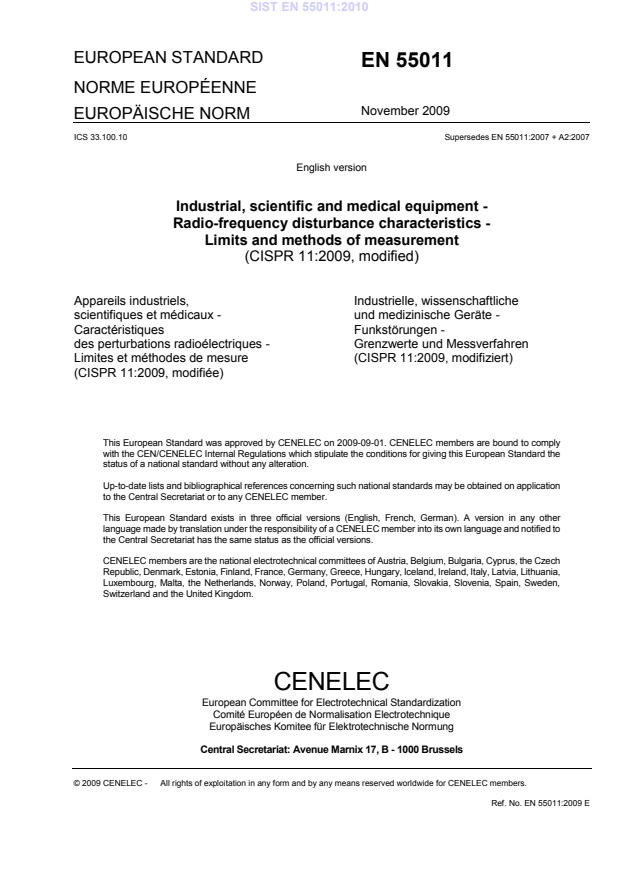
EUROPEAN STANDARD EN 55011 NORME EUROPÉENNE
EUROPÄISCHE NORM November 2009
CENELEC European Committee for Electrotechnical Standardization Comité Européen de Normalisation Electrotechnique Europäisches Komitee für Elektrotechnische Normung
Central Secretariat: Avenue Marnix 17, B - 1000 Brussels
© 2009 CENELEC -
All rights of exploitation in any form and by any means reserved worldwide for CENELEC members.
Ref. No. EN 55011:2009 E
ICS 33.100.10 Supersedes EN 55011:2007 + A2:2007
English version
Industrial, scientific and medical equipment -
Radio-frequency disturbance characteristics -
Limits and methods of measurement (CISPR 11:2009, modified)
Appareils industriels,
scientifiques et médicaux -
Caractéristiques
des perturbations radioélectriques -
Limites et méthodes de mesure (CISPR 11:2009, modifiée)
Industrielle, wissenschaftliche
und medizinische Geräte -
Funkstörungen -
Grenzwerte und Messverfahren
(CISPR 11:2009, modifiziert)
This European Standard was approved by CENELEC on 2009-09-01. CENELEC members are bound to comply with the CEN/CENELEC Internal Regulations which stipulate the conditions for giving this European Standard the status of a national standard without any alteration.
Up-to-date lists and bibliographical references concerning such national standards may be obtained on application to the Central Secretariat or to any CENELEC member.
This European Standard exists in three official versions (English, French, German). A version in any other language made by translation under the responsibility of a CENELEC member into its own language and notified to the Central Secretariat has the same status as the official versions.
CENELEC members are the national electrotechnical committees of Austria, Belgium, Bulgaria, Cyprus, the Czech Republic, Denmark, Estonia, Finland, France, Germany, Greece, Hungary, Iceland, Ireland, Italy, Latvia, Lithuania, Luxembourg, Malta, the Netherlands, Norway, Poland, Portugal, Romania, Slovakia, Slovenia, Spain, Sweden, Switzerland and the United Kingdom.
has to be implemented at national level by publication of an identical national standard or by endorsement
(dop)
2010-09-01 – latest date by which the national standards conflicting with the EN have to be withdrawn
(dow)
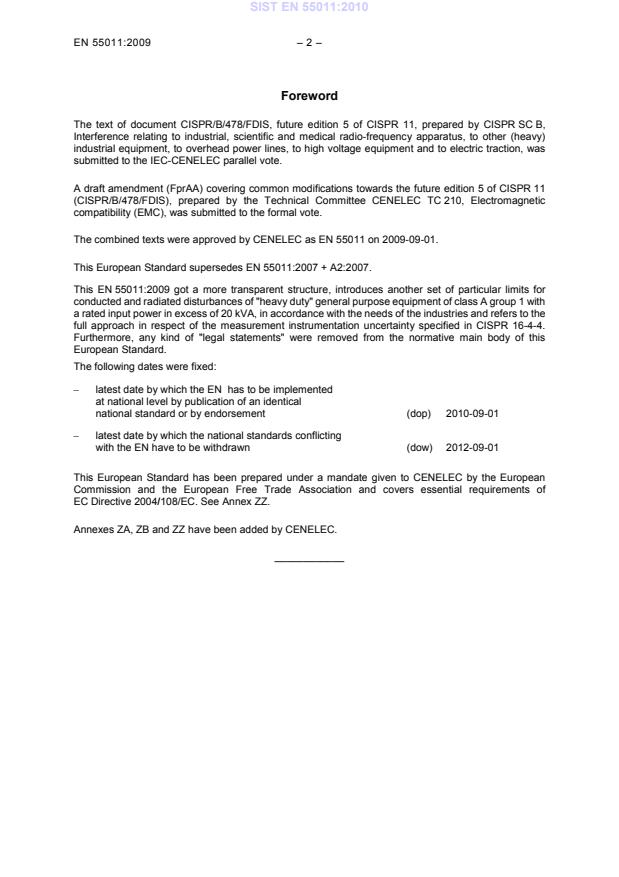
2012-09-01 This European Standard has been prepared under a mandate given to CENELEC by the European Commission and the European Free Trade Association and covers essential requirements of EC Directive 2004/108/EC. See Annex ZZ. Annexes ZA, ZB and ZZ have been added by CENELEC. ____________ SIST EN 55011:2010
– 3 – EN 55011:2009 The main content of this standard is based on CISPR Recommendation No. 39/2 given below: RECOMMENDATION No. 39/2 Limits and methods of measurement of electromagnetic disturbance characteristics
of industrial, scientific and medical (ISM) radio-frequency equipment The CISPR CONSIDERING a)
that ISM RF equipment is an important source of disturbance; b) that methods of measuring such disturbances have been prescribed by the CISPR; c)
that certain frequencies are designated by the International Telecommunication Union (ITU) for unrestricted radiation from ISM equipment, RECOMMENDS that the latest edition of EN 55011 be used for the application of limits and methods of measurement of ISM equipment. SIST EN 55011:2010
for use as fundamental ISM frequencies Centre frequency MHz Frequency range MHz Maximum radiation limit a Number of appropriate footnote to the table of frequency allocation of the ITU Radio Regulations b 6,780 6,765 – 6,795 Under consideration 5.138 13,560 13,553 – 13,567 Unrestricted 5.150 27,120 26,957 – 27,283 Unrestricted 5.150 40,680 40,66 – 40,70 Unrestricted 5.150 433,920 433,05 – 434,79 Under consideration 5.138 in Region 1, except countries mentioned in 5.280 915,000 902 – 928 Unrestricted 5.150 in Region 2 only 2 450 2 400 – 2 500 Unrestricted 5.150 5 800 5 725 – 5 875 Unrestricted 5.150 24 125 24 000 – 24 250 Unrestricted 5.150 61 250 61 000 – 61 500 Under consideration 5.138 122 500 122 000 – 123 000 Under consideration 5.138 245 000 244 000 – 246 000 Under consideration 5.138 a The term “unrestricted” applies to the fundamental and all other frequency components falling within the designated band. Outside of ITU designated ISM bands the limits for the disturbance voltage and radiation disturbance in this standard apply. b Resolution No. 63 of the ITU Radio Regulations applies. In some CENELEC countries different or additional frequencies may be designated for use with ISM RF applications in the meaning of the definition found in the ITU Radio Regulations, see definition 3.1. These frequencies are listed in Table ZB.1 (see Annex ZB). The limits for the disturbance voltage and radiation disturbance defined in this standard do also not apply to the fundamental ISM frequencies listed in Table ZB.1. If ISM RF applications use fundamental frequencies other than the ITU or nationally designated frequencies, then the limits for the disturbance voltage and radiation disturbance of this standard apply also to these fundamental frequencies. SIST EN 55011:2010
– 5 – EN 55011:2009 Bibliography In the official version, for Bibliography, the following notes have to be added for the standards indicated: CISPR 15 NOTE
Harmonized as EN 55015:2006 (not modified). IEC 60364-5-51 NOTE
Harmonized as HD 60364-5-51:2009 (modified). IEC 60705 NOTE
Harmonized as EN 60705:1999 (not modified). IEC 61308 NOTE
Harmonized as EN 61308:2006 (not modified). IEC 61689 NOTE
Harmonized as EN 61689:2007 (not modified). IEC 61922 NOTE
Harmonized as EN 61922:2002 (not modified).
(normative)
Normative references to international publications with their corresponding European publications
The following referenced documents are indispensable for the application of this document. For dated references, only the edition cited applies. For undated references, the latest edition of the referenced document (including any amendments) applies.
NOTE
When an international publication has been modified by common modifications, indicated by (mod), the relevant EN/HD applies.
Publication Year Title EN/HD Year
CISPR 16-1-1 A1 A2 2006 2006 2007 Specification for radio disturbance and immunity measuring apparatus and methods -Part 1-1: Radio disturbance and immunity measuring apparatus - Measuring apparatus EN 55016-1-1 A1 A2 2007 2007 2008
CISPR 16-1-2 A1 A2 2003 2004 2006 Specification for radio disturbance and immunity measuring apparatus and methods -Part 1-2: Radio disturbance and immunity measuring apparatus - Ancillary equipment - Conducted disturbances EN 55016-1-2 A1 A2 2004 2005 2006
CISPR 16-1-4 A1 A2 2007 2007 2008 Specification for radio disturbance and immunity measuring apparatus and methods -Part 1-4: Radio disturbance and immunity measuring apparatus - Ancillary equipment - Radiated disturbances EN 55016-1-4 A1 A2 2007 2008 2009
CISPR 16-2-3 2006 Specification for radio disturbance and immunity measuring apparatus and methods -Part 2-3: Methods of measurement of disturbances and immunity - Radiated disturbance measurements EN 55016-2-3 2006
CISPR 16-4-2 2003 Specification for radio disturbance and immunity measuring apparatus and methods -Part 4-2: Uncertainties, statistics and limit modelling - Uncertainty in EMC measurementsEN 55016-4-2 2004
IEC 60050-161 A1 A2 1990 1997 1998 International Electrotechnical Vocabulary
(IEV) -
Chapter 161: Electromagnetic compatibility – –
IEC 60601-1-2 (mod) 2007 Medical electrical equipment -
Part 1-2: General requirements for basic safetyand essential performance - Collateral standard: Electromagnetic compatibility - Requirements and tests EN 60601-1-2 2007
IEC 60601-2-2 2009 Medical electrical equipment -
Part 2-2: Particular requirements for basic safety and essential performance of high frequency surgical equipment and high frequency surgical accessories EN 60601-2-2 2009
IEC 60974-10 2007 Arc welding equipment -
Part 10: Electromagnetic compatibility (EMC) requirements EN 60974-10 2007
IEC 61307 2006 Industrial microwave heating installations - Test methods for the determination of power output EN 61307 2006
– 7 – EN 55011:2009 Publication Year Title EN/HD Year
IEC 62135-2 2007 Resistance welding equipment -
Part 2: Electromagnetic compatibility (EMC) requirements EN 62135-2 2008
ITU Radio Regulations 2008 Radio Regulations, Volume 3 - Resolutions and recommendations, resolution no. 63 - -
for use as fundamental ISM frequencies Table ZB.1 - Frequencies designated on a national basis in CENELEC countries
for use as fundamental ISM frequencies Frequency MHz Maximum radiation limit
Notes 0,009 - 0,010 83,996 - 84,004 167,992 - 168,008 886,000 - 906,000 Not limited Not limited Not limited Not limited Germany only United Kingdom only a United Kingdom only a United Kingdom only a a Radio communication services must accept harmful interference from ISM apparatus operating in accordance with the WT (Control of Interference from RF Heating Apparatus) Regulations 1971. The WT (Control of Interference from RF Heating Apparatus) Regulations 1971 specify the limits of levels of radiation permitted outside the ISM bands.
– 9 – EN 55011:2009 Annex ZZ (informative)
Coverage of Essential Requirements of EC Directives This European Standard has been prepared under a mandate given to CENELEC by the European Commission and the European Free Trade Association and within its scope the standard covers protection requirements as given in Article 1(a) of Annex I of the EC Directive 2004/108/EC. Compliance with this standard provides presumption of conformity with the specified essential requirements of the Directive concerned. WARNING: Other requirements and other EC Directives may be applicable to the products falling within the scope of this standard. ____________ SIST EN 55011:2010
CISPR 11Edition 5.0 2009-05INTERNATIONAL STANDARD NORME INTERNATIONALEIndustrial, scientific and medical equipment – Radio-frequency disturbance characteristics – Limits and methods of measurement
Appareils industriels, scientifiques et médicaux – Caractéristiques de perturbations radioélectriques – Limites et méthodes de mesure
INTERNATIONAL ELECTROTECHNICAL COMMISSION COMMISSION ELECTROTECHNIQUE INTERNATIONALE XAICS 33.100.10 PRICE CODECODE PRIXISBN 2-8318-1042-1INTERNATIONAL SPECIAL COMMITTEE ON RADIO INTERFERENCE COMITÉ INTERNATIONAL SPÉCIAL DES PERTURBATIONS RADIOÉLECTRIQUES ® Registered trademark of the International Electrotechnical Commission
– 2 – CISPR 11 © IEC:2009
CONTENTS FOREWORD.5 INTRODUCTION.8 1 Scope.9 2 Normative references.9 3 Terms and definitions.10 4 Frequencies designated for ISM use.11 5 Classification of ISM equipment.12 5.1 Information for the user.12 5.2 Separation into groups.12 5.3 Division into classes.12 6 Limits of electromagnetic disturbances.13 6.1 General.13 6.2 Group 1 equipment measured on a test site.13 6.2.1 Limits of terminal disturbance voltage.13 6.2.2 Limits of electromagnetic radiation disturbance.14 6.3 Group 2 equipment measured on a test site.16 6.3.1 Limits of terminal disturbance voltage.16 6.3.2 Limits of electromagnetic radiation disturbance.18 6.4 Group 1 and group 2 class A equipment measured in situ.24 6.4.1 Limits of terminal disturbance voltage.24 6.4.2 Limits of electromagnetic radiation disturbance.24 7 Measurement requirements.26 7.1 General.26 7.2 Ambient noise.26 7.3 Measuring equipment.26 7.3.1 Measuring instruments.26 7.3.2 Artificial mains network.27 7.3.3 Voltage probe.27 7.3.4 Antennas.27 7.3.5 Artificial hand.28 7.4 Frequency measurement.28 7.5 Configuration of equipment under test.28 7.5.1 General.28 7.5.2 Interconnecting cables.28 7.5.3 Connection to the electricity supply network on a test site.29 7.6 Load conditions of equipment under test.30 7.6.1 General.30 7.6.2 Medical equipment.30 7.6.3 Industrial equipment.31 7.6.4 Scientific, laboratory and measuring equipment.32 7.6.5 Microwave cooking appliances.32 7.6.6 Other equipment in the frequency range 1 GHz to 18 GHz.32 7.6.7 Single and multiple-zone induction cooking appliances.32 7.6.8 Electric welding equipment.33 7.7 Recording of test-site measurement results.33 7.7.1 General.33 SIST EN 55011:2010
CISPR 11 © IEC:2009 – 3 –
7.7.2 Conducted emissions.34 7.7.3 Radiated emissions.34 8 Special provisions for test site measurements (9 kHz to 1 GHz).34 8.1 Ground planes.34 8.2 Measurement of mains terminal disturbance voltage.34 8.2.1 General.34 8.2.2 Handheld equipment which are normally operated without an earth connection.35 8.3 Radiation test site for 9 kHz to 1 GHz.35 8.3.1 General.35 8.3.2 Validation of the radiation test site (9 kHz to 1 GHz).35 8.3.3 Disposition of equipment under test (9 kHz to 1 GHz).36 8.3.4 Radiation measurements (9 kHz to 1 GHz).36 8.4 Alternative radiation test sites for the frequency range 30 MHz to 1 GHz.36 9 Radiation measurements: 1 GHz to 18 GHz.36 9.1 Test arrangement.36 9.2 Receiving antenna.36 9.3 Validation and calibration of test site.37 9.4 Measuring procedure.37 10 Measurement in situ.37 11 Safety precautions.37 12 Assessment of conformity of equipment.37 12.1 General.37 12.2 Statistical assessment of compliance of series produced equipment.38 12.3 Equipment in small-scale production.38 12.4 Equipment produced on an individual basis.38 12.5 Measurement uncertainty.39 13 Figures and flowcharts.39 Annex A (informative)
Examples of equipment classification.42 Annex B (informative)
Precautions to be taken in the use
of a spectrum analyzer (see 7.3.1).44 Annex C (normative)
Measurement of electromagnetic radiation disturbance in the presence of signals from radio transmitters.45 Annex D (informative)
Propagation of interference from industrial radio-frequency equipment at frequencies between 30 MHz and 300 MHz.46 Annex E (informative)
Recommendations of CISPR for protection of certain
radio services in particular areas.47 Annex F (informative)
Frequency bands allocated for safety-related radio services.48 Annex G (informative)
Frequency bands allocated for sensitive radio services.49 Bibliography.50
Figure 1 – Test site.39 Figure 2 – Minimum size of metal ground plane.39 Figure 3 – Disposition of medical (capacitive type) and dummy load (see 7.6.2.1).40 Figure 4 – Circuit for disturbance voltage measurements on mains supply (see 7.3.3).40 Figure 5 – Decision tree for the measurement of emissions from 1 GHz to 18 GHz
of class B, group 2 ISM equipment operating at frequencies above 400 MHz.41 SIST EN 55011:2010
– 4 – CISPR 11 © IEC:2009
Figure 6 – Artificial hand, RC element (see 7.3.5).41
Table 1 – Frequencies in the radio-frequency (RF) range designated by ITU
for use as fundamental ISM frequencies.12 Table 2 – Mains terminal disturbance voltage limits for class A group 1 equipment
measured on a test site.14 Table 3 – Mains terminal disturbance voltage limits for class B group 1 equipment
measured on a test site.14 Table 4 – Electromagnetic radiation disturbance limits for class A group 1 equipment
measured on a test site.15 Table 5 – Electromagnetic radiation disturbance limits for class B group 1 equipment
measured on a test site.15 Table 6 – Mains terminal disturbance voltage limits for class A group 2 equipment
measured on a test site.17 Table 7 – Mains terminal disturbance voltage limits for class B group 2 equipment
measured on a test site.17 Table 8 – Mains terminal disturbance voltage limits for induction cooking appliances.18 Table 9 – Electromagnetic radiation disturbance limits for class A group 2 equipment
measured on a test site.20 Table 10 – Electromagnetic radiation disturbance limits for class A EDM and
arc welding equipment measured on a test site.20 Table 11 – Electromagnetic radiation disturbance limits for class B group 2 equipment
measured on a test site.21 Table 12 – Limits of the magnetic field strength
for induction cooking appliances intended for commercial use.21 Table 13 – Limits of the magnetic field induced current in a 2 m loop antenna
for induction cooking appliances for domestic use.22 Table 14 – Electromagnetic radiation disturbance peak limits for
group 2 equipment producing CW type disturbances
and operating at frequencies above 400 MHz.23 Table 15 – Electromagnetic radiation disturbance peak limits for
class B group 2 equipment producing fluctuating disturbances
other than CW and operating at frequencies above 400 MHz.23 Table 16 – Electromagnetic radiation disturbance weighted limits
for class B group 2 equipment producing fluctuating disturbances
other than CW and operating at frequencies above 400 MHz.24 Table 17 – Electromagnetic radiation disturbance limits for
class A group 1 equipment measured in situ.24 Table 18 – Electromagnetic radiation disturbance limits for
class A group 2 equipment measured in situ.25 Table 19 – The non-central t-distribution factor k as a function of the sample size n.38 Table E.1 – Limits for electromagnetic radiation disturbances for in situ measurements
to protect specific safety-related radio services in particular areas.47
CISPR 11 © IEC:2009 – 5 –
INTERNATIONAL ELECTROTECHNICAL COMMISSION
INTERNATIONAL SPECIAL COMMITTEE ON RADIO INTERFERENCE _____________
INDUSTRIAL, SCIENTIFIC AND MEDICAL EQUIPMENT –
RADIO-FREQUENCY DISTURBANCE CHARACTERISTICS –
LIMITS AND METHODS OF MEASUREMENT
FOREWORD 1) The International Electrotechnical Commission (IEC) is a worldwide organization for standardization comprising all national electrotechnical committees (IEC National Committees). The object of IEC is to promote international co-operation on all questions concerning standardization in the electrical and electronic fields. To this end and in addition to other activities, IEC publishes International Standards, Technical Specifications, Technical Reports, Publicly Available Specifications (PAS) and Guides (hereafter referred to as “IEC Publication(s)”). Their preparation is entrusted to technical committees; any IEC National Committee interested in the subject dealt with may participate in this preparatory work. International, governmental and non-governmental organizations liaising with the IEC also participate in this preparation. IEC collaborates closely with the International Organization for Standardization (ISO) in accordance with conditions determined by agreement between the two organizations. 2) The formal decisions or agreements of IEC on technical matters express, as nearly as possible, an international consensus of opinion on the relevant subjects since each technical committee has representation from all interested IEC National Committees.
3) IEC Publications have the form of recommendations for international use and are accepted by IEC National Committees in that sense. While all reasonable efforts are made to ensure that the technical content of IEC Publications is accurate, IEC cannot be held responsible for the way in which they are used or for any misinterpretation by any end user. 4) In order to promote international uniformity, IEC National Committees undertake to apply IEC Publications transparently to the maximum extent possible in their national and regional publications. Any divergence between any IEC Publication and the corresponding national or regional publication shall be clearly indicated in the latter. 5) IEC provides no marking procedure to indicate its approval and cannot be rendered responsible for any equipment declared to be in conformity with an IEC Publication. 6) All users should ensure that they have the latest edition of this publication. 7) No liability shall attach to IEC or its directors, employees, servants or agents including individual experts and members of its technical committees and IEC National Committees for any personal injury, property damage or other damage of any nature whatsoever, whether direct or indirect, or for costs (including legal fees) and expenses arising out of the publication, use of, or reliance upon, this IEC Publication or any other IEC Publications.
8) Attention is drawn to the Normative references cited in this publication. Use of the referenced publications is indispensable for the correct application of this publication. 9) Attention is drawn to the possibility that some of the elements of this IEC Publication may be the subject of patent rights. IEC shall not be held responsible for identifying any or all such patent rights. International Standard CISPR 11 has been prepared by CISPR Subcommittee B: Interference relating to industrial, scientific and medical radio-frequency apparatus, to other (heavy) industrial equipment, to overhead power lines, to high voltage equipment and to electric traction. This fifth edition of CISPR 11 cancels and replaces the fourth edition published in 2003, its Amendment 1 (2004) and Amendment 2 (2006). It constitutes a technical revision.
This fifth edition of CISPR 11 got a more transparent structure, introduces another set of particular limits for conducted and radiated disturbances of "heavy duty" general purpose equipment of class A group 1 with a rated input power in excess of 20 kVA, in accordance with the needs of the industries and refers to the full approach in respect of the measurement instrumentation uncertainty specified in CISPR 16-4-4. Furthermore, any kind of "legal statements" were removed from the normative main body of this International Standard. SIST EN 55011:2010
– 6 – CISPR 11 © IEC:2009
It has the status of a Product Family EMC standard in accordance with IEC Guide 107, Electromagnetic compatibility – Guide to the drafting of electromagnetic compatibility publications (2009). The text of this standard is based on the following documents: FDIS Report on voting CISPR/B/478/FDIS CISPR/B/482/RVD
Full information on the voting for the approval of this standard can be found in the report on voting indicated in the above table. This publication has been drafted in accordance with the ISO/IEC Directives, Part 2. The committee has decided that the contents of this publication will remain unchanged until the maintenance result date indicated on the IEC web site under "http://webstore.iec.ch" in the data related to the specific publication. At this date, the publication will be
• reconfirmed, • withdrawn, • replaced by a revised edition, or • amended.
CISPR 11 © IEC:2009 – 7 –
The main content of this standard is based on CISPR Recommendation No. 39/2 given below:
RECOMMENDATION No. 39/2 Limits and methods of measurement of electromagnetic disturbance characteristics of industrial, scientific and medical (ISM) radio-frequency equipment The CISPR
CONSIDERING a) that ISM RF equipment is an important source of disturbance; b) that methods of measuring such disturbances have been prescribed by the CISPR; c) that certain frequencies are designated by the International Telecommunication Union (ITU) for unrestricted radiation from ISM equipment,
RECOMMENDS that the latest edition of CISPR 11 be used for the application of limits and methods of measurement of ISM equipment.
– 8 – CISPR 11 © IEC:2009
INTRODUCTION This CISPR publication contains, amongst common requirements for the control of RF disturbances from equipment intended for use in industrial, scientific, and medical (ISM) electrical applications, specific requirements for the control of RF disturbances caused by ISM RF applications in the meaning of the definition of the International Telecommunication Union (ITU), see also Definition 3.1 in this International Standard. CISPR and ITU share their responsibility for the protection of radio services in respect of the use of ISM RF applications. The CISPR is concerned with the control of RF disturbances from ISM RF applications by means of an assessment of these disturbances, either at a standardised test site or, for an individual ISM RF application which cannot be tested at such a site, at its place of operation. Consequently, this CISPR publication covers requirements for conformity assessment of both, equipment assessed by means of type tests at standardised test sites or of individual equipment under in situ conditions. The ITU is concerned with the control of RF disturbances from ISM RF applications during normal operation and use of the respective equipment at its place of operation. There, use of radio-frequency energy decoupled from the ISM RF application by radiation, induction or capacitive coupling is restricted to the location of that individual application. This CISPR publication contains, in 6.2 and 6.3, the essential emission requirements for an assessment of RF disturbances from ISM RF applications at standardised test sites. These requirements allow for type testing of ISM RF applications operated at frequencies up to 18 GHz. It further contains, in 6.4, the essential emission requirements for an in situ assessment of RF disturbances from individual ISM RF applications in the frequency range up to 18 GHz. All requirements were established in close collaboration with the ITU and enjoy approval of the ITU. However, for operation and use of several types of ISM RF applications, the manufacturer, installer and/or customer should be aware of additional national provisions regarding possible licensing and particular protection needs of local radio services and applications. Depending on the country concerned, such additional provisions may apply to individual ISM RF applications operated at frequencies outside designated ISM bands (see Table 1). They also may apply to ISM RF applications operated at frequencies above 18 GHz. For the latter type of applications, local protection of radio services and appliances requires an accomplishment of the conformity assessment by application of the relevant national provisions in the frequency range above 18 GHz in accordance with vested interests of the ITU and national administrations. These additional national provisions may apply to spurious emissions, emissions appearing at harmonics of the operation frequency, and to wanted emissions at the operation frequency allocated outside a designated ISM band in the frequency range above 18 GHz. Recommendations of CISPR for the protection of radio services in particular areas are found in Annex E of this International Standard.
CISPR 11 © IEC:2009 – 9 –
INDUSTRIAL, SCIENTIFIC AND MEDICAL EQUIPMENT –
RADIO-FREQUENCY DISTURBANCE CHARACTERISTICS –
LIMITS AND METHODS OF MEASUREMENT
1 Scope This International Standard applies to industrial, scientific and medical electrical equipment operating in the frequency range 0 Hz to 400 GHz and to domestic and similar appliances designed to generate and/or use locally radio-frequency energy. This standard covers emission requirements related to radio-frequency (RF) disturbances in the frequency range of 9 kHz to 400 GHz. Measurements need only be performed in frequency ranges where limits are specified in Clause 6. For ISM RF applications in the meaning of the definition found in the ITU Radio Regulations (see Definition 3.1), this standard covers emission requirements related to radio-frequency disturbances in the frequency range of 9 kHz to 18 GHz. Requirements for ISM RF lighting apparatus and UV irradiators operating at frequencies within the ISM frequency bands defined by the ITU Radio Regulations are contained in this standard. Equipment covered by other CISPR product and product family emission standards are excluded from the scope of this standard. 2 Normative references The following referenced documents are indispensable for the application of this document. For dated references, only the edition cited applies. For undated references, the latest edition of the referenced document (including any amendments) applies. CISPR 16-1-1:2006, Specification for radio disturbance and immunity measuring apparatus and methods – Part 1-1: Radio disturbance and immunity measuring apparatus – Measuring apparatus Amendment 1 (2006) Amendment 2 (2007) CISPR 16-1-2:2003, Specification for radio disturbance and immunity measuring apparatus and methods – Part 1-2: Radio disturbance and immunity measuring apparatus – Ancillary equipment – Conducted disturbances Amendment 1 (2004) Amendment 2 (2006) CISPR 16-1-4:2007, Specification for radio disturbance and immunity measuring apparatus and methods – Part 1-4: Radio disturbance and immunity measuring apparatus – Ancillary equipment – Radiated disturbances Amendment 1 (2007) Amendment 2 (2008) CISPR 16-2-3:2006, Specification for radio disturbance and immunity measuring apparatus and methods – Part 2-3: Methods of measurement of disturbances and immunity – Radiated disturbance measurements SIST EN 55011:2010
– 10 – CISPR 11 © IEC:2009
CISPR 16-4-2:2003, Specification for radio disturbance and immunity measuring apparatus and methods – Part 4-2: Uncertainties, statistics and limit modelling – Uncertainty in EMC measurements IEC 60050-161:1990, International Electrotechnical Vocabulary (IEV) – Chapter 161: Electromagnetic compatibility Amendment 1 (1990) Amendment 2 (1998) IEC 60601-1-2:2007, Medical electrical equipment – Part 1-2: General requirements for basic safety and essential performance – Collateral standard: Electromagnetic compatibility – Requirements and tests IEC 60601-2-2:2009, Medical electrical equipment – Part 2-2: Particular requirements for the basic safety and essential performance of high frequency surgical equipment and high frequency surgical accessories IEC 60974-10:2007, Arc welding equipment – Part 10: Electromagnetic compatibility (EMC) requirements IEC 61307:2006, Industrial microwave heating installations – Test methods for the determination of power output IEC 62135-2:2007, Resistance welding equipment – Part 2: Electromagnetic compatibility (EMC) requirements ITU Radio Regulations (2008), Radio regulations, Volume 3 – Resolutions and recommendations, resolution no. 63 3 Terms and definitions For the purposes of this document, the terms and definitions of IEC 60050-161 and the following apply. 3.1
industrial, scientific and medical (ISM) applications (of radio frequency energy) operation of equipment or appliances designed to generate and use locally radio frequency energy for industrial, scientific, medical, domestic or similar purposes, excluding applications in the field of telecommunications [ITU Radio Regulations Volume 1: 2004 – Articles, Definition 1.15] NOTE 1 Typical applications are the production of physical, biological, or chemical effects such as heating, ionisation of gases, mechanical vibrations, hair removal, acceleration of charged particles. A non-exhaustive list of examples is given in Annex A. NOTE 2 The abbreviation ISM RF is used throughout this standard for such equipment or appliances. 3.2
ISM equipment and appliances equipment or appliances designed to generate and/or use locally radio-frequency energy for industrial, scientific, medical, domestic or similar purposes, excluding applications in the field of telecommunications and information technology and other applications covered by other CISPR publications SIST EN 55011:2010
CISPR 11 © IEC:2009 – 11 –
3.3
(electromagnetic) radiation 1. phenomenon by which energy in the form of electromagnetic waves emanates from a source into space 2. energy transferred through space in the form of electromagnetic waves NOTE By extension, the term "electromagnetic radiation" sometimes also covers induction phenomena. [IEV 161-01-10:1990] 3.4
boundary of the equipment under test imaginary straight line periphery describing a simple geometric configuration encompassing the equipment under test. All interconnecting cables are included within this boundary 3.5
electro-discharge machining (EDM) equipment all the necessary units for the spark erosion process including the machine tool, the generator, control circuits, the working fluid container and integral devices 3.6
spark erosion removal of material in a dielectric working fluid by electro-discharges, which are separated in time and randomly distributed in space, between two electrically conductive electrodes (the tool electrode and the work piece electrode), and where the energy in the discharge is controlled 3.7
arc welding equipment equipment for applying current and voltage and having the required characteristics suitable for arc welding and allied processes 3.8
equipment for resistance welding and allied processes all equipment associated with carrying out the processes of resistance welding or allied processes consisting of e.g. power source, electrodes, tooling and associated control equipment, which may be a separate unit or part of a complex machine 3.9
low voltage LV a set of voltage levels used for the distribution of electricity and whose upper limit is generally accepted to be 1 000 V a.c. [IEV 601-01-26:1985] 4 Frequencies designated for ISM use Certain frequencies are designated by the International Telecommunication Union (ITU) for use as fundamental frequencies for ISM RF applications (see also Definition 3.1). These frequencies are listed in Table 1. NOTE In individual countries, different or additional frequencies may be designated for use by ISM equipment. SIST EN 55011:2010
– 12 – CISPR 11 © IEC:2009
Table 1 – Frequencies in the radio-frequency (RF) range designated by ITU
for use as fundamental ISM frequencies Centre frequency MHz Frequency range MHz Maximum radiation limit b Number of appropriate footnote to the table of frequency allocation of the ITU Radio Regulationsa 6,780 6,765 – 6,795 Under consideration 5.138 13,560 13,553 – 13,567 Unrestricted 5.150 27,120 26,957 – 27,283 Unrestricted 5.150 40,680 40,66 – 40,70 Unrestricted 5.150 433,920 433,05 – 434,79 Under consideration 5.138 in Region 1, except countries mentioned in 5.280 915,000 902 – 928 Unrestricted 5.150 in Region 2 only 2 450 2 400 – 2 500 Unrestricted 5.150 5 800 5 725 – 5 875 Unrestricted 5.150 24 125 24 000 – 24 250 Unrestricted 5.150 61 250 61 000 – 61 500 Under conside
...