

EN 50110-1:2023/prA1:2026
(Amendment)Operation of electrical installations - Part 1: General requirements
General Information
- Abstract
This standard is applicable to all operation of and work activity on, with, or near electrical installations. These are electrical installations operating at voltage levels from and including extra-low voltage up to and including high voltage. This latter term includes those levels commonly referred to as medium and extra-high voltage
- Status
- Not Published
- Publication Date
- 31-Jan-2027
- Technical Committee
- TC 221 - Operation of electrical installations
- Drafting Committee
- CLC/BTTF 62-3 - Operation of electrical installations
- Current Stage
- 4060 - Enquiry results established and sent to TC, SR, BTTF - Enquiry
- Start Date
- 08-May-2026
- Due Date
- 17-Mar-2026
- Completion Date
- 08-May-2026

Overview
EN 50110-1:2023/prA1:2026 is a draft European standard from CLC (CENELEC) that specifies the general requirements for the safe operation of electrical installations. Applicable to all work on, with, or near electrical installations, this standard covers a range of voltage levels - from extra-low voltage up to and including high voltage, encompassing medium and extra-high voltage as well. The standard is designed to guide organizations and workers in ensuring the safety of personnel and property during electrical work and operational activities.
As an amendment to EN 50110-1:2023, this document introduces updated definitions, clarifies roles and responsibilities, and enhances recommended working procedures based on practical industry experience, including additional guidance on personnel, distances, arc hazards, and emergency arrangements.
Key Topics
- Scope of Application: Covers all operational activities on electrical installations of all voltage levels.
- Personnel Roles & Responsibilities:
- Definitions and duties for key roles, including the Installation Manager (IM) and Work Controller (WC).
- Requirements for instruction and communication among personnel, particularly when different languages are spoken.
- Working Distances and Safe Approach:
- Clear definitions for extra-low, low, and high voltages.
- Updated formulas and parameters for determining minimum approach and working distances near live parts.
- Safety Procedures:
- Instructions for securing disconnection and preventing unintentional re-energization.
- Requirements for earthing and short-circuiting equipment.
- Precautions against adjacent live parts and guidance for working in limited visibility conditions like thick fog.
- Arc Flash & Hazard Assessment:
- Guidelines for assessing and mitigating arc hazards-including recommendations for Personal Protective Equipment (PPE) and risk assessment methodologies.
- Reference to internationally recognized practices and calculation methods.
Applications
EN 50110-1:2023/prA1:2026 is intended for a wide range of stakeholders involved in the operation and maintenance of electrical installations, including:
- Power transmission and distribution companies: Ensures harmonized rules for safe operation across national and organizational boundaries.
- Industrial and large commercial facilities: Provides detailed procedures for safe working practices, especially in complex environments with multiple installations.
- Electrical contractors and maintenance teams: Sets clear requirements for safe working distances, PPE use, and risk assessment protocols to protect workers on-site.
- Health and safety officers: Offers a framework for developing site-specific safety management systems that comply with European best practices.
- Designers and planners of electrical installations: Encourages consideration of operational safety during the design phase to minimize risks throughout the installation lifecycle.
- Regulators and standardization bodies: Supplies a reference for the assessment of workplace safety compliance and helps align national practices with pan-European standards.
In practice, this standard is particularly relevant for those engaged in live working, scheduled maintenance, fault response, and operational coordination, and is vital for managing hazards associated with electrical arcs and ensuring effective emergency response.
Related Standards
When implementing or referencing EN 50110-1:2023/prA1:2026, consider the following closely related standards for comprehensive compliance and safety management:
- EN 61219 / EN 61230: Earthing and short-circuiting equipment for electrical installations.
- EN IEC 61936-1: Power installations exceeding 1 kV AC.
- EN IEC 61472 / 61472-2: Determination of minimum approach distances for live working.
- IEC 60050-651: International Electrotechnical Vocabulary - Live working.
- NFPA 70E, IEEE 1584, CSA Z462: Guidelines for arc flash risk assessment and PPE selection.
- DGUV Information 203-077: Practical guidance for arc hazard assessment and mitigation.
- Drafts of IEC TR 63375 and TR 63491: Additional technical references on arc flash risk assessment.
By integrating EN 50110-1:2023/prA1:2026 with these standards, organizations can optimize electrical safety, reduce hazard risks, and streamline regulatory compliance across diverse operational scenarios.
Keywords: operation of electrical installations, electrical safety, safe working distances, arc flash risk, CLC standard, EN 50110-1, high voltage, low voltage, safety procedures, PPE, power distribution.
Relations
- Effective Date
- 15-Jul-2025
Get Certified
Connect with accredited certification bodies for this standard

IMQ S.p.A. (Certification)
Italian electrical product certification.

SLG Prüf- und Zertifizierungs GmbH
German testing and certification body.

UL Solutions
Global safety science company with testing, inspection and certification.
Sponsored listings
Frequently Asked Questions
EN 50110-1:2023/prA1:2026 is a draft published by CLC. Its full title is "Operation of electrical installations - Part 1: General requirements". This standard covers: This standard is applicable to all operation of and work activity on, with, or near electrical installations. These are electrical installations operating at voltage levels from and including extra-low voltage up to and including high voltage. This latter term includes those levels commonly referred to as medium and extra-high voltage
This standard is applicable to all operation of and work activity on, with, or near electrical installations. These are electrical installations operating at voltage levels from and including extra-low voltage up to and including high voltage. This latter term includes those levels commonly referred to as medium and extra-high voltage
EN 50110-1:2023/prA1:2026 is classified under the following ICS (International Classification for Standards) categories: 29.240.01 - Power transmission and distribution networks in general. The ICS classification helps identify the subject area and facilitates finding related standards.
EN 50110-1:2023/prA1:2026 has the following relationships with other standards: It is inter standard links to EN 50110-1:2023. Understanding these relationships helps ensure you are using the most current and applicable version of the standard.
EN 50110-1:2023/prA1:2026 is available in PDF format for immediate download after purchase. The document can be added to your cart and obtained through the secure checkout process. Digital delivery ensures instant access to the complete standard document.
Standards Content (Sample)
SLOVENSKI STANDARD
01-april-2026
Obratovanje električnih postrojev - 1. del: Splošne zahteve - Dopolnilo A1
Operation of electrical installations - Part 1: General requirements
Betrieb von elektrischen Anlagen - Teil 1: Allgemeine Anforderungen
Exploitation des installations électriques - Partie 1: Exigences générales
Ta slovenski standard je istoveten z: EN 50110-1:2023/prA1:2026
ICS:
29.240.01 Omrežja za prenos in Power transmission and
distribucijo električne energije distribution networks in
na splošno general
2003-01.Slovenski inštitut za standardizacijo. Razmnoževanje celote ali delov tega standarda ni dovoljeno.
EUROPEAN STANDARD DRAFT
EN 50110-1:2023
NORME EUROPÉENNE
EUROPÄISCHE NORM
prA1
February 2026
ICS 29.240.01 -
English Version
Operation of electrical installations - Part 1: General
requirements
Exploitation des installations électriques - Partie 1: Betrieb von elektrischen Anlagen - Teil 1: Allgemeine
Exigences générales Anforderungen
This draft amendment prA1, if approved, will modify the European Standard EN 50110-1:2023; it is submitted to CENELEC members for
enquiry.
Deadline for CENELEC: 2026-05-08.
It has been drawn up by CLC/BTTF 62-3.
If this draft becomes an amendment, CENELEC members are bound to comply with the CEN/CENELEC Internal Regulations which
stipulate the conditions for giving this amendment the status of a national standard without any alteration.
This draft amendment was established by CENELEC in three official versions (English, French, German).
A version in any other language made by translation under the responsibility of a CENELEC member into its own language and notified to
the CEN-CENELEC Management Centre has the same status as the official versions.
CENELEC members are the national electrotechnical committees of Austria, Belgium, Bulgaria, Croatia, Cyprus, the Czech Republic,
Denmark, Estonia, Finland, France, Germany, Greece, Hungary, Iceland, Ireland, Italy, Latvia, Lithuania, Luxembourg, Malta, the
Netherlands, Norway, Poland, Portugal, Republic of North Macedonia, Romania, Serbia, Slovakia, Slovenia, Spain, Sweden, Switzerland,
Türkiye and the United Kingdom.
Recipients of this draft are invited to submit, with their comments, notification of any relevant patent rights of which they are aware and to
provide supporting documentation.
Warning : This document is not a European Standard. It is distributed for review and comments. It is subject to change without notice and
shall not be referred to as a European Standard.
European Committee for Electrotechnical Standardization
Comité Européen de Normalisation Electrotechnique
Europäisches Komitee für Elektrotechnische Normung
CEN-CENELEC Management Centre: Rue de la Science 23, B-1040 Brussels
© 2026 CENELEC All rights of exploitation in any form and by any means reserved worldwide for CENELEC Members.
Project: 82282 Ref. No. EN 50110-1:2023/prA1:2026 E
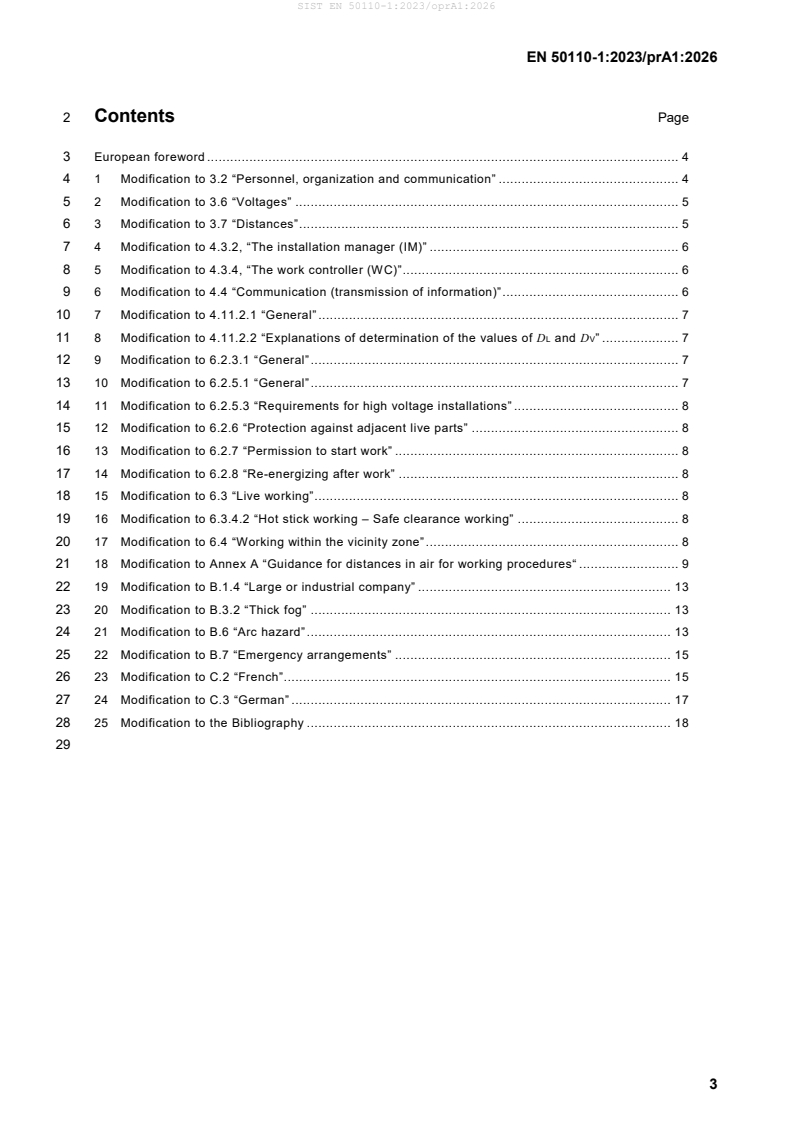
2 Contents Page
3 European foreword . 4
4 1 Modification to 3.2 “Personnel, organization and communication” . 4
5 2 Modification to 3.6 “Voltages” . 5
6 3 Modification to 3.7 “Distances” . 5
7 4 Modification to 4.3.2, “The installation manager (IM)” . 6
8 5 Modification to 4.3.4, “The work controller (WC)” . 6
9 6 Modification to 4.4 “Communication (transmission of information)” . 6
10 7 Modification to 4.11.2.1 “General” . 7
11 8 Modification to 4.11.2.2 “Explanations of determination of the values of DL and DV” . 7
12 9 Modification to 6.2.3.1 “General” . 7
13 10 Modification to 6.2.5.1 “General” . 7
14 11 Modification to 6.2.5.3 “Requirements for high voltage installations” . 8
15 12 Modification to 6.2.6 “Protection against adjacent live parts” . 8
16 13 Modification to 6.2.7 “Permission to start work” . 8
17 14 Modification to 6.2.8 “Re-energizing after work” . 8
18 15 Modification to 6.3 “Live working” . 8
19 16 Modification to 6.3.4.2 “Hot stick working – Safe clearance working” . 8
20 17 Modification to 6.4 “Working within the vicinity zone” . 8
21 18 Modification to Annex A “Guidance for distances in air for working procedures“ . 9
22 19 Modification to B.1.4 “Large or industrial company” . 13
23 20 Modification to B.3.2 “Thick fog” . 13
24 21 Modification to B.6 “Arc hazard” . 13
25 22 Modification to B.7 “Emergency arrangements” . 15
26 23 Modification to C.2 “French” . 15
27 24 Modification to C.3 “German” . 17
28 25 Modification to the Bibliography . 18
30 European foreword
31 This document (EN 50110-1:2023/prA1:2026) has been prepared by CLC/BTTF 62-3 “Operation of
32 electrical installations”.
33 The following dates are proposed:
• latest date by which the existence of this (doa) dav + 6 months
document has to be announced at national
level
• latest date by which this document has to be (dop) dav + 12 months
implemented at national level by publication of
an identical national standard or by
endorsement
• latest date by which the national standards (dow) dav + 36 months
conflicting with this document have to be (to be confirmed or
withdrawn modified when voting)
34 This document amends EN 50110-1:2023 on the following items:
35 — adding a new standard in Clause 2 – Normative references;
36 — improvement of some definitions in Clause 3 – Terms and definitions;
37 — editorial improvements and corrections of some parts of the Text in Clause 4 – Basic principles and
38 Clause 6 – Working procedures;
39 — corrections of some parts of the Text in Annex A – Guidance for distances in air for
40 working procedures;
41 — improvement of some parts of the Text in Annex B – Additional information for safe working;
42 — improvement of the Text in B.6 – Arc hazard;
43 — corrections of some parts of the Text in C.2 – French and C.3 – German;
44 — update of the Clause “Bibliography”.
45 1 Modification to 3.2 “Personnel, organization and communication”
46 Replace term and definition 3.2.6 with the following:
47 “3.2.6
48 instructed person,
49 person adequately advised by a skilled person to enable them to understand the risks as instructed and to
50 avoid hazards which electricity can create
51 [SOURCE: IEC 60050-651:2014, 651-26-12 modified, the term “supervised” was deleted, “electrically” was
52 deleted “danger” was replaced by “hazard”, “perceive” was replaced by “understand” and added “as
53 instructed”]”
54 2 Modification to 3.6 “Voltages”
55 Replace term and definition 3.6.1 with the following:
56 “3.6.1
57 extra-low voltage
58 ELV
59 nominal voltage not exceeding 50 V alternating current AC or 120 V ripple free direct current DC whether
60 between conductors or to earth
61 Note 1 to entry: This definition includes SELV, PELV and FELV (see HD 60364-4–41).”
62 Replace term and definition 3.6.2 with the following:
63 “3.6.2
64 low voltage
65 L
V
66 nominal voltage not exceeding 1 000 V AC or 1 500 V DC”
67 Replace term and definition 3.6.3 with the following:
68 “3.6.3
69 high voltage
70 H
V
71 nominal voltage exceeding 1 kV AC or 1,5 kV DC”
72 3 Modification to 3.7 “Distances”
73 Replace term and definition 3.7.1 with the following:
74 “3.7.1
75 live working limit distance
76 D
L
77 distance in air defining the outer limit of the live working zone”
78 Replace term and definition 3.7.2 with the following:
79 “3.7.2
80 vicinity limit distance
81 D
V
82 distance in air defining the outer limit of the vicinity zone”
83 Replace term and definition 3.7.3 with the following:
84 “3.7.3
85 minimum approach distance for live working
86 D
A
87 minimum distance in air for live working to be maintained between any part of the body of a worker (W),
88 including any object (except tools appropriate for live working) being handled directly, and any part(s) at
89 different electric potential(s)
90 Note 1 to entry: The minimum approach distance for live working is the sum of the electrical distance D appropriate
U
91 for the maximum nominal voltage and of the selected ergonomic distance D .
E
92 [SOURCE: IEC 60050-651: 2014, 651-21-11 modified by adding: for live working”]”
93 Replace term and definition 3.7.4 with the following:
94 “3.7.4
95 minimum working distance
96 D
W
97 minimum distance in air (including tools, objects and equipment) to be maintained between any part of the
98 body of a worker and bare live parts during work activities within or outside the vicinity zone
99 Note 1 to entry: For minimum working distance for working within the vicinity zone the symbol is D .
WL
100 Note 2 to entry: For minimum working distance for working outside the vicinity zone the symbol is DWV.”
101 Replace term and definition 3.7.7 with the following:
102 “3.7.7
103 ergonomic distance,
104 E
105 distance in air, to take account of normal and unintentional movements and errors in judgement of distances
106 during work activities within or outside the vicinity zone
107 Note 1 to entry: This distance is not fixed because it is necessary to make an evaluation for different situations of
108 work.”
109 4 Modification to 4.3.2, “The installation manager (IM)”
110 Replace subclause 4.3.2 with the following:
111 “The installation manager (IM) is in charge of the overall responsibility to ensure the safe operation of the
112 electrical installation by setting rules and organization or framework
113 The installation manager (IM) can be a natural person from the own organization or a third-party
114 organization. In the case of a person from another organization, it is recommended to document the
115 nomination, the part of the installation the person is responsible for and the timescale of nomination in
116 writing
117 The installation manager (IM) can delegate a part of their duties to other persons. This should be
118 documented
119 Where two or more electrical installations or organizations come together, it is essential that there are
120 formal arrangements for consultation and cooperation between the installation manager (IM) of each of
121 those installations or organizations to ensure safety
122 Access to all places where ordinary persons are exposed to electrical hazards shall be regulated. The
123 method of regulation and control of access shall be the responsibility of the installation manager (IM)
124 NOTE National requirements can apply to the method of regulation and control of access.”
125 5 Modification to 4.3.4, “The work controller (WC)”
126 Replace subclause 4.3.4 with the following:
127 “The work controller (WC) has the responsibility for the work activity
128 Where the work activity is subdivided, it may be necessary to nominate a person for each subdivision to be
129 responsible for the safety, all under the responsibility of the work controller (WC) as the coordinating person
130 The work controller (WC) and the operation controller (OC) shall agree both the arrangements of the
131 electrical system to allow the work to take place and a description of the work activity on, with or near the
132 electrical installation before any changes to the arrangements of the electrical installation are made or work
133 takes place.”
134 6 Modification to 4.4 “Communication (transmission of information)”
st
135 Replace the 1 paragraph with the following:
136 “This includes every way in which information is passed or exchanged between persons i.e. by spoken
137 word (including telephone, personal radio, and face to face), in writing (including, e.g. fax or e-mail), and
138 visually (including visual display units, warning panels, lights etc.).”
139 Replace the last paragraph with the following:
140 “In the case of personnel in a work location speaking different languages, to ensure understanding and
141 comprehensibility, the agreed language that relevant parties understand shall be granted in advance.”
142 7 Modification to 4.11.2.1 “General”
143 Replace the three list items with the following:
144 — the live working zone: the inner limit is the bare live part, the outer limit is the live working limit
145 distance D ;
L
146 — the vicinity zone: the inner limit is the live working limit distance D , the outer limit is the vicinity limit
L
147 distance D ;
V
148 — the surrounding outside the vicinity zone. (beyond the vicinity limit distance D ).
V
149 8 Modification to 4.11.2.2 “Explanations of determination of the values of DL and
150 D ”
V
151 Replace the 2nd paragraph with the following:
152 “The minimum values of DL are determined by the calculation of the electrical distance DU plus a safety
153 margin. As a result, the minimum values given in Table 1 are estimated or rounded and represent the lowest
154 value among the set of European values. Explanations are given in Annex A.
155 NOTE The values of the distance in air defining the outer limit of the live working zone DL, are based on the lowest
156 values of N (minimum clearance in air phase to earth and phase to phase given in Tables 2 and 3 of
157 EN IEC 61936-1:2021).”
158 Replace the 4th paragraph with the following:
159 In the absence of computation methods for DC-systems, the values for distance DL and DV for AC-systems
160 may also be used for DC-systems up to and including 70 kV. (see Table 1). For low voltage (either 0 to
161 1 000 V AC or 0 to 1 500 V DC) the respective distances are the same.
162 Replace the title of the 2nd and 3rd column in Table 1 with the following:
163 Table 1 — Estimated values for distances D and D
L V
Nominal system Live working limit distance Vicinity limit distance
voltage
U (RMS) D D
N L V
kV mm mm
164 9 Modification to 6.2.3.1 “General”
165 Replace the 1st paragraph with the following:
166 “All relevant devices, e.g. fuses, switches, jumpers that have been used or removed to disconnect the
167 electrical installation for the work activity shall be secured against re-connection.
168 Other relevant devices, e.g. fuses, switches, jumpers, that can be used to energize the electrical installation,
169 shall also be secured against re-connection.”
170 10 Modification to 6.2.5.1 “General”
171 Replace the 5th paragraph with the following:
172 “Earthing and short-circuiting equipment or devices shall comply with EN 61219 or EN 61230.”
173 Replace the 7th paragraph with the following:
174 “Precautions shall be taken to ensure that the earthing and short-circuiting equipment or devices remain in
175 place as long as the work is in progress. If, during measurement or testing, the earthing and short-circuiting
176 connections are removed, additional or alternative special precautions to prevent electrical danger shall be
177 taken.”
178 11 Modification to 6.2.5.3 “Requirements for high voltage installations”
179 Replace the text of the first two list items with the following:
180 “
181 — for a specific work activity, where there is no interruption in conductors during work, the installation of
182 a single earthing and short-circuiting equipment or device at the work location is acceptable;
183 — If no earthing and short-circuiting devices or equipment can be seen within the limits of the work
184 location, locally applied earthing and short-circuiting devices or equipment or additional signalling
185 devices or other equivalent markings shall be provided to ensure that there is no significantly increased
186 risk to the person working on the bare live part or that the bare live part is energized during the work
187 activity.”
188 12 Modification to 6.2.6 “Protection against adjacent live parts”
189 Replace the paragraph with the following
190 “If the work location is in the vicinity of parts of an electrical installation which cannot be made dead, then
191 special additional precautions are necessary and shall be applied before work starts as detailed in working
192 within the vicinity zone (see 6.4) or working outside the vicinity zone (see 6.5).”
193 13 Modification to 6.2.7 “Permission to start work”
194 Replace the 3rd paragraph with the following:
195 “For work activities on, with or near high voltage installations, formal written details of disconnections and
196 earthing and/or short-circuiting, where appropriate, should be used to avoid misunderstandings.”
197 14 Modification to 6.2.8 “Re-energizing after work”
198 Replace the 2nd paragraph with the following:
199 “All earthing, short-circuiting and safety equipment and/or devices at the work location shall be removed.
200 Starting from the work location and progressing outwards, the earthing, short-circuiting equipment and/or
201 devices that were applied to the electrical installation shall be removed and all the locks or other devices,
202 which were used to prevent re-connection shall also be removed. All signs used for the work activity shall
203 be removed.”"
204 15 Modification to 6.3 “Live working”
205 Replace paragraph 6.3.1.2 with the following:
206 “6.3.1.2 The requirements of 6.3 might not apply to activities such as voltage detection and the
207 application of earthing and short-circuiting equipment or devices, etc.”
208 16 Modification to 6.3.4.2 “Hot stick working – Safe clearance working”
209 Replace subclause 6.3.4.2 with the following:
210 “The method of live working by which the worker (W) remains at a specified distance (see A.2.5) from the
211 live parts and carries out their work by means of insulating sticks.”
212 17 Modification to 6.4 “Working within the vicinity zone”
213 Replace paragraph 6.4.1.4 with the following:
214 “6.4.1.4 For working within the vicinity zone, the minimum working distance DWL according to the type
215 of work planned should be determined and maintained at all time and situations.”
216 18 Modification to Annex A “Guidance for distances in air for working
217 procedures“
218 Replace Annex A with the following:
219 “
220 Annex A
221 (informative)
223 Guidance for distances in air for working procedures
224 A.1 Limit distances
225 Limit distances D and D define zones in which the safety rules should be applied for electrical and non-
L V
226 electrical work.
227 The explanation and determination of those distances is pointed out in 4.11.2.2.
228 A.2 Working distances
229 A.2.1 General
230 In the presence of an electrical hazard, regardless of the work to be carried out, working distances should
231 be determined during the work preparation, taking into account the following items:
232 — the type of work to be carried out;
233 — the value of the operating voltage;
234 — the tools or objects used;
235 — the possibility of normal and unintentional movements towards the electrical hazard (ergonomic
236 considerations).
237 This anne
...