


EN 62366-1:2015/A1:2020
(Amendment)Medical devices - Part 1: Application of usability engineering to medical devices
Medical devices - Part 1: Application of usability engineering to medical devices
2019-04-04-JO-: link to legislation to the MDD 93/42/EEC and mandate M/432 removed following CLC/BT decision D162/C076
Medizinprodukte - Teil 1: Anwendung der Gebrauchstauglichkeit auf Medizinprodukte
Dispositifs médicaux - Partie 1: Application de l'ingénierie de l'aptitude à l'utilisation aux dispositifs médicaux
Medicinske naprave - 1. del: Izvedba tehnik uporabe pri medicinskih napravah - Dopolnilo A1 (IEC 62366-1:2015/A1:2020)
General Information
- Status
- Published
- Publication Date
- 06-Aug-2020
- Technical Committee
- CLC/TC 62 - Electrical equipment in medical practice
- Drafting Committee
- IEC/SC 62A - IEC_SC_62A
- Current Stage
- 6060 - Document made available - Publishing
- Start Date
- 07-Aug-2020
- Completion Date
- 07-Aug-2020
- Directive
- Not Harmonized93/42/EEC - Medical devices
Not Harmonized98/79/EC - In vitro diagnostic medical devices
Relations
- Effective Date
- 09-Feb-2026
- Effective Date
- 09-Feb-2026
- Effective Date
- 09-Feb-2026
- Effective Date
- 09-Feb-2026
- Referred By
EN 1865-2:2024 - Patient handling equipment used in ambulances - Part 2: Power assisted stretcher - Effective Date
- 09-Feb-2026
- Effective Date
- 03-Feb-2026
- Effective Date
- 03-Feb-2026
- Effective Date
- 03-Feb-2026
- Effective Date
- 03-Feb-2026
- Effective Date
- 03-Feb-2026
- Effective Date
- 03-Feb-2026
- Amends
EN 62366-1:2015 - Medical devices - Part 1: Application of usability engineering to medical devices - Effective Date
- 26-Jan-2023
Overview
EN 62366-1:2015/A1:2020 (adoption of IEC 62366-1:2015/A1:2020) specifies the application of usability engineering to medical devices. The 2020 Amendment A1 clarifies definitions, corrects identified issues, and aligns the usability engineering process with updated risk management references (notably ISO 14971:2019) without changing the fundamental process. The standard explains how manufacturers must identify use-related hazards, design and evaluate user interfaces, and document the usability engineering activities in a Usability Engineering File.
Key topics and requirements
- Usability engineering process: iterative activities from use specification through formative design work to final summative evaluation.
- Use specification: define intended users, intended use environment, tasks, and user profiles.
- Identification of safety-related UI characteristics: determine which user interface elements could contribute to use errors or hazardous situations.
- Risk control hierarchy: follows ISO 14971:2019 priorities - (a) inherently safe design, (b) protective measures, and (c) information for safety/training.
- Formative and summative evaluations:
- Formative evaluation supports iterative design improvements.
- Summative evaluation tests selected hazard-related use scenarios and requires analysis of observed use errors and root causes.
- Selection of hazard-related use scenarios: manufacturer must select all scenarios or justified subsets based on severity of potential harm and device-specific considerations.
- Documentation: store rationale, test plans, participant profiles (user groups/user profiles), test data, and residual risk evaluations in the Usability Engineering File.
- Definitions and scope updates: amendment refines terms (accompanying documentation, user profile, use environment) and updates cross‑references to ISO 14971:2019 and ISO 13485:2016.
Applications - who uses this standard
- Medical device manufacturers (design, human factors, regulatory teams) - to design safe user interfaces and demonstrate compliance.
- Human factors / usability engineers - to plan formative and summative usability tests and analyse use errors.
- Regulatory affairs specialists - to prepare technical documentation and support conformity assessments.
- Clinical engineers and risk managers - to integrate UI-related risks into device risk management.
Practical uses include developing safer device interfaces, preparing regulatory submissions, and justifying labeling/training as risk control measures.
Related standards
- IEC 62366-1:2015 (base publication) and IEC TR 62366-2 (guidance/tutorial)
- ISO 14971:2019 (risk management for medical devices)
- ISO 13485:2016 (quality management)
- References in the amendment also note ISO/TR 24971 (guidance on ISO 14971) and harmonized standards like EN IEC 60601-1-11 where applicable.
Keywords: EN 62366-1:2015/A1:2020, usability engineering, medical device usability, user interface design, summative evaluation, ISO 14971:2019, usability engineering file.



Get Certified
Connect with accredited certification bodies for this standard

BSI Group
BSI (British Standards Institution) is the business standards company that helps organizations make excellence a habit.

TÜV Rheinland
TÜV Rheinland is a leading international provider of technical services.

TÜV SÜD
TÜV SÜD is a trusted partner of choice for safety, security and sustainability solutions.
Sponsored listings
Frequently Asked Questions
EN 62366-1:2015/A1:2020 is a amendment published by CLC. Its full title is "Medical devices - Part 1: Application of usability engineering to medical devices". This standard covers: 2019-04-04-JO-: link to legislation to the MDD 93/42/EEC and mandate M/432 removed following CLC/BT decision D162/C076
2019-04-04-JO-: link to legislation to the MDD 93/42/EEC and mandate M/432 removed following CLC/BT decision D162/C076
EN 62366-1:2015/A1:2020 is classified under the following ICS (International Classification for Standards) categories: 11.040 - Medical equipment. The ICS classification helps identify the subject area and facilitates finding related standards.
EN 62366-1:2015/A1:2020 has the following relationships with other standards: It is inter standard links to EN ISO 14971:2019, EN 1865-6:2024, EN 14180:2025, EN 13060:2025, EN 1865-2:2024, EN 60601-1-10:2008/A2:2021, EN 60601-1-8:2007/A2:2021, EN 60601-1-6:2010/A2:2021, EN 60601-1-11:2015/A1:2021, EN IEC 80601-2-77:2021/A1:2023, EN IEC 80601-2-78:2020/A1:2024, EN 62366-1:2015. Understanding these relationships helps ensure you are using the most current and applicable version of the standard.
EN 62366-1:2015/A1:2020 is associated with the following European legislation: EU Directives/Regulations: 93/42/EEC, 98/79/EC; Standardization Mandates: M/432. When a standard is cited in the Official Journal of the European Union, products manufactured in conformity with it benefit from a presumption of conformity with the essential requirements of the corresponding EU directive or regulation.
EN 62366-1:2015/A1:2020 is available in PDF format for immediate download after purchase. The document can be added to your cart and obtained through the secure checkout process. Digital delivery ensures instant access to the complete standard document.
Standards Content (Sample)
SLOVENSKI STANDARD
01-november-2020
Medicinske naprave - 1. del: Izvedba tehnik uporabe pri medicinskih napravah -
Dopolnilo A1 (IEC 62366-1:2015/A1:2020)
Medical devices - Part 1: Application of usability engineering to medical devices (IEC
62366-1:2015/A1:2020)
Medizinprodukte - Teil 1: Anwendung der Gebrauchstauglichkeit auf Medizinprodukte
(IEC 62366-1:2015/A1:2020)
Dispositifs médicaux - Partie 1: Application de l'ingénierie de l'aptitude à l'utilisation aux
dispositifs médicaux (IEC 62366-1:2015/A1:2020)
Ta slovenski standard je istoveten z: EN 62366-1:2015/A1:2020
ICS:
11.040.01 Medicinska oprema na Medical equipment in general
splošno
2003-01.Slovenski inštitut za standardizacijo. Razmnoževanje celote ali delov tega standarda ni dovoljeno.
EUROPEAN STANDARD EN 62366-1:2015/A1
NORME EUROPÉENNE
EUROPÄISCHE NORM
August 2020
ICS 11.040
English Version
Medical devices - Part 1: Application of usability engineering to
medical devices
(IEC 62366-1:2015/A1:2020)
Dispositifs médicaux - Partie 1: Application de l'ingénierie Medizinprodukte - Teil 1: Anwendung der
de l'aptitude à l'utilisation aux dispositifs médicaux Gebrauchstauglichkeit auf Medizinprodukte
(IEC 62366-1:2015/A1:2020) (IEC 62366-1:2015/A1:2020)
This amendment A1 modifies the European Standard EN 62366-1:2015; it was approved by CENELEC on 2020-07-22. CENELEC
members are bound to comply with the CEN/CENELEC Internal Regulations which stipulate the conditions for giving this amendment the
status of a national standard without any alteration.
Up-to-date lists and bibliographical references concerning such national standards may be obtained on application to the CEN-CENELEC
Management Centre or to any CENELEC member.
This amendment exists in three official versions (English, French, German). A version in any other language made by translation under the
responsibility of a CENELEC member into its own language and notified to the CEN-CENELEC Management Centre has the same status as
the official versions.
CENELEC members are the national electrotechnical committees of Austria, Belgium, Bulgaria, Croatia, Cyprus, the Czech Republic,
Denmark, Estonia, Finland, France, Germany, Greece, Hungary, Iceland, Ireland, Italy, Latvia, Lithuania, Luxembourg, Malta, the
Netherlands, Norway, Poland, Portugal, Republic of North Macedonia, Romania, Serbia, Slovakia, Slovenia, Spain, Sweden, Switzerland,
Turkey and the United Kingdom.
European Committee for Electrotechnical Standardization
Comité Européen de Normalisation Electrotechnique
Europäisches Komitee für Elektrotechnische Normung
CEN-CENELEC Management Centre: Rue de la Science 23, B-1040 Brussels
© 2020 CENELEC All rights of exploitation in any form and by any means reserved worldwide for CENELEC Members.
Ref. No. EN 62366-1:2015/A1:2020 E
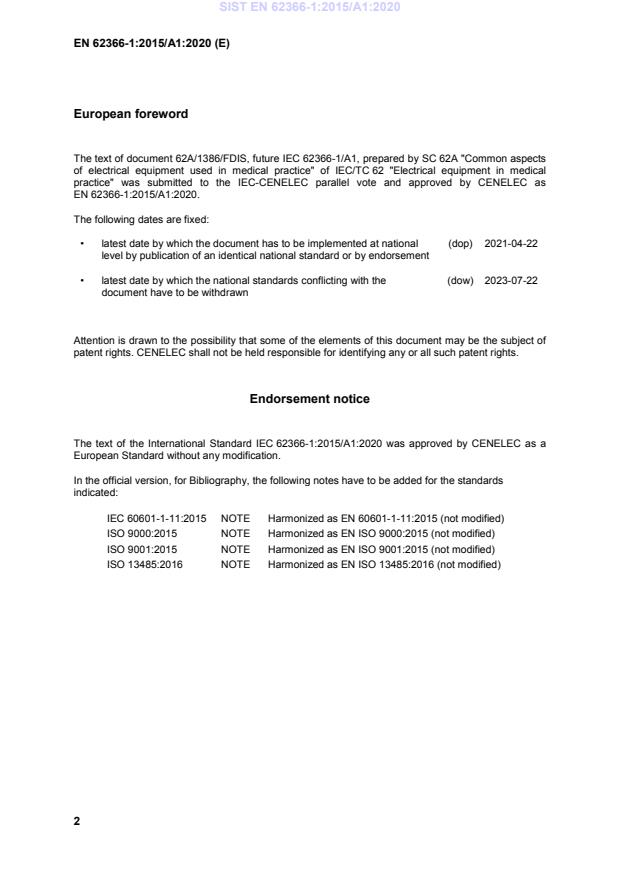
European foreword
The text of document 62A/1386/FDIS, future IEC 62366-1/A1, prepared by SC 62A "Common aspects
of electrical equipment used in medical practice" of IEC/TC 62 "Electrical equipment in medical
practice" was submitted to the IEC-CENELEC parallel vote and approved by CENELEC as
The following dates are fixed:
• latest date by which the document has to be implemented at national (dop) 2021-04-22
level by publication of an identical national standard or by endorsement
• latest date by which the national standards conflicting with the (dow) 2023-07-22
document have to be withdrawn
Attention is drawn to the possibility that some of the elements of this document may be the subject of
patent rights. CENELEC shall not be held responsible for identifying any or all such patent rights.
Endorsement notice
The text of the International Standard IEC 62366-1:2015/A1:2020 was approved by CENELEC as a
European Standard without any modification.
In the official version, for Bibliography, the following notes have to be added for the standards
indicated:
IEC 60601-1-11:2015 NOTE Harmonized as EN 60601-1-11:2015 (not modified)
ISO 9000:2015 NOTE Harmonized as EN ISO 9000:2015 (not modified)
ISO 9001:2015 NOTE Harmonized as EN ISO 9001:2015 (not modified)
ISO 13485:2016 NOTE Harmonized as EN ISO 13485:2016 (not modified)
Annex ZA
(normative)
Normative references to international publications
with their corresponding European publications
The following documents are referred to in the text in such a way that some or all of their content
constitutes requirements of this document. For dated references, only the edition cited applies. For
undated references, the latest edition of the referenced document (including any amendments)
applies.
NOTE 1 Where an International Publication has been modified by common modifications, indicated by (mod), the relevant
EN/HD applies.
NOTE 2 Up-to-date information on the latest versions of the European Standards listed in this annex is available here:
www.cenelec.eu.
Publication Year Title EN/HD Year
ISO 14971 2019 Medical devices – Application of risk EN ISO 14971 2019
management to medical devices
IEC 62366-1
Edition 1.0 2020-06
INTERNATIONAL
STANDARD
NORME
INTERNATIONALE
A MENDMENT 1
AM ENDEMENT 1
Medical devices –
Part 1: Application of usability engineering to medical devices
Dispositifs médicaux –
Partie 1: Application de l'ingénierie de l'aptitude à l'utilisation aux dispositifs
médicaux
INTERNATIONAL
ELECTROTECHNICAL
COMMISSION
COMMISSION
ELECTROTECHNIQUE
INTERNATIONALE
ICS 11.040.01 ISBN 978-2-8322-8384-4
– 2 – IEC 62366-1:2015/AMD1:2020
© IEC 2020
FOREWORD
This amendment has been prepared by subcommittee 62A: Common aspects of electrical
equipment used in medical practice, of IEC technical committee 62: Electrical equipment in
medical practice, and ISO technical committee 210: Quality management and corresponding
general aspects for medical devices.
The text of this amendment is based on the following documents:
FDIS Report on voting
62A/1386/FDIS 62A/1397/RVD
Full information on the voting for the approval of this amendment can be found in the report
on voting indicated in the above table.
The committee has decided that the contents of this amendment and the base publication will
remain unchanged until the stability date indicated on the IEC web site under
"http://webstore.iec.ch" in the data related to the specific publication. At this date, the
publication will be
• reconfirmed,
• withdrawn,
• replaced by a revised edition, or
• amended.
_____________
FOREWORD
In the fourth paragraph, replace “ISO 14971:2007” with “ISO 14971:2019”, format “medical
device user interfaces” in small caps and replace “manufactures” with “MANUFACTURERS” to
correct the spelling and the format.
INTRODUCTION to Amendment 1
The first edition of IEC 62366-1 was published in 2015. Since its publication, experts working
in the field have identified several inaccuracies that warrant correction. In total, 22 issues
were identified and presented to the National Committee members of IEC/SC 62A and to the
Member Bodies of ISO/TC 210. A majority of the members of both committees that stated a
position supported developing this amendment to address the identified issues while making
no fundamental changes to the USABILITY ENGINEERING PROCESS as originally conceived in
IEC 62366-1:2015.
To assist the USER to implement the USABILITY ENGINEERING PROCESS, the technical report
MANUFACTURERS in
IEC TR 62366-2 is available, which contains tutorial information to assist
complying with this document, as well as more generally to design MEDICAL DEVICES that goes
beyond SAFETY-related aspects of USER INTERFACES and offers more detailed descriptions of
USABILITY ENGINEERING methods that can be applied.
IEC 62366-1:2015/AMD1:2020 – 3 –
© IEC 2020
INTRODUCTION
Replace, in the second paragraph, “Figure A.4” with “Figure A.5”.
Replace, in the NOTE, “functionality” with “performance”.
Replace, in the last paragraph, “benefits” with “advantages”.
Replace the existing footnote 1 with the following:
IEC TR 62366-2:2016, Medical devices – Part 2: Guidance on the application of usability engineering to medical
devices.
1 * Scope
In the second sentence, replace “with CORRECT USE and USE ERRORS, i.e., NORMAL USE” with
“with NORMAL USE, i.e., CORRECT USE and USE ERROR”.
Replace NOTE 1 with the following:
NOTE 1 SAFETY is freedom from unacceptable RISK. Unacceptable RISK can arise from USE ERROR, which can lead
to exposure to HAZARDS including loss or degradation of clinical performance.
Replace the existing footnote 2 with the following:
IEC TR 62366-2:2016, Medical devices – Part 2: Guidance on the application of usability engineering to medical
devices.
2 Normative references
Replace “ISO 14971:2007” with “ISO 14971:2019”.
3 Terms and definitions
Replace, in the first paragraph, “ISO 14971:2007” with “ISO 14971:2019”.
3.1
ABNORMAL USE
*
Replace, in the existing definition and its example, “intentional” with “deliberate” in 3 places.
3.2
ACCOMPANYING DOCUMENTATION
Replace the existing definition, notes to entry and source with the following:
3.2
ACCOMPANYING DOCUMENTATION
materials accompanying a MEDICAL DEVICE and containing information for the USER or those
accountable for the installation, use, maintenance, decommissioning and disposal of the
MEDICAL DEVICE, particularly regarding safe use
Note 1 to entry: The ACCOMPANYING DOCUMENTATION can consist of the instructions for use, technical description,
installation manual, quick reference guide, etc.
Note 2 to entry: ACCOMPANYING DOCUMENTATION is not necessarily a written or printed document but could involve
auditory, visual, or tactile materials and multiple media types.
– 4 – IEC 62366-1:2015/AMD1:2020
© IEC 2020
Note 3 to entry: MEDICAL DEVICES that can be used safely without instructions for use are exempted from having
instructions for use by some authorities with jurisdiction.
[SOURCE: ISO 14971:2019, 3.1, modified – Note 3 to entry has been added.]
3.20
USE ENVIRONMENT
Add, in Note 1 to entry, the following second sentence:
Social attributes such as team versus individual, chaotic versus calm, stress level and length of shift can also play
a role.
3.23
* USE SPECIFICATION
Replace, in Note 3 to entry, “ISO 14971:2007” with “ISO 14971:2019”.
3.25
USER GROUP
Replace the definition with the following:
subset of USERS who are differentiated from other USERS by factors that are likely to influence
their interactions with the MEDICAL DEVICE
NOTE 1 to entry: Attributes of USER GROUPS can include age, culture, expertise.
3.29
USER PROFILE
Replace the existing definition with the following:
summary of the mental, physical and demographic traits of a USER GROUP, as well as
characteristics, such as knowledge, skills and abilities, which can have a bearing on design
decisions
4.1.1 * USABILITY ENGINEERING PROCESS
Replace, in the third paragraph, “ISO 13485:2003” with “ISO 13485:2016”.
Replace, in NOTE 1, “ISO 13485:2003” with “ISO 13485:2016”.
Replace, in the fourth paragraph, “ISO 14971:2007” with “ISO 14971:2019” and “Figure A.4”
with “Figure A.5”.
Replace, in the fifth paragraph, “Figure A.4” with “Figure A.5” and “carried out” with “carried
out iteratively or”.
4.1.2 * RISK CONTROL as it relates to USER INTERFACE design
Replace the first paragraph and list items a) to c) with the following:
To reduce use-related RISK, the MANUFACTURER shall use one or more of the following options,
in the priority listed (as required by ISO 14971:2019, 7.1):
a) inherently safe design and manufacture;
b) protective measures in the MEDICAL DEVICE itself or in the manufacturing PROCESS; and
c) information for SAFETY and, where appropriate, training to USERS.
IEC 62366-1:2015/AMD1:2020 – 5 –
© IEC 2020
4.1.3 Information for SAFETY as it relates to USABILITY
Replace, in the second paragraph, “intentional” with “deliberate” in 2 places.
4.3 Tailoring of the USABILITY ENGINEERING effort
Delete the compliance check.
5.1 * Prepare USE SPECIFICATION
Replace the fifth dash with:
– * intended USE ENVIRONMENT; and
5.2 * Identify USER INTERFACE characteristics related to SAFETY and potential USE ERRORS
Replace, in the first paragraph, “ISO 14971:2007, 4.2” with “ISO 14971:2019, 5.3”.
Replace the last sentence of the first paragraph with the following:
This identification shall include consideration of the PRIMARY OPERATING FUNCTIONS if they are
MEDICAL DEVICE SAFETY standards.
provided in applicable product-specific
Replace, in NOTE 1, “ISO 14971:2007, C.2.29 to C.2.34” with “ISO/TR 24971:— , A.2.31 to
A.2.37”.
Insert the following footnote:
Under preparation. Stage at the time of circulation: ISO /TR APUB 24971:2020.
Replace the paragraph preceding the compliance check with the following:
The results of this identification of characteristics related to SAFETY and potential USE ERRORS
shall be stored in the USABILITY ENGINEERING FILE.
5.3 * Identify known or foreseeable HAZARDS and HAZARDOUS SITUATIONS
Replace the last sentence of the first paragraph with the following:
This identification shall be conducted as part of a RISK ANALYSIS performed according to
ISO 14971:2019, 5.4.
5.5 * Select the HAZARD-RELATED USE SCENARIOS for SUMMATIVE EVALUATION
Replace the text of the subclause with the following:
The MANUFACTURER shall select the HAZARD-RELATED USE SCENARIOS to be included in the
SUMMATIVE EVALUATION.
The MANUFACTURER shall select:
– all HAZARD-RELATED USE SCENARIOS;
– 6 – IEC 62366-1:2015/AMD1:2020
© IEC 2020
– a subset of the HAZARD-RELATED USE SCENARIOS based on the SEVERITY of the potential
HARM that could be caused by USE ERROR (e.g. for which medical intervention would be
needed); or
NOTE 1 The SEVERITY of HARM is determined in ISO 14971:2019, 5.5.
– a subset of the HAZARD-RELATED USE SCENARIOS based on the SEVERITY of the potential
HARM and based on other circumstances specific to the MEDICAL DEVICE and the
MANUFACTURER.
NOTE 2 Examples of selection schemes are given in Annex A, 5.5, and IEC TR 62366-2.
A summary of any selection scheme, the rationale for its use and the results of applying it shall
be stored in the USABILITY ENGINEERING FILE.
Compliance is checked by inspection of the USABILITY ENGINEERING FILE.
5.7.1 General
Delete, in the first sentence, “SPECIFICATION”.
Replace the first dash under list item b), including Examples 1 and 2, with the following:
– document which USER GROUPS are intended to be included in the test;
EXAMPLE 1 In a FORMATIVE EVALUATION, clinical personnel who are employees of the MANUFACTURER are
used to represent a nurse-USER GROUP.
EXAMPLE 2 In a SUMMATIVE EVALUATION, a panel of practicing intensive care nurses is used to represent
a critical care nursing USER GROUP.
Multiple USER PROFILES may be combined into a USER GROUP for the purposes of a
USABILITY TEST;
Add, in the penultimate dash under list item b) “and” after the semicolon.
Replace, in NOTE 3, “scaling” with “tailoring”.
5.7.3 * SUMMATIVE EVALUATION planning
Replace list item e) with the following:
e) * for a USABILITY TEST,
– how the characteristics of the test participants are representative of the intended USER
PROFILES;
– justifying how the test participants are grouped into distinct USER GROUPS for the
purpose of determining the number of test participants;
– the test environment and conditions of use and a rationale for how they are adequately
representative of the intended USE ENVIRONMENT;
– the definition of CORRECT USE for each HAZARD-RELATED USE SCENARIO; and
– the method of collecting data during the USABILITY TEST for the subsequent analysis of
observed USE ERRORS and use difficulties.
Delete the existing NOTE 5.
5.8 * Perform USER INTERFACE design, implementation and FORMATIVE EVALUATION
Replace, in NOTE 1, “ISO 14971:2007, Subclause 6.6” with “ISO 14971:2019, 7.5”.
IEC 62366-1:2015/AMD1:2020 – 7 –
© IEC 2020
5.9 * Perform SUMMATIVE EVALUATION of the USABILITY of the USER INTERFACE
Replace the second paragraph with the following:
The MANUFACTURER shall analyse the data of the SUMMATIVE EVALUATION and shall identify all
USE ERRORS and use difficulties that occurred. If a USE ERROR or use difficulty can lead to a
HAZARDOUS SITUATION, the root cause of any such USE ERROR or use difficulty shall be
determined. The root causes should be determined based on methods including observations
of USER performance as well as subjective comments from the USER.
NOTE 1 A use difficulty where a USER almost commits a USE ERROR while performing a TASK, but recovers in time
to avoid making the USE ERROR is sometimes called a “close call”.
Renumber NOTES 1 to 5 as 2 to 6.
Replace item i), without modifying the note, with the following:
i) document why improvement is not necessary or not practicable;
Replace, in NOTE 3, “ISO 14971:2007, 6.2” with “ISO 14971:2019, 7.1 and
ISO/TR 24971:— , Annex C”.
Insert the following footnote:
Under preparation. Stage at the time of circulation: ISO/TR APUB 24971:2020.
Replace item iii) with the following:
iii) evaluate the RESIDUAL RISK according to ISO 14971:2019, 7.3.
Replace, in NOTE 4, “ISO 14971:2007, Subclause 6.6” with “ISO 14971:2019, 7.5”.
Replace, in NOTE 5, “ISO 14971:2007, Clause 7” with “ISO 14971:2019, Clause 8”.
Replace, in the compliance check, "ISO 14971:2007, 6.4” with “ISO 14971:2019, 7.3”.
A.2 Rationale for requirements in particular clauses and subclauses
Clause 1 – Scope
In the sixth paragraph, set benefits in small caps in 2 places.
Replace, in the last paragraph, “benefits” with “advantages”.
Definition 3.1 – ABNORMAL USE
Replace, in the third dash, “RISK benefit” with “BENEFIT-RISK”.
Replace, in Example 2, “RISK/benefit” with “BENEFIT and RISK”.
Replace, in the first sentence of the last paragraph, “inaction” with “lack of USER action”.
Definition 3.11 – PRIMARY OPERATING FUNCTION
Replace the entire paragraph with the following:
For the purposes of this document, a PRIMARY OPERATING FUNCTION is a function that is directly
related to the SAFETY of the MEDICAL DEVICE. PRIMARY OPERATING FUNCTIONS are identified in
some product-specific MEDICAL DEVICE SAFETY standards. These standards require those
– 8 – IEC 62366-1:2015/AMD1:2020
© IEC 2020
identified PRIMARY OPERATING FUNCTIONS to be an input to the USABILITY ENGINEERING PROCESS.
This document does not require any further identification of PRIMARY OPERATING FUNCTIONS
because this document requires the identification, description and evaluation of HAZARD-
RELATED USE SCENARIOS. However, TASKS to be performed within a HAZARD-RELATED USE
SCENARIO might be related to a function that has been identified as a PRIMARY OPERATING
.
FUNCTION
Definition 3.17 – USABILITY ENGINEERING or HUMAN FACTORS ENGINEERING
Delete the second sentence of the first paragraph and combine the first and second
paragraphs.
USE ERROR
Definition 3.21 –
Replace the first and second sentences of the first paragraph with:
USE ERRORS often can be an indication of USER INTERFACE design flaws that affect the
interaction of a USER with a MEDICAL DEVICE.
Definition 3.22 – USE SCENARIO
Add the following sentence to the end of the second paragraph:
A TASK in a HAZARD-RELATED USE SCENARIO, in which a USE ERROR can lead to significant HARM,
can be thought of as a 'critical task' [48] [49].
Clause 5 – USABILITY ENGINEERING PROCESS
Replace the entire rationale for Clause 5 including Figure A.4 with the following:
The purpose of the USABILITY ENGINEERING PROCESS, as described in this document, is to
provide use-related SAFETY of the MEDICAL DEVICE for the PATIENT, USER and others. To
USABILITY ENGINEERING PROCESS mitigates RISK caused by USER
achieve this purpose, the
interaction problems associated with NORMAL USE, such as USE ERROR.
Figure A.4 illustrates the types of use as described in this document and their relationship to
the concept of “reasonably foreseeable misuse” in ISO 14971.
IEC 62366-1:2015/AMD1:2020 – 9 –
© IEC 2020
Figure A.4 – Types of use as described in this document and their relationship
to the concept of “reasonably foreseeable misuse” in ISO 14971
OBJECTIVE EVIDENCE to support the determination that use-related RESIDUAL RISK has been
reduced to acceptable levels is generated by conducting SUMMATIVE EVALUATION of the
USABILITY of the USER INTERFACE.
To establish criteria for the acceptability of RESIDUAL RISKS related to USABILITY, the
MANUFACTURER considers relevant available data (e.g., the state of technology, experience
with similar MEDICAL DEVICES, POST-PRODUCTION surveillance reports). The MANUFACTURER can
RESIDUAL RISK
apply these criteria according to ISO 14971, which additionally considers
relative to the BENEFIT of the MEDICAL DEVICE.
A comprehensive RISK MANAGEMENT PROCESS, such as that defined in ISO 14971, requires that
a MANUFA
...
Questions, Comments and Discussion
Ask us and Technical Secretary will try to provide an answer. You can facilitate discussion about the standard in here.
Loading comments...