

EN 50155:2021
(Main)Railway applications - Rolling stock - Electronic equipment
General Information
- Abstract
Revision of EN50155:2017 in order to include, after analysis and evaluation by WG29, the unresolved comments/issues on FprEN 50155, most of which were casted by Fr NC and Fi NC and reported in the document SC9XB_61051vot1_res_ccmc_20170714-Final.doc.
- Status
- Published
- Publication Date
- 22-Jul-2021
- Technical Committee
- CLC/TC 9X - Electrical and electronic applications for railways
- Drafting Committee
- CLC/SC 9XB - Electromechanical material on board rolling stock
- Current Stage
- 6060 - Document made available - Publishing
- Start Date
- 23-Jul-2021
- Due Date
- 07-Jun-2021
- Completion Date
- 23-Jul-2021
2016/797/EU - Directive (EU) 2016/797 of the European Parliament and of the Council of 11 May 2016 on the interoperability of the rail system within the European Union (Text with EEA relevance)OJ Ref: 2023/2584, OJ L, OJ L, 2023/2584 OJ Date: 21-Nov-2023
2016/797/EU - Directive (EU) 2016/797 of the European Parliament and of the Council of 11 May 2016 on the interoperability of the rail system within the European Union (Text with EEA relevance)OJ Ref: 2023/2584, OJ L OJ Date: 21-Nov-2023
2016/797/EU - Directive (EU) 2016/797 of the European Parliament and of the Council of 11 May 2016 on the interoperability of the rail system within the European Union (Text with EEA relevance)OJ Ref: 2023/2584, OJ L OJ Date: 21-Nov-2023
2016/797/EU - Directive (EU) 2016/797 of the European Parliament and of the Council of 11 May 2016 on the interoperability of the rail system within the European Union (Text with EEA relevance)OJ Ref: 2023/2584, OJ L OJ Date: 21-Nov-2023
2016/797/EU - Directive (EU) 2016/797 of the European Parliament and of the Council of 11 May 2016 on the interoperability of the rail system within the European Union (Text with EEA relevance)OJ Ref: 2023/2584, OJ L OJ Date: 21-Nov-2023
2016/797/EU - Directive (EU) 2016/797 of the European Parliament and of the Council of 11 May 2016 on the interoperability of the rail system within the European Union (Text with EEA relevance)OJ Ref: 2023/2584, OJ L OJ Date: 21-Nov-2023
2016/797/EU - Directive (EU) 2016/797 of the European Parliament and of the Council of 11 May 2016 on the interoperability of the rail system within the European Union (Text with EEA relevance)OJ Ref: 2023/2584, OJ L OJ Date: 21-Nov-2023
2016/797/EU - Directive (EU) 2016/797 of the European Parliament and of the Council of 11 May 2016 on the interoperability of the rail system within the European Union (Text with EEA relevance)OJ Ref: 2023/2584, OJ L OJ Date: 21-Nov-2023
2016/797/EU - Directive (EU) 2016/797 of the European Parliament and of the Council of 11 May 2016 on the interoperability of the rail system within the European Union (Text with EEA relevance)OJ Ref: 2023/2584, OJ L, OJ L, 2023/2584 OJ Date: 21-Nov-2023
2016/797/EU - Directive (EU) 2016/797 of the European Parliament and of the Council of 11 May 2016 on the interoperability of the rail system within the European Union (Text with EEA relevance)OJ Ref: 2023/2584, OJ L, OJ L, 2023/2584 OJ Date: 21-Nov-2023
2016/797/EU - Directive (EU) 2016/797 of the European Parliament and of the Council of 11 May 2016 on the interoperability of the rail system within the European Union (Text with EEA relevance)OJ Ref: 2023/2584, OJ L, OJ L, 2023/2584 OJ Date: 21-Nov-2023


Overview
EN 50155:2021 (EN 50155:2021) is the CENELEC European standard for railway applications - rolling stock - electronic equipment. Adopted as a Slovenian national standard, it supersedes EN 50155:2017 and consolidates unresolved comments from previous drafts. The standard defines the requirements for design, environmental and electrical service conditions, reliability, testing and documentation of electronic equipment intended for use on-board railway vehicles.
Key topics and technical requirements
The standard covers technical topics across hardware, software and system-level concerns. Major clause groups and requirements include:
- Scope and definitions - precise definitions for electronic equipment, performance, adjacent circuits, specification and procedures.
- General requirements - classes of environmental, constructional and service conditions; performance criteria (normal performance level and deviations).
- Environmental service conditions - temperature, humidity, vibration/shock and location-related severity levels.
- Electrical service conditions - DC and AC supply systems, rated voltages, battery supplies and transients.
- Reliability, maintainability and useful life - expected operational life, maintainability and test equipment provisions.
- Design and components - hardware and software design practices, procurement and application of components.
- Construction and installation - PCB, wiring, mounting, cooling, marking and materials requirements.
- Safety and fire behaviour - personnel and functional safety considerations.
- Documentation - datasheets, user and maintenance manuals, installation and commissioning documentation.
- Testing - categories, type/routine tests, test matrices and test specification guidance.
Informative annexes provide practical guidance on system testing approach, severity of service conditions by vehicle location, example compliance summaries, lifecycle of programmable devices, design suggestions and relationship to EU Directive 2016/797.
Practical applications and who uses it
EN 50155:2021 is essential for:
- Rolling stock manufacturers and OEMs specifying and validating on-board electronic equipment
- Electronic component and subsystem suppliers for rail applications
- Systems integrators and engineering designers ensuring compatibility with vehicle environments
- Test laboratories and certification bodies performing type and routine testing
- Procurement teams and asset owners defining technical requirements and maintenance regimes
- Maintenance organizations preparing documentation and in-service verification
Typical uses include specifying environmental classes, ensuring power-supply compatibility, defining test programs, preparing datasheets and proving compliance for safety-critical and non-safety-critical electronics on trains, trams and metros.
Related standards
EN 50155 is part of the CLC/SC 9XB suite for on-board electrotechnical equipment and interacts with standards on EMC, signalling, power supply and the EU rail safety directives (e.g., EU Directive 2016/797). For system-level compliance, consult associated EN standards cited in Clause 2 (Normative references).
Relations
- Effective Date
- 12-Dec-2017
- Effective Date
- 13-Sep-2022
- Effective Date
- 09-Feb-2026
- Effective Date
- 09-Feb-2026
- Effective Date
- 09-Feb-2026
- Effective Date
- 09-Feb-2026
- Effective Date
- 09-Feb-2026
- Effective Date
- 09-Feb-2026
- Effective Date
- 09-Feb-2026
- Effective Date
- 09-Feb-2026
- Effective Date
- 09-Feb-2026
- Effective Date
- 09-Feb-2026
- Effective Date
- 09-Feb-2026
- Effective Date
- 09-Feb-2026
- Effective Date
- 09-Feb-2026
Get Certified
Connect with accredited certification bodies for this standard

IRIS Certification (UNIFE)
International Railway Industry Standard certification.

TÜV SÜD Rail GmbH
TÜV SÜD railway certification services.

Bureau Veritas Railway Certification
Railway and transportation certification.
Sponsored listings
Frequently Asked Questions
EN 50155:2021 is a standard published by CLC. Its full title is "Railway applications - Rolling stock - Electronic equipment". This standard covers: Revision of EN50155:2017 in order to include, after analysis and evaluation by WG29, the unresolved comments/issues on FprEN 50155, most of which were casted by Fr NC and Fi NC and reported in the document SC9XB_61051vot1_res_ccmc_20170714-Final.doc.
Revision of EN50155:2017 in order to include, after analysis and evaluation by WG29, the unresolved comments/issues on FprEN 50155, most of which were casted by Fr NC and Fi NC and reported in the document SC9XB_61051vot1_res_ccmc_20170714-Final.doc.
EN 50155:2021 is classified under the following ICS (International Classification for Standards) categories: 45.060.01 - Railway rolling stock in general. The ICS classification helps identify the subject area and facilitates finding related standards.
EN 50155:2021 has the following relationships with other standards: It is inter standard links to EN 50155:2017, EN 50155:2026, EN 15220:2016, EN 15220:2025, EN 14752:2025, EN 15152:2019, CEN/TS 13149-8:2025, CEN/TS 13149-8:2013, CEN/TR 17532:2020, EN 16207:2024, EN 14033-3:2017, EN 15955-2:2025, EN 15595:2018+A1:2023, EN 14752:2005, EN 15595:2018. Understanding these relationships helps ensure you are using the most current and applicable version of the standard.
EN 50155:2021 is associated with the following European legislation: EU Directives/Regulations: 2008/57/EC, 2016/797/EU, 2016/797/EU, 2016/797/EU, 2016/797/EU, 2016/797/EU, 2016/797/EU, 2016/797/EU, 2016/797/EU, 2016/797/EU, 2016/797/EU, 2016/797/EU; Standardization Mandates: M/483. When a standard is cited in the Official Journal of the European Union, products manufactured in conformity with it benefit from a presumption of conformity with the essential requirements of the corresponding EU directive or regulation.
EN 50155:2021 is available in PDF format for immediate download after purchase. The document can be added to your cart and obtained through the secure checkout process. Digital delivery ensures instant access to the complete standard document.
Standards Content (Sample)
SLOVENSKI STANDARD
01-oktober-2021
Nadomešča:
SIST EN 50155:2018
Železniške naprave - Vozna sredstva - Elektronska oprema
Railway applications - Rolling stock - Electronic equipment
Bahnanwendungen - Elektronische Einrichtungen auf Schienenfahrzeugen
Applications ferroviaires - Équipements électroniques utilisés sur le matériel roulant
Ta slovenski standard je istoveten z: EN 50155:2021
ICS:
45.060.01 Železniška vozila na splošno Railway rolling stock in
general
2003-01.Slovenski inštitut za standardizacijo. Razmnoževanje celote ali delov tega standarda ni dovoljeno.
EUROPEAN STANDARD EN 50155
NORME EUROPÉENNE
EUROPÄISCHE NORM
July 2021
ICS 45.060.01 Supersedes EN 50155:2017 and all of its amendments
and corrigenda (if any)
English Version
Railway applications - Rolling stock - Electronic equipment
Applications ferroviaires - Équipements électroniques Bahnanwendungen - Fahrzeuge - Elektronische
utilisés sur le matériel roulant Betriebsmittel
This European Standard was approved by CENELEC on 2021-06-28. CENELEC members are bound to comply with the CEN/CENELEC
Internal Regulations which stipulate the conditions for giving this European Standard the status of a national standard without any alteration.
Up-to-date lists and bibliographical references concerning such national standards may be obtained on application to the CEN-CENELEC
Management Centre or to any CENELEC member.
This European Standard exists in three official versions (English, French, German). A version in any other language made by translation
under the responsibility of a CENELEC member into its own language and notified to the CEN-CENELEC Management Centre has the
same status as the official versions.
CENELEC members are the national electrotechnical committees of Austria, Belgium, Bulgaria, Croatia, Cyprus, the Czech Republic,
Denmark, Estonia, Finland, France, Germany, Greece, Hungary, Iceland, Ireland, Italy, Latvia, Lithuania, Luxembourg, Malta, the
Netherlands, Norway, Poland, Portugal, Republic of North Macedonia, Romania, Serbia, Slovakia, Slovenia, Spain, Sweden, Switzerland,
Turkey and the United Kingdom.
European Committee for Electrotechnical Standardization
Comité Européen de Normalisation Electrotechnique
Europäisches Komitee für Elektrotechnische Normung
CEN-CENELEC Management Centre: Rue de la Science 23, B-1040 Brussels
© 2021 CENELEC All rights of exploitation in any form and by any means reserved worldwide for CENELEC Members.
Ref. No. EN 50155:2021 E
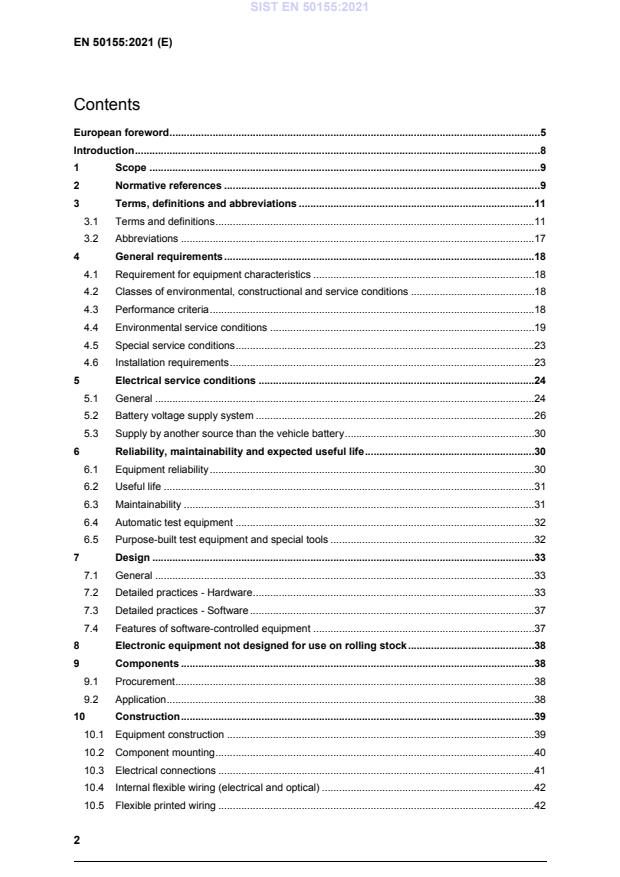
Contents
European foreword . 5
Introduction . 8
1 Scope . 9
2 Normative references . 9
3 Terms, definitions and abbreviations .11
3.1 Terms and definitions .11
3.2 Abbreviations .17
4 General requirements .18
4.1 Requirement for equipment characteristics .18
4.2 Classes of environmental, constructional and service conditions .18
4.3 Performance criteria .18
4.4 Environmental service conditions .19
4.5 Special service conditions .23
4.6 Installation requirements .23
5 Electrical service conditions .24
5.1 General .24
5.2 Battery voltage supply system .26
5.3 Supply by another source than the vehicle battery .30
6 Reliability, maintainability and expected useful life .30
6.1 Equipment reliability .30
6.2 Useful life .31
6.3 Maintainability .31
6.4 Automatic test equipment .32
6.5 Purpose-built test equipment and special tools .32
7 Design .33
7.1 General .33
7.2 Detailed practices - Hardware .33
7.3 Detailed practices - Software .37
7.4 Features of software-controlled equipment .37
8 Electronic equipment not designed for use on rolling stock .38
9 Components .38
9.1 Procurement .38
9.2 Application .38
10 Construction .39
10.1 Equipment construction .39
10.2 Component mounting .40
10.3 Electrical connections .41
10.4 Internal flexible wiring (electrical and optical) .42
10.5 Flexible printed wiring .42
10.6 Printed circuit boards - flexible and rigid .42
10.7 Protective coatings for printed board assemblies .43
10.8 Identification .44
10.9 Mounting .44
10.10 Cooling and ventilation .44
10.11 Materials and finishes .45
10.12 Reworking, modification and repair of electronic assemblies .45
11 Safety .45
11.1 General .45
11.2 Personnel safety .45
11.3 Functional safety .45
11.4 Fire behaviour requirements .45
12 Documentation .46
12.1 General .46
12.2 Supply and storage of documentation .46
12.3 Datasheet .46
12.4 User and maintenance manual .46
12.5 Equipment installation documentation .46
12.6 Commissioning documentation .47
12.7 Design documentation .47
13 Testing .51
13.1 General .51
13.2 Categories of tests .52
13.3 List of tests and test conditions .53
13.4 Test specification .54
Annex A (informative) List of default requirements of EN 50155 and related subclauses .69
Annex B (informative) System testing approach .70
B.1 General .70
B.2 Situation of applicability .70
B.3 General methodology .70
B.3.1 General .70
B.3.2 Item specific procedures .71
B.3.3 Equipment specific steps .71
B.4 Equipment integration design review .72
B.5 Equipment integration type test .72
B.6 Equipment installation design review.72
B.7 Equipment installation type test .72
B.8 Equipment installation routine test .72
B.9 Equipment periodic re-verification .72
B.10 Replacement of items and ancillary components .72
Annex C (informative) Severity level of service conditions in different vehicle locations .74
C.1 General .74
C.2 Severity of service conditions in different rolling stock types .74
C.3 Intended use of rolling stock .74
C.4 Location of equipment on-board rolling stock .74
C.5 Severity of the service conditions in different rolling stock locations .76
Annex D (informative) Example for a summary of equipment type test compliance .78
Annex E (informative) User programmable integrated circuit life cycle example .81
Annex F (informative) Design suggestions for electronic hardware used on rolling stock .82
F.1 Purpose of this annex .82
F.2 Design topics .82
F.2.1 Pollutants .82
F.2.2 Methods against ageing regarding energetic transient pulses .82
F.2.3 Capacitors to earth .83
F.2.4 Inside cabling for equipment .83
F.2.5 Earth configuration .84
F.2.6 Prototype testing .84
F.2.7 Interfacing .84
F.2.8 Solder joint on PBA .84
F.2.9 Derating .84
Annex G (informative) Electronic equipment not designed for use on rolling stock .92
Annex H (informative) Paragraphs with Agreements between the involved Parties .94
Annex I (informative) Electronic equipment supplied from AC supply system .99
I.1 General .99
I.2 Electric requirements .99
Annex J (informative) Typical content of datasheets .100
Annex K (informative) Insulation test and testing matrix example .103
Annex L (informative) Relationship between this European Standard and the Essential
Requirements of EU Directive 2016/797/EU aimed to be covered .105
Bibliography .107
European foreword
This document (EN 50155:2021) has been prepared by CLC/SC 9XB, “Electrical, electronic and
electromechanical material on-board rolling stock, including associated software”.
The following dates are fixed:
• latest date by which this document has to be (dop) 2022-06-28
implemented at national level by publication of
an identical national standard or by
endorsement
• latest date by which the national standards (dow) 2024-06-28
conflicting with this document have to be
withdrawn
This document supersedes EN 50155:2017 and all of its amendments and corrigenda (if any).
a) Revision of Clause 1 Scope;
1) Precision about definition of electronic equipment and his components;
2) Precision about covered scopes;
3) Precision about applicability of this standard to electronic equipment or systems performing
safety-related functions.
b) Updating of Clause 2 Normative references;
c) Revision of Clause 3 Terms, definitions and abbreviations”, new definitions and reorganisation of
subclauses;
1) Definition added for “performance”;
2) Definition added for “adjacent circuit”;
3) Definition added for “specification”;
4) Definition added for “procedure”.
d) Improvement of Clause 4 General requirements, in terms of better wording, requirement expansion
and reorganisation of subclauses;
1) Precision about concept of normal performance level and concept of deviation of the normal
performance level;
2) Wording improvements of 4.3.2 to 4.3.4 “Performance criterion A, B and C”;
3) Wording improvement of “4.6.4 Thermal compatibility”;
4) Wording improvement of “4.6.6 Cabling inside vehicle” and “4.6.7 Wiring inside equipment”.
e) Improvement of Clause 5 Electrical service conditions, with reorganisation of subclauses;
1) Subclause “DC supply” is renamed “5.1.1 DC Supply system”;
2) Subclause “5.1.2 AC supply system” is added;
3) Precisions added and editorial improvements of 5.2.1 to 5.2.8;
4) Concept of “rated voltage” is clarified in 5.2.2;
5) Wording improvement of subclause “5.2.6 Grouping of supply voltages”;
6) Subclause added: “5.3 Supply by another source than the vehicle battery”.
f) Improvement and simplification of Clause 6 Reliability, maintainability and expected useful life, with
reorganization of subclauses and introduction of explicative figures;
g) Wording improvements and precision added to Clause 7 Design;
h) Clause 8 is renamed “Electronic equipment not designed for use on rolling stock application”;
i) Improvement of Clause 9 Components, revised requirement regarding the compliance with a quality
system;
j) Wording improvements and precisions added for Clause 10 Construction;
k) Revision of Clause 11 Safety, reorganisation of subclauses;
l) Revision of Clause 12 Documentation;
1) In addition to the datasheet and user manual, equipment installation and commissioning
information have to be provided to the user;
2) Typical content of the datasheet, is moved to Annex J;
3) The acronyms UPIC is used to designate User Programmable Integrated Circuit.
m) Improvements of texts and figures of Clause 13 Testing;
1) Generation, access and delivery of type test and routine test reports, are clarified.
2) Access or delivery of test reports, and tests subject to agreement must be agreed at tender
stage.
3) Equipment used for type tests shall be already submitted to routine test procedure and shall
be identified in the type test report by its part number and serial number.
4) Added : For “Prototype testing”, see Annex F – F.2.6
5) Table 11 — List of tests is rearranged;
6) Conditions during testing is moved in a new 13.3.2;
7) Improvements and clarification of 13.4.3 DC Power supply test;
8) Precisions added to 13.4.4 Low temperature test;
9) Precisions added to 13.4.5 Dry heat test - including use of rated voltage;
10) Precisions added to 13.4.7 Insulation test;
11) Precisions added to 13.4.8 Cyclic damp heat test;
12) Precisions added to 13.4.10 Shock and vibration test;
13) Precisions added to 13.4.12 Rapid temperature variation test;
14) Precisions added to 13.4.13 Salt mist test.
n) Improvement of the following informative Annexes:
1) Annex A - List of default requirements of EN 50155 and related subclauses;
2) Annex B - System Testing approach;
3) Annex C - Severity level of service conditions in different vehicle locations;
4) Annex D - Example for a summary of equipment type test compliance;
5) Annex E - User programmable integrated circuit life cycle example;
6) Annex F - Design suggestions for electronic hardware used on rolling stock;
7) Annex G - Electronic equipment not designed for use on rolling stock;
8) Annex H – Paragraphs with agreement with the involved parties.
o) Introduction of the following informative Annexes;
1) New Annex I – Electronic equipment supplied from AC supply system;
2) New Annex J – Typical content of datasheets;
3) New Annex K – Insulation test and testing matrix example.
p) Bibliography (extended and corrected).
Attention is drawn to the possibility that some of the elements of this document may be the subject of
patent rights. CENELEC shall not be held responsible for identifying any or all such patent rights.
This document has been prepared under a Standardization Request given to CENELEC by the
European Commission and the European Free Trade Association, and supports essential requirements
of EU Directive(s) / Regulation(s).
For relationship with EU Directive(s) / Regulation(s), see informative Annex ZZ, which is an integral part
of this document.
Any feedback and questions on this document should be directed to the users’ national committee. A
complete listing of these bodies can be found on the CENELEC website.
Introduction
This document specifies the requirements for the design, the manufacturing, the documentation and
testing of any electronic equipment installed on-board of rolling stock.
It also describes the electrical and environmental operating conditions.
The aim of this document is not to be a detailed guideline for the design of the electronic equipment.
The design is the supplier´s responsibility, however some recommendations are given in informative
annexes in order to draw the attention of the designer on known design aspects. The supplier should
take into account the requirements resulting from the specific location of the on-board installation
(see Annex C).
This document specifies the requirements for the design, the manufacturing, the documentation and
testing of any electronic equipment installed on-board rolling stock.
The roles of user and/or supplier are shown in Figure 1 below.
Figure 1 — Roles and relationship of user and/or supplier
1 Scope
This document applies to all electronic equipment for control, regulation, protection, diagnostic, energy
supply, etc. installed on rail vehicles.
For the purpose of this document, electronic equipment is defined as equipment composed of electronic
components (e.g. resistors, capacitors, transistors, diodes, integrated circuits, hybrids, application
specific integrated circuits, wound components and relays), and recognized associated components
(e.g. connectors, mechanical parts). These components are mainly mounted on printed circuit boards.
Sensors (e.g. current, voltage, speed) and semiconductor drive units for power electronic devices are
covered by this standard. Complete semiconductor drive units and power converters are covered by
EN 61287-1.
This document covers the requirements for operating conditions, design, documentation, testing and
integration of electronic equipment, as well as hardware and software requirements considered
necessary for compliant and reliable equipment.
Specific requirements related to practices necessary to ensure defined safety integrity level or functional
safety are not covered by this document. Nevertheless, this document applies to the hardware of all
rolling stock electronic equipment or systems performing safety-related functions.
The software requirements for on-board railway equipment are specified by EN 50657.
2 Normative references
The following documents are referred to in the text in such a way that some or all of their content
constitutes requirements of this document. For dated references, only the edition cited applies. For
undated references, the latest edition of the referenced document (including any amendments) applies.
NOTE 1 The IPC normative references are acceptable only until an equivalent standard from an official
International or European Standardisation body will become available which cover the same requirements now
covered by the referenced IPC standard.
NOTE 2 The version of IPC normative references, herein after listed, is identified by the last letter of the
identification code, e.g. the letter J in IPC-A-600J identify the version J which was published in May 2016. However,
the publication date is reported, even though implicit in the last letter. Consequently, the date is not repeated in the
text of this document when the IPC normative references appear.
EN 45545-1:2013, Railway applications - Fire protection on railway vehicles - Part 1: General
EN 45545-2:2020, Railway applications - Fire protection on railway vehicles - Part 2: Requirements for
fire behavior of materials and components
EN 45545-5:2013+A1:2015, Railway applications - Fire protection on railway vehicles - Part 5: Fire
safety requirements for electrical equipment including that of trolley buses, track guided buses and
magnetic levitation vehicles
EN 50121-3-2, Railway applications - Electromagnetic compatibility - Part 3-2: Rolling stock -
Apparatus1), Railway applications — Electromagnetic compatibility — Part 3-2: Rolling stock -
Apparatus
EN 50124-1:2017, Railway applications - Insulation coordination - Part 1: Basic requirements -
Clearances and creepage distances for all electrical and electronic equipment
EN 50125-1:2014, Railway applications - Environmental conditions for equipment - Part 1: Rolling stock
and on-board equipment
1) Document impacted by EN 50121-3-2:2016/A1:2019.
EN 50126-1:2017, Railway Applications - The Specification and Demonstration of Reliability,
Availability, Maintainability and Safety (RAMS) - Part 1: Generic RAMS Process
EN 50153, Railway applications - Rolling stock - Protective provisions relating to electrical hazards2)
EN 50163, Railway applications - Supply voltages of traction systems3)
EN 50343, Railway applications - Rolling stock - Rules for installation of cabling4)
EN 50533, Railway applications - Three-phase train line voltage characteristics5)
EN 50657:2017, Railways Applications - Rolling stock applications - Software on Board Rolling Stock
EN 60068-2-1:2007, Environmental testing - Part 2-1: Tests - Test A: Cold
EN 60068-2-2:2007, Environmental testing - Part 2-2: Tests - Test B: Dry heat
EN IEC 60068-2-11:2021, Environmental testing - Part 2: Tests - Test Ka: Salt mist
EN 60068-2-30:2005, Environmental testing - Part 2-30: Tests - Test Db: Damp heat, cyclic (12 h + 12
h cycle)
EN 60297-3-100:2009, Mechanical structures for electronic equipment - Dimensions of mechanical
structures of the 482,6 mm (19 in) series - Part 3-100: Basic dimensions of front panels, subracks,
chassis, racks and cabinets
EN 60297-3-101:2004, Mechanical structures for electronic equipment - Dimensions of mechanical
structures of the 482,6 mm (19 in) series - Part 3-101: Subracks and associated plug-in units
EN 60529, Degrees of protection provided by enclosures (IP Code)6)
EN 61373, Railway applications - Rolling stock equipment - Shock and vibration tests7)
EN ISO 13732-1:2008, Ergonomics of the thermal environment - Methods for the assessment of human
responses to contact with surfaces - Part 1: Hot surfaces (ISO 13732-1:2006)
ISO/IEC/IEEE 15289:2019, Systems and software engineering — Content of life-cycle information items
(documentation)
IPC-A-600J, Acceptability of Printed Boards (Published date: May 2016)
IPC-A-610G, Acceptability of Electronic Assemblies (Published date: October 2017)
IPC-7711C/7721C, Rework, Modification and Repair of Electronic Assemblies (Published date: January
2017)
2) Document impacted by EN 50153:2014/A1:2017 and EN 50153:2014/A2:2020.
3) Document impacted by EN 50163:2004/A1:2007 and EN 50163:2004/A2:2020.
4) Document impacted by EN 50343:2014/A1:2017.
5) Document impacted by EN 50533:2011/A1:2016.
6) Document impacted by EN 60529:1991/A1:2000 and EN 60529:1991/A2:2013.
7) Document impacted by EN 61373:2010/AC:2017-09.
3 Terms, definitions and abbreviations
3.1 Terms and definitions
For the purposes of this document, the following terms and definitions apply.
ISO and IEC maintain terminological databases for use in standardization at the following addresses:
• IEC Electropedia: available at http://www.electropedia.org/
• ISO Online browsing platform: available at http://www.iso.org/obp
3.1.1
printed board
printed circuit board
PCB
base material which is cut to size containing all required holes and incorporating at least one conductive
layer
Note 1 to entry: Printed circuit boards are typically subdivided according to:
― their structure (e.g. single and double sided, multilayers);
― the nature of the base material (e.g. rigid, flexible).
Note 2 to entry: In some standards instead of printed circuit board the synonym printed board is used.
[SOURCE: IEV 541-01-03, modified]
3.1.2
printed board assembly
PBA
printed circuit board with electrical and mechanical components and/or other printed board assemblies
attached to it with all manufacturing processes, soldering, coating, etc., completed
3.1.3
operating temperature,
temperature range in which the electronic equipment is operating (e.g. cubicle temperature, rack
temperature, roof box temperature) in full conformity with its performance criteria
Note 1 to entry: Outside of the operating temperature range there can be temporary or permanent degradation of
the equipment performances
3.1.4
plug-in unit
unit which plugs into a subrack and is supported by guides
Note 1 to entry: Plug-in units can be of various types, e.g. a PBA with or without enclosure designed with a plug-
in connection to be inserted into a subrack.
3.1.5
subrack
structural unit for housing PBA/PBAs and plug-in units
3.1.6
rack
free-standing or fixed structure for housing electrical and electronic equipment
[SOURCE: IEV 581-25-03]
3.1.7
enclosure
adequate housing for electrical and/or electronic equipment, provided by the equipment manufacturer
to mount the equipment and to protect it from accidental damage, and occasionally from electromagnetic
fields or environmental effects
Note 1 to entry: The equipment housing can offer protection to personnel, e.g. from electric shock.
Note 2 to entry: Several enclosure types are given in Figure 2
Figure 2 — Types of enclosures
3.1.8
cubicle
enclosure for whole equipment, including electrical, electronic and mechanical parts (e.g. converter,
inverter)
EXAMPLE cabinet, roof container, underframe container
3.1.9
box
enclosure for smaller equipment, including electrical, electronic and mechanical parts
3.1.10
line replaceable unit
LRU
unit which can be removed from a railway system and replaced by an operating unit with the same
function in order to restore the operational capability of the system
3.1.11
performance test
test in which all functions of the equipment are stimulated and verified in accordance with the specified
functional requirements
Note 1 to entry: The performance test is carried out according to the performance test specification and
performance test procedure provided by the supplier.
3.1.12
operational check
tailored performance test which is carried out during and/or after environmental tests or stress screening
sufficient to prove that the equipment is still functioning within its operational limits
Note 1 to entry: Each environmental test or stress screening can use a different operational check.
Note 2 to entry: Operational checks are carried out according to operational check specifications and operational
check procedures provided by the supplier.
3.1.13
system power supply
combination of vehicle battery and battery charger to provide the DC on-board supply voltage
Note 1 to entry: see Figure 3.
3.1.14
power supply
unit used to supply the electronic equipment with electrical energy
Note 1 to entry: The power supply can be also part of the equipment
Note 2 to entry: see Figure 3 and Figure 4.
3.1.15
supply voltage
voltage at the supply terminals of the electronic equipment
3.1.16
vehicle cabling
all cabling which can be connected to the power supply, and all other cabling outside of the electronic
equipment
3.1.17
supply overvoltage
disturbance to the system power supply (e.g. caused by battery charger malfunction or by load drop)
Note 1 to entry: A supply overvoltage will occur as an increase in the level of the supply voltage.
3.1.18
energetic transient pulses
non-periodic and relatively short positive and negative pulse or sequence of pulses of voltage and/or
current
3.1.19
failure
loss of ability to perform as required
Note 1 to entry: “Failure” is an event, as distinguished from “fault”, which is a state.
Note 2 to entry: Attention is drawn to the possibility of a consequential failure of a second item of equipment
resulting from a temporary malfunction of an item of equipment connected to it.
Note 3 to entry: A temporary malfunction will not be considered as a failure provided that the equipment recovers
normal operation automatically following malfunction.
[SOURCE: IEV 192-03-01, modified – other notes to entry]
3.1.20
damage
change in visual appearance or alteration of electrical or mechanical integrity
3.1.21
useful life
time interval, from first use until user requirements are no longer met, due to economics of operation
and maintenance, or obsolescence
Note 1 to entry: In this context, “first use” excludes testing activities prior to hand-over of the item to the end-user.
Note 2 to entry: For a repairable item the individual useful life may be ended by a failure which is not considered
as repairable for any reason.
[SOURCE: IEV 192-02-27, modified – Note 2 to entry has been added]
3.1.22
fault
inability to perform as required, due to an internal state
Note 1 to entry: A fault of an item results from a failure, either of the item itself, or from a deficiency in an earlier
stage of the life cycle, such as specification, design, manufacture or maintenance. See latent fault (IEV 192-04-08).
Note 2 to entry: Qualifiers, such as specification, design, manufacture, maintenance or misuse, may be used to
indicate the cause of a fault.
Note 3 to entry: The type of fault may be associated with the type of associated failure, e.g. wear-out fault and
wear-out failure.
Note 4 to entry: The adjective “faulty” designates an item having one or more faults.
[SOURCE: IEV 192-04-01]
3.1.23
performance
quantitative characteristics defining the ability of an equipment to achieve the intended functions
[SOURCE: IEV 311-06-11, modified]
3.1.24
performance classes
classification applied to an electronic equipment and specifying different performance levels for a
performance requirement
3.1.25
performance criterion
performance class (A, B or C) specified for validation of the operation of the electronic equipment
throughout the environmental test conditions
[SOURCE: Based on EN 50121-1:2017 Clause 4 – modified]
3.1.26
user
person or organization that receives and specifies equipment or software for further use, and that can
be:
― a system integrator in relationship to the manufacturer;
― a purchaser;
― a maintainer;
― a railway undertaking.
3.1.27
manufacturer
party who develops and manufactures the electronic equipment
3.1.28
system integrator
party who is responsible for the specification and/or the integration of the electronic equipment into the
railway vehicle or vehicle subsystem
3.1.29
system
set of interrelated elements considered in a defined context as a whole and separated from their
environment
[SOURCE: IEV 351-42-08, modified — The notes to entry have been omitted.]
3.1.30
equipment
single apparatus or set of devices or apparatuses, or the set of main devices of an installation, or all
devices necessary to perform a specific task
[SOURCE: IEV 151-11-25, modified — The note to entry has been omitted.]
3.1.31
apparatus
device or assembly of devices which can be used as an independent unit for specific functions
Note 1 to entry: In English, the term “apparatus” sometimes implies use by skilled persons for professional
purposes.
[SOURCE: IEV 151-11-22]
3.1.32
component
constituent part of a device which cannot be physically divided into smaller parts without losing its
particular function
[SOURCE: IEV 151-11-21]
3.1.33
device
material element or assembly of such elements intended to perform a required function
Note 1 to entry: A device may form part of a larger device.
[SOURCE: IEV 151-11-20]
3.1.34
package
case
enclosure for one or more chips, film elements or other components, that allows electrical connection
and provides mechanical and environmental protection
[SOURCE: IEV 521-05-31, heading modified]
3.1.35
item
part, component, device, subsystem, functional unit, equipment or system that can be individually
considered
3.1.36
event
something that occurs in a certain place during a particular interval of time
3.1.37
supplier
organization which has the responsibility for the supply of an individual item of equipment or groups of
the equipment to the user.
Note 1 to entry: This can be:
― a manufacturer;
― a system integrator in relation to railway undertaking or maintainer.
3.1.38
commercial off-the-shelf equipment/components
item purchased from a supplier’s catalogue, available on the domestic and foreign market, according to
a supplier reference, and for which the user has no control over the design definition or on the production
Note 1 to entry: This item can be modified, and manufacturing or maintenance can be discontinued without the
user being notified.
3.1.39
equipotential area
area of electronic components and electric connections referenced to the same potential and without
insulation between the electronic components
3.1.40
DC ripple factor
ratio of half the difference between the maximum and minimum value of a pulsating voltage to the mean
value of this voltage
Note 1 to entry: With low values of the DC ripple factor this quantity is approximately equal to the ratio of the
difference to the sum of the maximum and the minimum values.
[SOURCE: IEV 551-17-29, modified – “direct current” has been replaced by “voltage”]
3.1.41
Extra Low Voltage circuit
ELV circuit
secondary circuit with voltages between any two conductors of the circuit, and between any one such
conductor and earth, not exceeding AC 25 V or DC 60 V, under normal operating conditions, which is
separated from hazardous voltage by basic insulation
Note 1 to entry: The values AC 25 V and DC 60 V are taken from band I of EN 50153:2014+A2:2020.
3.1.42
functional earth
terminal for earthing in a system or in an installation or in equipment, for purposes other than electrical
safety
[SOURCE: IEV 195-01-13, modified]
3.1.43
terminal
conductive part of a device, electric circuit or electric network, provided for connecting that device,
electric circuit or electric network to one or more external conductors
[SOURCE: IEV 151-12-12, modified – Note which is not relevant in the context of this standard omitted]
3.1.44
adjacent circuit
circuit next to the circuit under consideration having a requirement for functional, simple or
protective insulation
[SOURCE: IEC 62477-1, ed. 1.0 (2012-07)]
3.1.45
specification
document stating requirements
Note 1 to entry: A specification can be related to activities (e.g. test specification) or products (e.g. product
specification, interface specification, performance specification).
[SOURCE: ISO 9000 2015, 3.8.7, modified – Example and Note 2 which are not relevant in the context
of this standard omitted, Note1 modified]
3.1.46
procedure
specified way to carry out an activity or a process
[SOURCE: ISO 9000:2015, 3.4.5 - modified – Note which is not relevant in the context of this standard
omitted]
3.2 Abbreviations
For the purposes of this document, the following abbreviations apply.
AC Alternating Current
ASIC Application Specific Integrated Circuit
ATE Automatic Test Equipment
CAN Controller Area Network bus
CMRR Common Mode Rejection Ratio
CPLD Complex Programmable Logic Device
CPU Central Processing Unit
CTR Current Transfer Ratio
DC Direct Current
ELV Extra Low Voltage
EMC Electromagnetic Compatibility
ESD Electrostatic Discharge
FPGA Field Programmable Gate Array
GBWP Gain–Bandwidth Product
IEV International Electrotechnical Vocabulary
I/O Input Output
IP Code International Protection Code
LED Light Emitting Diode
LRU Line Replaceable Unit
MTBF Mean Time Between Failures
MVB Multifunction Vehicle Bus
NA Not Applicable
PBA Printed Board Assembly
PCB Printed Circuit Board
PLD Programmable Logic Device
PPS Polyphenylene Sulfide
PTE Portable Test Equipment
RAMS Reliability Availability, Maintainability and Safety
RF Radio Frequency
RH Relative Humidity
RMS Root Mean Square
...