


EN 60216-3:2006
(Main)Electrical insulating materials - Thermal endurance properties - Part 3: Instructions for calculating thermal endurance characteristics
General Information
- Abstract
IEC 60216-3:2006 specifies the calculation procedures to be used for deriving thermal endurance characteristics from experimental data obtained in accordance with the instructions of IEC 60216-1 and IEC 60216-2, using fixed ageing temperatures and variable ageing times. The experimental data may be obtained using non-destructive, destructive or proof tests. Data obtained from non-destructive or proof tests may be incomplete, in that measurement of times taken to reach the endpoint may have been terminated at some point after the median time but before all specimens have reached end-point. The procedures are illustrated by worked examples, and suitable computer programs are recommended to facilitate the calculations. The major technical changes with regard to the first edition concern an updating of Table C.2. In addition, the scope has been extended to cover a greater range of data characteristics, particularly with regard to incomplete data, as often obtained from proof test criteria. The greater flexibility of use should lead to more efficient employment of the time available for ageing purposes. Finally, the procedures specified in this part of IEC 60216 have been extensively tested and have been used to calculate results from a large body of experimental data obtained in accordance with other parts of the standard. Annex E "Computer program" has been completely reworked.
- Status
- Withdrawn
- Publication Date
- 12-Jul-2006
- Withdrawal Date
- 31-May-2009
- Technical Committee
- CLC/SR 112 - Evaluation and qualification of electrical insulating materials and systems (to be defined)
- Drafting Committee
- IEC/TC 112 - IEC_TC_112
- Parallel Committee
- IEC/TC 112 - IEC_TC_112
- Current Stage
- 9960 - Withdrawal effective - Withdrawal
- Start Date
- 20-Apr-2024
- Completion Date
- 20-Apr-2024



Relations
- Effective Date
- 28-Jan-2023
- Effective Date
- 04-May-2021
- Effective Date
- 03-Feb-2026
- Effective Date
- 03-Feb-2026
- Effective Date
- 03-Feb-2026
- Effective Date
- 03-Feb-2026
- Effective Date
- 03-Feb-2026
- Effective Date
- 03-Feb-2026
- Referred By
EN 61439-1:2011 - Low-voltage switchgear and controlgear assemblies - Part 1: General rules - Effective Date
- 03-Feb-2026
- Effective Date
- 03-Feb-2026
- Effective Date
- 03-Feb-2026
- Effective Date
- 03-Feb-2026
- Effective Date
- 03-Feb-2026
- Effective Date
- 03-Feb-2026
- Effective Date
- 03-Feb-2026
Get Certified
Connect with accredited certification bodies for this standard

IMQ S.p.A. (Certification)
Italian electrical product certification.

SLG Prüf- und Zertifizierungs GmbH
German testing and certification body.

UL Solutions
Global safety science company with testing, inspection and certification.
Sponsored listings
Frequently Asked Questions
EN 60216-3:2006 is a standard published by CLC. Its full title is "Electrical insulating materials - Thermal endurance properties - Part 3: Instructions for calculating thermal endurance characteristics". This standard covers: IEC 60216-3:2006 specifies the calculation procedures to be used for deriving thermal endurance characteristics from experimental data obtained in accordance with the instructions of IEC 60216-1 and IEC 60216-2, using fixed ageing temperatures and variable ageing times. The experimental data may be obtained using non-destructive, destructive or proof tests. Data obtained from non-destructive or proof tests may be incomplete, in that measurement of times taken to reach the endpoint may have been terminated at some point after the median time but before all specimens have reached end-point. The procedures are illustrated by worked examples, and suitable computer programs are recommended to facilitate the calculations. The major technical changes with regard to the first edition concern an updating of Table C.2. In addition, the scope has been extended to cover a greater range of data characteristics, particularly with regard to incomplete data, as often obtained from proof test criteria. The greater flexibility of use should lead to more efficient employment of the time available for ageing purposes. Finally, the procedures specified in this part of IEC 60216 have been extensively tested and have been used to calculate results from a large body of experimental data obtained in accordance with other parts of the standard. Annex E "Computer program" has been completely reworked.
IEC 60216-3:2006 specifies the calculation procedures to be used for deriving thermal endurance characteristics from experimental data obtained in accordance with the instructions of IEC 60216-1 and IEC 60216-2, using fixed ageing temperatures and variable ageing times. The experimental data may be obtained using non-destructive, destructive or proof tests. Data obtained from non-destructive or proof tests may be incomplete, in that measurement of times taken to reach the endpoint may have been terminated at some point after the median time but before all specimens have reached end-point. The procedures are illustrated by worked examples, and suitable computer programs are recommended to facilitate the calculations. The major technical changes with regard to the first edition concern an updating of Table C.2. In addition, the scope has been extended to cover a greater range of data characteristics, particularly with regard to incomplete data, as often obtained from proof test criteria. The greater flexibility of use should lead to more efficient employment of the time available for ageing purposes. Finally, the procedures specified in this part of IEC 60216 have been extensively tested and have been used to calculate results from a large body of experimental data obtained in accordance with other parts of the standard. Annex E "Computer program" has been completely reworked.
EN 60216-3:2006 is classified under the following ICS (International Classification for Standards) categories: 17.220.99 - Other standards related to electricity and magnetism; 19.020 - Test conditions and procedures in general; 29.035.01 - Insulating materials in general. The ICS classification helps identify the subject area and facilitates finding related standards.
EN 60216-3:2006 has the following relationships with other standards: It is inter standard links to EN 60216-3:2002, EN IEC 60216-3:2021, EN 60216-1:2001, EN 60216-2:2005, EN 61347-1:2015, EN 60034-18-1:2010, EN 50290-2-38:2016, EN 60216-5:2008, EN 61439-1:2011, EN 50290-2-29:2016, EN 50290-2-37:2016, EN 50290-2-33:2016, EN 60454-2:2007, EN IEC 60455-2:2023, EN IEC 60684-2:2025. Understanding these relationships helps ensure you are using the most current and applicable version of the standard.
EN 60216-3:2006 is available in PDF format for immediate download after purchase. The document can be added to your cart and obtained through the secure checkout process. Digital delivery ensures instant access to the complete standard document.
Standards Content (Sample)
SLOVENSKI SIST EN 60216-3:2006
STANDARD
oct 2006
Električni izolacijski materiali – Lastnosti v zvezi s toplotno vzdržljivostjo – 3.
del: Navodila za izračunavanje karakteristik toplotne vzdržljivosti (IEC 60216-
3:2006)
Electrical insulating materials - Thermal endurance properties – Part 3: Instructions
for calculating thermal endurance characteristics (IEC 60216-3:2006)
ICS 29.035.01 Referenčna številka
© Standard je založil in izdal Slovenski inštitut za standardizacijo. Razmnoževanje ali kopiranje celote ali delov tega dokumenta ni dovoljeno
EUROPEAN STANDARD
EN 60216-3
NORME EUROPÉENNE
July 2006
EUROPÄISCHE NORM
ICS 17.220.99; 19.020; 29.035.01 Supersedes EN 60216-3:2002
English version
Electrical insulating materials -
Thermal endurance properties
Part 3: Instructions for calculating thermal endurance characteristics
(IEC 60216-3:2006)
Matériaux isolants électriques - Elektroisolierstoffe –
Propriétés d'endurance thermique Eigenschaften hinsichtlich des
Partie 3: Instructions pour le calcul des thermischen Langzeitverhaltens
caractéristiques d'endurance thermique Teil 3: Anweisungen zur Berechnung
(CEI 60216-3:2006) thermischer Langzeitkennwerte
(IEC 60216-3:2006)
This European Standard was approved by CENELEC on 2006-06-01. CENELEC members are bound to comply
with the CEN/CENELEC Internal Regulations which stipulate the conditions for giving this European Standard
the status of a national standard without any alteration.
Up-to-date lists and bibliographical references concerning such national standards may be obtained on
application to the Central Secretariat or to any CENELEC member.
This European Standard exists in three official versions (English, French, German). A version in any other
language made by translation under the responsibility of a CENELEC member into its own language and notified
to the Central Secretariat has the same status as the official versions.
CENELEC members are the national electrotechnical committees of Austria, Belgium, Cyprus, the Czech
Republic, Denmark, Estonia, Finland, France, Germany, Greece, Hungary, Iceland, Ireland, Italy, Latvia,
Lithuania, Luxembourg, Malta, the Netherlands, Norway, Poland, Portugal, Romania, Slovakia, Slovenia, Spain,
Sweden, Switzerland and the United Kingdom.
CENELEC
European Committee for Electrotechnical Standardization
Comité Européen de Normalisation Electrotechnique
Europäisches Komitee für Elektrotechnische Normung
Central Secretariat: rue de Stassart 35, B - 1050 Brussels
© 2006 CENELEC - All rights of exploitation in any form and by any means reserved worldwide for CENELEC members.
Ref. No. EN 60216-3:2006 E
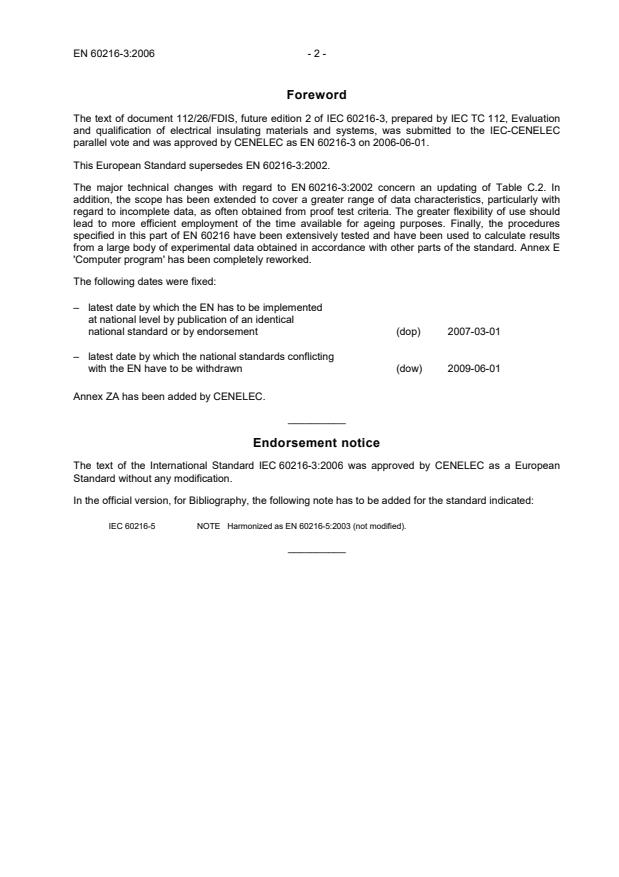
Foreword
The text of document 112/26/FDIS, future edition 2 of IEC 60216-3, prepared by IEC TC 112, Evaluation
and qualification of electrical insulating materials and systems, was submitted to the IEC-CENELEC
parallel vote and was approved by CENELEC as EN 60216-3 on 2006-06-01.
This European Standard supersedes EN 60216-3:2002.
The major technical changes with regard to EN 60216-3:2002 concern an updating of Table C.2. In
addition, the scope has been extended to cover a greater range of data characteristics, particularly with
regard to incomplete data, as often obtained from proof test criteria. The greater flexibility of use should
lead to more efficient employment of the time available for ageing purposes. Finally, the procedures
specified in this part of EN 60216 have been extensively tested and have been used to calculate results
from a large body of experimental data obtained in accordance with other parts of the standard. Annex E
'Computer program' has been completely reworked.
The following dates were fixed:
– latest date by which the EN has to be implemented
at national level by publication of an identical
national standard or by endorsement (dop) 2007-03-01
– latest date by which the national standards conflicting
with the EN have to be withdrawn (dow) 2009-06-01
Annex ZA has been added by CENELEC.
__________
Endorsement notice
The text of the International Standard IEC 60216-3:2006 was approved by CENELEC as a European
Standard without any modification.
In the official version, for Bibliography, the following note has to be added for the standard indicated:
IEC 60216-5 NOTE Harmonized as EN 60216-5:2003 (not modified).
__________
- 3 - EN 60216-3:2006
Annex ZA
(normative)
Normative references to international publications
with their corresponding European publications
The following referenced documents are indispensable for the application of this document. For dated
references, only the edition cited applies. For undated references, the latest edition of the referenced
document (including any amendments) applies.
NOTE When an international publication has been modified by common modifications, indicated by (mod), the relevant EN/HD
applies.
Publication Year Title EN/HD Year
IEC 60216-1 2001 Electrical insulating materials - Properties of EN 60216-1 2001
thermal endurance
Part 1: Ageing procedures and evaluation of
test results
IEC 60216-2 2005 Electrical insulating materials - Thermal EN 60216-2 2005
endurance properties
Part 2: Determination of thermal endurance
properties of electrical insulating materials -
Choice of test criteria
IEC 60493-1 1974 Guide for the statistical analysis of ageing - -
test data
Part 1: Methods based on mean values of
normally distributed test results
INTERNATIONAL IEC
STANDARD 60216-3
Second edition
2006-04
Electrical insulating materials –
Thermal endurance properties –
Part 3:
Instructions for calculating thermal
endurance characteristics
IEC 2006 Copyright - all rights reserved
No part of this publication may be reproduced or utilized in any form or by any means, electronic or
mechanical, including photocopying and microfilm, without permission in writing from the publisher.
International Electrotechnical Commission, 3, rue de Varembé, PO Box 131, CH-1211 Geneva 20, Switzerland
Telephone: +41 22 919 02 11 Telefax: +41 22 919 03 00 E-mail: inmail@iec.ch Web: www.iec.ch
PRICE CODE
Commission Electrotechnique Internationale X
International Electrotechnical Commission
МеждународнаяЭлектротехническаяКомиссия
For price, see current catalogue
– 2 – 60216-3 IEC:2006(E)
CONTENTS
FOREWORD.4
1 Scope.6
2 Normative references .6
3 Terms, definitions, symbols and abbreviated terms.6
4 Principles of calculations .10
4.1 General principles .10
4.2 Preliminary calculations.10
4.3 Variance calculations .11
4.4 Statistical tests.12
4.5 Results.12
5 Requirements and recommendations for valid calculations .13
5.1 Requirements for experimental data .13
5.2 Precision of calculations.13
6 Calculation procedures.13
6.1 Preliminary calculations.13
6.2 Main calculations.17
6.3 Statistical tests.19
6.4 Thermal endurance graph .21
7 Calculation and requirements for results.21
7.1 Calculation of thermal endurance characteristics.21
7.2 Summary of statistical tests and reporting .22
7.3 Reporting of results .22
8 Test report.22
Annex A (normative) Decision flow chart.24
Annex B (normative) Decision table .25
Annex C (informative) Statistical tables.26
Annex D (informative) Worked examples .35
Annex E (informative) Computer program .42
Bibliography.50
Figure D.1 – Thermal endurance graph.39
Figure D.2 – Example 3: Property-time graph (destructive test data).41
Table B.1 – Decisions and actions according to tests.25
Table C.1 – Coefficients for censored data calculations .26
Table C.2 – Fractiles of the F-distribution, F(0,95 ,f ,f ).32
n d
Table C.3 – Fractiles of the F-distribution, F(0,995 ,f ,f ) .33
n d
Table C.4 –Fractiles of the t-distribution, t .34
0,95
Table C.5 – Fractiles of the χ -distribution.34
60216-3 IEC:2006(E) – 3 –
Table D.1 – Worked example 1 – Censored data (proof tests).35
Table D.2 – Worked example 2 – Complete data (non-destructive tests) .37
Table D.3 – Worked example 3 – Destructive tests .40
Table E.1 – Non-destructive test data .43
Table E.2 – Destructive test data .44
– 4 – 60216-3 IEC:2006(E)
INTERNATIONAL ELECTROTECHNICAL COMMISSION
____________
ELECTRICAL INSULATING MATERIALS –
THERMAL ENDURANCE PROPERTIES –
Part 3: Instructions for calculating thermal
endurance characteristics
FOREWORD
1) The International Electrotechnical Commission (IEC) is a worldwide organization for standardization comprising
all national electrotechnical committees (IEC National Committees). The object of IEC is to promote
international co-operation on all questions concerning standardization in the electrical and electronic fields. To
this end and in addition to other activities, IEC publishes International Standards, Technical Specifications,
Technical Reports, Publicly Available Specifications (PAS) and Guides (hereafter referred to as “IEC
Publication(s)”). Their preparation is entrusted to technical committees; any IEC National Committee interested
in the subject dealt with may participate in this preparatory work. International, governmental and non-
governmental organizations liaising with the IEC also participate in this preparation. IEC collaborates closely
with the International Organization for Standardization (ISO) in accordance with conditions determined by
agreement between the two organizations.
2) The formal decisions or agreements of IEC on technical matters express, as nearly as possible, an international
consensus of opinion on the relevant subjects since each technical committee has representation from all
interested IEC National Committees.
3) IEC Publications have the form of recommendations for international use and are accepted by IEC National
Committees in that sense. While all reasonable efforts are made to ensure that the technical content of IEC
Publications is accurate, IEC cannot be held responsible for the way in which they are used or for any
misinterpretation by any end user.
4) In order to promote international uniformity, IEC National Committees undertake to apply IEC Publications
transparently to the maximum extent possible in their national and regional publications. Any divergence
between any IEC Publication and the corresponding national or regional publication shall be clearly indicated in
the latter.
5) IEC provides no marking procedure to indicate its approval and cannot be rendered responsible for any
equipment declared to be in conformity with an IEC Publication.
6) All users should ensure that they have the latest edition of this publication.
7) No liability shall attach to IEC or its directors, employees, servants or agents including individual experts and
members of its technical committees and IEC National Committees for any personal injury, property damage or
other damage of any nature whatsoever, whether direct or indirect, or for costs (including legal fees) and
expenses arising out of the publication, use of, or reliance upon, this IEC Publication or any other IEC
Publications.
8) Attention is drawn to the Normative references cited in this publication. Use of the referenced publications is
indispensable for the correct application of this publication.
9) Attention is drawn to the possibility that some of the elements of this IEC Publication may be the subject of
patent rights. IEC shall not be held responsible for identifying any or all such patent rights.
International Standard IEC 60216-3 has been prepared by IEC technical committee 112:
Evaluation and qualification of electrical insulating materials and systems .
This second edition of IEC 60216-3 cancels and replaces the first edition, published in 2002,
and constitutes a technical revision.
The major technical changes with regard to the first edition concern an updating of Table C.2.
In addition, the scope has been extended to cover a greater range of data characteristics,
particularly with regard to incomplete data, as often obtained from proof test criteria. The
greater flexibility of use should lead to more efficient employment of the time available for
ageing purposes. Finally, the procedures specified in this part of IEC 60216 have been
extensively tested and have been used to calculate results from a large body of experimental
data obtained in accordance with other parts of the standard. Annex E “Computer program”
has been completely reworked.
—————————
Provisional title: IEC technical committee 112 has been formed out of a merger between subcommittee 15E and
technical committee 98.
60216-3 IEC:2006(E) – 5 –
The text of this standard is based on the following documents:
FDIS Report on voting
112/26/FDIS 112/29/RVD
Full information on the voting for the approval of this standard can be found in the report on
voting indicated in the above table.
This publication has been drafted in accordance with the ISO/IEC Directives, Part 2.
IEC 60216 consists of the following parts, under the general title Electrical insulating
materials – Thermal endurance properties :
Part 1: Ageing procedures and evaluation of test results
Part 2: Determination of thermal endurance properties of electrical insulating materials –
Choice of test criteria
Part 3: Instructions for calculating thermal endurance characteristics
Part 4: Ageing ovens
Part 5: Determination of relative thermal endurance index (RTE) of an insulating material
Part 6: Determination of thermal endurance indices (TI and RTE) of an insulating material
using the fixed time frame method
NOTE This series may be extended. For revisions and new parts, see the current catalogue of IEC publications
for an up-to-date list.
The committee has decided that the contents of this publication will remain unchanged until
the maintenance result date indicated on the IEC web site under "http://webstore.iec.ch" in
the data related to the specific publication. At this date, the publication will be
• reconfirmed;
• withdrawn;
• replaced by a revised edition, or
• amended.
A CD-ROM containing the computer program and data files referred to in Annex E is affixed to
the back cover of this publication.
A bilingual version of this publication may be issued at a later date.
—————————
Titles of existing parts in this series will be updated at the time of their next revision.
– 6 – 60216-3 IEC:2006(E)
ELECTRICAL INSULATING MATERIALS –
THERMAL ENDURANCE PROPERTIES –
Part 3: Instructions for calculating thermal
endurance characteristics
1 Scope
This part of IEC 60216 specifies the calculation procedures to be used for deriving thermal
endurance characteristics from experimental data obtained in accordance with the instructions
of IEC 60216-1 and IEC 60216-2, using fixed ageing temperatures and variable ageing times.
The experimental data may be obtained using non-destructive, destructive or proof tests. Data
obtained from non-destructive or proof tests may be incomplete, in that measurement of times
taken to reach the endpoint may have been terminated at some point after the median time
but before all specimens have reached end-point.
The procedures are illustrated by worked examples, and suitable computer programs are
recommended to facilitate the calculations.
2 Normative references
The following referenced documents are indispensable for the application of this document.
For dated references, only the edition cited applies. For undated references, the latest edition
of the referenced document (including any amendments) applies.
IEC 60216-1:2001, Electrical insulating materials – Properties of thermal endurance – Part 1:
Ageing procedures and evaluation of test results
IEC 60216-2:2005, Electrical insulating materials – Properties of thermal endurance – Part 2:
Determination of thermal endurance properties of electrical insulating materials – Choice of
test criteria
IEC 60493-1:1974, Guide for the statistical analysis of ageing test data – Part 1: Methods
based on mean values of normally distributed test results
3 Terms, definitions, symbols and abbreviated terms
3.1 Terms and definitions
For the purposes of this document, the following definitions apply.
3.1.1
ordered data
group of data arranged in sequence so that in the appropriate direction through the sequence
each member is greater than, or equal to, its predecessor
NOTE 1 In this standard, ascending order implies that the data is ordered in this way, the first being the smallest.
NOTE 2 It has been established that the term “group” is used in the theoretical statistics literature to represent a
subset of the whole data set. The group comprises those data having the same value of one of the parameters of
the set (e.g. ageing temperature). A group may itself comprise a number of sub-groups characterised by another
parameter (e.g. time in the case of destructive tests).
60216-3 IEC:2006(E) – 7 –
3.1.2
order-statistic
each individual value in a group of ordered data is referred to as an order-statistic identified
by its numerical position in the sequence
3.1.3
incomplete data
ordered data, where the values above and/or below defined points are not known
3.1.4
censored data
incomplete data, where the number of unknown values is known.
NOTE 1 If the censoring is begun above/below a specified numerical value, the censoring is Type I.
If above/below a specified order-statistic it is Type II This standard is concerned only with Type II.
3.1.5
degrees of freedom
number of data values minus the number of parameter values
3.1.6
variance of a data group
sum of the squares of the deviations of the data from a reference level.
NOTE 1 The reference level may be defined by one or more parameters, for example a mean value (one
parameter) or a line (two parameters, slope and intercept), divided by the number of degrees of freedom
3.1.7
central second moment of a data group
sum of the squares of the differences between the data values and the value of the group
mean, divided by the number of data in the group
3.1.8
covariance of data groups
for two groups of data with equal numbers of elements where each element in one group
corresponds to one in the other, the sum of the products of the deviations of the
corresponding members from their group means, divided by the number of degrees of
freedom
3.1.9
regression analysis
process of deducing the best-fit line expressing the relation of corresponding members of two
data groups by minimizing the sum of squares of deviations of members of one of the groups
from the line
NOTE The parameters are referred to as the regression coefficients.
3.1.10
correlation coefficient
number expressing the completeness of the relation between members of two data groups,
equal to the covariance divided by the square root of the product of the variances of the
groups
NOTE The value of its square is between 0 (no correlation) and 1 (complete correlation).
3.1.11
end-point line
line parallel to the time axis intercepting the property axis at the end-point value
– 8 – 60216-3 IEC:2006(E)
3.2 Symbols and abbreviated terms
Subclause
a Regression coefficient (y-intercept) 4.3, 6.2
a Regression coefficient for destructive test calculations 6.1
p
b Regression coefficient (slope) 4.3, 6.2
b Regression coefficient for destructive test calculations 6.1
p
ˆ
b Intermediate constant (calculation of X) 6.3
r
c
c Intermediate constant (calculation of χ) 6.3
f Number of degrees of freedom Tables C.2 to C5
F Fisher distributed stochastic variable 4.2, 6.1, 6.3
F Tabulated value of F (linearity of thermal endurance graph) 4.4, 6.3
F Tabulated value of F (linearity of property graph – significance 0,05) 6.1
F Tabulated value of F (linearity of property graph – significance 0,005) 6.1
g Order number of ageing time for destructive tests 6.1
h Order number of property value for destructive tests 6.1
HIC Halving interval at temperature equal to TI 4.3, 7
HIC Halving interval corresponding to TI 7.3
g g
i Order number of exposure temperature 4.1, 6.2
j Order number of time to end-point 4.1, 6.2
k Number of ageing temperatures 4.1, 6.2
m Number of specimens aged at temperature ϑ 4.1, 6.1
i i
N Total number of times to end-point 6.2
n Number of property values in group aged for time τ 6.1
g g
n Number of values of y at temperature ϑ 4.1, 6.1
i i
p Mean value of property values in selected groups 6.1
p Value of diagnostic property 6.1
P Significance level of χ distribution 4.4, 6.3.1
p Value of diagnostic property at end-point for destructive tests 6.1
e
p Mean of property values in group aged for time τ 6.1
g g
p Individual property value 6.1
gh
q Base of logarithms 6.3
r Number of ageing times selected for inclusion in calculation
(destructive tests) 6.1
r Square of correlation coefficient 6.2.3
2 2
s Weighted mean of s and s 6.3
1 2
2 2
s Weighted mean of s , pooled variance within selected groups 4.3, 6.1 - 6.3
1i
2 2
(s ) Adjusted value of s 4.4, 6.3
a 1
s Variance of property values in group aged for time τ 6.1
g
1g
s Variance of y values at temperature ϑ 4.3, 6.2
ij i
1i
s Variance about regression line 6.1 - 6.3
s Adjusted value of s 6.3
a
60216-3 IEC:2006(E) – 9 –
s Intermediate constant 6.3
r
Variance of Y 6.3
s
Y
t Student distributed stochastic variable 6.3
t Adjusted value of t (incomplete data) 6.3
c
TC Lower 95 % confidence limit of TI 4.4, 7
TC Adjusted value of TC 7.1
a
TI Temperature Index 4.3, 7
TI Temperature Index at 10 kh 7.1
TI Adjusted value of TI 7.3
a
TI Temperature index obtained by graphical means or
g
without defined confidence limits 7.3
x Independent variable: reciprocal of thermodynamic temperature
x Weighted mean value of x 6.2
X Specified value of x for estimation of y 6.3
ˆ
X Estimated value of x at specified value of y 6.3
ˆ ˆ
X Upper 95 % confidence limit of X 6.3
c
x Reciprocal of thermodynamic temperature corresponding to ϑ 4.1, 6.1
i i
y Weighted mean value of y 6.2
y Dependent variable: logarithm of time to end-point
ˆ
Y Estimated value of y at specified value of x 6.3
Y Specified value of y for estimation of x 6.3
ˆ ˆ
Y Lower 95 % confidence limit of Y 6.3
c
y Mean values of y at temperature ϑ 4.3, 6.2
i ij i
y Value of y corresponding to τ 4.1, 6.1
ij ij
z Mean value of z 6.1
g
z Logarithm of ageing time for destructive tests – group g 6.1
g
α Censored data coefficient for variance 4.3, 6.2
β Censored data coefficient for variance 4.3, 6.2
ε Censored data coefficient for variance of mean 4.3, 6.2
Θ The temperature 0 °C on the thermodynamic scale (273,15 K) 4.1, 6.1
ˆ
ϑ Estimate of temperature for temperature index 6.3.3
ˆ ˆ
ϑ Confidence limit of ϑ 6.3.3
c
ϑ Ageing temperature for group i 4.1, 6.1
i
µ Censored data coefficient for mean 4.3, 6.2
µ (x) Central second moment of x values 6.2, 6.3
ν Total number of property values selected at one ageing temperature 6.1
τ Time selected for estimate of temperature 6.3
f
τ Times to end-point 6.4
ij
2 2
χ χ -distributed stochastic variable 6.3
– 10 – 60216-3 IEC:2006(E)
4 Principles of calculations
4.1 General principles
The general calculation procedures and instructions given in Clause 6 are based on the principles
set out in IEC 60493-1. These may be simplified as follows (see 3.7.1 of IEC 60493-1:1974):
a) the relation between the mean of the logarithms of the times taken to reach the specified
end-point (times to end-point) and the reciprocal of the thermodynamic (absolute)
temperature is linear;
b) the values of the deviations of the logarithms of the times to end-point from the linear
relation are normally distributed with a variance which is independent of the ageing
temperature.
The data used in the general calculation procedures are obtained from the experimental data
by a preliminary calculation. The details of this calculation are dependent on the character of
the diagnostic test: non-destructive, proof or destructive (see 4.2). In all cases the data
comprise values of x, y, m, n and k
where
x = 1/(ϑ + Θ ) is the reciprocal of thermodynamic value of ageing temperature ϑ in °C;
i i 0 i
y = log τ is the logarithm of value of time (j) to end-point at temperature ϑ ;
ij ij i
n is the number of y values in group number i aged at temperature ϑ ;
i i
m is the number of samples in group number i aged at temperature ϑ (different from n for
i i i
censored data);
k is the number of ageing temperatures or groups of y values.
NOTE Any number may be used as the base for logarithms, provided consistency is observed throughout
calculations. The use of natural logarithms (base e) is recommended, since most computer programming
languages and scientific calculators have this facility.
4.2 Preliminary calculations
In all cases, the reciprocals of the thermodynamic values of the ageing temperatures are
calculated as the values of x .
i
The values of y are calculated as the values of the logarithms of the individual times to end-
ij
point τ obtained as described below.
ij
In many cases of non-destructive and proof tests, it is advisable for economic reasons, (for
example, when the scatter of the data is high) to stop ageing before all specimens have
reached the end-point, at least for some temperature groups. In such cases, the procedure for
calculation on censored data (see 6.2.1.2) shall be carried out on the (x, y) data available.
Groups of complete and incomplete data or groups censored at a different point for each
ageing temperature may be used together in one calculation in 6.2.1.2.
4.2.1 Non-destructive tests
Non-destructive tests (for example, loss of mass on ageing) give directly the value of the
diagnostic property of each specimen each time it is measured at the end of an ageing period.
The time to end-point τ is therefore available, either direct or by linear interpolation between
ij,
consecutive measurements.
60216-3 IEC:2006(E) – 11 –
4.2.2 Proof tests
The time to end-point τ for an individual specimen is taken as the mid-point of the ageing
ij
period immediately prior to reaching the end-point (6.3.2 of IEC 60216-1:2001).
4.2.3 Destructive tests
When destructive test criteria are employed, each test specimen is destroyed in obtaining a
property value and its time to end-point cannot therefore be measured directly.
To enable estimates of the times to end-point to be obtained, the assumptions are made that
in the vicinity of the endpoint:
a) the relation between the mean property values and the logarithm of the ageing time is
approximately linear;
b) the values of the deviations of the individual property values from this linear relation are
normally distributed with a variance which is independent of the ageing time;
c) the curves of property versus logarithm of time for the individual test specimens are
straight lines parallel to the line representing the relation of a) above.
For application of these assumptions, an ageing curve is drawn for the data obtained at each
of the ageing times. The curve is obtained by plotting the mean value of property for each
specimen group against the logarithm of its ageing time. If possible, ageing is continued at
each temperature until at least one group mean is beyond the end-point level. An
approximately linear region of this curve is drawn in the vicinity of the end-point line (see
Figure D.2).
A statistical test (F-test) is carried out to decide whether deviations from linearity of the
selected region are acceptable (see 6.1.4.4). If acceptable, then, on the same graph, points
representing the properties of the individual specimens are drawn. A line parallel to the
ageing line is drawn through each individual specimen data point. The estimate of
the logarithm of the time to end-point for that specimen (y ) is then the value of the logarithm
ij
of time corresponding to the intersection of the line with the end-point line (Figure D.2).
With some limitations, an extrapolation of the linear mean value graph to the end-point level is
permitted.
The above operations are executed numerically in the calculations detailed in 6.1.4.
4.3 Variance calculations
Commencing with the values of x and y obtained as above, the following calculations are
made:
For each group of y values, the mean y and variance s are calculated, and from the latter
ij
i
1i
the pooled variance within the groups, s , is derived, weighting the groups according to size.
For incomplete data, the calculations have been developed from those originated by Saw [1]
and given in 6.2.1.2. The coefficients required (µ for mean, α, β for variance and ε for deriving
the variance of mean from the group variance) are given in Table C.1. For multiple groups,
the variances are pooled, weighting according to the group size. The mean value of the group
values of ε is obtained without weighting, and multiplied by the pooled variance.
NOTE The weighting according to the group size is implicit in the definition of ε, which here is equal to that
originally proposed by Saw, multiplied by the group size. This makes for simpler representation in equations.
—————————
Figures in square brackets refer to the bibliography.
– 12 – 60216-3 IEC:2006(E)
From the means y and the values of x , the coefficients a and b (the coefficients of the best
i
i
fit linear representation of the relationship between x and y) are calculated by linear
regression analysis.
From the regression coefficients, the values of TI and HIC are calculated. The variance of
the deviations from the regression line is calculated from the regression coefficients and the
group means.
4.4 Statistical tests
The following statistical tests are made:
a) Fisher test for linearity (Fisher test, F-test) on destructive test data prior to the calculation
of estimated times to end-point (see 4.2.3);
b) variance equality (Bartlett's χ -test) to establish whether the variances within the groups of
y values differ significantly;
c) F-test to establish whether the ratio of the deviations from the regression line to the
pooled variance within the data groups is greater than the reference value F , i.e. to test
the validity of the Arrhenius hypothesis as applied to the test data.
In the case of data of very small dispersion, it is possible for a non-linearity to be detected as
statistically significant which is of little practical importance.
In order that a result may be obtained even where the requirements of the F-test are not met
for this reason, a procedure is included as follows:
1) increase the value of the pooled variance within the groups (s ) by the factor F/F so that
1 0
the F-test gives a result which is just acceptable (see 6.3.2);
2) use this adjusted value (s ) to calculate the lower confidence limit TC of the result;
a
a
3) if the lower confidence interval (TI – TC ) is found acceptable, the non-linearity is deemed
a
to be of no practical importance (see 6.3.2);
2 2
4) from the components of the data dispersion, (s ) and (s ) the confidence interval of an
1 2
estimate is calculated using the regression equation.
When the temperature index (TI), its lower confidence limit (TC) and the halving interval (HIC)
have been calculated, (see 7.1), the result is considered acceptable if
TI – TC ≤ 0,6 HIC (1)
When the lower confidence interval (TI – TC) exceeds 0,6 HIC by a small margin, a usable
result may still be obtained, provided F ≤ F , by substituting (TC + 0,6 HIC) for the value of TI
(see Clause 7).
4.5 Results
The temperature index (TI), its halving interval (HIC) and its lower 95 % confidence limit (TC)
are calculated from the regression equation, making allowance as described above for minor
deviations from the prescribed results of the statistical tests.
The mode of reporting of the temperature index and halving interval is determined by the
results of the statistical tests (see 7.2).
It is necessary to emphasize the need to present the thermal endurance graph as part of the
report, since a single numerical result, TI (HIC), cannot present an overall qualitative view of
the test data, and appraisal of the data cannot be complete without this.
60216-3 IEC:2006(E) – 13 –
5 Requirements and recommendations for valid calculations
5.1 Requirements for experimental data
The data submitted to the procedures of this standard shall conform to the requirements of
5.1 to 5.8 of IEC 60216-1:2001.
5.1.1 Non-destructive tests
For most diagnostic properties in this category, groups of five specimens will be adequate.
However, if the data dispersion (confidence interval, see 6.3.3) is found to be too great, more
satisfactory results are likely to be obtained by using a greater number of specimens. This is
particularly true if it is necessary to terminate ageing before all specimens have reached end-
point.
5.1.2 Proof tests
Not more than one specimen in any group shall reach end-point during the first ageing period:
if more than one group contains such a specimen, the experimental procedure should be
carefully examined (see 6.1.3) and the occurrence included in the test report.
The number of specimens in each group shall be at least five, and for practical reasons the
maximum number treatable is restricted to 31 (Table C.1). The recommended number for
most purposes is 21.
5.1.3 Destructive tests
At each temperature, ageing should be continued until the property value mean of at least one
group is above and at least one below the end-point level. In some circumstances, and with
appropriate limitations, a small extrapolation of the property value mean past the end-point
level may be permitted (see 6.1.4.4). This shall not be permitted for more than one
temperature group.
5.2 Precision of calculations
Many of the calculation steps involve summing of the differences of numbers or the squares
of these differences, where the differences may be small by comparison with the numbers. In
these circumstances it is necessary that the calculations be made with an internal precision of
at least six significant digits, and preferably more, to achieve a result precision of three
significant digits. In view of the repetitive and tedious nature of the calculations, it is strongly
recommended that they be performed using a programmable calculator or microcomputer, in
which case internal precision of ten or more significant digits is easily available.
6 Calculation procedures
6.1 Preliminary calculations
6.1.1 Temperatures and x-values
For all types of test, express each ageing temperature in K on the thermodynamic
temperature scale, and calculate its reciprocal for use as x :
i
x = 1/(ϑ + Θ) (2)
i i 0
where Θ = 273, 15 K.
– 14 – 60216-3 IEC:2006(E)
6.1.2 Non-destructive tests
For specimen number j of group number i a property value after each ageing period is
obtained. From these values, if necessary by linear interpolation, obtain the time to end-point
and calculate its logarithm as y .
ij
6.1.3 Proof tests
For specimen number j of group number i calculate the mid point of the ageing period
immediately prior to reaching the end-point and take the logarithm of this time as y .
ij
A time to end-point within the first ageing period shall be treated as invalid. Either:
a) start again with a new group of specimens, or
b) ignore the specimen and reduce the value ascribed to the number of specimens in the
group (m ) by one in the calculation for group means and variances (see 6.2.1.2).
i
If the end-point is reached for more than one specimen during the first period, discard the
group and test a further group, paying particular attention to any critical points of experimental
procedure.
6.1.4 Destructive tests
Within the groups of specimens aged at each temperature ϑ, carry out the procedures
i
described in 6.1.4.1 to 6.1.4.5.
NOTE The subscript i is omitted from the expressions in 6.1.4.2 to 6.1.4.4 in order to avoid confusing multiple
subscript combinations in print. The calculations of these subclauses shall be carried out separately on the data
from each ageing temperature.
6.1.4.1 Calculate the mean property value for the data group obtained at each ageing time
and the logarithm of the ageing time. Plot these values on a graph with the property value p
as ordinate and the logarithm of the ageing time z as abscissa (see Figure D.2). Fit by visual
means a smooth curve through the mean property points.
6.1.4.2 Select a time range within which the curve so fitted is approximately linear
(see 6.1.4.4). Ensure that this time range includes at least three mean property values with at
least one point on each side of the end-point line p = p . If this is not the case, and further
e
measurements at greater times cannot be made (for example, because no specimens
remain), a small extrapolation is permitted, subject to the conditions of 6.1.4.4.
Let the number of selected mean values (and corresponding value groups) be r, the
logarithms of the individual ageing times be z and the individual property values be p ,
g gh
where
g = 1 . r is the order number of the selected group tested at time τ ;
g
h = 1 . n is the order number of the property value within group number g;
g
n is the number of property values in group number g.
g
In most cases, the number n of specimens tested at each test time is identical, but this is not
g
a necessary condition, and the calculation can be carried out with different values of n for
g
different groups.
Calculate the mean value p and the variance s for each selected property value group.
g
1g
n
g
p = p / n (3)
g ∑ gh g
h=1
60216-3 IEC:2006(E) – 15 –
n
g
2 2 2
s = p − n p ()n − 1 (4)
g g g
1g ∑ gh
h =1
Calculate the logarithms of τ :
g
z = log τ (5)
g g
6.1.4.3 Calculate the values
r
ν = n (6)
g
∑
g =1
r
z = z n /ν (7)
g g
∑
g =1
r
p = p n /ν (8)
∑
g g
g=1
Calculate the coefficients of the regression equation p = a + b z
p p
r
n z p −ν z p
g g g
∑
g =1
= (9)
b
p
r
2 2
n z −ν z
g g
∑
g =1
a = p − b z (10)
p p
Calculate the pooled variance within the property groups
r
2 2
s = ()n −1 (s /()ν − r 11)
g
∑
1 1g
g =1
Calculate the weighted variance of the deviations of the property group means from the
regression line
r
2 2
ˆ
() ()
s = n p − p / r − 2 (12)
∑
g g g
g =1
ˆ
where p = a + b z (13)
g P P g
– 16 – 60216-3 IEC:2006(E)
This may also be expressed as
r r
2 2 2
s = n p −ν p − b n z p −ν z p ()r − 2 (14)
g g P g g g
∑ ∑
2
g =1 g =1
6.1.4.4 Make the F-test for non-linearity at significance level 0,05 by calculating
2 2
F = s / s (15)
2 1
If the calculated value of F exceeds the tabulated value F with f = r – 2 and f = ν – r
1 n d
degrees of freedom (see Table C.2).
F = F(0,95, r – 2, ν – r)
change the selection in 6.1.4.2 and repeat the calculations.
If it is not possible to satisfy the F-test on the significance level 0,05 with r ≥ 3, make the
F-test at a significance level 0,005 by comparing the calculated value of F with the tabulated
value F with f = r – 2 and f = ν – r degrees of freedom (see Table C.3).
2 n d
F = F(0,995, r – 2, ν – r)
If the test is satisfied at this level, the calculations may be continued, but the adjustment of TI
according to 7.3.2 is not permitted.
If the F-test on significance level 0,005 (i.e. F ≤ F ) cannot be satisfied, or the property points
plotted according to 6.1.4.1 are all on the same side of the end-point line, an extrapolation
may be permitted, subject to the following condition.
If the F-test on significance level 0,05 can be met for a range of values (with r ≥ 3) where all
mean values p are on the same side of the end-point value p , an extrapolation may be
g e
made provided that the absolute value of the difference between the end-point value p and
e
the mean value p closest to the end-point (usually p ) is less than 0,25 of the absolute
g r
value of the difference ()p − p .
1 r
In this case, calculations can be continued, but again it is not permitted to carry out the
adjustm
...