

FprEN IEC 63177:2024
(Main)Test methods for compatibility of construction materials with electrical insulating liquids
General Information
- Abstract
IEC 63177:2024 specifies the test method for the compatibility of construction materials with electrical insulating liquids for use in electrical equipment, such as liquid-immersed transformers and tap-changers, liquid-impregnated capacitors, and liquid-cooled rotating machines used in electrical vehicles and oil pumps. This document is applicable to mineral insulating liquids, natural esters, silicone insulating liquids, synthetic organic esters, modified esters, capacitor fluids based on synthetic aromatic hydrocarbons and e-transmission fluids used in electrical vehicles and oil pumps. The compatibility tests are not sufficient for a full qualification of construction materials for a given application without additional tests requested by the appropriate IEC Technical Committee or equipment manufacturers.
- Status
- Not Published
- Publication Date
- 09-Jun-2024
- Technical Committee
- CLC/SR 112 - Evaluation and qualification of electrical insulating materials and systems (to be defined)
- Drafting Committee
- IEC/TC 112 - IEC_TC_112
- Current Stage
- 5060 - Voting results sent to TC, SR - Formal Approval
- Start Date
- 08-Mar-2024
- Completion Date
- 08-Mar-2024

Overview
FprEN IEC 63177:2024 establishes standardized test methods to assess the compatibility of construction materials with electrical insulating liquids used in electrical equipment. Developed by CLC in close alignment with IEC, this standard serves manufacturers and stakeholders involved with devices such as liquid-immersed transformers, tap-changers, liquid-impregnated capacitors, and liquid-cooled rotating machines - including those used in electric vehicles and oil pumps. The document provides essential guidance to ensure that new and existing combinations of materials and insulating liquids perform reliably under demanding operational conditions.
Key Topics
Scope of Compatibility Testing: The standard covers the compatibility assessment of a broad spectrum of electrical insulating liquids, including:
- Mineral insulating oils
- Natural esters
- Synthetic organic and modified esters
- Silicone insulating liquids
- Capacitor fluids (based on synthetic aromatic hydrocarbons)
- E-transmission fluids for electric vehicles and oil pumps
Test Methodology: FprEN IEC 63177:2024 describes procedures for the sampling, pre-treatment, and conditioning of both liquid and solid test specimens. This includes clear instructions for preparing materials, exposure durations, and test intervals matched to the type of equipment and application.
Evaluation Focus: The core focus is on the chemical compatibility between construction materials (such as gaskets, resins, coatings, and wires) and insulating liquids, providing a measure of material stability and performance over time. While these compatibility tests are essential, they are not a full qualification and should be complemented by additional tests as required by equipment standards or manufacturers.
Testing Parameters: The standard references various ISO, IEC, and ASTM test methods for measuring key parameters such as breakdown voltage, interfacial tension, dielectric dissipation factor, acidity, and water content.
Applications
FprEN IEC 63177:2024 is designed for practical implementation throughout the electrical and power engineering industry:
- Equipment Manufacturing: Assists manufacturers in selecting construction materials that are compatible with specific insulating liquids, reducing the risk of early failures due to chemical incompatibility.
- Design of Liquid-Immersed Devices: Supports the design and maintenance of transformers, capacitors, and rotating machines, especially as industries move toward alternative insulating liquids to address environmental and performance challenges.
- Electric Vehicles (EVs): Provides a framework for testing materials in liquid-cooled rotating machinery and e-transmission systems, which are increasingly integral to modern EV technology.
- Quality Assurance: Offers standardized methods for equipment qualification phases and during ongoing quality assurance processes.
- Research and Development: Facilitates the introduction and validation of novel insulating fluids and the approval of new construction materials for advanced electrical systems.
Related Standards
FprEN IEC 63177:2024 is harmonized with related IEC and ISO standards, ensuring international alignment and compatibility. Key references include:
- IEC 60296: Mineral insulating oils for electrical equipment
- IEC 60156: Determination of breakdown voltage at power frequency
- IEC 60836: Specifications for unused silicone insulating liquids
- IEC 61099: Specifications for synthetic organic esters
- IEC 63012: Modified or blended esters
- IEC 60867: Synthetic aromatic hydrocarbon liquids for capacitors
- ISO 2049: Colour determination for petroleum products
- ASTM D3455: Methods for material compatibility with petroleum-based insulating oils
The standard emphasizes that compatibility testing should be used alongside these referenced methods for a comprehensive material qualification process, tailored to the precise requirements of each application.
By following FprEN IEC 63177:2024, organizations ensure best practices for material selection, reducing risk and improving the reliability and safety of electrical equipment operating with modern insulating liquids. This standard is essential for anyone involved in the engineering, design, manufacturing, or maintenance of liquid-filled electrical apparatus.
Get Certified
Connect with accredited certification bodies for this standard

IMQ S.p.A. (Certification)
Italian electrical product certification.

SLG Prüf- und Zertifizierungs GmbH
German testing and certification body.

UL Solutions
Global safety science company with testing, inspection and certification.
Sponsored listings
Frequently Asked Questions
FprEN IEC 63177:2024 is a draft published by CLC. Its full title is "Test methods for compatibility of construction materials with electrical insulating liquids". This standard covers: IEC 63177:2024 specifies the test method for the compatibility of construction materials with electrical insulating liquids for use in electrical equipment, such as liquid-immersed transformers and tap-changers, liquid-impregnated capacitors, and liquid-cooled rotating machines used in electrical vehicles and oil pumps. This document is applicable to mineral insulating liquids, natural esters, silicone insulating liquids, synthetic organic esters, modified esters, capacitor fluids based on synthetic aromatic hydrocarbons and e-transmission fluids used in electrical vehicles and oil pumps. The compatibility tests are not sufficient for a full qualification of construction materials for a given application without additional tests requested by the appropriate IEC Technical Committee or equipment manufacturers.
IEC 63177:2024 specifies the test method for the compatibility of construction materials with electrical insulating liquids for use in electrical equipment, such as liquid-immersed transformers and tap-changers, liquid-impregnated capacitors, and liquid-cooled rotating machines used in electrical vehicles and oil pumps. This document is applicable to mineral insulating liquids, natural esters, silicone insulating liquids, synthetic organic esters, modified esters, capacitor fluids based on synthetic aromatic hydrocarbons and e-transmission fluids used in electrical vehicles and oil pumps. The compatibility tests are not sufficient for a full qualification of construction materials for a given application without additional tests requested by the appropriate IEC Technical Committee or equipment manufacturers.
FprEN IEC 63177:2024 is classified under the following ICS (International Classification for Standards) categories: 29.040.01 - Insulating fluids in general; 29.080.99 - Other standards related to insulation. The ICS classification helps identify the subject area and facilitates finding related standards.
FprEN IEC 63177:2024 is available in PDF format for immediate download after purchase. The document can be added to your cart and obtained through the secure checkout process. Digital delivery ensures instant access to the complete standard document.
Standards Content (Sample)
SLOVENSKI STANDARD
oSIST prEN IEC 63177:2023
01-marec-2023
Preskusna metoda za ugotavljanje združljivosti gradbenih materialov z
elektroizolacijskimi tekočinami
Test method for compatibility of construction materials with electrical insulating liquids
Ta slovenski standard je istoveten z: prEN IEC 63177:2023
ICS:
29.040.01 Izolacijski fluidi na splošno Insulating fluids in general
29.080.99 Drugi standardi v zvezi z Other standards related to
izolacijo insulation
oSIST prEN IEC 63177:2023 en
2003-01.Slovenski inštitut za standardizacijo. Razmnoževanje celote ali delov tega standarda ni dovoljeno.
oSIST prEN IEC 63177:2023
oSIST prEN IEC 63177:2023
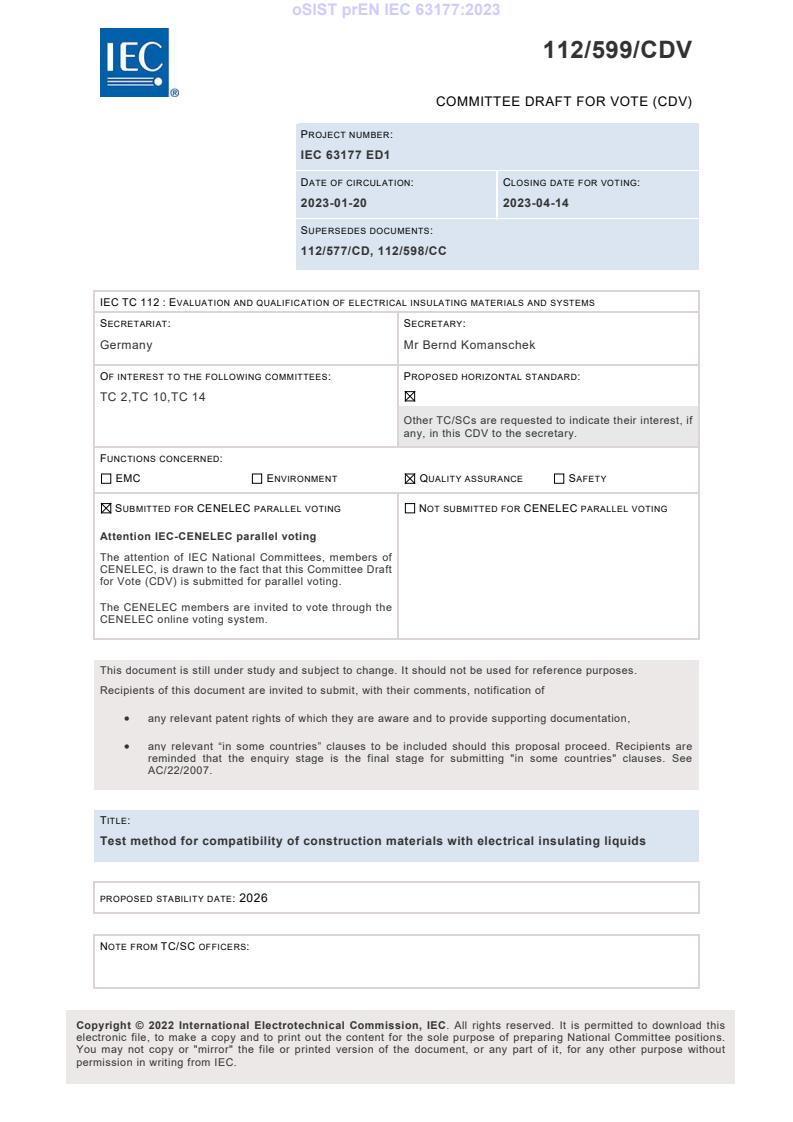
112/599/CDV
COMMITTEE DRAFT FOR VOTE (CDV)
PROJECT NUMBER:
IEC 63177 ED1
DATE OF CIRCULATION: CLOSING DATE FOR VOTING:
2023-01-20 2023-04-14
SUPERSEDES DOCUMENTS:
112/577/CD, 112/598/CC
IEC TC 112 : EVALUATION AND QUALIFICATION OF ELECTRICAL INSULATING MATERIALS AND SYSTEMS
SECRETARIAT: SECRETARY:
Germany Mr Bernd Komanschek
OF INTEREST TO THE FOLLOWING COMMITTEES: PROPOSED HORIZONTAL STANDARD:
TC 2,TC 10,TC 14
Other TC/SCs are requested to indicate their interest, if
any, in this CDV to the secretary.
FUNCTIONS CONCERNED:
EMC ENVIRONMENT QUALITY ASSURANCE SAFETY
SUBMITTED FOR CENELEC PARALLEL VOTING NOT SUBMITTED FOR CENELEC PARALLEL VOTING
Attention IEC-CENELEC parallel voting
The attention of IEC National Committees, members of
CENELEC, is drawn to the fact that this Committee Draft
for Vote (CDV) is submitted for parallel voting.
The CENELEC members are invited to vote through the
CENELEC online voting system.
This document is still under study and subject to change. It should not be used for reference purposes.
Recipients of this document are invited to submit, with their comments, notification of
• any relevant patent rights of which they are aware and to provide supporting documentation,
• any relevant “in some countries” clauses to be included should this proposal proceed. Recipients are
reminded that the enquiry stage is the final stage for submitting "in some countries" clauses. See
AC/22/2007.
TITLE:
Test method for compatibility of construction materials with electrical insulating liquids
PROPOSED STABILITY DATE: 2026
NOTE FROM TC/SC OFFICERS:
electronic file, to make a copy and to print out the content for the sole purpose of preparing National Committee positions.
You may not copy or "mirror" the file or printed version of the document, or any part of it, for any other purpose without
permission in writing from IEC.
oSIST prEN IEC 63177:2023
– 2 – IEC CDV 63177 © IEC:2022
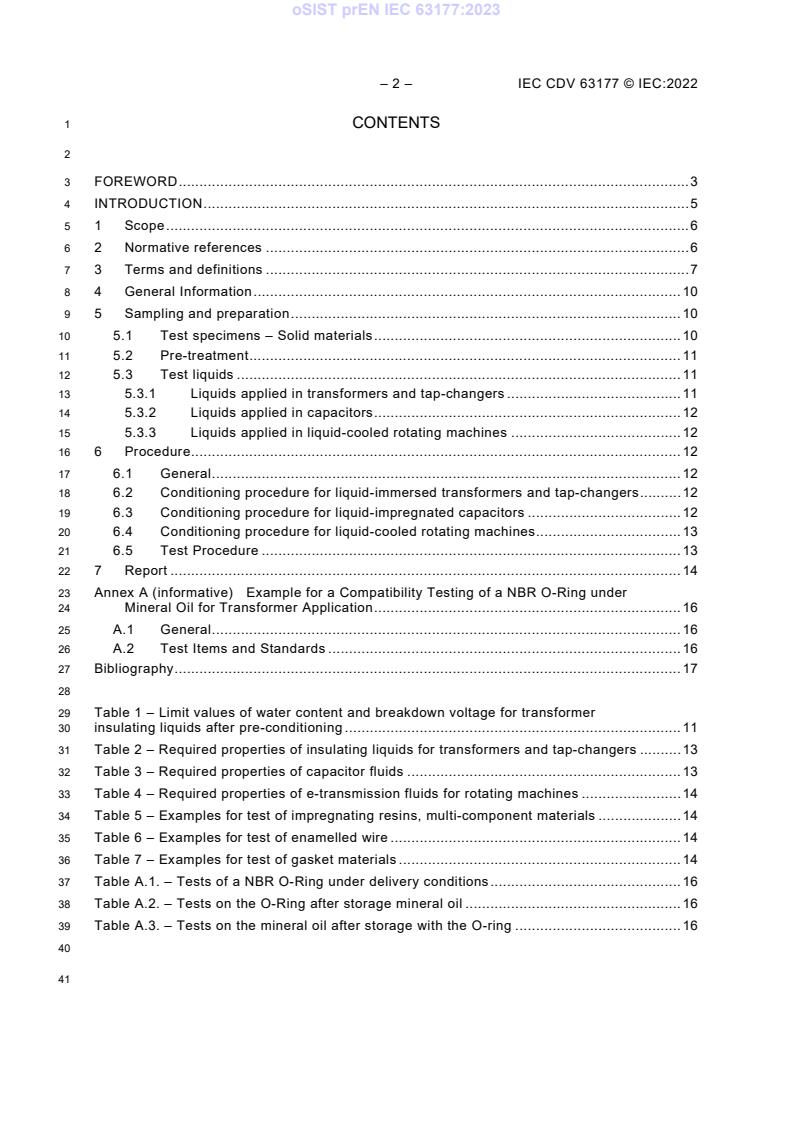
1 CONTENTS
3 FOREWORD . 3
4 INTRODUCTION . 5
5 1 Scope . 6
6 2 Normative references . 6
7 3 Terms and definitions . 7
8 4 General Information . 10
9 5 Sampling and preparation . 10
10 5.1 Test specimens – Solid materials . 10
11 5.2 Pre-treatment . 11
12 5.3 Test liquids . 11
13 5.3.1 Liquids applied in transformers and tap-changers . 11
14 5.3.2 Liquids applied in capacitors . 12
15 5.3.3 Liquids applied in liquid-cooled rotating machines . 12
16 6 Procedure . 12
17 6.1 General . 12
18 6.2 Conditioning procedure for liquid-immersed transformers and tap-changers . 12
19 6.3 Conditioning procedure for liquid-impregnated capacitors . 12
20 6.4 Conditioning procedure for liquid-cooled rotating machines . 13
21 6.5 Test Procedure . 13
22 7 Report . 14
23 Annex A (informative) Example for a Compatibility Testing of a NBR O-Ring under
24 Mineral Oil for Transformer Application . 16
25 A.1 General . 16
26 A.2 Test Items and Standards . 16
27 Bibliography . 17
29 Table 1 – Limit values of water content and breakdown voltage for transformer
30 insulating liquids after pre-conditioning . 11
31 Table 2 – Required properties of insulating liquids for transformers and tap-changers . 13
32 Table 3 – Required properties of capacitor fluids . 13
33 Table 4 – Required properties of e-transmission fluids for rotating machines . 14
34 Table 5 – Examples for test of impregnating resins, multi-component materials . 14
35 Table 6 – Examples for test of enamelled wire . 14
36 Table 7 – Examples for test of gasket materials . 14
37 Table A.1. – Tests of a NBR O-Ring under delivery conditions . 16
38 Table A.2. – Tests on the O-Ring after storage mineral oil . 16
39 Table A.3. – Tests on the mineral oil after storage with the O-ring . 16
oSIST prEN IEC 63177:2023
IEC CDV 63177 © IEC:2022 – 3 –
42 TEST METHODS FOR COMPATIBILITY OF CONSTRUCTION MATERIALS
43 WITH ELECTRICAL INSULATING LIQUIDS
44 ____________
46 FOREWORD
47 1) The International Electrotechnical Commission (IEC) is a worldwide organization for standardization comprising
48 all national electrotechnical committees (IEC National Committees). The object of IEC is to promote international
49 co-operation on all questions concerning standardization in the electrical and electronic fields. To this end and
50 in addition to other activities, IEC publishes International Standards, Technical Specifications, Technical Reports,
51 Publicly Available Specifications (PAS) and Guides (hereafter referred to as “IEC Publication(s)”). Their
52 preparation is entrusted to technical committees; any IEC National Committee interested in the subject dealt with
53 may participate in this preparatory work. International, governmental and non-governmental organizations liaising
54 with the IEC also participate in this preparation. IEC collaborates closely with the International Organization for
55 Standardization (ISO) in accordance with conditions determined by agreement between the two organizations.
56 2) The formal decisions or agreements of IEC on technical matters express, as nearly as possible, an international
57 consensus of opinion on the relevant subjects since each technical committee has representation from all
58 interested IEC National Committees.
59 3) IEC Publications have the form of recommendations for international use and are accepted by IEC National
60 Committees in that sense. While all reasonable efforts are made to ensure that the technical content of IEC
61 Publications is accurate, IEC cannot be held responsible for the way in which they are used or for any
62 misinterpretation by any end user.
63 4) In order to promote international uniformity, IEC National Committees undertake to apply IEC Publications
64 transparently to the maximum extent possible in their national and regional publications. Any divergence between
65 any IEC Publication and the corresponding national or regional publication shall be clearly indicated in the latter.
66 5) IEC itself does not provide any attestation of conformity. Independent certification bodies provide conformity
67 assessment services and, in some areas, access to IEC marks of conformity. IEC is not responsible for any
68 services carried out by independent certification bodies.
69 6) All users should ensure that they have the latest edition of this publication.
70 7) No liability shall attach to IEC or its directors, employees, servants or agents including individual experts and
71 members of its technical committees and IEC National Committees for any personal injury, property damage or
72 other damage of any nature whatsoever, whether direct or indirect, or for costs (including legal fees) and
73 expenses arising out of the publication, use of, or reliance upon, this IEC Publication or any other IEC
74 Publications.
75 8) Attention is drawn to the Normative references cited in this publication. Use of the referenced publications is
76 indispensable for the correct application of this publication.
77 9) Attention is drawn to the possibility that some of the elements of this IEC Publication may be the subject of patent
78 rights. IEC shall not be held responsible for identifying any or all such patent rights.
79 IEC 63177 has been prepared by subcommittee WG 6: general methods of evaluation of
80 electrical insulation systems, of IEC technical committee 112: evaluation and qualification of
81 electrical insulating materials and systems. It is an International Standard.
82 The text of this International Standard is based on the following documents:
Draft Report on voting
112/XX/FDIS 112/XX/RVD
84 Full information on the voting for its approval can be found in the report on voting indicated in
85 the above table.
86 The language used for the development of this International Standard is English.
87 This document was drafted in accordance with ISO/IEC Directives, Part 2, and developed in
88 accordance with ISO/IEC Directives, Part 1 and ISO/IEC Directives, IEC Supplement, available
89 at www.iec.ch/members_experts/refdocs. The main document types developed by IEC are
90 described in greater detail at http://www.iec.ch/standardsdev/publications.
91 The committee has decided that the contents of this document will remain unchanged until the
92 stability date indicated on the IEC website under webstore.iec.ch in the data related to the
93 specific document. At this date, the document will be
oSIST prEN IEC 63177:2023
– 4 – IEC CDV 63177 © IEC:2022
94 • reconfirmed,
95 • withdrawn,
96 • replaced by a revised edition, or
97 • amended.
oSIST prEN IEC 63177:2023
IEC CDV 63177 © IEC:2022 – 5 –
98 INTRODUCTION
99 The objective of the standard is to clarify the evaluation methodology for the compatibility
100 between construction materials and electrical insulating liquids. It provides recommendations
101 for manufacturers, who produce liquid-immersed transformers and tap-changers, liquid-
102 impregnated capacitors, and liquid-cooled rotating machines used in electrical vehicles and oil
103 pumps to screen appropriate construction materials for their use with different liquids under
104 different operating conditions and contains tests for aged liquids and aged construction
105 materials.
106 In the past, limited construction materials and liquids based on mineral oil served the industry
107 needs. Since the industry needs have been advanced with new applications and driven by
108 higher flash points and improved reliability of performance for liquid-filled electrical equipment,
109 it is necessary to be able to evaluate high temperature electrical insulation systems, using
110 silicone oils, synthetic esters, natural esters and other potential suitable insulating liquids.
111 At the same time, liquid-cooled rotating machines used in electrical vehicles and oil pumps also
112 increase the possibility for construction materials to be exposed to different liquids, driven by
113 better thermal conductive performance. To avoid mechanical, electrical and sealing failure for
114 construction materials, such as gasket materials, impregnating resins, prefabricates, etc., the
115 test methods described in this standard can be applied for different liquid-immersed electrical
116 equipment, including liquid-immersed transformers and tap-changers, liquid-impregnated
117 capacitors and liquid-cooled rotating machines used in electrical vehicles and oil pumps.
118 The evaluation process specified in this document focuses on the chemical compatibility
119 between construction materials and liquids but does not provide a long-term thermal or aging
120 evaluation. In addition, threshold values for functional parameters of each material are not
121 specified, as they depend on the requirements of the specific application.
122 Clauses 1 to 5 contain definitions and describe the preparation of suitable solid and liquid test
123 samples.
124 Clause 6 describes the test procedure (e.g. temperatures, test duration and cycles) and gives
125 exemplary guidance on characteristic parameters to be evaluated. This allows an estimate of
126 the basic compatibility of typical construction materials with insulating liquids.
127 Application example is given in Annex A.
oSIST prEN IEC 63177:2023
– 6 – IEC CDV 63177 © IEC:2022
128 TEST METHODS FOR COMPATIBILITY OF CONSTRUCTION MATERIALS
129 WITH ELECTRICAL INSULATING LIQUIDS
132 1 Scope
133 This document specifies the test method for the compatibility of construction materials with
134 electrical insulating liquids for use in electrical equipment, such as liquid-immersed
135 transformers and tap-changers, liquid-impregnated capacitors, and liquid-cooled rotating
136 machines used in electrical vehicles and oil pumps. This document is applicable to mineral
137 insulating liquids, natural esters, silicone insulating liquids, synthetic organic esters, modified
138 esters, capacitor fluids based on synthetic aromatic hydrocarbons and e-transmission fluids
139 used in electrical vehicles and oil pumps. The compatibility tests are not sufficient for a full
140 qualification of construction materials for a given application without additional tests requested
141 by the appropriate IEC Technical Committee or equipment manufacturers.
142 2 Normative references
143 The following documents are referred to in the text in such a way that some or all of their content
144 constitutes requirements of this document. For dated references, only the edition cited applies.
145 For undated references, the latest edition of the referenced document (including any
146 amendments) applies.
147 IEC 60296, Fluids for electrotechnical applications - Mineral insulating oils for electrical
148 equipment
149 IEC 60836, Specifications for unused silicone insulating liquids for electrotechnical purposes
150 IEC 60156, Insulating liquids - Determination of the breakdown voltage at power frequency -
151 Test method
152 IEC 61099, Specifications for unused synthetic organic esters for electrical purposes
153 IEC 63012, Insulating liquids - Unused modified or blended esters for electrotechnical
154 applications
155 IEC 60422, Mineral insulating oils in electrical equipment - Supervision and maintenance
156 guidance
157 IEC 62975, Natural esters - Guidelines for maintenance and use in electrical equipment
158 IEC 60867, Insulating liquids - Specifications for unused liquids based on synthetic aromatic
159 hydrocarbons
160 IEC 62961, Insulating liquids - Test methods for the determination of interfacial tension of
161 insulating liquids - Determination with the ring method
162 IEC 62021-1, Insulating liquids - Determination of acidity - Part 1: Automatic potentiometric
163 titration
164 IEC 62021-2, Insulating liquids - Determination of acidity - Part 2: Colourimetric titration
165 IEC 62021-3, Insulating liquids - Determination of acidity - Part 3: Test methods for nonmineral
166 insulating oils
167 IEC 60050-151, International Electrotechnical Vocabulary (IEV) - Part 151: Electrical and
168 magnetic devices
169 IEC 60664-2-1, Insulation coordination for equipment within low-voltage systems - Part 2-1:
170 Application guide - Explanation of the application of the IEC 60664 series, dimensioning
171 examples and dielectric testing
oSIST prEN IEC 63177:2023
IEC CDV 63177 © IEC:2022 – 7 –
172 IEC 60247, Insulating liquids - Measurement of relative permittivity, dielectric dissipation factor
173 (tan δ) and d.c. resistivity
174 IEC 60814, Insulating liquids - Oil-impregnated paper and pressboard - Determination of water
175 by automatic coulometric Karl Fischer titration
176 IEC 60851-4, Winding wires - Test methods - Part 4: Chemical properties
177 IEC 60851-5, Winding wires - Test methods - Part 5: Electrical properties
178 IEC 60455-2, Resin based reactive compounds used for electrical insulation - Part 2: Methods
179 of test
180 IEC 61033, Test methods for the determination of bond strength of impregnating agents to an
181 enamelled wire substrate
182 ISO 2049, Petroleum products - Determination of colour (ASTM scale)
183 ISO 1817, Rubber, vulcanized or thermoplastic - Determination of the effect of liquids
184 ISO 48-4, Rubber, vulcanized or thermoplastic - Determination of hardness - Part 4: Indentation
185 hardness by durometer method (Shore hardness)
186 ISO 868, Plastics and ebonite - Determination of indentation hardness by means of a durometer
187 (Shore hardness)
188 ISO 37, Rubber, vulcanized or thermoplastic - Determination of tensile stress-strain properties
189 ISO 815-1, Rubber, vulcanized or thermoplastic - Determination of compression set - Part 1: At
190 ambient or elevated temperatures
191 ASTM D971, Standard Test Method for Interfacial Tension of Insulating Liquids Against Water
192 by the Ring Method
193 ASTM D877, Standard Test Method for Dielectric Breakdown Voltage of Insulating Liquids
194 Using Disk Electrodes
195 ASTM D1524, Standard Test Method for Visual Examination of Used Electrical Insulating
196 Liquids in the Field
197 ASTM D3039, Standard Test Method for Tensile Properties of Polymer Matrix Composite
198 Materials
199 ASTM D3455, Standard Test Methods for Compatibility of Construction Material with Electrical
200 Insulating Oil of Petroleum Origin
201 3 Terms and definitions
202 3.1
203 insulating liquid
204 insulating material consisting entirely of a liquid
205 [SOURCE: 212-11-14]
206 3.2
207 mineral insulating oil
208 insulating liquid obtained by refining, modifying and/or blending of petroleum products and other
209 hydrocarbons
210 [SOURCE: IEC 60296]
211 3.3
212 natural ester
213 vegetable oils obtained from seeds and oils obtained from other suitable biological materials
214 and comprised of triglycerides
oSIST prEN IEC 63177:2023
– 8 – IEC CDV 63177 © IEC:2022
215 [SOURCE: IEC 62770]
216 3.4
217 silicone insulating liquid
218 liquid organopolysiloxanes whose molecular structure consists mainly of linear chains of
219 alternating silicon and oxygen atoms, with hydrocarbon groups attached to the silicon atoms
220 [SOURCE: IEC 60836]
221 3.5
222 synthetic organic ester
223 insulating liquid produced from acids and alcohols by chemical reaction
224 [SOURCE: IEC 61099]
225 3.6
226 modified ester insulating liquid
227 ester insulating liquid which has been made/synthesized or altered by chemical reaction
228 [SOURCE: IEC 63012]
229 3.7
230 blended ester insulating liquid
231 homogeneous combination of unused natural, synthetic and/or modified esters that are miscible
232 [SOURCE: IEC 63012]
233 3.8
234 compatibility (of materials)
235 ability of materials to be used together without deleterious changes in any of the materials
236 [SOURCE: 212-14-19]
237 3.9
238 kinematic viscosity
239 quotient of the dynamic viscosity and the density, both determined at the same temperature
240 [SOURCE: 212-18-04]
241 3.10
242 breakdown voltage
243 voltage at which electric breakdown occurs under prescribed test conditions, or in use
244 [SOURCE: 212-11-34]
245 3.11
246 dielectric dissipation factor
247 absolute value of the ratio of the imaginary to the real part of the complex relative permittivity
248 Note 1 to entry: The dielectric dissipation factor is equal to the tangent of the dielectric loss angle.
249 Note 2 to entry: In English the abbreviation DDF is sometimes used to characterize the dielectric loss in insulating
250 materials.
251 [SOURCE: 212-11-29]
252 3.12
253 acidity
254 quantity of base, expressed in milligrams of potassium hydroxide per gram of sample, required
255 to titrate potentiometrically or calorimetrically a test portion in a specified solvent to the end
256 point
257 [SOURCE: IEC 62021-3]
oSIST prEN IEC 63177:2023
IEC CDV 63177 © IEC:2022 – 9 –
258 3.13
259 thermal class
260 designation that is equal to the numerical value of the recommended maximum continuous use
261 temperature in degrees Celsius
262 Note 1 to entry: EIS subjected to operating temperatures exceeding its assigned thermal class can result in shorter
263 expected life.
264 Note 2 to entry: Electrical insulation materials with different thermal endurance indices (ATE/RTE according to IEC
265 6021
...