


EN 50215:2009
(Main)Railway applications - Rolling stock - Testing of rolling stock on completion of construction and before entry into service
General Information
- Abstract
This European Standard specifies general criteria to demonstrate by testing that newly constructed complete railway vehicles conform with standards or other normative documents. This standard is intended to be used as technical instructions for the processing of tests which may be needed for demonstration of certain technical requirements where they are relevant. This standard is not intended to be used as a list of approval requirements without consideration of aforementioned technical requirements. This standard, as a whole or in part, applies to all railway vehicles except special purpose vehicles such as track-laying machines, ballast cleaners and personnel carriers. The extent of application of the standard for particular vehicles will be specifically mentioned in the contract. NOTE 1 The parts of the standard which are applicable will depend on the type of vehicle (e.g. passenger, freight, powered, trailer, etc.). NOTE 2 The scope of this standard excludes railbound and road/rail vehicles for construction and maintenance of railway infrastructure. NOTE 3 This standard does not deal with tests carried out on components or equipment before fitting to the vehicle. In so far as this standard is applicable it may be used for the following: - generator sets mounted on a vehicle provided for auxiliary purposes; - the electrical transmission used on trolley buses or similar vehicles; - control and auxiliary equipment of vehicles with non-electrical propulsion systems; - vehicles guided, supported or electrically propelled by systems which do not use the adhesion between wheel and rail.
- Status
- Withdrawn
- Publication Date
- 29-Oct-2009
- Withdrawal Date
- 30-Jun-2012
- Technical Committee
- CLC/TC 9X - Electrical and electronic applications for railways
- Drafting Committee
- CLC/SC 9XB - Electromechanical material on board rolling stock
- Current Stage
- 9960 - Withdrawal effective - Withdrawal
- Start Date
- 29-Nov-2024
- Completion Date
- 29-Nov-2024



Relations
- Effective Date
- 28-Jan-2023
- Effective Date
- 10-Apr-2018
- Referred By
EN 14752:2019+A1:2021 - Railway applications - Bodyside entrance systems for rolling stock - Effective Date
- 09-Feb-2026
- Effective Date
- 09-Feb-2026
- Effective Date
- 03-Feb-2026
- Effective Date
- 03-Feb-2026
- Effective Date
- 03-Feb-2026
Get Certified
Connect with accredited certification bodies for this standard

IRIS Certification (UNIFE)
International Railway Industry Standard certification.

TÜV SÜD Rail GmbH
TÜV SÜD railway certification services.

Bureau Veritas Railway Certification
Railway and transportation certification.
Sponsored listings
Frequently Asked Questions
EN 50215:2009 is a standard published by CLC. Its full title is "Railway applications - Rolling stock - Testing of rolling stock on completion of construction and before entry into service". This standard covers: This European Standard specifies general criteria to demonstrate by testing that newly constructed complete railway vehicles conform with standards or other normative documents. This standard is intended to be used as technical instructions for the processing of tests which may be needed for demonstration of certain technical requirements where they are relevant. This standard is not intended to be used as a list of approval requirements without consideration of aforementioned technical requirements. This standard, as a whole or in part, applies to all railway vehicles except special purpose vehicles such as track-laying machines, ballast cleaners and personnel carriers. The extent of application of the standard for particular vehicles will be specifically mentioned in the contract. NOTE 1 The parts of the standard which are applicable will depend on the type of vehicle (e.g. passenger, freight, powered, trailer, etc.). NOTE 2 The scope of this standard excludes railbound and road/rail vehicles for construction and maintenance of railway infrastructure. NOTE 3 This standard does not deal with tests carried out on components or equipment before fitting to the vehicle. In so far as this standard is applicable it may be used for the following: - generator sets mounted on a vehicle provided for auxiliary purposes; - the electrical transmission used on trolley buses or similar vehicles; - control and auxiliary equipment of vehicles with non-electrical propulsion systems; - vehicles guided, supported or electrically propelled by systems which do not use the adhesion between wheel and rail.
This European Standard specifies general criteria to demonstrate by testing that newly constructed complete railway vehicles conform with standards or other normative documents. This standard is intended to be used as technical instructions for the processing of tests which may be needed for demonstration of certain technical requirements where they are relevant. This standard is not intended to be used as a list of approval requirements without consideration of aforementioned technical requirements. This standard, as a whole or in part, applies to all railway vehicles except special purpose vehicles such as track-laying machines, ballast cleaners and personnel carriers. The extent of application of the standard for particular vehicles will be specifically mentioned in the contract. NOTE 1 The parts of the standard which are applicable will depend on the type of vehicle (e.g. passenger, freight, powered, trailer, etc.). NOTE 2 The scope of this standard excludes railbound and road/rail vehicles for construction and maintenance of railway infrastructure. NOTE 3 This standard does not deal with tests carried out on components or equipment before fitting to the vehicle. In so far as this standard is applicable it may be used for the following: - generator sets mounted on a vehicle provided for auxiliary purposes; - the electrical transmission used on trolley buses or similar vehicles; - control and auxiliary equipment of vehicles with non-electrical propulsion systems; - vehicles guided, supported or electrically propelled by systems which do not use the adhesion between wheel and rail.
EN 50215:2009 is classified under the following ICS (International Classification for Standards) categories: 45.060.01 - Railway rolling stock in general. The ICS classification helps identify the subject area and facilitates finding related standards.
EN 50215:2009 has the following relationships with other standards: It is inter standard links to EN 50215:1999, EN IEC 61133:2021, EN 14752:2019+A1:2021, EN 14752:2019, EN 50702:2021, EN 50163:2004/A3:2022, EN 50343:2014. Understanding these relationships helps ensure you are using the most current and applicable version of the standard.
EN 50215:2009 is available in PDF format for immediate download after purchase. The document can be added to your cart and obtained through the secure checkout process. Digital delivery ensures instant access to the complete standard document.
Standards Content (Sample)
2003-01.Slovenski inštitut za standardizacijo. Razmnoževanje celote ali delov tega standarda ni dovoljeno.Bahnanwendungen - Prüfung von Bahnfahrzeugen nach Fertigstellung und vor IndienststellungApplications ferroviaires - Matériel roulant - Essais sur matériel roulant après achèvement et avant mise en serviceRailway applications - Rolling stock - Testing of rolling stock on completion of construction and before entry into service45.060.01Železniška vozila na splošnoRailway rolling stock in general29.280Electric traction equipmentICS:Ta slovenski standard je istoveten z:EN 50215:2009SIST EN 50215:2009en,fr,de01-december-2009SIST EN 50215:2009SLOVENSKI
STANDARDSIST EN 50215:19991DGRPHãþD
EUROPEAN STANDARD EN 50215 NORME EUROPÉENNE
EUROPÄISCHE NORM October 2009
CENELEC European Committee for Electrotechnical Standardization Comité Européen de Normalisation Electrotechnique Europäisches Komitee für Elektrotechnische Normung
Central Secretariat: Avenue Marnix 17, B - 1000 Brussels
© 2009 CENELEC -
All rights of exploitation in any form and by any means reserved worldwide for CENELEC members.
Ref. No. EN 50215:2009 E
ICS 45.060.01 Supersedes EN 50215:1999
English version
Railway applications -
Rolling stock -
Testing of rolling stock
on completion of construction and before entry into service
Applications ferroviaires -
Matériel roulant -
Essais sur matériel roulant
après achèvement
et avant mise en service
Bahnanwendungen -
Bahnfahrzeuge -
Prüfung von Bahnfahrzeugen
nach Fertigstellung
und vor Indienststellung
This European Standard was approved by CENELEC on 2009-07-01. CENELEC members are bound to comply with the CEN/CENELEC Internal Regulations which stipulate the conditions for giving this European Standard the status of a national standard without any alteration.
Up-to-date lists and bibliographical references concerning such national standards may be obtained on application to the Central Secretariat or to any CENELEC member.
This European Standard exists in three official versions (English, French, German). A version in any other language made by translation under the responsibility of a CENELEC member into its own language and notified to the Central Secretariat has the same status as the official versions.
CENELEC members are the national electrotechnical committees of Austria, Belgium, Bulgaria, Cyprus, the Czech Republic, Denmark, Estonia, Finland, France, Germany, Greece, Hungary, Iceland, Ireland, Italy, Latvia, Lithuania, Luxembourg, Malta, the Netherlands, Norway, Poland, Portugal, Romania, Slovakia, Slovenia, Spain, Sweden, Switzerland and the United Kingdom.
at national level by publication of an identical
national standard or by endorsement
(dop)
2010-07-01 – latest date by which the national standards conflicting
with the EN have to be withdrawn
(dow)
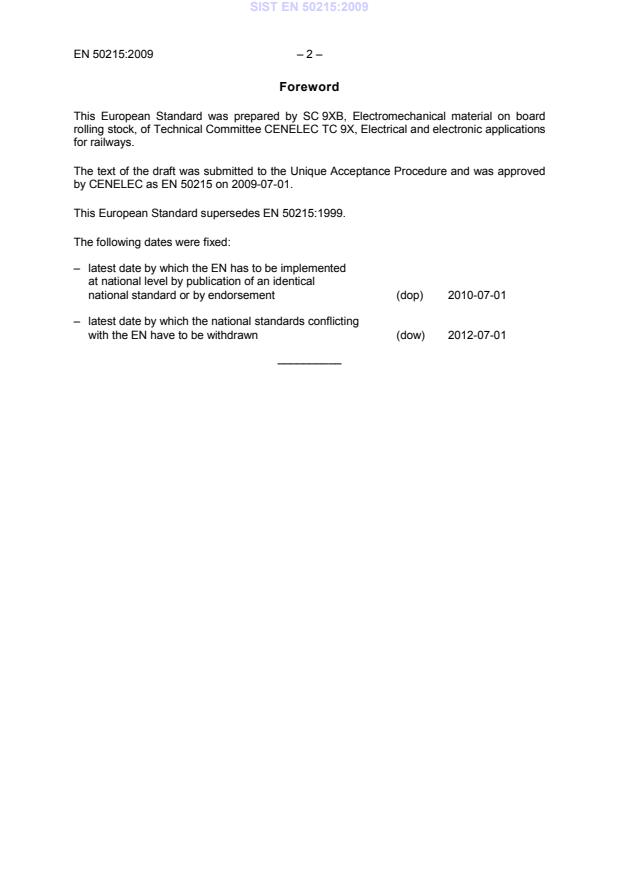
2012-07-01 __________ SIST EN 50215:2009
– 3 – EN 50215:2009
Contents
Page 1 Scope .
5 2 Normative references .
5 3 Definitions .
8 4 Requirements .
9 4.1 General .
9 4.2 Third party test facilities .
10 4.3 Test plan .
10 5 Categories of tests .
11 5.1 General .
11 5.2 Preliminary adjustment tests .
11 5.3 Acceptance tests.
11 5.4 Investigation tests .
13 6 Test conditions.
12 6.1 General .
12 6.2 Static tests .
13 6.3 Dynamic tests .
13 7 Validation documentation .
13 8 Schedule of static tests .
14 8.1 General .
14 8.2 Dimensional tests .
14 8.3 Gauging test .
15 8.4 Lifting ability test .
16 8.5 Weighing tests .
16 8.6 Sealing tests .
19 8.7 Electrical insulation tests .
20 8.8 Protective bonding and return circuits tests .
21 8.9 Air system tests .
21 8.10 Hydraulic system tests .
22 8.11 Friction brake system tests .
23 8.12 Parking brake type tests .
25 8.13 Auxiliary power supply system tests .
24 8.14 Battery charging tests .
25 8.15 Auxiliary and control system tests .
26 8.16 Tests on thermal engine and associated generating sets .
29 8.17 Traction system tests .
32 8.18 Operability and maintainability .
32 SIST EN 50215:2009
34 8.20 Safety-related system tests .
33 9 Schedule of dynamic tests .
34 9.1 General .
35 9.2 Traction performance (tractive effort/speed characteristics) .
34 9.3 Traction performance (journey time check) .
35 9.4 Braking tests .
37 9.5 Traction and braking thermal capacity tests .
40 9.6 Resistance to motion .
40 9.7 Speed regulating system tests .
41 9.8 Automatic train protection systems .
41 9.9 Vehicle/track interaction .
43 9.10 Ride comfort quality .
43 9.11 Kinematic gauging .
44 9.12 The operation of wheel flange lubricators .
44 9.13 Current collector and power supply compatibility tests .
44 9.14 Aerodynamic effects .
44 9.15 Electromagnetic compatibility .
46 9.16 Interruption & voltage/jump and short circuit test .
46 9.17 Noise tests .
48 9.18 Air systems - Compressor duty cycle .
48 9.19 Windscreen wipers .
48 9.20 Train control system .
49 Annex A (informative) List of tests .
50 Bibliography .
– 5 – EN 50215:2009
1 Scope This European Standard specifies general criteria to demonstrate by testing that newly constructed complete railway vehicles conform with standards or other normative documents. This standard is intended to be used as technical instructions for the processing of tests which may be needed for demonstration of certain technical requirements where they are relevant. This standard is not intended to be used as a list of approval requirements without consideration of aforementioned technical requirements. This standard, as a whole or in part, applies to all railway vehicles except special purpose vehicles such as track-laying machines, ballast cleaners and personnel carriers. The extent of application of the standard for particular vehicles will be specifically mentioned in the contract. NOTE 1 The parts of the standard which are applicable will depend on the type of vehicle (e.g. passenger, freight, powered, trailer, etc.). NOTE 2 The scope of this standard excludes railbound and road/rail vehicles for construction and maintenance of railway infrastructure. NOTE 3 This standard does not deal with tests carried out on components or equipment before fitting to the vehicle. In so far as this standard is applicable it may be used for the following: - generator sets mounted on a vehicle provided for auxiliary purposes; - the electrical transmission used on trolley buses or similar vehicles; - control and auxiliary equipment of vehicles with non-electrical propulsion systems; - vehicles guided, supported or electrically propelled by systems which do not use the adhesion between wheel and rail. 2 Normative references The following referenced documents are indispensable for the application of this document. For dated references, only the edition cited applies. For undated references, the latest edition of the referenced document (including any amendments) applies. EN 12663:2000, Railway applications - Structural requirements of railway vehicle bodies EN 13129-2:2004, Railway applications - Air conditioning for main line rolling stock - Part 2: Type tests EN 13272:2001, Railway applications - Electrical lighting for rolling stock in public transport systems EN 13452-2:2003, Railway applications - Braking - Mass transit brake systems - Part 2: Methods of test EN 13775-1:2003, Railway applications - Measuring of new and modified freight wagons - Part 1: Measuring principles EN 13775-2:2003, Railway applications - Measuring of new and modified freight wagons - Part 2: Freight wagons with bogies EN 13775-3:2003, Railway applications - Measuring of new and modified freight wagons - Part 3: Freight wagons with 2 wheelsets EN 13775-4:2004, Railway applications - Measuring of new and modified freight wagons - Part 4: Bogies with 2 wheelsets SIST EN 50215:2009
1) At draft stage.
– 7 – EN 50215:2009
EN 60077-2:2002, Railway applications - Electric equipment for rolling stock - Part 2: Electrotechnical components - General rules (IEC 60077-2:1999, mod.) EN 60077-3:2003, Railway applications - Electric equipment for rolling stock - Part 3: Electrotechnical components - Rules for d.c. circuit-breakers (IEC 60077-3:2001) EN 60077-4:2003, Railway applications - Electric equipment for rolling stock - Part 4: Electrotechnical components - Rules for AC circuit-breakers (IEC 60077-4:2003) EN 60077-5:2003, Railway applications - Electrotechnical equipment for rolling stock - Part 5: Electrotechnical components - Rules for HV fuses (IEC 60077-5:2003) EN 60310:2004, Railway applications - Traction transformers and inductors on board rolling stock (IEC 60310:2004) EN 60322:2001, Railway applications - Electric equipment for rolling stock - Rules for power resistors of open construction (IEC 60322:2001) EN 60349-1:2000 (+ A1:2002), Electric traction - Rotating electrical machines for rail and road vehicles - Part 1: Machines other than electronic convertor-fed alternating current motors (IEC 60349-1:1999 + A1:2002) EN 60349-2:2001, Railway applications - Rotating electrical machines for rail and road vehicles - Part 2: Electronic converter-fed alternating current motors (IEC 60349-2:1993, mod.) EN 60529:1991 (+ A1:2000), Degrees of protection provided by enclosures (IP Code) (IEC 60529:1989 + A1:1999) EN 61287-1:2006, Railway applications - Power convertors installed on board rolling stock - Part 1: Characteristics and test methods (IEC 61287-1:2005) EN 61377-1:2006, Railway applications - Rolling stock - Part 1: Combined testing of inverter-fed alternating current motors and their control system (IEC 61377-1:2006) EN 61377-2:2002, Railway applications - Rolling stock - Combined testing - Part 2: Chopper-fed direct current traction motors and their control (IEC 61377-2:2002) EN 61377-3:2002, Railway applications - Rolling stock - Part 3: Combined testing of alternating current motors, fed by an indirect convertor, and their control system (IEC 61377-3:2002) EN ISO 3095:2005, Railway applications - Acoustics - Measurement of noise emitted by railbound vehicles (ISO 3095:2005) EN ISO 3381:2005, Railway applications - Acoustics - Measurement of noise inside railbound vehicles (ISO 3381:2005) 3 Terms and definitions For the purpose of this document, the following terms and definitions apply. 3.1 manufacturer organisation which has the technical responsibility for the supply of the vehicle system
NOTE There may be more than one manufacturer where the contract for the vehicle is split in two or more parts. 3.2 manufacturer’s works location where the assembly of the vehicles is completed and where static tests are generally performed SIST EN 50215:2009
organisation which controls the railway infrastructure, including, for example, track, signalling, communications and structures 3.9 type test a test of one or more devices, system or complete vehicle to show that the design meets the required specifications and the relevant standards 3.10 routine test a test to which each vehicle is subjected to during or after manufacture to ascertain whether it complies with the specified criteria 3.11 safety-related carries responsibility for safety 3.12 voluntary test any additional test (either type or routine) added to the Test Plan by agreement between the manufacturer and the purchaser 3.13 validation documentation documented evidence that a product, process or service is in conformance with specified requirements or other normative documents 3.14 test plan the plan of the tests to be undertaken by the manufacturer as presented within its Quality Plan, including all supporting information on the conduct of the tests NOTE In the context of this standard, the Test Plan includes all subordinate test specifications. SIST EN 50215:2009
– 9 – EN 50215:2009
3.15 Quality Plan document specifying which procedures and associated resources shall be applied by whom and when to a specific project, product, process or contract [ISO 9000:2000] 3.16 Approval Authority any body other than the purchaser with the legal right to require tests to be performed on vehicles within the scope of this standard and to whom compliance verification must be demonstrated NOTE These bodies may be different in each country and may include national or international regulatory bodies, national safety authorities, infrastructure controllers, and Notified Bodies. 4 Requirements 4.1 General The manufacturer shall exercise control over all activities affecting the quality of the products to ensure that the requirements of the standards or other normative documents to which the declaration refers are met. For this purpose the manufacturer shall have at his disposal all necessary means for carrying out this control at all levels (for example raw materials, supplies, production, finished products or packing). Information shall be available on the manufacturer's quality system and the results of tests as appropriate. The manufacturer shall establish and maintain a quality system. This shall include auditable procedures covering the final inspection and test operations, including workmanship standards, test specifications, test records, calibration of test instruments and equipment, document control, control of non-conforming products and personnel training. NOTE It is recommended that manufacturers operate a quality system in accordance with EN ISO 9001. The Quality Plan for the design, production, inspection and testing of the product shall include a Test Plan defining how the manufacturer will demonstrate conformance to the specified requirements. The contract shall define the various tests to be undertaken on completed vehicles and before entry into service to assure the purchaser that: - the vehicles comply with the technical requirements of the contract (type tests, 3.9, see also 5.3.1); - every vehicle conforms to the design standard proved in the type tests (routine tests, 3.10, see also 5.3.2). All component type and routine tests shall be successfully completed according to the relevant standards and specifications, except as permitted by 6.1, before the tests within the scope of this standard are commenced. The tests covered by this standard are to demonstrate correct interfacing with the functions of the vehicle. This standard does not cover the following types of testing: - endurance and reliability; - development; - investigative (except for guidance only); - system test, such as subassembly or system combined test. SIST EN 50215:2009
– 11 – EN 50215:2009
5 Categories of tests 5.1 General The Test Plan shall present the tests to be carried out in the following categories: a) preliminary adjustment tests (see 5.2); b) acceptance tests, which include:
y type tests, see 5.3.1;
y routine tests, see 5.3.2; c) investigation tests (see 5.4). The tests may be simplified or omitted by agreement between purchaser and manufacturer: i) if the vehicles concerned are demonstrated to be identical to vehicles previously constructed and for which experience is available, or if the vehicles are equipped with motors or other important components stipulated by the purchaser; ii) if it can be shown by documentary proof that equivalent tests have been performed under representative conditions. 5.2 Preliminary adjustment tests Before submitting the vehicle to the acceptance tests, the manufacturer may require to carry out preliminary adjustment tests which cannot be made in manufacturer’s works and which may involve test runs on the user's lines with or without load. In this event, at least the minimum amount of testing required for safe running (see 6.2) shall be completed to the satisfaction of the user and the infrastructure controller. The maximum total distance of the trial runs to obtain necessary adjustments should be agreed in the contract and shall take into account the type of vehicle, more especially its maximum speed and the new devices which are incorporated. Failing a specified value in the contract, a maximum run not exceeding 5 000 km should be adopted for vehicles which are to be subjected to the type tests. Test runs may only be undertaken under the supervision and with the participation of a qualified agent appointed by the user. The user shall also appoint the driver of the vehicle. 5.3 Acceptance tests 5.3.1 Type tests These tests shall be performed over an agreed duration to demonstrate that the vehicle design complies with the performance requirements specified in the contract. They are listed in Tables A.1 and A.2 and described in Clauses 8 and 9. The tests shall be undertaken on the first vehicles built to the design unless otherwise agreed at the time of contract and included in the Test Plan. If the type tests are performed on a prototype or pre-production vehicle, then the manufacturer shall agree with the purchaser those additional tests which are necessary on the first production built vehicle to be included in the Test Plan. The tests shall be performed under the appropriate test conditions as explained in Clause 6. Voluntary type tests may be required only if they are specified in the Test Plan. 5.3.2 Routine tests These tests shall be carried out on each vehicle to be delivered. They are listed in Tables A.1 and A.2 and described in Clauses 8 and 9 (see Clause 6). SIST EN 50215:2009
– 13 – EN 50215:2009
The test facilities shall be appropriate and sufficient to ensure the tests are performed consistently; otherwise, the manufacturer shall inform the purchaser of any limitations of their test facilities with respect to these tests. Where tests are performed at a third-party facility (see 4.2) which involves transportation of the vehicle to or from that facility, sufficient tests shall be undertaken by the manufacturer to ensure that the transportation can be completed safely. 6.3 Dynamic tests The tests are normally undertaken on the lines over which the vehicle is intended to operate or, if not available, over lines with similar characteristics as specified in the contract, and are described in Clause 9. The purchaser shall arrange access to the lines as appropriate and the necessary crew under the conditions specified in the contract. Operation of the test trains shall comply with all regulations of the infrastructure controller. The purchaser shall provide all the necessary facilities for any preparation for dynamic tests (including preliminary test running) under the conditions specified in the contract. Where it is necessary to undertake the dynamic tests on the track of another infrastructure controller, the selected route, its characteristics and conditions of operation shall be agreed at the time of contract. It is permitted to perform some or all of the dynamic tests at a dedicated facility by agreement. NOTE 1 Attention is drawn to the need to ensure that the responsibilities of all parties involved in performing the dynamic tests are clearly defined. NOTE 2 Attention is also drawn to the need to complete all the necessary preliminaries such as the relevant parts of the Reliability, Availability and Maintenance Case and the Safety Case before undertaking the dynamic tests. 7 Validation documentation The validation documentation shall contain sufficient information to identify the vehicle and all its major components and enable these to be traced through the test records. As a minimum the following shall be provided: a) the name and address of the organisation which produced the documentation; b) the name and address of the manufacturer; c) the identification of the vehicle and its major components by name, type, model number and any relevant supplementary information such as lot number, batch or serial number and modification level; d) the standards or normative documents referenced in the contract or Test Plan in a clear and concise way; e) all supplementary information such as grade or category of the vehicle components; f) the date of the documentation; g) the signature and title or an equivalent marking of the authorised signatory. SIST EN 50215:2009
– 15 – EN 50215:2009
8.2.2.2 Clearance tests (safety-related test) Tests shall be carried out to determine whether the specified clearances are achieved during relative movements for the load conditions specified in the contract as follows: a) between vehicle bodies and bogies; b) between adjacent coupled vehicles. See the note after 8.2.2.3 below. 8.2.2.3 Hose and cable length tests Tests shall be carried out to determine the appropriate length for bogie and inter-car hoses and cables. NOTE The clearances and lengths determined by tests 8.2.2.2 and 8.2.2.3 can be calculated, and verified by test, which can be carried out statically, using a bogie rotation table and traverser, or during the dynamic tests. 8.2.2.4 Current collector static tests (safety-related test) It shall be ascertained statically that the operation of current collectors is satisfactory within the limits of movement and static contact force specified in the contract. Tests shall be made on pantographs, including the limiting dimensions of lateral displacement, as specified in EN 50206-1 or EN 50206-2. Requirements for gauging are given in UIC Leaflet No. 505-1. 8.2.3 Routine tests Outside dimension tests (8.2.2.1) and clearance tests (8.2.2.2) shall be carried out in one load condition only (see 8.5.2), and confined to key dimensions determined from the type test. Parts with provision for adjustment according to the wear of the wheels (such as stone guards, snowploughs, sanding pipes and life guards) shall be checked for correct adjustment. 8.3 Gauging test 8.3.1 Objective To verify that the envelope of the vehicle is in accordance with the design. 8.3.2 General (type and safety-related test) The contract may specify the size of the vehicle in a number of alternative ways, requiring different tests for verification, for example: Build gauge – if the dimensions of the vehicle are specified, the dimensional checks in 8.2 are sufficient verification. Kinematic envelope – if a kinematic envelope is specified, an analysis of the dynamic movements of the vehicle is required, supported by the coefficient of flexibility (sway) test (8.3.3) to validate the calculations used in the analysis. Swept envelope – if the vehicle is being run on a line where clearances are less than the normal clearances specified by the infrastructure controller, a swept envelope, taking account of centre throw and end throw on curves may be required, supported by the coefficient of flexibility (sway) test (8.3.3) to validate the swept envelope calculations. SIST EN 50215:2009
– 17 – EN 50215:2009
Table 1 - Recommended load cases
Minimum load Normal load Exceptional/crush load Passenger/freight loads 0 See following text Tooling Complete Crew 0 Full complement Level of Sand 0 2/3 Full Water for heating, toilets, catering, etc. 0 2/3 Full Fuel 0 2/3 Full Thermal engine coolants & lubricants Normal Normal Normal Other fluids & lubricants Normal Normal Normal For vehicles intended to carry passengers or freight loads, in the absence of other information from the purchaser the loads shall be determined as follows. - Minimum load: loading state of the vehicle specified in the contract in which the vehicle is complete and which will enable the vehicle to be moved or towed. - Normal load: load as specified in the contract for the performance tests, for example motoring or braking. - Exceptional/crush load: maximum load that can be operated safely under conditions specified in the contract and used for specific performance tests, for example, emergency braking. For vehicles not intended to carry passenger or freight loads, for example locomotives, the normal and exceptional/crush passenger/freight load is assumed to be zero, i.e. the same as minimum load. In order to reduce to a minimum the handling of additional loads, dimensional tests and weighing operations may be: - carried out in the same loading state; - executed in loading states other than those specified in the contract, provided suitable corrections are applied to the recorded values. NOTE EN 15663, concerning vehicle mass definition, is currently in the course of preparation by CEN/TC 256. 8.5.3 Type tests (safety-related test) The weight of the vehicle and the vertical load exerted by each wheel on the track shall be measured and shall be accompanied by a statement as to the accurac
...