


EN 60289:1994
(Main)Reactors
General Information
- Abstract
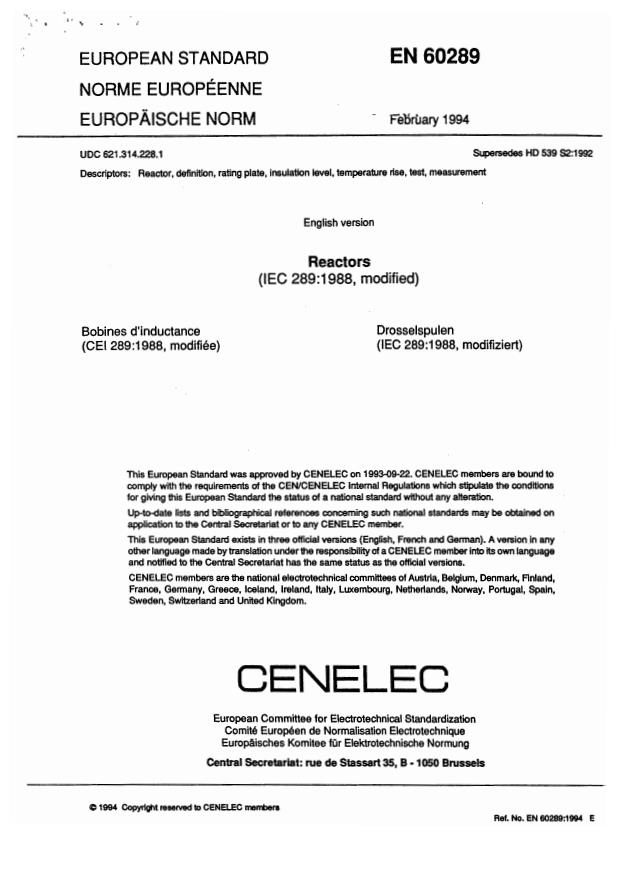
This standard applies to the following types of reactors: shunt reactors, current-limiting reactors including neutral-earthing reactors, damping reactors, tuning (filter) reactors, earthing transformers (neutral couplers), arc-suppression reactors, smoothing reactors, with the exception of the following reactors: small reactors with a rating generally less than 2 kvar single-phase and 10 kvar three-phase, reactors for special purposes such as high-frequency line traps or reactors mounted on rolling stock.
- Status
- Withdrawn
- Publication Date
- 01-Mar-1994
- Withdrawal Date
- 01-Sep-1994
- Technical Committee
- CLC/TC 14 - Power transformers
- Drafting Committee
- IEC/SC 14C - IEC_SC_14C
- Parallel Committee
- IEC/SC 14C - IEC_SC_14C
- Current Stage
- 9960 - Withdrawal effective - Withdrawal
- Start Date
- 01-Jun-2011
- Completion Date
- 01-Jun-2011
- Ref Project
SIST EN 60289:1997 - Reactors

Relations
- Effective Date
- 29-Jan-2023
- Referred By
EN 61378-1:1998 - Convertor transformers - Part 1: Transformers for industrial applications - Effective Date
- 03-Feb-2026
- Effective Date
- 03-Feb-2026
- Referred By
EN 60310:2004 - Railway applications - Traction transformers and inductors on board rolling stock - Effective Date
- 03-Feb-2026
- Effective Date
- 03-Feb-2026
- Effective Date
- 03-Feb-2026
- Effective Date
- 03-Feb-2026
- Amended By
EN 60289:1994/A11:2002 - Reactors - Effective Date
- 29-Jan-2023
Get Certified
Connect with accredited certification bodies for this standard

IMQ S.p.A. (Certification)
Italian electrical product certification.

SLG Prüf- und Zertifizierungs GmbH
German testing and certification body.

UL Solutions
Global safety science company with testing, inspection and certification.
Sponsored listings
Frequently Asked Questions
EN 60289:1994 is a standard published by CLC. Its full title is "Reactors". This standard covers: This standard applies to the following types of reactors: shunt reactors, current-limiting reactors including neutral-earthing reactors, damping reactors, tuning (filter) reactors, earthing transformers (neutral couplers), arc-suppression reactors, smoothing reactors, with the exception of the following reactors: small reactors with a rating generally less than 2 kvar single-phase and 10 kvar three-phase, reactors for special purposes such as high-frequency line traps or reactors mounted on rolling stock.
This standard applies to the following types of reactors: shunt reactors, current-limiting reactors including neutral-earthing reactors, damping reactors, tuning (filter) reactors, earthing transformers (neutral couplers), arc-suppression reactors, smoothing reactors, with the exception of the following reactors: small reactors with a rating generally less than 2 kvar single-phase and 10 kvar three-phase, reactors for special purposes such as high-frequency line traps or reactors mounted on rolling stock.
EN 60289:1994 is classified under the following ICS (International Classification for Standards) categories: 29.180 - Transformers. Reactors. The ICS classification helps identify the subject area and facilitates finding related standards.
EN 60289:1994 has the following relationships with other standards: It is inter standard links to EN 60076-6:2008, EN 61378-1:1998, EN 60076-4:2002, EN 60310:2004, EN 60143-2:1994, EN 60076-10:2001, EN 61803:1999, EN 60289:1994/A11:2002. Understanding these relationships helps ensure you are using the most current and applicable version of the standard.
EN 60289:1994 is available in PDF format for immediate download after purchase. The document can be added to your cart and obtained through the secure checkout process. Digital delivery ensures instant access to the complete standard document.