


EN 50131-8:2019
(Main)Alarm systems - Intrusion and hold-up systems - Part 8: Security fog devices
Alarm systems - Intrusion and hold-up systems - Part 8: Security fog devices
This document specifies the requirements for Security Fog Devices as part of an I&HAS. It covers application and performance and also gives the necessary tests and trials to ensure efficiency and reliability of such obscuration devices. This document also gives guidance on the criteria for design, installation, operation and maintenance of Security Fog Devices.
Alarmanlagen - Einbruch- und Überfallmeldeanlagen - Teil 8: Nebelgeräte für Sicherungsanwendungen
Dieses Dokument legt die Anforderungen an Nebelgeräte für Sicherungsanwendungen fest, die Teil einer EMA/ÜMA sind. Es deckt die Anwendung und die Leistungsmerkmale ab und gibt die notwendigen Prüfungen und Probeläufe an, mit denen die Effizienz und die Zuverlässigkeit solcher Geräte zur Verminderung der Sichtweite sichergestellt werden. Dieses Dokument gibt auch eine Anleitung für Vorgaben zu Planung, Einbau, Betrieb und Instandhaltung von Nebelgeräten für Sicherungsanwendungen.
Systèmes d’alarme - Systèmes d'alarme contre l’intrusion et les hold-up - Partie 8: Dispositifs générateurs de brouillard
Le présent document spécifie les exigences relatives aux dispositifs générateurs de brouillard faisant partie d’un I&HAS. Il couvre l’application et les performances et fournit également les essais et mises à l’épreuve nécessaires pour garantir l’efficacité et la fiabilité de tels dispositifs d’obscurcissement. Le présent document donne par ailleurs des recommandations sur les critères de conception, d'installation, de fonctionnement et de maintenance des dispositifs générateurs de brouillard.
Alarmni sistemi - Sistemi za javljanje vloma in ropa - 8. del: Sistem za varnostno meglo
Ta evropski standard določa zahteve za sisteme za varnostno meglo, ki so povezani s sistemi za javljanje vloma in ropa. Zajema uporabo in delovanje ter podaja potrebne preskuse in preskušanja za zagotovitev učinkovitosti ter zanesljivosti tovrstnih naprav za potemnitev.
Ta evropski standard podaja tudi smernice glede kriterijev za zasnovo, vgradnjo, delovanje in vzdrževanje sistemov za varnostno meglo.
Sistem za varnostno meglo se ne obravnava kot sestavni del sistema za javljanje vloma in ropa, prav tako niso podane nobene zahteve v zvezi z varnostnim razredom, opisanim v standardu EN 50131-1.c
General Information
- Status
- Published
- Publication Date
- 09-May-2019
- Withdrawal Date
- 17-Feb-2022
- Technical Committee
- CLC/TC 79 - Alarm systems
- Drafting Committee
- CLC/TC 79/WG 10 - Smoke security devices
- Current Stage
- 9093 - Decision to confirm - Review Enquiry
- Start Date
- 13-Dec-2023
- Completion Date
- 20-Feb-2026
Relations
- Effective Date
- 14-May-2019
- Effective Date
- 09-Feb-2026
- Effective Date
- 09-Feb-2026
- Refers
EN ISO 16000-1:2006 - Indoor air - Part 1: General aspects of sampling strategy (ISO 16000-1:2004) - Effective Date
- 09-Feb-2026
- Effective Date
- 09-Feb-2026
- Effective Date
- 03-Feb-2026
- Effective Date
- 03-Feb-2026
- Effective Date
- 03-Feb-2026
- Effective Date
- 03-Feb-2026
- Effective Date
- 09-Feb-2026
- Effective Date
- 03-Feb-2026
- Effective Date
- 03-Feb-2026
Overview
EN 50131-8:2019 - published by CLC/CENELEC - defines requirements for Security Fog Devices (SFDs) as part of Intrusion & Hold‑Up Alarm Systems (I&HAS). The standard covers application, performance and the tests needed to verify efficiency and reliability of obscuration devices, and it provides guidance on design, installation, operation and maintenance. EN 50131-8:2019 replaces the 2009 edition and introduces new requirements such as Environmental Class II, pressure vessel provisions and energy‑efficiency measurement.
Key topics and technical requirements
EN 50131-8:2019 addresses Functional, Environmental and Safety aspects of SFDs. Major technical topics include:
- Performance and testing: standardized test methods (Annex A) - e.g., fog test chamber, activation tests, fog output and fog persistency measurements.
- Environmental requirements: classification (all SFDs shall meet Environmental Class II), environmental tests, EMC immunity and IP/IK ratings.
- Safety and product requirements: non‑toxicity of generated fog, pressure vessel rules, heater block temperature/overheating protection, nozzle protection and obstruction handling.
- Operational resilience: operation during mains failures, provision for mains‑only operation, tamper detection and fault monitoring.
- Interface and communication: minimum information exchanged between SFD and the host I&HAS, alarms for non‑critical faults and optional signals.
- Consumables and traceability: requirements for fog fluid formulation and traceability.
- Marking and documentation: required labels, warning signs (Annex B), manufacturer documentation and maintenance guidance.
- Energy efficiency and idle power measurement: new clauses and a measurement procedure (Annex C).
Practical applications
- Deterrent and crime‑reduction: SFDs rapidly reduce visibility in a protected area, forming a barrier between intruder and target - widely used in retail, banking, jewellery, warehouses and high‑value storage areas.
- Integrated alarm response: activated by verified alarm conditions to delay or prevent theft while minimizing risk to occupants.
- Note: EN 50131-8:2019 applies to SFDs connected to I&HAS and is not intended for standalone or mobile fog devices.
Who uses this standard
- Manufacturers of Security Fog Devices (design, testing and marking requirements)
- Alarm installers and integrators (installation, commissioning, interfacing with I&HAS)
- Specifiers and consultants, including insurers and loss‑prevention professionals
- Authorities and police for consistent product and installation expectations
- Maintenance providers (service, consumable handling and traceability)
Related standards
EN 50131‑8 is part of the EN 50131 series (system requirements, detectors, control equipment, power supplies, warning devices, etc.). The document also references normative standards such as EN 286‑1 (pressure vessels), EN 482 (workplace exposure) and EN 50130‑4 (EMC requirements).
Keywords: EN 50131-8:2019, security fog devices, SFD, intrusion and hold-up, I&HAS, fog persistency, fog output, pressure vessels, environmental classification.


Get Certified
Connect with accredited certification bodies for this standard

NSF International
Global independent organization facilitating standards development and certification.

CIS Institut d.o.o.
Personal Protective Equipment (PPE) certification body. Notified Body NB-2890 for EU Regulation 2016/425 PPE.

Kiwa BDA Testing
Building and construction product certification.
Sponsored listings
Frequently Asked Questions
EN 50131-8:2019 is a standard published by CLC. Its full title is "Alarm systems - Intrusion and hold-up systems - Part 8: Security fog devices". This standard covers: This document specifies the requirements for Security Fog Devices as part of an I&HAS. It covers application and performance and also gives the necessary tests and trials to ensure efficiency and reliability of such obscuration devices. This document also gives guidance on the criteria for design, installation, operation and maintenance of Security Fog Devices.
This document specifies the requirements for Security Fog Devices as part of an I&HAS. It covers application and performance and also gives the necessary tests and trials to ensure efficiency and reliability of such obscuration devices. This document also gives guidance on the criteria for design, installation, operation and maintenance of Security Fog Devices.
EN 50131-8:2019 is classified under the following ICS (International Classification for Standards) categories: 13.320 - Alarm and warning systems. The ICS classification helps identify the subject area and facilitates finding related standards.
EN 50131-8:2019 has the following relationships with other standards: It is inter standard links to EN 50131-8:2009, EN ISO/IEC 17025:2017, EN 286-1:1998, EN ISO 16000-1:2006, EN 482:2021, EN 50563:2011, EN 50131-5-3:2017, EN 50131-1:2006, EN 50564:2011, EN 15999-2:2025, EN 50600-2-5:2021, EN 50600-2-5:2016. Understanding these relationships helps ensure you are using the most current and applicable version of the standard.
EN 50131-8:2019 is available in PDF format for immediate download after purchase. The document can be added to your cart and obtained through the secure checkout process. Digital delivery ensures instant access to the complete standard document.
Standards Content (Sample)
SLOVENSKI STANDARD
01-september-2019
Nadomešča:
SIST EN 50131-8:2009
Alarmni sistemi - Sistemi za javljanje vloma in ropa - 8. del: Sistem za varnostno
meglo
Alarm systems - Intrusion and hold-up systems - Part 8: Security fog devices
Alarmanlagen - Einbruch- und Überfallmeldeanlagen - Teil 8: Nebelgeräte für
Sicherungsanwendungen
Systèmes d'alarme - Systèmes d'alarme contre l'intrusion et les hold-up - Partie 8:
Dispositifs générateurs de fumée
Ta slovenski standard je istoveten z: EN 50131-8:2019
ICS:
13.310 Varstvo pred kriminalom Protection against crime
13.320 Alarmni in opozorilni sistemi Alarm and warning systems
2003-01.Slovenski inštitut za standardizacijo. Razmnoževanje celote ali delov tega standarda ni dovoljeno.
EUROPEAN STANDARD EN 50131-8
NORME EUROPÉENNE
EUROPÄISCHE NORM
May 2019
ICS 13.320 Supersedes EN 50131-8:2009
English Version
Alarm systems - Intrusion and hold-up systems - Part 8: Security
fog devices
Systèmes d'alarme - Systèmes d'alarme contre l'intrusion et Alarmanlagen - Einbruch- und Überfallmeldeanlagen - Teil
les hold-up - Partie 8: Dispositifs générateurs de brouillard 8: Nebelgeräte für Sicherungsanwendungen
This European Standard was approved by CENELEC on 2019-02-18. CENELEC members are bound to comply with the CEN/CENELEC
Internal Regulations which stipulate the conditions for giving this European Standard the status of a national standard without any alteration.
Up-to-date lists and bibliographical references concerning such national standards may be obtained on application to the CEN-CENELEC
Management Centre or to any CENELEC member.
This European Standard exists in three official versions (English, French, German). A version in any other language made by translation
under the responsibility of a CENELEC member into its own language and notified to the CEN-CENELEC Management Centre has the
same status as the official versions.
CENELEC members are the national electrotechnical committees of Austria, Belgium, Bulgaria, Croatia, Cyprus, the Czech Republic,
Denmark, Estonia, Finland, Former Yugoslav Republic of Macedonia, France, Germany, Greece, Hungary, Iceland, Ireland, Italy, Latvia,
Lithuania, Luxembourg, Malta, the Netherlands, Norway, Poland, Portugal, Romania, Serbia, Slovakia, Slovenia, Spain, Sweden,
Switzerland, Turkey and the United Kingdom.
European Committee for Electrotechnical Standardization
Comité Européen de Normalisation Electrotechnique
Europäisches Komitee für Elektrotechnische Normung
CEN-CENELEC Management Centre: Rue de la Science 23, B-1040 Brussels
© 2019 CENELEC All rights of exploitation in any form and by any means reserved worldwide for CENELEC Members.
Ref. No. EN 50131-8:2019 E
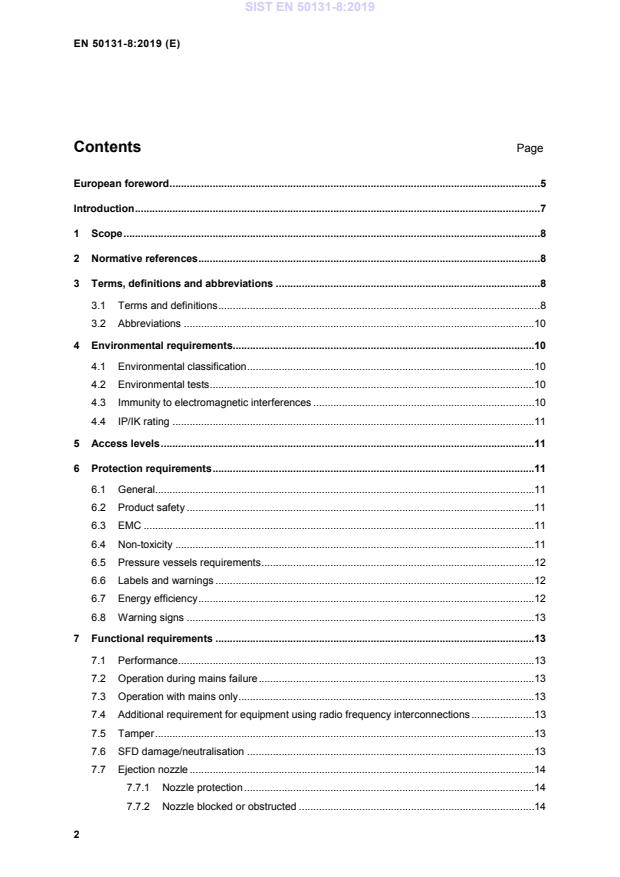
Contents Page
European foreword . 5
Introduction . 7
1 Scope . 8
2 Normative references . 8
3 Terms, definitions and abbreviations . 8
3.1 Terms and definitions . 8
3.2 Abbreviations .10
4 Environmental requirements.10
4.1 Environmental classification .10
4.2 Environmental tests .10
4.3 Immunity to electromagnetic interferences .10
4.4 IP/IK rating .11
5 Access levels .11
6 Protection requirements .11
6.1 General.11
6.2 Product safety .11
6.3 EMC .11
6.4 Non-toxicity .11
6.5 Pressure vessels requirements .12
6.6 Labels and warnings .12
6.7 Energy efficiency .12
6.8 Warning signs .13
7 Functional requirements .13
7.1 Performance .13
7.2 Operation during mains failure .13
7.3 Operation with mains only .13
7.4 Additional requirement for equipment using radio frequency interconnections .13
7.5 Tamper .13
7.6 SFD damage/neutralisation .13
7.7 Ejection nozzle .14
7.7.1 Nozzle protection .14
7.7.2 Nozzle blocked or obstructed .14
7.8 Fog eject limiter .14
7.9 Stopping fog generation .14
7.10 Heater block - temperature .14
7.11 Heater block - overheating .14
7.12 Isolation of the SFD .14
7.13 Fixings .14
7.14 Visual Indications .14
7.15 Communication between the SFD and the I&HAS .14
7.15.1 General .14
7.15.2 Minimum information to be communicated .15
7.15.3 Non-critical faults .15
7.15.4 Optional signals .15
7.16 Fault monitoring .15
7.17 Power failure .15
8 Consumables .15
8.1 General.15
8.2 Formulation .15
8.3 Traceability .16
9 Marking .16
10 Documentation .16
11 Design, installation, operation and maintenance .16
Annex A (normative) Performance tests .17
A.1 General .17
A.2 Fog test chamber .17
A.3 Test procedure .17
A.4 Activation test .18
A.5 Fog output of EUT .18
A.6 Fog persistency .19
A.7 Fog output over test periods.19
A.8 Fog visibility/density table .19
A.9 Performance data .20
Annex B (normative) SFD warning sign .23
B.1 Warning sign requirements .23
Annex C (normative) Measurement procedure for power in idle mode .25
C.1 Test room (EN 50564:2011, 4.2) .25
C.2 Power supply (EN 50564:2011, 4.3) .25
C.3 Measuring instruments (EN 50564:2011, 4.4) .25
C.4 Preparation of unit under test (EN 50564:2011, 5.2) .25
C.5 Test setup.26
C.6 Measurement (EN 50564:2011, 5.3.2) .26
C.7 Reporting .26
Annex D (informative) Guidance on design, installation, operation and maintenance of the
SFD .28
D.1 Risk assessment .28
D.2 General notification .28
D.3 Verified alarm triggering .28
D.4 Multi-occupancy .28
D.5 Man trap – building unoccupied .28
D.6 Hold-up – Building occupied .29
D.7 Installed SFD test .29
D.8 Training .29
D.9 Manufacturers requirements .29
Bibliography .30
European foreword
This document (EN 50131-8:2019) has been prepared by CLC/TC 79 "Alarm systems".
The following dates are fixed:
• latest date by which this document has to be (dop) 2020-02-18
implemented at national level by publication
of an identical national standard or by
endorsement
• latest date by which the national standards (dow) 2022-02-18
conflicting with this document have to
be withdrawn
This document supersedes EN 50131-8:2009.
EN 50131-8:2009:
— the standard no longer views a group of parts capable of generating fog as a system and instead
considers it to be a device (possibly consisting of separate parts);
— all Security Fog Devices shall meet Environmental Class II;
— requirements for pressure vessels and energy efficiency measurement are now included.
Attention is drawn to the possibility that some of the elements of this document may be the subject of
patent rights. CENELEC shall not be held responsible for identifying any or all such patent rights.
The EN 50131 series consists of the following parts, under the general title “Alarm systems – Intrusion
and hold-up systems”:
— Part 1: System requirements
— Part 2-2: Intrusion detectors – Passive infrared detectors
— Part 2-3: Requirements for microwave detectors
— Part 2-4: Requirements for combined passive infrared and microwave detectors
— Part 2-5: Requirements for combined passive infrared and ultrasonic detectors
— Part 2-6: Opening contacts (magnetic)
— Part 2-7-1: Intrusion detectors – Glass break detectors (acoustic)
— Part 2-7-2: Intrusion detectors – Glass break detectors (passive)
— Part 2-7-3: Intrusion detectors – Glass break detectors (active)
— Part 2-8: Intrusion detectors – Shock detectors
— Part 2-9: Intrusion detectors – Active infrared beam detectors
— Part 2-10: Intrusion detectors – Lock state contacts (magnetic)
— Part 2-11: Intrusion detectors – ALDDR
— Part 3: Control and indicating equipment
— Part 4: Warning devices
— Part 5-3: Requirements for interconnections equipment using radio frequency techniques
— Part 6: Power supplies
— Part 7: Application guidelines
— Part 8: Security fog devices
— Part 9: Alarm verification. Methods and principles
— Part 10: Application Specific Requirements for Supervised Premises Transceiver (SPT)
— Part 12: Methods and requirements for setting and unsetting of Intruder Alarm Systems (IAS)
Introduction
Security Fog Devices are used both as a deterrent device for building security and as a crime
reduction device for the protection of people.
This European Standard applies to a Security Fog Device that can be connected to an Intruder and
Hold-up Alarm System (I&HAS). It can assist insurers, intruder alarm companies, customers and the
police in understanding the principles and specifications of a Security Fog Device.
The purpose of a Security Fog Device is to reduce the visibility in a protected area by the use of a
non-toxic fog in order to form a barrier between the criminal and the criminal’s intended target.
This European Standard is not intended to cover standalone or mobile Security Fog Devices.
This European Standard has been designed to be flexible enough to encourage and encompass
future developments in the field of Security Fog Devices.
1 Scope
This document specifies the requirements for Security Fog Devices as part of an I&HAS. It covers
application and performance and also gives the necessary tests and trials to ensure efficiency and
reliability of such obscuration devices.
This document also gives guidance on the criteria for design, installation, operation and maintenance
of Security Fog Devices.
2 Normative references
The following documents are referred to in the text in such a way that some or all of their content
constitutes requirements of this document. For dated references, only the edition cited applies. For
undated references, the latest edition of the referenced document (including any amendments)
applies.
EN 286-1:1998, Simple unfired pressure vessels designed to contain air or nitrogen — Part 1:
Pressure vessels for general purposes
EN 482, Workplace exposure — General requirements for the performance of procedures for the
measurement of chemical agents
EN 50130-4, Alarm systems — Part 4: Electromagnetic compatibility — Product family standard:
Immunity requirements for components of fire, intruder, hold up, CCTV, access control and social
alarm systems
EN 50130-5:2011, Alarm systems — Part 5: Environmental test methods
EN 50131-1:2006, Alarm systems — Intrusion and hold-up systems — Part 1: System requirements
EN 50131-5-3, Alarm systems — Intrusion systems — Part 5-3: Requirements for interconnections
equipment using radio frequency techniques
EN 50563:2011, External a.c. - d.c. and a.c. - a.c. power supplies — Determination of no-load power
and average efficiency of active modes
EN 50564:2011, Electrical and electronic household and office equipment — Measurement of low
power consumption
EN ISO 16000-1, Indoor air — Part 1: General aspects of sampling strategy (ISO 16000-1)
EN ISO/IEC 17025, General requirements for the competence of testing and calibration laboratories
(ISO/IEC 17025)
3 Terms, definitions and abbreviations
3.1 Terms and definitions
For the purposes of this document, the terms and definitions given in EN 50131-1 and the following
apply.
ISO and IEC maintain terminological databases for use in standardization at the following addresses:
— IEC Electropedia: available at http://www.electropedia.org/
— ISO Online browsing platform: available at http://www.iso.org/obp
3.1.1
alarm verification
process to provide information additional to a notified alarm, which increases the probability that the
alarm should be considered genuine
[SOURCE: EN 50518-3:2013]
3.1.2
idle mode
condition during which the equipment can promptly provide a primary function but is not doing so
Note 1 to entry: In the case of an SFD, it means a condition where the heater block (if any) and the heat
accumulator (if any) are sufficiently warm to immediately eject in one-shot the fog quantity for which the SFD is
designed.
[SOURCE: EN 62542 Edition 1, definition 5.3, modified by addition of the note to entry]
3.1.3
pressure vessel
housing designed and built to contain gases and/or liquids under pressure, including its direct
attachments up to the coupling point connecting it to other equipment
Note 1 to entry: A vessel can be composed of more than one chamber.
3.1.4
protected area
designated space that the SFD is designed to restrict the visibility in when operated
3.1.5
obscuration
reduction in visibility as a result of fog from the activation of an SFD
3.1.6
security fog
artificially produced dense cloud of tiny, liquid droplets suspended in the atmosphere to achieve
obscuration for protection purposes
3.1.7
security fog device
device (or a series of separate parts that make up a device) within tamper resistant housing(s), that,
when activated, produce, in the protected area, a security fog from a consumable
3.1.8
verified alarm
alarm considered genuine as a result of the use of alarm verification
3.2 Abbreviations
For the purposes of this document, the abbreviations given in EN 50131-1 and the following apply.
CLP Classification, Labelling and Packaging
EMC Electromagnetic compatibility
EPS External Power Supply
IAS Intruder Alarm System
I&HAS Intruder and Hold-up Alarm System
IK Degrees of protection provided by enclosures for electrical equipment against
external mechanical impacts
IP Ingress protection classification
LEA Law Enforcement Authority (Police or governmental body that responds to
activations from security systems)
SFD Security Fog Device
4 Environmental requirements
4.1 Environmental classification
The Security Fog Device shall meet Environmental Class II (Indoor – General: environmental
influences normally experienced indoors when the temperature is not well maintained) in accordance
with EN 50131-1.
4.2 Environmental tests
For all operation the SFD shall not activate, generate tamper, fault or other signals or messages when
subject to the specific range of environmental and EMC conditions and shall continue to function
normally and within the safety specifications of its components.
The following Class II level environmental tests from EN 50130-5:2011 shall be applicable when
testing the SFD:
— Clause 8: dry heat (operational);
— Clause 10: cold test (operational);
— Clause 14: damp heat, cyclic (operational);
— Clause 17: sulphur dioxide (SO2) (endurance);
— Clause 20: impact (operational);
— Clause 22: vibration sinusoidal (operational).
4.3 Immunity to electromagnetic interferences
Electromagnetic compatibility (immunity, operational) shall be assessed in accordance with
EN 50130-4.
4.4 IP/IK rating
All parts and consumables of the SFD shall be housed in an enclosure meeting the following
requirements:
— IP rating of IP20 or better;
— IK rating of IK08 or better.
5 Access levels
The access levels used in this standard shall be as stated in EN 50131-1:2006, 8.3.1.
6 Protection requirements
6.1 General
The SFD shall operate in a way that does not harm persons and other equipment in its vicinity.
6.2 Product safety
This standard does not specify product safety requirements. Such requirements can be found in
relevant product safety standards.
NOTE 1 If the SFD falls under the Low Voltage Directive (2014/35/EU), electrical safety requirements can be
found in EN 60065 or EN 60950-1.
NOTE 2 EN 60065 and EN 60950-1 are being replaced by EN 63268-1.
NOTE 3 The standards mentioned above cover both electrical and flammability hazards.
6.3 EMC
This standard does not specify EMC requirements. Such requirements can be found in relevant EMC
standards.
NOTE 1 Emission limits and test methods are defined in the generic standard EN 61000-6-3.
NOTE 2 Immunity requirements for components of fire, intruder, hold up, CCTV, access control and social
alarm systems are defined in EN 50130-4 (see also 4.3).
6.4 Non-toxicity
The manufacturer shall provide evidence that the consumable(s) and the emitted fog do not present a
health and safety hazard to persons in normal use within the manufacturer’s specified consumable
life-time.
The non-toxicity assessment shall be carried out by a laboratory accredited to EN ISO/IEC 17025 in
the relevant field and shall include the following minimum elements:
— identification of the substances present in the consumable (fog liquid) and in the emitted fog;
— bibliographical research;
— sampling and analysis of all pollutants (gaseous, aerosol liquid and airborne particles) that
contribute to the potential exposure as identified in the bibliographical research.
For that assessment, the laboratory shall use pollutant specific standards referenced in EN 482 or
EN ISO 16000-1.
The non-toxicity assessment shall be repeated after each modification to the SFD or to the
consumable that can affect the toxicity of the ejected/emitted fog. It is the manufacturer’s responsibility
to decide whether such a change in design or formulation has occurred.
6.5 Pressure vessels requirements
When SFD includes a pressure vessel as propelling gas container, the container and its accessories
shall be such that:
— Maximum working pressure ≤ 30 bar (3 MPa)
— “Ps x V” ≤ 50 bar.litre (5 MPa.dm )
— Minimum working temperature ≤ -10 °C, but ≥ -50 °C
— Maximum working temperature ≥ 75 °C, but ≤ 300 °C for steel containers and ≤ 100 °C for
aluminium containers
NOTE This means the pressurized container will be suitable for any working temperatures between -10 °C
and +75 °C.
The container shall also meet the applicable requirements specified in EN 286-1.
In order t
...
Questions, Comments and Discussion
Ask us and Technical Secretary will try to provide an answer. You can facilitate discussion about the standard in here.
Loading comments...