EN 130300:1998
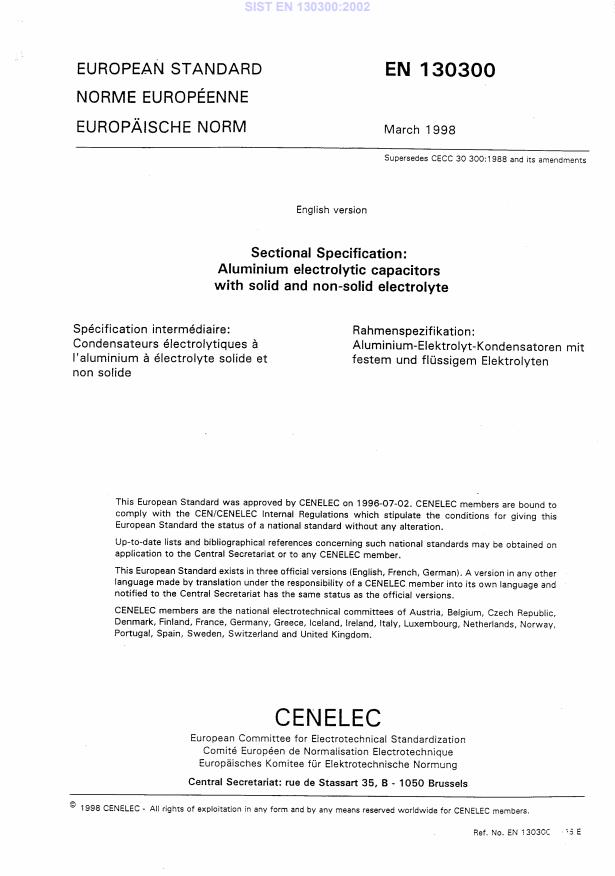
(Main)Sectional Specification: Aluminium electrolytic capacitors with solid and non-solid electrolyte
Sectional Specification: Aluminium electrolytic capacitors with solid and non-solid electrolyte
Supersedes CECC 30 300:1988 & its amdts * Superseded by EN 60384-4:2007
Rahmenspezifikation: Aluminium-Elektrolyt-Kondensatoren mit festem und flüssigem Elektrolyten
Spécification intermédiaire: Condensateurs électrolytiques à l'aluminium à électrolyte solide et non solide
Sectional specification: Aluminium electrolytic capacitors with solid non-solid electrolyte
General Information
- Status
- Withdrawn
- Publication Date
- 26-Mar-1998
- Withdrawal Date
- 30-Sep-1998
- Technical Committee
- CLC/TC 40XA - CLC/TC 40XA
- Drafting Committee
- IEC/TC 40 - IEC_TC_40
- Parallel Committee
- IEC/TC 40 - IEC_TC_40
- Current Stage
- 9960 - Withdrawal effective - Withdrawal
- Start Date
- 01-Apr-2010
- Completion Date
- 01-Apr-2010
Relations
- Effective Date
- 29-Jan-2023
Frequently Asked Questions
EN 130300:1998 is a standard published by CLC. Its full title is "Sectional Specification: Aluminium electrolytic capacitors with solid and non-solid electrolyte". This standard covers: Supersedes CECC 30 300:1988 & its amdts * Superseded by EN 60384-4:2007
Supersedes CECC 30 300:1988 & its amdts * Superseded by EN 60384-4:2007
EN 130300:1998 has the following relationships with other standards: It is inter standard links to EN 60384-4:2007. Understanding these relationships helps ensure you are using the most current and applicable version of the standard.
EN 130300:1998 is available in PDF format for immediate download after purchase. The document can be added to your cart and obtained through the secure checkout process. Digital delivery ensures instant access to the complete standard document.
Standards Content (Sample)
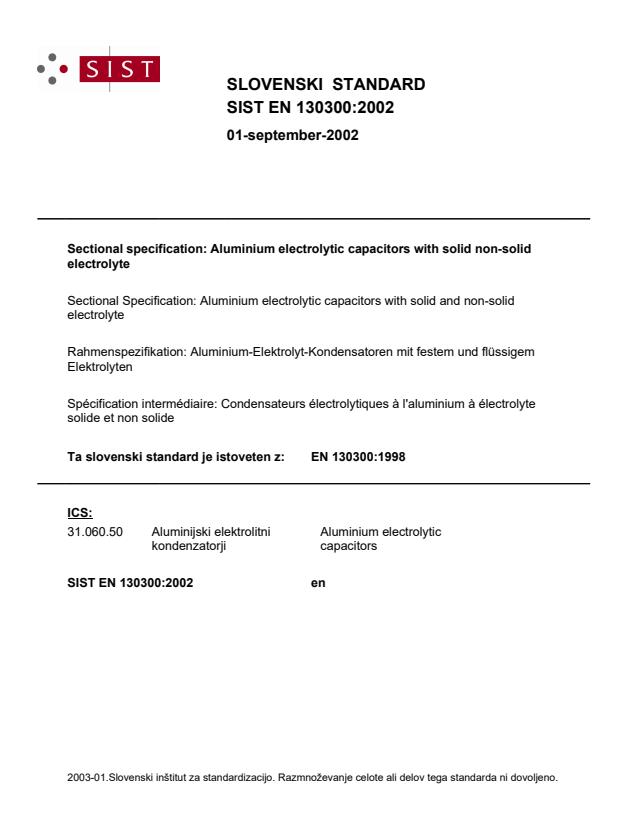
2003-01.Slovenski inštitut za standardizacijo. Razmnoževanje celote ali delov tega standarda ni dovoljeno.Sectional specification: Aluminium electrolytic capacitors with solid non-solid electrolyteRahmenspezifikation: Aluminium-Elektrolyt-Kondensatoren mit festem und flüssigem ElektrolytenSpécification intermédiaire: Condensateurs électrolytiques à l'aluminium à électrolyte solide et non solideSectional Specification: Aluminium electrolytic capacitors with solid and non-solid electrolyte31.060.50Aluminijski elektrolitni kondenzatorjiAluminium electrolytic capacitorsICS:Ta slovenski standard je istoveten z:EN 130300:1998SIST EN 130300:2002en01-september-2002SIST EN 130300:2002SLOVENSKI
STANDARD
...
This May Also Interest You
IEC 60749-22-2:2025 establishes a means for determining the strength of a ball bond to a die or package bonding surface and can be performed on pre-encapsulation or post-encapsulation devices. This measure of bond strength is extremely important in determining two features: a) the integrity of the metallurgical bond which has been formed, and b) the quality of ball bonds to die or package bonding surfaces. This test method covers thermosonic (ball) bonds made with small diameter wire from 15 µm to 76 µm (0,000 6" to 0,003"). This test method can only be used when the bonds are large enough to allow for proper contact with the shear test chisel and when there are no adjacent interfering structures that would hinder the movement of the chisel. For consistent shear results the ball height will be at least 4,0 µm (0,000 6 ") for ball bonds, which is the current state of the art for bond shear test equipment at the time of this revision. This test method can also be used on ball bonds that have had their wire removed and on to which a second bond wire (typically a stitch bond) is placed. This is known as "stitch on ball" and "reverse bonding". See Annex A for additional information. The wire bond shear test is destructive. It is appropriate for use in process development, process control, or quality assurance, or both. This test method can be used on ultrasonic (wedge) bonds, however its use has not been shown to be a consistent indicator of bond integrity. See Annex B for information on performing shear testing on wedge bonds. This test method does not include bond strength testing using wire bond pull testing. Wire bond pull testing is described in IEC 60749-22-1. This first edition, together with the first edition of IEC 60749-22-1, cancels and replaces the first edition IEC 60749-22 published in 2002. This International Standard is to be used in conjunction with IEC 60749-22-1:2025. This edition includes the following significant technical changes with respect to the previous edition: a) Major update, including new techniques and use of new materials (e.g. copper wire) involving a complete rewrite as two separate subparts (this document and IEC 60749‑22‑1).
- Draft32 pagesEnglish languagee-Library read for×1 day
- 15-Jan-2026
- 31.080.01
- CLC/TC 47X
IEC 63382-1:2025 series specifies the management of distributed energy storage systems, composed of electrically chargeable vehicle batteries (ECV-DESS), which are handled by an aggregator/flexibility operator (FO) to provide energy flexibility services to grid operators. IEC 63382-1:2025 describes the technical characteristics and architectures of ECV-DESS, including: – EV charging stations configurations, comprising several AC-EVSEs and/or DC-EVSEs; – individual EVs connected to grid via an EVSE and managed by an aggregator/FO. The focus of this document is on the interface between the FO and the FCSBE and the data exchange at this interface, necessary to perform energy flexibility services (FS). The data exchange between FO and FCSBE typically includes: – flexibility service request and response; – flexibility services parameters; – EV charging station configuration and technical capabilities; – credentials check of parties involved in the flexibility service; – FS execution related notifications; – event log, detailed service record, proof of work. The exchange of credentials has the purpose to identify, authenticate and authorize the actors involved in the flexibility service transaction, to check the validity of a FS contract and to verify the technical capabilities of the system EV + CS, and conformity to applicable technical standards to provide the requested flexibility service. This document also describes the technical requirements of ECV-DESS, the use cases, the information exchange between the EV charging station operator (CSO) and the aggregator/FO, including both technical and business data. It covers many aspects associated to the operation of ECV-DESS, including: – privacy issues consequent to GDPR application (general data protection regulation); – cybersecurity issues; – grid code requirements, as set in national guidelines, to include ancillary services, mandatory functions and remunerated services; – grid functions associated to V2G operation, including new services, as fast frequency response; – authentication/authorization/transactions relative to charging sessions, including roaming, pricing and metering information; – management of energy transfers and reporting, including information interchange, related to power/energy exchange, contractual data, metering data; – demand response, as smart charging (V1G). It makes a distinction between mandatory grid functions and market driven services, taking into account the functions which are embedded in the FW control of DER smart inverters. This document deals with use cases, requirements and architectures of the ECV-DESSs with the associated EV charging stations. Some classes of energy flexibility services (FS) have been identified and illustrated in dedicated use cases: – following a dynamic setpoint from FO; – automatic execution of a droop curve provided by FO, according to local measurements of frequency, voltage and power; – demand response tasks, stimulated by price signals from FO; – fast frequency response. Furthermore, some other more specific flexibility service use cases include: – V2G for tertiary control with reserve market; – V2H with dynamic pricing linked to the wholesale market price; – distribution grid congestion by EV charging and discharging. FS are performed under flexibility service contracts (FSC) which can be stipulated
- Draft219 pagesEnglish languagee-Library read for×1 day
- 15-Jan-2026
- 29.240
- 33.200
- 43.120
- 2014/94/EU
- 2023/1804
- 2023/1804-1
- 2023/1804-2
- M/581
- CLC/TC 69X
IEC 63616:2025 relates to a conductivity measurement method of thin metal films at microwave and millimeter-wave frequencies. This method has been developed to evaluate the conductivity of a metal foil used for adhering to a substrate or the interfacial conductivity of a metal layer formed on a dielectric substrate. It uses higher-order modes of a balanced-type circular disk resonator and provides broadband conductivity measurements by using a single resonator.
- Draft13 pagesEnglish languagee-Library read for×1 day
- 15-Jan-2026
- 17.220.20
- 29.050
- CLC/SR 46F
IEC 60079-29-0:2025 specifies general requirements, test methods and acceptance criteria that apply to flammable, oxygen and toxic gas detection equipment intended to detect gases and vapours and to provide an indication, alarm or other output function for personnel or property protection in industrial and commercial applications. This document applies to the following gas detection equipment: – Gas detection equipment Type "FL" intended for the detection of flammable gases: • Type FL-Group I, in mines susceptible to firedamp; • Type FL-Group II, in locations other than mines susceptible to firedamp; and • Type FL-OP, open path gas detection equipment for flammable gases. – Gas detection equipment Type "O2" intended for the detection of Oxygen: • Type O2-DE, detection of oxygen deficiency or oxygen enrichment; and • Type O2-IN, inertisation as measuring function for explosion protection. – Gas detection equipment Type "TX" intended for the detection of toxic gases: • Type TX-SM, detection in areas for safety monitoring applications and typically using alarm signalling; • Type TX-HM, occupational exposure measurement in the region of occupational exposure limit values; and • Type TX-OP, open path gas detection equipment for toxic gases. This document is not applicable to equipment: – used for medical applications; – used only in laboratories for analysis or measurement; – used only for process monitoring or control purposes (such as a gas analyser); – used in the domestic environment; – used in environmental air pollution monitoring; – used for flue gas analysis; – used for sampling systems external to the gas detection equipment; – with samplers and concentrators such as sorbents or paper tape having an irreversible indication; – consisting of a passive optical receiver without a dedicated optical source; – equipment within the scope of IEC 60335-2-40 and IEC 60335-2-89. This first edition of IEC 60079-29-0 cancels and replaces the second edition of 60079-29-1 published in 2016 and its Amendment 1:2020, and the first edition of IEC 60079-29-4 published in 2009. In addition, IEC 60079-29-0 Type TX-SM cancels and replaces Type SM of the first edition of IEC 62990-1.
- Draft87 pagesEnglish languagee-Library read for×1 day
- Draft89 pagesEnglish languagee-Library read for×1 day
IEC 60749-24:2025 specifies unbiased highly accelerated stress testing (HAST). HAST is performed for the purpose of evaluating the reliability of non-hermetically packaged solid-state devices in humid environments. It is a highly accelerated test which employs temperature and humidity under non-condensing conditions to accelerate the penetration of moisture through the external protective material (encapsulant or seal) or along the interface between the external protective material and the metallic conductors which pass through it. Bias is not applied in this test to ensure that the failure mechanisms potentially overshadowed by bias can be uncovered (e.g. galvanic corrosion). This test is used to identify failure mechanisms internal to the package and is destructive. This edition includes the following significant technical changes with respect to the previous edition: a) rearrangement of clauses to reposition requirements; b) addition of two notes to the post-test electrical procedures.
- Draft9 pagesEnglish languagee-Library read for×1 day
- 15-Jan-2026
- 31.080.01
- CLC/TC 47X
IEC 60749-22-1:2025 provides a means for determining the strength and failure mode of a wire bonded to, and the corresponding interconnects on, a die or package bonding surface and can be performed on unencapsulated or decapsulated devices. This test method can be performed on gold alloy, copper alloy, and silver alloy thermosonic (ball and stitch) bonds made of wire ranging in diameter from 15 µm to 76 µm (0,000 6" to 0,003"); and on gold alloy, copper alloy, and aluminium alloy ultrasonic (wedge) bonds made of wire ranging in diameter from 18 µm to 600 µm (0,000 7" to 0,024"). This wire bond pull test method is destructive. It is appropriate for use in process development, process control, or quality assurance. This test method allows for two distinct methods of pulling wires: a) One method incorporates the use of a hook that is placed under the wire and is then pulled. b) One method requires that after the wire be cut, a clamp is placed on the wire connected to the bond to be tested, and this clamp is used to pull the wire. This test method does not include bond strength testing using wire bond shear testing. Wire bond shear testing is described in IEC 60749-22-2. This first edition, together with the first edition of IEC 60749-22-2:2025, cancels and replaces the first edition of IEC 60749-22 published in 2002. This edition includes the following significant technical changes with respect to the previous edition: a) Major update, including new techniques and use of new materials (e.g. copper wire) involving a complete rewrite as two separate subparts (this document and IEC 60749-22-2). This International Standard is to be used in conjunction with IEC 60749-22-2:2025.
- Draft63 pagesEnglish languagee-Library read for×1 day
- 15-Jan-2026
- 31.080.01
- CLC/TC 47X
IEC 60749-7:2025 specifies the testing and measurement of water vapour and other gas content of the atmosphere inside a metal or ceramic hermetically sealed device. The test is used as a measure of the quality of the sealing process and to provide information about the long-term chemical stability of the atmosphere inside the package. It is applicable to semiconductor devices sealed in such a manner but generally only used for high reliability applications such as military or aerospace. Of particular interest is the measurement of the primary sealing gases (or lack thereof), the moisture content, the presence of bombing gases that are indicative of non-hermeticity (e.g. helium), oxygen to argon ratio indicative of room air ~ 20 to 1 (± 10 %), dissimilar concentration of internally sealed gases (e.g. nitrogen, helium) than originally sealed in the device package, the presence of leak test fluid (i.e. fluorocarbon, helium, air), and all other gases to determine if the device meets the specified moisture, hermeticity and other criteria. Also of interest is the measurement of all the other gases since they reflect upon the quality of the sealing process and provide information about the long-term chemical stability of the atmosphere inside the device. The presence of leak test fluorocarbon vapour in the internal gas analysis (IGA) is an indication of failure to meet leak test requirements of IEC 60749‑8. This test is destructive. This edition includes the following significant technical changes with respect to the previous edition: a) This document has been re-written and rearranged to align with the text of MIL-STD-883, Method 1018.10. b) Additional detail has been provided in the calibration requirements.
- Draft12 pagesEnglish languagee-Library read for×1 day
- 15-Jan-2026
- 31.080.01
- CLC/TC 47X
IEC 61076-2:2025 establishes uniform specifications and technical information for circular connectors.
- Draft28 pagesEnglish languagee-Library read for×1 day
- 15-Jan-2026
- 31.220.10
- CLC/SR 48B
IEC 61643-21:2025 is applicable to devices for surge protection against indirect and direct effects of lightning or other transient overvoltages. These devices are intended to be connected to telecommunications and signalling networks, and equipment rated up to 1 000 V RMS and 1 500 V DC. These telecommunications and signalling networks can also provide power on the same line, e.g. Power over Ethernet (PoE). Performance and safety requirements, tests and ratings are specified in this document. These devices contain at least one voltage-limiting component (clamping or switching) and are intended to limit surge voltages and divert surge currents. This second edition cancels and replaces the first edition published in 2000, Amendment1:2008 and Amendment 2:2012. This edition constitutes a technical revision. This edition includes the following significant technical changes with respect to the previous edition: a) New structure of IEC 61643-21 based on IEC 61643-01:2024; b) Several safety requirements based on IEC 61643-01:2024 have been added. This International Standard is to be used in conjunction with IEC 61643-01:2024.
- Standard89 pagesEnglish languagee-Library read for×1 day
- 08-Jan-2026
- 29.240.10
- 2014/35/EU
- M/511
- CLC/TC 37A
IEC 63437:2025 specifies the essential characteristics of off grid and unreliable grid refrigerating appliances for domestic and similar use or light commercial use, cooled by internal natural or forced air convection. It defines input voltage supply signals for appliances designed for unreliable grid and off grid conditions. An unreliable grid condition can be the result of disturbances on the electricity supply, such as power outages, or issues with power quality, such as voltage spikes and surges, that could cause performance challenges to refrigerating appliances. An off grid supply, in this context, for example is generated by a solar panel or a stand-alone solar home system that is not connected to the power grid. This document simulates the power characteristics in off grid and unreliable grid conditions but does not specify requirements or test procedures to assess performance of generators, solar panels, solar home system or any other system generating a supply signal. The supply signals defined in this document can also be used for evaluation of the performance of other refrigerating appliances such as medical or laboratory appliances, professional storage refrigerators or freezers, refrigerated display cabinets, beverage coolers or ice cream freezers. This document specifies the test methods for measuring the functional performance characteristics and requirements. This document does not apply to refrigerating appliances designed for a good quality and stable electricity grid and refrigerating appliances utilising fuelled absorption cooling technology. This document is applicable to any refrigerating appliance for domestic or light commercial use that has a rated performance to properly operate off grid or under unreliable grid operating conditions resisting power interruptions and supply variations. Off grid and unreliable grid refrigerating appliances are appliances intended to for use with standalone or intermittent or distorted electrical mains. Electrical mains supply is assumed to be alternating current (AC) for unreliable grid or direct current (DC) for off grid. This document is also applicable to hybrid refrigerating appliances.
- Standard72 pagesEnglish languagee-Library read for×1 day
- 08-Jan-2026
- 97.030
- CLC/TC 59X


Questions, Comments and Discussion
Ask us and Technical Secretary will try to provide an answer. You can facilitate discussion about the standard in here.
Loading comments...