


EN 60966-2-1:1995
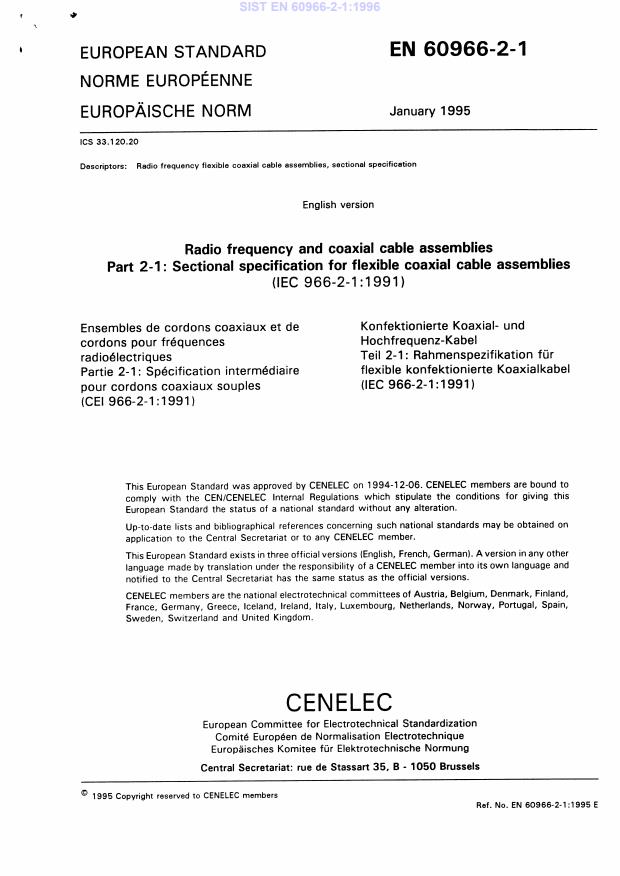
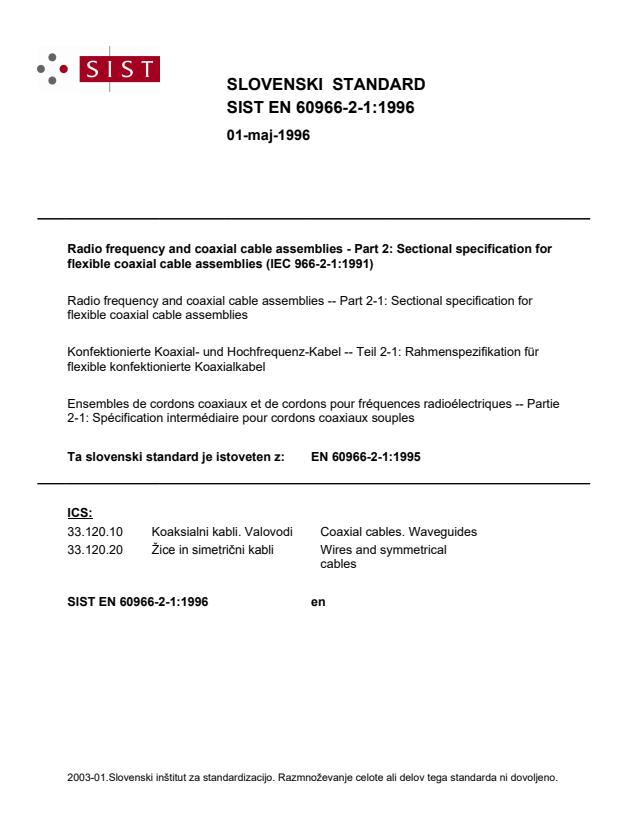
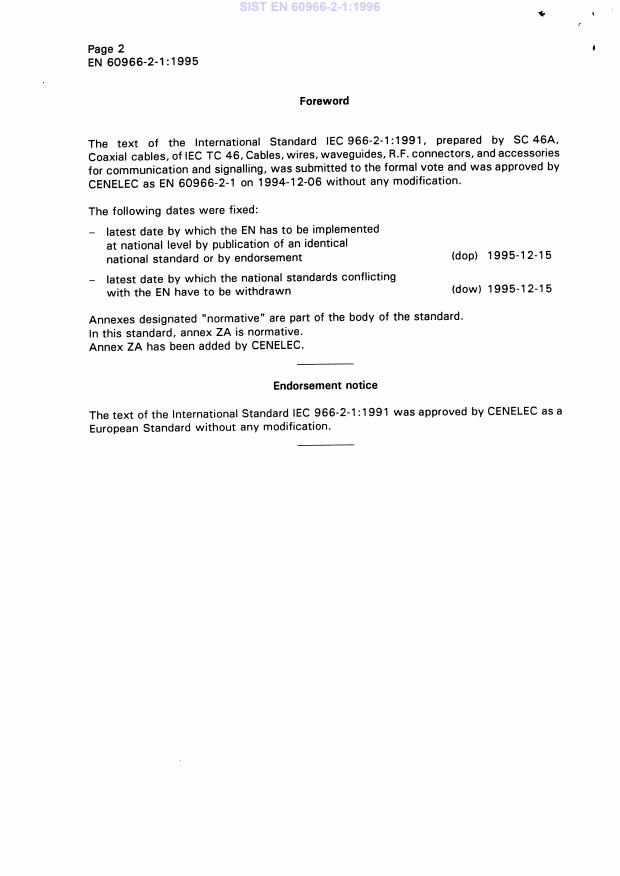
(Main)Radio frequency and coaxial cable assemblies - Part 2-1: Sectional specification for flexible coaxial cable assemblies
General Information
- Abstract
Relates to flexible coaxial cable assemblies operating in the transverse electromagnetic mode (TEM). Establishes uniform requirements for testing the electrical, mechanical and climatic properties of flexible coaxial cable assemblies composed of flexible coaxial cables and coaxial connectors.
- Status
- Withdrawn
- Publication Date
- 19-Jan-1995
- Withdrawal Date
- 14-Dec-1995
- Technical Committee
- CLC/TC 46X - Communication cables
- Drafting Committee
- CLC/SC 46XA - Coaxial cables
- Parallel Committee
- IEC/SC 46A - IEC_SC_46A
- Current Stage
- 9960 - Withdrawal effective - Withdrawal
- Start Date
- 01-Oct-2006
- Completion Date
- 01-Oct-2006

Relations
- Effective Date
- 29-Jan-2023
- Effective Date
- 09-Feb-2026
- Effective Date
- 03-Feb-2026
- Effective Date
- 29-Jan-2023
Get Certified
Connect with accredited certification bodies for this standard

ANCE
Mexican certification and testing association.

Intertek Slovenia
Intertek testing, inspection, and certification services in Slovenia.

LNE (Laboratoire National de Métrologie et d'Essais)
French national laboratory for metrology and testing.
Sponsored listings
Frequently Asked Questions
EN 60966-2-1:1995 is a standard published by CLC. Its full title is "Radio frequency and coaxial cable assemblies - Part 2-1: Sectional specification for flexible coaxial cable assemblies". This standard covers: Relates to flexible coaxial cable assemblies operating in the transverse electromagnetic mode (TEM). Establishes uniform requirements for testing the electrical, mechanical and climatic properties of flexible coaxial cable assemblies composed of flexible coaxial cables and coaxial connectors.
Relates to flexible coaxial cable assemblies operating in the transverse electromagnetic mode (TEM). Establishes uniform requirements for testing the electrical, mechanical and climatic properties of flexible coaxial cable assemblies composed of flexible coaxial cables and coaxial connectors.
EN 60966-2-1:1995 is classified under the following ICS (International Classification for Standards) categories: 33.120.20 - Wires and symmetrical cables. The ICS classification helps identify the subject area and facilitates finding related standards.
EN 60966-2-1:1995 has the following relationships with other standards: It is inter standard links to EN 60966-2-1:2003, EN ISO 14272:2001, EN 60966-1:1993, EN 60966-2-1:1995/A1:1997. Understanding these relationships helps ensure you are using the most current and applicable version of the standard.
EN 60966-2-1:1995 is available in PDF format for immediate download after purchase. The document can be added to your cart and obtained through the secure checkout process. Digital delivery ensures instant access to the complete standard document.
Standards Content (Sample)
2003-01.Slovenski inštitut za standardizacijo. Razmnoževanje celote ali delov tega standarda ni dovoljeno.Radio frequency and coaxial cable assemblies - Part 2: Sectional specification for flexible coaxial cable assemblies (IEC 966-2-1:1991)Konfektionierte Koaxial- und Hochfrequenz-Kabel -- Teil 2-1: Rahmenspezifikation für flexible konfektionierte KoaxialkabelEnsembles de cordons coaxiaux et de cordons pour fréquences radioélectriques -- Partie 2-1: Spécification intermédiaire pour cordons coaxiaux souplesRadio frequency and coaxial cable assemblies -- Part 2-1: Sectional specification for flexible coaxial cable assemblies33.120.20Wires and symmetrical ca
...