


EN 50122-2:2022
(Main)Railway applications - Fixed installations - Electrical safety, earthing and the return circuit - Part 2: Provisions against the effects of stray currents caused by DC traction systems
Railway applications - Fixed installations - Electrical safety, earthing and the return circuit - Part 2: Provisions against the effects of stray currents caused by DC traction systems
This document specifies requirements for protective provisions against the effects of stray currents, which result from the operation of DC electric traction power supply systems. As several decades' experience has not shown evident corrosion effects from AC electric traction power supply systems, this document only deals with stray currents flowing from a DC electric traction power supply system. This document applies to all metallic fixed installations which form part of the traction system, and also to any other metallic components located in any position in the earth, which can carry stray currents resulting from the operation of the railway system. This document applies to all new DC lines and to all major revisions to existing DC lines. The principles can also be applied to existing electrified transportation systems where it is necessary to consider the effects of stray currents. This document does not specify working rules for maintenance but provides design requirements to allow maintenance. The range of application includes: a) railways, b) guided mass transport systems such as: 1) tramways, 2) elevated and underground railways, 3) mountain railways, 4) magnetically levitated systems, which use a contact line system, and 5) trolleybus systems, c) material transportation systems. This document does not apply to a) electric traction power supply systems in underground mines, b) cranes, transportable platforms and similar transportation equipment on rails, temporary structures (e.g. exhibition structures) in so far as these are not supplied directly from the contact line system and are not endangered by the electric traction power supply system, c) suspended cable cars, d) funicular railways.
Bahnanwendungen - Ortsfeste Anlagen - Elektrische Sicherheit, Erdung und Rückleitung - Teil 2: Schutzmaßnahmen gegen Streustromwirkungen durch Gleichstrombahnen
Applications ferroviaires - Installations fixes - Sécurité électrique, mise à la terre et circuit de retour - Partie 2: Mesures de protection contre les effets des courants vagabonds issus de la traction électrique à courant continu
Le présent document spécifie les exigences relatives aux dispositions de protection contre les effets des courants vagabonds dus au fonctionnement des systèmes d’alimentation de traction électrique à courant continu. Plusieurs décennies d'expérience n'ayant pas démontré d'effets corrosifs évidents dus aux systèmes d'ali-mentation de traction électrique à courant alternatif, le présent document traite uniquement des courants va-gabonds issus des systèmes d'alimentation de traction électrique à courant continu. Le présent document s'applique à toutes les installations fixes métalliques qui font partie du système de traction ainsi qu'à tout autre composant métallique se trouvant dans le sol, quelle que soit sa position, et qui peut transporter des courants vagabonds issus de l'exploitation du réseau ferroviaire. Le présent document s'applique à l'ensemble des lignes nouvelles à courant continu, ainsi qu'aux rénova-tions majeures des lignes à courant continu existantes. Ces principes peuvent également s'appliquer aux systèmes de transport électrifiés existants lorsqu'il est nécessaire de tenir compte des effets des courants vagabonds. Le présent document ne spécifie pas les règles de travail pour la maintenance, mais définit des exigences de conception pour permettre la maintenance. Le présent document s'applique aux applications suivantes : a) les réseaux ferroviaires ; b) les réseaux de transport en commun guidés tels que : 1) les tramways ; 2) les voies ferroviaires aériennes et souterraines ; 3) les voies ferroviaires de montagne ; 4) les systèmes à sustentation magnétique, qui utilisent un système de ligne de contact, et 5) les systèmes de trolleybus ; c) les systèmes de transport de matériaux. Le présent document ne s'applique pas aux : a) systèmes d’alimentation de traction électrique des mines souterraines ; b) grues, plateformes transportables et autres matériels de transport similaires sur rails, structures tempo-raires (dans les foires et expositions, par exemple) lorsqu'ils ne sont pas alimentés par les lignes aé-riennes de contact, directement, ni affectés par le système d'alimentation électrique de traction ; c) téléphériques, télécabines ; d) funiculaires à câbles.
Železniške naprave - Fiksni postroji - Električna varnost, ozemljitev in povratni tokokrog - 2. del: Zaščitni ukrepi proti učinkom blodečih tokov, ki jih povzročajo enosmerni sistemi vleke
General Information
- Status
- Published
- Publication Date
- 01-Sep-2022
- Technical Committee
- CLC/TC 9X - Electrical and electronic applications for railways
- Current Stage
- 6060 - Document made available - Publishing
- Start Date
- 02-Sep-2022
- Due Date
- 12-Jan-2022
- Completion Date
- 02-Sep-2022
Relations
- Effective Date
- 06-Sep-2022
- Effective Date
- 03-Feb-2026
- Effective Date
- 03-Feb-2026
- Referred By
EN 16432-1:2017 - Railway applications - Ballastless track systems - Part 1: General requirements - Effective Date
- 09-Feb-2026
- Effective Date
- 09-Feb-2026
- Effective Date
- 09-Feb-2026
- Effective Date
- 09-Feb-2026
- Effective Date
- 09-Feb-2026
- Effective Date
- 09-Feb-2026
- Effective Date
- 03-Feb-2026
- Effective Date
- 03-Feb-2026
- Effective Date
- 03-Feb-2026
- Effective Date
- 03-Feb-2026
- Effective Date
- 14-Feb-2023
- Effective Date
- 17-Sep-2018
Overview
EN 50122-2:2022 (CLC) - Railway applications - Fixed installations - Electrical safety, earthing and the return circuit - Part 2 - specifies protective provisions against the effects of stray currents caused by DC traction systems. The standard applies to all metallic fixed installations and other conductive parts in the earth that can carry stray currents from DC railway power supplies. It covers new DC lines and major revisions to existing DC systems and provides design requirements (not maintenance working rules) to enable safe operation and maintainability.
Key topics and requirements
- Scope and applicability: Targets DC traction systems (tramways, elevated/underground railways, mountain railways, maglev with contact line, trolleybuses, material-handling systems). Exclusions include underground mine traction, suspended cable cars and funiculars.
- Stray current assessment: Criteria for assessing stray current risk and acceptance, including protection criteria for tracks and steel‑reinforced or metallic structures.
- Design provisions for the return circuit: Guidance on return conductors/cables, rail resistance, track bonding, electrical separation and exceptions for systems with return conductor rails.
- Protection of structures: Measures for conductive civil structures, longitudinal interconnection, sectionalized reinforcement, insulating joints, external conductive parts and adjacent pipes/cables.
- Mitigation devices: Use of voltage limiting devices and other protective provisions for metallic structures affected by stray currents.
- Testing and monitoring: Procedures for tests and measurements, rail insulation supervision, repetitive and continuous monitoring of rail potential.
- Informative annexes: Measurement methods for track characteristics (Annex A), rail potential monitoring examples (Annex B), stray current impact estimation (Annex C) and laboratory testing of rail insulation materials (new Annex D).
Practical applications - who uses it
- Railway electrification designers and engineers: To design return circuits and earthing that minimize stray current effects.
- Infrastructure owners and asset managers: For compliance, risk assessment and long‑term asset protection against corrosion.
- Contractors and system integrators: To select return conductors, insulating joints and mitigation measures during upgrades or new builds.
- Safety and corrosion specialists: To evaluate, monitor and remediate stray‑current induced damage on metallic structures and buried utilities.
- Manufacturers and test labs: For qualification of insulating materials and monitoring equipment following the Annex D test approaches.
Related standards
- EN 50122-1:2022 - Protective provisions against electric shock (harmonized with this edition)
- EN 50122-3:2022 - Mutual interaction of AC and DC traction systems
- EN 50163 - Supply voltages of traction systems
EN 50122-2:2022 is essential reading for anyone responsible for DC traction earthing, stray current assessment, corrosion mitigation and safe railway fixed installation design.


Get Certified
Connect with accredited certification bodies for this standard

Intertek Testing Services NA Inc.
Intertek certification services in North America.

UL Solutions
Global safety science company with testing, inspection and certification.

ANCE
Mexican certification and testing association.
Sponsored listings
Frequently Asked Questions
EN 50122-2:2022 is a standard published by CLC. Its full title is "Railway applications - Fixed installations - Electrical safety, earthing and the return circuit - Part 2: Provisions against the effects of stray currents caused by DC traction systems". This standard covers: This document specifies requirements for protective provisions against the effects of stray currents, which result from the operation of DC electric traction power supply systems. As several decades' experience has not shown evident corrosion effects from AC electric traction power supply systems, this document only deals with stray currents flowing from a DC electric traction power supply system. This document applies to all metallic fixed installations which form part of the traction system, and also to any other metallic components located in any position in the earth, which can carry stray currents resulting from the operation of the railway system. This document applies to all new DC lines and to all major revisions to existing DC lines. The principles can also be applied to existing electrified transportation systems where it is necessary to consider the effects of stray currents. This document does not specify working rules for maintenance but provides design requirements to allow maintenance. The range of application includes: a) railways, b) guided mass transport systems such as: 1) tramways, 2) elevated and underground railways, 3) mountain railways, 4) magnetically levitated systems, which use a contact line system, and 5) trolleybus systems, c) material transportation systems. This document does not apply to a) electric traction power supply systems in underground mines, b) cranes, transportable platforms and similar transportation equipment on rails, temporary structures (e.g. exhibition structures) in so far as these are not supplied directly from the contact line system and are not endangered by the electric traction power supply system, c) suspended cable cars, d) funicular railways.
This document specifies requirements for protective provisions against the effects of stray currents, which result from the operation of DC electric traction power supply systems. As several decades' experience has not shown evident corrosion effects from AC electric traction power supply systems, this document only deals with stray currents flowing from a DC electric traction power supply system. This document applies to all metallic fixed installations which form part of the traction system, and also to any other metallic components located in any position in the earth, which can carry stray currents resulting from the operation of the railway system. This document applies to all new DC lines and to all major revisions to existing DC lines. The principles can also be applied to existing electrified transportation systems where it is necessary to consider the effects of stray currents. This document does not specify working rules for maintenance but provides design requirements to allow maintenance. The range of application includes: a) railways, b) guided mass transport systems such as: 1) tramways, 2) elevated and underground railways, 3) mountain railways, 4) magnetically levitated systems, which use a contact line system, and 5) trolleybus systems, c) material transportation systems. This document does not apply to a) electric traction power supply systems in underground mines, b) cranes, transportable platforms and similar transportation equipment on rails, temporary structures (e.g. exhibition structures) in so far as these are not supplied directly from the contact line system and are not endangered by the electric traction power supply system, c) suspended cable cars, d) funicular railways.
EN 50122-2:2022 is classified under the following ICS (International Classification for Standards) categories: 29.120.50 - Fuses and other overcurrent protection devices; 29.280 - Electric traction equipment. The ICS classification helps identify the subject area and facilitates finding related standards.
EN 50122-2:2022 has the following relationships with other standards: It is inter standard links to EN 50122-2:2010, EN 50163:2004, EN 50122-3:2022, EN 16432-1:2017, EN 16704-2-2:2016, CEN/TR 14819-2:2005, EN 15654-1:2018, CEN/TR 14819-1:2004, EN 17168:2021, CLC/TS 50740:2025, CLC/TS 50729:2025, EN 50122-1:2022, EN 50119:2009, EN 50122-2:2022/A1:2025, EN 50122-2:2010. Understanding these relationships helps ensure you are using the most current and applicable version of the standard.
EN 50122-2:2022 is associated with the following European legislation: EU Directives/Regulations: 2008/57/EC, 2016/797/EU; Standardization Mandates: M/483. When a standard is cited in the Official Journal of the European Union, products manufactured in conformity with it benefit from a presumption of conformity with the essential requirements of the corresponding EU directive or regulation.
EN 50122-2:2022 is available in PDF format for immediate download after purchase. The document can be added to your cart and obtained through the secure checkout process. Digital delivery ensures instant access to the complete standard document.
Standards Content (Sample)
SLOVENSKI STANDARD
01-december-2022
Nadomešča:
SIST EN 50122-2:2010
Železniške naprave - Fiksni postroji - Električna varnost, ozemljitev in povratni
tokokrog - 2. del: Zaščitni ukrepi proti učinkom blodečih tokov, ki jih povzročajo
enosmerni sistemi vleke
Railway applications - Fixed installations - Electrical safety, earthing and the return circuit
- Part 2: Provisions against the effects of stray currents caused by DC traction systems
Bahnanwendungen - Ortsfeste Anlagen - Elektrische Sicherheit, Erdung und Rückleitung
- Teil 2: Schutzmaßnahmen gegen Streustromwirkungen durch Gleichstrombahnen
Applications ferroviaires - Installations fixes - Sécurité électrique, mise à la terre et circuit
de retour - Partie 2: Mesures de protection contre les effets des courants vagabonds
issus de la traction électrique à courant continu
Ta slovenski standard je istoveten z: EN 50122-2:2022
ICS:
29.120.50 Varovalke in druga Fuses and other overcurrent
nadtokovna zaščita protection devices
29.280 Električna vlečna oprema Electric traction equipment
2003-01.Slovenski inštitut za standardizacijo. Razmnoževanje celote ali delov tega standarda ni dovoljeno.
EUROPEAN STANDARD EN 50122-2
NORME EUROPÉENNE
EUROPÄISCHE NORM September 2022
ICS 29.120.50; 29.280 Supersedes EN 50122-2:2010
English Version
Railway applications - Fixed installations - Electrical safety,
earthing and the return circuit - Part 2: Provisions against the
effects of stray currents caused by DC traction systems
Applications ferroviaires - Installations fixes - Sécurité Bahnanwendungen - Ortsfeste Anlagen - Elektrische
électrique, mise à la terre et circuit de retour - Partie 2: Sicherheit, Erdung und Rückleitung - Teil 2:
Mesures de protection contre les effets des courants Schutzmaßnahmen gegen Streustromwirkungen durch
vagabonds issus de la traction électrique à courant continu Gleichstrombahnen
This European Standard was approved by CENELEC on 2022-07-25. CENELEC members are bound to comply with the CEN/CENELEC
Internal Regulations which stipulate the conditions for giving this European Standard the status of a national standard without any alteration.
Up-to-date lists and bibliographical references concerning such national standards may be obtained on application to the CEN-CENELEC
Management Centre or to any CENELEC member.
This European Standard exists in three official versions (English, French, German). A version in any other language made by translation
under the responsibility of a CENELEC member into its own language and notified to the CEN-CENELEC Management Centre has the
same status as the official versions.
CENELEC members are the national electrotechnical committees of Austria, Belgium, Bulgaria, Croatia, Cyprus, the Czech Republic,
Denmark, Estonia, Finland, France, Germany, Greece, Hungary, Iceland, Ireland, Italy, Latvia, Lithuania, Luxembourg, Malta, the
Netherlands, Norway, Poland, Portugal, Republic of North Macedonia, Romania, Serbia, Slovakia, Slovenia, Spain, Sweden, Switzerland,
Türkiye and the United Kingdom.
European Committee for Electrotechnical Standardization
Comité Européen de Normalisation Electrotechnique
Europäisches Komitee für Elektrotechnische Normung
CEN-CENELEC Management Centre: Rue de la Science 23, B-1040 Brussels
© 2022 CENELEC All rights of exploitation in any form and by any means reserved worldwide for CENELEC Members.
Ref. No. EN 50122-2:2022 E
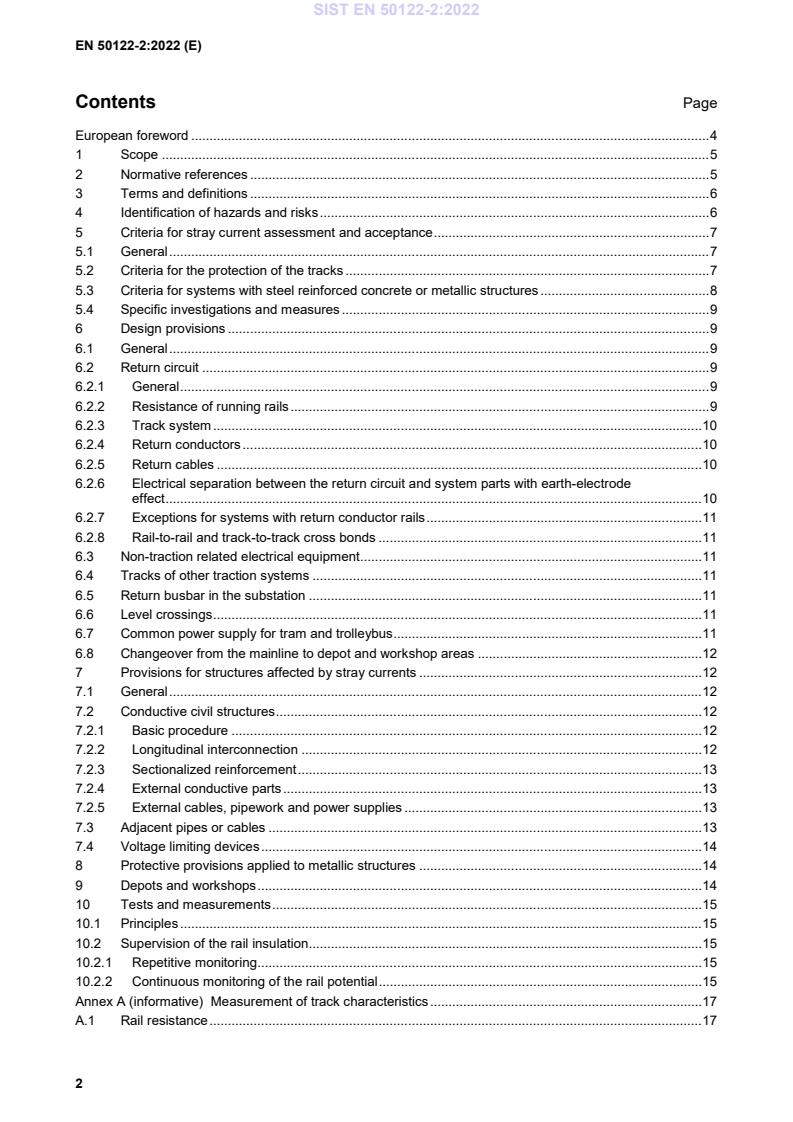
Contents Page
European foreword . 4
1 Scope . 5
2 Normative references . 5
3 Terms and definitions . 6
4 Identification of hazards and risks . 6
5 Criteria for stray current assessment and acceptance . 7
5.1 General . 7
5.2 Criteria for the protection of the tracks . 7
5.3 Criteria for systems with steel reinforced concrete or metallic structures . 8
5.4 Specific investigations and measures . 9
6 Design provisions . 9
6.1 General . 9
6.2 Return circuit . 9
6.2.1 General . 9
6.2.2 Resistance of running rails . 9
6.2.3 Track system . 10
6.2.4 Return conductors . 10
6.2.5 Return cables . 10
6.2.6 Electrical separation between the return circuit and system parts with earth-electrode
effect . 10
6.2.7 Exceptions for systems with return conductor rails . 11
6.2.8 Rail-to-rail and track-to-track cross bonds . 11
6.3 Non-traction related electrical equipment . 11
6.4 Tracks of other traction systems . 11
6.5 Return busbar in the substation . 11
6.6 Level crossings . 11
6.7 Common power supply for tram and trolleybus . 11
6.8 Changeover from the mainline to depot and workshop areas . 12
7 Provisions for structures affected by stray currents . 12
7.1 General . 12
7.2 Conductive civil structures . 12
7.2.1 Basic procedure . 12
7.2.2 Longitudinal interconnection . 12
7.2.3 Sectionalized reinforcement . 13
7.2.4 External conductive parts . 13
7.2.5 External cables, pipework and power supplies . 13
7.3 Adjacent pipes or cables . 13
7.4 Voltage limiting devices . 14
8 Protective provisions applied to metallic structures . 14
9 Depots and workshops . 14
10 Tests and measurements . 15
10.1 Principles . 15
10.2 Supervision of the rail insulation. 15
10.2.1 Repetitive monitoring. 15
10.2.2 Continuous monitoring of the rail potential . 15
Annex A (informative) Measurement of track characteristics . 17
A.1 Rail resistance . 17
A.2 Conductance per length between running rails and steel reinforced structures . 18
A.3 Conductance per length for track sections without civil structure . 19
A.4 Local conductance per length for track sections without civil structure . 20
A.5 Insulated rail joints . 22
A.6 Insulating joints between steel reinforced structures . 23
Annex B (informative) Stray current assessment – Rail insulation assessment using rail potential . 25
B.1 Repetitive measurements of the rail potential to monitor the conductance . 25
B.2 Example for a continuous monitoring of the rail potential . 25
Annex C (informative) Estimation of stray current and impact on metallic structures . 27
C.1 Estimation of the stray currents passing from the running rails to the earth . 27
C.2 Estimation of the longitudinal voltage in steel reinforced structures . 28
Annex D (informative) Laboratory testing of materials for the insulation of rails . 30
D.1 General . 30
D.2 Test procedure . 30
D.2.1 General . 30
D.2.2 Initial test . 30
D.2.3 Heat Aging . 30
D.2.4 Influence of winter weather and rain . 30
D.2.5 Evaluation . 30
D.3 Acceptance criterion of the tests . 30
Annex E (informative) Fastening systems . 31
Bibliography . 32
Figures
Figure A.1 — Measurement of the rail resistance for a rail section of length d . 17
Figure A.2 — Measuring arrangement for the conductance per length G´ between rails and steel
RS
reinforced structure . 18
Figure A.3 — Determination of the conductance per length G´ for track sections without civil
RE
structures . 19
Figure A.4 — Measuring arrangement for the local conductance per length . 21
Figure A.5 — Test of insulated rail joints . 22
Figure A.6 — Test of insulating joints in steel reinforced structures . 23
Figure B.1 — Scheme of continuous monitoring of the rail potential . 26
European foreword
This document (EN 50122-2:2022) has been prepared by CLC/SC 9XC “Electric supply and earthing systems
for public transport equipment and ancillary apparatus (Fixed installations)”.
The following dates are fixed:
• latest date by which this document has to be (dop) 2023-07-25
implemented at national level by publication of
an identical national standard or by
endorsement
• latest date by which the national standards (dow) 2025-07-25
conflicting with this document have to be
withdrawn
This document supersedes EN 50122-2:2010 and all of its amendments and corrigenda (if any).
— harmonization with EN 50122-1:2022;
— improvement of measurement specification in Annex A;
— new Annex D “Laboratory testing of materials for the insulation of rails”.
Attention is drawn to the possibility that some of the elements of this document may be the subject of patent
rights. CENELEC shall not be held responsible for identifying any or all such patent rights.
Any feedback and questions on this document should be directed to the users’ national committee. A complete
listing of these bodies can be found on the CENELEC website.
1 Scope
This document specifies requirements for protective provisions against the effects of stray currents, which
result from the operation of DC electric traction power supply systems.
As several decades' experience has not shown evident corrosion effects from AC electric traction power supply
systems, this document only deals with stray currents flowing from a DC electric traction power supply system.
This document applies to all metallic fixed installations which form part of the traction system, and also to any
other metallic components located in any position in the earth, which can carry stray currents resulting from
the operation of the railway system.
This document applies to all new DC lines and to all major revisions to existing DC lines. The principles can
also be applied to existing electrified transportation systems where it is necessary to consider the effects of
stray currents.
This document does not specify working rules for maintenance but provides design requirements to allow
maintenance.
The range of application includes:
a) railways,
b) guided mass transport systems such as:
1) tramways,
2) elevated and underground railways,
3) mountain railways,
4) magnetically levitated systems, which use a contact line system, and
5) trolleybus systems,
c) material transportation systems.
This document does not apply to
a) electric traction power supply systems in underground mines,
b) cranes, transportable platforms and similar transportation equipment on rails, temporary structures (e.g.
exhibition structures) in so far as these are not supplied directly from the contact line system and are not
endangered by the electric traction power supply system,
c) suspended cable cars,
d) funicular railways.
2 Normative references
The following documents are referred to in the text in such a way that some or all of their content constitutes
requirements of this document. For dated references, only the edition cited applies. For undated references,
the latest edition of the referenced document (including any amendments) applies.
EN 50122-1:2022, Railway applications - Fixed installations - Electrical safety, earthing and the return circuit -
Part 1: Protective provisions against electric shock
EN 50122-3:2022, Railway applications - Fixed installations - Electrical safety, earthing and the return circuit -
Part 3: Mutual Interaction of AC and DC traction systems
EN 50163, Railway applications - Supply voltages of traction systems
3 Terms and definitions
For the purposes of this document, the terms and definitions given in EN 50122-1:2022 apply.
ISO and IEC maintain terminological databases for use in standardization at the following addresses:
— ISO Online browsing platform: available at https://www.iso.org/obp
— IEC Electropedia: available at https://www.electropedia.org/
4 Identification of hazards and risks
DC traction systems can cause stray currents which could adversely affect the railway concerned and/or
outside installations, when the feed and return circuits are not sufficiently insulated from earth.
The major effects of stray currents can be corrosion and subsequent damage of metallic structures, where
stray currents leave the metallic structures. There is also the risk of overheating, arcing and fire and
subsequent danger to persons and equipment both inside and outside the DC electric traction power supply
system.
The following systems, which can produce stray currents, shall be considered:
— DC railways using running rails carrying the traction return current including track sections of other traction
systems bonded to the tracks of DC railways;
— DC trolleybus systems which share the same power supply with a system using the running rails carrying
the traction return current;
— DC railways not using running rails carrying the traction return current, where DC currents can flow to
earth or earthing installations.
All components and systems which can be affected by stray currents shall be considered such as
— running rails,
— metallic pipe work,
— cables with metal armour and/or metal shield,
— metallic tanks,
— earthing installations,
— steel reinforced concrete structures and elements (e.g. bearers and slab track components),
— buried metallic structures,
— signalling and telecommunication installations,
— non-traction AC and DC power supply systems,
— cathodic protection installations.
Any provisions employed to control the effects of stray currents shall be checked, verified and validated
according to this document.
The system design shall be completed before key parameters for stray current effects are decided. This
includes parameters such as substation locations, track formations, bonding, insulated rail joint positions and
civil structure designs (e.g. overhead line equipment mast bases). See also 5.4 and Clause 6.
The entity responsible for the design and construction of the railway infrastructure shall make sure that
electrical requirements for railway related civil structures are met.
In case of major revisions of existing lines, the effects on the stray current situation shall be assessed by
calculation and/or by measurements.
If stray current mitigation adversely affects electrical safety with regards to electric shock, then the electrical
safety provisions described in EN 50122-1:2022 shall take precedence.
5 Criteria for stray current assessment and acceptance
5.1 General
Stray current effects depend on the overall system design of the electric traction power supply system. Stray
currents leaving the return circuit can affect the return circuit itself and neighbouring installations, see Clause 4.
As well as the operating currents, the most important parameters for the magnitude of stray current are:
— the conductance per length of the tracks and the other parts of the return circuit;
— the distance between traction substations;
— the longitudinal resistance of the running rails, when used for traction return current;
— spacing of cross bonds.
There shall be no permanent direct electrical connection of the return circuit, either accidental or intended, to
earthing installations and earth.
NOTE 1 Depots, workshops and similar locations are an exception as described in Clause 9.
If the railway system meets the requirements and measures of this document, the railway system is deemed
to be acceptable from the stray current point of view.
NOTE 2 Third party installations in proximity to the railway system could require additional measures.
The most important influencing variable for stray currents leaving the tracks is the combination of the
conductance per length between track and earth and the rail potential. The corrosion rate is the main aspect
for the assessment of risk.
5.2 Criteria for the protection of the tracks
Experience over more than three decades has proven that there is no damage in the tracks over this period,
if the average stray current per length does not exceed the following value:
I’ = 2,5 mA/m
max
(Time averaged stray current leakage per length of a single track line).
For a double track line, the value for the maximum average stray current leakage is to be multiplied by two.
For more than two tracks or tracks with more than two running rails the factor increases accordingly.
For stray current considerations the local positive rail potential shift ΔU is relevant. This is the difference
RE
between the rail potential U occurring during operation and no-operation.
RE
NOTE 1 During non-operational periods a voltage U can be present.
RE
If the following values for the conductance per length G’ and time averaged rail potential shift ΔU are not
RE RE
exceeded during the system life-time, further investigations according to 5.4 do not need to be performed.
— G’ ≤ 0,5 S/km per track and ∆U ≤ + 5 V for open formation (1)
RE RE
— G’ ≤ 2,5 S/km per track and ∆U ≤ + 1 V for closed formation (2)
RE RE
For the averaging process, only the parts of the rail potential shift, ΔU , that are more positive than the
RE
potential U (measured during the non-operational periods) are taken into account. The averaging period
RE
shall normally be 24 h, or multiples of 24 h. For some systems, shorter measuring periods can be used. The
ΔU values are then divided by the total number of measurements over the recording time. A guide value for
RE
the sampling rate is two per second.
Due to the degradation of the track system over time, more conservative values are required at commissioning.
Maintenance interventions will help ensure the stray currents do not cause degradation of vulnerable assets.
If the requirements in Formula (1) and Formula (2) are not met, an alternative maximum value for G’ shall
RE
be calculated and used for the design, applying Formula (3).
𝐼𝐼’
𝐺𝐺’ ≤ (3)
RE
∆𝑈𝑈
RE
where
I’ is 2,5 mA/m per track or the value coming from the investigation in 5.4;
G’ is the conductance per length between rails and earth, in siemens per kilometre (S/km,
RE
whereby 1 S/km = 1/Ω ·km);
∆U is the average positive rail potential shift, in volts (V).
RE
Because of changing moisture, a conductance per length of G’ < 0,5 S/km is not practical for tracks in closed
RE
formation and hence not recommended. If the average conductance per length does not allow to fulfil the
criteria of I’ = 2,5 mA/m, the electric traction power supply system should be optimized.
For a double track line, the value for the maximum conductance per length is to be multiplied by two. For more
than two tracks the factor increases accordingly.
As it is not easy to measure the stray currents directly, the measurement of the rail potential is a convenient
method. According to Formula (3), the acceptable conductance per length can be calculated for a single track
line.
NOTE 2 Simulation of the electric traction power supply system for scheduled train operation can provide values for
the stray current per length for design purposes. A method of calculating dead-end tracks is given in C.1. This is a
conservative method, because the actual values are lower.
When the construction phase has been completed, it shall be proven that the permissible conductance per
length according to Formulae (1), (2) or (3) is fulfilled. Annex A indicates proven methods for the measurement.
During operation, compliance with the limits of conductance per length according to Formulae (1), (2) or (3)
shall be maintained, see 10.2.1.
NOTE 3 Experience has shown that if the requirements given in 5.2 regarding stray current leakage and conductance
are fulfilled, impacts on non-railway installations caused by stray currents are generally acceptable.
5.3 Criteria for systems with steel reinforced concrete or metallic structures
In systems with steel reinforced concrete or metallic structures, like
— reinforced track bed,
— tunnels or
— viaducts,
the impact of stray currents on the structures shall be considered.
The positive voltage shift of the structure with respect to earth is one criterion for acceptance. Measurement
of the corrosion rate can be achieved using an electrical resistance probe, and the measured corrosion rate
can be compared to the design corrosion rate value.
If the average value of the positive potential shift between the structure and earth does not exceed + 200 mV
for steel in concrete structures the risk of corrosion can be considered as low, see EN 50162:2004. A margin
may be added according to the expected possible traffic extension in the future. For buried metal constructions
without cathodic protection the values depend on soil resistivity and the material. For both requirements refer
to EN 50162:2004.
In order to avoid inadmissible stray current effects on steel reinforced concrete or metallic structures, the
longitudinal voltage between any two points of these (longitudinally) interconnected structures should be
calculated. The maximum longitudinal voltage shall be smaller than the permissible positive potential shift, e.g.
+200 mV. As an example for calculation see C.2. This is a conservative procedure which ensures that the
actual values for the structure potential with respect to earth will be lower.
5.4 Specific investigations and measures
If the requirements stated in 5.2 and 5.3 are not achieved, or if other methods of construction are planned, a
study shall be carried out at an early planning stage. The study is also necessary when major revisions of
existing lines are carried out, when the stray current situation is likely to become worse.
The following aspects should be included in the study:
— insulation from earth of the rails and connected metallic structures,
— humidity of the track bed,
— longitudinal resistance of the running rails, when used for traction return circuit,
— number of and distance between the substations,
— effects of inequalities in the no load voltages of substations,
— substation no-load voltage and source impedance,
— timetable and vehicles,
— neighbouring metallic structures.
Clause 6 and Clause 7 show suitable corrective provisions.
6 Design provisions
6.1 General
Clause 4 identifies the hazards and risks that shall be considered in the design for stray current mitigation.
6.2 Return circuit
6.2.1 General
In order to minimize stray current caused by a DC electric traction power supply system, the traction return
current shall be confined to the intended return circuit as far as possible.
As the return circuit in case of DC electric traction power supply systems usually is not connected to earth,
safety requirements for the rail potential according to EN 50122-1:2022, 6.2.2 and Clause 9, shall be fulfilled.
6.2.2 Resistance of running rails
In order to achieve the requirements set out in Clause 5, the longitudinal resistance of the running rails when
used for traction return circuit shall be as low as reasonably practical. Therefore, rail joints shall be welded or
connected by rail joint bonds of low resistance such that the longitudinal resistance of the rails is not increased
by more than 5 % of the initial resistance. This does not include insulated rail joints, where electrical separation
is required.
Impedance bonds, used for track circuit separation, will also carry the full rail current and can result in an
increase of rail resistance greater than the required 5 %. Signalling requirements shall take precedence over
stray current mitigation. In such a case, alternative methods to reduce the overall rail circuit resistance, or the
effects of the increased stray currents, shall be applied.
The longitudinal resistance can be reduced by using rails with a greater cross section or, if signalling
considerations allow, cross bonding of the running rails.
6.2.3 Track system
When the running rails are used as a part of the return circuit, the insulation between the running rails and the
earth shall ensure that the requirements of 5.2 are fulfilled.
The track formation shall be designed so that the insulation quality of the rails with respect to earth will not be
substantially diminished by water. To fulfil the values given in Formulae (1), (2) and (3) of 5.2 the water
drainage of the substructure of the running rails is essential.
The values of conductance per length, specified in 5.2, apply to a track consisting of two running rails, as well
as any attached system parts (e.g. tie bars or cross bonds) under dry conditions.
NOTE 1 In this context, dry conditions means at least 24 h without, for example, precipitation or washing water.
NOTE 2 After concreting, it is preferable to wait until the concrete has set and has dried out sufficiently. This takes
usually at least one month. The setting of concrete is strongly dependent on the environmental conditions.
EXAMPLE 1 The following provisions can be made to achieve the required values of the conductance G’ for rails
RE
laid in an open formation:
— clean ballast;
— wooden sleepers or steel reinforced concrete sleepers with insulating fastening;
— provide the required distance between running rails and ballast.
EXAMPLE 2 The following provisions can be made to achieve the required values of the conductance G’ for rails
RE
laid in a closed formation:
— fitting of the running rails in an insulating resin bed; Annex D and Annex E provide guidelines to test encapsulation and
fastening systems respectively;
— provision of insulating intermediate layers between the tracks and the bearing systems;
— effective water drainage.
6.2.4 Return conductors
Return conductors, if required, are laid in parallel to the running rails and shall be connected to them at regular
intervals so that the rail potentials and stray current criteria are met. The return conductors shall be insulated
from earth.
6.2.5 Return cables
Return cables connect the running rails with the substation. They shall have an insulating outer sheath, so that
no stray currents can leave or enter.
Where mechanical damage is likely, return cables should have an additional protection.
Requirements of EN 50122-1:2022, 10.3 remain.
6.2.6 Electrical separation between the return circuit and system parts with earth-electrode effect
In order to reduce stray currents, no part of the return circuit shall have a direct conductive connection to
installations, components or metallic structures which are not insulated from earth.
If a connection to the return circuit is unavoidable for reasons of protection against electric shock, provisions
shall be taken to reduce the stray current effects. These can be for example:
— open connection to the return circuit, protected by a voltage limiting device, which shall be in accordance
with EN 50122-1:2022, Annex G;
— insulation of the equipment or components that are connected to the running rails, from foundations or
components that are earthed;
— insulation of the steel reinforcement of the structure from earth.
In case of direct conductive connection to installations, components or metallic structures which are not
insulated from earth, the values given in Formulae (1), (2) and (3) of 5.2 shall be fulfilled for the return circuit
and parts connected to it.
For exceptions regarding depots, workshops and similar locations see Clause 9.
6.2.7 Exceptions for systems with return conductor rails
A return conductor rail insulated from earth, the so-called “fourth rail”, can be used for the traction return
current. If this is a live part and not connected to the running rails, usually no stray currents occur. Hence no
stray current protective provisions for the running rails are required. In the case of conductor rail systems with
third and fourth rails, each conductor rail shall be insulated from earth depending on the nominal voltage of the
system according to EN 50163.
If it is possible that an electric traction power supply system can operate with compromised insulation
resistance under such circumstances the risk of stray current corrosion is increased significantly. This should
be taken into account when considering continuous monitoring of key parameters.
6.2.8 Rail-to-rail and track-to-track cross bonds
Rail-to-rail cross bonds, tie bars, track-to-track cross bonds and other bonds which can come in contact with
earth shall be insulated.
6.3 Non-traction related electrical equipment
Non-traction related electrical equipment shall be installed according to EN 50122-1:2022, Clause 7.
6.4 Tracks of other traction systems
Generally, the tracks of other traction systems shall not have any direct conductive connection to tracks of DC
electric traction power supply systems.
Tracks without contact line may be connected to the return circuit in special cases if they fulfil the requirements
given in 6.2.3.
If running rails are used by DC and AC electric traction power supply systems, additional provisions shall be
made against the stray current hazard and against impermissible touch voltages, see EN 50122-3:2022.
Any additional provisions shall not affect electrical safety as well as the operation of the electric traction power
supply system, track circuits and communication systems.
6.5 Return busbar in the substation
The substation shall be arranged so that stray current does not flow between the substation structure earth
and the return busbar. This is to be achieved by not providing any permanent direct connection. Risks from
stray current relating to the earthing of equipment due to maintenance work shall be taken into account. The
return busbars in substations and similar installations shall be operated so that they are insulated from earth.
Where required for safety reasons a voltage-limiting device (minimum type O) to connect between the return
busbar and earth shall be provided in accordance with EN 50122-1:2022, Annex G. For substations in depots
and workshops see Clause 9.
6.6 Level crossings
At level crossings, where the running rails are laid in a closed formation, care shall be taken that the value of
the conductance per length does not exceed the value of the neighbouring tracks.
6.7 Common power supply for tram and trolleybus
If trolleybuses and tramways receive their traction power from the same substation, one of the trolley contact
wires may be connected with the track return system according to EN 50122-1:2022, 5.7.3. In this case it shall
be checked to determine whether the protective provisions for both systems to minimize stray current effects
are still sufficient.
The insulation of the running rails shall be coordinated with other provisions ensuring that acceptable touch
voltages according to EN 50122-1:2022, Clause 9 are not exceeded during operation, in case of a short-circuit
and in case of an earth fault.
6.8 Changeover from the mainline to depot and workshop areas
See Clause 9 for guidance where the main line enters the depot and workshop area.
7 Provisions for structures affected by stray currents
7.1 General
There shall be no direct electrical contact between the metallic components of structures that are not insulated
from earth and the return circuit.
In the case of depots and workshops (see Clause 9) earth and track return systems may be connected directly.
A direct connection to earth may also be allowed in certain industrial systems with a DC electric traction power
supply system taking into consideration the particular surrounding conditions, e.g. open cast coal mines.
7.2 Conductive civil structures
7.2.1 Basic procedure
It can be necessary to make provisions to limit the possible effects of stray currents in steel reinforced or civil
structures.
Examples of civil structures with steel reinforcement are:
— tunnels,
— bridges,
— viaducts (including pre- and post-tension cables),
— buildings, and
— slab tracks.
The requirements for protection against electric shock shall have precedence over stray current mitigation
measures.
The provisions to reduce the stray current effects in structures with conductive components depend on whether
the predominant interference source is internal or external to this structure. The provisions also depend on
whether it is the structure’s metallic components or other metallic structures that are to be protected.
7.2.2 Longitudinal interconnection
Stray currents in conductive civil structures adjacent to the running rails can cause influence to other metallic
structures, including third party structures (this is known as secondary interference). Where this occurs, it is
possible to reduce the interference by equipotential bonding within the civil structure adjacent to the running
rails to achieve the voltage requirements according to 5.3. The equipotential bonds shall be made close to the
running rails (e.g. the lower part of a tunnel or the upper part of a bridge deck).
Equipotential bonding to other structures shall be carefully considered to ensure that there are no adverse
effects.
Equipotential bonding may be achieved in different ways, depending on the structures involved. Reinforcing
steel may be connected by welding e.g. via a transverse bar between the reinforcing bars. Steel mats, and
other structures, may be connected by direct bonding. Bonds shall be sized and rated to meet the resistance
and current requirements of the system. In case of exposed bond cables they shall be insulated.
Individual sections of civil structures in particular cases may be excluded from the equipotential bonding of the
rest of the civil structure. The equipotential bonding of the other sections of civil structures can be achieved by
means of a conductor extending over the segregated section of civil structure.
For stray current protection purposes the equipotential bonding shall meet the voltage requirements in 5.3.
The connections shall be durable and protected from corrosion. The selection of connection methods, for
example welding or tie wrapping, will be influenced by the site constraints and construction requirements. For
longitudinal continuity welding is recommended.
7.2.3 Sectionalized reinforcement
If a sufficiently high value of rail to earth resistance cannot be achieved, e.g. due to humidity or ballast which
is not sufficiently clean, the main consideration shall be the corrosion of the metallic structures.
Steel reinforced concrete structures can be divided into longitudinal sections by insulating joints in the case
where stray currents from any source, including third party systems, can flow along the structure, thus causing
an undesirable electrical connection between different areas.
If the resistance between these structures and earth is relatively high, for example in rock tunnels, the steel
reinforced concrete tunnel structures can also be divided into longitudinal sections by insulating joints. Rail
insulation should be improved to limit stray current to an acceptable level in this area.
If there is any risk of an impermissible voltage between simultaneously accessible parts, refer to
EN 50122-1:2022.
At insulating joints between each section, terminals shall be provided for test purposes. A reliable electrical
connection shall be made between these terminals and the longitudinal reinforcing bars. A recommended
measurement method is given in A.6.
Normally, no connection will be made between the terminals of adjacent sections.
7.2.4 External conductive parts
The reinforcement of steel reinforced concrete structures and its components consisting of conductive
materials shall not have any electrical connection to pipes and cables located outside the structure or to the
return circuit or to any adjacent systems which are not insulated from earth. If this electrical separation is not
possible, for instance due to different earthing systems being present in one building, danger of stray current
exchange and in consequence danger of stray current corrosion exists. In this case continuous monitoring,
shall be provided, see 10.2.2, and rail to structure earth connections shall be removed promptly.
Connections of the structure reinforcement to additional earthing systems should be avoided but remain
permissible in order to satisfy earthing requirements for safety protective provisions.
7.2.5 External cables, pipework and power supplies
Precautions are necessary in order to avoid possible
...
Questions, Comments and Discussion
Ask us and Technical Secretary will try to provide an answer. You can facilitate discussion about the standard in here.
Loading comments...