

EN 60908:1999
(Main)Audio recording - Compact disc digital audio system
General Information
- Abstract
Applies to a pre-recorded optical reflective digital audio disc system. Defines those parameters of compact discs that affect interchangeability between discs and players. Is also intended as a reference for manufacturers wishing to produce discs and/or players that conform to the system described.
- Status
- Published
- Publication Date
- 03-Mar-1999
- Withdrawal Date
- 31-Oct-2001
- Technical Committee
- CLC/TC 100X - Audio, video and multimedia systems and equipment and related sub-systems
- Drafting Committee
- IEC/TC 100 - IEC_TC_100
- Parallel Committee
- IEC/TC 100 - IEC_TC_100
- Current Stage
- 6060 - Document made available - Publishing
- Start Date
- 04-Mar-1999
- Completion Date
- 04-Mar-1999

Overview
EN 60908:1999 - Audio recording: Compact disc digital audio system is the European adoption of IEC 60908:1999 for pre‑recorded optical reflective digital audio discs (Compact Discs). The standard defines the physical, optical, electrical and data‑format parameters that ensure interchangeability between discs and players, and serves as a technical reference for manufacturers, test laboratories and product designers producing CDs and CD players.
Key topics and technical requirements
EN 60908:1999 covers the full system specification rather than application‑specific features. Key topics include:
- System description and measurement requirements - measurement conditions, pick‑up requirements and clamping methods to ensure repeatable testing.
- Mechanical parameters - disc dimensions, centre hole, thickness, labelling, reference plane, clamping area and mass considerations that affect playback.
- Optical parameters - substrate thickness, refractive index, birefringence, reflectivity and angular deviation limits relevant to laser reading.
- Recording and tracking - rotation during playback, track geometry, radial tolerance and limits on information‑layer deviations that influence read reliability.
- High‑frequency (HF) and radial differential (RD) signals - modulation amplitude, asymmetry, cross‑talk, RD signal shape and sensitivity used for data and tracking.
- Defects and error metrics - Block Error Rate (BLER), local defects and allowable defect behaviour.
- Data modulation and frame formats - Eight‑to‑Fourteen Modulation (EFM), frame and PACK structures.
- Error correction and interleaving - Cross‑Interleaved Reed–Solomon Code (CIRC), P/Q parity generation, interleave/de‑interleave sequences.
- Subcode and control system - subcode channels P and Q (TOC, time, control), channels R–W for graphics and extra data, and mode definitions (ZERO, LINE GRAPHICS, TV GRAPHICS, EXTENDED TV, MIDI, USER, CD‑TEXT).
- CD‑TEXT and auxiliary modes - metadata encoding for lead‑in and program areas and recommended repetition/skew behaviour.
Applications and who uses it
EN 60908:1999 is essential for:
- Disc manufacturers and replication plants producing pre‑recorded CDs to ensure mechanical/optical conformity.
- Player and drive manufacturers designing optical pick‑ups, servo systems and firmware for reliable playback.
- Test laboratories and QA teams performing conformity testing, BLER measurement and optical/mechanical verification.
- Audio engineers and archivists implementing preservation, replication and playback systems with predictable interoperability.
- Standards bodies and procurement teams referencing technical requirements in specifications and compliance documentation.
Related standards
- EN 60908:1999 is identical to IEC 60908:1999 (international edition) as noted in the document extract.
- Implementers commonly consult adjacent IEC/ISO standards and industry test methods for media longevity, environmental testing and digital audio system interoperability.
Keywords: EN 60908:1999, IEC 60908, Compact Disc, CD digital audio, optical disc, EFM, CIRC, BLER, CD‑TEXT, optical disc standards.
Relations
- Effective Date
- 28-Jan-2023
- Effective Date
- 03-Feb-2026
- Effective Date
- 03-Feb-2026
- Effective Date
- 03-Feb-2026
- Effective Date
- 03-Feb-2026
- Effective Date
- 03-Feb-2026
- Effective Date
- 03-Feb-2026
- Effective Date
- 03-Feb-2026
- Effective Date
- 03-Feb-2026
- Effective Date
- 03-Feb-2026
- Effective Date
- 03-Feb-2026
Get Certified
Connect with accredited certification bodies for this standard

ANCE
Mexican certification and testing association.

Intertek Slovenia
Intertek testing, inspection, and certification services in Slovenia.

LNE (Laboratoire National de Métrologie et d'Essais)
French national laboratory for metrology and testing.
Sponsored listings
Frequently Asked Questions
EN 60908:1999 is a standard published by CLC. Its full title is "Audio recording - Compact disc digital audio system". This standard covers: Applies to a pre-recorded optical reflective digital audio disc system. Defines those parameters of compact discs that affect interchangeability between discs and players. Is also intended as a reference for manufacturers wishing to produce discs and/or players that conform to the system described.
Applies to a pre-recorded optical reflective digital audio disc system. Defines those parameters of compact discs that affect interchangeability between discs and players. Is also intended as a reference for manufacturers wishing to produce discs and/or players that conform to the system described.
EN 60908:1999 is classified under the following ICS (International Classification for Standards) categories: 33.160.30 - Audio systems. The ICS classification helps identify the subject area and facilitates finding related standards.
EN 60908:1999 has the following relationships with other standards: It is inter standard links to EN 60908:1992/A1:1993, EN 61866:1997, EN 61938:1997, EN 61104:1992, EN 60721-3-5:1997, EN 60068-2-30:1999, EN 62403:2006, EN 61909:2000, EN 60958-3:2000, EN 60958-3:2006, EN 60958-3:2003. Understanding these relationships helps ensure you are using the most current and applicable version of the standard.
EN 60908:1999 is available in PDF format for immediate download after purchase. The document can be added to your cart and obtained through the secure checkout process. Digital delivery ensures instant access to the complete standard document.
Standards Content (Sample)
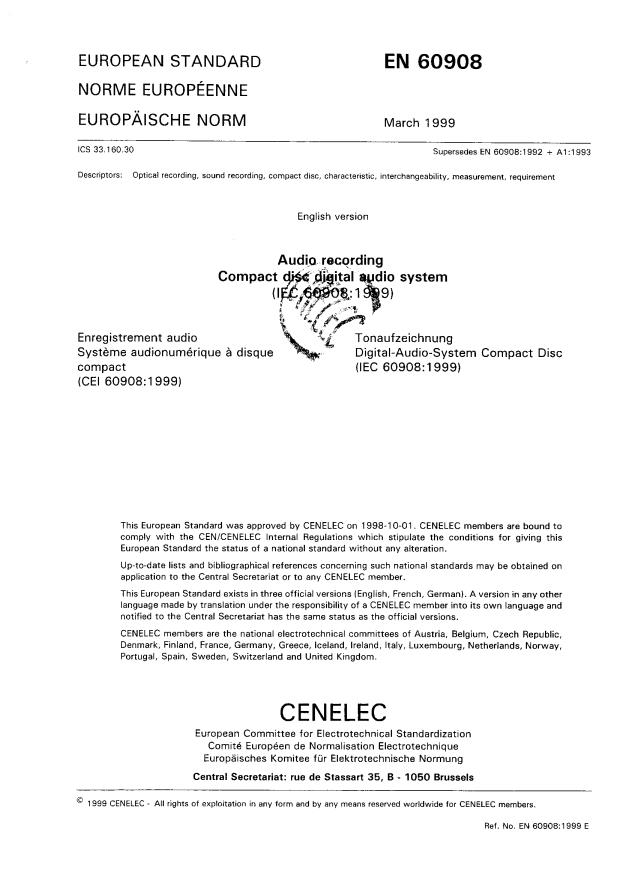
SLOVENSKI STANDARD
01-april-2000
Audio recording - Compact disc digital audio system (IEC 60908:1999)
Audio recording - Compact disc digital audio system
Tonaufzeichnung - Digital-Audio-System Compact Disc
Enregistrement audio - Système audionumérique à disque compact
Ta slovenski standard je istoveten z: EN 60908:1999
ICS:
33.160.30 Avdio sistemi Audio systems
2003-01.Slovenski inštitut za standardizacijo. Razmnoževanje celote ali delov tega standarda ni dovoljeno.
NORME
CEI
INTERNATIONALE
IEC
INTERNATIONAL
Deuxième édition
STANDARD
Second edition
1999-02
Enregistrement audio –
Système audionumérique à disque compact
Audio recording –
Compact disc digital audio system
IEC 1999 Droits de reproduction réservés Copyright - all rights reserved
Aucune partie de cette publication ne peut être reproduite ni No part of this publication may be reproduced or utilized in
utilisée sous quelque forme que ce soit et par aucun any form or by any means, electronic or mechanical,
procédé, électronique ou mécanique, y compris la photo- including photocopying and microfilm, without permission in
copie et les microfilms, sans l'accord écrit de l'éditeur. writing from the publisher.
International Electrotechnical Commission 3, rue de Varembé Geneva, Switzerland
Telefax: +41 22 919 0300 e-mail: inmail@iec.ch IEC web site http://www.iec.ch
CODE PRIX
Commission Electrotechnique Internationale
PRICE CODE XD
International Electrotechnical Commission
Pour prix, voir catalogue en vigueur
For price, see current catalogue
60908 IEC:1999 – 3 –
CONTENTS
Page
FOREWORD .11
Clause
1 Scope and object . 13
2 Normative references . 13
3 Description of system . 15
4 Requirements for measurements. 15
4.1 Conditions of measurement. 15
4.2 Requirements for the measuring pick-up . 15
4.3 Requirements for the clamping of the disc . 17
5 Mechanical parameters . 17
5.1 Outer dimensions of disc. 17
5.2 Centre hole dimensions. 17
5.3 Thickness of disc . 17
5.4 Labelling . 17
5.5 Reference plane. 17
5.6 Clamping area. 17
5.7 Mass of disc. 19
5.8 Limits for the deflections of the read-out side of the disc. 19
6 Optical parameters. 19
6.1 Thickness of transparent substrate. 19
6.2 Refractive index . 19
6.3 Limits for the angular deviation of the reflected beam (α). 19
6.4 Birefringence of transparent substrate . 19
6.5 Reflectivity . 19
6.6 Limits for reflectivity variation in program area. 19
7 Recording parameters . 19
7.1 Rotation during playback . 19
7.2 Track . 19
7.3 Limits for deviations of information layer perpendicular to reference plane . 21
7.4 Limits for radial deviations of the track . 21
8 Environmental conditions for playing the compact disc. 21
8.1 Playing the compact disc. 21
8.2 Temperature and humidity requirements. 21
9 High-frequency signal. 23
9.1 Measurement conditions . 23
9.2 Modulation amplitude . 23
9.3 Signal asymmetry. 23
9.4 Cross-talk . 23
9.5 Frequency modulation of the channel bit frequency (see clause 13) . 23
10 Radial differential (RD) signal. 25
10.1 Measurement conditions . 25
10.2 Shape of the radial differential signal. 25
10.3 Sensitivity to radial offset . 25
10.4 Noise . 25
60908 IEC:1999 – 5 –
Clause Page
11 Defects . 27
11.1 Block error rate (BLER) . 27
11.2 Local defects . 27
12 General – Recorded parameters. 27
13 Eight to 14 modulation code (EFM-code) . 29
14 Frame format . 31
15 EFM-modulator . 31
16 Error correction .31
16.1 General. 31
16.2 Structure. 33
16.3 CIRC encoder and decoder . 33
17 Subcode/control and display system . 33
17.1 General. 33
17.2 Data format. 35
17.3 Subcode structure. 35
17.4 Channel P. 35
17.5 Channel Q. 37
17.6 Channels R to W inclusive. 45
18 General. 45
19 General data organization . 45
19.1 Basic format. 45
19.2 PACK format. 47
19.3 Error correction parity P . 47
19.4 Interleaving . 49
19.5 P-parity encoder and interleave sequence . 49
19.6 P-parity decoder and de-interleave sequence . 49
19.7 Error-correction parity Q. 49
19.8 Q-parity encoder . 51
19.9 Q-parity decoder . 51
20 ZERO mode (MODE = 0, ITEM = 0). 51
20.1 General. 51
20.2 ZERO mode PACK format . 51
21 LINE GRAPHICS mode (MODE = 1, ITEM = 0) . 53
21.1 General. 53
21.2 LINE-GRAPHICS mode PACK format . 53
21.3 LINE-GRAPHICS mode FONT format . 55
21.4 LINE-GRAPHICS mode SCREEN format . 55
21.5 LINE-GRAPHICS mode colour table . 57
21.6 LINE-GRAPHICS mode instructions . 57
22 TV-GRAPHICS mode (MODE = 1, ITEM = 1) . 61
22.1 General. 61
22.2 TV-GRAPHICS mode PACK format . 61
22.3 TV-GRAPHICS mode FONT format . 63
22.4 TV-GRAPHICS mode SCREEN format . 63
22.5 TV-GRAPHICS mode instructions. 65
60908 IEC:1999 – 7 –
Clause Page
23 EXTENDED TV-GRAPHICS mode (MODE = 1, ITEM = 1 & 2). 77
23.1 General. 77
23.2 EXTENDED TV-GRAPHICS mode PACK format. 79
23.3 EXTENDED TV-GRAPHICS mode FONT format. 79
23.4 EXTENDED TV-GRAPHICS mode SCREEN and MEMORY formats. 79
23.5 EXTENDED TV-GRAPHICS mode instructions . 81
24 MIDI mode (MODE = 3, ITEM = 0) . 91
24.1 General. 91
24.2 MIDI mode PACK format . 93
25 USER mode (MODE = 7, ITEM = 0). 93
25.1 General. 93
25.2 USER mode PACK format . 95
26 CD TEXT mode (MODE = 2, ITEM = 1, 2, 3, 5, 6, 7 or MODE = 4) . 95
26.1 General. 95
26.2 CD TEXT mode for the lead-in area (MODE = 4) . 97
26.3 CD TEXT mode for the program area (MODE = 2) .113
26.4 Mandatory, recommended and optional items .125
26.5 Repetition rate and skew .129
Annexes
Annex A (informative) Examples of the combination of the EFM-code with 3 extra channel
bits. .185
Annex B (normative) Abbreviations .189
Annex C (informative) Recommendations .191
Annex D (informative) Aperture specification for 8 cm – CD .193
Annex E (informative) TV-GRAPHICS mode implementation aspects .195
Annex F (informative) EXTENDED TV-GRAPHICS mode implementation aspects .197
Bibliography . .209
Figures
Figure 1 – Pre-emphasis characteristic .131
Figure 2 – Overall disc layout.13 5
Figure 3 – HF signal . .137
Figure 4 – Typical shape of the RD signal used for tracking versus radial spot position .139
Figure 5 – Transfer function.13 9
Figure 6 – Eight to 14 modulation code (EFM code) .141
Figure 7 – EFM conversion table.145
Figure 8 – Frame format .14 7
Figure 9 – Block structure.1 49
Figure 10 – Column vectors .151
Figure 11 – Parity check matrices .153
Figure 12 – CIRC encoder .155
60908 IEC:1999 – 9 –
Page
Figure 13 – CIRC decoder .157
Figure 14 – Example of encoding in channels P and Q .159
Figure 15 – Example of encoding of table of contents with six tracks (program items) .161
Figure 16 – Angular deviation .163
Figure 17 – Operating conditions of disc .165
Figure 18 – Time error versus modulation frequency.167
Figure 19 – Basic format subcode channels R to W .169
Figure 20 – General organization of a PACK .171
Figure 21 – P-parity and interleave sequence.173
Figure 22 – P-parity and de-interleave sequence.175
Figure 23 – Q-parity encoder .177
Figure 24 – Q-parity decoder .179
Figure 25 – Block diagram of a video/graphics mixing unit.181
Figure 26 – Example of encoding 3 bytes in 4 SYMBOLS .181
Figure 27 – Text group and BLOCK structure.181
Figure 28 – CD TEXT mode PACK format for the lead-in area.181
Figure 29 – CD TEXT mode PACK format for the program area .183
Figure 30 – Example of partial interleaving of PACKS .183
Figure 31 – Maximum allowed mode transition skew .183
Figure D.1 – Adaptor including disc.193
Figure F.1 – Memory organization of EXTENDED TV-GRAPHICS .203
Figure F.2 – CLUT structure of EXTENDED TV-GRAPHICS .205
Figure F.3 – Relationship of colours between TV-GRAPHICS and
EXTENDED TV-GRAPHICS.207
60908 IEC:1999 – 11 –
INTERNATIONAL ELECTROTECHNICAL COMMISSION
–––––––––––––
AUDIO RECORDING –
COMPACT DISC DIGITAL AUDIO SYSTEM –
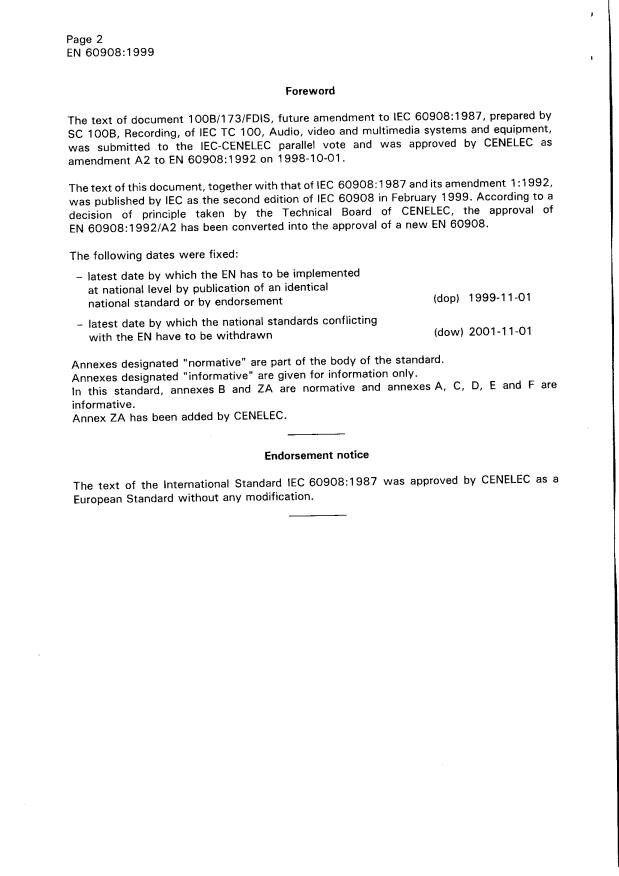
FOREWORD
1) The IEC (International Electrotechnical Commission) is a worldwide organization for standardization comprising
all national electrotechnical committees (IEC National Committees). The object of the IEC is to promote
international co-operation on all questions concerning standardization in the electrical and electronic fields. To
this end and in addition to other activities, the IEC publishes International Standards. Their preparation is
entrusted to technical committees; any IEC National Committee interested in the subject dealt with may
participate in this preparatory work. International, governmental and non-governmental organizations liaising
with the IEC also participate in this preparation. The IEC collaborates closely with the International Organization
for Standardization (ISO) in accordance with conditions determined by agreement between the two
organizations.
2) The formal decisions or agreements of the IEC on technical matters express, as nearly as possible, an
international consensus of opinion on the relevant subjects since each technical committee has representation
from all interested National Committees.
3) The documents produced have the form of recommendations for international use and are published in the form
of standards, technical reports or guides and they are accepted by the National Committees in that sense.
4) In order to promote international unification, IEC National Committees undertake to apply IEC International
Standards transparently to the maximum extent possible in their national and regional standards. Any
divergence between the IEC Standard and the corresponding national or regional standard shall be clearly
indicated in the latter.
5) The IEC provides no marking procedure to indicate its approval and cannot be rendered responsible for any
equipment declared to be in conformity with one of its standards.
6) Attention is drawn to the possibility that some of the elements of this International Standard may be the subject
of patent rights. The IEC shall not be held responsible for identifying any or all such patent rights.
International Standard IEC 60908 has been prepared by subcommittee 100B: Audio, video and
multimedia information storage systems, of IEC technical committee 100: Audio, video and
multimedia systems and equipments.
This second edition cancels and replaces the first edition published in 1987, amendment 1
(1992) and the corrigendum to amendment 1.
The text of this standard is based on the first edition, amendment 1, the corrigendum to
amendment 1 and the following documents:
FDIS Report on voting
100B/173/FDIS 100B/185/RVD
Full information on the voting for the approval of this standard can be found in the report on
voting indicated in the above table.
Annex B forms an integral part of this international Standard.
Annexes A, C, D, E and F are for information only.
60908 IEC:1999 – 13 –
AUDIO RECORDING –
COMPACT DISC DIGITAL AUDIO SYSTEM –
1 Scope and object
This standard is applicable to a prerecorded optical reflective digital audio disc system.
This standard defines those parameters of compact disc that affect interchangeability between
discs and players. It is also intended as a reference for manufacturers wishing to produce discs
and/or players that conform to the system described in this standard. It deals with discs of
80 mm in diameter as well as those of 120 mm in diameter.
2 Normative references
The following normative documents contain provisions which, through reference in this text,
constitute provisions of this International Standard. For dated references, subsequent
amendments to, or revisions of, any of these publications do not apply. However, parties to
agreements based on this International Standard are encouraged to investigate the possibility
of applying the most recent editions of the normative documents indicated below. For undated
references, the latest edition of the normative document referred to applies. Members of IEC
and ISO maintain registers of currently valid International Standards.
IEC 60068-2-2:1974, Environmental testing – Part 2: Tests – Tests B: Dry heat
IEC 60068-2-30:1980, Environmental testing – Part 2: Tests – Test Db and guidance: Damp
heat, cyclic (12 + 12-hour cycle)
IEC 60721-3-5:1997, Classification of environmental conditions – Part 3: Classification of groups
of environmental parameters and their severities – Section 5: Ground vehicle installations
IEC 61104:1992, Compact disc video system – 12 cm CD-V
IEC 61866:1997, Audiovisual systems – Interactive text transmission system (ITTS)
IEC 61938:1996, Audio, video and audiovisual systems – Interconnections and matching
values – Preferred matching values of analogue signals
ISO/IEC 646:1991, Information technology – ISO 7-bit coded character set for information
interchange
ISO 3901:1986, Documentation – International Standard Recording Code (ISRC)
ISO/IEC 8859-1:1998, Information technology – 8-bit single-byte coded graphic character sets –
Part 1: Latin alphabet No.1
EBU Tech 3258-E:1991, Specification of the systems of the MAC/packet family
UPC/EAN, Universal product code/International article numbering association
RIAJ Document RS506, Music shift Kanji character set
CD EXTRA, Enhanced music CD specification, Version 1.0, December 1995, Sony/Philips
60908 IEC:1999 – 15 –
3 Description of system
The information carrier is a transparent disc, the substrate, one side of which carries the
information. This side, the encoded side, is covered in turn by a reflective and a protective
layer.
The information of the disc is stored in a spiral-shaped track consisting of successive shallow
depressions (pits). When the disc is playing and viewed from the read-out side, the spiral starts
near the centre of the disc and finishes near its edge.
The lengths of the pits and the spaces between them can take discrete values only, and
represent the encoded two-channel audio information.
The information is read out by means of a beam of light which passes through the plain, i.e. the
non-encoded side of the transparent disc to the encoded side, where it is reflected and
modulated by the recorded information (see figure 2b, detail B).
The information is followed by means of a servo-system for tracking and focusing.
4 Requirements for measurements
4.1 Conditions of measurement
Measurements and mechanical checks shall be carried out within the following limits unless
otherwise specified:
– ambient temperature: 15 °C to 35 °C;
– relative humidity: 45 % to 75 %;
– air pressure: 86 kPa to 106 kPa.
4.2 Requirements for the measuring pick-up
The optical pick-up to be used for disc measurement shall comply with the following
requirements:
– wavelength: 780 ± 10 nm;
– polarization: circular;
– numerical aperture (NA): 0,45 ± 0,01;
– intensity at the rim of the pupil > 50 % of the maximum intensity value;
of the objective lens:
– diffraction limited performance within the Maréchal criterion, preferably
of the optical system: equally divided between disc and player.
60908 IEC:1999 – 17 –
4.3 Requirements for the clamping of the disc
The disc shall be fixed between two equally sized concentric rings, having inner diameters
of 29 mm and outer diameters of 31 mm, the clamping force being between 1 N and 2 N (see
figure 2b).
Methods and/or conditions
Parameters to be specified Requirements
of measurement
5 Mechanical parameters
Figures 2a, 2b and 2c,
specify the dimensions of the disc,
including reflective layer, protective
layer and label
5.1 Outer dimensions
of disc
5.1.1 Outer diameter 120 ± 0,3 mm To be measured at 23 ± 2 °C and
80 ± 0,2 mm (50 ± 5) % relative humidity
5.1.2 Radial run-out of outer edge 0,4 mm max. Relative to the inscribed circle
of centre hole
5.1.3 Edge shape Edges shall be free from burrs;
chamfer or radius is permitted on
both sides
5.2
Centre hole dimensions For 8 cm-CD, see figures 2c and 2d.
5.2.1 Diameter To be measured at 23 ± 2 °C and
+0,1
15 mm
0 (50 ± 5) % relative humidity
5.2.2 Shape Cylindrical
5.2.3 Edge shape Burrs are permitted on the label side,
but not on the read-out side. Chamfer
or radius is permitted (see figure 2b,
detail C)
5.3
Thickness of disc 0,3 Including protective layer and labelling
+
1,2 mm
0,1
−
5.4
Labelling
5.4.1 Label dimensions Shall not project over edge of centre May be applied by printing or
hole or outer edge of disc by means of a label
5.4.2 Label information At least the following information
shall be given:
a) Title of program
b) Catalogue number of disc
c) Sequence number of and total
number of discs if complete
program occupies more than
one disc (e.g.: disc 2 of 4)
5.5
Reference plane Ring between diameters of 26 mm On the read-out side
and 33 mm (see figures 2a and 2b)
5.6
Clamping area
5.6.1 Inner diameter of 26 mm max.*
clamping area
5.6.2 Outer diameter of 33 mm min.*
clamping area
5.6.3 Thickness of disc in Within the requirements given in 5.3
clamping area and figure 2b
5.6.4 Adaptor clamping area An outer ring with 1,5 mm in width
for 8 cm-CD
5.6.5 Thickness in clamping 1,2 ± 0,1 mm
area for 8 cm-CD
adaptor
* These dimensions ensure that the ring between 26 mm and 33 mm is available for clamping.
60908 IEC:1999 – 19 –
Methods and/or conditions
Parameters to be specified Requirements
of measurement
5.7 14 g to 33 g
Mass of disc
6 g to 16 g for 8 cm-CD
Within the information area (45 mm
5.8
Limits for the deflec-
to 118 mm maximum diameter)
tions of the read-out
(see figure 2c)
side of the disc
5.8.1 Peak deflection ±0,4 mm
±0,3 mm for 8 cm-CD
5.8.2 Deflection averaged over ±0,3 mm
one revolution ±0,2 mm for 8 cm-CD
5.8.3 ±0,6° See figure 16.
Angular deviation (β)
6 Optical parameters
6.1 Thickness of trans- 1,2 ± 0,1 mm Within the information area
(see figures 2a, 2b and 2c).
parent substrate
Excluding reflective layer, protective
layer, and labelling
6.2 Refractive index 1,55 ± 0,1
±1,6° Referred to reference plane E
6.3 Limits for the angular
deviation of the (see figures 2a and 16) including
disc deflection and substrate
reflected beam (α)
unparellelism
6.4 Birefringence of trans-
Double pass through transparent
100 nm max.
parent substrate
substrate
6.5 Reflectivity 70 % min.
6.6 Limits for reflectivity 3 % for f < 100 Hz The reflectivity variation is measured
variation in program by observing the variation of A ,
top
during one revolution of the disc
area
at scanning velocity (see 7.1.2)
7 Recording parameters
7.1 Rotation during
playback
7.1.1 Sense of rotation of disc Counter-clockwise
as seen from read-out
side
7.1.2 Scanning velocity 1,2 m/s min.
1,4 m/s max.
7.1.3 Limits for the velocity ±0,01 m/s
variation on any one disc
7.2 Track
7.2.1 Track path Continuous spiral from inside
(start of the lead-in) to outside
(end of the lead-out) of disc
7.2.2 Starting diameter of 46 mm max. See figure 2c
lead-in area
7.2.3 Starting diameter of See figure 2c
50 mm
−0,4
program area To be measured at 23 ± 2 °C and
(50 ± 5) % relative humidity
7.2.4 Maximum diameter of 116 mm
program area 75 mm for 8 cm-CD
7.2.5 Minimum outer diameter Outer diameter of program are plus 1 mm See figure 2c
of lead-out area
7.2.6 Pitch of track: distance
1,6 ± 0,1 μm
between any two adjacent
turns
(continued)
60908 IEC:1999 – 21 –
Methods and/or conditions
Parameters to be specified Requirements
of measurement
7.3 Limits for deviations of As observed by the measuring pick-up,
the disc rotating at scanning velocity
information layer perpendi-
(see 7.1.2)
cular to reference plane
7.3.1 For frequencies below 500 Hz
7.3.1.1 Deviation from nominal value ±0,5 mm The nominal position is defined by
±0,35 mm for 8 cm-CD an ideal disc of substrate thickness
1,2 mm and refractive index of 1,55
7.3.1.2 RMS value ±0,4 mm max.
±0,8 mm max. for 8 cm-CD
7.3.1.3 Acceleration 10 m/s max.
7.3.2 For frequencies above 500 Hz
2 μm peak-to-peak max.
7.4 Limits for radial deviations Disc rotating at scanning velocity
(see 7.1.2)
of the track
7.4.1 For frequencies below 500 Hz
7.4.1.1 Radial run-out of tracks 140 μm peak-to-peak max. Relative to the inscribed inner circle
of centre hole
7.4.1.2 Radial acceleration 0,4 m/s max.
(eccentricity and unroundness)
7.4.2 For frequencies above 500 Hz See 10.4
8 Environmental conditions
for playing the compact disc
8.1 Playing the compact disc The disc shall be played under Sudden changes in temperature and
the following conditions: humidity within these ranges may
temporarily cause too large a
Temperature: –25 °C to +70 °C
deflection. Recovery time up to
Relative humidity: 10 % to 95 %
several hours has to be taken into
Absolute humidity: 0,5 g/m³ to
account (see also IEC 60721-3-5,
60 g/m³
class 5K2).
Max. temperature change: 50 °C
Max. humidity change: 30 % RH
(see also climatogram, figure 17 Parameters to be measured in
below) accordance with clause 4.
8.2 Temperature and humidity After these tests, some time
should be left for recovery
requirements
before measuring (24 h or 48 h)
8.2.1 Dry heat test in accordance Temperature: 55 °C
with IEC 60068-2-2 Ba Relative humidity: 50 % max.
at 35 °C
Storage time: 96 h
8.2.2 Cyclic damp heat test Severity: a; number of cycles: 6
in accordance with Temperature: max. 40 °C ± 2 °C
IEC 60068-2-30 Db Relative humidity: 95 %
Temperature: min. 25 °C ± 3 °C
Cycle time: 12 h + 12 h
60908 IEC:1999 – 23 –
9 High-frequency signal
The scanning light spot is diffracted by the information pits in the reflective layer. The high-
frequency (h.f.) signal is defined as the modulation of the optical power that is diffracted back
into the objective lens.
9.1 Measurement conditions
9.1.1 Time constant: t = 100 μs
9.1.2 Filtering: high-pass
9.1.3 Scanning velocity between 1,2 m/s and 1,4 m/s
9.2 Modulation amplitude
The lowest fundamental frequency of the modulation code is 196 kHz which corresponds to
T (See clause 13.) The peak-to-peak value of this component is A (see figure 3) and the
max. 11
peak value of the corresponding high-frequency signal before high-pass filtering is A .
top
The highest fundamental frequency of the modulation code is 720 kHz which corresponds
to T (See clause 13.) Its peak-to-peak amplitude is A (see figure 3).
min. 3
These parameters shall fulfil the following specifications:
A A
= 0,3 to 0,7; ≥ 0,6
A A
top top
9.3 Signal asymmetry
9.3.1 Definitions
The asymmetry is defined by:
A
D
− ⋅ 100 %
A 2
11
where A is the decision level (see figure 3).
D
The absolute value of the asymmetry shall be less than or equal to 20 %.
9.4 Cross-talk
The ratio of the amplitude of the h.f. signal when the spot focuses between two adjacent turns
of the track to the amplitude of the h.f. signal when the spot focuses on the track shall be less
than 0,5 (50 %).
9.5 Frequency modulation of the channel bit frequency (see clause 13)
Unintentional frequency modulation of the channel bit frequency during mastering may cause
clock regeneration problems in CD players. The maximum time error of the channel
bit frequency as a function of the modulation frequency shall be below the values given in
figure 18. This time error is measured with a constant linear velocity.
60908 IEC:1999 – 25 –
10 Radial differential (RD) signal
A slightly off-track position of the scanning light spot results in a diffraction pattern that is
asymmetrical in the radial direction of the disc. The radial differential signal is defined as the
difference of the optical powers diffracted into the two halves (positioned on opposite sides of
the track) of the aperture of the objective lens.
10.1 Measurement conditions
Time constant: t = 15 μs
Filtering: low-pass
10.2 Shape of the radial differential signal
See figure 4. The zero-crossing with a positive slope corresponds to the correct radial position
of the scanning spot. Detail B of figure 2b prescribes shallow pits, and defines the sign of the
signal.
10.3 Sensitivity to radial offset
P − P
1 2
The sensitivity is equal to at a radial offset of 0,1 μm, where P – P is the optical
1 2
A
top
power difference in the two halves of the reflected beam measured at far field and where A
top
is the peak optical power (see 9.2).
The sensitivity shall be within 0,04 and 0,07.
The variation on any one disc shall be within ±15 %.
10.4 Noise
When the RD signal is used for tracking, with a servo-bandwidth of 200 Hz (see figure 5), the
noise in the RD signal is measured in the frequency band 500 Hz to 10 000 Hz.
The r.m.s. value measured with an integration time of 20 ms shall correspond to a tracking
error of less than 0,03 μm.
Optional measurement
Single-frequency noise contributions should be avoided in the RD signal. It is recommended to
measure the r.m.s. value of the noise in the residual error signal with a real-time frequency
analyser (bandwidth of 100 Hz) over the frequency range 500 Hz to 10 000 Hz.
The tracking error corresponding to the measured r.m.s. value should be less than 0,01 μm.
60908 IEC:1999 – 27 –
11 Defects
11.1 Block error rate (BLER)
11.1.1 Definitions
The block error rate is measured at the input of the C -decoder (see figure 13).
A block (see figure 9) is called erroneous if one or more symbols of that block are erroneous.
A symbol (see 16.2) is called erroneous if one or more bits of that symbol are erroneous.
11.1.2 Specification of random errors
–2
BLER averaged over any 10 s shall be less than 3 × 10 .
11.1.3 Specification of burst errors
Burst errors in the h.f. signal due to local defects shall not induce audible effects for any error-
correcting decoding strategy.
The most simple error-correcting decoder consists of a C1 and C2 single-error corrector. No
more than one symbol error shall occur in a data block measured at the input of the C2
decoder.
In any case, the number of successive C1-uncorrectable blocks shall be less than 7.
11.2 Local defects
Maximum dimensions of local defects that are allowed are:
– air bubbles, diameter 100 μm
– black spots, diameter 200 μm
– black spots without birefringent area, diameter 300 μm
The minimum distance, measured between adjacent defects (of maximum diameter) along the
track, is at least 20 mm.
Black spot may be dirt enclosures in the substrate or "pin-holes" in the reflective layer.
12 Recorded parameters – General
The recorded area on the disc shall be divided into three parts, viz:
– the lead-in area;
– the program area;
– the lead-out area.
The data to be recorded shall consist of 16-bits wide words encoded as 2's-complement
numbers.
60908 IEC:1999 – 29 –
In the lead-in and the lead-out areas these encoded words are 2's-complement zero ±15 LSB.
In the program area the data word contains audio information only, encoded in a two-channel
format.
The sampling frequency (fs) of the information in the program area shall be 44,1 kHz, both
channels being simultaneously sampled.
The audio samples are linear encoded in a 16-bit, 2's-complement format.
The encoding is carried out either without pre-emphasis or with the first order pre-emphasis
shown in figure 1.
The recording and error protection process basically consists of
a) splitting each 16-bit audio sample word into two 8-bit symbols;
b) introducing extra 8-bit parity symbols for error detection and correction (in accordance with
CIRC encoding);
c) building up a frame consisting of the previously defined 8-bit symbols, with one 8-bit symbol
for control and display;
d) representing these 8-bit symbols by particular channel bit sequences which are appropriate
for recording on the disc (in accordance with the EFM encoding);
e) adding specific synchronization patterns different from EFM-codes.
13 8 to 14 modulation code (EFM-code)
After modulation, each group of 8 data bits (symbol) is represented by a succession of 14
channel bits. The information is contained in the position of the transitions between channel
bits.
The EFM encoding is carried out in accordance with figure 6 and figure 7. In the NRZ-I
representation used to describe the EFM encoding, "0" indicates the absense of transitions
between two successive channel bits whereas "1" indicates the presence of transitions.
For merging the blocks and for low-frequency (l.f.) suppression, three extra channel bits
(merging bits) are added between two blocks of 14 channel bits.
Minimum requirements for l.f. suppression are under consideration.
The EFM-code is such that the minimum run length (the distance between two transitions) is
3 channel bits (T ) and the sampling window (eye pattern) is 1 channel bit.
min.
The maximum length is 11 channel bits (T ).
max.
The merging bits do not need to contain a transition, so that between the blocks the
requirements for T can always be fulfilled.
min.
Examples for the combination of the EFM-code with the merging bits are given in annex A.
60908 IEC:1999 – 31 –
14 Frame format
After modulation (see clause 15), one frame shall contain 588 channel bits, consisting of
– a synchronization pattern of 24 channel bits;
– control and display symbols of 14 channel bits (clause 17);
– 24 data symbols coded in the EFM-code of 14 channel bits (clause 13);
– 8 symbols for parity of 14 channel bits (clause 16);
– 34 groups of merging bits of 3 channel bits (clause 13).
The composition of a frame is given in figure 8.
15 EFM-modulator
24 channel bits
Sync
pattern
Control 14 channel bits*
and display
sync pattern
Data bits 8
Control
and display encoder
Serial output
24 data
Multi-
Modulator
symbols
plexer
16-bit data words
from A/D
CIRC
encoder
8 parity
symbols
* Twice per 98 frames for synchronization of control and display channel.
The proper sequence of symbols from data, error correction and control and display units is
generated by the time multiplexer.
The modulator then converts the symbol sequence into a channel bit sequence according to
the EFM-code as given in clause 13 and adds the merging bits and sync pattern, resulting in a
serial output of frames as given in clause 14.
16 Error correction
16.1 General
The error correction shall be carried out using the Cross Interleave Reed-Solomon Code
(CIRC).
60908 IEC:1999 – 33 –
16.2 Structure
Each data word consists of two symbols which are designated as WmA and WmB. WmA
includes the higher and WmB the lower 8 bits of the data word.
d d d d d d d d d d d d d d d d
1 2 3 4 5 6 7 8 1 2 3 4 5 6 7 8
WmA WmB
LSB
MSB
Each frame (see clause 14) recorded on a disc results, after demodulation, in a block of
32 symbols, of which 24 area data symbols and 8 are parity symbols, named Pm or Qm; these
parity symbols are recorded inverted ( Pm and Qm).
The symbol names and their sequences are given in figure 9.
The definition of the 8 parity symbols:
– P12n, P12n+1, P12n+2, P12n+3
(see figures 9 and 10)
– Q12n, Q12n+1, Q12n+2, Q12n+3
is such that the following equations are satisfied:
H ⋅ V = 0
p p
(see figures 10 and 11)
H ⋅ V = 0
q q
The calculation is defined on GF (2 ) (Galois Field) by the following polynominal:
8 4 3 2
P(x) = x + x + x + x + 1
and a primitive element α of GF (2 ) is defined as follows:
[]
α = 0 0 0 0 0 0 1 0
↑
LSB
16.3 CIRC encoder and decoder
The CIRC consists of two Reed-Solomon Codes, C C .
1 and 2
C is a (32,28) Reed-Solomon Code over GF (2 ).
C is a (28,24) Reed-Solomon Code over GF (2 ).
A CIRC encoder is given in figure 12, a CIRC decoder in figure 13.
17 Subcode/control and display system
17.1 General
After demodulation, eight bits per frame are available for control and display purpose (see also
clause 14). These bits are named P-Q-R-S-T-U-V-W and are used as eight different subcoding
channels.
The following channels are defined:
– Channel P: a simple track (program item) separator flag (see 17.4);
– Channel Q: for control purposes, for example, track (program item) number and time (see 17.5);
60908 IEC:1999 – 35 –
An example of the encoding in channels P and Q is given in figure 14.
Channels R up to W inclusive have not yet been defined (see 17.6).
17.2 Data format
The data format of the control and display symbols shall be as follows:
Subcoding symbol P Q R S T U V W
d1 d8
Example 0 0 1 0 1 1 1 1 (NRZ notation)
C1 C14
After modulation 0 0 1 0 0 0 0 1 0 0 1 0 0 0 XXX (NRZ-I notation)
merging bits
synchronization pattern control and display first symbol
TIME
Bit C1 is first out
17.3 Subcode str
...