


prEN IEC 63541:2025
(Main)Lithium tantalate and lithium niobate crystals for surface acoustic wave (SAW) device applications - Specifications and measuring methods
Lithium tantalate and lithium niobate crystals for surface acoustic wave (SAW) device applications - Specifications and measuring methods
IEC 63541:2025 applies to lithium tantalate (LT) and lithium niobate (LN) crystals for surface acoustic wave devices, including the as-grown crystals and lumbered crystals.
Cristaux de tantalate de lithium et de niobate de lithium pour applications utilisant des dispositifs à ondes acoustiques de surface (OAS) - Spécifications et méthodes de mesure
L'IEC 63541:2025 s'applique aux cristaux de tantalate de lithium (LT) et de niobate de lithium (LN) pour dispositifs à ondes acoustiques de surface, y compris les cristaux bruts et les cristaux localisés.
Kristali litijevega tantalata in litijevega niobata za površinske zvočnovalovne naprave (SAW) - Specifikacije in merilne metode
General Information
- Status
- Not Published
- Publication Date
- 12-Feb-2026
- Current Stage
- 4060 - Enquiry results established and sent to TC, SR, BTTF - Enquiry
- Start Date
- 11-Jul-2025
- Completion Date
- 11-Jul-2025
Overview
prEN IEC 63541:2025 - Lithium tantalate and lithium niobate crystals for surface acoustic wave (SAW) device applications defines specifications and measuring methods for lithium tantalate (LT) and lithium niobate (LN) crystals used in surface acoustic wave (SAW) devices. This committee draft (CDV) covers both as-grown crystals and lumbered crystals, and sets out requirements, sampling/inspection plans, test methods and delivery/packaging provisions to support consistent quality and interchangeability in SAW manufacturing and testing.
Key topics and requirements
- Material scope: Applies specifically to LT and LN crystals for SAW device applications (as-grown and lumbered forms).
- Quality and physical requirements: Includes macroscopic quality, single-domain specification, Curie temperature tolerance, and lattice parameter requirements for as-grown crystals.
- Dimensional and geometric requirements for lumbered crystals: surface orientation, diameter, orientation flat and its width, effective length, cylindricity and verticality.
- Sampling and inspection: Defines sampling plans and determination of inspection results to support statistical conformity checks.
- Test and measurement methods (normative annexes):
- Single-domain measurement: scattered light path, etching, and electromotive-voltage methods.
- Curie temperature measurement: DTA (differential thermal analysis), DSC (differential scanning calorimetry), and dielectric constant methods.
- Lattice parameter: Bond method.
- Geometric measurements: cylindricity and verticality measurement procedures and equipment guidance.
- Identification, labelling and packaging: Requirements for labelling, packaging and delivery conditions to ensure traceability and protection of crystals in transit.
Practical applications and users
This standard is intended for professionals and organizations involved in the SAW supply chain:
- Crystal manufacturers producing LT and LN boules, wafers and lumbered crystals.
- SAW device manufacturers conducting incoming inspection and acceptance testing.
- Quality assurance and metrology labs implementing standardized test methods for Curie temperature, lattice parameters and single-domain verification.
- Procurement and specification engineers who need consistent product acceptance criteria for LT/LN crystals.
- R&D teams developing frequency control, sensing and RF filter components that rely on SAW substrates.
Using IEC 63541 ensures reproducible test results, supports interoperability of SAW substrates and helps reduce device variability linked to crystal properties.
Related standards
- Normative reference cited: IEC 62276 - Single crystal wafers for SAW device applications (specifications and measuring method).
- prEN IEC 63541:2025 is a parallel IEC/CENELEC draft with a proposed stability date of 2028; users should consult the final published text for definitive requirements.

Frequently Asked Questions
prEN IEC 63541:2025 is a draft published by CLC. Its full title is "Lithium tantalate and lithium niobate crystals for surface acoustic wave (SAW) device applications - Specifications and measuring methods". This standard covers: IEC 63541:2025 applies to lithium tantalate (LT) and lithium niobate (LN) crystals for surface acoustic wave devices, including the as-grown crystals and lumbered crystals.
IEC 63541:2025 applies to lithium tantalate (LT) and lithium niobate (LN) crystals for surface acoustic wave devices, including the as-grown crystals and lumbered crystals.
prEN IEC 63541:2025 is classified under the following ICS (International Classification for Standards) categories: 31.140 - Piezoelectric devices. The ICS classification helps identify the subject area and facilitates finding related standards.
prEN IEC 63541:2025 is available in PDF format for immediate download after purchase. The document can be added to your cart and obtained through the secure checkout process. Digital delivery ensures instant access to the complete standard document.
Standards Content (Sample)
SLOVENSKI STANDARD
01-junij-2025
Kristali litijevega tantalata in litijevega niobata za površinske zvočnovalovne
naprave (SAW) - Specifikacije in merilne metode
Lithium tantalate and lithium niobate crystals for surface acoustic wave (SAW) device
applications - Specifications and measuring methods
Ta slovenski standard je istoveten z: prEN IEC 63541:2025
ICS:
31.140 Piezoelektrične naprave Piezoelectric devices
2003-01.Slovenski inštitut za standardizacijo. Razmnoževanje celote ali delov tega standarda ni dovoljeno.
49/1496/CDV
COMMITTEE DRAFT FOR VOTE (CDV)
PROJECT NUMBER:
IEC 63541 ED1
DATE OF CIRCULATION: CLOSING DATE FOR VOTING:
2025-04-18 2025-07-11
SUPERSEDES DOCUMENTS:
49/1471/CD, 49/1488/CC
IEC TC 49 : PIEZOELECTRIC, DIELECTRIC AND ELECTROSTATIC DEVICES AND ASSOCIATED MATERIALS FOR FREQUENCY
CONTROL, SELECTION AND DETECTION
SECRETARIAT: SECRETARY:
Japan Mr Masanobu Okazaki
OF INTEREST TO THE FOLLOWING COMMITTEES: HORIZONTAL FUNCTION(S):
ASPECTS CONCERNED:
SUBMITTED FOR CENELEC PARALLEL VOTING NOT SUBMITTED FOR CENELEC PARALLEL VOTING
Attention IEC-CENELEC parallel voting
The attention of IEC National Committees, members of
CENELEC, is drawn to the fact that this Committee Draft
for Vote (CDV) is submitted for parallel voting.
The CENELEC members are invited to vote through the
CENELEC online voting system.
This document is still under study and subject to change. It should not be used for reference purposes.
Recipients of this document are invited to submit, with their comments, notification of any relevant patent rights of
which they are aware and to provide supporting documentation.
Recipients of this document are invited to submit, with their comments, notification of any relevant “In Some
Countries” clauses to be included should this proposal proceed. Recipients are reminded that the CDV stage is the
final stage for submitting ISC clauses. (SEE AC/22/2007 OR NEW GUIDANCE DOC).
TITLE:
Lithium tantalate and lithium niobate crystals for surface acoustic wave (SAW) device
applications - Specifications and measuring methods
PROPOSED STABILITY DATE: 2028
NOTE FROM TC/SC OFFICERS:
download this electronic file, to make a copy and to print out the content for the sole purpose of preparing National
Committee positions. You may not copy or "mirror" the file or printed version of the document, or any part of it,
for any other purpose without permission in writing from IEC.
IEC CDV 63541 ED1 © IEC 2025 – 2 – 49/1496/CDV
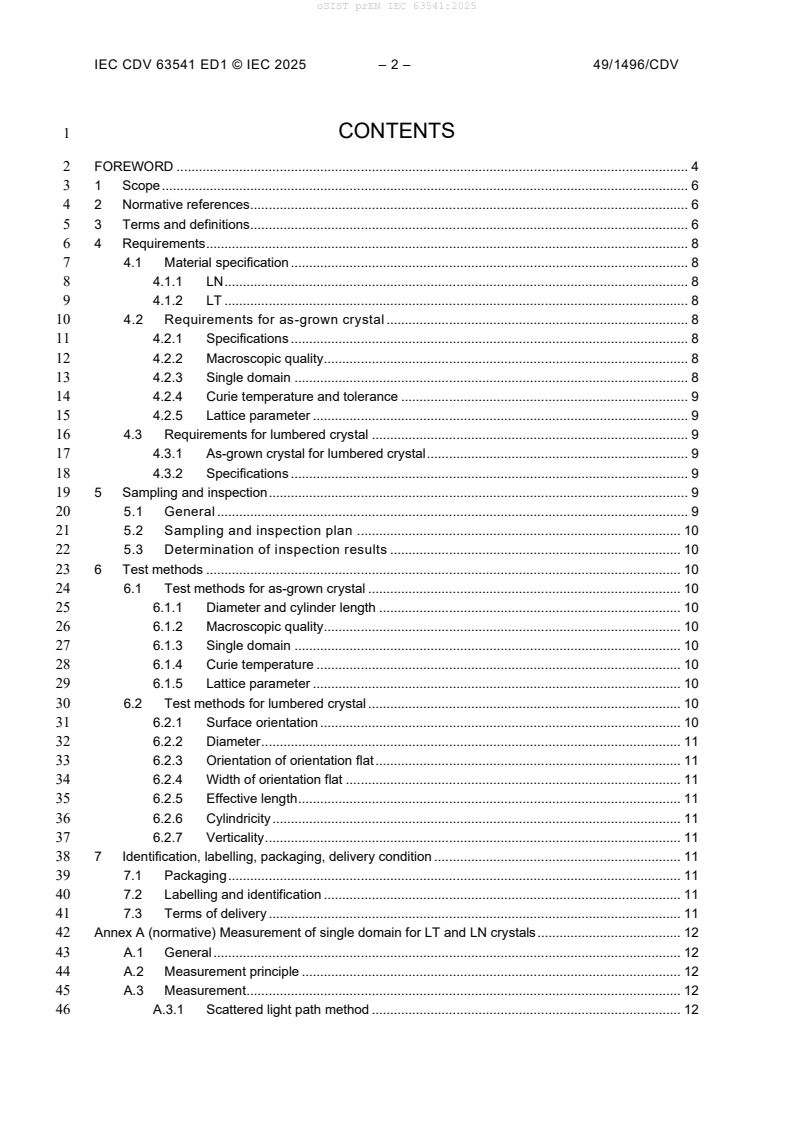
1 CONTENTS
2 FOREWORD . 4
3 1 Scope . 6
4 2 Normative references . 6
5 3 Terms and definitions . 6
6 4 Requirements . 8
7 4.1 Material specification . 8
8 4.1.1 LN . 8
9 4.1.2 LT . 8
10 4.2 Requirements for as-grown crystal . 8
11 4.2.1 Specifications . 8
12 4.2.2 Macroscopic quality . 8
13 4.2.3 Single domain . 8
14 4.2.4 Curie temperature and tolerance . 9
15 4.2.5 Lattice parameter . 9
16 4.3 Requirements for lumbered crystal . 9
17 4.3.1 As-grown crystal for lumbered crystal . 9
18 4.3.2 Specifications . 9
19 5 Sampling and inspection . 9
20 5.1 General . 9
21 5.2 Sampling and inspection plan . 10
22 5.3 Determination of inspection results . 10
23 6 Test methods . 10
24 6.1 Test methods for as-grown crystal . 10
25 6.1.1 Diameter and cylinder length . 10
26 6.1.2 Macroscopic quality . 10
27 6.1.3 Single domain . 10
28 6.1.4 Curie temperature . 10
29 6.1.5 Lattice parameter . 10
30 6.2 Test methods for lumbered crystal . 10
31 6.2.1 Surface orientation . 10
32 6.2.2 Diameter . 11
33 6.2.3 Orientation of orientation flat . 11
34 6.2.4 Width of orientation flat . 11
35 6.2.5 Effective length . 11
36 6.2.6 Cylindricity . 11
37 6.2.7 Verticality . 11
38 7 Identification, labelling, packaging, delivery condition . 11
39 7.1 Packaging . 11
40 7.2 Labelling and identification . 11
41 7.3 Terms of delivery . 11
42 Annex A (normative) Measurement of single domain for LT and LN crystals . 12
43 A.1 General . 12
44 A.2 Measurement principle . 12
45 A.3 Measurement . 12
46 A.3.1 Scattered light path method . 12
IEC CDV 63541 ED1 © IEC 2025 – 3 – 49/1496/CDV
47 A.3.2 Etching method . 12
48 A.3.3 Electromotive voltage method . 14
49 Annex B (normative) Measurement of Curie temperature . 16
50 B.1 General . 16
51 B.2 DTA method . 16
52 B.3 DSC method . 16
53 B.4 Dielectric constant method . 17
54 Annex C (normative) Measurement of lattice parameter (Bond method) . 18
55 Annex D (normative) Measurement of cylindricity for LT and LN crystals . 20
56 D.1 General . 20
57 D.2 Measurement . 20
58 D.2.1 Device . 20
59 D.2.2 Measuring procedure . 20
60 D.2.3 Other instructions . 20
61 Annex E (normative) Measurement of verticality for LT and LN crystals . 21
62 E.1 General. 21
63 E.2 Measurement . 21
64 E.2.1 Equipment . 21
65 E.2.2 Measuring procedure . 21
67 Figure 1 – Schematic diagram of lumbered crystal . 7
68 Figure 2 – Schematic diagram of verticality for lumbered crystal . 8
69 Figure A.1 – Schematic diagram of sample position . 13
70 Figure A.2 – Schematic diagram of measurement points . 13
71 Figure A.3 – Examples of 42°Y-X LT after etching . 14
72 Figure A.4 – Examples of 128°Y-X LN after etching . 14
73 Figure A.5 – Schematic diagram of waveform for single-domain crystals . 14
74 Figure A.6 – Schematic diagram of waveform for non-single-domain crystals . 15
75 Figure B.1 – Schematic of a DTA system . 16
76 Figure B.2 – Schematic of a DSC system . 17
77 Figure B.3 – Schematic of a dielectric constant measurement system . 17
78 Figure C.1 – The Bond method . 19
79 Figure D.1 – Measurement schematic diagram of cylindricity . 20
80 Figure E.1 – Measurement schematic diagram of verticality . 21
82 Table 1 – Typical specifications of as-grown crystal . 8
83 Table 2 – The centre value and tolerance of Curie temperature specification . 9
84 Table 3 – Typical specifications of lumbered crystal . 9
85 Table 4 – Sampling and inspection plan . 10
IEC CDV 63541 ED1 © IEC 2025 – 4 – 49/1496/CDV
INTERNATIONAL ELECTROTECHNICAL COMMISSION
____________
LITHIUM TANTALATE AND LITHIUM NIOBATE CRYSTALS
FOR SURFACE ACOUSTIC WAVE (SAW) DEVICE
APPLICATIONS – SPECIFICATIONS AND MEASURING
METHODS
FOREWORD
1) The International Electrotechnical Commission (IEC) is a worldwide organization for standardization
comprising all national electrotechnical committees (IEC National Committees). The object of IEC is to
promote international co-operation on all questions concerning standardization in the electrical and
electronic fields. To this end and in addition to other activities, IEC publishes International Standards,
Technical Specifications, Technical Reports, Publicly Available Specifications (PAS) and Guides
(hereafter referred to as “IEC Publication(s)”). Their preparation is entrusted to technical committees;
any IEC National Committee interested in the subject dealt with may participate in this preparatory work.
International, governmental and non-governmental organizations liaising with the IEC also participate in
this preparation. IEC collaborates closely with the International Organization for Standardization (ISO)
in accordance with conditions determined by agreement between the two organizations.
2) The formal decisions or agreements of IEC on technical matters express, as nearly as possible, an
international consensus of opinion on the relevant subjects since each technical committee has
representation from all interested IEC National Committees.
3) IEC Publications have the form of recommendations for international use and are accepted by IEC
National Committees in that sense. While all reasonable efforts are made to ensure that the technical
content of IEC Publications is accurate, IEC cannot be held responsible for the way in which they are
used or for any misinterpretation by any end user.
4) In order to promote international uniformity, IEC National Committees undertake to apply IEC
Publications transparently to the maximum extent possible in their national and regional publications.
Any divergence between any IEC Publication and the corresponding national or regional publication
shall be clearly indicated in the latter.
5) IEC itself does not provide any attestation of conformity. Independent certification bodies provide
conformity assessment services and, in some areas, access to IEC marks of conformity. IEC is not
responsible for any services carried out by independent certification bodies.
6) All users should ensure that they have the latest edition of this publication.
7) No liability shall attach to IEC or its directors, employees, servants or agents including individual
experts and members of its technical committees and IEC National Committees for any personal injury,
property damage or other damage of any nature whatsoever, whether direct or indirect, or for costs
(including legal fees) and expenses arising out of the publication, use of, or reliance upon, this IEC
Publication or any other IEC Publications.
8) Attention is drawn to the Normative references cited in this publication. Use of the referenced
publications is indispensable for the correct application of this publication.
9) Attention is drawn to the possibility that some of the elements of this IEC Publication may be the
subject of patent rights. IEC shall not be held responsible for identifying any or all such patent rights.
IEC 63541 has been prepared by IEC technical committee 49: Piezoelectric, dielectric and electrostatic
devices and associated materials for frequency control, selection and detection. It is an International
IEC CDV 63541 ED1 © IEC 2025 – 5 – 49/1496/CDV
Standard.
The text of this International Standard is based on the following documents:
CDV Poll report
Full information on the voting for its approval can be found in the report on voting indicated in the above
table.
The language used for the development of this International Standard is English
This document was drafted in accordance with ISO/IEC Directives, Part 2, and developed in accordance
with ISO/IEC Directives, Part 1 and ISO/IEC Directives, IEC Supplement, available at
www.iec.ch/members_experts/refdocs. The main document types developed by IEC are described in
greater detail at www.iec.ch/publications.
The committee has decided that the contents of this document will remain unchanged until the stability
date indicated on the IEC website under webstore.iec.ch in the data related to the specific document.
At this date, the document will be:
reconfirmed
withdrawn
replaced by a revised edition, or
amended
IEC CDV 63541 ED1 © IEC 2025 – 6 – 49/1496/CDV
LITHIUM TANTALATE AND LITHIUM NIOBATE CRYSTALS FOR
SURFACE ACOUSTIC WAVE (SAW) DEVICE APPLICATIONS –
SPECIFICATIONS AND MEASURING METHODS
1 Scope
This document applies to lithium tantalate (LT) and lithium niobate (LN) crystals for surface acoustic
wave devices, including the as-grown crystals and lumbered crystals.
2 Normative references
The following documents are referred to in the text in such a way that some or all of their content
constitutes requirements of this document. For dated references, only the edition cited applies. For
undated references, the latest edition of the referenced document (including any amendments) applies.
IEC 62276: XXXX Single crystal wafers for surface acoustic wave (SAW) device applications -
Specifications and measuring methods
3 Terms and definitions
For the purposes of this document, the following terms and definitions apply.
ISO and IEC maintain terminology databases for use in standardization at the following addresses:
• IEC Electropedia: available at https://www.electropedia.org/
• ISO Online browsing platform: available at https://www.iso.org/obp
3.1
as-grown crystal
synthetic crystal without any processing
3.2
crystal orientation
crystallization direction of the crystal
3.3
Curie temperature
T
c
temperature at which a ferroelectric material undergoes a structural phase transition to a state where
spontaneous polarization vanishes
Note 1 to entry: The Curie temperature is measured by differential thermal analysis (DTA), differential scanning
calorimetry (DSC), or dielectric measurement
3.4
cylinder length
the continuous geometric length which is greater than the minimum diameter of the corresponding
specification in as-grown crystal
3.5
cylindricity
difference between the maximum and minimum dimensions of any vertical section of lumbered crystal
3.6
effective length
geometric length after the removal of Internal defects and processing defects in the actual length of
lumbered crystal
IEC CDV 63541 ED1 © IEC 2025 – 7 – 49/1496/CDV
3.7
lattice parameter
lattice constant
length of one unit cell along the major crystallographic axis
Note 1 to entry: The lattice parameter is measured by X-ray diffraction using the Bond method.
3.8
lithium niobate
LN
single crystal approximately described by the chemical formula LiNbO , grown by the Czochralski
(crystal pulling from melt) or other methods
3.9
lithium tantalate
LT
single crystal approximately described by the chemical formula LiTaO , grown by the Czochralski
(crystal pulling from melt) or other methods
3.10
lumbered crystal
synthetic crystal has been processed flat by sawing, grinding, lapping, etc., to meet specified dimensions
and orientation as shown in Figure 1
Figure 1 – Schematic diagram of lumbered crystal
3.11
polarization process
electrical process used to establish a single domain crystal
3.12
single domain
ferroelectric crystal with uniform electric polarization throughout
3.13
surface orientation
crystallographic orientation of the axis perpendicular to the surface of lumbered crystal
3.14
twin
two or more identical single crystals that are combined by the law of symmetrical plane or
axis
Note 1 to entry: Twins exhibit symmetry that can be classified as reflection across a mirror plane (twin plane),
rot
...
Questions, Comments and Discussion
Ask us and Technical Secretary will try to provide an answer. You can facilitate discussion about the standard in here.
Loading comments...