


EN 60079-7:2007
(Main)Explosive atmospheres - Part 7: Equipment protection by increased safety "e"
General Information
- Abstract
This part of IEC 60079 specifies the requirements for the design, construction, testing and marking of electrical apparatus with type of protection increased safety 'e' intended for use in explosive gas atmospheres. This standard applies to electrical apparatus where the rated voltage does not exceed 11 kV r.m.s. a.c. or d.c. Additional measures are applied to ensure that the apparatus does not produce arcs, sparks, or excessive temperatures in normal operation or under specified abnormal conditions.
- Status
- Withdrawn
- Publication Date
- 17-Jan-2007
- Withdrawal Date
- 30-Sep-2009
- Technical Committee
- CLC/TC 31 - Electrical apparatus for explosive atmospheres - General requirements
- Drafting Committee
- CLC/SC 31-4 - Increased safety “e”
- Parallel Committee
- IEC/TC 31 - Electrical apparatus for potentially explosive atmospheres
- Current Stage
- 9960 - Withdrawal effective - Withdrawal
- Start Date
- 31-Jul-2018
- Completion Date
- 31-Jul-2018
- Directive
- Not Harmonized2008/68/EC - Directive 2008/68/EC of the European Parliament and of the council of 24 September 2008 on the inland transport of the dangerous goods
Not Harmonized94/9/EC - Equipment and protective systems intended for use in potentially explosive atmospheres (ATEX)OJ Ref: C 97/, C 97/01, C 76/04 OJ Date: 14-Mar-2014

Relations
- Replaces
EN 60079-7:2003 - Electrical apparatus for explosive gas atmospheres - Part 7: Increased safety "e" - Effective Date
- 28-Jan-2023
- Replaced By
EN 60079-7:2015 - Explosive atmospheres - Part 7: Equipment protection by increased safety "e" - Effective Date
- 28-Jan-2023
- Effective Date
- 10-Feb-2026
- Effective Date
- 10-Feb-2026
- Refers
EN ISO 1516:2002 - Determination of flash/no flash - Closed cup equilibrium method (ISO 1516:2002) - Effective Date
- 09-Feb-2026
- Effective Date
- 09-Feb-2026
- Refers
EN 60079-0:2006 - Electrical apparatus for explosive gas atmospheres - Part 0: General requirements - Effective Date
- 03-Feb-2026
- Effective Date
- 03-Feb-2026
- Effective Date
- 03-Feb-2026
- Effective Date
- 03-Feb-2026
- Effective Date
- 03-Feb-2026
- Effective Date
- 03-Feb-2026
- Effective Date
- 03-Feb-2026
- Effective Date
- 03-Feb-2026
- Effective Date
- 03-Feb-2026
Get Certified
Connect with accredited certification bodies for this standard

IMQ S.p.A. (Certification)
Italian electrical product certification.

SLG Prüf- und Zertifizierungs GmbH
German testing and certification body.

UL Solutions
Global safety science company with testing, inspection and certification.
Sponsored listings
Frequently Asked Questions
EN 60079-7:2007 is a standard published by CLC. Its full title is "Explosive atmospheres - Part 7: Equipment protection by increased safety "e"". This standard covers: This part of IEC 60079 specifies the requirements for the design, construction, testing and marking of electrical apparatus with type of protection increased safety 'e' intended for use in explosive gas atmospheres. This standard applies to electrical apparatus where the rated voltage does not exceed 11 kV r.m.s. a.c. or d.c. Additional measures are applied to ensure that the apparatus does not produce arcs, sparks, or excessive temperatures in normal operation or under specified abnormal conditions.
This part of IEC 60079 specifies the requirements for the design, construction, testing and marking of electrical apparatus with type of protection increased safety 'e' intended for use in explosive gas atmospheres. This standard applies to electrical apparatus where the rated voltage does not exceed 11 kV r.m.s. a.c. or d.c. Additional measures are applied to ensure that the apparatus does not produce arcs, sparks, or excessive temperatures in normal operation or under specified abnormal conditions.
EN 60079-7:2007 is classified under the following ICS (International Classification for Standards) categories: 29.260.20 - Electrical apparatus for explosive atmospheres. The ICS classification helps identify the subject area and facilitates finding related standards.
EN 60079-7:2007 has the following relationships with other standards: It is inter standard links to EN 60079-7:2003, EN 60079-7:2015, ISO 2859-1:1999, IEC 60317-3:2004+AMD1:2010 CSV, EN ISO 1516:2002, EN 196-1:1994, EN 60079-0:2006, EN 60068-2-27:1993, EN 60432-1:2000, EN 60228:2005, EN 60238:2004, EN 60317-7:1994, EN 60061-1:1993, EN 60317-8:1994, EN 62086-1:2005. Understanding these relationships helps ensure you are using the most current and applicable version of the standard.
EN 60079-7:2007 is associated with the following European legislation: EU Directives/Regulations: 2008/68/EC, 2014/34/EU, 94/9/EC. When a standard is cited in the Official Journal of the European Union, products manufactured in conformity with it benefit from a presumption of conformity with the essential requirements of the corresponding EU directive or regulation.
EN 60079-7:2007 is available in PDF format for immediate download after purchase. The document can be added to your cart and obtained through the secure checkout process. Digital delivery ensures instant access to the complete standard document.
Standards Content (Sample)
2003-01.Slovenski inštitut za standardizacijo. Razmnoževanje celote ali delov tega standarda ni dovoljeno.Explosive atmospheres - Part 7: Equipment protection by increased safety "e"Atmospheres explosives - Partie 7: Protection de l'équipment par sécurité augmentée "e"Explosionsfahige Atmosphäre - Teil 7: Geräteschutz durch erhöhte Sicherheit "e"29.260.20Electrical apparatus for explosive atmospheresICS:SIST EN 60079-7:2007en,fr,deTa slovenski standard je istoveten z:EN 60079-7:200701-december-2007SIST EN 60079-7:2007SLOVENSKI
STANDARDSIST EN 60079-7:20031DGRPHãþD
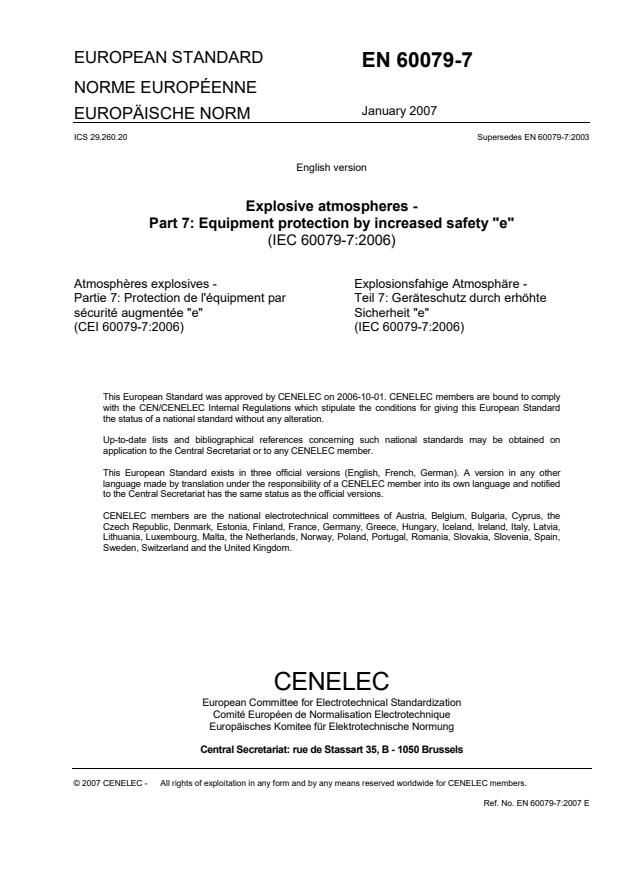
EUROPEAN STANDARD EN 60079-7 NORME EUROPÉENNE
EUROPÄISCHE NORM January 2007
CENELEC European Committee for Electrotechnical Standardization Comité Européen de Normalisation Electrotechnique Europäisches Komitee für Elektrotechnische Normung
Central Secretariat: rue de Stassart 35, B - 1050 Brussels
© 2007 CENELEC -
All rights of exploitation in any form and by any means reserved worldwide for CENELEC members.
Ref. No. EN 60079-7:2007 E
ICS 29.260.20 Supersedes EN 60079-7:2003
English version
Explosive atmospheres -
Part 7: Equipment protection by increased safety "e" (IEC 60079-7:2006)
Atmosphères explosives -
Partie 7: Protection de l'équipment par sécurité augmentée "e" (CEI 60079-7:2006)
Explosionsfahige Atmosphäre -
Teil 7: Geräteschutz durch erhöhte Sicherheit "e" (IEC 60079-7:2006)
This European Standard was approved by CENELEC on 2006-10-01. CENELEC members are bound to comply with the CEN/CENELEC Internal Regulations which stipulate the conditions for giving this European Standard the status of a national standard without any alteration.
Up-to-date lists and bibliographical references concerning such national standards may be obtained on application to the Central Secretariat or to any CENELEC member.
This European Standard exists in three official versions (English, French, German). A version in any other language made by translation under the responsibility of a CENELEC member into its own language and notified to the Central Secretariat has the same status as the official versions.
CENELEC members are the national electrotechnical committees of Austria, Belgium, Bulgaria, Cyprus, the Czech Republic, Denmark, Estonia, Finland, France, Germany, Greece, Hungary, Iceland, Ireland, Italy, Latvia, Lithuania, Luxembourg, Malta, the Netherlands, Norway, Poland, Portugal, Romania, Slovakia, Slovenia, Spain, Sweden, Switzerland and the United Kingdom.
at national level by publication of an identical
national standard or by endorsement
(dop)
2007-08-01 – latest date by which the national standards conflicting
with the EN have to be withdrawn
(dow)
2009-10-01 This European Standard has been prepared under a mandate given to CENELEC by the European Commission and the European Free Trade Association and covers essential requirements of EC Directive 94/9/EC. See Annex ZZ. Annexes ZA and ZZ have been added by CENELEC. __________ Endorsement notice The text of the International Standard IEC 60079-7:2006 was approved by CENELEC as a European Standard without any modification. In the official version, for Bibliography, the following notes have to be added for the standards indicated: IEC 60034-17 NOTE
Harmonized as CLC/TS 60034-17:2004 (not modified). IEC 60079-14 NOTE
Harmonized as EN 60079-14:2003 (not modified). IEC 60079-17 NOTE
Harmonized as EN 60079-17:2003 (not modified). IEC 60079-18 NOTE
Harmonized as EN 60079-18:2004 (not modified). IEC 60086-1 NOTE
Harmonized as EN 60086-1:2001 (not modified). IEC 60095-1 NOTE
Harmonized as EN 60095-1:1993 (not modified). IEC 60622 NOTE
Harmonized as EN 60622:2003 (not modified). IEC 60623 NOTE
Harmonized as EN 60623:2001 (not modified). IEC 61008-1 NOTE
Harmonized as EN 61008-1:2004 (not modified). IEC 61056-1 NOTE
Harmonized as EN 61056-1:2003 (not modified). IEC 61951-1 NOTE
Harmonized as EN 61951-1:2003 (not modified). IEC 62013-1 NOTE
Harmonized as EN 62013-1:2006 (not modified). __________
- 3 - EN 60079-7:2007 Annex ZA
(normative)
Normative references to international publications with their corresponding European publications
The following referenced documents are indispensable for the application of this document. For dated references, only the edition cited applies. For undated references, the latest edition of the referenced document (including any amendments) applies.
NOTE
When an international publication has been modified by common modifications, indicated by (mod), the relevant EN/HD applies.
Publication Year Title EN/HD Year
IEC 60034-1 –1) Rotating electrical machines -
Part 1: Rating and performance EN 60034-1 20042)
IEC 60034-5 –1) Rotating electrical machines -
Part 5: Degrees of protection provided by the integral design of rotating electrical machines (IP code) - Classification EN 60034-5 20012)
IEC 60044-6 (mod) –1) Instrument transformers -
Part 6: Requirements for protective current transformers for transient performance EN 60044-6 19992)
IEC 60050-426 –1) International Electrotechnical Vocabulary (IEV) - Chapter 426: Electrical apparatus for explosive atmospheres - -
IEC 60061-1 (mod) –1) Lamp caps and holders together with gauges for the control of interchangeability and safety -
Part 1: Lamp caps EN 60061-1
19932)
IEC 60061-2 (mod) –1) Lamp caps and holders together with gauges for the control of interchangeability and safety -
Part 2: Lampholders EN 60061-2 19932)
IEC 60064 (mod) –1) Tungsten filament lamps for domestic and similar general lighting purposes - Performance requirements EN 60064 19952)
IEC 60068-2-6 –1) Environmental testing -
Part 2: Tests - Test Fc: Vibration (sinusoidal) EN 60068-2-6 19952)
IEC 60068-2-27 1987 Environmental testing -
Part 2: Tests - Test Ea and guidance: Shock EN 60068-2-27 1993
IEC 60068-2-42 –1) Environmental testing -
Part 2-42: Tests - Test Kc: Sulphur dioxide test for contacts and connections EN 60068-2-42 20032)
IEC 60079-0 (mod) 2004 Electrical apparatus for explosive gas atmospheres -
Part 0: General requirements EN 60079-0 2006
1) Undated reference. 2) Valid edition at date of issue.
Part 1: Flameproof enclosures 'd' EN 60079-1 + corr. April
20042)2006
IEC 60079-11 –1) Explosive atmospheres -
Part 11: Equipment protection by intrinsic safety "i" EN 60079-11 20072)
IEC 60085 –1) Electrical insulation - Thermal classification EN 60085 20042)
IEC 60112 –1) Method for the determination of the proof and the comparative tracking indices of solid insulating materials EN 60112 20032)
IEC 60228 –1) Conductors of insulated cables EN 60228 + corr. May
20052)2005
IEC 60238 –1) Edison screw lampholders EN 60238 + corr. January
20042)2005
IEC 60317-3 2004 Specifications for particular types of winding wires - Part 3: Polyester enamelled round copper wire, class 155 - -
IEC 60317-7 1990 Specifications for particular types of winding wires - Part 7: Polyimide enamelled round copper wire, class 220 EN 60317-7 1994
IEC 60317-8 1990 Specifications for particular types of winding wires - Part 8: Polyesterimide enamelled round copper wire, class 180 EN 60317-8 1994
IEC 60317-13 1990 Specifications for particular types of winding wires - Part 13: Polyester or polyesterimide overcoated with polyamide-imide enamelled round copper wire, class 200 EN 60317-13 1994
IEC 60364-5-55 –1) Electrical installations of buildings -
Part 5-55: Selection and erection of electrical equipment - Other equipments – –
IEC 60400 (mod) –1) Lampholders for tubular fluorescent lamps and starterholders EN 60400 20002)
IEC 60432-1 (mod) –1) Incandescent lamps - Safety specifications - Part 1: Tungsten filament lamps for domestic and similar general lighting purposes EN 60432-1 20002)
IEC 60529 –1) Degrees of protection provided by enclosures (IP Code) EN 60529 + corr. May
19912)1993
IEC 60664-1 1992 Insulation coordination for equipment within low-voltage systems -
Part 1: Principles, requirements and tests EN 60664-13)
IEC 60947-1 –1) Low-voltage switchgear and controlgear - Part 1: General rules EN 60947-1 + corr. November
20042)2004
3) EN 60664-1 includes A1:2000 + A2:2002 to IEC 60664-1.
- 5 - EN 60079-7:2007 Publication Year Title EN/HD Year IEC 60947-7-1 –1) Low-voltage switchgear and controlgear - Part 7-1: Ancillary equipment - Terminal blocks for copper conductors EN 60947-7-1 20022)
IEC 60947-7-2 –1) Low-voltage switchgear and controlgear - Part 7-2: Ancillary equipment - Protective conductor terminal blocks for copper conductors EN 60947-7-2 20022)
IEC 60999-1 –1) Connecting devices - Electrical copper conductors - Safety requirements for screw-type and screwless-type clamping units -
Part 1: General requirements and particular requirements for clamping units for conductors from 0,2 mm² up to 35 mm² (included) EN 60999-1 20002)
IEC 60999-2 –1) Connecting devices - Electrical copper conductors - Safety requirements for screw-type and screwless-type clamping units -
Part 2: Particular requirements for clamping units for conductors above 35 mm² up to 300 mm² (included) EN 60999-2 20032)
IEC 61195 1999 Double-capped fluorescent lamps - Safety specifications EN 61195 1999
IEC 61347-2-3
A1 A2 2000
2004 2006 Lamp controlgear -
Part 2-3: Particular requirements for a.c. supplied electronic ballasts for fluorescent lamps EN 61347-2-3 + corr. July
A1 A2 2001 2003 2004 2006
IEC 62086-1 –1) Electrical apparatus for explosive gas atmospheres - Electrical resistance trace heating -
Part 1: General and testing requirements EN 62086-1 20052)
ISO 2859-1 –1) Sampling procedures for inspection by attributes -
Part 1: Sampling schemes indexed by acceptance quality limit (AQL) for lot-by-lot inspection - -
Coverage of Essential Requirements of EC Directives This European Standard has been prepared under a mandate given to CENELEC by the European Commission and the European Free Trade Association and within its scope the standard covers only the following essential requirements out of those given in Annex II of the EC Directive 94/9/EC: – ER 1.0.1 to ER 1.0.6 – ER 1.1.1 to ER 1.1.3 – ER 1.2.1, ER 1.2.2, ER 1.2.3, ER 1.2.5 to ER 1.2.8
– ER 1.3.1, ER 1.3.3, ER 1.3.4 – ER 1.4.1, ER 1.4.2 – ER 1.5.1 to ER 1.5.8 – ER 2.0.2.1, ER 2.0.2.3 Compliance with this standard provides one means of conformity with the specified essential requirements of the Directive concerned. WARNING: Other requirements and other EC Directives may be applicable to the products falling within the scope of this standard. ___________
IEC 60079-7Edition 4.0 2006-07INTERNATIONAL STANDARD NORME INTERNATIONALEExplosive atmospheres –
Part 7: Equipment protection by increased safety "e"
Atmosphères explosives – Partie 7: Protection de l'équipement par sécurité augmentée «e»
INTERNATIONAL ELECTROTECHNICAL COMMISSION COMMISSION ELECTROTECHNIQUE INTERNATIONALE XCICS 29.260.20 PRICE CODECODE PRIXISBN 2-8318-8726-7
– 2 – 60079-7 © IEC:2006
CONTENTS FOREWORD.5
1 Scope.7 2 Normative references.7 3 Terms and definitions.9 4 Constructional requirements for all electrical apparatus.12 4.1 General.12 4.2 Electrical connections.12 4.3 Clearances.15 4.4 Creepage distances.20 4.5 Solid electrical insulating materials.21 4.6 Windings.21 4.7 Temperature limitations.22 4.8 Wiring internal to apparatus.24 4.9 Degrees of protection provided by enclosures.24 4.10 Fasteners.24 5 Supplementary requirements for specific electrical apparatus.25 5.1 General.25 5.2 Rotating electrical machines.25 5.3 Luminaires.30 5.4 Caplights and handlights.34 5.5 Measuring instruments and instrument transformers.35 5.6 Transformers other than instrument transformers.35 5.7 Batteries.36 5.8 General purpose connection and junction boxes.42 5.9 Resistance heaters (other than trace heaters).42 5.10 Other electrical apparatus.44 6 Type verifications and type tests.44 6.1 Dielectric strength.44 6.2 Rotating electrical machines.45 6.3 Luminaires designed for mains supply.47 6.4 Measuring instruments and instrument transformers.49 6.5 Transformers other than instrument transformers.50 6.6 Secondary batteries.50 6.7 General purpose connection and junction boxes.53 6.8 Resistance heating devices and resistance heating units.53 6.9 Terminal insulating material tests.54 7 Routine verifications and routine tests.55 7.1 Dielectric tests.55 7.2 Dielectric tests for batteries.55 7.3 Inter-turn overvoltage tests.56 8 Ex component certificates.56 8.1 General.56 8.2 Terminals.56
60079-7 © IEC:2006 – 3 –
9 Marking and instructions.56 9.1 General marking.56 9.2 Instructions for use.57 9.3 Warning markings.59
Annex A (normative)
Cage motors − Methods of test and of calculation.60 Annex B (normative)
Type tests for specific forms of resistance heating devices or resistance heating units (other than trace heater).62 Annex C (informative)
Cage motors – Thermal protection in service.64 Annex D (informative)
Resistance heating devices and units – Additional electrical protection.65 Annex E (informative)
Combinations of terminals and conductors for general purpose connection and junction boxes.66 Annex F (informative)
Dimensions of copper conductors.68 Annex G (informative)
Potential stator winding discharge risk assessment – Ignition risk factors.69 Annex H (normative)
Test procedure for T8, T10 and T12 lamps.70 Annex I (Informative) Introduction of an alternative risk assessment method encompassing ‘Equipment Protection Levels’ for Ex Equipment.75
Bibliography.80
Figure 1 – Determination of creepage distances and clearances.20 Figure 2 – Minimum values of the time tE of motors in relation to the starting current ratio IA/IN.28 Figure 3 – Arrangement for the luminaire vibration test.49 Figure A.1 – Diagram illustrating the determination of time tE.61 Figure E.1 – Example of defined terminal/conductor arrangement table.67 Figure H.1 – Asymmetric pulse test circuit.71 Figure H.2 – Asymmetric power detection circuit.73 Figure H.3 – Flow Chart – Asymmetric power Test.74
Table 1 – Creepage distances and clearances.16 Table 2 – Tracking resistance of insulating materials.20 Table 3 – Limiting temperatures for insulated windings.23 Table 4 – Potential air gap sparking risk assessment for cage rotor ignition risk factors.27 Table 5 – Minimum distance between lamp and protective cover.31 Table 6 – Creepage distances and clearances for screw lamp caps.31 Table 7 − Resistance to the effect of short-circuit currents.35 Table 8 – Explosion test mixtures.46 Table 9 – Insertion torque and minimum removal torque.47 Table 10 – Value for pull-out tests.55 Table 11 – Creepage distances and clearances for screw lamp caps.58 Table 12 − Text of warning markings.59
– 4 – 60079-7 © IEC:2006
Table F.1 – Standard cross-sections of copper conductors.68 Table G.1 – Potential stator winding discharge risk assessment – Ignition risk factors.69 Table I.1 – Traditional relationship of EPLs to Zones (no additional risk assessment).77 Table I.2 – Description of risk of ignition protection provided.78
60079-7 © IEC:2006 – 5 –
INTERNATIONAL ELECTROTECHNICAL COMMISSION ____________
EXPLOSIVE ATMOSPHERES –
Part 7: Equipment protection
by increased safety "e"
FOREWORD 1) The International Electrotechnical Commission (IEC) is a worldwide organization for standardization comprising all national electrotechnical committees (IEC National Committees). The object of IEC is to promote international co-operation on all questions concerning standardization in the electrical and electronic fields. To this end and in addition to other activities, IEC publishes International Standards, Technical Specifications, Technical Reports, Publicly Available Specifications (PAS) and Guides (hereafter referred to as “IEC Publication(s)”). Their preparation is entrusted to technical committees; any IEC National Committee interested in the subject dealt with may participate in this preparatory work. International, governmental and non-governmental organizations liaising with the IEC also participate in this preparation. IEC collaborates closely with the International Organization for Standardization (ISO) in accordance with conditions determined by agreement between the two organizations. 2) The formal decisions or agreements of IEC on technical matters express, as nearly as possible, an international consensus of opinion on the relevant subjects since each technical committee has representation from all interested IEC National Committees.
3) IEC Publications have the form of recommendations for international use and are accepted by IEC National Committees in that sense. While all reasonable efforts are made to ensure that the technical content of IEC Publications is accurate, IEC cannot be held responsible for the way in which they are used or for any misinterpretation by any end user. 4) In order to promote international uniformity, IEC National Committees undertake to apply IEC Publications transparently to the maximum extent possible in their national and regional publications. Any divergence between any IEC Publication and the corresponding national or regional publication shall be clearly indicated in the latter. 5) IEC provides no marking procedure to indicate its approval and cannot be rendered responsible for any equipment declared to be in conformity with an IEC Publication. 6) All users should ensure that they have the latest edition of this publication. 7) No liability shall attach to IEC or its directors, employees, servants or agents including individual experts and members of its technical committees and IEC National Committees for any personal injury, property damage or other damage of any nature whatsoever, whether direct or indirect, or for costs (including legal fees) and expenses arising out of the publication, use of, or reliance upon, this IEC Publication or any other IEC Publications.
8) Attention is drawn to the Normative references cited in this publication. Use of the referenced publications is indispensable for the correct application of this publication. 9) Attention is drawn to the possibility that some of the elements of this IEC Publication may be the subject of patent rights. IEC shall not be held responsible for identifying any or all such patent rights. International Standard IEC 60079-7 has been prepared by IEC technical committee 31: Equipment for explosive atmospheres. This fourth edition cancels and replaces the third edition published in 2001, and constitutes a technical revision. The significant changes with respect to the previous edition are listed below: – requirements for electrical connections expanded and clarified, – requirements for luminaire ballasts expanded and clarified, – requirements for evaluation and testing of motor rotors clarified.
– 6 – 60079-7 © IEC:2006
The text of this standard is based on the following documents: FDIS Report on voting 31/623/FDIS 31/639/RVD
Full information on the voting for the approval of this standard can be found in the report on voting indicated in the above table. This publication has been drafted in accordance with the ISO/IEC Directives, Part 2. Cette publication a été rédigée selon les Directives ISO/CEI, Partie 2. The list of all parts of IEC 60079 series, under the general title Explosive atmospheres, can be found on the IEC website. The committee has decided that the contents of this publication will remain unchanged until the maintenance result date indicated on the IEC web site under "http://webstore.iec.ch" in the data related to the specific publication. At this date, the publication will be
• reconfirmed; • withdrawn; • replaced by a revised edition, or • amended.
60079-7 © IEC:2006 – 7 –
EXPLOSIVE ATMOSPHERES –
Part 7: Equipment protection
by increased safety "e"
1 Scope This part of IEC 60079 specifies the requirements for the design, construction, testing and marking of electrical apparatus with type of protection increased safety "e" intended for use in explosive gas atmospheres. This standard applies to electrical apparatus where the rated voltage does not exceed 11 kV r.m.s. a.c. or d.c. Additional measures are applied to ensure that the apparatus does not produce arcs, sparks, or excessive temperatures in normal operation or under specified abnormal conditions. This standard supplements and modifies the general requirements of IEC 60079-0. Where a requirement of this standard conflicts with a requirement of IEC 60079-0, the requirement of this standard takes precedence.
NOTE
Increased safety "e" can provide Equipment Protection Levels (EPL) Mb or Gb. For further information, see Annex I. 2 Normative references The following referenced documents are indispensable for the application of this document. For dated references, only the edition cited applies. For undated references, the latest edition of the referenced document (including any amendments) applies. IEC 60034-1, Rotating electrical machines – Part 1: Rating and performance IEC 60034-5, Rotating electrical machines – Part 5: Degrees of protection provided by the internal design of rotating electrical machines (IP code) – Classification
IEC 60044-6, Instrument transformers – Part 6: Requirements for protective current trans-formers for transient performance IEC 60050(426), International Electrotechnical Vocabulary (IEV) – Chapter 426: Electrical apparatus for explosive atmospheres IEC 60061-1, Lamp caps and holders together with gauges for the control of interchangeability and safety – Part 1: Lamp caps IEC 60061-2, Lamp caps and holders together with gauges for the control of interchangeability and safety – Part 2: Lampholders IEC 60064, Tungsten filament lamps for domestic and similar general lighting purposes – Performance requirements IEC 60068-2-6, Environmental testing – Part 2: Tests – Test Fc: Vibration (sinusoidal)
– 8 – 60079-7 © IEC:2006
IEC 60068-2-27:1987, Environmental testing – Part 2: Tests – Test Ea and guidance: Shock IEC 60068-2-42, Environmental testing –
Part 2-42: Tests –
Test Kc: Sulphur dioxide test for contacts and connections IEC 60079-0:2004, Electrical apparatus for explosive gas atmospheres – Part 0: General requirements IEC 60079-1, Electrical apparatus for explosive gas atmospheres – Part 1: Flameproof enclosures "d"
IEC 60079-11, Electrical apparatus for explosive gas atmospheres – Part 11: Equipment
protection by intrinsic safety "i" IEC 60085, Electrical insulation – Thermal classification IEC 60112, Method for the determination of the proof and the comparative tracking indices of solid insulating materials IEC 60228, Conductors of insulated cables IEC 60238, Edison screw lampholders IEC 60317-3:2004, Specifications for particular types of winding wires – Part 3: Polyester enamelled round copper wires, class 155 IEC 60317-7:1990, Specifications for particular types of winding wires – Part 7: Polyimide enamelled round copper wire, class 220
IEC 60317-8:1990, Specifications for particular types of winding wires – Part 8: Polyesterimide enamelled round copper wire, class 180
IEC 60317-13:1990, Specifications for particular types of winding wires – Part 13: Polyester or polyesterimide overcoated with polyamide-imide enamelled round copper wire, class 200
IEC 60364-3, Electrical installations of buildings – Part 5-55: Selection and erection of electrical equipment – Other equipment IEC 60400, Lampholders for tubular fluorescent lamps and starterholders IEC 60432-1, Incandescent lamps – Safety specifications – Part 1: Tungsten filament lamps for domestic and similar general lighting purposes IEC 60529, Degrees of protection provided by enclosures (IP Code) IEC 60664-1:1992, Insulation coordination for equipment within low-voltage systems – Part 1: Principles, requirements, and tests
IEC 60947-1, Low-voltage switchgear and controlgear – Part 1: General rules IEC 60947-7-1, Low-voltage switchgear and controlgear – Part 7: Ancillary equipment – Section 1: Terminal blocks for copper conductors
60079-7 © IEC:2006 – 9 –
IEC 60947-7-2, Low-voltage switchgear and controlgear – Part 2 – Ancillary equipment – Section 1: Protective conductor terminal blocks for copper conductors IEC 60999-1, Connecting devices – Electrical copper conductors – Safety requirements for screw-type and screwless-type clamping units – Part 1: General requirements and particular requirements for clamping units for conductors from 0,2 mm2 up to 35 mm2 (included) IEC 60999-2, Connecting devices – Electrical copper conductors – Safety requirements for screw-type and screwless-type clamping units – Part 2: Particular requirements for clamping units for conductors above 35 mm2 up to 300 mm2 (included) IEC 61195:1999, Double-capped fluorescent lamps – Safety specifications
IEC 61347-2-3:2000, Lamp controlgear – Part 2-3: Particular requirements for a.c. supplied electronic ballasts for fluorescent lamps
Amendment 1(2004)
Amendment 2 (2006) IEC 62086-1, Electrical apparatus for explosive gas atmospheres – Electrical resistance trace heating – Part 1: General and testing requirements ISO 2859-1, Sampling procedures for inspection by attributes – Part 1: Sampling schemes indexed by acceptance quality limit (AQL) for lot-by-lot inspection
3 Terms and definitions For the purposes of this document, the terms and definitions used in IEC 60079-0, together with the following terms and definitions apply. For the definitions of any other terms, particularly those of a more general nature, reference should be made to IEC 60050(426) or other appropriate parts of the IEV (International Electrotechnical Vocabulary). 3.1
clearance shortest distance in air between two conductive parts 3.2
connections, factory terminations intended for connection during a manufacturing process under controlled conditions 3.3
connections, field-wiring
terminations intended for connection by the installer in the field 3.4
creepage distance shortest distance along the surface of an electrically insulating material between two conductive parts
– 10 – 60079-7 © IEC:2006
3.5
increased safety "e" type of protection applied to electrical apparatus in which additional measures are applied so as to give increased security against the possibility of excessive temperatures and of the occurrence of arcs and sparks in normal service or under specified abnormal conditions NOTE 1 This type of protection is denoted by "e". The “additional measures” are those required for compliance with this standard. NOTE 2 Apparatus producing arcs or sparks in normal service is excluded by this definition of increased safety. 3.6
initial starting current
IA
highest r.m.s. value of current absorbed by an a.c. motor when at rest or by an a.c. magnet with its armature clamped in the position of maximum air gap when supplied at rated voltage and rated frequency NOTE Transient phenomena are ignored. 3.7
limiting temperature maximum permissible temperature for apparatus or parts of apparatus equal to the lower of the two temperatures determined by a)
the danger of ignition of the explosive gas atmosphere, b)
the thermal stability of the materials used NOTE This temperature may be the maximum surface temperature (see both 3.18 and Clause 5 of IEC 60079-0) or a lower value (see 4.7). 3.8
normal service, motors continuous operation at the nameplate rating (or set of ratings) including starting conditions 3.9
rated dynamic current
Idyn
peak value of the current, the dynamic effect of which the electrical apparatus can sustain without damage 3.10
rated short-time thermal current
Ith r.m.s. value of the current required to heat up the conductor within 1 s from the temperature reached in rated service at the maximum ambient temperature to a temperature not exceeding the limiting temperature 3.11
rated voltage value of voltage assigned by the manufacturer to a component, device or equipment and to which operation and performance characteristics are referred
60079-7 © IEC:2006 – 11 –
3.12
resistance-heating devices and resistance-heating units 3.12.1 resistance-heating device part of a resistance heating unit comprising one or more heating resistors, typically composed of metallic conductors or an electrically conductive material suitably insulated and protected 3.12.2
resistance-heating unit apparatus comprising an assembly of one or more resistance heating devices associated with any devices necessary to ensure that the limiting temperature is not exceeded NOTE It is not intended that the devices necessary to ensure that the limiting temperature is not exceeded should have type of protection "e", or any type of protection when they are located outside the hazardous area. 3.12.3 workpiece object to which a resistance-heating device or unit is applied 3.12.4 temperature self-limiting characteristic characteristic whereby the thermal output of a resistance-heating device at its rated voltage decreases as the temperature of its surroundings increases until the device reaches a temperature at which its thermal output is reduced to a value at which there is no further rise in temperature NOTE The temperature of the surface of the element is then effectively that of its surroundings. 3.12.5 stabilized design concept where the temperature of the resistance-heating device or unit will, by design and use, stabilize below the limiting temperature, under the most unfavourable conditions, without the need for a safety device to limit the temperature 3.13 short-circuit current
Isc maximum r.m.s. value of the short-circuit current to which the apparatus may be subjected in service NOTE This maximum value is recorded in the documentation according to Clause 24 of IEC 60079-0. 3.14 starting current ratio
IA/IN
ratio between initial starting current IA and rated current IN 3.15 time tE time, in seconds, taken for an a.c. rotor or stator winding, when carrying the initial starting current IA, to be heated up to the limiting temperature from the temperature reached in rated service at the maximum ambient temperature (see Figure A.1)
– 12 – 60079-7 © IEC:2006
3.16 trace heater device designed for the purpose of producing heat on the principle of electrical resistance and typically composed of one or more metallic conductors or an electrically conductive material suitably electrically insulated and protected
3.17 working voltage
highest r.m.s. value of the a.c. or d.c. voltage across any particular insulation which can occur when the equipment is supplied at rated voltage NOTE 1 Transients are disregarded. NOTE 2 Both open-circuit conditions and normal operating conditions are taken into account. 4 Constructional requirements for all electrical apparatus 4.1 General The requirements of this clause apply, unless otherwise stated in Clause 5, to all electrical apparatus with type of protection "e" and are themselves supplemented for certain electrical apparatus by the supplementary requirements in Clause 5. 4.2 Electrical connections 4.2.1 General Electrical connections are sub-divided into those for field-wiring and for factory wiring and into permanent types and re-connectable / re-wirable types for convenience in detailing the appropriate requirements. Each type shall, as applicable: a) be constructed in such a way that the conductors cannot slip out from their intended location during tightening of a screw or after insertion; b) provide a means to avoid loosening of the connection in service; c) be such that contact is assured without damage to the conductors such that would impair the ability of the conductors to fulfil their function, even if multi-stranded conductors are used in connections intended for direct clamping of a single conductor; d) provide a positive compression force to assure contact pressure in service; e) be constructed in such a way that the contact they assure is not appreciably impaired by temperature changes occurring in normal service; f) except as permitted by the earth continuity test of IEC 60079-0, provide contact pressure that is not applied through insulating materials; g) not be specified to accommodate more than one individual conductor in a clamping point unless specifically designed and assessed for doing so; h) if intended for stranded conductors, employ a means to protect the conductors and distribute the contact pressure evenly. The method of applying contact pressure shall be capable, on installation, of reliably forming the stranded conductor into an effectively solid shape that does not subsequently change in service. Alternatively, the method of applying the contact pressure should be such that it is designed to accommodate any settlement of the strands in service; i) for screw connections, have a specified torque value;
60079-7 © IEC:2006 – 13 –
j) for screwless connections intended for class 5 and/or class 6 fine-stranded conductors according to IEC 60228, the fine-stranded wire shall be equipped with a ferrule or the termination shall have a method to open the clamping mechanism so that the conductors are not damaged during the installation of the conductor.
NOTE 1 The use of aluminium wire may cause difficulties by compromising critical creepage and clearance distances when anti-oxidant materials are applied. The connection of aluminium wire to terminals may be accomplished by the use of suitable bi-metallic
connection devices providing a copper connection to the terminal. NOTE 2 Special precautions against vibration and mechanical shock may be required. NOTE 3 Special precautions against electrolytic corrosion should be considered. NOTE 4 Special precautions against corrosion should be considered where ferrous materials are used. NOTE 5 The limiting temperature of the insulation of terminal blocks and accessories will usually be based on the limiting temperature of the insulation in accordance with item a) of 4.7.2 but the limiting temperature allocated to the terminal when used in equipment will also depend on the maximum cable insulation temperature rating of the cable which is to be connected.
4.2.2 Field wiring connections 4.2.2.1 General Terminals for field wiring shall be generously dimensioned to permit the effective connection of conductors of cross-section equal to at least that corresponding to the rated current of the electrical apparatus. Connections shall be located in a position such that where required to be inspected in service they are reasonably accessible. The number and size of conductors that can be safely connected shall be specified in the descriptive documentation according to IEC 60079-0. 4.2.2.2 Connections made using terminals complying with IEC 60947-7-1, IEC 60947-7-2, IEC 60999-1, or IEC 60999-2 Such terminals are intended for the connection of copper conductors with the insulation locally removed and without the addition of intermediate parts other than those replicating the form of a bare conductor, such as a ferrule. Terminals shall be subject to the terminal insulation material tests of 6.9. Terminals shall be capable of being fixed in their mountings.
The temperature rise of the conductor bar shall not exceed 45 K at a test current of 110 % of rated current according to the method of the temperature-rise test of IEC 60947-7-1. NOTE 1 This test relates to the absolute maximum current rating of the terminal when tested without any enclosure. For practical purposes, when terminals are used in multiple within enclosures, it will be necessary to establish reduced current ratings according to the particular circumstances. See 5.8, 6.7 and Annex E. Terminals for connecting conductors of rated cross-section not exceeding 4 mm2 (12 AWG) shall also be suitable for the effective connection of conductors at least two ISO wire sizes smaller if not otherwise specified in the certificate. See Annex F. NOTE 2 Subclause 4.2.2.2 is primarily intended to give requirements for terminals as components. When mounted in equipment any consequent limitations given in this standard apply.
– 14 – 60079-7 © IEC:2006
4.2.2.3 Field wiring connection facilities integral to “e” apparatus or components Terminals shall meet the requirements of 4.2.2.2, where applicable. Temperatures for the verification of the thermal stability of materials shall be determined using a test sample configured to represent the complete apparatus, from a heating perspective, in accordance with IEC 60079-0. 4.2.2.4 Connections designed to be used with cable lugs and similar devices Such connections shall be fixed in their mountings. A means of securing the cable to prevent rotation or movement shall be provided to avoid either loosening or compromising creepage and clearance. Alternatively, it shall be demonstrated that such rotation or movement is not reasonably foreseeable. 4.2.2.5 Connections using permanent arrangements These connections are typically tails with crimping or soldering facilities that are intended to be connected during installation using appropriate connection methods. Either a means of fixing the completed connections to a suitable location is to be provided or the completed connections are to be provided with means of reliably insulating them to the requirements of this standard. If the method of connection is by soldering, a method of providing mechanical support of the completed connection shall be provided. The security of the joint shall not be permitted to rely solely on the solder. 4.2.3 Factory connections 4.2.3.1 General Factory connections shall be either fixed in a specific location or be provided with means of meeting the creepage and clearance requirements of this standard. 4.2.3.2 Field wiring connection methods used for factory connections Any of the connection methods suitable for use as field wiring connections may be used for a factory connection, except in this case, the terminal insulation material tests of 6.9 need not be conducted. 4.2.3.3 Permanent connections Permanent connections shall only be made by
a) crimping, b) brazing, c) welding, d) soldering, provided that the conductors are not supported by the soldered connection alone.
60079-7 © IEC:2006 – 15 –
4.2.3.4 Pluggable connections
These connections are designed to be readily connected or disconnected during assembly, maintenance, or repair.
NOTE Typical examples are plug-in components, and card edge connectors. Pluggable connections shall provide the following: a) each connect
...