

EN IEC 60619:2026
(Main)Electrically operated food preparation appliances - Methods for measuring the performance
- Status
- Not Published
- Publication Date
- 17-Dec-2026
- Technical Committee
- CLC/TC 59X - Performance of household and similar electrical appliances
- Drafting Committee
- SC 59L - Small household appliances
- Current Stage
- 5060 - Voting results sent to TC, SR - Formal Approval
- Start Date
- 21-Aug-2026
- Due Date
- 21-Aug-2026
- Completion Date
- 21-Aug-2026

EN IEC 60619:2026 is a CENELEC standard for electrically operated food preparation appliances used in the home. It specifies methods for measuring performance and user-related functions such as whisking, whipping cream, mixing, kneading, chopping, slicing, shredding, juice separation, citrus juice extraction, splashing and spillage, and cleaning. Manufacturers, test laboratories, quality teams, and buyers can use it to compare appliances under the same test conditions and to report results in a consistent way.
What does EN IEC 60619:2026 specify?
EN IEC 60619:2026 applies to electrically operated food preparation appliances for household use. It sets out test methods for functions that matter to users in practice, and it gives guidance for evaluating the results.
The standard excludes safety requirements and does not apply to appliances designed exclusively for commercial or industrial use. It also notes that some different functions may produce the same result, so the measured performance needs to be interpreted by function, not only by end product.
The document is arranged around:
- scope and normative references
- terms and definitions
- a list of measurements
- general conditions for measurements
- function-specific test clauses
- figures for the test set-ups
- Annex A and Annex B
| Annex | What it covers |
|---|---|
| Annex A (normative) | Ingredients used for the measurements, with specifications that support repeatable testing |
| Annex B (informative) | Information to be provided at the point of sale |
What are the key requirements of EN IEC 60619:2026?
General conditions for measurements
EN IEC 60619:2026 requires tests to be run with the attachments, speed, tools, and ingredient quantities recommended by the manufacturer. If the manufacturer gives no recommendation, the specified quantities in the standard are used, and the test report has to state the settings used.
The standard also requires repeated testing. Unless a clause says otherwise, tests from whisking through splashing and spillage are carried out three times. In practice, that means results are meant to show repeatable performance, not a one-off best case.
The electrical and environmental conditions are controlled as well. Measurements are made at rated frequency and at a voltage within 1 % of rated voltage or the mean of the rated voltage range, and the ambient temperature and ingredient temperature are kept at 23 °C ± 2 °C unless a clause says otherwise. For battery-powered appliances, the batteries are fully charged. This matters because small changes in power and temperature can alter mixing, whipping, and cutting results.
For hand-held machines, the standard gives movement patterns and limits. In whipping cream and beating, the preferred movement is the shape of the Arabic number eight, and the bowl must not be moved or lifted. For kneading and other operations, the hand-held machine is moved only as needed for good operation and at no more than 30 movements per minute. This keeps the operator method consistent across tests.
Function-specific performance tests
EN IEC 60619:2026 uses separate procedures for each major function so that performance is measured against the intended task. The document covers whipping cream, beating, heavy mixing, mixing, kneading, blending/pureeing, emulsifying, chopping, slicing, shredding, French fries chipping, juice separation, and citrus juice extraction.
The whipping cream test is one of the most detailed. It uses fresh whipping cream with at least 30 % fat, held at 7 °C ± 1 °C before testing. The appliance is tested with a standard amount and with the maximum amount, and the result is judged by the quality of the whipped mass, the persistence of a knife incision, and foam stability. In practice, this test checks whether the appliance can create a stable whipped product, not just move the cream around.
The dough and cake-related tests cover beating, heavy mixing, mixing, and kneading. These tests measure not only whether the ingredients are combined, but also how much residue remains on the bowl and attachments, how long the process takes, and, after baking, the volume and structure of the baked product. That means the standard looks at both mixing efficiency and the effect of the appliance on the final food.
The cutting and processing tests cover chopping, slicing, shredding, and French fries chipping. For these functions, the standard records the quantity processed, the amount of damaged or undamaged product, residues, visible defects, and the setting or disc used. For users, this shows whether the appliance gives clean, usable pieces or whether it bruises, tears, or leaves too much waste.
Juice-related tests cover juice separation and citrus juice extraction. These tests use defined fruit or vegetables and assess both how much juice is recovered and how the appliance behaves during processing. For citrus, the standard also calculates extractor efficiency and strainer efficiency, so the result is not only the amount of juice but also how effectively the machine handles pulp and skins.
Convenience, hygiene, and reporting
EN IEC 60619:2026 also measures splashing and spillage during the main function tests. The observation is visual and the result is classified as none, slight, or excessive. This matters because a machine can perform the food task but still create a poor user experience if it is messy.
Cleaning efficiency and cleaning time are assessed after the function tests. The standard asks the evaluator to look at dismantling, sharp edges, food-trapping areas, dishwasher resistance, hand cleaning, and any special cleaning tools supplied by the manufacturer. Results are classified as very good, satisfactory, or poor. In practice, this tells a buyer or product manager how much effort the appliance will need after use.
The test report is expected to record the relevant settings, accessories, times, weights, and other outcomes for each function. That makes the results traceable and easier to compare across products or test campaigns.
What terms does EN IEC 60619:2026 define?
- Whisking - incorporating air into egg whites to increase their volume.
- Whipping cream - incorporating air into cream to increase its volume.
- Beating - mixing ingredients while incorporating air.
- Heavy mixing - combining ingredients evenly in a heavy mixture without chopping the ingredients.
- Mono-function appliance - an appliance designed to perform only one function.
- Multi-function appliance - an appliance designed to perform more than one function.
- Splashing and spillage - unintentional loss of ingredients during start-up and operation.
- Cleaning efficiency - the effort needed to empty, clean, dry, and disassemble the appliance or its parts.
Who uses EN IEC 60619:2026?
EN IEC 60619:2026 is used by manufacturers of household food preparation appliances, test laboratories, and technical teams that compare product performance. It is also useful for quality managers, buyers, and product developers who need repeatable evidence for functions such as whipping, chopping, slicing, or juice extraction.
The standard is especially relevant for small kitchen appliances and for product families that may have one function or several interchangeable functions. Annex B also shows that the document is relevant to point-of-sale information, so it supports both technical evaluation and product communication.
What changed in EN IEC 60619:2026 from the previous edition?
EN IEC 60619:2026 is the third edition and cancels and replaces the second edition published in 1993, together with Amendment 1:1995 and Amendment 2:2004.
The stated technical changes are:
- deletion of the test in Clause 6
- modified description of movement of hand-held machines in subclause 5.4
- fully revised whipping cream test in Clause 7
- revised Clause 15
- removal of Clause 20 on grinding coffee, because a separate IEC standard exists for that subject
Which standards are used with EN IEC 60619:2026?
EN IEC 60619:2026 does not name any normative references. The bibliography points to IEC 60704-2-11 for airborne acoustical noise of electrically operated food preparation appliances, which is relevant when noise measurement is considered alongside performance testing.
What does the EN IEC 60619:2026 document contain?
EN IEC 60619:2026 contains detailed test procedures for each listed function, including ingredients, apparatus set-ups, operating steps, and result criteria. It also contains formulas or calculation methods for performance measures such as overrun, extractor efficiency, and strainer efficiency.
The figures show the hand movement for hand-held machines, the knife-incision check for whipped cream, standard mixing bowls, a Petri dish for overrun measurement, a glass funnel, and a baking tin. These illustrations support consistent lab practice and reduce ambiguity in the test method.
Annex A specifies ingredients such as flour, margarine, sugar, vegetable oil, eggs, and vinegar so that laboratories can use materials with comparable properties. Annex B gives the point-of-sale information items, including dimensions, electrical supply, cord length, weight, functions or accessories, and noise level.
Relations
- Effective Date
- 03-Jan-2023
- Effective Date
- 03-Jan-2023
- Effective Date
- 03-Jan-2023
Frequently Asked Questions
EN IEC 60619:2026 is a draft published by CLC. Its full title is "Electrically operated food preparation appliances - Methods for measuring the performance". This standard covers: Electrically operated food preparation appliances - Methods for measuring the performance
Electrically operated food preparation appliances - Methods for measuring the performance
EN IEC 60619:2026 is classified under the following ICS (International Classification for Standards) categories: 97.040.50 - Small kitchen appliances. The ICS classification helps identify the subject area and facilitates finding related standards.
EN IEC 60619:2026 has the following relationships with other standards: It is inter standard links to EN 60619:1993/A1:1995, EN 60619:1993, EN 60619:1993/A2:2004. Understanding these relationships helps ensure you are using the most current and applicable version of the standard.
EN IEC 60619:2026 is available in PDF format for immediate download after purchase. The document can be added to your cart and obtained through the secure checkout process. Digital delivery ensures instant access to the complete standard document.
Standards Content (Sample)
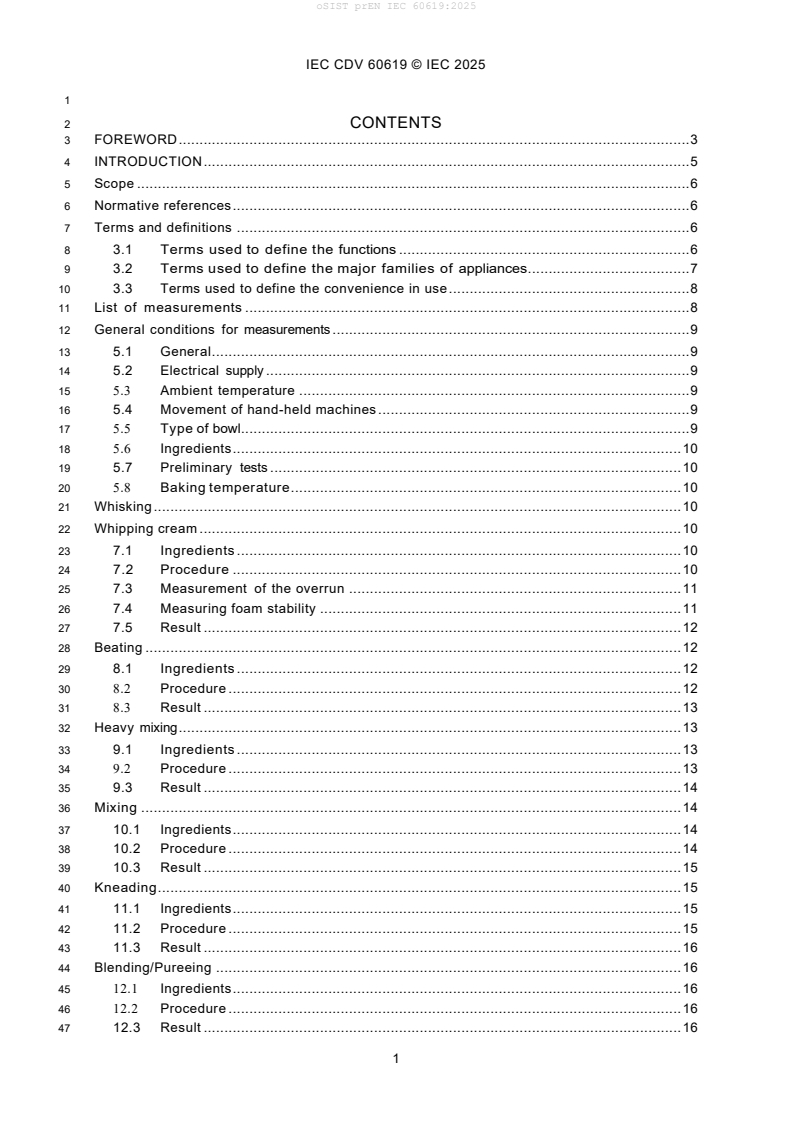
Contents
- 3 FOREWORD
- 4 INTRODUCTION
- 5 Scope
- 6 Normative references
- 7 Terms and definitions
- 8 3.1 Terms used to define the functions
- 9 3.2 Terms used to define the major families of appliances
- 10 3.3 Terms used to define the convenience in use
- 11 List of measurements
- 12 General conditions for measurements
- 13 5.1 General
- 14 5.2 Electrical supply
- 15 5.3 Ambient temperature
- 16 5.4 Movement of hand-held machines
- 17 5.5 Type of bowl
- 18 5.6 Ingredients
- 19 5.7 Preliminary tests
- 20 5.8 Baking temperature
- 21 Whisking
- 22 Whipping cream
- 23 7.1 Ingredients
- 24 7.2 Procedure
- 25 7.3 Measurement of the overrun
- 26 7.4 Measuring foam stability
- 27 7.5 Result
- 28 Beating
- 29 8.1 Ingredients
- 30 8.2 Procedure
- 31 8.3 Result
- 32 Heavy mixing
- 33 9.1 Ingredients
- 34 9.2 Procedure
- 35 9.3 Result
- 36 Mixing
- 37 10.1 Ingredients
- 38 10.2 Procedure
- 39 10.3 Result
- 40 Kneading
- 41 11.1 Ingredients
- 42 11.2 Procedure
- 43 11.3 Result
- 44 Blending/Pureeing
- 45 12.1 Ingredients
- 46 12.2 Procedure
- 47 12.3 Result
172 Scope 173 This International Standard applies to electrically operated food preparation appliances for 174 household use.
175 The purpose of this standard is to state and define test methods of measuring the functions 176 that can be carried out by means of household electrical food preparation appliances, which 177 are of interest to the user and to give some guidelines for the evaluation of test results. 178 Taking into account the lower grade of accuracy and repeatability, due to variations in 179 time and origin of test materials and ingredients and to the influence of the subjective 180 judgement of test operators, the described test methods may be applied more reliably for 181 comparative testing of a number of appliances at approximately the same time, in the same 182 laboratory, by the same operator and with the same utensils, rather than for testing of single 183 appliances in different laboratories.
184 As there is no definition of a given type or size of oven, and as a number of the tests involve 185 baking of the final product in order to make a determination of volume, a variation in results 186 can be expected between ovens used. All comparative tests should be undertaken in the 187 same oven.
188 This standard does not cover safety.
189 This standard does not apply to appliances designed exclusively for commercial or industrial 190 use.
191 Attention is drawn to the fact that sometimes the same result may be obtained using 192 different functions.
193 NOTE 1 The definition of other functions is under consideration.
194 Normative references 195 There are no normative references in this document.
196 Terms and definitions 197 For the purposes of this document, the following terms and definitions apply. 198 ISO and IEC maintain terminology databases for use in standardization at the following 199 addresses:
200 • IEC Electropedia: available at https://www.electropedia.org/ 201 • ISO Online browsing platform: available at https://www.iso.org/obp 202 3.1 Terms used to define the functions 203 3.1.1 204 Whisking 205 to incorporate air and increase the volume of egg-whites.
206 3.1.2 207 whipping cream 208 to incorporate air and increase the volume of cream.
209 3.1.3 210 beating 211 to mix and incorporate air 212 EXAMPLE: beating of cake batter to produce dough 214 heavy mixing 215 to incorporate ingredients evenly into a heavy mixture without chopping 216 EXAMPLE: mixing of ingredients including dried fruits and glazed cherries to produce fruit cake dough 217 3.1.5 218 mixing 219 to combine ingredients evenly 220 EXAMPLE: mixing ingredients to produce pastry or pie 221 3.1.6 222 kneading 223 to work a heavy mixture to form a smooth, pliable mass 224 3.1.7 225 blending/pureeing 226 to make semi-solid ingredients liquid or to chop with liquid 227 EXAMPLE: chopping or liquidifying vegetables or fruits to produce babyfood, pureed fruit or soup 228 3.1.8 229 emulsifying 230 to combine together insoluble liquids so that one or more is suspended in droplets throughout 231 the other 232 EXAMPLE: combining egg and oil to produce mayonnaise 233 3.1.9 234 chopping 235 to reduce solid ingredients to small particles 236 EXAMPLE: chopping of meat to produce minced meat, chopping of onions to produce chopped onions, 237 chopping of almonds to produce chopped almonds 238 3.1.10 239 slicing 240 to cut into slices 241 EXAMPLE: slicing of vegetables to produce carrot slices, cucumber slices or leek slices 242 3.1.11 243 shredding 244 to reduce to small strips 245 EXAMPLE: cutting carrots to produce carrot shredds, cutting cheese to produce cheese shreds 246 3.1.12 247 cutting french fries 248 to cut potatoes into the shape of French fries 249 3.1.13 250 juice separation 251 to remove juice from fruit or vegetables by centrifugal force or a stainer by use of auger 252 citrus juice extraction 253 to remove juice from citrus fruits by applying fruit halves to a rotating cone 254 3.2 Terms used to define the major families of appliances 255 3.2.1 256 mono-function appliance 257 appliance designed to perform only one function 259 multi-function appliance 260 appliance designed to perform more than one function 261 NOTE 1 to entry: Appliances can be either hand-held type or countertop appliances. 262 NOTE 2 to entry: Sometimes, for some appliances, it may be necessary to change the attachments 263 or tools in order to perform the different functions.
264 3.3 Terms used to define the convenience in use 265 3.3.1 266 splashing and spillage 267 unintentional loss of ingredients during switching on and operation of an appliance 268 3.3.2 269 cleaning efficiency 270 effort necessary to empty, clean and dry an appliance (or separate parts), including the 271 disassembling of the appliance 272 3.3.3 273 cleaning time 274 time necessary to empty, clean and dry an appliance (or separate parts), including the 275 disassembling of the appliance 276 277 List of measurements 278 This standard covers the following functions:
279 – whisking (clause 6); 280 – whipping cream (clause 7); 281 – beating (clause 8); 282 – heavy mixing (clause 9); 283 – mixing (clause 10); 284 – kneading (clause 11); 285 – blending/pureeing (clause 12); 286 – emulsifying (clause 13); 287 – chopping of meat (subclause 14.1); 288 – chopping of onions (subclause 14.2); 289 – chopping of almonds (subclause 14.3); 290 – slicing of carrots (subclause 15.1); 291 – slicing of cucumbers (subclause 15.2); 292 – slicing of leeks (subclause 15.3); 293 – shredding of carrots (subclause 16.1); 294 – shredding of cheese (subclause 16.2); 295 – cutting french fries (clause 17); 296 – juice separation (clause 18); 297 – citrus juice extraction (clause 19); 298 – splashing and spillage (clause 20); 299 – cleaning efficiency and cleaning time (clause 21).
300 General conditions for measurements 301 Unless otherwise specified, the measurements are conducted under the following conditions. 302 5.1 General 303 The attachments, speed, tools and quantities of ingredients used shall be those 304 recommended by the manufacturer. In the absence of manufacturer's recommendations, 305 the quantities quoted shall be used. The ingredients specified have been selected primarily 306 to ensure uniform and reproducible results. A list of ingredients known to be suitable is given 307 in annex A. Unless otherwise stated, the appliance shall be operated in accordance with 308 the manufacturer's instructions.
309 All the tests from 6 to 20 shall be carried out three times (repeated twice), unless otherwise 310 stated in the specific clause.
311 A test report shall include the settings used for the respective test.
312 5.2 Electrical supply 313 The measurements shall be made at rated frequency and at a voltage which is within 314 ±1 % of the rated voltage or the mean of the rated voltage range.
315 For battery-powered appliances, the appliances are operated with batteries fully charged. 316 NOTE - If the rated voltage differs from the nominal supply voltage of the country concerned, measurements carried 317 out at rated voltage may be misleading. Therefore, for comparative testing the voltage used for the tests is to 318 conform to the nominal supply voltage and this shall be reported.
319 5.3 Ambient temperature 320 The ambient temperature and the temperature of all utensils and ingredients shall be 321 maintained at (23 ± 2) °C, unless otherwise specified.
322 NOTE - In tropical climates, the ambient temperature may be (27 ± 5) °C but the temperature should be recorded 323 5.4 Movement of hand-held machines 324 When whipping cream (clause 7) with a hand-held machine, a movement that describes the 325 shape of the arabic number eight (see Fig. 1) shall be used if possible; otherwise, the shape of 326 the bowl shall be followed. The number of complete movements should be between 45 and 60 327 per minute. The bowl shall not be moved or lifted during whipping. Touching walls, raising or 328 lowering the hand-held appliance should be avoided.
329 When processing cake batter (clause 8) with a hand-held machine, a movement that describes 330 the shape of the arabic number eight shall be used if possible; otherwise, the shape of the bowl 331 shall be followed. The number of complete movements should be between 30 and 40 per minute. 332 The bowl shall not be moved or lifted during beating. Touching walls, raising or lowering the 333 hand-held appliance should be avoided.
334 When kneading (clause 10) hand mixers shall be moved as necessary to achieve good 335 operation but at a speed not exceeding thirty movements per minute. The bowl shall not be 336 moved or lifted during kneading.
337 For other operations, hand-held machines shall be moved as necessary to achieve good 338 operation but at a speed not exceeding thirty movements per minute.
339 5.5 Type of bowl 340 For appliances supplied with a bowl, the measurements shall be made using this bowl. 341 Hand-held machines supplied with bowl and stand shall be operated in accordance with the 342 manufacturer's instructions. If no instructions are supplied and it is obvious that the bowl has 343 to be moved, this is allowed but shall be stated in the report.
344 For appliances not supplied with a bowl, one of the bowls shown in Figures 3, 4 and 5 shall 345 be used, choosing the most suitable for the function that has to be measured.
346 5.6 Ingredients 347 Ingredients are stated in the respective clauses.
348 Where it is required that minimum and maximum quantities have to be processed, care has 349 to be taken that the same proportion between all ingredients is maintained. 350 5.7 Preliminary tests 351 Sometimes and for some functions it may be necessary to carry out, for a given appliance 352 or for a series of appliances, some preliminary tests in order to find out the time and the 353 procedure to obtain the best result.
354 5.8 Baking temperature 355 Where in the standard it is required to bake the prepared mixture, the conventional heating 356 function of the oven shall be used, at a suitable temperature in accordance with the oven 357 manufacturer's instructions.
358 Whisking 359 VOID 360 Secretary’s note: Whisking egg white is very dependent on the eggs and not very reliable. 361 In various test measurements in Germany, we could show that the results are equal to 362 the whipping cream test, which gives a better repeatability. Hence, the German proposal 363 is to delete Clause 6 and focus on Clause 7.
364 Whipping cream 365 7.1 Ingredients 366 Fresh whipping cream, made from pasteurized milk and with a fat content of at least 30% 367 and carrageenan, is used. The fat content and manufacturer of the cream used shall be 368 stated in the report. Cream with the same fat content shall be used within a series of 369 measurements.
370 The cream used for a series of measurements should be obtained from the same 371 manufacturer. The cream used should be used within its shelf life.
372 The amount required for each individual measurement is taken from the refrigerator 373 immediately before the measurement begins. The temperature of the cream must be (7 ± 374 1) °C when it is taken out of the refrigerator.
375 7.2 Procedure 376 The ambient temperature and the temperature of all equipment shall be (23 ± 2) °C. The 377 cream is placed in the bowl and whipping shall begin immediately. The cream should be 378 weighed into the bowl exactly to the gram, ± 1 g.
379 NOTE 1: Even for devices with an integrated scale, the cream is weighed in separately. 380 The test includes whipping a standard amount of cream (200 g) as well as a maximum 381 amount of cream. The test is carried out three times for each of the two volumes. 382 NOTE 2: If the manufacturer's instructions state that the minimum amount to be whipped is >200 g, this must 383 be used as the standard amount.
384 The cream shall be whipped according to the instructions for use of the device (speed/level, 385 time, accessories if necessary), both for the standard quantity and for the maximum quantity 386 to be used.
387 NOTE 3: Only the accessories supplied and intended by the manufacturer for whipping cream are allowed for 388 the test.
389 If there is no sufficiently detailed specification in the instructions for use, the following 390 procedure shall be adopted:
391 – The speed/level shall be set that will give the most satisfactory result 392 The test is terminated when the incision made with a knife remains for at least 10 seconds. 393 If no incision that remains for at least 10 seconds can be observed after 10 minutes of 394 whipping, the test should also be terminated.
395 Note 4: See Fig. 2 for guidance on knife incision in whipped cream.
396 Supplied accessories are to be used according to the expert opinion of the test laboratory. 397 – To determine the maximum quantity, preliminary tests are carried out which, in the 398 opinion of the test laboratory, still provide an acceptable whipping result (see 7.5) at a 399 multiple of 100 g.
400 7.3 Measurement of the overrun 401 A Petri dish (see Figure 6), the mass and volume of which have been determined, is filled with 402 a sample taken from the whipped cream and weighed.
403 To measure the volume of the petri dish, proceed as follows:
404 The volume of the Petri dish is determined by filling it with water (15 ± 5 °C, containing 1% low - 405 foaming surfactant) and measuring the volume in Liters. The Petri dish must be filled to the 406 upper rim with water and the weight of the water required must be determined. A pipette should 407 be used to help with precise dosing.
408 NOTE 1 To avoid small ripples when adding the water with the pipette, it should be held under the water surface. 409 To take a sample, proceed as follows:
410 Sample is taken with a spatula with a silicone blade.
411 The sample is to be taken from different places on the edge of the bowl and transferred to the 412 petri dish. The places should be evenly distributed over the edge of the bowl. The sample is 413 taken across the entire depth of the bowl.
414 After each sample has been taken, the whipped cream should be transferred to the Petri dish, 415 avoiding air entrapment, until it is slightly overfilled. Any excess cream is scraped off with a 416 cake spatula (or similarly shaped object).
417 NOTE 2 When transferring the whipped cream, it is important to exert as little pressure as possible on the whipped 418 cream.
419 The mean and standard deviation of all measurements for the minimum and maximum quantity 420 are determined.
421 The following formula is used to determine the overrun:
𝑂= (1) 422 where 423 O is the Overrun, 424 m is the mass of the liquid expressed in g, l 425 mc is the mass of the whipped cream, expressed in g, 426 V is the volume of the petri dish, expressed in l.
p 427 7.4 Measuring foam stability 428 As described in 7.3, 100 g ± 1 g of the cream is taken and transferred without pressure into a 429 prepared funnel (see Fig. 5). Cream that drips down is collected in a container of a known 430 weight.
431 After 15 minutes, the drained mass shall be weighed and the drained weight shall be noted. 432 7.5 Result 433 The test is considered to have a satisfactory result if:
434 – a whipping result has been achieved that maintains a knife incision for at least 10 seconds 435 and a homogeneous mass is present.
436 NOTE A homogeneous mass is present when no coagulation or phase separation has occurred due to flashover. 437 – a foam stability has been achieved that has a dripping weight of <1 g.
438 The following shall be stated in a test report:
439 – test has satisfactory or non-satisfactory result for standard quantity and maximum quantity; 440 NOTE If the standard quantity was deviated from (see 7.1), it is documented that no cream was whipped at the 441 standard quantity and the results of the minimum cream quantity according to the manufacturer's instructions is 442 recorded.
443 – maximum quantity tested 444 – the accessories used; if applicable, the standard cup used if no cup is included with the 445 device 446 – settings; 447 – whipping time; 448 – fat content and manufacturer of the cream used; 449 – overrun: mean and standard deviation.
450 – drained weight after 15 minutes 451 – qualitative description of non-whipped cream residues in the cup 452 Beating 453 8.1 Ingredients 454 The mass of ingredients to each egg is as follows:
455 – 50 g margarine; 456 – 50 g sugar; 457 – 50 g flour; 458 – 1 g baking powder or in accordance with the instructions of the manufacturer of the 459 baking powder.
460 Initial temperature (23 ± 2) °C.
461 8.2 Procedure 462 Tests of different amounts of ingredients are made to find the minimum and maximum 463 quantities that can be satisfactorily beaten.
464 The result is satisfactory when all ingredients are evenly distributed.
465 Record the weight of the bowl and its attachments. Make a dough based on three eggs. 466 Cut the margarine into cubes of approximately 20 mm. Place all the ingredients into the 467 bowl and beat until satisfactorily mixed. Scrape down the sides of the bowl once, if 468 necessary, with a spatula. Record the time needed for beating.
469 550 g of the dough is put into a long uncoated aluminium baking tin (see Figure 8). 470 Place the tin in the middle of a preheated oven at a suitable temperature according to 471 the oven manufacturer's instructions and bake until the cake is deemed to be done. 472 The baking time and the temperature have to be recorded.
473 After carefully scraping the bowl and its attachments, weigh these and calculate the residual 474 dough in the bowl and its attachments as a percentage of the total weight of the ingredients.
475 After the baking, the cake is taken out of the tin and turned upside down on a flat surface. 476 It is covered with the tin and left for 24 h at room temperature. After the resting time the 477 cake is weighed.
478 In order to determine the volume, the tin with the cake is filled up to the rim with mustard seeds. 479 The seeds are measured in a measuring bowl. The difference between the known volume of 480 the tin and the volume of the mustard seeds is the volume of the baked cake. If the cake 481 has risen over the tin the measurement should be made, for instance, by aid of additional 482 walls put on the top of the tin or by other suitable means, but without cutting the cake. 483 The cake has to be sliced evenly at different points (normally at 1/5, 2/5, 3/5 and 4/5 of its 484 length).
485 The test has to be repeated and the mean value is calculated.
486 8.3 Result 487 Record the following:
488 – the minimum and maximum quantities that give satisfactory results, expressed as the 489 number of eggs; 490 – the weight of residual dough in the working bowl and on its attachments; 491 – the baking time, the temperature and the type of the oven; 492 – the time taken to mix a dough of three eggs; 493 – volume of the baked cake; 494 – comments on the structure of the slices that has to be such that air pockets should be 495 of even size and distribution; 496 – the attachments and setting used.
497 Heavy mixing 498 9.1 Ingredients 499 The mass of ingredients to each egg is as follows:
500 – 45 g margarine; 501 – 45 g sugar; 502 – 85 g flour; 503 – 3,5 g baking powder; 504 – 50 g currants, after soaking in tea; 505 – 50 g mixed dried fruit according to national availability.
0 506 Initial temperature (23 ± 2) c.
507 9.2 Procedure 508 Tests of different amounts of ingredients are made to find the minimum and maximum 509 quantities that can be satisfactorily mixed.
510 A satisfactory result is when all ingredients are evenly distributed and the fruits are not 511 damaged.
...