

prEN IEC 61025:2023
(Main)Fault tree analysis (FTA)
General Information
- Abstract
- Status
- Not Published
- Publication Date
- 02-Apr-2025
- Technical Committee
- CLC/SR 56 - Dependability
- Drafting Committee
- IEC/TC 56 - IEC_TC_56
- Current Stage
- 4098 - Decision to drop project - Standstill maintained / released - Enquiry
- Start Date
- 01-Sep-2025
- Completion Date
- 25-Aug-2026

Overview
prEN IEC 61025:2023 - Fault Tree Analysis (FTA) - is the CLC/CENELEC draft reflecting the IEC TC 56 dependability standard (IEC 61025, edition 3) for performing fault tree analysis. Published as a Committee Draft for Vote (CDV) in 2023, the document defines terminology, notation and best practices for building, analysing and reporting fault trees used in reliability, safety and dependability assessments. The standard supports both qualitative and quantitative FTA methods and includes extensions for dynamic behaviour and advanced computational techniques.
Key topics and technical requirements
The standard covers the full FTA lifecycle, including:
- Terms, symbols and definitions for fault trees and dependability concepts (clauses 3–4).
- General aspects and objectives of FTA, its scope, limitations and typical applications (clause 5).
- Step‑by‑step development of a fault tree: defining objectives, gathering information, selecting the top event, modelling and labelling (clause 6).
- Mathematical representation of logic gates (OR, AND, voting, NOT/NAND/NOR) and the use of transfer symbols and subtrees (clause 7).
- Qualitative analysis: identification and use of minimal cut sets, common‑cause failure considerations (clause 8).
- Quantitative analysis: methods for constant and time‑dependent probabilities, use of cut sets, Sylvester‑Poincaré formula, importance measures and sensitivity/uncertainty analysis (clause 9).
- Dynamic fault trees (DFT) and XOR/non‑coherent gates for local and systemic interactions (clause 10).
- Annexes with advanced methods: relationships to RBD, FMEA, ETA/CCA, Markov analysis; Monte Carlo for uncertainty; Binary Decision Diagrams (BDD), Shannon decomposition; Petri nets; numerical examples and importance factors (Annexes A–H).
Practical applications
This standard is intended for practical use in:
- Reliability and safety assessments of machines, apparatus and equipment.
- Design reviews, hazard analysis and certification activities.
- Quantifying system unavailability, mean time between failures/failures frequencies, and prioritising mitigations.
- Integrating FTA with FMEA, RBD, event trees, Markov and Monte Carlo methods for comprehensive risk analysis.
Who should use this standard
- Reliability, safety and systems engineers
- Risk analysts and maintenance planners
- Certification bodies and test laboratories
- Researchers and tool vendors implementing FTA/DFT, BDD or Monte Carlo analysis
Related standards and notes
- Prepared by IEC TC 56 (Dependability); submitted for IEC‑CENELEC parallel voting.
- Annex A expressly links FTA to RBD, FMEA, ETA/CCA and Markov techniques.
- Document is a CDV (subject to change) and supersedes previous committee documents cited in the draft.
Keywords: Fault Tree Analysis, FTA, prEN IEC 61025:2023, IEC 61025, dependability, reliability analysis, minimal cut sets, dynamic fault trees, BDD, Monte Carlo.
Relations
- Effective Date
- 03-Feb-2026
- Effective Date
- 24-Jan-2023
Get Certified
Connect with accredited certification bodies for this standard

BSI Group
BSI (British Standards Institution) is the business standards company that helps organizations make excellence a habit.

Bureau Veritas
Bureau Veritas is a world leader in laboratory testing, inspection and certification services.

DNV
DNV is an independent assurance and risk management provider.
Sponsored listings
Frequently Asked Questions
prEN IEC 61025:2023 is a draft published by CLC. Its full title is "Fault tree analysis (FTA)". This standard covers: Fault tree analysis (FTA)
Fault tree analysis (FTA)
prEN IEC 61025:2023 is classified under the following ICS (International Classification for Standards) categories: 03.120.01 - Quality in general; 03.120.99 - Other standards related to quality. The ICS classification helps identify the subject area and facilitates finding related standards.
prEN IEC 61025:2023 has the following relationships with other standards: It is inter standard links to EN IEC 62933-5-2:2020, EN 61025:2007. Understanding these relationships helps ensure you are using the most current and applicable version of the standard.
prEN IEC 61025:2023 is available in PDF format for immediate download after purchase. The document can be added to your cart and obtained through the secure checkout process. Digital delivery ensures instant access to the complete standard document.
Standards Content (Sample)
SLOVENSKI STANDARD
01-november-2023
Analiza drevesa okvar (FTA)
Fault tree analysis (FTA)
Fehlzustandsbaumanalyse
Analyse par arbre de panne (AAP)
Ta slovenski standard je istoveten z: prEN IEC 61025:2023
ICS:
03.120.01 Kakovost na splošno Quality in general
21.020 Značilnosti in načrtovanje Characteristics and design of
strojev, aparatov, opreme machines, apparatus,
equipment
2003-01.Slovenski inštitut za standardizacijo. Razmnoževanje celote ali delov tega standarda ni dovoljeno.
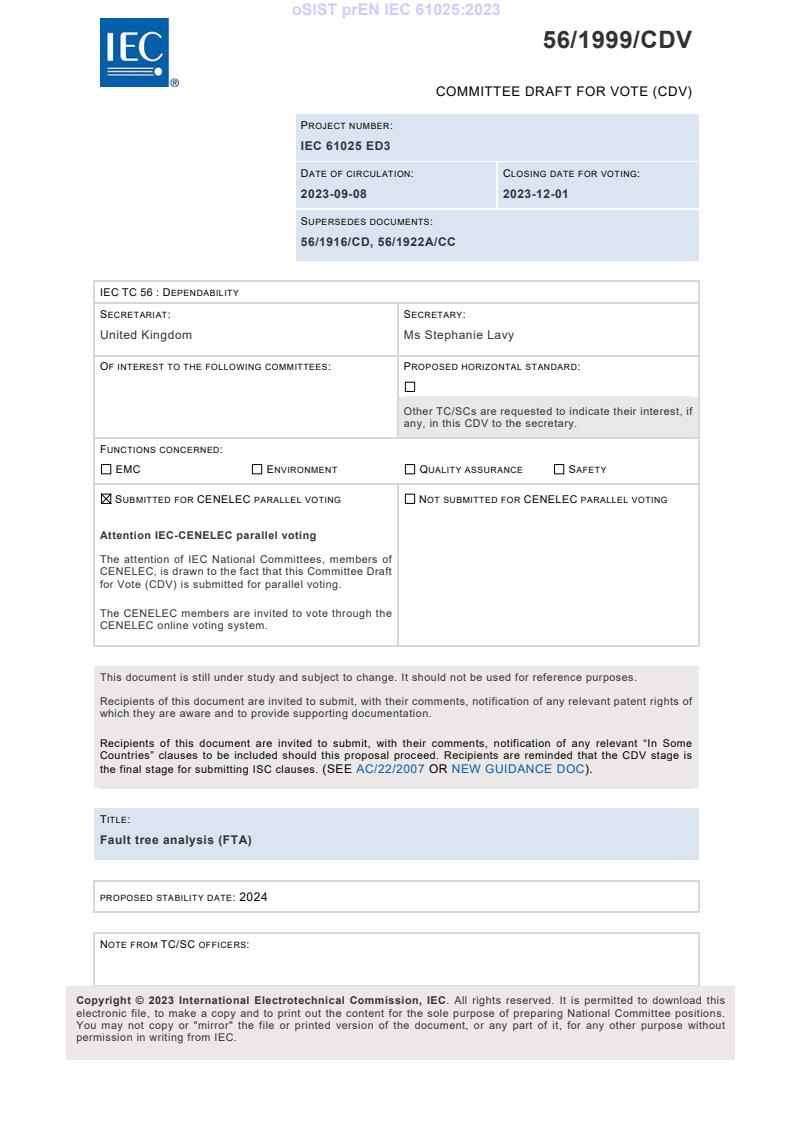
56/1999/CDV
COMMITTEE DRAFT FOR VOTE (CDV)
PROJECT NUMBER:
IEC 61025 ED3
DATE OF CIRCULATION: CLOSING DATE FOR VOTING:
2023-09-08 2023-12-01
SUPERSEDES DOCUMENTS:
56/1916/CD, 56/1922A/CC
IEC TC 56 : DEPENDABILITY
SECRETARIAT: SECRETARY:
United Kingdom Ms Stephanie Lavy
OF INTEREST TO THE FOLLOWING COMMITTEES: PROPOSED HORIZONTAL STANDARD:
Other TC/SCs are requested to indicate their interest, if
any, in this CDV to the secretary.
FUNCTIONS CONCERNED:
EMC ENVIRONMENT QUALITY ASSURANCE SAFETY
SUBMITTED FOR CENELEC PARALLEL VOTING NOT SUBMITTED FOR CENELEC PARALLEL VOTING
Attention IEC-CENELEC parallel voting
The attention of IEC National Committees, members of
CENELEC, is drawn to the fact that this Committee Draft
for Vote (CDV) is submitted for parallel voting.
The CENELEC members are invited to vote through the
CENELEC online voting system.
This document is still under study and subject to change. It should not be used for reference purposes.
Recipients of this document are invited to submit, with their comments, notification of any relevant patent rights of
which they are aware and to provide supporting documentation.
Recipients of this document are invited to submit, with their comments, notification of any relevant “In Some
Countries” clauses to be included should this proposal proceed. Recipients are reminded that the CDV stage is
the final stage for submitting ISC clauses. (SEE AC/22/2007 OR NEW GUIDANCE DOC).
TITLE:
Fault tree analysis (FTA)
PROPOSED STABILITY DATE: 2024
NOTE FROM TC/SC OFFICERS:
Copy right © 2023 International Electrotechnical Commission, IEC. All rights reserved. It is permitted to download this
electronic file, to make a copy and to print out the content for the sole purpose of preparing National Committee positions.
You may not copy or "mirror" the file or printed version of the document, or any part of it, for any other purpose without
permission in writing from IEC.
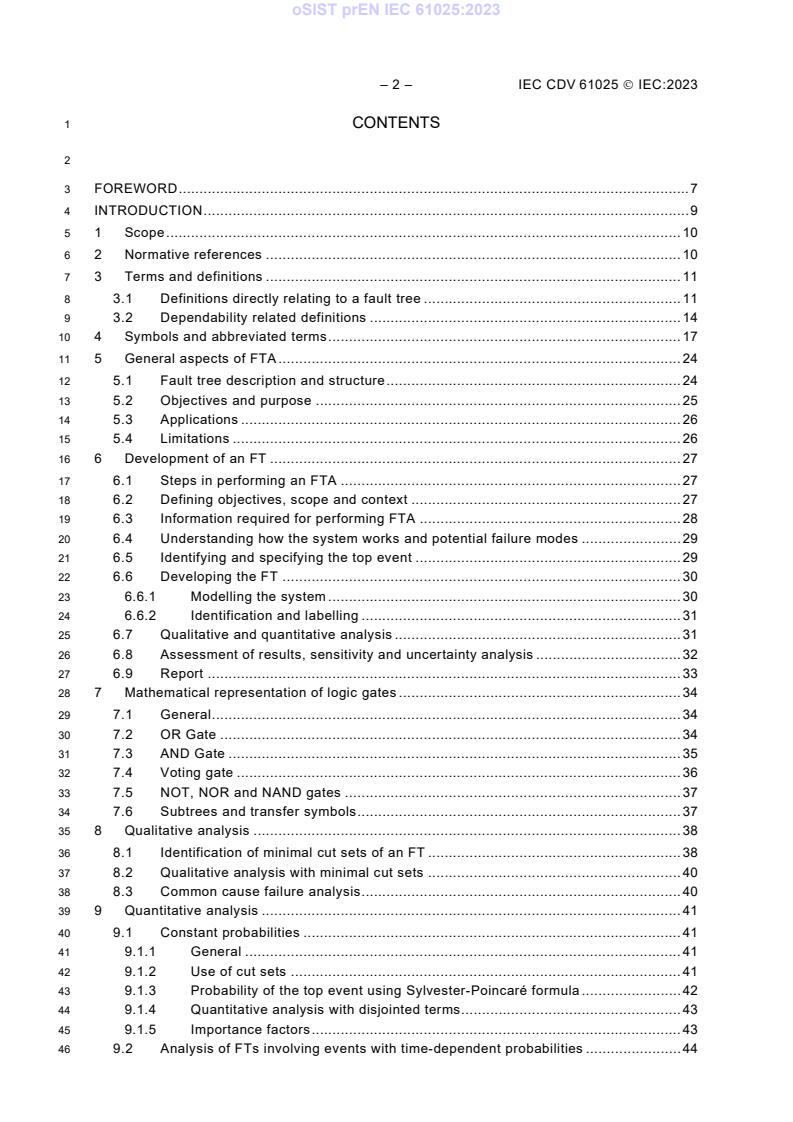
– 2 – IEC CDV 61025 IEC:2023
1 CONTENTS
3 FOREWORD . 7
4 INTRODUCTION . 9
5 1 Scope . 10
6 2 Normative references . 10
7 3 Terms and definitions . 11
8 3.1 Definitions directly relating to a fault tree . 11
9 3.2 Dependability related definitions . 14
10 4 Symbols and abbreviated terms . 17
11 5 General aspects of FTA . 24
12 5.1 Fault tree description and structure . 24
13 5.2 Objectives and purpose . 25
14 5.3 Applications . 26
15 5.4 Limitations . 26
16 6 Development of an FT . 27
17 6.1 Steps in performing an FTA . 27
18 6.2 Defining objectives, scope and context . 27
19 6.3 Information required for performing FTA . 28
20 6.4 Understanding how the system works and potential failure modes . 29
21 6.5 Identifying and specifying the top event . 29
22 6.6 Developing the FT . 30
23 6.6.1 Modelling the system . 30
24 6.6.2 Identification and labelling . 31
25 6.7 Qualitative and quantitative analysis . 31
26 6.8 Assessment of results, sensitivity and uncertainty analysis . 32
27 6.9 Report . 33
28 7 Mathematical representation of logic gates . 34
29 7.1 General . 34
30 7.2 OR Gate . 34
31 7.3 AND Gate . 35
32 7.4 Voting gate . 36
33 7.5 NOT, NOR and NAND gates . 37
34 7.6 Subtrees and transfer symbols . 37
35 8 Qualitative analysis . 38
36 8.1 Identification of minimal cut sets of an FT . 38
37 8.2 Qualitative analysis with minimal cut sets . 40
38 8.3 Common cause failure analysis . 40
39 9 Quantitative analysis . 41
40 9.1 Constant probabilities . 41
41 9.1.1 General . 41
42 9.1.2 Use of cut sets . 41
43 9.1.3 Probability of the top event using Sylvester-Poincaré formula . 42
44 9.1.4 Quantitative analysis with disjointed terms . 43
45 9.1.5 Importance factors . 43
46 9.2 Analysis of FTs involving events with time-dependent probabilities . 44
IEC CDV 61025 IEC:2023– 3 –
47 9.2.1 General . 44
48 9.3 Boolean techniques for quantitative analysis of large models . 46
49 9.4 Time dependent analysis for systems consisting of non-repaired components . 47
50 9.4.1 Failure rates . 47
51 9.4.2 Small sub trees related to non-repaired items . 47
52 9.4.3 Preventive replacement strategies and MTTF . 49
53 9.5 Time-dependent analysis for systems that include repaired components . 49
54 9.5.1 General . 49
55 9.5.2 Small sub trees related to repaired items . 50
56 9.5.3 FTs involving failures of periodically tested components . 51
57 9.5.4 Average and asymptotic unavailability calculations . 52
58 9.5.5 Frequency calculations and METBF . 53
59 9.5.6 Unreliability calculations . 54
60 9.5.7 Composition of two independent items – Practical examples using rates . 56
61 10 Extension of fault tree technique. 57
62 10.1 XOR gates and non-coherent fault trees . 57
63 10.1.1 Example of probabilistic calculation for a non-coherent fault tree . 58
64 10.2 Dynamic fault trees . 59
65 10.2.1 General . 59
66 10.2.2 Local interactions . 59
67 10.2.3 Systemic dynamic interactions . 61
68 10.2.4 Graphical representations of dynamic interactions . 61
69 10.2.5 Probabilistic calculations . 64
70 Annex A (informative) Relationship with other dependability and risk assessment
71 techniques . 66
72 A.1 Reliability block diagrams . 66
73 A.1.1 Introduction . 66
74 A.1.2 Series structure . 66
75 A.1.3 Parallel structure . 67
76 A.1.4 Mix of series and parallel structures . 67
77 A.2 Combination of FTA and failure modes and effects analysis (FMEA) . 68
78 A.3 Combination of FTA and event tree analysis (ETA) or cause-consequence
79 analysis (CCA) . 68
80 A.4 Combination of FTA and Markov analysis . 70
81 Annex B (informative) Automated fault tree construction . 71
82 Annex C (informative) Use of Monte Carlo analysis for analysing uncertainty . 72
83 Annex D (informative) Procedure for disjointing minimal cut sets . 75
84 Annex E (informative) Shannon decomposition and BDDs. 77
85 E.1 Shannon decomposition . 77
86 E.2 Binary decision diagram (BDD) . 79
87 E.2.1 Building of BDDs . 79
88 E.2.2 Minimal cut sets identification . 79
89 E.2.3 Probabilistic calculations with BDDs . 80
90 E.2.4 Conditional probability calculations with BDD . 81
91 Annex F (informative) Importance factors . 83
92 F.1 General . 83
93 F.2 Vesely-Fussell importance factor . 83
94 F.3 Birnbaum importance factor or marginal importance factor . 83
– 4 – IEC CDV 61025 IEC:2023
95 F.4 Lambert importance factor or critical importance factor . 84
96 F.5 Diagnostic importance factor . 85
97 F.6 Risk achievement worth . 85
98 F.7 Risk reduction worth . 85
99 F.8 Differential importance measure . 85
100 F.9 Remarks about importance factors . 86
101 Annex G (informative) FT driven Petri nets . 87
102 G.1 General . 87
103 G.2 Example of sub-PN to be used within FT driven PN models . 87
104 G.3 Evaluation of the DFT state . 89
105 G.4 Availability, reliability, frequency and MTTF calculations . 91
106 Annex H (informative) Numerical examples . 93
107 H.1 General . 93
108 H.2 Typical series structures (OR gates) . 93
109 H.2.1 Non-repaired components . 93
110 H.2.2 Repaired components . 94
111 H.3 Typical parallel structure (AND gate) . 96
112 H.3.1 Non-repaired components . 96
113 H.3.2 Repaired components . 97
114 H.4 Series-parallel structures . 98
115 H.5 Complex structures . 99
116 H.5.1 Fault tree with a repeated event . 99
117 H.5.2 Convergence to asymptotic values versus MRT . 101
118 H.5.3 System with periodically tested components . 101
119 H.6 Dynamic fault tree example . 103
120 H.6.1 Comparison between analytical and Monte Carlo simulation results . 103
121 H.6.2 Dynamic RBD example . 104
122 Bibliography . 107
124 Figure 1– Simple pumping system . 29
125 Figure 2 – Fault tree for system illustrated in Figure 1 . 30
126 Figure 3 – OR Gate. 34
127 Figure 4 – Venn diagram illustrating Union of 3 events . 35
128 Figure 5 – AND gate . 35
129 Figure 6 – Voting gate . 36
130 Figure 7 Representation of equation (7) in an equivalent fault tree . 36
131 Figure 8 –Use of transfer symbols to split a large FT into smaller trees. 38
132 Figure 9 – Fault tree as in Figure 2 showing gate outputs . 39
133 Figure 10 – Simplified fault tree for system illustrated in Figure 1 . 40
134 Figure 11 – Principle of combining time dependent probabilities . 44
135 Figure 12 – Combining time dependent probabilities: example unavailability with
136 periodically tested components . 45
137 Figure 13 –Example showing the relationship between a Markov process and a primary
138 event for a non-repaired item . 48
139 Figure 14 – Example of dependent primary events gathered into a single primary event . 48
140 Figure 15 –State transition diagram for a simple repaired item . 50
141 Figure 16 – Standby redundancy . 51
IEC CDV 61025 IEC:2023– 5 –
142 Figure 17 –Typical unavailability of a periodically tested component . 51
143 Figure 18 –Average unavailability over [0, T] . 52
144 Figure 19 –𝑼𝑼𝑼𝑼avg(𝟎𝟎,𝒕𝒕) for a system with periodically tested components . 53
145 Figure 20 –FT and equivalent Markov process for reliability calculations. 55
146 Figure 21 – Equivalence XOR gate with a combination of AND and OR gates . 57
147 Figure 22 – Example of a non-coherent Fault tree and of ITE gate . 58
148 Figure 23 – BDD equivalent to the example of Figure 22 . 59
149 Figure 24 – Symbol for external elements . 60
150 Figure 25 – Dynamic interaction between CCF and primary events . 61
151 Figure 26 –Two ways to indicate dynamic interactions between primary events . 62
152 Figure 27 – Example of functional dependency due to a single repair team . 62
153 Figure 28 – Implementation of a PAND gate . 63
154 Figure 29 – Implementation of a SEQ gate . 63
155 Figure 30 – CCF as a repeated event . 64
156 Figure 31 – PAND gate modelled with a Markov process . 65
157 Figure 32 – SEQ gate modelled with a Markov process . 65
158 Figure A.1 – Series structure: equivalence between RBD and FT . 66
159 Figure A.2 – Parallel structure: equivalence between RBD and FT . 67
160 Figure A.3 – Example of mix between series and parallel structures . 67
161 Figure A.4 – Analysis of a procedure by cause consequence diagram . 69
162 Figure A.5 – Event tree equivalent to the cause consequence diagram in Figure A.4 . 69
163 Figure A.6 Global FT related to Figures A.4 and A.5 . 70
164 Figure C.1 – Example of distribution of a failure rate considered as a random variable . 72
165 Figure C.2 – Principle of Monte Carlo simulation . 72
166 Figure C.3 – Example of uncertainty handling by using Monte Carlo simulation . 73
167 Figure C.4 – Results highlighting the impact of input parameters uncertainties . 74
168 FigureD.1 – Simple FT for applying disjointing procedure . 75
169 Figure E.1 – Shannon decomposition of a simple Boolean expression and resulting
170 BDD . 77
171 Figure E.2 – Shannon decomposition of a 2/4 logical structure . 78
172 Figure E.3 – Shannon decomposition (reduced graph) . 78
173 Figure E 4 – Binary decision diagram related to the FT in Figure E.2 . 79
174 Figure E.5 – Minimal cut set identification . 80
175 Figure E.6 – Probabilistic calculations from a BDD . 81
176 Figure E.7 – Calculation of conditional probabilities using BDDs . 82
177 Figure G.1 – Example of a sub-PN modelling a primary event . 87
178 Figure G.2 – Example of a sub-PN modelling common cause failures . 88
179 Figure G.3 – Example of DFT based on FT driven PN . 89
180 Figure G.4 – Logical calculation of classical FT structures . 89
181 Figure G.5 – Example of logical calculation for an 2/3 gate . 90
182 Figure G.6 – Example of sub-PN modelling a PAND gate with 2 inputs . 90
183 Figure G.7 – Example of the inhibition of a primary event . 91
184 Figure G.8 – Sub-PN for availability, reliability and frequency calculations . 92
– 6 – IEC CDV 61025 IEC:2023
185 Figure H.1 – Unavailability/unreliability of a typical non-repaired series structure . 93
186 Figure H.2 –Failure rate and failure frequency/failure density related to Figure H.1. 94
187 Figure H.3 – Equivalence of a non-repaired series structure to a single component . 94
188 Figure H.4 – Unavailability/unreliability of a typical repaired series structure. 95
189 Figure H.5 – Failure rate and failure frequency related to Figure H.4 . 95
190 Figure H.6 – Unavailability/unreliability of a typical non-repaired parallel structure . 96
191 Figure H.7 – Failure rate and failure frequency related to Figure H.6 . 97
192 Figure H.8 – Unavailability/unreliability of a typical repaired parallel structure . 97
193 Figure H.9 – Vesely failure rate and failure frequency related to Figure H.8 . 98
194 Figure H.10 – Example of mixed series and parallel structures . 99
195 Figure H.11 – Vesely failure rate and failure frequency related to Figure H.10 . 99
196 Figure H.12 – FT with a repeated event . 100
197 Figure H.14 – Failure rate and failure frequency related to Figure H.12. . 100
198 Figure H.15 – Impact of the MRT on the convergence quickness . 101
199 Figure H.16 – Typical safety instrumented system . 102
200 Figure H.17 – Unavailabilities related to primary events of the SIS (Figure H.16) . 102
201 Figure H.18 – SIS unavailability and reliability . 103
202 Figure H.19 – Vesely failure rate and failure frequency of the SIS (Figure H.16) . 103
203 Figure H.20 – Parallel-series system. 103
204 Figure H.21 – Analytical versus Monte Carlo simulation results according to the
205 number of simulations . 104
206 Figure H.22 – Parallel-series system with common cause failures and single
207 maintenance team . 104
208 Figure H.23 – Impact of CCFs and limited number of repair teams – . 104
209 Figure H.24 – Markov graphs modelling the impact of the number of repair teams – . 105
210 Figure H.25 – Approximation for two redundant components . 106
212 Table 1 – Acronyms used in this document . 17
213 Table 2 – Symbols used in this document . 18
214 Table 3 – Graphical representation of fault tree: events . 21
215 Table 4 – Graphical representation of fault tree: gates . 22
216 Table 5 – Graphical representation of FTs: dynamic gates and functional dependencies . 23
217 Table 6 – Ranking of cut sets . 42
218 Table 7 – Approximate formulae for system reliability measures . 54
219 Table H.1 – Reliability parameters of the SIS in Figure H.16 . 102
220 Table H.2 – Impact of functional dependencies . 105
IEC CDV 61025 IEC:2023– 7 –
223 INTERNATIONAL ELECTROTECHNICAL COMMISSION
224 ____________
226 FAULT TREE ANALYSIS
229 FOREWORD
230 1) The International Electrotechnical Commission (IEC) is a worldwide organization for standardization comprising
231 all national electrotechnical committees (IEC National Committees). The object of IEC is to promote international
232 co-operation on all questions concerning standardization in the electrical and electronic fields. To this end and
233 in addition to other activities, IEC publishes International Standards, Technical Specifications, Technical Reports,
234 Publicly Available Specifications (PAS) and Guides (hereafter referred to as “IEC Publication(s)”). Their
235 preparation is entrusted to technical committees; any IEC National Committee interested in the subject dealt with
236 may participate in this preparatory work. International, governmental and non-governmental organizations liaising
237 with the IEC also participate in this preparation. IEC collaborates closely with the International Organization for
238 Standardization (ISO) in accordance with conditions determined by agreement between the two organizations.
239 2) The formal decisions or agreements of IEC on technical matters express, as nearly as possible, an international
240 consensus of opinion on the relevant subjects since each technical committee has representation from all
241 interested IEC National Committees.
242 3) IEC Publications have the form of recommendations for international use and are accepted by IEC National
243 Committees in that sense. While all reasonable efforts are made to ensure that the technical content of IEC
244 Publications is accurate, IEC cannot be held responsible for the way in which they are used or for any
245 misinterpretation by any end user.
246 4) In order to promote international uniformity, IEC National Committees undertake to apply IEC Publications
247 transparently to the maximum extent possible in their national and regional publications. Any divergence between
248 any IEC Publication and the corresponding national or regional publication shall be clearly indicated in the latter.
249 5) IEC itself does not provide any attestation of conformity. Independent certification bodies provide conformity
250 assessment services and, in some areas, access to IEC marks of conformity. IEC is not responsible for any
251 services carried out by independent certification bodies.
252 6) All users should ensure that they have the latest edition of this publication.
253 7) No liability shall attach to IEC or its directors, employees, servants or agents including individual experts and
254 members of its technical committees and IEC National Committees for any personal injury, property damage or
255 other damage of any nature whatsoever, whether direct or indirect, or for costs (including legal fees) and
256 expenses arising out of the publication, use of, or reliance upon, this IEC Publication or any other IEC
257 Publications.
258 8) Attention is drawn to the Normative references cited in this publication. Use of the referenced publications is
259 indispensable for the correct application of this publication.
260 9) Attention is drawn to the possibility that some of the elements of this IEC Publication may be the subject of patent
261 rights. IEC shall not be held responsible for identifying any or all such patent rights.
262 International Standard IEC61025 has been prepared by Technical committee TC 56:
263 Dependability.
264 This third edition cancels and replaces the second edition published in 2006. This edition
265 constitutes a technical revision.
266 This edition includes the following significant technical changes with respect to the previous
267 edition:
268 a) The structure of the document has been modified with general applications of fault trees
269 discussed in the earlier clauses and applications specific to dependability in the later
270 clauses.
271 b) The mathematical content relating to dependability has been written to align with IEC 61078
272 (Reliability block diagrams) and to provide more information about availability, reliability and
273 failure frequency calculations.
274 c) Clauses have been introduced to describe non-coherent fault trees and dynamic fault trees.
275 d) Additional annexes have been added as follows: Annex A (Relationship with other
276 dependability and risk assessment techniques), Annex B (Automated fault tree
277 construction), Annex C (Use of Monte Carlo analysis for analysing uncertainty), Annex E
– 8 – IEC CDV 61025 IEC:2023
278 (Shannon decomposition and binary decision diagrams), Annex F (Importance factors),
279 Annex G (FT driven Petri net models) and Annex H (Numerical examples and curves).
280 The text of this International Standard is based on the following documents:
FDIS Report on voting
XX/XX/FDIS XX/XX/RVD
281 Full information on the voting for the approval of this International Standard can be found in the
282 report on voting indicated in the above table.
283 This document has been drafted in accordance with the ISO/IEC Directives, Part 2.
284 The committee has decided that the contents of this document will remain unchanged until the
285 stability date indicated on the IEC website under "http://webstore.iec.ch" in the data related to
286 the specific document. At this date, the document will be
287 • reconfirmed,
288 • withdrawn,
289 • replaced by a revised edition, or
290 • amended.
291 The National Committees are requested to note that for this document the stability date
292 is 20XX.
293 THIS TEXT IS INCLUDED FOR THE INFORMATION OF THE NATIONAL COMMITTEES AND WILL BE DELETED
294 AT THE PUBLICATION STAGE.
IEC CDV 61025 IEC:2023– 9 –
295 INTRODUCTION
296 Fault tree analysis (FTA) is used to identify and analyse combinations of events, conditions and
297 factors that cause or can potentially cause or contribute to the occurrence of a defined
298 undesirable outcome, referred to as the "top event".
299 The fault tree (FT) is an organized graphical representation of events leading to an undesired
300 event that can be clearly understood and analysed. Standardized symbols are used to show the
301 logical relationship among FT events (primary events or leaves and intermediate events) that
302 lead to the occurrence of the top event.
303 It is a deductive (top-down, effect to cause) technique which is very effective in the analysis of
304 multiple failure combinations. It can be used to complement the results obtained by other
305 analysis techniques such as FMEA [3]1 or HAZOP [4] which are inductive in nature (bottom-up,
306 cause to effect) and which consider each failure individually.
307 Depending on its scope, FTA can be qualitative or quantitative. Qualitative analysis identifies
308 combinations of primary events (minimal cut sets or prime implicants) that lead to the top event.
309 This enables weak points to be identified, gives guidance for failure prevention and helps to
310 determine how a product or system can be brought back to operation.
311 Quantitative analysis provides calculations of the probability of the top event and the importance
312 of primary events. For dependability applications the unavailability, unreliability and failure
313 frequency, of the product or system under study can be calculated.
314 FTA can be used to inform decisions for improving the performance, dependability and safety
315 of products and systems in a cost-effective way.
316 In its simplest form, an FT implements simple OR and AND logic gates and is equivalent to a
317 logic equation giving the top event as a function of the primary events, with events being
318 considered as Boolean variables. FTA, like the reliability block diagram (RBD) [5] or event tree
319 analysis (ETA) [6] belongs to the Boolean approaches. For simple FTs, the conventional rules
320 of probabilistic calculations with constant probability values apply.
321 Provided that each primary event in the FT can reasonably be assumed to behave
322 independently the probabilistic calculations can be extended to time dependent probabilistic
323 calculations so the FT can, for example, handle primary events involving non-repaired as well
324 as repaired items. FTA can also be extended to deal with large FTs, more complex gates,
325 sequence dependent behaviours and situations where an assumption that probability of the
326 primary event is low is not valid. While small FTs can be developed and analysed manually,
327 FTA of large or complicated systems generally requires software support.
328 NOTE FTA typically uses a top event that represents an undesirable event of some kind. Where the top event is a
329 success or improvement a similar approach called STA (success tree analysis) can be used.
330 This document is intended for those who need to develop and use FTs to analyse undesired
331 events.
—————————
Numbers in square brackets refer to the Bibliography
– 10 – IEC CDV 61025 IEC:2023
332 FAULT TREE ANALYSIS
334 1 Scope
335 Fault tree analysis (FTA) is used to identify and analyse combinations of events, conditions and
336 factors that cause or can potentially cause or contribute to the occurrence of a defined
337 undesirable outcome, referred to as the "top event". This document describes the (FTA)
338 technique and provides guidance on its application. This includes:
339 – definition and description of commonly used terms and symbols;
340 – purpose, applications and limitations of FTs;
341 – a description of basic concepts and principles;
342 – a description of the steps involved in scoping, constructing and developing the FT;
343 – guidance on performing qualitative and quantitative analysis of the FT, including discussion
344 of requirements and limitations of the associated mathematical models;
345 – identification of basic items that should be included when documenting and reporting the
346 FTA;
347 – methods for performing FTA when some of the commonly used assumptions are not satisfied
348 (e.g., non-coherent FTs, dynamic FTs);
349 – example applications in support of the above;
350 – procedures for calculating dependability measures (unavailability, failure frequency and
351 unreliability) for different types of system, with constant or time dependent probabilities or
352 with non-repaired or repaired items).
353 In annexes, the document also describes:
354 – the relationship of FTA with other related techniques such as Reliability Block Diagram
355 analysis (IEC 61078), Failure Mode and Effects Analysis (FMEA) (IEC 60812), Event Tree
356 Analysis (IEC 62502) and Markov techniques (IEC 61165);
357 – methods by which the importance of various events included in the FT can be established;
358 – automated fault tree construction;
359 – mathematical models required for large and more complex FTs;
360 – numerical examples demonstrating the use of FTs in dependability.
361 2 Normative references
362 The following documents are referred to in the text in such a way that some or all of their content
363 constitutes requirements of this document. For dated references, only the edition cited applies.
364 For undated references, the latest edition of the referenced document (including any
365 amendments) applies.
366 IEC 60050-192, International Electrotechnical Vocabulary – Part 192: Dependability (available
367 at http://www.electropedia.org)
368 IEC 61703, Mathematical expressions for reliability, availability, maintainability and
369 maintenance support terms
IEC CDV 61025 IEC:2023– 11 –
371 3 Terms and definitions
372 For the purposes of this document, the following terms and definitions apply.
373 ISO and IEC maintain terminological databases for use in standardization at the following
374 addresses:
375 • IEC Electropedia: available at http://www.electropedia.org/
376 • ISO Online browsing platform: available at http://www.iso.org/obp
377 3.1 Definitions directly relating to a fault tree
378 NOTE Symbols for events are given in Table 3 and gates in Tables 4 and 5.
379 3.1.1
380 Boolean related model
381 mathematical model where the state of a system is represented by a logical function of Boolean
382 variables representing the states of its components
383 Note 1 to entry: A Boolean variable only has two values and a logical function of several Boolean variables also
384 has only two values. Those two values can be for example, {0, 1}, {up, down}, {true, false}, {working, failed}, etc. The
385 underlying mathematics behind the logical functions is Boolean algebra.
386 [SOURCE: IEC 61078:2016]
387 3.1.2
388 fault tree
389 FT
390 a directed acyclic graph (i.e. a graph without loops) representing the logical links between a top
391 event and the primary events that caused it
392 Note 1 to entry: The primary events could be component hardware failures, human errors, software failures or any
393 other pertinent events that could contribute to the occurrence of the undesired event (top event).
394 Note 2 to entry: According to IEC 60050-192 [192-04-01] a fault is the state of being unable to perform as required
395 and a failure is the loss of the ability to perform as required (i.e. an event) However, in an FT, the term event is used
396 to refer to either a state or an event.
397 3.1.3
398 static fault tree
399 fault tree where it is reasonable to assume that the primary events are independent and their
400 probabilities are constant
401 3.1.4
402 sub fault tree
403 fault tree related to an intermediate event within a fault tree
404 Note 1 to entry: Sub fault trees are used to split large fault trees into several parts, e.g. for readability,
405 understandability or to fit on a page.
406 3.1.5
407 dynamic fault tree
408 DFT
409 fault tree implementing temporal interactions and where the assumption of independency
410 between the primary events is not reasonably fulfilled
411 Note 1 to entry: The primary events of a DFT can have interactions with elements external to the FT itself (e.g.
412 weather, night and day, repair team availability, spare parts provisioning, etc.).
413 Note 2 to entry: The symbols for DFTs are given in Table 5.
– 12 – IEC CDV 61025 IEC:2023
414 3.1.6
415 non coherent fault tree
416 fault tree where a failure path can become a success path by adding another fault or a success
417 path can become a failure path by removing a fault
418 Note 1 to entry: A necessary but not sufficient condition to have a non-coherent FT is that some primary events
419 appear both in direct (occurred) and complementary (non-occurred) states (see Table 3). In this case, the concept
420 of minimal cut sets (see 3.1.22) is no longer valid and has to be replaced by the concept of prime implicants.
421 Note 2 to entry: Mathematically speaking a non-coherent FT models a non-monotonic logical function.
422 3.1.7
423 gate
424 logic gate
425 symbol used to represent the logical relationship that must exist among its input events for its
426 output event to occur
427 Note 1 to entry: Each symbol represents a logic operator reflecting the type of relationship (e.g. OR, AND, 2/3)
428 required between the input events for the output event to occur.
429 3.1.8
430 transfer symbol
431 transfer gate
432 an IN-OUT symbol used to indicate that a fault tree has been split into smaller sub-fault trees
433 3.1.9
434 top event
435 root
436 top outcome
437 final event
438 event of interest for which the FTA is performed
439 N
...