

EN IEC 60296:2020
(Main)Fluids for electrotechnical applications - Mineral insulating oils for electrical equipment
General Information
- Abstract
IEC 60296:2020 provides specifications and test methods for unused and recycled mineral insulating oils. It applies to mineral oil delivered according to the contractual agreement, intended for use in transformers, switchgear and similar electrical equipment in which oil is required for insulation and heat transfer. Both unused oil and recycled oil under the scope of this document have not been used in, nor been in contact with electrical equipment or other equipment not required for manufacture, storage or transport. Unused oils are obtained by refining, modifying and/or blending of petroleum products and other hydrocarbons from virgin feedstock. Recycled oils are produced from oils previously used as mineral insulating oils in electrical equipment that have been subjected to re-refining or reclaiming (regeneration) by processes employed offsite. Such oils will have originally been supplied in compliance with a recognized unused mineral insulating oil specification. This document does not differentiate between the methods used to recycle mineral insulating oil. Oils treated on-site (see IEC 60422) are not within the scope of this document. Oils with and without additives are both within the scope of this document. This document does not apply to mineral insulating oils used as impregnating medium in cables or capacitors. This fifth edition cancels and replaces the fourth edition published in 2012. This edition constitutes a technical revision. This edition includes the following significant technical changes with respect to the previous edition: – This International Standard is applicable to specifications and test methods for unused and recycled mineral insulating oils in the delivered state. – Within the transformer insulating oils, two groups, Type A and Type B, are defined, based on their performance. – A new method for stray gassing under thermo-oxidative stress of mineral insulating oils, which has been tested in a joint round robin test (RRT) between CIGRE D1 and IEC technical committee 10, has been included.
- Status
- Published
- Publication Date
- 20-Aug-2020
- Technical Committee
- CLC/SR 10 - Fluids for electrotechnical applications
- Drafting Committee
- IEC/TC 10 - IEC_TC_10
- Current Stage
- 6060 - Document made available - Publishing
- Start Date
- 21-Aug-2020
- Completion Date
- 21-Aug-2020



Overview
EN IEC 60296:2020 - Fluids for electrotechnical applications - Mineral insulating oils for electrical equipment - is the fifth edition that updates specifications and test methods for unused and recycled mineral insulating oils delivered for use in transformers, switchgear and similar electrical equipment. This standard covers oils intended for insulation and heat transfer, defines classification and labelling requirements, and specifies sampling and a wide range of physical, electrical and chemical test methods. It replaces EN 60296:2012 and introduces key technical revisions including the definition of Type A and Type B transformer oils and a new stray gassing under thermo-oxidative stress test (Annex A).
Key topics and requirements
- Scope and exclusions: Applies to unused (virgin-refined/blended) and offsite re-refined recycled mineral insulating oils in the delivered state. Excludes oils treated on-site (see IEC 60422) and oils used as impregnating media in cables or capacitors.
- Classification & labelling: Classes, antioxidant content, Lowest Cold Start Energizing Temperature (LCSET) and ordering designations.
- Performance groups: Transformer insulating oils split into Type A and Type B based on performance characteristics.
- Properties and test methods (normative): viscosity, pour point, water content, breakdown voltage, density, dielectric dissipation factor (DDF), colour, acidity, interfacial tension (IFT), sulphur content, corrosive/potentially corrosive sulphur (DBDS), PCBs, 2‑furfural, flash point, oxidation stability and additive determination.
- New stray gassing test: Method for evaluating stray gassing under thermo-oxidative stress (validated in a joint round-robin test between CIGRE D1 and IEC/TC 10).
- Additional properties: electrostatic charging tendency, gassing tendency, thermal properties, particle content and foaming are covered as informative/additional test considerations.
- Sampling & delivery: Requirements for sampling, identification, and contractual delivery state.
Applications and users
EN IEC 60296:2020 is used for:
- Procurement and acceptance specifications by utilities, transformer manufacturers and switchgear OEMs.
- Quality control and release testing by oil suppliers and recycling/re-refining facilities.
- Laboratory test methods and accreditation by testing labs performing dielectric and chemical analyses.
- Maintenance and end-of-life assessment by asset managers and service contractors to ensure safety, performance and environmental compliance.
- Regulatory and environmental reviews regarding additives, PCBs and PAHs.
Related standards
- IEC 60422 (supervision & maintenance guidance for mineral insulating oils) - referenced for on-site treatment guidance
- IEC 61125, IEC 60567, IEC 60156 and others - referenced for specific test methods (breakdown voltage, dissolved gas analysis, oxidation stability, etc.)
Using EN IEC 60296:2020 ensures consistent, auditable specifications and reliable test methods for safe, high-performance transformer oil and insulating oil supply, recycling and asset management.
Relations
- Effective Date
- 11-Dec-2018
- Effective Date
- 09-Feb-2026
- Effective Date
- 09-Feb-2026
- Effective Date
- 09-Feb-2026
- Effective Date
- 09-Feb-2026
- Effective Date
- 09-Feb-2026
- Refers
EN ISO 2719:2025 - Determination of flash point - Pensky-Martens closed cup method (ISO 2719:2025) - Effective Date
- 09-Feb-2026
- Effective Date
- 09-Feb-2026
- Effective Date
- 09-Feb-2026
- Effective Date
- 03-Feb-2026
- Effective Date
- 03-Feb-2026
- Effective Date
- 03-Feb-2026
- Refers
EN 62021-2:2007 - Insulating liquids - Determination of acidity - Part 2: Colourimetric titration - Effective Date
- 03-Feb-2026
- Effective Date
- 03-Feb-2026
- Effective Date
- 03-Feb-2026
Get Certified
Connect with accredited certification bodies for this standard

IMQ S.p.A. (Certification)
Italian electrical product certification.

SLG Prüf- und Zertifizierungs GmbH
German testing and certification body.

UL Solutions
Global safety science company with testing, inspection and certification.
Sponsored listings
Frequently Asked Questions
EN IEC 60296:2020 is a standard published by CLC. Its full title is "Fluids for electrotechnical applications - Mineral insulating oils for electrical equipment". This standard covers: IEC 60296:2020 provides specifications and test methods for unused and recycled mineral insulating oils. It applies to mineral oil delivered according to the contractual agreement, intended for use in transformers, switchgear and similar electrical equipment in which oil is required for insulation and heat transfer. Both unused oil and recycled oil under the scope of this document have not been used in, nor been in contact with electrical equipment or other equipment not required for manufacture, storage or transport. Unused oils are obtained by refining, modifying and/or blending of petroleum products and other hydrocarbons from virgin feedstock. Recycled oils are produced from oils previously used as mineral insulating oils in electrical equipment that have been subjected to re-refining or reclaiming (regeneration) by processes employed offsite. Such oils will have originally been supplied in compliance with a recognized unused mineral insulating oil specification. This document does not differentiate between the methods used to recycle mineral insulating oil. Oils treated on-site (see IEC 60422) are not within the scope of this document. Oils with and without additives are both within the scope of this document. This document does not apply to mineral insulating oils used as impregnating medium in cables or capacitors. This fifth edition cancels and replaces the fourth edition published in 2012. This edition constitutes a technical revision. This edition includes the following significant technical changes with respect to the previous edition: – This International Standard is applicable to specifications and test methods for unused and recycled mineral insulating oils in the delivered state. – Within the transformer insulating oils, two groups, Type A and Type B, are defined, based on their performance. – A new method for stray gassing under thermo-oxidative stress of mineral insulating oils, which has been tested in a joint round robin test (RRT) between CIGRE D1 and IEC technical committee 10, has been included.
IEC 60296:2020 provides specifications and test methods for unused and recycled mineral insulating oils. It applies to mineral oil delivered according to the contractual agreement, intended for use in transformers, switchgear and similar electrical equipment in which oil is required for insulation and heat transfer. Both unused oil and recycled oil under the scope of this document have not been used in, nor been in contact with electrical equipment or other equipment not required for manufacture, storage or transport. Unused oils are obtained by refining, modifying and/or blending of petroleum products and other hydrocarbons from virgin feedstock. Recycled oils are produced from oils previously used as mineral insulating oils in electrical equipment that have been subjected to re-refining or reclaiming (regeneration) by processes employed offsite. Such oils will have originally been supplied in compliance with a recognized unused mineral insulating oil specification. This document does not differentiate between the methods used to recycle mineral insulating oil. Oils treated on-site (see IEC 60422) are not within the scope of this document. Oils with and without additives are both within the scope of this document. This document does not apply to mineral insulating oils used as impregnating medium in cables or capacitors. This fifth edition cancels and replaces the fourth edition published in 2012. This edition constitutes a technical revision. This edition includes the following significant technical changes with respect to the previous edition: – This International Standard is applicable to specifications and test methods for unused and recycled mineral insulating oils in the delivered state. – Within the transformer insulating oils, two groups, Type A and Type B, are defined, based on their performance. – A new method for stray gassing under thermo-oxidative stress of mineral insulating oils, which has been tested in a joint round robin test (RRT) between CIGRE D1 and IEC technical committee 10, has been included.
EN IEC 60296:2020 is classified under the following ICS (International Classification for Standards) categories: 29.040 - Insulating fluids; 29.040.10 - Insulating oils. The ICS classification helps identify the subject area and facilitates finding related standards.
EN IEC 60296:2020 has the following relationships with other standards: It is inter standard links to EN 60296:2012, EN ISO 3819:2015, EN ISO 8754:2025, EN ISO 3675:1998, EN ISO 3016:2019, EN ISO 3104:2023, EN ISO 2719:2025, EN ISO 12185:2024, EN ISO 14596:2007, EN 61198:1994, EN 60666:2010, EN 61868:1999, EN 62021-2:2007, EN IEC 61125:2018, EN 62697-1:2012. Understanding these relationships helps ensure you are using the most current and applicable version of the standard.
EN IEC 60296:2020 is available in PDF format for immediate download after purchase. The document can be added to your cart and obtained through the secure checkout process. Digital delivery ensures instant access to the complete standard document.
Standards Content (Sample)
SLOVENSKI STANDARD
01-oktober-2020
Nadomešča:
SIST EN 60296:2012
Tekočine za elektrotehniko - Mineralna izolacijska olja za električno opremo
Fluids for electrotechnical applications - Mineral insulating oils for electrical equipment
Flüssigkeiten für elektrotechnische Anwendungen - Isolieröle auf Mineralölbasis für
elektrische Betriebsmittel
Fluides pour applications électrotechniques - Huiles minérales isolantes pour matériel
électrique
Ta slovenski standard je istoveten z: EN IEC 60296:2020
ICS:
29.040.10 Izolacijska olja Insulating oils
2003-01.Slovenski inštitut za standardizacijo. Razmnoževanje celote ali delov tega standarda ni dovoljeno.
EUROPEAN STANDARD EN IEC 60296
NORME EUROPÉENNE
EUROPÄISCHE NORM
August 2020
ICS 29.040.10 Supersedes EN 60296:2012 and all of its amendments
and corrigenda (if any)
English Version
Fluids for electrotechnical applications - Mineral insulating oils
for electrical equipment
(IEC 60296:2020)
Fluides pour applications électrotechniques - Huiles Flüssigkeiten für elektrotechnische Anwendungen -
minérales isolantes pour matériel électrique Isolieröle auf Mineralölbasis für elektrische Betriebsmittel
(IEC 60296:2020) (IEC 60296:2020)
This European Standard was approved by CENELEC on 2020-07-31. CENELEC members are bound to comply with the CEN/CENELEC
Internal Regulations which stipulate the conditions for giving this European Standard the status of a national standard without any alteration.
Up-to-date lists and bibliographical references concerning such national standards may be obtained on application to the CEN-CENELEC
Management Centre or to any CENELEC member.
This European Standard exists in three official versions (English, French, German). A version in any other language made by translation
under the responsibility of a CENELEC member into its own language and notified to the CEN-CENELEC Management Centre has the
same status as the official versions.
CENELEC members are the national electrotechnical committees of Austria, Belgium, Bulgaria, Croatia, Cyprus, the Czech Republic,
Denmark, Estonia, Finland, France, Germany, Greece, Hungary, Iceland, Ireland, Italy, Latvia, Lithuania, Luxembourg, Malta, the
Netherlands, Norway, Poland, Portugal, Republic of North Macedonia, Romania, Serbia, Slovakia, Slovenia, Spain, Sweden, Switzerland,
Turkey and the United Kingdom.
European Committee for Electrotechnical Standardization
Comité Européen de Normalisation Electrotechnique
Europäisches Komitee für Elektrotechnische Normung
CEN-CENELEC Management Centre: Rue de la Science 23, B-1040 Brussels
© 2020 CENELEC All rights of exploitation in any form and by any means reserved worldwide for CENELEC Members.
Ref. No. EN IEC 60296:2020 E
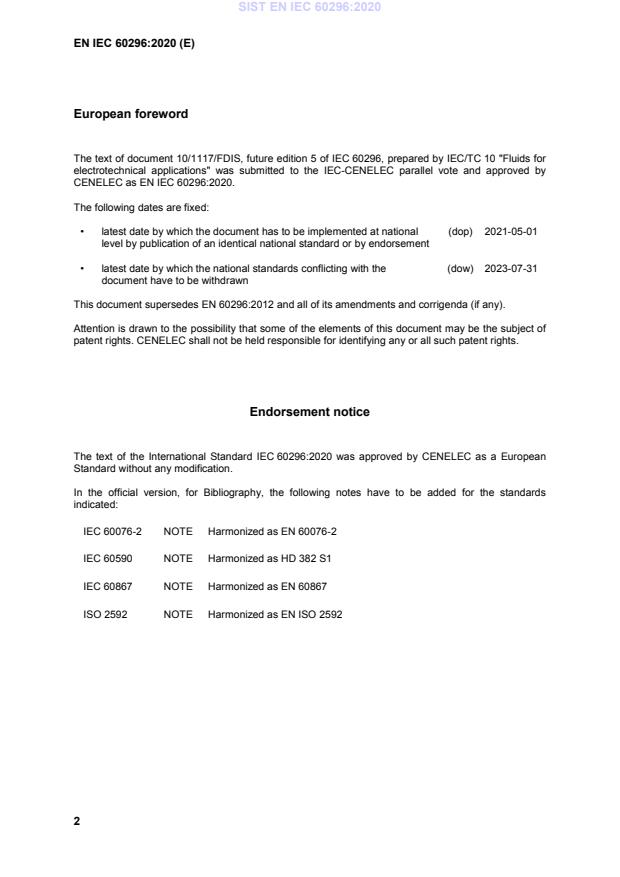
European foreword
The text of document 10/1117/FDIS, future edition 5 of IEC 60296, prepared by IEC/TC 10 "Fluids for
electrotechnical applications" was submitted to the IEC-CENELEC parallel vote and approved by
CENELEC as EN IEC 60296:2020.
The following dates are fixed:
• latest date by which the document has to be implemented at national (dop) 2021-05-01
level by publication of an identical national standard or by endorsement
• latest date by which the national standards conflicting with the (dow) 2023-07-31
document have to be withdrawn
This document supersedes EN 60296:2012 and all of its amendments and corrigenda (if any).
Attention is drawn to the possibility that some of the elements of this document may be the subject of
patent rights. CENELEC shall not be held responsible for identifying any or all such patent rights.
Endorsement notice
The text of the International Standard IEC 60296:2020 was approved by CENELEC as a European
Standard without any modification.
In the official version, for Bibliography, the following notes have to be added for the standards
indicated:
IEC 60076-2 NOTE Harmonized as EN 60076-2
IEC 60590 NOTE Harmonized as HD 382 S1
IEC 60867 NOTE Harmonized as EN 60867
ISO 2592 NOTE Harmonized as EN ISO 2592
Annex ZA
(normative)
Normative references to international publications
with their corresponding European publications
The following documents are referred to in the text in such a way that some or all of their content
constitutes requirements of this document. For dated references, only the edition cited applies. For
undated references, the latest edition of the referenced document (including any amendments)
applies.
NOTE 1 Where an International Publication has been modified by common modifications, indicated by (mod), the relevant
EN/HD applies.
NOTE 2 Up-to-date information on the latest versions of the European Standards listed in this annex is available here:
www.cenelec.eu.
Publication Year Title EN/HD Year
IEC 60156 - Insulating liquids - Determination of the - -
breakdown voltage at power frequency - Test
method
IEC 60247 - Insulating liquids - Measurement of relative EN 60247 -
permittivity, dielectric dissipation factor (tan d)
and d.c. resistivity
IEC 60422 2013 Mineral insulating oils in electrical equipment - EN 60422 2013
Supervision and maintenance guidance
IEC 60475 - Method of sampling insulating liquids EN 60475 -
IEC 60567 2011 Oil-filled electrical equipment - Sampling of EN 60567 2011
gases and analysis of free and dissolved gases
- Guidance
IEC 60628 1985 Gassing of insulating liquids under electrical HD 488 S1 1987
stress and ionization
IEC 60666 2010 Detection and determination of specified EN 60666 2010
additives in mineral insulating oils
IEC 60814 - Insulating liquids - Oil-impregnated paper and EN 60814 -
pressboard - Determination of water by
automatic coulometric Karl Fischer titration
IEC 60970 - Insulating liquids - Methods for counting and EN 60970 -
sizing particles
IEC 61125 2018 Insulating liquids - Test methods for oxidation EN IEC 61125 2018
stability - Test method for evaluating the
oxidation stability of insulating liquids in the
delivered state
Publication Year Title EN/HD Year
IEC 61198 - Mineral insulating oils - Methods for the EN 61198 -
determination of 2-furfural and related
compounds
IEC 61619 - Insulating liquids - Contamination by EN 61619 -
polychlorinated biphenyls (PCBs) - Method of
determination by capillary column gas
chromatography
IEC 61620 - Insulating liquids - Determination of the EN 61620 -
dielectric dissipation factor by measurement of
the conductance and capacitance - Test method
IEC 61868 - Mineral insulating oils - Determination of EN 61868 -
kinematic viscosity at very low temperatures
IEC 62021-1 - Insulating liquids - Determination of acidity - EN 62021-1 -
Part 1: Automatic potentiometric titration
IEC 62021-2 - Insulating liquids - Determination of acidity - EN 62021-2 -
Part 2: Colourimetric titration
IEC 62535 2008 Insulating liquids - Test method for detection of EN 62535 2009
potentially corrosive sulphur in used and
unused insulating oil
IEC 62697-1 - Test methods for quantitative determination of EN 62697-1 -
corrosive sulfur compounds in unused and used
insulating liquids - Part 1: Test method for
quantitative determination of dibenzyldisulfide
(DBDS)
IEC 62961 - Insulating liquids - Test methods for the EN IEC 62961 -
determination of interfacial tension of insulating
liquids - Determination with the ring method
ISO 2049 - Petroleum products - Determination of colour - -
(ASTM scale)
ISO 2719 - Determination of flash point - Pensky-Martens EN ISO 2719 -
closed cup method
ISO 3016 - Petroleum and related products from natural or EN ISO 3016 -
synthetic sources - Determination of pour point
ISO 3104 - Petroleum products - Transparent and opaque EN ISO 3104 -
liquids - Determination of kinematic viscosity
and calculation of dynamic viscosity
ISO 3675 - Crude petroleum and liquid petroleum products EN ISO 3675 -
- Laboratory determination of density -
Hydrometer method
ISO 3819 - Laboratory glassware - Beakers EN ISO 3819 -
Publication Year Title EN/HD Year
ISO 8754 - Petroleum products - Determination of sulphur EN ISO 8754 -
content - Energy-dispersive X-ray fluorescence
spectrometry
ISO 12185 - Crude petroleum and petroleum products - EN ISO 12185 -
Determination of density - Oscillating U-tube
method
ISO 14596 - Petroleum products - Determination of sulphur EN ISO 14596 -
content - Wavelength-dispersive X-ray
fluorescence spectrometry
ASTM D 1500 - Standard Test Method for ASTM Color of - -
Petroleum Products (ASTM Color Scale)
ASTM D 6591 - Standard Test Method for Determination of - -
Aromatic Hydrocarbon Types in Middle
Distillates - High Performance Liquid
Chromatography Method with Refractive Index
Detection
ASTM D 7042 - Standard Test Method for Dynamic Viscosity - -
and Density of Liquids by Stabinger Viscometer
(and the Calculation of Kinematic Viscosity)
ASTM D 7896 - Standard Test Method for Thermal Conductivity, - -
Thermal Diffusivity and Volumetric Heat
Capacity of Engine Coolants and Related Fluids
by Transient Hot Wire Liquid Thermal
Conductivity Method
DIN 51353 - Testing of insulating oils; detection of corrosive - -
sulfur; silver strip test
IP 346 - Determination of polycyclic aromatics in - -
lubricant base oils and asphaltene free
petroleum fractions - Dimethylsulfoxide
refractive method
IEC 60296 ®
Edition 5.0 2020-06
INTERNATIONAL
STANDARD
NORME
INTERNATIONALE
colour
inside
Fluids for electrotechnical applications – Mineral insulating oils for electrical
equipment
Fluides pour applications électrotechniques – Huiles minérales isolantes pour
matériel électrique
INTERNATIONAL
ELECTROTECHNICAL
COMMISSION
COMMISSION
ELECTROTECHNIQUE
INTERNATIONALE
ICS 29.040.10 ISBN 978-2-8322-8377-6
– 2 – IEC 60296:2020 © IEC 2020
CONTENTS
FOREWORD . 5
INTRODUCTION . 7
1 Scope . 8
2 Normative references . 8
3 Terms and definitions . 10
4 Properties of oil . 12
4.1 General . 12
4.2 Functional properties . 12
4.3 Production and stability . 12
4.4 Performance . 13
4.5 Health, safety and environment (HSE) properties . 13
5 Classification, labelling, identification, general delivery requirements and sampling . 13
5.1 Classification and labelling . 13
5.1.1 Classes . 13
5.1.2 Antioxidant (oxidation inhibitor) content . 13
5.1.3 Lowest cold start energizing temperature (LCSET) . 14
5.1.4 Labelling and ordering designation . 14
5.2 Requirements . 14
5.3 Miscibility and compatibility . 14
5.4 Identification and general delivery requirements . 15
5.5 Sampling. 15
6 Properties, their significance and test methods . 15
6.1 Viscosity . 15
6.2 Pour point . 16
6.3 Water content . 16
6.4 Breakdown voltage . 16
6.5 Density . 16
6.6 Dielectric dissipation factor (DDF) . 17
6.7 Colour and appearance . 17
6.8 Acidity . 17
6.9 Interfacial tension (IFT) . 17
6.10 Sulphur content. 17
6.11 Corrosive and potentially corrosive sulphur . 17
6.12 Additives (see 3.3) . 18
6.12.1 General . 18
6.12.2 Antioxidants (see 3.4) . 18
6.12.3 Metal passivators. 18
6.12.4 Pour point depressants . 18
6.13 Oxidation stability . 19
6.14 Flash point . 19
6.15 Polycyclic aromatics (PCAs) and polyaromatic hydrocarbons (PAHs) . 19
6.16 Polychlorinated biphenyl content (PCBs). 19
6.17 2-furfural (2-FAL) and related compounds content . 19
6.18 DBDS content . 20
6.19 Stray gassing under thermo-oxidative stress . 20
7 Additional properties . 24
IEC 60296:2020 © IEC 2020 – 3 –
7.1 General . 24
7.2 Electrostatic charging tendency (ECT) . 24
7.3 Gassing tendency . 24
7.4 Thermal properties . 25
7.5 Properties connected with consistency (aromatic content, distribution of
PAHs, refractive index) . 25
7.6 Lubricating properties . 25
7.7 Particle content . 25
7.8 Foaming. 25
7.9 Transformer oil test equivalents . 25
Annex A (normative) Method for stray gassing under thermo-oxidative stress . 26
A.1 Overview of the method . 26
A.2 Required materials . 26
A.3 Pretreatment of syringes . 26
A.4 Procedure A: stray gassing under oxidative conditions (high oxygen content) . 27
A.4.1 Pretreatment of mineral oil . 27
A.4.2 Filling syringes with mineral oil . 27
A.4.3 Incubation procedure . 27
A.4.4 Dissolved gas analysis . 27
A.5 Procedure B: stray gassing under inert conditions (low oxygen content) . 27
A.6 Reporting . 28
A.6.1 Test report . 28
A.6.2 Evaluation of the stray gassing behaviour of the oil . 28
A.7 Precision data . 28
A.7.1 General . 28
A.7.2 Repeatability . 28
A.7.3 Reproducibility . 28
A.8 Results of the RRT. 29
A.8.1 General . 29
A.8.2 Stray gassing pattern 1 . 29
A.8.3 Stray gassing pattern 2 . 30
A.8.4 Stray gassing pattern 3 . 31
A.8.5 Stray gassing pattern 4 . 32
Annex B (informative) Potentially corrosive sulphur . 33
B.1 Mechanism of copper sulphide deposition . 33
B.2 Corrosive sulphur compounds in oil . 33
B.3 Detection of corrosive sulphur compounds in oils containing passivators . 33
B.3.1 General . 33
B.3.2 Procedure 1 . 34
B.3.3 Procedure 2 . 34
Annex C (informative) Contamination of oils with silicone. 35
Annex D (informative) Transformer oil test equivalents . 36
Bibliography . 38
Figure A.1 – Syringes with and without copper . 27
Figure A.2 – Stray gassing pattern 1 . 29
Figure A.3 – Stray gassing pattern 2 . 30
Figure A.4 – Stray gassing pattern 3 . 31
– 4 – IEC 60296:2020 © IEC 2020
Figure A.5 – Stray gassing pattern 4 . 32
Table 1 – Meaning of the identifying letter codes in the ordering designation of mineral
oil according to IEC 60296 . 14
Table 2 – Maximum viscosity and pour point of mineral insulating oil . 16
Table 3 – General specifications, Type A (fully inhibited high grade oils) . 21
Table 4 – General specifications, Type B (uninhibited and inhibited
standard grade oils) . 23
Table D.1 – Some transformer oil test equivalents . 36
IEC 60296:2020 © IEC 2020 – 5 –
INTERNATIONAL ELECTROTECHNICAL COMMISSION
____________
FLUIDS FOR ELECTROTECHNICAL APPLICATIONS –
MINERAL INSULATING OILS FOR ELECTRICAL EQUIPMENT
FOREWORD
1) The International Electrotechnical Commission (IEC) is a worldwide organization for standardization comprising
all national electrotechnical committees (IEC National Committees). The object of IEC is to promote
international co-operation on all questions concerning standardization in the electrical and electronic fields. To
this end and in addition to other activities, IEC publishes International Standards, Technical Specifications,
Technical Reports, Publicly Available Specifications (PAS) and Guides (hereafter referred to as “IEC
Publication(s)”). Their preparation is entrusted to technical committees; any IEC National Committee interested
in the subject dealt with may participate in this preparatory work. International, governmental and non-
governmental organizations liaising with the IEC also participate in this preparation. IEC collaborates closely
with the International Organization for Standardization (ISO) in accordance with conditions determined by
agreement between the two organizations.
2) The formal decisions or agreements of IEC on technical matters express, as nearly as possible, an international
consensus of opinion on the relevant subjects since each technical committee has representation from all
interested IEC National Committees.
3) IEC Publications have the form of recommendations for international use and are accepted by IEC National
Committees in that sense. While all reasonable efforts are made to ensure that the technical content of IEC
Publications is accurate, IEC cannot be held responsible for the way in which they are used or for any
misinterpretation by any end user.
4) In order to promote international uniformity, IEC National Committees undertake to apply IEC Publications
transparently to the maximum extent possible in their national and regional publications. Any divergence
between any IEC Publication and the corresponding national or regional publication shall be clearly indicated in
the latter.
5) IEC itself does not provide any attestation of conformity. Independent certification bodies provide conformity
assessment services and, in some areas, access to IEC marks of conformity. IEC is not responsible for any
services carried out by independent certification bodies.
6) All users should ensure that they have the latest edition of this publication.
7) No liability shall attach to IEC or its directors, employees, servants or agents including individual experts and
members of its technical committees and IEC National Committees for any personal injury, property damage or
other damage of any nature whatsoever, whether direct or indirect, or for costs (including legal fees) and
expenses arising out of the publication, use of, or reliance upon, this IEC Publication or any other IEC
Publications.
8) Attention is drawn to the Normative references cited in this publication. Use of the referenced publications is
indispensable for the correct application of this publication.
9) Attention is drawn to the possibility that some of the elements of this IEC Publication may be the subject of
patent rights. IEC shall not be held responsible for identifying any or all such patent rights.
International Standard IEC 60296 has been prepared by IEC technical committee 10: Fluids
for electrotechnical applications.
This fifth edition cancels and replaces the fourth edition published in 2012. This edition
constitutes a technical revision.
This edition includes the following significant technical changes with respect to the previous
edition:
– This International Standard is applicable to specifications and test methods for unused
and recycled mineral insulating oils in the delivered state.
– Within the transformer insulating oils, two groups, Type A and Type B, are defined, based
on their performance.
– A new method for stray gassing under thermo-oxidative stress of mineral insulating oils,
which has been tested in a joint round robin test (RRT) between CIGRE D1 and
IEC technical committee 10, has been included.
– 6 – IEC 60296:2020 © IEC 2020
The text of this International Standard is based on the following documents:
FDIS Report on voting
10/1117/FDIS 10/1118/RVD
Full information on the voting for the approval of this International Standard can be found in
the report on voting indicated in the above table.
This document has been drafted in accordance with the ISO/IEC Directives, Part 2.
The committee has decided that the contents of this document will remain unchanged until the
stability date indicated on the IEC web site under "http://webstore.iec.ch" in the data related
to the specific document. At this date, the document will be
• reconfirmed,
• withdrawn,
• replaced by a revised edition, or
• amended.
IMPORTANT – The 'colour inside' logo on the cover page of this publication indicates
that it contains colours which are considered to be useful for the correct
understanding of its contents. Users should therefore print this document using a
colour printer.
IEC 60296:2020 © IEC 2020 – 7 –
INTRODUCTION
WARNING – This document does not purport to address all the safety problems associated
with its use. It is the responsibility of the user of this document to establish appropriate health
and safety practices and determine the applicability of regulatory limitations prior to use.
The mineral insulating oils which are the subject of this document should be handled in
compliance with local regulations and suppliers safety data-sheets.
This document is applicable to mineral insulating oils, chemicals and used sample containers.
The disposal of these items should be carried out according to local regulations with regard to
their impact on the environment.
– 8 – IEC 60296:2020 © IEC 2020
FLUIDS FOR ELECTROTECHNICAL APPLICATIONS –
MINERAL INSULATING OILS FOR ELECTRICAL EQUIPMENT
1 Scope
This document provides specifications and test methods for unused and recycled mineral
insulating oils (see Clause 3 for definitions). It applies to mineral oil delivered according to the
contractual agreement, intended for use in transformers, switchgear and similar electrical
equipment in which oil is required for insulation and heat transfer. Both unused oil and
recycled oil under the scope of this document have not been used in, nor been in contact with
electrical equipment or other equipment not required for manufacture, storage or transport.
Unused oils are obtained by refining, modifying and/or blending of petroleum products and
other hydrocarbons from virgin feedstock.
Recycled oils are produced from oils previously used as mineral insulating oils in electrical
equipment that have been subjected to re-refining or reclaiming (regeneration) by processes
employed offsite. Such oils will have originally been supplied in compliance with a recognized
unused mineral insulating oil specification. This document does not differentiate between the
methods used to recycle mineral insulating oil. Oils treated on-site (see IEC 60422) are not
within the scope of this document.
Oils with and without additives are both within the scope of this document.
This document does not apply to mineral insulating oils used as impregnating medium in
cables or capacitors.
2 Normative references
The following documents are referred to in the text in such a way that some or all of their
content constitutes requirements of this document. For dated references, only the edition
cited applies. For undated references, the latest edition of the referenced document (including
any amendments) applies.
IEC 60156, Insulating liquids – Determination of the breakdown voltage at power frequency –
Test method
IEC 60247, Insulating liquids – Measurement of relative permittivity, dielectric dissipation
factor (tan δ) and d.c. resistivity
IEC 60422:2013, Mineral insulating oils in electrical equipment – Supervision and
maintenance guidance
IEC 60475, Method of sampling liquid dielectrics
IEC 60567:2011, Oil-filled electrical equipment – Sampling of gases and analysis of free and
dissolved gases – Guidance
IEC 60628:1985, Gassing of insulating liquids under electrical stress and ionization
IEC 60666:2010, Detection and determination of specified additives in mineral insulating oils
IEC 60296:2020 © IEC 2020 – 9 –
IEC 60814, Insulating liquids – Oil-impregnated paper and pressboard – Determination of
water by automatic coulometric Karl Fischer titration
IEC 60970, Insulating liquids – Methods for counting and sizing particles
IEC 61125:2018, Insulating liquids – Test methods for oxidation stability – Test method for
evaluating the oxidation stability of insulating liquids in the delivered state
IEC 61198, Mineral insulating oils – Methods for the determination of 2-furfural and related
compounds
IEC 61619, Insulating liquids – Contamination by polychlorinated biphenyls (PCBs) – Method
of determination by capillary column gas chromatography
IEC 61620, Insulating liquids – Determination of the dielectric dissipation factor by
measurement of the conductance and capacitance – Test method
IEC 61868, Mineral insulating oils – Determination of kinematic viscosity at very low
temperatures
IEC 62021-1, Insulating liquids – Determination of acidity – Part 1: Automatic potentiometric
titration
IEC 62021-2, Insulating liquids – Determination of acidity – Part 2: Colourimetric titration
IEC 62535:2008, Insulating liquids – Test method for detection of potentially corrosive sulphur
in used and unused insulating oils
IEC 62697-1, Test methods for quantitative determination of corrosive sulfur compounds in
unused and used insulating liquids – Part 1: Test method for quantitative determination of
dibenzyldisulfide (DBDS)
IEC 62961, Insulating liquids – Test methods for the determination of interfacial tension of
insulating liquids – Determination with the ring method
ISO 2049, Petroleum products, Determination of colour (ASTM scale)
ISO 2719, Determination of flash point – Pensky-Martens closed cup method
ISO 3016, Petroleum and related products from natural or synthetic sources – Determination
of pour point
ISO 3104, Petroleum products – Transparent and opaque liquids – Determination of kinematic
viscosity and calculation of dynamic viscosity
ISO 3675, Crude petroleum and liquid petroleum products – Laboratory determination of
density – Hydrometer method
ISO 3819, Laboratory glassware –Beakers
ISO 8754, Petroleum products – Determination of sulphur content – Energy-dispersive X-ray
fluorescence spectrometry
ISO 12185, Crude petroleum and petroleum products – Determination of density – Oscillating
U-tube method
– 10 – IEC 60296:2020 © IEC 2020
ISO 14596, Petroleum products – Determination of sulphur content – Wavelength-dispersive
X-ray fluorescence spectrometry
ASTM D971, Standard Test Method for Interfacial Tension of Oil Against Water by the Ring
Method
ASTM D1500, Standard Test Method for ASTM Color of Petroleum Products (ASTM Color
Scale)
ASTM D6591, Standard Test Method for Determination of Aromatic Hydrocarbon Types in
Middle Distillates – High Performance Liquid Chromatography Method with Refractive Index
Detection
ASTM D7042, Standard Test Method for Dynamic Viscosity and Density of Liquids by
Stabinger Viscometer (and the Calculation of Kinematic Viscosity)
ASTM D7896, Standard Test Method for Thermal Conductivity, Thermal Diffusivity and
Volumetric Heat Capacity of Engine Coolants and Related Fluids by Transient Hot Wire Liquid
Thermal Conductivity Method
DIN 51353, Testing of insulating oils; detection of corrosive sulphur; Silver strip test
IP 346, Determination of polycyclic aromatics in unused lubricating base oils and asphaltene
free petroleum fractions – Dimethyl sulfoxide extraction refractive index method
3 Terms and definitions
For the purposes of this document, the following terms and definitions apply.
ISO and IEC maintain terminological databases for use in standardization at the following
addresses:
• IEC Electropedia: available at http://www.electropedia.org/
• ISO Online browsing platform: available at http://www.iso.org/obp
3.1
mineral insulating oil
insulating liquid for transformers and similar electrical equipment (e.g. switchgear, tap-
changers), derived from petroleum products and/or other hydrocarbons
Note 1 to entry: Mineral insulating oils include unused (3.8) and recycled (3.9) mineral insulating oils.
[SOURCE: IEC 60050-212:2010, 212-17-02, modified – "for transformers and similar electrical
equipment, (e.g. switchgear, tap-changers)" added, "crudes" replaced with "petroleum
products and/or other hydrocarbons" and note to entry added.]
3.2
low temperature switchgear oil
mineral insulating oil for oil-filled switchgear for outdoor applications in very cold climatic
conditions
3.3
additive
chemical substance that is added to mineral insulating oil in order to improve certain
characteristics
IEC 60296:2020 © IEC 2020 – 11 –
EXAMPLES Antioxidants, metal passivators, metal deactivators, electrostatic charging tendency depressants,
gassing tendency modifier, pour point depressants, anti-foam agents and refining process improvers.
[SOURCE: IEC 60050-212:2010, 212-17-13, modified – "specific" replaced with "chemical",
"an insulating material or liquid in small proportion" replaced with "mineral insulating oil" and
examples added.]
3.4
antioxidant
oxidation inhibitor
additive incorporated in mineral insulating oil that improves oxidation stability
Note 1 to entry: DBPC = 2,6-di-tert-butyl-para-cresol; DBP = 2,6-di-tert-butyl-phenol.
Note 2 to entry: For the purposes of this document, the oxidation inhibitor is a synthetic chemical substance of
the phenolic type, such as DBPC and DBP described in IEC 60666.
[SOURCE: IEC 60050-212:2010, 212-17-14, modified – "an insulating material to reduce or
delay degradation by oxidation" replaced with "mineral insulating oil that improves oxidation
stability" and note replaced with notes to entry.]
3.4.1
other antioxidant additive
antioxidant additive of the sulphur-, amine- or phosphorous- type
Note 1 to entry: Sulphur-type additives do not include dibenzyldisulphide (DBDS) or other potentially corrosive
sulphur compounds.
3.4.2
passivator
additive used primarily as corrosion deactivator and sometimes as electrostatic charging
depressant
Note 1 to entry: It can also improve the oxidation stability, by reducing the catalytic effect of copper on oxidation
of the oil
3.5
uninhibited oil (U)
mineral insulating oil containing no oxidation inhibitor or other antioxidant additives
Note 1 to entry: No inhibitor means that the total inhibitor content is below the detection limit of 0,01 % indicated
in IEC 60666.
[SOURCE: IEC 60050-212:2010, 212-17-19, modified – In the term, deletion of "insulating", in
the definition "antioxidant, but which may contain other additives" replaced with "oxidation
inhibitor or other antioxidant additives" and note replaced with the note to entry.]
3.6
trace inhibited oil (T)
mineral insulating oil containing minimum 0,01 % and less than 0,08 % of total inhibitor
content as measured in IEC 60666
3.7
inhibited oil (I)
mineral insulating oil containing a minimum of 0,08 % and a maximum of 0,40 % of total
inhibitor content as measured in IEC 60666
3.8
unused mineral insulating oil (V)
mineral insulating oil, obtained by refining, modifying and/or blending of petroleum products
and other hydrocarbons and that has not been used in, nor been in contact with electrical
equipment or other equipment not required for manufacture, storage or transport
– 12 – IEC 60296:2020 © IEC 2020
Note 1 to entry: In some countries unused mineral oil is described as virgin oil.
Note 2 to entry: The manufacturer and supplier of unused mineral insulating oil shall take reasonable precautions
to ensure that there is no contamination with polychlorinated biphenyls or terphenyls (PCB, PCT) or other
contaminants.
3.9
recycled mineral insulating oil (R)
mineral insulating oil previously used in electrical equipment that has been subjected to re-
refining or reclaiming (regeneration) after removal from the electrical equipment
Note 1 to entry: Any blend of unused and recycled oils is to be considered as recycled.
Note 2 to entry: The characteristics of recycled oil are heavily dependent on the oil from which it was recycled,
the original refining technique, the service history and the type of recycling process.
Note 3 to entry: Natural or added antioxidants originally present in the oil might have been depleted in service or
removed by the recycling process. The oxidation stability therefore needs to be restored/improved and is usually
achieved by the addition of an oxidation inhibitor.
Note 4 to entry: Such recycled oils are often produced from mixtures of mineral insulating oils of different origins.
The manufacturer and supplier of recycled mineral insulating oil shall take reasonable precautions to ensure that
there is no contamination with polychlorinated biphenyls or terphenyls (PCB, PCT) or other contaminants.
3.10
reclaimed mineral insulating oil
regenerated mineral insulating oil
recycled mineral insulating oil used in electrical equipment, which has been subjected after
removal from the electrical equipment to chemical and physical processing to reduce soluble
and insoluble contaminants
3.11
re-refined mineral insulating oil
recycled mineral insulating oil used in electrical equipment that has been removed from
service and subjected to a process similar to that used for the production of unused mineral
insulating oil from virgin feedstock, in order to reduce the level of undesired compounds
Note 1 to entry: Such re-refined oils are often produced from mixtures of mineral insulating oils of different origins
including processes such as distillation and hydrogenation.
4 Properties of oil
4.1 General
Oil characteristics are listed in Table 2, Table 3 and Table 4 and in Clause 6 and Clause 7.
4.2 Functional properties
These are properties of oil that have an impact on its function as a liquid for insulation and
heat transfer.
NOTE Functional properties include viscosity, density, pour point, water content, breakdown voltage, dielectric
dissipation factor, as well as specific heat capacity, thermal conductivity and expansion coefficient.
4.3 Production and stability
These are properties of oil that are influenced by the quality and type of refining and
additives.
NOTE 1 These can include appearance, interfacial tension, sulphur content, acidity, corrosive sulphur, potentially
corrosive sulphur, 2-furfural and related compounds content and stray gassing.
NOTE 2 Properties like aromatic content, refractive index or/and distribution of aromatic type of compounds can
provide valuable information on consistency of a certain oil product.
IEC 60296:2020 © IEC 2020 – 13 –
4.4 Performance
These are properties that are related to the long-term behaviour of oil in service and/or its
reaction to high electrical or thermal stresses. In terms of performance, transformer insulating
oils are divided into Type A (Table 3) and Type B (Table 4).
4.5 Health, safety and environment (HSE) properties
These are oil properties related to safe handling and environmental protection.
NOTE Examples can include flash point, density, PCA (polycyclic aromatics) and PCB/PCT (polychlorinated
biphenyls/ terphenyls) content.
5 Classification, labelling, identification, general delivery requirements and
sampling
5.1 Classification and labelling
5.1.1 Classes
For the purposes of this document, mineral insulating oils are classified into two classes:
– transformer oils;
– low temperature switchgear oils.
Within the transformer oils two groups of oils are defined: Type A (Table 3) and Type B
(Table 4).
Type A insulating oils are fully inhibited ("I" according to 5.1.2) and deliver higher oxidation
stability than Type B.
Type B insulating oils can be uninhibited ("U"), trace inhibited ("T") or fully inhibited ("I") and
deliver good resistance to oil degradation and provide good oxidation stability.
Inhibitor concentration for inhibited oil in service needs to be monitored and eventually
maintained. This is described in IEC 60422.
NOTE During base oil refining some components such as aromatic and polycyclic aromatic compounds are
removed depending on the severity and type of refining process.
Uninhibited o
...