

prEN 50191:2026
(Main)Installation and operation of electrical test stations
General Information
- Abstract
1.1 This document is applicable to the installation and operation of fixed and temporary electrical test installations. 1.2 Compliance with this document needs to be applied, if contact with live parts presents dangerous. This is the case when: a) the voltage exceeds 25 V AC (frequencies lower than 500 Hz) or 60 V DC and current exceeds 3 mA for AC or 12 mA for DC, or b) the voltage exceeds 25 V AC (for any frequency) or 60 V DC and the discharge energy of the test station and test object exceeds 350 mJ, or c) at frequencies above 500 Hz the national determined current and voltage values are applied. If there are no national requirements, determined reference values for permissible body currents and contact voltages can be taken from Table A.1; This document is applicable even if conditions a) to c) are fulfilled, due to other possible risks, e.g. risk of fire or explosion. NOTE The values for the resultant current of 3 mA AC or 12 mA DC comply with the information about the effects of current on human beings and livestock in IEC/TS 60479 1. 1.3 Some specifications in this document refer to a voltage value of 1 000 V. This value applies to AC voltages and is equated to a value of 1 500 V DC voltage. 1.4 Where no requirements are given in this document, the documents of the HD 60364 series (for nominal voltages up to 1 000 V) or EN IEC 61936 1 and EN 50522 (for nominal voltages exceeding 1 kV) apply to the installation of electrical test installations and EN 50110 1 applies to the operation of electrical test installations. 1.5 This document does not apply to the power supply to the test installations. In this case, the documents of the HD 60364 series (for nominal voltages up to 1 000 V) or EN IEC 61936 1 (for nominal voltages exceeding 1 kV) apply to their installation and EN 50110 1 applies to their operation.
- Status
- Not Published
- Publication Date
- 16-Sep-2025
- Technical Committee
- CLC/BTTF 128-2 - Erection and operation of electrical test equipment
- Drafting Committee
- CLC/BTTF 128-2 - Erection and operation of electrical test equipment
- Current Stage
- 4060 - Enquiry results established and sent to TC, SR, BTTF - Enquiry
- Start Date
- 17-Apr-2026
- Due Date
- 24-Jul-2024
- Completion Date
- 17-Apr-2026

Overview
prEN 50191:2026 sets the requirements for the installation and operation of electrical test stations. Published by CLC, this standard applies to both fixed and temporary electrical test installations where potentially hazardous contact with live parts is possible. It replaces EN 50191:2010, updating the structure, references, and safety criteria for modern testing environments in electrical engineering, electronics manufacturing, and R&D facilities. The standard focuses on ensuring safety, reliability, and compliance across various types of electrical test stations.
Key Topics
- Scope and Applicability: Relevant for test stations exceeding specific voltage and current thresholds (over 25 V AC or 60 V DC; currents over 3 mA AC or 12 mA DC), and where discharge energy exceeds certain limits.
- Types of Test Stations:
- With automatic protection against direct contact (e.g., test enclosures, cabinets, and non-enterable/enterable designs)
- Without automatic protection (e.g., development, repair, or temporary stations)
- Defined Areas:
- Prohibition zone: Area near live parts requiring protection
- Danger area: Zone comprising the prohibition zone and additional protective distance
- Operating area: Safely accessible area for personnel
- Operational Status Indication:
- Use of signal lights (red for non-safe, green for safe) and clear warning signs
- Procedures for out of operation, ready for operation, ready to switch on, and in operation states
- Protection Measures:
- Barriers, enclosures, and safe distances to prevent accidental contact with live parts
- Requirements for use of safety test probes and two-hand control devices
- Emergency switching-off and residual voltage protection
- Personnel and Responsibilities:
- Roles defined for skilled and instructed persons and test controllers
- Emphasis on proper training and risk awareness
Applications
This standard is crucial for organizations involved in:
- Development and production testing: Ensuring safe procedures during product verification before market delivery.
- R&D laboratories: Creating controlled environments for testing prototypes and new components.
- Quality control: Routine batch testing of electrical and electronic products.
- Repair and maintenance: Safe diagnostics and repair of high-voltage equipment in workshops.
- Temporary and field testing: Setting up compliant temporary installations for on-site test activities.
Key practical benefits include:
- Improved safety for personnel by minimizing risks of electric shock, fire, and related hazards.
- Regulatory compliance with European and international electrotechnical safety directives.
- Consistent best practices for configuration and management of diverse test station setups.
Related Standards
Application of prEN 50191:2026 often requires reference to other standards, including:
- EN 50110-1: Operation of electrical installations (general requirements)
- HD 60364 series: Low-voltage electrical installation requirements (up to 1,000 V)
- EN IEC 61936-1 & EN 50522: Installations exceeding 1 kV
- EN 60529: Degrees of protection by enclosures (IP Code)
- EN 61140: Protection against electric shock
- EN 61010-031: Safety for hand-held probe assemblies
- EN ISO 13850/13851: Emergency stop functions and two-hand control devices
Summary
Adhering to prEN 50191:2026 ensures that electrical test stations-whether permanent or temporary-are installed and operated with a high standard of safety, clarity, and reliability. By embracing its requirements, electrical engineers, testers, and facility managers can mitigate risks, support personnel safety, and meet legal obligations in testing environments across manufacturing, R&D, and industrial settings.
Relations
- Effective Date
- 09-Aug-2022
Get Certified
Connect with accredited certification bodies for this standard

IMQ S.p.A. (Certification)
Italian electrical product certification.

SLG Prüf- und Zertifizierungs GmbH
German testing and certification body.

UL Solutions
Global safety science company with testing, inspection and certification.
Sponsored listings
Frequently Asked Questions
prEN 50191:2026 is a draft published by CLC. Its full title is "Installation and operation of electrical test stations". This standard covers: 1.1 This document is applicable to the installation and operation of fixed and temporary electrical test installations. 1.2 Compliance with this document needs to be applied, if contact with live parts presents dangerous. This is the case when: a) the voltage exceeds 25 V AC (frequencies lower than 500 Hz) or 60 V DC and current exceeds 3 mA for AC or 12 mA for DC, or b) the voltage exceeds 25 V AC (for any frequency) or 60 V DC and the discharge energy of the test station and test object exceeds 350 mJ, or c) at frequencies above 500 Hz the national determined current and voltage values are applied. If there are no national requirements, determined reference values for permissible body currents and contact voltages can be taken from Table A.1; This document is applicable even if conditions a) to c) are fulfilled, due to other possible risks, e.g. risk of fire or explosion. NOTE The values for the resultant current of 3 mA AC or 12 mA DC comply with the information about the effects of current on human beings and livestock in IEC/TS 60479 1. 1.3 Some specifications in this document refer to a voltage value of 1 000 V. This value applies to AC voltages and is equated to a value of 1 500 V DC voltage. 1.4 Where no requirements are given in this document, the documents of the HD 60364 series (for nominal voltages up to 1 000 V) or EN IEC 61936 1 and EN 50522 (for nominal voltages exceeding 1 kV) apply to the installation of electrical test installations and EN 50110 1 applies to the operation of electrical test installations. 1.5 This document does not apply to the power supply to the test installations. In this case, the documents of the HD 60364 series (for nominal voltages up to 1 000 V) or EN IEC 61936 1 (for nominal voltages exceeding 1 kV) apply to their installation and EN 50110 1 applies to their operation.
1.1 This document is applicable to the installation and operation of fixed and temporary electrical test installations. 1.2 Compliance with this document needs to be applied, if contact with live parts presents dangerous. This is the case when: a) the voltage exceeds 25 V AC (frequencies lower than 500 Hz) or 60 V DC and current exceeds 3 mA for AC or 12 mA for DC, or b) the voltage exceeds 25 V AC (for any frequency) or 60 V DC and the discharge energy of the test station and test object exceeds 350 mJ, or c) at frequencies above 500 Hz the national determined current and voltage values are applied. If there are no national requirements, determined reference values for permissible body currents and contact voltages can be taken from Table A.1; This document is applicable even if conditions a) to c) are fulfilled, due to other possible risks, e.g. risk of fire or explosion. NOTE The values for the resultant current of 3 mA AC or 12 mA DC comply with the information about the effects of current on human beings and livestock in IEC/TS 60479 1. 1.3 Some specifications in this document refer to a voltage value of 1 000 V. This value applies to AC voltages and is equated to a value of 1 500 V DC voltage. 1.4 Where no requirements are given in this document, the documents of the HD 60364 series (for nominal voltages up to 1 000 V) or EN IEC 61936 1 and EN 50522 (for nominal voltages exceeding 1 kV) apply to the installation of electrical test installations and EN 50110 1 applies to the operation of electrical test installations. 1.5 This document does not apply to the power supply to the test installations. In this case, the documents of the HD 60364 series (for nominal voltages up to 1 000 V) or EN IEC 61936 1 (for nominal voltages exceeding 1 kV) apply to their installation and EN 50110 1 applies to their operation.
prEN 50191:2026 is classified under the following ICS (International Classification for Standards) categories: 17.220.20 - Measurement of electrical and magnetic quantities; 19.080 - Electrical and electronic testing; 29.020 - Electrical engineering in general. The ICS classification helps identify the subject area and facilitates finding related standards.
prEN 50191:2026 has the following relationships with other standards: It is inter standard links to EN 50191:2010. Understanding these relationships helps ensure you are using the most current and applicable version of the standard.
prEN 50191:2026 is available in PDF format for immediate download after purchase. The document can be added to your cart and obtained through the secure checkout process. Digital delivery ensures instant access to the complete standard document.
Standards Content (Sample)
SLOVENSKI STANDARD
01-marec-2026
Vgradnja in delovanje električnih preskusnih postaj
Installation and operation of electrical test stations
Errichten und Betreiben elektrischer Prüfanlagen
Installation et exploitation des stations électriques d’essais
Ta slovenski standard je istoveten z: prEN 50191:2026
ICS:
17.220.20 Merjenje električnih in Measurement of electrical
magnetnih veličin and magnetic quantities
19.080 Električno in elektronsko Electrical and electronic
preskušanje testing
29.020 Elektrotehnika na splošno Electrical engineering in
general
2003-01.Slovenski inštitut za standardizacijo. Razmnoževanje celote ali delov tega standarda ni dovoljeno.
EUROPEAN STANDARD DRAFT
prEN 50191
NORME EUROPÉENNE
EUROPÄISCHE NORM
January 2026
ICS 17.220.20; 19.080; 29.020 Will supersede EN 50191:2010
English Version
Installation and operation of electrical test stations
Installation et exploitation des équipements électriques Errichten und Betreiben elektrischer Prüfanlagen
d'essais
This draft European Standard is submitted to CENELEC members for enquiry.
Deadline for CENELEC: 2026-04-17.
It has been drawn up by CLC/BTTF 128-2.
If this draft becomes a European Standard, CENELEC members are bound to comply with the CEN/CENELEC Internal Regulations which
stipulate the conditions for giving this European Standard the status of a national standard without any alteration.
This draft European Standard was established by CENELEC in three official versions (English, French, German).
A version in any other language made by translation under the responsibility of a CENELEC member into its own language and notified to
the CEN-CENELEC Management Centre has the same status as the official versions.
CENELEC members are the national electrotechnical committees of Austria, Belgium, Bulgaria, Croatia, Cyprus, the Czech Republic,
Denmark, Estonia, Finland, France, Germany, Greece, Hungary, Iceland, Ireland, Italy, Latvia, Lithuania, Luxembourg, Malta, the
Netherlands, Norway, Poland, Portugal, Republic of North Macedonia, Romania, Serbia, Slovakia, Slovenia, Spain, Sweden, Switzerland,
Türkiye and the United Kingdom.
Recipients of this draft are invited to submit, with their comments, notification of any relevant patent rights of which they are aware and to
provide supporting documentation.
Warning : This document is not a European Standard. It is distributed for review and comments. It is subject to change without notice and
shall not be referred to as a European Standard.
European Committee for Electrotechnical Standardization
Comité Européen de Normalisation Electrotechnique
Europäisches Komitee für Elektrotechnische Normung
CEN-CENELEC Management Centre: Rue de la Science 23, B-1040 Brussels
© 2026 CENELEC All rights of exploitation in any form and by any means reserved worldwide for CENELEC Members.
Project: 76494 Ref. No. prEN 50191:2026 E
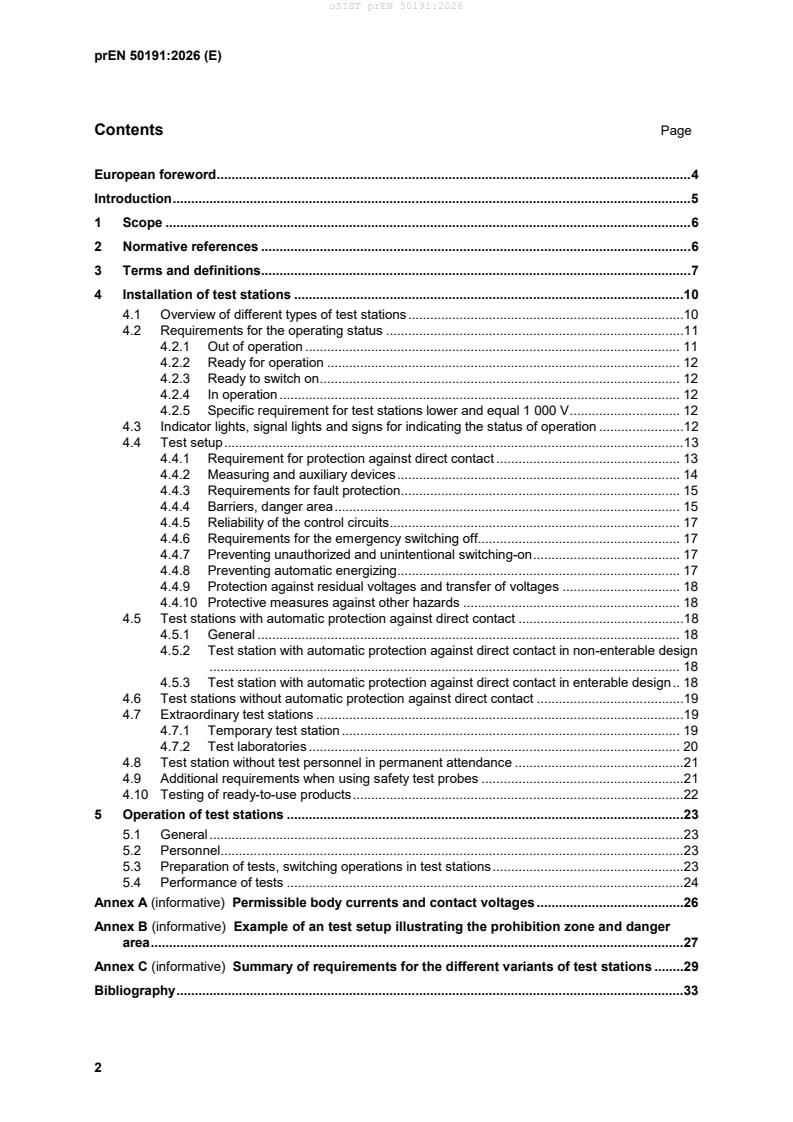
Contents Page
European foreword . 4
Introduction . 5
1 Scope . 6
2 Normative references . 6
3 Terms and definitions. 7
4 Installation of test stations . 10
4.1 Overview of different types of test stations . 10
4.2 Requirements for the operating status . 11
4.2.1 Out of operation . 11
4.2.2 Ready for operation . 12
4.2.3 Ready to switch on . 12
4.2.4 In operation . 12
4.2.5 Specific requirement for test stations lower and equal 1 000 V . 12
4.3 Indicator lights, signal lights and signs for indicating the status of operation . 12
4.4 Test setup . 13
4.4.1 Requirement for protection against direct contact . 13
4.4.2 Measuring and auxiliary devices . 14
4.4.3 Requirements for fault protection . 15
4.4.4 Barriers, danger area . 15
4.4.5 Reliability of the control circuits . 17
4.4.6 Requirements for the emergency switching off. 17
4.4.7 Preventing unauthorized and unintentional switching-on . 17
4.4.8 Preventing automatic energizing . 17
4.4.9 Protection against residual voltages and transfer of voltages . 18
4.4.10 Protective measures against other hazards . 18
4.5 Test stations with automatic protection against direct contact . 18
4.5.1 General . 18
4.5.2 Test station with automatic protection against direct contact in non-enterable design
................................................................................................................................ 18
4.5.3 Test station with automatic protection against direct contact in enterable design . 18
4.6 Test stations without automatic protection against direct contact . 19
4.7 Extraordinary test stations . 19
4.7.1 Temporary test station . 19
4.7.2 Test laboratories . 20
4.8 Test station without test personnel in permanent attendance . 21
4.9 Additional requirements when using safety test probes . 21
4.10 Testing of ready-to-use products . 22
5 Operation of test stations . 23
5.1 General . 23
5.2 Personnel . 23
5.3 Preparation of tests, switching operations in test stations . 23
5.4 Performance of tests . 24
Annex A (informative) Permissible body currents and contact voltages . 26
Annex B (informative) Example of an test setup illustrating the prohibition zone and danger
area . 27
Annex C (informative) Summary of requirements for the different variants of test stations . 29
Bibliography . 33
Figures
Figure 1 — Overview of a test station with operating and danger areas . 11
Figure 2 — Clarification of the dimensions stated in Table 2 . 16
Figure 3 — Measurement of discharge current . 22
Figure B.1 — Prohibition zone and danger area in a test laboratory . 28
Tables
Table 1 — Prohibition zone (s) dependent on test voltages to earth (U) . 14
Table 2 — Horizontal distance between the barrier and the prohibition zone in relation to
the height of the barrier and the distance of the danger point from the floor . 16
Table 3 — Minimum distance between openings in the barrier and the prohibition zone in
relation to the width of the opening . 17
Table A.1 — Reference values for permissible sinusoidal body currents and contact
voltages at frequencies > 500 Hz . 26
Table C.1 — Requirements for test stations with automatic protection against direct
contact . 29
Table C.2 — Requirements for test stations without automatic protection against direct
contact . 31
European foreword
This document (prEN 50191:2026) has been prepared by CLC BTTF 128-2, “Erection and operation of
electrical test equipment”.
This document is currently submitted to the Enquiry.
The following dates are proposed:
• latest date by which the existence of this (doa) dav + 6 months
document has to be announced at national
level
• latest date by which this document has to be (dop) dav + 12 months
implemented at national level by publication of
an identical national standard or by
endorsement
• latest date by which the national standards (dow) dav + 36 months
conflicting with this document have to be (to be confirmed or
withdrawn modified when voting)
This document will supersede EN 50191:2010.
EN 50191:2010:
— update of the title;
— improvement of structure Clause 4 and renumbering;
— improvement of the wording;
— add some figures for clarification;
— creation of new Annex C;
— update the normative references.
Introduction
With reference to Clause 5 of this document, prepared in the field of application of Article 137 of the
EC Treaty, the user should be aware that standards have no formal legal relationship with Directives
which may have been made under Article 137 of the Treaty. In addition, national legislation in the
Member States may contain more stringent requirements than the minimum requirements of a
Directive based on Article 137 of the Treaty. Information on the relationship between the national
legislation implementing Directives based on Article 137 of the Treaty and this document may be given
in a national foreword of the national standard implementing this document.
This standard applies to development and production testing activities prior to providing the test items
to the Union market as well as to measurements and tests in research and development (R&D).
Unless other regulations or procedure are available, the principles of this standard can be applied to
other testing and measurement tasks as well.
1 Scope
1.1 This document is applicable to the installation and operation of fixed and temporary electrical
test installations.
1.2 Compliance with this document needs to be applied, if contact with live parts presents
dangerous. This is the case when:
a) the voltage exceeds 25 V AC (frequencies lower than 500 Hz) or 60 V DC and current exceeds
3 mA for AC or 12 mA for DC, or
b) the voltage exceeds 25 V AC (for any frequency) or 60 V DC and the discharge energy of the test
station and test object exceeds 350 mJ, or
c) at frequencies above 500 Hz the national determined current and voltage values are applied. If
there are no national requirements, determined reference values for permissible body currents
and contact voltages can be taken from Table A.1;
This document is applicable even if conditions a) to c) are fulfilled, due to other possible risks, e.g. risk
of fire or explosion.
NOTE The values for the resultant current of 3 mA AC or 12 mA DC comply with the information about the
effects of current on human beings and livestock in IEC/TS 60479-1.
1.3 Some specifications in this document refer to a voltage value of 1 000 V. This value applies to
AC voltages and is equated to a value of 1 500 V DC voltage.
1.4 Where no requirements are given in this document, the documents of the HD 60364 series (for
nominal voltages up to 1 000 V) or EN IEC 61936-1 and EN 50522 (for nominal voltages exceeding
1 kV) apply to the installation of electrical test installations and EN 50110-1 applies to the operation of
electrical test installations.
1.5 This document does not apply to the power supply to the test installations. In this case, the
documents of the HD 60364 series (for nominal voltages up to 1 000 V) or EN IEC 61936-1 (for
nominal voltages exceeding 1 kV) apply to their installation and EN 50110-1 applies to their operation.
2 Normative references
The following documents are referred to in the text in such a way that some or all of their content
constitutes requirements of this document. For dated references, only the edition cited applies. For
undated references, the latest edition of the referenced document (including any amendments) applies.
EN 50110-1:2023, Operation of electrical installations - Part 1: General requirements
EN 60529, Degrees of protection provided by enclosures (IP Code ) (IEC 60529)
EN 61010-031, Safety requirements for electrical equipment for measurement, control, and laboratory
use - Part 031: Safety requirements for hand-held and hand-manipulated probe assemblies for
electrical test and measurement (IEC 61010-031)
EN 61140:2016, Protection against electric shock - Common aspects for installation and equipment
(IEC 61140:2016)
EN ISO 13850, Safety of machinery - Emergency stop function - Principles for design (ISO 13850)
EN ISO 13851:2019, Safety of machinery - Two-hand control devices - Principles for design and
selection (ISO 13851:2019)
EN IEC 61558-2-4, Safety of transformers, reactors, power supply units and combinations thereof -
Part 2-4: Particular requirements and tests for isolating transformers and power supply units
incorporating isolating transformers for general applications (IEC 61558-2-4)
EN IEC 61558-2-6, Safety of transformers, reactors, power supply units and combinations thereof -
Part 2-6: Particular requirements and tests for safety isolating transformers and power supply units
incorporating safety isolating transformers for general applications (IEC 61558-2-6)
ISO 7010:2019, Graphical symbols - Safety colours and safety signs - Registered safety signs
3 Terms and definitions
For the purposes of this document, the following terms and definitions apply.
ISO and IEC maintain terminology databases for use in standardization at the following addresses:
— IEC Electropedia: available at https://www.electropedia.org/
— ISO Online browsing platform: available at https://www.iso.org/obp
3.1
electrical test installation
test installation
test devices, test appliances and facilities combined for test purposes, by means of which electrical
tests are performed on test objects
Note 1 to entry: Equipment including, but not limited to, measuring instruments, software, consumables,
auxiliary apparatus or earthing rods.
3.2
test setup
area which includes the test installation and the test object
3.3
test station
appropriately identified test installation within a defined area
3.3.1
test station with automatic protection against direct contact
test station in which the test object and all live parts of the test station have automatically activated full
protection against direct contact in an energized condition
Note 1 to entry: At a test station with automatic protection against direct contact, there is generally only one
person employed, e.g. in the line of series production or in electric workshops, repair and service shops.
Note 2 to entry: Automatic protection means that voltages can only occur when the safety devices are
effective, e.g. when the cover or door of the test station is closed.
3.3.2
test station without automatic protection against direct contact
test station in which parts of the test object or live parts of the test installation are not fully protected
against direct contact during testing
As impacted by ISO 7010:2019/A1:2020, ISO 7010:2019/A2:2020, ISO 7010:2019/A3:2021, ISO 7010:2019/A4:2021, ISO
7010:2019/A5:2022, ISO 7010:2019/A6:2022, ISO 7010:2019/A7:2023, ISO 7010:2019/A8:2024, ISO 7010:2019/A9:2025,
ISO 7010:2019/A10:2025.
Note 1 to entry: Test station without automatic protection against direct contact includes, for instance, test
stations in electric workshops, laboratories, measurement and experimental test stations.
Note 2 to entry: Test station without automatic protection against direct contact can be designed as
stationary or non-stationary.
3.3.3
enterable test station
test station where the test area can be entered by person (e.g. walked in)
3.3.4
non-stationary test station
test station for carrying out tests on individual test objects with different local conditions and at different
locations over the time
3.4
test laboratory
delimited area with restricted access for the operation of at least one test station, in which more than
one person are usually performing with the testing of test objects for longer periods of time
3.5
prohibition zone
volume around live parts which should not be reached if full protection against direct contact with these
parts is not provided
Note 1 to entry: “prohibition zone” a reference to Annex B.
3.6
signal light
light which are clearly visible from outside the boundaries of the danger area giving red or green
signals to indicate the operational status inside the danger area
3.7
indicator lights
visual indication of the switching or operating status on the control panels
3.8
risk
combination of the probability of occurrence of harm and the severity of that harm
Note 1 to entry: The term “harm” in this context relates to damage to either persons and/or test installations.
[SOURCE: IEC 60050-351:2013, 351-57-03 modified, Note 1 to entry was added.]
3.9
electrical hazard
potential source of harm when electric energy is present in an test installation
Note 1 to entry: The term “harm” in this context relates to damage to either persons and/or test installations.
Note 2 to entry: In electrical test stations electrical hazards can caused by the test object and the test
installation.
Note 3 to entry: This entry was numbered 651–01–30 in IEC 60050-651:1999. It has been modified to follow
the new translation of ISO/IEC Guide 51 and to precise the term “harm”.
[SOURCE: IEC 60050-651:2014, 651-26-05 modified, by, replacing the word “electrical” with the word
“test”; adding a new Note 2 to entry; former Note 2 to entry renumbered to Note 3 to entry]
3.10
skilled person
person with relevant education, knowledge and experience to enable them to analyse
risks and to avoid hazards which electricity can create
[SOURCE: IEC 60050-651:2014, 651-26-11, modified, the term “training” was deleted,” perceive” was
replaced by “analyse”; “danger” was replaced by “hazard”]
3.11
instructed person
person adequately advised by skilled persons to enable them to perceive risks as
instructed and to avoid hazards which electricity can create
[SOURCE: IEC 60050-651:2014, 651-26-12 modified, the term “supervised” was deleted, “electrically”
was deleted “danger” was replaced by “hazard” and added “as instructed”]
3.12
test controller
TC
designated skilled person with direct management responsibility for conducting the test at the test
station
Note 1 to entry: Parts of this responsibility may be delegated to others as required.
3.13
danger area
area composed from prohibition zone and protective distance
3.14
protective distance
required horizontal distance from the prohibition zone
Note 1 to entry: see Table 2 and 3
3.15
operating area
area from which the test system can be safely operated (without reaching the prohibited zone)
3.16
emergency switching-off
opening operation intended to remove electric power from the electrical test station to avert or alleviate
a hazardous situation
[SOURCE: IEC 60050-826:2014, 826-17-03, modified by delete “a switching device” and replace
installation by test station]
3.17
test object
item submitted to a test, including any accessories, unless otherwise specified
[SOURCE, IEC 60050-151:2014, 151-16-28]
3.18
safety test probe
IP2X probe tips with retractable sleeve
Note 1 to entry: further information is given in EN IEC 61010-031:2022, 7.4.3.5
Note 2 to entry: (German version only) this device is called “high voltage safety test probe”
(Hochspannungsprüfpistole).
4 Installation of test stations
4.1 Overview of different types of test stations
Test stations are divided into different variants with corresponding requirements. A high priority is given
to protection against direct contact.
They are designed with or without automatic protection against direct contact.
Typical test stations are:
• test stations with automatic protection against direct contact:
o test station with non-accessible danger area (Test cage, test enclosure, test cabinet);
o test station with accessible danger area (Test cabin);
o test station without permanent presence of personnel (e.g. endurance test);
• test stations without automatic protection against direct contact:
o for development and repair;
o for series production with two-hand control device;
o high voltage test with safety test probes;
o temporary test station;
o without permanent presence of personnel, e.g. for endurance tests.
An overview of the different requirements for different types of test stations is given in Annex C.
The overview of the a station is composed of different areas as shown in Figure 1.
Key
1 test object, here envelope around a live object, 2 200 mm high
2 prohibition zone
3 danger area
4 operating area
5 barrier constructed as a bar tape, chain or rope, 1 000 mm high
6 barrier, 2 400 mm high
7 control panel
Figure 1 — Overview of a test station with operating and danger areas
4.2 Requirements for the operating status
4.2.1 Out of operation
This includes:
a) all power supplies, signalling and control circuits are switched off and secured against
unauthorized switching-on;
b) all safety precautions necessary before entering the danger area e.g. for voltages exceeding 1 kV,
earthing, short-circuiting have been taken.
4.2.2 Ready for operation
This includes:
a) the power supplies for the switchgear signalling and control circuits of the test installations are
switched on;
b) the green signal lights, where these are required in accordance with the provisions in Clause 4,
are on;
c) all power supplies for the test voltage are switched off and secured against unintentional
switching;
d) the safety precautions specified in 4.2.1 b) are in force.
4.2.3 Ready to switch on
This includes:
a) all power supplies for the test voltage are switched off;
b) all entries to the danger area are closed;
c) the red signal lights are switched on;
d) the safety precautions specified in 4.2.1 b) are no longer in force.
4.2.4 In operation
This includes:
a) all entries to the danger area are closed;
b) the red signal lights are switched on;
c) one or more power supplies for the test station are switched on.
4.2.5 Specific requirement for test stations lower and equal 1 000 V
In Clauses 4 and 5, the technical devices for setting up the operational status Ready to switch on
(4.2.2) and Ready to switch on (4.2.3) are only required for certain test installations with voltages
exceeding 1 kV.
In test stations lower and equal 1 000 V the requirements of Ready for operation (4.2.2) and Ready to
switch on (4.2.3) can be omitted.
4.3 Indicator lights, signal lights and signs for indicating the status of operation
Control devices for the test installation and the test circuits shall be clearly identified.
Test installations shall have means, e.g. indicator lights, which indicate the switching status, e.g.
position of earthing switches or status of components.
The operating status can additionally be indicated by indicator lights or other means.
The signal lights for indicating the status of operation are based on the following:
a) any safe operation status indicated by green signal lights;
b) any non-safe operation status is indicated by red signal lights.
According to a risk assessment the status of Ready to switch on (4.2.3) can be indicated by orange
signal light.
If the risk assessment requires the differentiation of operational status Ready to switch on (4.2.3) and
In operation (4.2.4), it is recommended in this case to indicate the operational status In operation
(4.2.4) by a blinking red signal light. The blink frequency shall not be below 1 Hz.
Indicator lights may be replaced by indicators on displays or similar display devices.
Indicator lights are not an alternative to required signal lights.
Test installations and danger areas shall be clearly and visibly indicated by means of warning signs.
4.4 Test setup
4.4.1 Requirement for protection against direct contact
The test setup shall be arranged and designed that the protection against direct contact is provided by:
– insulation of live parts; or
– covers, enclosures (min. IPXXB or IP 2X according to EN 60529); or
– obstacles or safe distances.
A safe distance is ensured, when the person carrying out the tests cannot reach the prohibition zone
with parts of them body or tools.
The boundary of the prohibition zone shall be determined in accordance with Table 1.
In case of voltages up to 1 000 V, the surface of the live part is considered to be the boundary of the
prohibition zone. In case of voltages exceeding 1 kV, reaching the prohibition zone is considered equal
to touching live parts.
The protection for reaching the prohibited zone can also be fulfilled by using two safety test probes.
Safety test probes shall have the adequate insulation level for the applied test voltage. Measures which
prevent the automatic return of the contact tip after release the two hand control switches are not
permitted.
Safety can also be satisfied by means of a two-hand control device. Test leads with full protection
against direct contact shall be used. Two-hand control devices shall comply with EN ISO 13851:2019,
Type II or IIIB.
Where several persons are involved in a test, a two-hand control device shall be provided for each
person of the test personnel, connected in such a way that all two hand controls shall be operated
before the test supplies can be energized.
The test object shall be isolated from earth, e.g. by using test tables with surfaces of insulating
materials. If this is not technically possible, e.g. due to the weight of the test object, or if the test
method requires earthing, the test setup shall be designed and arranged in such a way that the transfer
of voltage to extraneous conductive parts is prevented.
The surfaces of test table boards shall be made of insulating materials.
Table 1 — Prohibition zone (s) dependent on test voltages to earth (U)
Lightning impulse voltage Switching impulse voltage
Alternating test voltage
50/60 Hz 1,2/50 µs 250/2 500 µs
(RMS value) (peak value) (peak value)
a
U s U s U s
kV mm kV mm kV mm
≤ 1 No contact 20 100 500 2 000
3 20 40 175 600 2 600
5 30 60 250 700 3 300
6 35 80 325 800 4 100
10 60 100 400 900 4 900
15 85 150 550 1 000 5 800
20 115 200 700 1 100 6 800
25 140 250 850 1 200 7 800
30 170 300 1 000 1 300 8 900
35 195 350 1 100 1 400 10 000
40 225 400 1 200 1 500 11 200
45 250 450 1 300 1 600 12 500
50 280 500 1 400
55 305 600 1 650
60 335 700 1 950
70 390 800 2 200
80 450 900 2 450
90 510 1 000 2 700
100 560 1 100 2 950
110 620 1 200 3 250
130 740 1 300 3 500
150 860 1 400 3 750
170 980 1 500 4 000
190 1 100
210 1 240
220 1 300
260 1 550
300 1 850
340 2 150
380 2 450
420 2 750
460 3 100
500 3 500
600 4 500
700 5 600
800 6 900
900 8 300
1 000 9 900
Intermediate values may be obtained by interpolation; however, linear extrapolation beyond the highest
specified values is not permissible.
For test voltages up to 1 000 kV DC the distance s shall comply with the value for lightning impulse
voltages.
The table is not applicable to high-frequency voltages or any voltages other than those specified.
a
s is the distance in air from live parts.
4.4.2 Measuring and auxiliary devices
If measuring and signal circuits shall be operated free of earth potential when using measuring and
auxiliary devices of protection class I in accordance with EN 61140:2016, 7.3, e.g. cathode ray
oscilloscope, sine wave voltage generator, measuring transformers with galvanic isolation should
preferably be used.
If this is not possible for test reasons, e.g. because the housing is to be isolated from earth potential,
the mains connection of the measuring and auxiliary device shall be made via an isolating transformer
that complies with standards EN IEC 61558-2-4 or EN IEC 61558-2-6.
The internal insulation of isolating transformers and instrument transformers shall be rated at least for
the expected voltages to earth.
4.4.3 Requirements for fault protection
An effective protective measure for fault protection (protection against indirect contact) shall be
provided (see HD 60364-4-41:2017, 411.3).
4.4.4 Barriers, danger area
4.4.4.1 Test stations shall be separated from other work areas and passageways. The barriers
shall be designed as to
— prevent access to the test station by persons other than the test persons,
— prevent persons, other than the test persons, from reaching the prohibition zone,
— prevent persons outside the barrier from reaching the operating devices of test installations which
are located inside the barrier.
The minimum distance to demarcate the danger area and the operating elements shall be determined
in accordance with Figure 2 and Table 2. In case of grid barriers, the minimum distance between the
barrier and the prohibition zone shall comply with Table 3 at any opening, where it is possible to reach
through the banner.
Barriers made of conductive materials shall be earthed or other measures shall be taken for fault
protection.
Table 2 — Horizontal distance between the barrier and the prohibition zone in relation
to the height of the barrier and the distance of the danger point from the floor
Height of the edge of the means of protection (barrier) b
Distance
of the mm
danger
1 000 1 200 1 400 1 600 1 800 2 000 2 200 2 400
point from
the floor
Horizontal distance c between means of protection (barrier) and the danger point
a
mm mm
2 400 100 100 100 100 100 100 100 100
2 200 600 600 500 500 400 350 250
2 000 1 100 900 700 600 500 350
1 800 1 100 1 000 900 900 600
1 600 1 300 1 000 900 900 500
1 400 1 300 1 000 900 800 100
1 200 1 400 1 000 900 500
1 000 1 400 1 000 900 300
800 1 300 900 600
600 1 200 500
400 1 200 300
200 1 100 200
Values below 1 000 mm for edge b are not specified as this would not increase the arm's reach and in
addition there would be a risk of falling into the danger area.
Barriers, e.g. tapes, ropes, chains or bars, shall be fixed between 1 000 mm and 1 400 mm distance
from the floor. The minimum distance to the floor (sagging) shall not drop below 800 mm.
Key
a distance between the danger point and the floor (danger point is the point on the boundary of the prohibition
zone having the shortest distance from the edge of the means of protection)
b height of the edge of the means of protection
c horizontal distance between the edge of the means of protection and the danger point
Figure 2 — Clarification of the dimensions stated in Table 2
Table 3 — Minimum distance between openings in the barrier and the prohibition zone
in relation to the width of the opening
Minimum distance
Width of opening
(diameter or side length) from the prohibition zone
mm mm
Slot Square Circle
over 4 to 6 10 5 5
over 6 to 8 20 15 5
over 8 to 10 80 25 20
over 10 to 12 100 80 80
over 12 to 20 120 120 120
over 20 to 30 850 120 120
over 30 to 40 850 200 120
over 40 to 120 850 850 850
4.4.4.2 The test station shall be designed in such a way that it can be left unhindered in the event
of danger and accessed in an emergency.
NOTE Attention is drawn to national rules and regulations that can apply.
4.4.4.3 Mechanical means of protection shall be adequately strong.
4.4.5 Reliability of the control circuits
In the operating states Out of operation (4.2.1) and Ready for operation (4.2.2), an appropriate
reliability of the control circuit shall ensure that the test voltage is switched off.
NOTE EN ISO 12100, EN IEC 62061, ISO 13849 provide guidance on how the reliability of control circuits
can be achieved.
4.4.6 Requirements for the emergency switching off
Test installations shall be equipped with an emergency stop device that completely switches off the
electrical supply to the circuits that cause hazards. The function shall be triggered even by a single
action. For test circuits with residual voltages 4.4.8 shall be considered.
The devices or equipment for emergency stop shall be in accordance with the requirements of
EN ISO 13850. The effective ranges of the emergency stop devices shall be precisely defined and
labelled; effective ranges may overlap.Connection points, e.g. outlets of the general power supply
within the danger area, shall be identified accordingly, if they are not interrupted by the emergency
switching off equipment. The emergency stop devices shall be checked regularly for proper function.
A sufficient number of manual operating devices shall be provided inside and outside the danger area
in accordance with the size of the area and the complexity of the arrangement.
4.4.7 Preventing unauthorized and unintentional switching-on
Test installations shall be secured against unauthorized and unintentional switching-on of test circuits.
Manual controls shall be clearly correlated to the respective test circuits.
4.4.8 Preventing automatic energizing
Automatic energizing of test circuits shall be prevented when mains voltage recovers after a power
failure.
4.4.9 Protection against residual voltages and transfer of voltages
If there is a likelihood of danger due to residual voltages greater than 25 V AC or 60 V DC or a
discharge energy greater than 350 mJ after switching-off test circuits, suitable devices or equipment
shall be provided and the residual voltage shall be relieved before active parts can be touched.
NOTE 1 The voltage can also be reduced over time or via automated devices.
For test voltages above 1 kV, earthing and short-circuiting devices shall be provided (see
EN 50110-1:2023, 6.2.5).
Transfer of voltage to accessible conductive parts outside the danger area shall be prevented by
adequate measures – e.g. earthing, shielding, appropriate cable routing – or these conductive parts
shall be protected against direct contact.
NOTE 2 Voltage carryover can be caused by capacitive or inductive interference and faults, among other
things.
4.4.10 Protective measures against other hazards
Appropriate means of protection shall be provided, in cases where in addition to dangers due to
voltages other hazards are to be expected, e.g. due to arcs, noise, explosion, radiation, flying parts,
formation of gas, fire, dangerous substances.
4.5 Test stations with automatic protection against direct contact
4.5.1 General
The protection against direct contact in accordance with 4.4.1 shall be satisfied by insulation of live
parts, covers or enclosures. The means of protection against direct contact shall guarantee at least the
defined degree of protection IPXXC in accordance with EN 60529 and include all parts of the test
object.
It shall not be possible to switch on the test voltages until the means of protection are fully operational
and functioning correctly. Opening the protective devices shall inevitably switch off the test voltage and
discharge the residual voltages to a level lower than according to 1.2.
Single fault conditions in the safety circuit shall not prevent the test voltages from being switched-off
and discharged when the means of protection are opened. The fault occurrence shall ensure that it is
impossible to switch on the test voltages again. It shall not be possible to bypass the means of
protection in an easy way.
If parts of the enclosure at the operation side are replaced by an electro-optical safety device (light
barrier) with a beam distance of not more than 14 mm, then in this case, the degree of protection
IPXXC may be omitted for this part of the enclosure. The safety distance between the detection zone
of the electro-optical safety device and prohibition zone shall be large enough, so that the prohibition
zone cannot be reached while breaching into the detection zone. While investigating the safety
distances at least the test probe for the degree of protection IPXXC in accordance with EN 60529 (test
probe 2,5) shall be applied. In addition, the approach speed and the required used tools and materials
within the installation, the respond time of the protection device and switching devices shall be
considered (see EN ISO 13855).
4.5.2 Test station with automatic protection against direct contact in non-enterable design
For test stations with automatic protection against direct contact, barriers in accordance with 4.4.4.1,
emergency switching off devices in accordance with 4.4.6 and signal lights in accordance with 4.3 may
be omitted.
4.5.3 Test station with automatic protection against direct contact in enterable design
The degree of protection against direct contact IPXXC may be omitted if the enclosure complies with
the following requirements:
— means of protection for the automatic protection against direct contact shall be solid walls or
barrier grids (side length or diameter of the openings not exceeding 40 mm) at least 1 800 mm
high;
— the test enclosure shall be equipped with devices which do not permit doors to the danger area to
be opened until the test voltage has been switched off and secured against being switched on
again and – if necessary – earthed and short-circuited. It shall not be possible to disable these
protective measures until the doors have been closed.
4.6 Test stations without automatic protection against direct contact
4.6.1 Test stations without automatic protection against direct contact shall only be installed if the
installation of test stations with automatic protection against direct contact is not practicable, e.g.:
— due to frequently changing test duties;
— in case of varying types of test objects;
— in case of serious difficulties in performing the work;
— when test duties occur only occasionally.
4.6.2 The barriers in accordance with 4.4.4.1 can be e.g. walls, grids, tapes, ropes, chains or bars
subject to national regulations. They shall be so designed that visual and audible contact with the
operator can be maintained from outside at all times.
4.6.3 At least one emergency switching device shall be installed outside the danger areas.
4.6.4 An adequate number of red and green signal lights (see Annex B), indicating the operational
status, shall be installed. The green signal lights are not required in case of voltages up to 1 000 V.
4.6.5 If test circuits are electrically connected to the general power supply system, additional
protection shall be provided by means of a residual current protective device (RCD) at a rated residual
current IΔN ≤ 30 mA. If the residual current includes DC. components, an appropriate RCD shall be
used.
If, due to test tasks, an additional protection by means of a RCD is not possible, then a residual current
monitoring device (RCM) with a rated residual current IΔN ≤ 30 mA shall be used. By exceeding the
rated residual current the switch off time shall not exceed the switch off time of a RCD. A supply
voltage breakdown of RCM shall cause a switch off of the test circuit.
4.6.6 Electrical equipment, e.g. measuring instruments, variable resistors, shall be incorporated in
an effective protective measure for fault protection (protection against indirect contact). This also
applies to the exposed conductive parts of test objects unless these parts of the test object are also
included in the test, e.g. insulation test, leakage current test, see Figure 2. Electrical equipment with
protective insulation or supplied by means of isolating transformers shall preferably be used.
4.6.7 The working area of test stations shall be such that movement of test personnel is not
impeded.
NOTE Attention is drawn to national regulations t
...