


EN 61223-3-3:1996
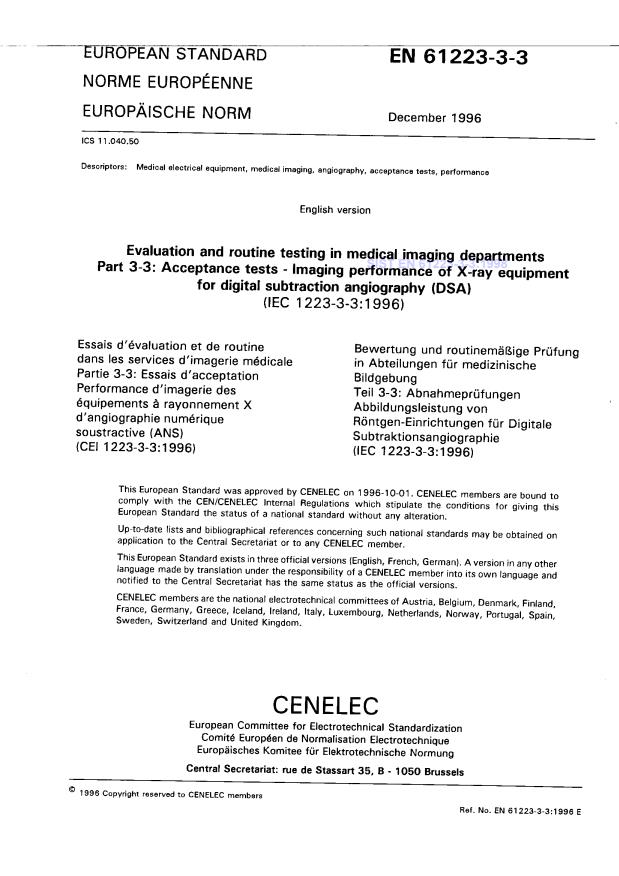
(Main)Evaluation and routine testing in medical imaging departments - Part 3-3: Acceptance tests - Imaging performance of X-ray equipment for digital subtraction angiography (DSA)
General Information
- Abstract
Applies to those components of X-ray equipment which influence the image quality of equipment for digital subtraction angiography (DSA) with an imaging system consisting of an X-ray generation subsystem, a detection device comprising an X-ray image intensifier television chain, means of digitization and digital image processing, image storage and image manipulation including subtraction, and facilities for image display. Defines the essential parameters which describe the performance of the above-mentioned components of X-ray equipment with regard to imaging properties, and defines methods of testing whether measured quantities related to those parameters comply with specified tolerances.
- Status
- Withdrawn
- Publication Date
- 18-Dec-1996
- Withdrawal Date
- 31-Jul-1997
- Technical Committee
- CLC/TC 62 - Electrical equipment in medical practice
- Drafting Committee
- IEC/SC 62B - IEC_SC_62B
- Parallel Committee
- IEC/SC 62B - IEC_SC_62B
- Current Stage
- 9960 - Withdrawal effective - Withdrawal
- Start Date
- 02-Aug-2023
- Completion Date
- 25-Aug-2026

Relations
- Effective Date
- 03-Feb-2026
- Effective Date
- 03-Feb-2026
- Refers
EN 60601-1:1990/A1:1993 - Medical electrical equipment - Part 1: General requirements for safety - Effective Date
- 03-Feb-2026
- Effective Date
- 03-Feb-2026
- Effective Date
- 03-Feb-2026
- Effective Date
- 03-Feb-2026
- Effective Date
- 03-Feb-2026
- Refers
EN 60601-1:1990/A2:1995 - Medical electrical equipment - Part 1: General requirements for safety - Effective Date
- 03-Feb-2026
- Effective Date
- 03-Feb-2026
Get Certified
Connect with accredited certification bodies for this standard

BSI Group
BSI (British Standards Institution) is the business standards company that helps organizations make excellence a habit.

TÜV Rheinland
TÜV Rheinland is a leading international provider of technical services.

TÜV SÜD
TÜV SÜD is a trusted partner of choice for safety, security and sustainability solutions.
Sponsored listings
Frequently Asked Questions
EN 61223-3-3:1996 is a standard published by CLC. Its full title is "Evaluation and routine testing in medical imaging departments - Part 3-3: Acceptance tests - Imaging performance of X-ray equipment for digital subtraction angiography (DSA)". This standard covers: Applies to those components of X-ray equipment which influence the image quality of equipment for digital subtraction angiography (DSA) with an imaging system consisting of an X-ray generation subsystem, a detection device comprising an X-ray image intensifier television chain, means of digitization and digital image processing, image storage and image manipulation including subtraction, and facilities for image display. Defines the essential parameters which describe the performance of the above-mentioned components of X-ray equipment with regard to imaging properties, and defines methods of testing whether measured quantities related to those parameters comply with specified tolerances.
Applies to those components of X-ray equipment which influence the image quality of equipment for digital subtraction angiography (DSA) with an imaging system consisting of an X-ray generation subsystem, a detection device comprising an X-ray image intensifier television chain, means of digitization and digital image processing, image storage and image manipulation including subtraction, and facilities for image display. Defines the essential parameters which describe the performance of the above-mentioned components of X-ray equipment with regard to imaging properties, and defines methods of testing whether measured quantities related to those parameters comply with specified tolerances.
EN 61223-3-3:1996 is classified under the following ICS (International Classification for Standards) categories: 11.040.50 - Radiographic equipment. The ICS classification helps identify the subject area and facilitates finding related standards.
EN 61223-3-3:1996 has the following relationships with other standards: It is inter standard links to EN 61223-2-4:1994, EN 60601-1-3:1994, EN 60601-1:1990/A1:1993, EN 61223-2-5:1994, HD 501 S1:1988, HD 395.2.7 S1:1989, EN 60601-1:1990, EN 60601-1:1990/A2:1995, EN IEC 61968-4:2019. Understanding these relationships helps ensure you are using the most current and applicable version of the standard.
EN 61223-3-3:1996 is available in PDF format for immediate download after purchase. The document can be added to your cart and obtained through the secure checkout process. Digital delivery ensures instant access to the complete standard document.
Standards Content (Sample)
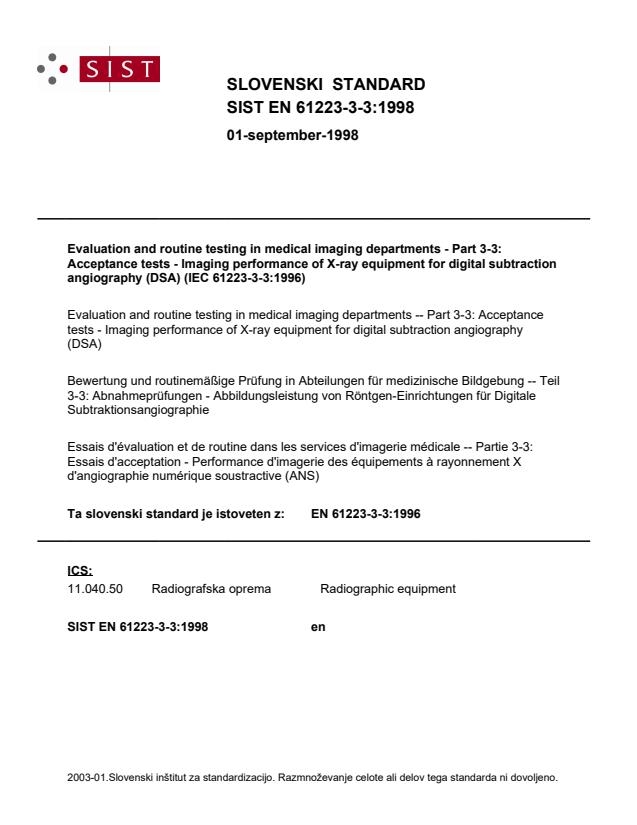
SLOVENSKI STANDARD
01-september-1998
Evaluation and routine testing in medical imaging departments - Part 3-3:
Acceptance tests - Imaging performance of X-ray equipment for digital subtraction
angiography (DSA) (IEC 61223-3-3:1996)
Evaluation and routine testing in medical imaging departments -- Part 3-3: Acceptance
tests - Imaging performance of X-ray equipment for digital subtraction angiography
(DSA)
Bewertung und routinemäßige Prüfung in Abteilungen für medizinische Bildgebung -- Teil
3-3: Abnahmeprüfungen - Abbildungsleistung von Röntgen-Einrichtungen für Digitale
Subtraktionsangiographie
Essais d'évaluation et de routine dans les services d'imagerie médicale -- Partie 3-3:
Essais d'acceptation - Performance d'imagerie des équipements à rayonnement X
d'angiographie numérique soustractive (ANS)
Ta slovenski standard je istoveten z: EN 61223-3-3:1996
ICS:
11.040.50 Radiografska oprema Radiographic equipment
2003-01.Slovenski inštitut za standardizacijo. Razmnoževanje celote ali delov tega standarda ni dovoljeno.
NORME
CEI
INTERNATIONALE
IEC
1223-3-3
INTERNATIONAL
Première édition
STANDARD
First edition
1996-11
Essais d’évaluation et de routine
dans les services d’imagerie médicale –
Partie 3-3:
Essais d’acceptation – Performances d’imagerie
des équipements à rayonnement X
d’angiographie numérique soustractive (ANS)
Evaluation and routine testing
in medical imaging departments –
Part 3-3:
Acceptance tests – Imaging performance
of X-ray equipment for digital subtraction
angiography (DSA)
CEI 1996 Droits de reproduction réservés Copyright - all rights reserved
Aucune partie de cette publication ne peut être reproduite ni No part of this publication may be reproduced or utilized
utilisée sous quelque forme que ce soit et par aucun procédé, in any form or by any means, electronic or mechanical,
électronique ou mécanique, y compris la photocopie et les including photocopying and microfilm, without permission
microfilms, sans l'accord écrit de l'éditeur. in writing from the publisher
Bureau central de la Commission Electrotechnique Internationale 3, rue de Varembé Genève, Suisse
CODE PRIX
Commission Electrotechnique Internationale
R
International Electrotechnical Commission PRICE CODE
Pour prix, voir catalogue en vigueur
For price, see current catalogue
1223-3-3 © IEC:1996 − 3 −
CONTENTS
Page
FOREWORD . 5
INTRODUCTION . 9
Clause
1 Scope and object. 11
1.1 Scope . 11
1.2 Object . 11
2 Normative references . 11
3 Terminology . 13
3.1 Degree of requirements . 13
3.2 Use of terms. 15
3.3 Defined terms. 15
4 General aspects of ACCEPTANCE TESTS. 15
4.1 General conditions to be considered in test procedures. 15
4.2 Documents and data for the tests . 17
4.3 Test conditions . 17
4.4 Test parameters . 17
4.5 Test equipment including PHANTOMS and TEST DEVICES. 19
4.6 Evaluating the test results. 21
5 Test methods for X-RAY EQUIPMENT for DSA . 21
5.1 Identification. 21
5.2 Check of documents . 21
5.3 Decision on representative DSA operation modes . 21
5.4 Visual and functional tests . 23
5.5 AIR KERMA measurements . 23
5.6 DYNAMIC RANGE . 23
5.7 DSA CONTRAST SENSITIVITY . 23
5.8 DSA VISUAL SPATIAL RESOLUTION . 25
5.9 ARTIFACTS . 25
5.10 Compensation for ATTENUATION non-linearity (optional) . 25
6 Test report and statement of compliance. 27
Annexes
A Terminology – Index of defined terms . 29
B Example of a DSA PHANTOM without test step for compensation . 33
C Example of a DSA PHANTOM with test step for compensation . 37
1223-3-3 © IEC:1996 − 5 −
INTERNATIONAL ELECTROTECHNICAL COMMISSION
____________
EVALUATION AND ROUTINE TESTING
IN MEDICAL IMAGING DEPARTMENTS –
Part 3-3: Acceptance tests –
Imaging performance of X-ray equipment
for digital subtraction angiography (DSA)
FOREWORD
1) The IEC (International Electrotechnical Commission) is a worldwide organization for standardization
comprising all national electrotechnical committees (IEC National Committees). The object of the IEC is to
promote international co-operation on all questions concerning standardization in the electrical and electronic
fields. To this end and in addition to other activities, the IEC publishes International Standards. Their
preparation is entrusted to technical committees; any IEC National Committee interested in the subject dealt
with may participate in this preparatory work. International, governmental and non-governmental organizations
liaising with the IEC also participate in this preparation. The IEC collaborates closely with the International
Organization for Standardization (ISO) in accordance with conditions determined by agreement between the
two organizations.
2) The formal decisions or agreements of the IEC on technical matters express, as nearly as possible, an
international consensus of opinion on the relevant subjects since each technical committee has representation
from all interested National Committees.
3) The documents produced have the form of recommendations for international use and are published in the
form of standards, technical reports or guides and they are accepted by the National Committees in that
sense.
4) In order to promote international unification, IEC National Committees undertake to apply IEC International
Standards transparently to the maximum extent possible in their national and regional standards. Any
divergence between the IEC Standard and the corresponding national or regional standard shall be clearly
indicated in the latter.
5) The IEC provides no marking procedure to indicate its approval and cannot be rendered responsible for any
equipment declared to be in conformity with one of its standards.
6) Attention is drawn to the possibility that some of the elements of this International Standard may be the
subject of patent rights. The IEC shall not be held responsible for identifying any or all such patent rights.
International Standard IEC 1223-3-3 has been prepared by subcommittee 62B: Diagnostic
imaging equipment, of IEC technical committee 62: Electrical equipment in medical practice.
The text of this standard is based on the following documents:
FDIS Report on voting
62B/288/FDIS 62B/301/RVD
Full information on the voting for the approval of this standard can be found in the report on
voting indicated in the above table.
Annex A forms an integral part of this standard.
Annexes B and C are for information only.
The French version of this standard has not been voted upon.
1223-3-3 © IEC:1996 − 7 −
In this standard, the following print types are used:
− Requirements, compliance with which can be tested, and definitions: roman type;
– Explanations, advice, notes, general statements, exceptions and references: smaller type;
− Test specifications: italic type;
− TERMS DEFINED IN IEC 788 OR IN IEC 1223: SMALL CAPITALS (SEE ANNEX A).
1223-3-3 © IEC:1996 − 9 −
INTRODUCTION
This standard is part of a series of International Standards which give methods of acceptance
testing and constancy testing for subsystems and systems (e.g. diagnostic X-RAY EQUIPMENT),
including film processing, used in medical imaging departments.
1223-3-3 © IEC:1996 − 11 −
EVALUATION AND ROUTINE TESTING
IN MEDICAL IMAGING DEPARTMENTS –
Part 3-3: Acceptance tests –
Imaging performance of X-ray equipment
for digital subtraction angiography (DSA)
1 Scope and object
1.1 Scope
This part of IEC 1223 applies to those components of X-RAY EQUIPMENT which influence the
image quality of EQUIPMENT for digital subtraction angiography (DSA) with an imaging system
consisting of an X-ray generation subsystem, a detection device comprising an X-RAY IMAGE
INTENSIFIER television chain, means of digitization and digital image processing, image storage
and image manipulation including subtraction, and facilities for image display.
This standard does not apply to general equipment of digital imaging. If such an equipment
includes a DSA function, it is restricted to the DSA function.
1.2 Object
This part of IEC 1223 defines:
a) the essential parameters which describe the performance of the above-mentioned
components of X-RAY EQUIPMENT with regard to imaging properties;
b) methods of testing whether measured quantities related to those parameters comply with
specified tolerances.
These methods mainly rely on non-invasive measurements using appropriate test equipment
performed during the installation or after the installation is completed. Signed statements
covering steps in the installation procedure can be used as part of acceptance testing.
The aim is to verify compliance of the installation with specifications affecting the image quality,
and to detect malfunctions affecting the image quality that are not in agreement with those
specifications.
This standard does not in itself specify tolerances for the parameters under investigation.
Neither is it intended to consider:
c) aspects of mechanical and electrical safety;
d) aspects of mechanical, electrical and software performance unless they are essential to
the performance of the tests directly affecting the image quality.
2 Normative references
The following normative documents contain provisions which, through reference in this text,
constitute provisions of this part of IEC 1223. At the time of publication, the editions indicated
were valid. All normative documents are subject to revision, and parties to agreements based
on this part of IEC 1223 are encouraged to investigate the possibility of applying the most
recent editions of the normative documents listed below. Members of IEC and ISO maintain
registers of currently valid International Standards.
1223-3-3 © IEC:1996 − 13 −
IEC 417N: 1995, Graphical symbols for use on equipment − Index, survey and compilation of
the single sheets – Thirteenth supplement
IEC 601-1: 1988, Medical electrical equipment – Part 1: General requirements for safety
Amendment 1 (1991)
Amendment 2 (1995)
IEC 601-1-3: 1994, Medical electrical equipment – Part 1: General requirements for safety –
3. Collateral Standard: General requirements for radiation protection in diagnostic X-ray
equipment
IEC 601-2-7: 1987, Medical electrical equipment – Part 2: Particular requirements for the
safety of high-voltage generators of diagnostic X-ray generators
IEC 788: 1984, Medical radiology – Terminology
IEC 878: 1988, Graphical symbols for electrical equipment in medical practice
IEC 1223-1: 1993, Evaluation and routine testing in medical imaging departments – Part 1:
General aspects
IEC 1223-2-4: 1994, Evaluation and routine testing in medical imaging departments – Part 2-4:
Constancy tests – Hard copy cameras
IEC 1223-2-5: 1994, Evaluation and routine testing in medical imaging departments – Part 2-5:
Constancy tests – Image display devices
ISO 2092: 1981, Light metals and their alloys – Code of designation based on chemical
symbols
3 Terminology
3.1 Degree of requirements
In this part of IEC 1223, certain terms (which are not printed in SMALL CAPITALS) have particular
meanings, as follows:
– "shall" indicates a requirement that is mandatory for compliance;
– "should" indicates a strong recommendation that is not mandatory for compliance;
– "may" indicates a permitted manner of complying with a requirement or of
avoiding the need to comply;
– "specific" is used to indicate definitive information stated in this standard or
referenced in other standards, usually concerning particular operating
conditions, test arrangements or values connected with compliance;
– "specified" is used to indicate definitive information stated by the MANUFACTURER in
ACCOMPANYING DOCUMENTS or in other documentation relating to the
EQUIPMENT under consideration, usually concerning its intended purpose,
or the parameters or conditions associated with its use or with testing to
determine compliance.
1223-3-3 © IEC:1996 − 15 −
3.2 Use of terms
In this part of IEC 1223, terms printed in SMALL CAPITALS are used as defined in IEC 788 or
other IEC publications or in 3.3 of this standard; see annex A. Where a defined term is used as
SMALL CAPITALS, unless the
a qualifier with another defined or undefined term it is not printed in
concept thus qualified is defined, or recognized as a derived term without a definition.
NOTE – Attention is drawn to the fact that, in cases where the concept addressed is not strongly confined to
the definition given in one of the publications listed above, a corresponding term is printed in lower-case
letters.
3.3 Defined terms
3.3.1 ARTIFACT: Apparent structure visible in the image which does not represent a structure
within the object and which cannot be explained by noise or the MODULATION TRANSFER
FUNCTION of the system.
3.3.2 DSA CONTRAST SENSITIVITY: Ability of the DSA system to display low contrast vessels
against background.
3.3.3 DSA VISUAL SPATIAL RESOLUTION: Ability of the DSA system to display small structures of
high contrast.
NOTE – DSA VISUAL SPATIAL RESOLUTION depends both on technical and observer performance.
3.3.4 DYNAMIC RANGE: Range of ATTENUATION that can be used for subtraction.
4 General aspects of ACCEPTANCE TESTS
4.1 General conditions to be considered in test procedures
The aim of an ACCEPTANCE TEST is to demonstrate that the specified characteristics of the
EQUIPMENT lie within the specified tolerances. Some requirements are enforced by legislation.
Other requirements and specifications may be in the order contract, in the supplier’s brochure
or in other standards, e.g. IEC 601 series.
Prior to the performance test procedures an inventory of the EQUIPMENT under test shall be
established. The X-RAY EQUIPMENT and its components shall be unambiguously identified, e.g.
with respect to type and SERIAL NUMBER, and checked against the order contract. The check
shall also encompass ascertaining that the ACCOMPANYING DOCUMENTS, including test protocols,
EQUIPMENT
are complete, that delivery is complete and that the documents relate to the
delivered.
The IMAGE DISPLAY DEVICE and HARD COPY CAMERA are vital parts of the DSA imaging chain. A
confirmation of the acceptable performance of these components shall be established prior to
ACCEPTANCE TEST measurements involving the IMAGE DISPLAY DEVICE and the HARD COPY
CAMERA.
DSA function requires digital X-RAY IMAGE INTENSIFIER television technology with a radiographic
function. Testing of RADIOSCOPY and general X-RAY IMAGE INTENSIFIER applications is described
in IEC 1223-3-1*. Testing of RADIOSCOPY function shall be done prior to or concurrently with
testing of DSA function.
_________
* IEC 1223-3-1: Evaluation and routine testing in medical imaging departments − Part 3-1: Acceptance tests –
Imaging performance of X-ray equipment for radiographic and radioscopic systems (under preparation)
1223-3-3 © IEC:1996 − 17 −
Non-invasive measurements are preferred for ACCEPTANCE TESTS. Whenever invasive tests are
part of the programme it shall be shown that the EQUIPMENT has been restored to its original
condition.
4.2 Documents and data for the tests
Together with the X-RAY EQUIPMENT the following documentation is required:
– statements of compliance with applicable parts of IEC 601;
– list of EQUIPMENT/parts of EQUIPMENT ordered and actual delivery list (IEC 601-1);
– performance specification as agreed upon between the purchaser and the supplier;
– results from tests performed in the factory or during installation covering items of
importance to quality, such as the NOMINAL FOCAL SPOT VALUE;
– INSTRUCTIONS FOR USE, including a comprehensive guidance for the operation of the
EQUIPMENT;
– details of the actual operating conditions under which the X-RAY EQUIPMENT is to be used
in practice and whether this results in a limitation of the scope of the tests, e.g. special work
places;
– guidance as to the extent and frequency of maintenance procedures;
– reports on previous tests where applicable;
– data on technical changes.
4.3 Test conditions
Different categories of tests can be identified:
– visual inspection;
– functional tests;
– system performance;
– check of the uncertainty in the values of variables.
ENTRANCE FIELD SIZES of the X-RAY IMAGE INTENSIFIER and the range of
The test shall cover all
X-RAY BEAM parameters as far as available in any application programme. The set of
programmes to be tested under the conditions of this standard shall be agreed upon between
the person responsible for performing the tests and the USER.
All data which are relevant to reproduce the test shall be recorded together with the test
results. The record shall include the location, the date and the names of the persons performing
the tests.
4.4 Test parameters
The following parameters are subject to ACCEPTANCE TESTING:
– identification of EQUIPMENT;
– check of documents;
– visual and functional tests;
– AIR KERMA per image;
– DYNAMIC RANGE;
– DSA CONTRAST SENSITIVITY;
– DSA VISUAL SPATIAL RESOLUTION;
– ARTIFACTS;
– compensation for ATTENUATION non-linearity (optional).
1223-3-3 © IEC:1996 − 19 −
4.5 Test equipment including PHANTOMS and TEST DEVICES
4.5.1 General
The measuring equipment used for ACCEPTANCE TESTS shall be certified as calibrated against a
national or international standard where such a standard exists.
4.5.2 KERMAMETER
The range of the integrating KERMAMETER for the measurements of the AIR KERMA shall have a
lower value of about 1 μGy for single IRRADIATIONS or 10 μGy for serial IRRADIATIONS, with a
total uncertainty less than ±10 %. This includes recombination losses at the AIR KERMA RATES
involved (up to 2 Gy/s and LOADING TIMES d
...