


prEN IEC 62920:2025
(Main)Photovoltaic power generating systems - EMC requirements and test methods for power conversion equipment
Photovoltaic power generating systems - EMC requirements and test methods for power conversion equipment
Photovoltaische Stromerzeugungssysteme - EMV-Anforderungen und Prüfverfahren für Leistungsumrichter
Systèmes de production d'énergie photovoltaïque - Exigences de CEM et méthodes d'essai pour les équipements de conversion de puissance
Fotonapetostni energetski sistemi - Zahteve EMC in preskusne metode za opremo močnostnih pretvornikov
General Information
- Status
- Not Published
- Publication Date
- 20-Dec-2026
- Technical Committee
- CLC/TC 82 - Solar photovoltaic energy systems
- Drafting Committee
- IEC/TC 82 - IEC_TC_82
- Current Stage
- 4060 - Enquiry results established and sent to TC, SR, BTTF - Enquiry
- Start Date
- 22-Aug-2025
- Completion Date
- 22-Aug-2025
Relations
- Effective Date
- 27-Sep-2022
- Effective Date
- 14-Dec-2021
- Effective Date
- 14-Dec-2021
- Effective Date
- 14-Dec-2021
Overview
prEN IEC 62920:2025 - "Photovoltaic power generating systems - EMC requirements and test methods for power conversion equipment" is a CLC-adopted Committee Draft (IEC TC 82) that defines electromagnetic compatibility (EMC) requirements and standardized test methods for photovoltaic (PV) power conversion equipment (PCE), such as inverters and converter assemblies. The document (IEC 62920 Ed.2 project) updates EMC rules covering both immunity and emissions to support safe, reliable PV system operation and grid integration.
Key topics and requirements
- Scope and classification
- Classification of PCE by location, class (A/B) and information required for users.
- Test setups and operating conditions
- Detailed configurations for immunity, low-frequency emission and high-frequency emission tests.
- Operating conditions during testing (general, immunity, low- and high-frequency tests).
- Immunity requirements
- Performance criteria, voltage dips/interruption tests, electrostatic discharge (ESD), EFT/burst, surge, radiated and conducted immunity.
- Tables specifying immunity levels for Class A and Class B PCE and for ports besides power ports.
- Emission requirements
- Low-frequency: harmonics, voltage change and flicker limits.
- High-frequency: conducted and radiated emission limits (including limits up to 1 GHz).
- Disturbance voltage limits at AC/DC power ports and measurements at wired network ports.
- Test procedures and reporting
- Standardized procedures for measurement, result evaluation and test reports.
- Informative and normative annexes
- Annex A–D: configuration examples, alternative setups for high-power PCE and measurement examples.
- Annex E (normative): conditional measurement methods and mapping to CISPR32 for conducted common‑mode disturbances.
Practical applications and users
This standard is essential for:
- PV equipment manufacturers designing inverters and power converters to meet EMC conformity.
- Test laboratories and certification bodies conducting immunity and emission testing to demonstrate compliance.
- System integrators and utilities ensuring PV installations meet grid EMC requirements and minimize interference.
- Regulatory and standards professionals harmonizing national requirements with IEC/CENELEC provisions.
Practical uses include EMC design validation, type testing for market access, troubleshooting interference issues, and ensuring interoperability with grid and communications infrastructure.
Related standards
- IEC 62920 (Ed.1.1) maintenance and update references are included.
- CISPR32 considerations and measurement conditions are referenced in Annex E for wired network ports.
Keywords: photovoltaic, EMC, power conversion equipment, PV inverters, conducted emission, radiated emission, immunity testing, harmonics, voltage dips, CISPR32.

Get Certified
Connect with accredited certification bodies for this standard

DNV
DNV is an independent assurance and risk management provider.

Lloyd's Register
Lloyd's Register is a global professional services organisation specialising in engineering and technology.
DNV Energy Systems
Energy and renewable energy certification.
Sponsored listings
Frequently Asked Questions
prEN IEC 62920:2025 is a draft published by CLC. Its full title is "Photovoltaic power generating systems - EMC requirements and test methods for power conversion equipment". This standard covers: Photovoltaic power generating systems - EMC requirements and test methods for power conversion equipment
Photovoltaic power generating systems - EMC requirements and test methods for power conversion equipment
prEN IEC 62920:2025 is classified under the following ICS (International Classification for Standards) categories: 27.160 - Solar energy engineering. The ICS classification helps identify the subject area and facilitates finding related standards.
prEN IEC 62920:2025 has the following relationships with other standards: It is inter standard links to EN 62920:2017/prAB, EN 62920:2017, EN 62920:2017/A1:2021, EN 62920:2017/A11:2020. Understanding these relationships helps ensure you are using the most current and applicable version of the standard.
prEN IEC 62920:2025 is associated with the following European legislation: EU Directives/Regulations: 2014/30/EU; Standardization Mandates: M/552. When a standard is cited in the Official Journal of the European Union, products manufactured in conformity with it benefit from a presumption of conformity with the essential requirements of the corresponding EU directive or regulation.
prEN IEC 62920:2025 is available in PDF format for immediate download after purchase. The document can be added to your cart and obtained through the secure checkout process. Digital delivery ensures instant access to the complete standard document.
Standards Content (Sample)
SLOVENSKI STANDARD
01-julij-2025
Fotonapetostni energetski sistemi - Zahteve EMC in preskusne metode za opremo
močnostnih pretvornikov
Photovoltaic power generating systems - EMC requirements and test methods for power
conversion equipment
Photovoltaische Stromerzeugungssysteme - EMV-Anforderungen und Prüfverfahren für
Leistungsumrichter
Systèmes de production d'énergie photovoltaïque - Exigences de CEM et méthodes
d'essai pour les équipements de conversion de puissance
Ta slovenski standard je istoveten z: prEN IEC 62920:2025
ICS:
27.160 Sončna energija Solar energy engineering
33.100.01 Elektromagnetna združljivost Electromagnetic compatibility
na splošno in general
2003-01.Slovenski inštitut za standardizacijo. Razmnoževanje celote ali delov tega standarda ni dovoljeno.
82/2402/CDV
COMMITTEE DRAFT FOR VOTE (CDV)
PROJECT NUMBER:
IEC 62920 ED2
DATE OF CIRCULATION: CLOSING DATE FOR VOTING:
2025-05-30 2025-08-22
SUPERSEDES DOCUMENTS:
82/2231/CD, 82/2257A/CC
IEC TC 82 : SOLAR PHOTOVOLTAIC ENERGY SYSTEMS
SECRETARIAT: SECRETARY:
United States of America Mr George Kelly
OF INTEREST TO THE FOLLOWING COMMITTEES: HORIZONTAL FUNCTION(S):
SC 22E,SC 22H,SC 77A,CIS/B
ASPECTS CONCERNED:
Electromagnetic Compatibility
SUBMITTED FOR CENELEC PARALLEL VOTING NOT SUBMITTED FOR CENELEC PARALLEL VOTING
Attention IEC-CENELEC parallel voting
The attention of IEC National Committees, members of
CENELEC, is drawn to the fact that this Committee Draft
for Vote (CDV) is submitted for parallel voting.
The CENELEC members are invited to vote through the
CENELEC online voting system.
This document is still under study and subject to change. It should not be used for reference purposes.
Recipients of this document are invited to submit, with their comments, notification of any relevant patent rights of
which they are aware and to provide supporting documentation.
Recipients of this document are invited to submit, with their comments, notification of any relevant “In Some
Countries” clauses to be included should this proposal proceed. Recipients are reminded that the CDV stage is
the final stage for submitting ISC clauses. (SEE AC/22/2007 OR NEW GUIDANCE DOC).
TITLE:
Photovoltaic power generating systems - EMC requirements and test methods for power
conversion equipment
PROPOSED STABILITY DATE: 2030
NOTE FROM TC/SC OFFICERS:
This project was discussed and supported by WG6 during their meeting in 2024-10.
electronic file, to make a copy and to print out the content for the sole purpose of preparing National Committee positions.
You may not copy or "mirror" the file or printed version of the document, or any part of it, for any other purpose without
permission in writing from IEC.
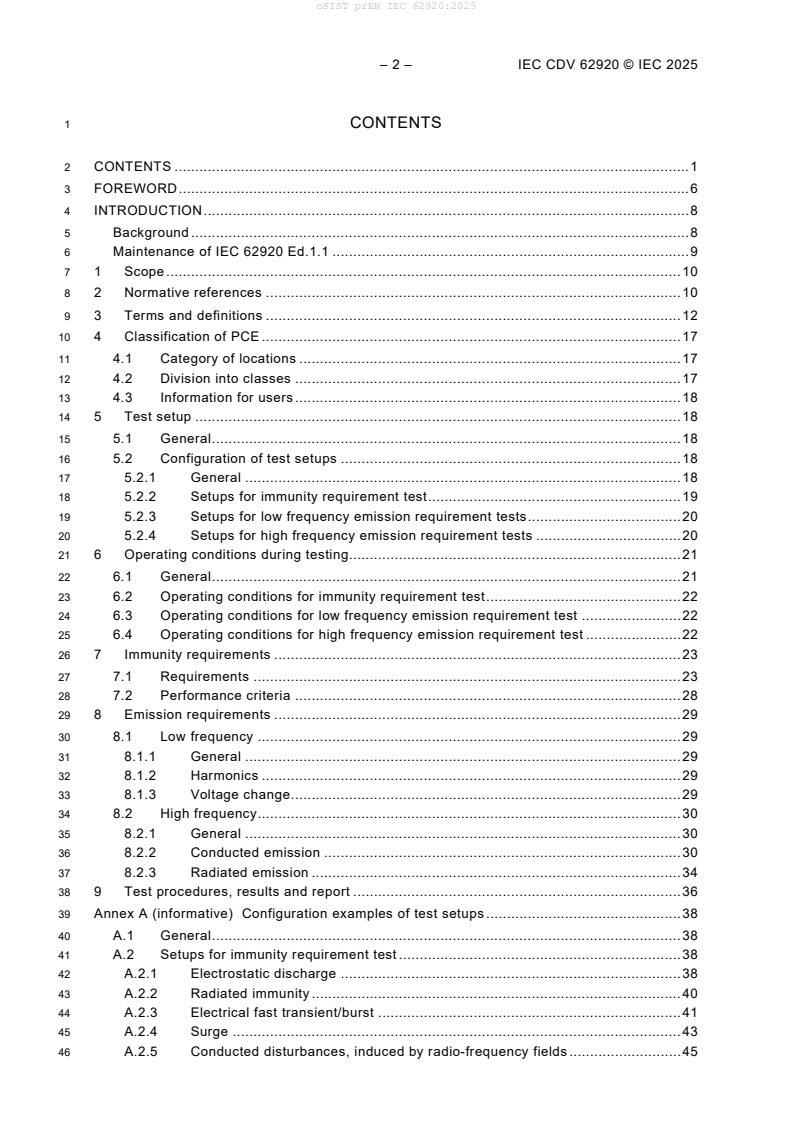
– 2 – IEC CDV 62920 © IEC 2025
1 CONTENTS
2 CONTENTS . 1
3 FOREWORD . 6
4 INTRODUCTION . 8
5 Background . 8
6 Maintenance of IEC 62920 Ed.1.1 . 9
7 1 Scope . 10
8 2 Normative references . 10
9 3 Terms and definitions . 12
10 4 Classification of PCE . 17
11 4.1 Category of locations . 17
12 4.2 Division into classes . 17
13 4.3 Information for users . 18
14 5 Test setup . 18
15 5.1 General . 18
16 5.2 Configuration of test setups . 18
17 5.2.1 General . 18
18 5.2.2 Setups for immunity requirement test . 19
19 5.2.3 Setups for low frequency emission requirement tests . 20
20 5.2.4 Setups for high frequency emission requirement tests . 20
21 6 Operating conditions during testing. 21
22 6.1 General . 21
23 6.2 Operating conditions for immunity requirement test . 22
24 6.3 Operating conditions for low frequency emission requirement test . 22
25 6.4 Operating conditions for high frequency emission requirement test . 22
26 7 Immunity requirements . 23
27 7.1 Requirements . 23
28 7.2 Performance criteria . 28
29 8 Emission requirements . 29
30 8.1 Low frequency . 29
31 8.1.1 General . 29
32 8.1.2 Harmonics . 29
33 8.1.3 Voltage change . 29
34 8.2 High frequency . 30
35 8.2.1 General . 30
36 8.2.2 Conducted emission . 30
37 8.2.3 Radiated emission . 34
38 9 Test procedures, results and report . 36
39 Annex A (informative) Configuration examples of test setups . 38
40 A.1 General . 38
41 A.2 Setups for immunity requirement test . 38
42 A.2.1 Electrostatic discharge . 38
43 A.2.2 Radiated immunity . 40
44 A.2.3 Electrical fast transient/burst . 41
45 A.2.4 Surge . 43
46 A.2.5 Conducted disturbances, induced by radio-frequency fields . 45
IEC CDV 62920 © IEC 2025 – 3 –
47 A.2.6 Voltage dips and interruption . 45
48 A.3 Setups for high frequency emission requirement test . 46
49 A.3.1 Conducted disturbances . 46
50 A.3.2 Radiated disturbances . 49
51 Annex B (informative) Setups for low frequency emission requirement test . 50
52 B.1 General . 50
53 B.2 Example of a test circuit for low frequency emission requirement test . 50
54 B.2.1 Harmonics . 50
55 B.2.2 Voltage fluctuations and flicker . 52
56 Annex C (informative) Test setup for conducted disturbance measurement . 54
57 C.1 General . 54
58 C.2 Examples of a test setup . 54
59 Annex D (informative) Alternative test setups for high-power PCE . 57
60 D.1 General . 57
61 D.2 Alternative setup for immunity requirement test . 57
62 D.2.1 Alternative setups for EFT/burst immunity test . 57
63 D.2.2 Alternative setup for surge test . 57
64 D.2.3 Alternative test setup for conducted disturbances, induced by radio-
65 frequency fields . 58
66 D.2.4 Conducted disturbances measurement . 59
67 Annex E (normative) Conditional measurement methods and limits of conducted
68 common mode (asymmetric mode) disturbance at ports other than power ports . 61
69 E.1 Consideration of requirements specified in CISPR32 and covered in IEC
70 62920 . 61
71 E.2 Configuration of EUT specified in CISPR 32. 61
72 E.3 Measurement conditions specified in CISPR 32 . 62
73 E.4 Proposals on measurements for wired network ports cover in IEC 62920 . 62
74 E.5 Consideration of the interface model covered in IEC 62920 . 63
75 E.6 Applicable conducted emission limits at wired network ports in IEC 62920 . 63
76 Bibliography . 65
78 Figure 1 – Example of ports . 13
79 Figure A.1 – Example of a test setup for direct application of discharges to PCE . 39
80 Figure A.2 – Example of a test setup for indirect application of discharges to PCE . 39
81 Figure A.3 – Example of a test setup for wall-mounted PCE . 41
82 Figure A.4 – Example of a test setup for direct coupling of the test voltage to AC
83 mains power ports . 42
84 Figure A.5 – Example of a test setup for application of the test voltage with a
85 capacitive coupling clamp . 43
86 Figure A.6 – Example of a test setup for AC mains power ports . 44
87 Figure A.7 – Example of a test setup for DC power ports . 44
88 Figure A.8 – Example of a setup of conducted disturbances immunity test applied for
89 wall-mounted PCE . 45
90 Figure A.9 – Example of a test setup using a generator for voltage dips and short
91 interruptions. 46
92 Figure A.10 – Example of a test setup of conducted disturbances measurement
93 applied for wall-mounted PCE . 47
– 4 – IEC CDV 62920 © IEC 2025
94 Figure A.11 – Example of a test setup of conducted disturbances measurement
95 applied for wall-mounted PCE with power circulation . 48
96 Figure A.12 – Example of a test setup of conducted disturbances measurement
97 applied for wall-mounted PCE with direct connection to AC mains . 48
98 Figure A.13 – Example of a test setup of radiated disturbances measurement applied
99 for wall-mounted PCE . 49
100 Figure B.1 – Measurement circuit for single-phase two-wire PCE . 50
101 Figure B.2 – Measurement circuit for single-phase three-wire PCE . 51
102 Figure B.3 – Measurement circuit for three-phase three-wire PCE . 51
103 Figure B.4 – Measurement circuit for three-phase four-wire PCE . 51
104 Figure B.5 – Measurement circuit for single-phase two-wire PCE . 52
105 Figure B.6 – Measurement circuit for single-phase three-wire PCE . 52
106 Figure B.7 – Measurement circuit for three-phase three-wire PCE . 53
107 Figure B.8 – Measurement circuit for three-phase four-wire PCE . 53
108 Figure C.1 – Example of a standardized test setup for conducted disturbances
109 measurement with AC mains power supply . 55
110 Figure C.2 – Example of a standardized test setup for conducted disturbances
111 measurement with a laboratory AC power source . 56
112 Figure D.1 – Example of an alternative setup for EFT/Burst immunity test . 57
113 Figure D.2 – Example of an alternative coupling/decoupling network for AC mains
114 power ports . 58
115 Figure D.3 – Example of a test setup applying clamp injection method to AC mains
116 power ports . 59
117 Figure D.4 – Alternative test setup of conduced disturbances measurement using
118 artificial networks as voltage probes . 60
119 Figure E.1 – Typical circuit diagram of PCE which is equipped with wired network ports
120 configured with a module . 62
122 Table 1 – Immunity requirements for class B PCE . 24
123 Table 2 – Immunity requirements for class B PCE (For ports besides power ports) . 25
124 Table 3 – Immunity requirements for class A PCE . 26
125 Table 4 – Immunity requirements for class A PCE (For ports besides power ports) . 27
126 Table 5 – Voltage dips and interruption immunity requirements for class B PCE . 27
127 Table 6 – Voltage dips and interruption immunity requirements for class A PCE . 28
128 Table 7 – Performance criteria for immunity tests . 29
129 Table 8 – Disturbance voltage limits at the AC mains and auxiliary AC power port for
130 class A PCE measured on a test site . 30
131 Table 9 – Disturbance voltage limits at the AC mains and auxiliary AC power port for
132 class B PCE measured on a test site . 31
133 Table 10 – Disturbance limits at the DC power port for class A PCE measured on a
134 test site . 32
135 Table 11 – Disturbance limits at the DC power port for class B PCE measured on a
136 test site . 32
137 Table 12 – Applicability of measurements at DC power ports . 33
138 Table 14 – Limits of conducted common mode (asymmetric mode) disturbance at ports
139 other than power ports for class A PCE (Under the operating condition b as in 6.4) . 33
140 Table 15 – Limits of conducted common mode (asymmetric mode) disturbance at
141 ports other than power ports for class B PCE . 34
IEC CDV 62920 © IEC 2025 – 5 –
142 Table 16 – Electromagnetic radiation disturbance limits up to 1GHz for class A PCE
143 measured on a test site . 35
144 Table 17 – Electromagnetic radiation disturbance limits up to 1GHz for class B PCE
145 measured on a test site . 35
146 Table 18 – Electromagnetic radiation disturbance limits > 1GHz for class A PCE
147 measured on a test site . 36
148 Table 19 – Electromagnetic radiation disturbance limits >1 GHz for class B PCE
149 measured on a test site . 36
150 Table 20 – Required highest frequency for radiated measurement . 36
– 6 – IEC CDV 62920 © IEC 2025
153 INTERNATIONAL ELECTROTECHNICAL COMMISSION
154 ____________
156 PHOTOVOLTAIC POWER GENERATING SYSTEMS –
157 EMC REQUIREMENTS AND TEST METHODS FOR
158 POWER CONVERSION EQUIPMENT
160 FOREWORD
161 1) The International Electrotechnical Commission (IEC) is a worldwide organization for standardization comprising
162 all national electrotechnical committees (IEC National Committees). The object of IEC is to promote international
163 co-operation on all questions concerning standardization in the electrical and electronic fields. To this end and
164 in addition to other activities, IEC publishes International Standards, Technical Specifications, Technical Reports,
165 Publicly Available Specifications (PAS) and Guides (hereafter referred to as “IEC Publication(s)”). Their
166 preparation is entrusted to technical committees; any IEC National Committee interested in the subject dealt with
167 may participate in this preparatory work. International, governmental and non-governmental organizations liaising
168 with the IEC also participate in this preparation. IEC collaborates closely with the International Organization for
169 Standardization (ISO) in accordance with conditions determined by agreement between the two organizations.
170 2) The formal decisions or agreements of IEC on technical matters express, as nearly as possible, an international
171 consensus of opinion on the relevant subjects since each technical committee has representation from all
172 interested IEC National Committees.
173 3) IEC Publications have the form of recommendations for international use and are accepted by IEC National
174 Committees in that sense. While all reasonable efforts are made to ensure that the technical content of IEC
175 Publications is accurate, IEC cannot be held responsible for the way in which they are used or for any
176 misinterpretation by any end user.
177 4) In order to promote international uniformity, IEC National Committees undertake to apply IEC Publications
178 transparently to the maximum extent possible in their national and regional publications. Any divergence between
179 any IEC Publication and the corresponding national or regional publication shall be clearly indicated in the latter.
180 5) IEC itself does not provide any attestation of conformity. Independent certification bodies provide conformity
181 assessment services and, in some areas, access to IEC marks of conformity. IEC is not responsible for any
182 services carried out by independent certification bodies.
183 6) All users should ensure that they have the latest edition of this publication.
184 7) No liability shall attach to IEC or its directors, employees, servants or agents including individual experts and
185 members of its technical committees and IEC National Committees for any personal injury, property damage or
186 other damage of any nature whatsoever, whether direct or indirect, or for costs (including legal fees) and
187 expenses arising out of the publication, use of, or reliance upon, this IEC Publication or any other IEC
188 Publications.
189 8) Attention is drawn to the Normative references cited in this publication. Use of the referenced publications is
190 indispensable for the correct application of this publication.
191 9) Attention is drawn to the possibility that some of the elements of this IEC Publication may be the subject of patent
192 rights. IEC shall not be held responsible for identifying any or all such patent rights.
IEC CDV 62920 © IEC 2025 – 7 –
195 International Standard IEC 62920 has been prepared by IEC technical committee 82: Solar
196 photovoltaic energy systems.
197 This document has been drafted in accordance with the ISO/IEC Directives, Part 2.
198 The committee has decided that the contents of the base publication and its amendment will
199 remain unchanged until the stability date indicated on the IEC web site under
200 "http://webstore.iec.ch" in the data related to the specific publication. At this date, the
201 publication will be
202 • reconfirmed,
203 • withdrawn,
204 • replaced by a revised edition, or
205 • amended.
IMPORTANT – The 'colour inside' logo on the cover page of this publication indicates that it
contains colours which are considered to be useful for the correct understanding of its
contents. Users should therefore print this document using a colour printer.
8 IEC CDV 62920 ED2 © IEC 2025
209 INTRODUCTION
210 Background
211 Power conversion equipment (PCE) is indispensable for solar photovoltaic power energy
212 systems in order to convert the DC electric power energy generated by solar photovoltaic
213 modules into AC or DC electric power, and to feed the AC power energy into the AC mains
214 network or loads. PCE consists of DC to DC, DC to AC or AC to DC converters and forms
215 systems with or without DC-coupled electrical energy storage devices.
216 Manufacturers of PCE ensure the performance and reliability of PCE. Electromagnetic
217 compatibility (EMC) is one aspect of performance which must be ensured wherever PCE is used
218 in or exposed to an electromagnetic environment.
219 IEC Guide 107 specifies that TC 77 and CISPR, which are called EMC committees, have
220 responsibility for the development of basic, product family and generic standards on EMC
221 requirements, and product committees must use the emission limits developed by EMC
222 committees and must refer to basic immunity standards for the specification of test techniques.
223 However, when the EMC standards which are developed by TC 77 and CISPR are not
224 considered suitable for a particular product or electromagnetic environment, product
225 committees must seek their assistance and advice for any change in the emission limits and/or
226 measurement requirements. Product committees are responsible for selecting the appropriate
227 immunity test items and levels for their products as well as for defining the relevant performance
228 criteria for the evaluation of the immunity test results. Consequently, product committees, such
229 as TC 22, TC 26, TC 9, and TC 69, have their own EMC standard to define EMC requirements
230 and test methods for their particular types of products.
231 TC 82 also has the responsibility to consider EMC requirements for PCE applying to the solar
232 photovoltaic power energy systems, and TC 82 has taken action as follows to develop its own
233 product EMC standards:
234 a) selection of the immunity test items in accordance with EMC environments for the solar
235 photovoltaic power energy systems,
236 b) supplement of generic standards with a detailed description of test conditions and test set
237 up,
238 c) development of the conditional limits and alternative test methods in terms of installation
239 environmental and operational conditions, and
240 d) development of appropriate requirements and test method for high power equipment.
241 In 2017, TC82 published IEC 62920 (Ed.1.0) and covered the minimum EMC requirements for
242 PCE applying to solar photovoltaic power energy systems in consideration with the above-
243 mentioned items.
244 Following the state-of-the-art technology as well as the latest market needs, IEC 62920:2017
245 (Ed.1.0) is amended to extend the scope of IEC 62920:2017 (Ed.1.0) by taking into account the
246 following technical items:
247 • DC to DC power conversion equipment used in photovoltaic power energy systems,
248 • Electrical energy storage devices connected to DC power ports of PCE used in photovoltaic
249 power energy systems,
250 • 5 m antenna distance of radiated disturbance measurements for the medium size PCE.
IEC CDV 62920 ED2 © IEC 2025 9
252 Maintenance of IEC 62920 Ed.1.1
253 For the purpose of keeping the consistency with EMC basic standards and considering market
254 needs, TC82 started the maintenance of IEC 62920 Ed.1.1 for the development of Ed.2.0 in
255 November 2021.
256 The Ed. 2.0 of IEC 62920 covers the following items:
257 • PCE with radio functionality is added in the scope,
258 • normative references are updated,
259 • some terms and definitions are updated or deleted,
260 • terms and definitions relevant to radio functionality are added,
261 • the classification of PCE is revised to introduce the location classes,
262 • the configurations of test setups are revised to cover the operation of the wired and wireless
263 functions,
264 • setups for high frequency emission requirement test are updated to keep the consistency
265 with EMC basic standards, such as CISPR 16-1-2 and CISPR 16-2-3,
266 • operating conditions for tests are revised to cover wired and wireless communications,
267 • immunity requirements for antenna ports are added,
268 • the surge test is added in the immunity requirements for wired and wireless network ports
269 of Class B PCE,
270 • immunity requirements regarding IEC 61000-4-3 are revised to fill the gap of frequency
271 range,
272 • performance criteria are revised to cover wired and wireless communications,
273 • current limits are added in the table of disturbance limits at the DC power port for class A
274 PCE to cover requirements of the measurement of common mode current when artificial
275 networks are used as voltage probes,
276 • limits of conducted common mode disturbance at the antenna port are added,
277 • conditional measurement methods and limits of conducted common mode (asymmetric
278 mode) disturbance at ports other than power ports are added,
279 • electromagnetic radiation disturbance limits above 1 GHz are added,
280 • an annex for the rational conditional measurement methods and limits of conducted common
281 mode (asymmetric mode) disturbance at ports other than power ports is added.
10 IEC CDV 62920 ED2 © IEC 2025
283 PHOTOVOLTAIC POWER GENERATING SYSTEMS –
284 EMC REQUIREMENTS AND TEST METHODS FOR
285 POWER CONVERSION EQUIPMENT
289 1 Scope
290 This document specifies electromagnetic compatibility (EMC) requirements for power
291 conversion equipment (PCE) (e.g., DC to DC, DC to AC and AC to DC) for use in photovoltaic
292 (PV) power systems with or without electrical energy storage devices.
293 PCE covered by this document can be grid-interactive, which is termed as a grid connected
294 power converter (GCPC), or stand-alone. It can be supplied by single or multiple photovoltaic
295 modules grouped in various array configurations. The PCE can be intended for use in
296 conjunction with batteries or other forms of energy storage and therefore a uni- or bidirectional.
297 This document covers not only PCE connected to a public low voltage AC mains network or
298 other low voltage AC mains installation, but also PCE connected to a medium or high voltage
299 AC network with or without step-down power transformers. Requirements for the PCE
300 connected to a medium or high voltage AC network are specified in this document. However,
301 some requirements relevant to grid interconnection are addressed with other standards
302 specifying power quality or their own grid codes in some countries.
303 This document provides test methods and test conditions for PCE at a test site, but not for
304 photovoltaic modules and other balance of system components.
305 PCE which incorporates radio transmit/receive functions or wireless communication functions
306 (PCE with radio functionality), is included in the scope of this document. However, the emission
307 requirements in this document are not intended to be applicable to the intentional transmissions
308 from a radio transmitter as defined by the ITU including their spurious emissions.
309 When compliance with EMC requirements at the test site cannot be shown due to technical
310 reasons of the test site, PCE can be assessed in situ. Clause 7.6 of CISPR 16-2-1 specifies
311 conditions of in situ measurements for conducted emission, and Clause 7.7 of CISPR 16-2-3
312 for radiated emission. Immunity tests are not required in the case of in situ.
313 2 Normative references
314 The following documents are referred to in the text in such a way that some or all of their content
315 constitutes requirements of this document. For dated references, only the edition cited applies.
316 For undated references, the latest edition of the referenced document (including any
317 amendments) applies.
318 IEC 61000-3-2:2024, Electromagnetic compatibility (EMC) – Part 3-2: Limits – Limits for
319 harmonic current emissions (equipment with input current ≤ 16 A per phase)
320 IEC 61000-3-3:2021, Electromagnetic compatibility (EMC) – Part 3-3: Limits – Limitation of
321 voltage changes, voltage fluctuations and flicker in public low-voltage supply systems, for
322 equipment with rated current ≤ 16 A per phase and not subject to conditional connection
323 IEC 61000-3-11:2017, Electromagnetic compatibility (EMC) – Part 3-11: Limits – Limitation of
324 voltage changes, voltage fluctuations and flicker in public low-voltage supply systems –
325 Equipment with rated current ≤ 75 A and subject to conditional connection
IEC CDV 62920 ED2 © IEC 2025 11
326 IEC 61000-3-12:2021, Electromagnetic compatibility (EMC) – Part 3-12: Limits – Limits for
327 harmonic currents produced by equipment connected to public low-voltage systems with input
328 current > 16 A and ≤ 75 A per phase
329 IEC 61000-4-2:2025, Electromagnetic compatibility (EMC) – Part 4-2: Testing and
330 measurement techniques – Electrostatic discharge immunity test
331 IEC 61000-4-3:2020, Electromagnetic compatibility (EMC) – Part 4-3: Testing and measure-
332 ment techniques – Radiated, radio-frequency, electromagnetic field immunity test
333 IEC 61000-4-4:2012, Electromagnetic compatibility (EMC) – Part 4-4: Testing and
334 measurement techniques – Electrical fast transient/burst immunity test
335 IEC 61000-4-5:2017, Electromagnetic compatibility (EMC) – Part 4-5: Testing and
336 measurement techniques – Surge immunity test
337 IEC 61000-4-6:2023, Electromagnetic compatibility (EMC) – Part 4-6: Testing and measure-
338 ment techniques – Immunity to conducted disturbances, induced by radio-frequency fields
339 IEC 61000-4-7:2008, Electromagnetic compatibility (EMC) – Part 4-7: Testing and
340 measurement techniques – General guide on harmonics and interharmonics measurements and
341 instrumentation, for power supply systems and equipment connected thereto
342 IEC 61000-4-11:2020, Electromagnetic compatibility (EMC) – Part 4-11: Testing and
343 measurement techniques – Voltage dips, short interruptions and voltage variations immunity
344 tests
345 IEC 61000-4-34:2009, Electromagnetic compatibility (EMC) – Part 4-34: Testing and
346 measurement techniques – Voltage dips, short interruptions and voltage variations immunity
347 tests for equipment with input current more than 16 A per phase
348 CISPR 11:2024, Industrial, scientific and medical equipment – Radio-frequency disturbance
349 characteristics – Limits and methods of measurement
350 CISPR 16-1-2:2017, Specification for radio disturbance and immunity measuring apparatus and
351 methods – Part 1-2: Radio disturbance and immunity measuring apparatus – Coupling devices
352 for conducted disturbance measurements
353 CISPR 32:2019, Electromagnetic compatibility of multimedia equipment – Emission
354 requirements
355 CISPR 16-2-1:2017, Specification for radio disturbance and immunity measuring apparatus and
356 methods - Part 2-1: Methods of measurement of disturbances and immunity - Conducted
357 disturbance measurements
358 CISPR 16-2-3:2023, Specification for radio disturbance and immunity measuring apparatus and
359 methods - Part 2-3: Methods of measurement of disturbances and immunity - Radiated
360 disturbance measurements
361 CISPR 16-1-1:2019, Specification for radio disturbance and immunity measuring apparatus and
362 methods - Part 1-1: Radio disturbance and immunity measuring apparatus - Measuring
363 apparatus
364 CISPR 16-1-4:2023, Specification for radio disturbance and immunity measuring apparatus and
365 methods - Part 1-4: Radio disturbance and immunity measuring apparatus - Antennas and test
366 sites for radiated disturbance measurements
12 IEC CDV 62920 ED2 © IEC 2025
367 CISPR 16-1-6:2022, Specification for radio disturbance and immunity measuring apparatus and
368 methods - Part 1-6: Radio disturbance and immunity measuring apparatus - EMC antenna
369 calibration
370 IEC 61000-6-3:2020, Electromagnetic compatibility (EMC) – Part 6-3: Generic standards -
371 Emission standard for equipment in residential environments
372 IEC 61000-6-8:2020, Electromagnetic compatibility (EMC) – Part 6-8: Generic standards -
373 Emission standard for professional equipment in commercial and light-industrial locations
374 IEC 61000-6-4:2018, Electromagnetic compatibility (EMC) – Part 6-4: Generic standards -
375 Emission standard for industrial environments
376 3 Terms and definitions
377 For the purposes of this document, the terms and definitions in IEC TS 61836, as well as the
378 following apply.
379 ISO and IEC maintain terminological databases for use in standardization at the following
380 addresses:
381 • IEC Electropedia: available at https://www.electropedia.org/
382 • ISO Online browsing platform: available at https://www.iso.org/obp
383 3.1
384 photovoltaic power generating system
385 PV system
386 electric power generating system which uses the photovoltaic effect to convert solar power into
387 electricity
388 3.2
389 power conversion equipment
390 PCE
391 electrical device converting one form of electrical power to another form of electrical power with
392 respect to voltage, current, frequency, phase and the number of phases
393 [SOURCE: IEC 62109-1:2010, 3.66, modified – The definition has been rephrased, and the note
394 has been deleted.]
395 3.3
396 photovoltaic module
397 PV modules
398 complete and environmentally protected assembly of interconnected photovoltaic cells
399 [SOURCE: IEC TS 61836:2016, 3.1.45.g, modified – The note has been deleted.]
400 3.4
401 electrical energy storage devices
402 ESS
403 devices that are able to absorb electrical energy, to store it for a certain amount of time and to
404 release electrical energy during which energy conversion processes may be included
405 [SOURCE: IEC 62933-1:2018, 3.1, modified – The example and the note have been deleted.]
406 3.5
407 port
408 physical interface of the PCE with the external electromagnetic environment
IEC CDV 62920 ED2 © IEC 2025 13
409 Note 1 to entry: See Figure 1 for examples of ports.
412 Figure 1 – Example of ports
413 3.6
414 enclosure port
415 physical boundary of the PCE product which electromagnetic fields may radiate through or
416 impinge on
417 3.7
418 AC mains power port
419 port used to connect to a public low voltage AC mains power distribution network or other low
420 voltage AC mains installation
421 3.8
422 auxiliary AC power port
423 additional low voltage AC power port for purposes other than feeding in AC power
424 3.9
425 DC power port
426 port used to connect a local low voltage DC power generating system or electrical energy
427 storage devices
428 3.10
429 auxiliary DC power port
430 additional low voltage DC power port for purposes other than supplying DC power for the DC
431 to AC conversion or electrical energy storage devices
432 3.11
433 signal and control port
434 port intended for the interconnection of components of PCE, or between PCE and local auxiliary
435 equipment, and used in accordance with relevant functional specifications
436 Note 1 to entry: Examples include RS-232, Universal Serial Bus (USB), High-Definition Multimedia Interface (HDMI),
437 IEEE standard 1394 (“Fire Wire”) and control pilot.
438 [SOURCE: CISPR 32:2019, 3.1.30, modified]
439 3.12
440 wired network port
441 point to connection for voice, data and signalling transfers intended to interconnect widely
442 dispersed systems by direct connection to a single-user or multi-user communication network
14 IEC CDV 62920 ED2 © IEC 2025
443 Note 1 to entry: Examples include CATV, PSTN, ISDN, xDSL, LAN and similar networks. These ports can support
444 screened or unscreened cables and can also carry AC or DC power where this is an integral part of the
445 telecommunication specification.
446 3.13
447 antenna port
448 port for connection of an antenna used for intentional transmission and/or reception of radiated
449 RF energy
450 [SOURCE: CISPR 32:2019, 3.1.3, modified]
451 3.14
452 high power electronic equipment and system
453 HPE
454 one or more power conversion equipment with a combined rated power greater than 75 kVA, or
455 a system containing such equipment
456 3.15
457 low voltage
458 LV
459 voltage not exceeding a conventionally adopted limit
460 Note 1 to entry: For AC, the conventionally adopted limit is 1 000 V.
461 Note 2 to entry: For DC, the conventionally adopted limit is 1 500 V.
462 [SOURCE: IEC 60050-195:2021, 195-05-25]
463 3.16
464 high voltage
465 HV
466 voltage exceeding the conventionally adopted limit for low voltage
467 [SOURCE: IEC 60050-195:2021, 195-05-26]
468 3.17
469 medium voltage
470 MV
471 any set of voltage levels lying between low and high voltage
472 [SOURCE: IEC 60050-601:1985, 601-01-28, modified – The note has been deleted.]
473 3.18
474 small equipment under test
475 small EUT
476 equipment under test, either positioned on a table top or standing on the floor, which, including
477 its cables, fits in a cylindrical volume of 1,5 m in diameter and 1,5 m height (as measured from
478 the floor)
479 Note 1 to entry: At an OATS or in a SAC, the radiated emission measurement distance of 3 m shall only be used
480 for small EUT
481 [SOURCE: CISPR 16-2-3:2023, 3.1.35, modified – only use the volume for 3 m measurement
482 distance]
IEC CDV 62920 ED2 © IEC 2025 15
483 3.19
484 medium equipment under test
485 medium EUT
486 equipment under test, either positioned on a table top or standing on the floor, which, including
487 its cables, fits in a cylindrical volume of 2 m in diameter and 2 m height (as measured from the
488 floor)
489 Note 1 to entry: At an OATS or in a SAC, the radiated emission measurement distance of 5 m shall only be used
490 for medium EUT
491 [SOURCE: CISPR 16-2-3:2023, 3.1.35, modified – only use the volume for 5 m measurement
492 distance]
493 3.20
494 residential location
495 area of land designated for domestic dwellings where the mains power within these locations is
496 directly connected to the low-voltage public mains network
497 Note 1 to entry: Examples of residential locations are: houses, apartments, farm buildings housing people.
498 Note 2 to entry: A dwelling can be a single building, separate building or a separate section of a larger building.
499 Note 3 to entry: Within these locations it is expected to operate a radio receiver within a distance of 10 m from the
500 equipment.
501 Note 4 to entry: Domestic dwellings are places for one or more people to live.
502 [SOURCE: IEC 61000-6-3:2020]
503 3.21
504 commercial and light-industrial location
505 location which are not residential in accordance with 3.20, where the mains supply is directly
506 connected to the low-voltage publ
...
Questions, Comments and Discussion
Ask us and Technical Secretary will try to provide an answer. You can facilitate discussion about the standard in here.
Loading comments...