

EN 50641:2020
(Main)Railway applications - Fixed installations - Requirements for the validation of simulation tools used for the design of electric traction power supply systems
General Information
- Abstract
This document specifies requirements for the acceptance of simulation tools used for the assessment of design of electric traction power supply systems with respect to TSI Energy. This document is applicable to the simulation of AC and DC electric traction power supply systems, in the frame of assessment required by Directive (EU) 2016/797. The methods and parameters defined in this document are only intended for use in the design of the electric traction power supply system, and hence this document solely considers validation of tools within the TSI energy subsystem for all envisaged railway networks. This document does not deal with validation of simulation tools by measurement. This document focuses on the core simulation functions comprising the equations and functions which calculate the mechanical movement of trains and also which calculate the load flow of the electrical traction power supply system. In doing so this document provides all requirements necessary to demonstrate that a simulation tool may be used for the purposes of TSI approval of electric traction power supply systems. Any simulation tool which meets the acceptance requirements of the test cases in this document can be used to determine TSI compatibility for all systems of the same voltage and frequency without any requirement for further validation as part of the TSI assessment process. This document includes controls for the modification of simulation tools, in particular the limits of applicability of certification when tools are modified. These controls focus on determining whether the core functions of the simulation model are modified. This document provides only the requirements for demonstration of the algorithms and calculations of core functions. The use of a certified simulation tool in accordance with this document does not, in itself, demonstrate good practice in electric traction power supply system design, neither does it guarantee that the simulation models and data for infrastructure or trains used in the tool are correct for a given application. The choice and application of any models and data, of individual system components, in a design is therefore subject to additional verification processes and not in the Scope of this document. Competent development of design models and full understanding of the limits of design tools remain requirements in any system design. This document does not reduce any element of the need for competent designers to lead the design process. The test cases and data shown in Clause 6 in this document do not represent an existing network, but these data are used as theoretical/virtual network only for the purpose of verification of the core functionality. NOTE A new test case will be drafted considering metro, tramways and trolleybuses using DC 600 V or DC 750 V. Until this test case is available, this document can also be applied to subway, tram and trolley bus systems. This test case will also integrate rail systems using DC 750 V. Additionally, the application of this document ensures that the output data of different simulation tools are consistent when they are using the same set of input data listed in Clause 6. This document only applies to the simulation of electric traction power supply systems characteristics at their nominal frequency for AC or DC systems. It does not consider harmonic studies, electrical safety studies (e.g. rail potential), short circuit or electromagnetic compatibility studies over a wide frequency spectrum. This document does not mandate the use of a particular simulation tool in order to validate the design of an electric traction power supply system. This document does not consider complex models with active components such as static frequency convertors.
- Status
- Published
- Publication Date
- 09-Jan-2020
- Withdrawal Date
- 03-Nov-2022
- Technical Committee
- CLC/TC 9X - Electrical and electronic applications for railways
- Current Stage
- 6060 - Document made available - Publishing
- Start Date
- 10-Jan-2020
- Due Date
- 01-Dec-2019
- Completion Date
- 10-Jan-2020
2016/797/EU - Directive (EU) 2016/797 of the European Parliament and of the Council of 11 May 2016 on the interoperability of the rail system within the European Union (Text with EEA relevance)OJ Ref: 2023/2584, OJ L, OJ L, 2023/2584 OJ Date: 21-Nov-2023
2016/797/EU - Directive (EU) 2016/797 of the European Parliament and of the Council of 11 May 2016 on the interoperability of the rail system within the European Union (Text with EEA relevance)OJ Ref: 2023/2584, OJ L OJ Date: 21-Nov-2023
2016/797/EU - Directive (EU) 2016/797 of the European Parliament and of the Council of 11 May 2016 on the interoperability of the rail system within the European Union (Text with EEA relevance)OJ Ref: 2023/2584, OJ L OJ Date: 21-Nov-2023
2016/797/EU - Directive (EU) 2016/797 of the European Parliament and of the Council of 11 May 2016 on the interoperability of the rail system within the European Union (Text with EEA relevance)OJ Ref: 2023/2584, OJ L OJ Date: 21-Nov-2023
2016/797/EU - Directive (EU) 2016/797 of the European Parliament and of the Council of 11 May 2016 on the interoperability of the rail system within the European Union (Text with EEA relevance)OJ Ref: 2023/2584, OJ L OJ Date: 21-Nov-2023
2016/797/EU - Directive (EU) 2016/797 of the European Parliament and of the Council of 11 May 2016 on the interoperability of the rail system within the European Union (Text with EEA relevance)OJ Ref: 2023/2584, OJ L OJ Date: 21-Nov-2023
2016/797/EU - Directive (EU) 2016/797 of the European Parliament and of the Council of 11 May 2016 on the interoperability of the rail system within the European Union (Text with EEA relevance)OJ Ref: 2023/2584, OJ L OJ Date: 21-Nov-2023
2016/797/EU - Directive (EU) 2016/797 of the European Parliament and of the Council of 11 May 2016 on the interoperability of the rail system within the European Union (Text with EEA relevance)OJ Ref: 2023/2584, OJ L OJ Date: 21-Nov-2023
2016/797/EU - Directive (EU) 2016/797 of the European Parliament and of the Council of 11 May 2016 on the interoperability of the rail system within the European Union (Text with EEA relevance)OJ Ref: 2023/2584, OJ L OJ Date: 21-Nov-2023
2016/797/EU - Directive (EU) 2016/797 of the European Parliament and of the Council of 11 May 2016 on the interoperability of the rail system within the European Union (Text with EEA relevance)OJ Ref: 2023/2584, OJ L, OJ L, 2023/2584 OJ Date: 21-Nov-2023
2016/797/EU - Directive (EU) 2016/797 of the European Parliament and of the Council of 11 May 2016 on the interoperability of the rail system within the European Union (Text with EEA relevance)OJ Ref: 2023/2584, OJ L, OJ L, 2023/2584 OJ Date: 21-Nov-2023


Overview
EN 50641:2020 - Railway applications - Requirements for the validation of simulation tools used for the design of electric traction power supply systems - is a CLC (CENELEC) standard that defines how simulation software must be assessed for use in the design and TSI Energy assessment of railway traction power supply systems. It covers both AC and DC traction systems at nominal frequency and specifies test cases, model parameters and acceptance criteria so that simulation outputs are consistent and adequate for TSI approval (Directive (EU) 2016/797). The standard addresses core algorithmic functions (train movement and electrical load‑flow), tool modification controls and certification applicability.
Key topics and requirements
- Scope of validation: Focus on core simulation functions - mechanical train movement and electrical load flow - not on field measurement validation, harmonic studies, short‑circuit, EMC or complex active components (e.g., static frequency converters).
- Test cases and data: Standardised theoretical/virtual networks and input data (Clause 6) used to verify tool behaviour; ensures different tools produce consistent outputs given identical inputs.
- Acceptance criteria: Defined output plausibility checks, verification and validation steps, and boundary values (Annexes A–C) for train and substation results.
- Model elements: Requirements for track layout models, train set and traffic models, electrical infrastructure and transformer/multi‑conductor modelling for AC and DC systems.
- Software quality & modification control: Expectations for software life‑cycle management, versioning and limits of certification when core functions are modified.
- Documentation and assessment: Roles (proposer, assessor), required evidence, and assessment procedures to demonstrate algorithms meet TSI validation needs.
Applications and who uses it
EN 50641:2020 is intended for:
- Simulation tool developers aiming to certify or demonstrate tool suitability for TSI Energy assessments.
- Railway power system designers and consultants who rely on validated simulation outputs for traction power supply design.
- Notified bodies, assessors and certifiers who evaluate simulation tools for compliance with TSI and EU directives.
- Infrastructure managers and rolling stock integrators needing confidence in design simulations across AC/DC systems.
Practical uses include certifying simulation software for TSI approval, ensuring inter‑tool consistency during design studies, and defining when re‑validation is required after tool modification. Note that tool certification does not replace the need for competent design practice or verification of train/infrastructure input data.
Related standards
- EN 50163:2004 - Supply voltages of traction systems (referenced)
- EN 50388:2012 - Power supply and rolling stock coordination (referenced)
- The standard aligns with Directive (EU) 2016/797 and complements technical criteria for traction power design and interoperability.
Keywords: EN 50641:2020, traction power supply, simulation tools validation, TSI Energy, railway simulation, AC/DC traction systems, simulation tool certification.
Relations
- Effective Date
- 05-Sep-2023
Get Certified
Connect with accredited certification bodies for this standard

IMQ S.p.A. (Certification)
Italian electrical product certification.

SLG Prüf- und Zertifizierungs GmbH
German testing and certification body.

UL Solutions
Global safety science company with testing, inspection and certification.
Sponsored listings
Frequently Asked Questions
EN 50641:2020 is a standard published by CLC. Its full title is "Railway applications - Fixed installations - Requirements for the validation of simulation tools used for the design of electric traction power supply systems". This standard covers: This document specifies requirements for the acceptance of simulation tools used for the assessment of design of electric traction power supply systems with respect to TSI Energy. This document is applicable to the simulation of AC and DC electric traction power supply systems, in the frame of assessment required by Directive (EU) 2016/797. The methods and parameters defined in this document are only intended for use in the design of the electric traction power supply system, and hence this document solely considers validation of tools within the TSI energy subsystem for all envisaged railway networks. This document does not deal with validation of simulation tools by measurement. This document focuses on the core simulation functions comprising the equations and functions which calculate the mechanical movement of trains and also which calculate the load flow of the electrical traction power supply system. In doing so this document provides all requirements necessary to demonstrate that a simulation tool may be used for the purposes of TSI approval of electric traction power supply systems. Any simulation tool which meets the acceptance requirements of the test cases in this document can be used to determine TSI compatibility for all systems of the same voltage and frequency without any requirement for further validation as part of the TSI assessment process. This document includes controls for the modification of simulation tools, in particular the limits of applicability of certification when tools are modified. These controls focus on determining whether the core functions of the simulation model are modified. This document provides only the requirements for demonstration of the algorithms and calculations of core functions. The use of a certified simulation tool in accordance with this document does not, in itself, demonstrate good practice in electric traction power supply system design, neither does it guarantee that the simulation models and data for infrastructure or trains used in the tool are correct for a given application. The choice and application of any models and data, of individual system components, in a design is therefore subject to additional verification processes and not in the Scope of this document. Competent development of design models and full understanding of the limits of design tools remain requirements in any system design. This document does not reduce any element of the need for competent designers to lead the design process. The test cases and data shown in Clause 6 in this document do not represent an existing network, but these data are used as theoretical/virtual network only for the purpose of verification of the core functionality. NOTE A new test case will be drafted considering metro, tramways and trolleybuses using DC 600 V or DC 750 V. Until this test case is available, this document can also be applied to subway, tram and trolley bus systems. This test case will also integrate rail systems using DC 750 V. Additionally, the application of this document ensures that the output data of different simulation tools are consistent when they are using the same set of input data listed in Clause 6. This document only applies to the simulation of electric traction power supply systems characteristics at their nominal frequency for AC or DC systems. It does not consider harmonic studies, electrical safety studies (e.g. rail potential), short circuit or electromagnetic compatibility studies over a wide frequency spectrum. This document does not mandate the use of a particular simulation tool in order to validate the design of an electric traction power supply system. This document does not consider complex models with active components such as static frequency convertors.
This document specifies requirements for the acceptance of simulation tools used for the assessment of design of electric traction power supply systems with respect to TSI Energy. This document is applicable to the simulation of AC and DC electric traction power supply systems, in the frame of assessment required by Directive (EU) 2016/797. The methods and parameters defined in this document are only intended for use in the design of the electric traction power supply system, and hence this document solely considers validation of tools within the TSI energy subsystem for all envisaged railway networks. This document does not deal with validation of simulation tools by measurement. This document focuses on the core simulation functions comprising the equations and functions which calculate the mechanical movement of trains and also which calculate the load flow of the electrical traction power supply system. In doing so this document provides all requirements necessary to demonstrate that a simulation tool may be used for the purposes of TSI approval of electric traction power supply systems. Any simulation tool which meets the acceptance requirements of the test cases in this document can be used to determine TSI compatibility for all systems of the same voltage and frequency without any requirement for further validation as part of the TSI assessment process. This document includes controls for the modification of simulation tools, in particular the limits of applicability of certification when tools are modified. These controls focus on determining whether the core functions of the simulation model are modified. This document provides only the requirements for demonstration of the algorithms and calculations of core functions. The use of a certified simulation tool in accordance with this document does not, in itself, demonstrate good practice in electric traction power supply system design, neither does it guarantee that the simulation models and data for infrastructure or trains used in the tool are correct for a given application. The choice and application of any models and data, of individual system components, in a design is therefore subject to additional verification processes and not in the Scope of this document. Competent development of design models and full understanding of the limits of design tools remain requirements in any system design. This document does not reduce any element of the need for competent designers to lead the design process. The test cases and data shown in Clause 6 in this document do not represent an existing network, but these data are used as theoretical/virtual network only for the purpose of verification of the core functionality. NOTE A new test case will be drafted considering metro, tramways and trolleybuses using DC 600 V or DC 750 V. Until this test case is available, this document can also be applied to subway, tram and trolley bus systems. This test case will also integrate rail systems using DC 750 V. Additionally, the application of this document ensures that the output data of different simulation tools are consistent when they are using the same set of input data listed in Clause 6. This document only applies to the simulation of electric traction power supply systems characteristics at their nominal frequency for AC or DC systems. It does not consider harmonic studies, electrical safety studies (e.g. rail potential), short circuit or electromagnetic compatibility studies over a wide frequency spectrum. This document does not mandate the use of a particular simulation tool in order to validate the design of an electric traction power supply system. This document does not consider complex models with active components such as static frequency convertors.
EN 50641:2020 is classified under the following ICS (International Classification for Standards) categories: 29.280 - Electric traction equipment. The ICS classification helps identify the subject area and facilitates finding related standards.
EN 50641:2020 has the following relationships with other standards: It is inter standard links to prEN 50641-1:2025. Understanding these relationships helps ensure you are using the most current and applicable version of the standard.
EN 50641:2020 is associated with the following European legislation: EU Directives/Regulations: 2008/57/EC, 2016/797/EU, 2016/797/EU, 2016/797/EU, 2016/797/EU, 2016/797/EU, 2016/797/EU, 2016/797/EU, 2016/797/EU, 2016/797/EU, 2016/797/EU, 2016/797/EU; Standardization Mandates: M/483, M/591. When a standard is cited in the Official Journal of the European Union, products manufactured in conformity with it benefit from a presumption of conformity with the essential requirements of the corresponding EU directive or regulation.
EN 50641:2020 is available in PDF format for immediate download after purchase. The document can be added to your cart and obtained through the secure checkout process. Digital delivery ensures instant access to the complete standard document.
Standards Content (Sample)
SLOVENSKI STANDARD
01-maj-2020
Železniške naprave - Stabilne naprave električne vleke - Zahteve za ocenjevanje
simulacijskih orodij za snovanje elektroenergetskih napajalnih sistemov električne
vleke
Railway applications - Fixed installations - Requirements for the validation of simulation
tools used for the design of traction power supply systems
Bahnanwendungen - Ortsfeste Anlagen - Anforderungen für die Validierung von
Simulationsprogrammen für die Auslegung von Bahnenergieversorgungssystemen
Applications ferroviaires - Installations fixes - Exigences relatives à la validation des
outils de simulation utilisés pour la conception des systèmes d’alimentation de la traction
Ta slovenski standard je istoveten z: EN 50641:2020
ICS:
29.280 Električna vlečna oprema Electric traction equipment
2003-01.Slovenski inštitut za standardizacijo. Razmnoževanje celote ali delov tega standarda ni dovoljeno.
EUROPEAN STANDARD EN 50641
NORME EUROPÉENNE
EUROPÄISCHE NORM
January 2020
ICS 29.280
English Version
Railway applications - Fixed installations - Requirements for the
validation of simulation tools used for the design of electric
traction power supply systems
Applications ferroviaires - Installations fixes - Exigences Bahnanwendungen - Ortsfeste Anlagen - Anforderungen für
relatives à la validation des outils de simulation utilisés pour die Validierung von Simulationsprogrammen für die
la conception des réseaux d'alimentation de traction Auslegung von Bahnenergieversorgungssystemen
This European Standard was approved by CENELEC on 2019-11-04. CENELEC members are bound to comply with the CEN/CENELEC
Internal Regulations which stipulate the conditions for giving this European Standard the status of a national standard without any alteration.
Up-to-date lists and bibliographical references concerning such national standards may be obtained on application to the CEN-CENELEC
Management Centre or to any CENELEC member.
This European Standard exists in three official versions (English, French, German). A version in any other language made by translation
under the responsibility of a CENELEC member into its own language and notified to the CEN-CENELEC Management Centre has the
same status as the official versions.
CENELEC members are the national electrotechnical committees of Austria, Belgium, Bulgaria, Croatia, Cyprus, the Czech Republic,
Denmark, Estonia, Finland, France, Germany, Greece, Hungary, Iceland, Ireland, Italy, Latvia, Lithuania, Luxembourg, Malta, the
Netherlands, Norway, Poland, Portugal, Republic of North Macedonia, Romania, Serbia, Slovakia, Slovenia, Spain, Sweden, Switzerland,
Turkey and the United Kingdom.
European Committee for Electrotechnical Standardization
Comité Européen de Normalisation Electrotechnique
Europäisches Komitee für Elektrotechnische Normung
CEN-CENELEC Management Centre: Rue de la Science 23, B-1040 Brussels
© 2020 CENELEC All rights of exploitation in any form and by any means reserved worldwide for CENELEC Members.
Ref. No. EN 50641:2020 E
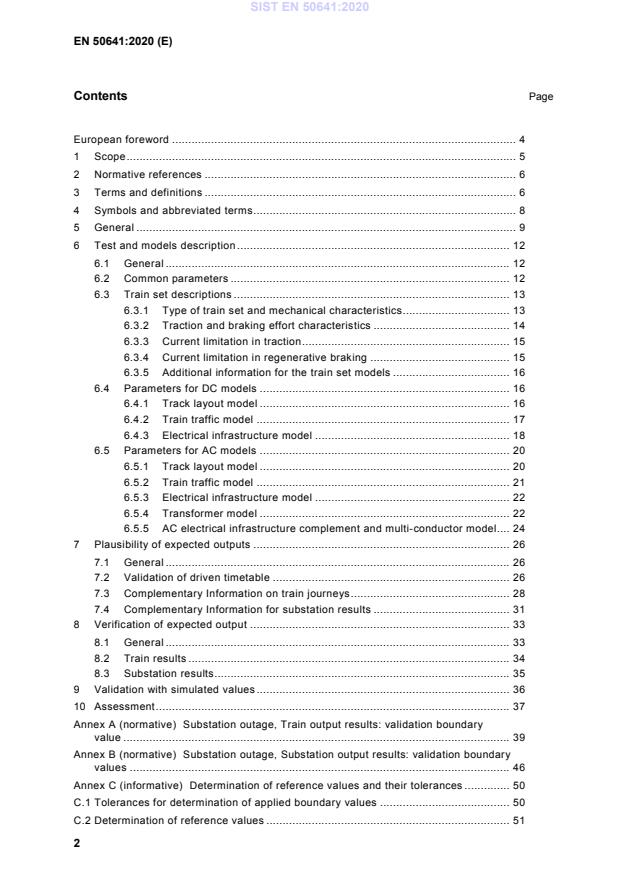
Contents Page
European foreword . 4
1 Scope . 5
2 Normative references . 6
3 Terms and definitions . 6
4 Symbols and abbreviated terms . 8
5 General . 9
6 Test and models description . 12
6.1 General . 12
6.2 Common parameters . 12
6.3 Train set descriptions . 13
6.3.1 Type of train set and mechanical characteristics . 13
6.3.2 Traction and braking effort characteristics . 14
6.3.3 Current limitation in traction . 15
6.3.4 Current limitation in regenerative braking . 15
6.3.5 Additional information for the train set models . 16
6.4 Parameters for DC models . 16
6.4.1 Track layout model . 16
6.4.2 Train traffic model . 17
6.4.3 Electrical infrastructure model . 18
6.5 Parameters for AC models . 20
6.5.1 Track layout model . 20
6.5.2 Train traffic model . 21
6.5.3 Electrical infrastructure model . 22
6.5.4 Transformer model . 22
6.5.5 AC electrical infrastructure complement and multi-conductor model . 24
7 Plausibility of expected outputs . 26
7.1 General . 26
7.2 Validation of driven timetable . 26
7.3 Complementary Information on train journeys . 28
7.4 Complementary Information for substation results . 31
8 Verification of expected output . 33
8.1 General . 33
8.2 Train results . 34
8.3 Substation results . 35
9 Validation with simulated values . 36
10 Assessment . 37
Annex A (normative) Substation outage, Train output results: validation boundary
value . 39
Annex B (normative) Substation outage, Substation output results: validation boundary
values . 46
Annex C (informative) Determination of reference values and their tolerances . 50
C.1 Tolerances for determination of applied boundary values . 50
C.2 Determination of reference values . 51
Annex D (informative) Individual graphs for each system and operating condition
infrastructure . 52
Annex ZZ (informative) Relationship between this European Standard and the Essential
Requirements of Directive (EU) 2016/797 aimed to be covered . 68
Bibliography . 69
European foreword
This document (EN 50641:2020) has been prepared by CLC/SC 9XC “Electric supply and earthing systems
for public transport equipment and ancillary apparatus (Fixed installations)”, of Technical Committee
CLC/TC 9X “Electrical and electronic applications for railways”.
The following dates are fixed:
• latest date by which this document has to be (dop) 2020-11-04
implemented at national level by publication of
an identical national standard or by
endorsement
• latest date by which the national standards (dow) 2022-11-04
conflicting with this document have to be
withdrawn
This document has been prepared under a mandate given to CENELEC by the European Commission and
the European Free Trade Association, and supports essential requirements of EU Directive(s).
For the relationship with EU Directive(s) see informative Annex ZZ, which is an integral part of this
document.
Experts representing approximately ten member states worked to draft a complete new document. The
results and data are taken from the most well-known representative simulation softwares in Europe and
related experts. This document provides a means of assessing simulation tools and provides assurance to
anyone who depends upon their output. Future versions will include other cases such as urban traffic.
1 Scope
This document specifies requirements for the acceptance of simulation tools used for the assessment of
design of electric traction power supply systems with respect to TSI Energy.
This document is applicable to the simulation of AC and DC electric traction power supply systems, in the
frame of assessment required by Directive (EU) 2016/797. The methods and parameters defined in this
document are only intended for use in the design of the electric traction power supply system, and hence
this document solely considers validation of tools within the TSI energy subsystem for all envisaged railway
networks.
This document does not deal with validation of simulation tools by measurement.
This document focuses on the core simulation functions comprising the equations and functions which
calculate the mechanical movement of trains and also which calculate the load flow of the electrical traction
power supply system. In doing so this document provides all requirements necessary to demonstrate that
a simulation tool may be used for the purposes of TSI approval of electric traction power supply systems.
Any simulation tool which meets the acceptance requirements of the test cases in this document can be
used to determine TSI compatibility for all systems of the same voltage and frequency without any
requirement for further validation as part of the TSI assessment process.
This document includes controls for the modification of simulation tools, in particular the limits of applicability
of certification when tools are modified. These controls focus on determining whether the core functions of
the simulation model are modified.
This document provides only the requirements for demonstration of the algorithms and calculations of core
functions. The use of a certified simulation tool in accordance with this document does not, in itself,
demonstrate good practice in electric traction power supply system design, neither does it guarantee that
the simulation models and data for infrastructure or trains used in the tool are correct for a given application.
The choice and application of any models and data, of individual system components, in a design is
therefore subject to additional verification processes and not in the Scope of this document. Competent
development of design models and full understanding of the limits of design tools remain requirements in
any system design. This document does not reduce any element of the need for competent designers to
lead the design process.
The test cases and data shown in Clause 6 in this document do not represent an existing network, but
these data are used as theoretical/virtual network only for the purpose of verification of the core
functionality.
NOTE A new test case will be drafted considering metro, tramways and trolleybuses using DC 600 V or DC 750 V.
Until this test case is available, this document can also be applied to subway, tram and trolley bus systems. This test
case will also integrate rail systems using DC 750 V.
Additionally, the application of this document ensures that the output data of different simulation tools are
consistent when they are using the same set of input data listed in Clause 6.
This document only applies to the simulation of electric traction power supply systems characteristics at
their nominal frequency for AC or DC systems. It does not consider harmonic studies, electrical safety
studies (e.g. rail potential), short circuit or electromagnetic compatibility studies over a wide frequency
spectrum. This document does not mandate the use of a particular simulation tool in order to validate the
design of an electric traction power supply system.
This document does not consider complex models with active components such as static frequency
convertors.
2 Normative references
The following documents are referred to in the text in such a way that some or all of their content constitutes
requirements of this document. For dated references, only the edition cited applies. For undated references,
the latest edition of the referenced document (including any amendments) applies.
EN 50163:2004, Railway applications - Supply voltages of traction systems
EN 50388:2012, Railway Applications - Power supply and rolling stock - Technical criteria for the
coordination between power supply (substation) and rolling stock to achieve interoperability
3 Terms and definitions
For the purposes of this document, the terms and definitions given in EN 50163:2004, EN 50388:2012 and
the following apply.
ISO and IEC maintain terminological databases for use in standardization at the following addresses:
• IEC Electropedia: available at http://www.electropedia.org/
• ISO Online browsing platform: available at http://www.iso.org/obp
3.1
assessor
entity that carries out an assessment
[SOURCE IEC 60050-821:2017, 821-12-05]
3.2
electric traction system
electric traction power supply system
railway electric distribution network used to provide energy for rolling stock
[SOURCE: IEC 60050-811:2017, 811-36-21, modified – “electric traction power supply system” has been
added as synonym and the Note 1 to entry has been removed.]
3.3
proposer
organization which proposes the simulation and validation
Note 1 to entry: This will normally be the software owner and or developer.
3.4
simulation accuracy
indicator dedicated to the characterization of the accuracy of the simulation output regarding a reference
(measure or theoretical model) for a given case
3.5
simulation method
construction and solution of a numerical time-step or space-step model of train movement and electric
traction power supply performance
3.6
simulation tool
software implementing a simulation method(s)
3.7
software quality management
management system for software to be updated
Note 1 to entry: The processes are the following:
— software development process comprising the steps of development request, software test, release;
— life cycle process with the steps release plan, versioning with code protection and changelog, bug tracking,
documentation (user manual, help system, developer's guide if any).
3.8
track layout model
model describing the physical characteristics of the track such as curves, tunnels and gradient description
3.9
train set
combination of vehicles coupled together
Note 1 to entry: Vehicle includes banking locomotives.
3.10
train set model
model describing the electrical and mechanical characteristics of the train set
3.11
train traffic model
model of the train service and the timetable over a given time period
3.12
validation
confirmation, through the provision of objective evidence, that the requirements for a specific intended use
or application have been fulfilled
Note 1 to entry: Verification is a prerequisite for validation.
[SOURCE: IEC 60050-192:2015, 192-01-18, modified – Notes 1 to 5 to entry have been removed and a
new Note 1 to entry has been added.]
3.13
verification
confirmation, through the provision of objective evidence, that specified requirements have been fulfilled
Note 1 to entry: Whilst the general term in this document is assessment, verification is commonly understood in the
assessment of models and data analysis and its use is more specific than the general term conformity.
[SOURCE: IEC 60050-192:2015, 192-01-17, modified – Notes 1 to 3 to entry have been removed and a
new Note 1 to entry has been added.]
4 Symbols and abbreviated terms
For the purposes of this document, the following symbols and abbreviated terms apply.
A coefficient of running resistance independent of speed
a knee point factor (see EN 50388:2012, 7.2)
AT autotransformer
ATPP autotransformer paralleling post including paralleling of CLS
B coefficient of running resistance for linear dependence of speed
C coefficient of running resistance for quadratic dependence of speed
CLS contact line system (overhead contact line or third rail)
cos φ power factor for the traction and auxiliary power
EMU electrical multiple unit
F tractive effort
F maximum tractive effort
m
FR freight train set
F running resistance
res
HS high speed train set
NOTE This name is used as a general term and does not relate to similar definitions given in
Directive (EU) 2016/797.
I current
I current for train set auxiliaries (e.g. air conditioning)
aux
I braking current of the train set
braking
I maximum current consumed by the train set at U
max n
Ind inductive behaviour
N/A not applicable
P auxiliary active power
aux
P maximum mechanical power
max
PP paralleling post where CLS of both tracks are electrically connected
R equivalent internal resistance of a substation
eq
SP sectioning point of the CLS for each track.
SS substation including paralleling of CLS
SUB suburban train set
TSI technical specification of interoperability
U no load voltage at a substation for DC traction system
di0
U no load voltage at a substation for AC traction system
U short circuit voltage of a transformer
cc
UIC60 rail profile with a mass of 60 kg/m
U highest permanent voltage (see EN 50163:2004)
max1
Umax2 highest non-permanent voltage (see EN 50163:2004)
U mean useful voltage (see EN 50388:2012, 8.2)
mean useful
U lowest non-permanent voltage (see EN 50163:2004)
min2
U nominal voltage for a given electrical supply system
n
U current collector voltage
p
V speed in km/h
v transfer speed 1 (transfer from adhesion characteristic to maximum voltage characteristic of
drive)
v transfer speed 2 (transfer from maximum voltage characteristic to torque limitation
characteristic of drive)
v maximum speed
v maximum allowed speed (track, train set)
max
Z transformer impedance
TR
η
traction/braking efficiency
µ relative permeability
r
5 General
This document considers the acceptance of typical impedance based models of electric traction power
supply systems at fundamental frequency or DC. Both lumped and multiconductor impedance models are
covered, but this document does not consider complex models of active components such as a static
frequency converter.
The theoretical study of the interactions between the operation of rolling stock and the power supply system
by means of computer simulation is generally used to obtain detailed information about a traction power
system. This minimizes the costs of live tests, and as a consequence optimizes the investment to be made
for a given performance of the electrical railway system.
Depending on the type of the supply system (for example: AC or DC system), the simulation tools require
different data and different system descriptions. Therefore the scope of the simulation should be defined in
advance, taking account of possible supply systems (see Figure 1). The assessment process of the
simulation is in two parts. Firstly, a validation process is undertaken which compares in a qualitative way
specific characteristics of the key simulation output graphs, in order to validate the performance of the
simulation at critical events. Secondly, the quantitative verification of the simulation is assessed by
comparing key calculated values with those given in this document. The verification process laid out in this
document is based on a verification using a defined benchmark example of an electric traction power supply
system, and employing a common set of input data incorporating the infrastructure (including station
locations, gradient, speed limit), types of train sets and timetable.
NOTE The output data sets have been developed through assessment with several existing simulation tools,
currently used in electric traction power supply system design, and which therefore represent a range of differences
within core algorithms. The simulation accuracy of the outputs from these tools were compared, and tolerances applied
to cover the range of variation considered reasonable across all tools. The observed variation in these tools has no
effect on their applicability for use in TSI assessments, and hence this range of tolerance can be applied to the
acceptance of new tools. Annex C gives information on the calculation methodology of tolerances for determination of
applied boundary values.
The following cases are provided in the standard:
— DC 1,5 kV,
— DC 3 kV,
— AC 15 kV, lumped element,
— AC 25 kV, lumped element,
— AC 25 kV, multi-conductor model,
— AC 2x25 kV, multi-conductor model.
In order to obtain an acceptable verification of a simulation tool, the results of the simulation tool shall be
compared with the output results presented in this document according to the criteria described in
Annexes A and B.
In order to use a simulation tool with confidence, it shall be validated initially and after each revision of the
core functions of the software that have an impact on the simulation results. If the modification affects a
core function then a new validation is necessary. The validation shall be done by following the steps shown
in Figure 1.
Core functions of the simulation tools are the algorithms to:
— solve the differential equations of train sets movement resulting in power demand at current
collector(s);
— calculate the load flow (current-voltage) of the electrical network with changing configurations caused
by moving loads.
Interaction between mechanical and electrical core functions are required to provide an integrated solution,
where lack of electrical power will feedback to influence the train set movement including iterations as
necessary.
The core functionality comprises the algorithms of mechanical train movement, the electrical network load
flow, and the interaction between mechanical and electrical core functions required to provide an integrated
solution.
Changes to these core functions, and also functions outside the core such as interaction with the user,
presentation and pre-processing of data and models before passing to the core, and all post-processing of
data from the core, do not require full validation by an assessor. If a validated simulation tool has been
certified, the organization holding the certificate may asses such changes, subject to the requirements for
internal software quality management to provide a traceable audit process to these changes.
Figure 1 — Steps of validation
6 Test and models description
6.1 General
Common parameters for both AC and DC systems are given in 6.2 and 6.3. Parameters specific to DC and
AC systems are given respectively in 6.4 and 6.5.
The test case configurations and data are used for the purpose of the standard only. They do not represent
typical applications for system design.
6.2 Common parameters
The test case describes simple traffic along a given open air double track straight line. Although there are
some differences due to the different supply systems, some parameters remain identical among the test
cases, in particular:
— traffic timetable;
— train set.
The maximum track operational speed is 200 km/h for all train types.
The general description of the case is described in Figure 2. Distances are indicated in Tables 2 and 3 for
DC cases and Tables 6 and 7 for AC cases.
Station Station
Station Station Station
Station
Track 2
Track 1
A B C D E F
Train set
Station
Railway station position
Figure 2 — Test case general description
Three different kinds of train set are defined throughout the test case:
a) high speed train set;
b) suburban train set;
c) freight train set.
6.3 Train set descriptions
6.3.1 Type of train set and mechanical characteristics
The mechanical characteristics for the three different kinds of train set of this test case are provided as
follows:
a) high speed train set (HS): locomotive and coaches;
b) suburban train set (SUB): EMU;
c) freight train set (FR): locomotive and wagons.
The parameters shall be as specified in Table 1.
Table 1 — Train set mechanical and traction characteristics
SUB
Type Unit HS FR
(2 units)
Speed v km/h 110 50 80
Speed v km/h 180 140 140
Speed v km/h 220 160 160
Maximum allowed train set speed km/h 220 160 100
Maximum Tractive effort F kN 250 320 250
m
Tractive effort at v kN 152,8 114,3 143
Tractive effort at v kN 102 87,5 109,4
Total mass t 580 400 1 580
Rotating mass t 58 40 158
Efficiency (η) - 85 % 85 % 85 %
Power factor at the pantograph (traction /
- 0,96 ind. 0,96 ind. 0,96 ind.
a
braking and auxiliaries)
Auxiliary active power P MW 0,5 0,4 0
aux
A kN 9,23 3,351 6 24,3
B kN/(km/h) 0,015 8 0,008 208 0,084 7
C kN/(km/h) 0,001 23 0,000 66 0,004 03
Locomotive(s) - 1 2 (EMU) 1
Coaches/wagon - 10 - 25
Max permissible deceleration m/s 0,8 1 0,5
a
Applicable only to the AC cases; for DC cases the power factor is 1.
For the locomotives for the HS and FR train sets, the individual parameters shall be:
— mass : 80 t;
The running resistance shall be defined using a formula: F = A + B x v + C x v with v the speed in km/h.
res
The A, B and C coefficients apply to the whole train set.
Additionally, it shall be understood that:
— the tractive effort for the SUB train set is provided for the whole train set, thus the two units combined
have a total tractive effort of 320 kN;
— the adhesion factor and the acceleration are not provided as the tractive effort is assumed to be
transferred to the track under all circumstances;
— for braking, it is assumed that it is possible to brake with the desired deceleration under all
circumstances;
— train set mass model is concentrated.
NOTE 1 If train mass model is distributed, then a length of 1 m can be used.
— current collection point is located at the front end of the train;
— the efficiency (η) refers to the whole traction chain from current collector to the wheels not taking into
account the auxiliary power;
— the efficiency (η) and the power factor are both applicable to the whole train set speed range;
— the tractive effort is dependent upon the line voltage caused by current limitation as defined in 6.3.3.
NOTE 2 Some data are given to provide more clarity, precise formulae are given in this document.
6.3.2 Traction and braking effort characteristics
The tractive effort of the train set used is described according to a standardized tractive effort (F) versus
speed (v) characteristic which will be defined according to a set of parameters. The model and the
parameters are described hereafter in Figure 3.
The curve for regenerative braking effort shall be the same as the tractive effort versus speed curve.
Train set traction force versus Time
F
m
v v v
1 2 3
F = 0 kN when v > v
0 50 100 150 200 250 300
v (km/h)
Figure 3 — Tractive effort diagram example for a train set at nominal voltage
F (kN)
Zone 1
Zone 2
Zone 3
The maximum tractive effort behaviour illustrated in Figure 3 shall be as follows:
— Zone 1: F = F from v = 0 km/h to v = v
m 1
— Zone 2: F = F(v ) × v / v from v = v to v = v ;
1 1 1 2
2 2
— Zone 3: F = F(v ) × v / v ;
2 2
— when v > v , F = 0.
The v , v , v characteristics are provided in 6.3.1.
1 2 3
6.3.3 Current limitation in traction
The current limitation with respect to the voltage level shall be taken into account according to
EN 50388:2012, 7.2, for the traction mode only (not for regenerative braking). Figure 4 is representative of
the limiting current:
I (Train set current)
I
max
I
aux
U
p
Umin2
a × U U
n max2
(Voltage at the
current collector)
Figure 4 — Maximum traction current as a function of voltage
The value a shall be as specified according to EN 50388:2012, 7.2, and U , U , U shall be as specified
n min2 max2
in EN 50163:2004. The current limitation applies to the current at the current collector and the parameters
I and I shall be calculated as follows:
aux max
— I = P / (U × cos φ) ;
aux aux min2
— I = (P / (η × cos φ) + P / cos φ) / U , with P the maximum mechanical power at U ;
max max aux n max n
For the DC case, use the formula above taking into account the value for cos φ equal to 1.
NOTE According to EN 50388:2012, Imax is the maximum current consumed by the train set at Un.
6.3.4 Current limitation in regenerative braking
The current limitation due to regenerative braking shall be as defined in Figure 5.
Available current
Available electrical
current from the
braking at Umax1:
Ibraking Zone 1
Zone 2
U
p
(Voltage at the
Umax1
U
max2
current collector)
Figure 5 — Regenerative braking, Current limitation vs Current collector Voltage
Ibraking shall be calculated as follows:
I = (η × P – P ) / (cos φ × U )
braking max aux max1
where
η is equal to 85 %, in accordance with the value provided in 6.3.1;
P is the maximum available mechanical power provided by the regenerative braking
max
effort when in the braking phase;
I is the current at the current collector;
braking
— In zone 1, there is no limitation of the regenerated current;
— In zone 2, between U and U the decrease of available regenerated
max1 max2
current is strictly linear.
6.3.5 Additional information for the train set models
The following parameters have very limited influence and shall only be provided for general information:
— the current collector position at which the train set voltage is calculated,
— train set reference position at which the train stops in a station.
6.4 Parameters for DC models
6.4.1 Track layout model
6.4.1.1 Route gradient
The route gradient shall be as specified in Table 2, and is based on the description set out in Figure 2:
Table 2 — Gradient description along the route
Position
Gradient
km
‰
Start End
0 20,5 0
20,5 29,5 5
29,5 30,5 0
30,5 34,5 10
34,5 35,5 0
35,5 39,5 −10
39,5 40,5 0
40,5 49,5 −5
49,5 52 0
For example, the first line of Table 2 indicates that from position 0 km to position 20,5 km, the gradient is
0 ‰.
Negative gradient indicates downhill in direction of increasing position.
6.4.1.2 Station locations
The station positions shall be as specified in Table 3, and is based on the description set out in Figure 2:
Table 3 — Station position along the line
Position
Station
km
Station A 0
Station B 10
Station C 20
Station D 30
Station E 40
Station F 50
6.4.2 Train traffic model
The train traffic model, including the timetable, shall be as specified in Table 4.
Table 4 — Timetable description
Departure
Train Train set Departure End
time
Additional information
no type position position
hh:mm
101 HS Station A (0 km) 00:00 Station F
Station A (0 km) 00:05
Stop at every intermediate
Station B (10 km) 00:12
station
201 SUB Station C (20 km) 00:19 Station F
Minimum dwell time for each
Station D (30 km) 00:26
station: 1 min
Station E (40 km) 00:33
103 HS Station A (0 km) 00:30 Station F
301 FR Station A (0 km) 00:35 Station F
102 HS Station F (50 km) 00:10 Station A
104 HS Station F (50 km) 00:40 Station A
The following additional data shall be used:
— all trains use the shortest running time;
— there are fixed departure times for all stations and a minimum fixed dwell time of 1 min in case of delay;
— after arrival at the last station, the train is removed immediately from the simulation;
— there is no dwell time at the first and last station (except if convenient from an implementation point of
view);
— every train stops at station F and station A;
— all trains are starting at a speed of 0 km/h
— there are no constraints on train running as a result of signalling.
6.4.3 Electrical infrastructure model
Different infrastructure configurations are defined for each type of traction supply system. The
characteristics defined in Table 5 shall be used.
Table 5 — Infrastructure electrical characteristics
Traction
Supply Station A B C D E F
System
Position (km) 0,0 7,5 10,0 15,0 20,0 22,5 30,0 32,5 40,0 45,0 50,0
Outage of substation SS PP SS SS SS PP PP PP SS SS SS
Permanent paralleling of the CLS of each track in SS and PP only
CLS
DC
0,029 5 Ω/km per track
1,5 kV
Track resistance: 0,020 Ω/km per track,
Track
if no permanent paralleling of the rail/track, rail/track paralleling every 250 m
Specificity No earthing cable, rails not earthed
Position (km) 0,0 10,0 20,0 33,0 45,0
Outage of substation SS PP PP PP SS
Permanent paralleling of the CLS of each track in SS and PP only
CLS
DC
0,059 Ω/km per track
3 kV
Track resistance: 0,020 Ω/km per track,
Track
if no permanent paralleling of the rail/track, rail/track paralleling every 500 m
Specificity No earthing cable, rails not earthed
Key
CLS Contact line system,
PP Paralleling post location
SS Substation location, including paralleling
The track numbering is defined in Figure 2, and can be summarized as follows:
— Track 1: increasing km;
— Track 2: decreasing km.
Direct connections of negligible resistance may be assigned a resistance value of 0,0001 Ω if a value is
specifically required by the simulation tool.
The voltage source equivalent circuit for a DC substation is shown in Figure 6:
R
eq
Contact line system
U
di0
Return circuit
Key
Udi0 ideal direct voltage
Req equivalent source resistance
Figure 6 — Transformer and rectifier model for standard system
For the no load voltages of each substation, the value provided as Umax1 in EN 50163:2004 shall be used.
According to Figure 6, the values of each system shall be:
– DC 1,5 kV: R = 0,01 Ω and U = 1,8 kV,
eq di0
– DC 3 kV: R = 0,01 Ω and U = 3,6 kV.
eq di0
6.5 Parameters for AC models
6.5.1 Track layout model
6.5.1.1 Route gradient
The route gradient shall be as specified in Table 6, and is based on the description set out in Figure 2.
Table 6 — Gradient description along the line, AC systems
Position
Gradient
km
‰
Start End
0 41 0
41 59 5
59 61 0
61 69 10
69 71 0
71 79 −10
79 81 0
81 99 −5
99 104 0
6.5.1.2 Stations locations
The stations locations shall be as specified in Table 7, and is based on the description set out in Figure 2:
Table 7 — Stations locations along the line
Position
Station
km
Station A 0
Station B 20
Station C 40
Station D 60
Station E 80
Station F 100
Stations shall allow passing and crossing of trains.
6.5.2 Train traffic model
The train traffic model, including the timetable, shall be as specified in Table 8.
Table 8 — Timetable description
Departure
Train Train set Departure End
time
Additional information
no type position position
hh:mm
101 HS Station A (0 km) 00:00 Station F
Station A (0 km) 00:05
Stop at every intermediate
Station B (20 km) 00:24
station
201 SUB Station C (40 km) 00:38 Station F
Minimum dwell time for each
Station D (60 km) 00:52
station: 1 min
Station E (80 km) 01:06
103 HS Station A (0 km) 00:30 Station F
301 FR Station A (0 km) 00:35 Station F
102 HS Station F (100 km) 00:10 Station A
104 HS Station F (100 km) 00:40 Station A
The following additional data shall be used:
— all trains use the shortest running time;
— there are fixed departure times for all stations and a minimum fixed dwell time of 1 min in case of delay;
— after arrival at the last station, the train is removed immediately from the simulation;
— there is no dwell time at the first and last station (except if convenient from an implementation point of
view);
— every train stops at station F and station A;
— all trains are starting at a speed of 0 km/h
— there are no constraints on train running as a result of signalling.
6.5.3 Electrical infrastructure model
The infrastructure definition is dependent upon the traction supply system. The characteristics defined in
Table 9 shall be used.
In AC systems the data for the rail is not used and is only informative when using the lumped impedance
model.
Table 9 — Infrastructure electrical characteristics
Station A B C D E F
System
Position (km) 0,00 20,00 40,00 50,00 60,00 80,00 100,00
Outage of substation SS PP PP PP PP PP PP
Lumped impedance for one track: (0,1 + j0,1) Ω/km
AC 15 kV
Permanent paralleling of the CLS of each track in SS and PP
CLS and rail loop
16,7 Hz
only
impedance
Paralleling and bonding of all rails every 250 m
Substation earthing resistance is 1 Ω
Outage of substation SS PP PP PP PP PP PP
Lumped impedance for one track: (0,15 + j0,45) Ω/km
For multi-conductor model, refer to Table 10, Figure 9 and
AC 25 kV
Figure 7
CLS and rail loop
50 Hz
Permanent paralleling of the CLS of each track in SS and PP
impedance
only
Paralleling and bonding of all rails every 250 m
Substation earthing resistance is 1 Ω
Outage of AT SS ATPP ATPP ATPP PP
Refer to Table 10, Figure 9 and Figure 8
Permanent paralleling of the CLS of each track in SS, PP and
AC 2 × 25 kV CLS and Return
ATPP only
50 Hz circuit
Paralleling and bonding of all rails every 250 m
Substation and AT earthing resistance is 1 Ω
Key
AT Autotransformer location with one AT. AT values are given in 6.5.5.
CLS Contact line system
PP Paralleling post location
SP Sectioning point
SS Substation location, including paralleling
The track numbering is defined in Figure 2, and can be summarized as follows:
— Track 1: increasing km;
— Track 2: decreasing km.
6.5.4 Transformer model
A simple lumped transformer model shall be used as shown in Figure 7.
Z
TR
Contact line system
U
Return circuit
Key
U0 no load voltage at the substation for a given electrical supply system
ZTR transformer impedance
Figure 7 — Transformer model for standard system
For the no load voltages of each substation, the value provided as Umax1 in EN 50163:2004 shall be used.
As given in Figure 7, the values for each system shall be:
— AC 15 kV - 16,7 Hz: Z = (0,05 + j 0,5) Ω and U = 16,5 kV,
TR 0
— AC 25 kV - 50 Hz: Z = (0,2 + j 2) Ω and U = 27,5 kV.
TR 0
For the 2 × 25 kV – 50 Hz case: Z = (0,2 + j 2) Ω, U = 27,5 kV as given in Figure 8. For the 2 × 25 kV –
TR 0
50 Hz case, a specific model shall be used as shown in Figure 8. The model given in Figure 8 refers to the
equivalent transformer impedance Z seen from the secondary winding side.
TR
Z
TR
Contact line system
U
Return circuit
U
Z
TR
Negative Feeder
Key
U no load voltage at the substation for a given electrical supply system
Z
TR transformer impedance
Figure 8 — Substation transformer model for 2 × 25 kV – 50 Hz system
NOTE The model given in Figure 8 includes the primary winding impedance.
The direction of arrows will be explained in the future EN 50388-1.
6.5.5 AC electrical infrastructure complement and multi-conductor model
No length for a neutral section zone shall be used between 2 electrical sections (for example: for 25 kV –
50 Hz and 2 × 25 kV – 50 Hz systems).
For AC systems, there is a choice of whether to use a lumped impedance model or a multi-conductor model.
The choice of model between the lumped impedance or multi-conductor models leads to different results.
Therefore, no strict comparison can be done between the two types of model.
The multi-conductor model shall use the geometry in Figure 9 using the conductor characteristics in
Table 10.
Figure 9 — AC conductor geometry (AC model only)
Based on the conductor numbers in Figure 9, Table 10 gives the characteristics of each conductor
Catenary wire (4 and 9) and contact wire (3 and 8) of the same track are considered continuously connected
and geometrically parallel. Feeder wires number 5 and 10 have a constant height.
Table 10 — Individual conductor characteristics and geometry (AC model only)
DC Equivalent Relative
Conductor Section
Track Conductor Use Remark x y Material Resistivity radius permeability
no. (mm )
(1e-8 ) (mm) (µr)
Ω⋅m
Return
1 1 Rail UIC60 −1,00 0,00 Steel 7 000 20,00 75 50
current
Return
2 1 Rail UIC60 −2,50 0,00 Steel 7 000 20,00 75 50
current
Contact Supply
3 1 −1,75 5,70 Copper 120 1,60 6 1
wire current
Catenary Supply
4 1 −1,75 6,90 Bronze 70 3,00 5 1
wire current
Only for
Negative
5 1 Feeder 2 × 25 kV −4,75 8,50 Aluminium 288 2,80 10 1
feeder
case
Return
6 2 Rail UIC60 1,00 0,00 Steel 7 000 20,00 75 50
current
Return
7 2 Rail UIC60 2,50 0,00 Steel 7 000 20,00 75 50
current
Contact Supply
8 2 1,75 5,70 Copper 120 1,60 6 1
wire current
Catenary Supply
9 2 1,75 6,90 Bronze 70 3,00 5 1
wire current
Only for
Negative
10 2 Feeder 2 × 25 kV 4,75 8,50 Aluminium 288 2,80 10 1
feeder
case
Complementary data
Earth conduct
...