

EN 50122-1:2022
(Main)Railway applications - Fixed installations - Electrical safety, earthing and the return circuit - Part 1: Protective provisions against electric shock
General Information
- Abstract
This document specifies requirements for the protective provisions relating to electrical safety in fixed installations associated with AC and/or DC traction systems and to any installations that can be endangered by the electric traction power supply system. This also includes requirements applicable to vehicles on electrified lines. It also applies to all aspects of fixed installations which are necessary to ensure electrical safety during maintenance work within electric traction power supply systems. This document applies to new electric traction power supply systems and major revisions to electric traction power supply systems for: a) railways; b) guided mass transport systems such as 1) tramways, 2) elevated and underground railways, 3) mountain railways, 4) trolleybus systems, 5) electric traction power supply systems for road vehicles, which use an overhead contact line system, and 6) magnetically levitated systems, which use a contact line system; c) material transportation systems. This document does not apply to: a) electric traction power supply systems in underground mines, b) cranes, transportable platforms and similar transportation equipment on rails, temporary structures (e.g. exhibition structures) in so far as these are not supplied directly or via transformers from the contact line system and are not endangered by the electric traction power supply system, c) suspended cable cars, d) funicular railways, e) existing vehicles. This document does not specify working rules for maintenance. The requirements within this document related to protection against electric shock are applicable to persons only.
- Status
- Published
- Publication Date
- 01-Sep-2022
- Technical Committee
- CLC/TC 9X - Electrical and electronic applications for railways
- Current Stage
- 6060 - Document made available - Publishing
- Start Date
- 02-Sep-2022
- Due Date
- 13-Apr-2021
- Completion Date
- 02-Sep-2022

Overview
EN 50122-1:2022 - published by CLC/CENELEC - defines protective provisions against electric shock for fixed installations associated with AC and/or DC traction systems. It covers electrical safety, earthing (grounding) and the return circuit for new electric traction power supply systems and major revisions used in railways, tramways, metros, mountain railways, trolleybus systems, electric road vehicles using overhead contact lines, magnetically levitated systems with contact lines and material transportation systems. The standard also includes requirements applicable to vehicles on electrified lines and to fixed installations that may be endangered by traction power. It excludes certain applications (e.g., underground mines, suspended cable cars, funiculars, cranes not supplied from the contact line, and existing vehicles).
Key topics and requirements
EN 50122-1:2022 structures technical requirements to manage electric shock risk and safe earthing/return circuits. Major topic areas include:
- Protective provisions against direct contact
- Clearance design, electrically protective obstacles, anti-climbing measures, and protections for vehicle-mounted live parts.
- Protection against indirect contact and non‑galvanic coupling
- Equipotential bonding, exposed-conductive-part treatment, and mitigation of inductive/capacitive coupling risks.
- Low-voltage non-traction systems
- Design and earthing schemes (TT/TN/IT concepts) for installations located in overhead contact line and current collector zones.
- Return circuit and track-related hazards
- Measures for track systems used to carry traction return current, insulating joints, parallel pipework and surge protection.
- Specific systems
- Ground-level conductor rail protections, current collector zones, and requirements for systems where vehicle wheels are not used for return.
- Limits and measurement
- Criteria for touch voltage, body voltage, time‑duration considerations and access control to manage rail potential hazards.
- Maintenance considerations
- Requirements to ensure electrical safety during maintenance (note: the standard does not set working rules for live working).
(These topics align with the standard’s structured clauses on clearances, bonding, touch voltage limits and protective devices.)
Practical applications and users
This standard is essential for:
- Railway system designers and electrical engineers specifying traction power installations
- Infrastructure owners and operators (rail, tram, metro, trolleybus and electric-road projects)
- Project managers and consultants involved in electrified transport infrastructure upgrades
- Depot and workshop designers ensuring safe maintenance environments
- Regulatory bodies and safety assessors validating compliance with European electrical safety practice
Using EN 50122-1:2022 helps reduce electric-shock risk, guide earthing strategy, and standardize return-circuit design across electrified transport projects.
Related standards
Refer to other parts of the EN 50122 series and relevant CENELEC/IEC standards for complementary topics (electromagnetic compatibility, installation practices and testing procedures) when developing or auditing traction power systems.
Keywords: EN 50122-1:2022, electrical safety, earthing, return circuit, protective provisions against electric shock, railway traction systems, touch voltage, equipotential bonding.
Relations
- Effective Date
- 23-Jan-2023
- Effective Date
- 06-Sep-2022
- Effective Date
- 06-Sep-2022
- Effective Date
- 06-Sep-2022
- Effective Date
- 17-Sep-2018
- Effective Date
- 17-Sep-2018
- Effective Date
- 17-Sep-2018
- Effective Date
- 20-Feb-2026
- Effective Date
- 10-Feb-2026
- Effective Date
- 10-Feb-2026
- Effective Date
- 09-Feb-2026
- Effective Date
- 03-Feb-2026
- Effective Date
- 03-Feb-2026
- Effective Date
- 03-Feb-2026
- Effective Date
- 03-Feb-2026
Get Certified
Connect with accredited certification bodies for this standard

IMQ S.p.A. (Certification)
Italian electrical product certification.

SLG Prüf- und Zertifizierungs GmbH
German testing and certification body.

UL Solutions
Global safety science company with testing, inspection and certification.
Sponsored listings
Frequently Asked Questions
EN 50122-1:2022 is a standard published by CLC. Its full title is "Railway applications - Fixed installations - Electrical safety, earthing and the return circuit - Part 1: Protective provisions against electric shock". This standard covers: This document specifies requirements for the protective provisions relating to electrical safety in fixed installations associated with AC and/or DC traction systems and to any installations that can be endangered by the electric traction power supply system. This also includes requirements applicable to vehicles on electrified lines. It also applies to all aspects of fixed installations which are necessary to ensure electrical safety during maintenance work within electric traction power supply systems. This document applies to new electric traction power supply systems and major revisions to electric traction power supply systems for: a) railways; b) guided mass transport systems such as 1) tramways, 2) elevated and underground railways, 3) mountain railways, 4) trolleybus systems, 5) electric traction power supply systems for road vehicles, which use an overhead contact line system, and 6) magnetically levitated systems, which use a contact line system; c) material transportation systems. This document does not apply to: a) electric traction power supply systems in underground mines, b) cranes, transportable platforms and similar transportation equipment on rails, temporary structures (e.g. exhibition structures) in so far as these are not supplied directly or via transformers from the contact line system and are not endangered by the electric traction power supply system, c) suspended cable cars, d) funicular railways, e) existing vehicles. This document does not specify working rules for maintenance. The requirements within this document related to protection against electric shock are applicable to persons only.
This document specifies requirements for the protective provisions relating to electrical safety in fixed installations associated with AC and/or DC traction systems and to any installations that can be endangered by the electric traction power supply system. This also includes requirements applicable to vehicles on electrified lines. It also applies to all aspects of fixed installations which are necessary to ensure electrical safety during maintenance work within electric traction power supply systems. This document applies to new electric traction power supply systems and major revisions to electric traction power supply systems for: a) railways; b) guided mass transport systems such as 1) tramways, 2) elevated and underground railways, 3) mountain railways, 4) trolleybus systems, 5) electric traction power supply systems for road vehicles, which use an overhead contact line system, and 6) magnetically levitated systems, which use a contact line system; c) material transportation systems. This document does not apply to: a) electric traction power supply systems in underground mines, b) cranes, transportable platforms and similar transportation equipment on rails, temporary structures (e.g. exhibition structures) in so far as these are not supplied directly or via transformers from the contact line system and are not endangered by the electric traction power supply system, c) suspended cable cars, d) funicular railways, e) existing vehicles. This document does not specify working rules for maintenance. The requirements within this document related to protection against electric shock are applicable to persons only.
EN 50122-1:2022 is classified under the following ICS (International Classification for Standards) categories: 29.280 - Electric traction equipment. The ICS classification helps identify the subject area and facilitates finding related standards.
EN 50122-1:2022 has the following relationships with other standards: It is inter standard links to EN 50122-1:2011, EN 50122-1:2011/AC:2012, EN 50122-1:2011/A1:2011, EN 50122-1:2011/AC:2012, EN 50122-1:2011/A3:2016, EN 50122-1:2011/A4:2017, EN 50122-1:2011/A2:2016, ISO 3864-1:2011, IEC 60755:2017, ISO 7010:2019, EN 1731:2006, EN 60898-1:2019, HD 60364-4-41:2017, EN 50153:2014, EN 50119:2020. Understanding these relationships helps ensure you are using the most current and applicable version of the standard.
EN 50122-1:2022 is associated with the following European legislation: EU Directives/Regulations: 2008/57/EC, 2016/797/EU, 2016/797/EU, 2016/797/EU, 2016/797/EU, 2016/797/EU, 2016/797/EU, 2016/797/EU, 2016/797/EU, 2016/797/EU, 2016/797/EU, 2016/797/EU; Standardization Mandates: M/483, M/591. When a standard is cited in the Official Journal of the European Union, products manufactured in conformity with it benefit from a presumption of conformity with the essential requirements of the corresponding EU directive or regulation.
EN 50122-1:2022 is available in PDF format for immediate download after purchase. The document can be added to your cart and obtained through the secure checkout process. Digital delivery ensures instant access to the complete standard document.
Standards Content (Sample)
SLOVENSKI STANDARD
01-december-2022
Nadomešča:
SIST EN 50122-1:2011
SIST EN 50122-1:2011/A1:2011
SIST EN 50122-1:2011/A2:2017
SIST EN 50122-1:2011/A3:2017
SIST EN 50122-1:2011/A4:2017
SIST EN 50122-1:2011/AC:2012
SIST EN 50122-1:2011/AC:2013
Železniške naprave - Fiksni postroji - Električna varnost, ozemljitev in povratni
tokokrog - 1. del: Zaščitni ukrepi proti električnemu udaru
Railway applications - Fixed installations - Electrical safety, earthing and the return circuit
- Part 1: Protective provisions against electric shock
Bahnanwendungen - Ortsfeste Anlagen - Elektrische Sicherheit, Erdung und Rückleitung
- Teil 1: Schutzmaßnahmen gegen elektrischen Schlag
Applications ferroviaires - Installations fixes - Sécurité électrique, mise à la terre et circuit
de retour - Partie 1: Mesures de protection contre les chocs électriques
Ta slovenski standard je istoveten z: EN 50122-1:2022
ICS:
13.260 Varstvo pred električnim Protection against electric
udarom. Delo pod napetostjo shock. Live working
29.280 Električna vlečna oprema Electric traction equipment
2003-01.Slovenski inštitut za standardizacijo. Razmnoževanje celote ali delov tega standarda ni dovoljeno.
EUROPEAN STANDARD EN 50122-1
NORME EUROPÉENNE
EUROPÄISCHE NORM September 2022
ICS 29.280 Supersedes EN 50122-1:2011; EN 50122-
1:2011/A1:2011; EN 50122-1:2011/AC:2012; EN 50122-
1:2011/A2:2016; EN 50122-1:2011/A3:2016; EN 50122-
1:2011/A4:2017
English Version
Railway applications - Fixed installations - Electrical safety,
earthing and the return circuit - Part 1: Protective provisions
against electric shock
Applications ferroviaires - Installations fixes - Sécurité Bahnanwendungen - Ortsfeste Anlagen - Elektrische
électrique, mise à la terre et circuit de retour - Partie 1: Sicherheit, Erdung und Rückleitung - Teil 1:
Mesures de protection contre les chocs électriques Schutzmaßnahmen gegen elektrischen Schlag
This European Standard was approved by CENELEC on 2022-07-25. CENELEC members are bound to comply with the CEN/CENELEC
Internal Regulations which stipulate the conditions for giving this European Standard the status of a national standard without any alteration.
Up-to-date lists and bibliographical references concerning such national standards may be obtained on application to the CEN-CENELEC
Management Centre or to any CENELEC member.
This European Standard exists in three official versions (English, French, German). A version in any other language made by translation
under the responsibility of a CENELEC member into its own language and notified to the CEN-CENELEC Management Centre has the
same status as the official versions.
CENELEC members are the national electrotechnical committees of Austria, Belgium, Bulgaria, Croatia, Cyprus, the Czech Republic,
Denmark, Estonia, Finland, France, Germany, Greece, Hungary, Iceland, Ireland, Italy, Latvia, Lithuania, Luxembourg, Malta, the
Netherlands, Norway, Poland, Portugal, Republic of North Macedonia, Romania, Serbia, Slovakia, Slovenia, Spain, Sweden, Switzerland,
Türkiye and the United Kingdom.
European Committee for Electrotechnical Standardization
Comité Européen de Normalisation Electrotechnique
Europäisches Komitee für Elektrotechnische Normung
CEN-CENELEC Management Centre: Rue de la Science 23, B-1040 Brussels
© 2022 CENELEC All rights of exploitation in any form and by any means reserved worldwide for CENELEC Members.
Ref. No. EN 50122-1:2022 E
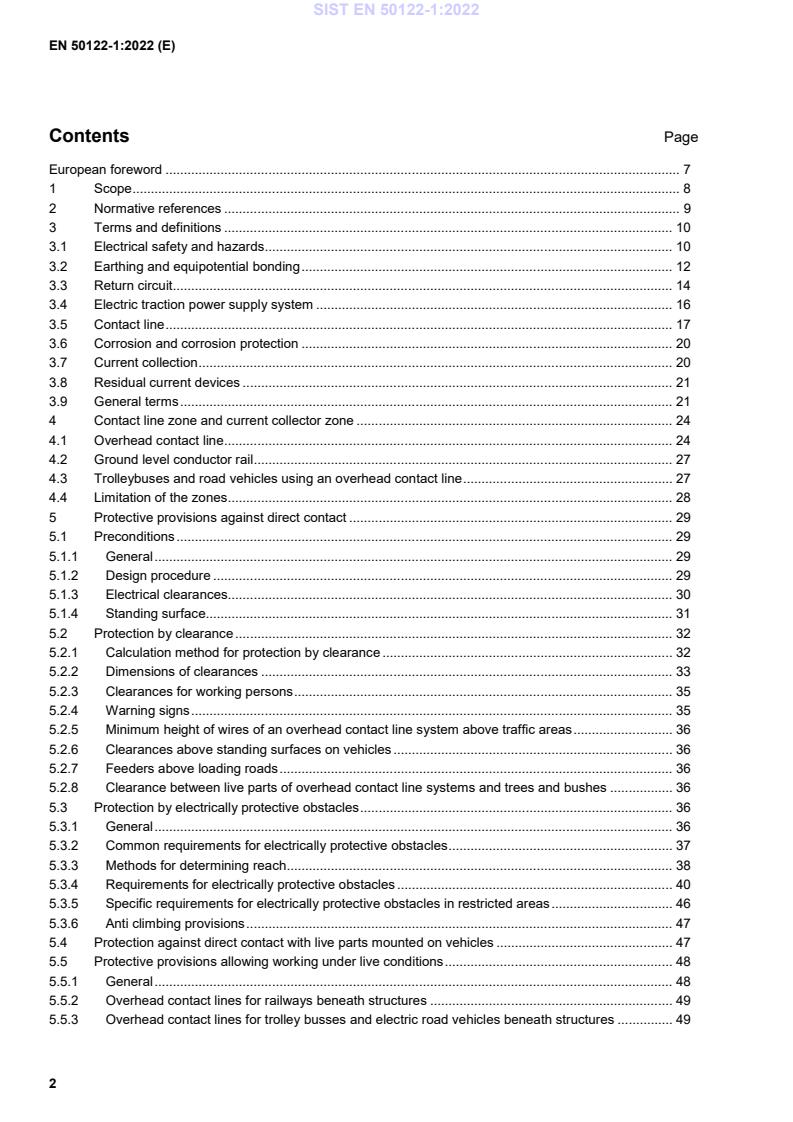
Contents Page
European foreword . 7
1 Scope . 8
2 Normative references . 9
3 Terms and definitions . 10
3.1 Electrical safety and hazards . 10
3.2 Earthing and equipotential bonding . 12
3.3 Return circuit. 14
3.4 Electric traction power supply system . 16
3.5 Contact line . 17
3.6 Corrosion and corrosion protection . 20
3.7 Current collection . 20
3.8 Residual current devices . 21
3.9 General terms . 21
4 Contact line zone and current collector zone . 24
4.1 Overhead contact line . 24
4.2 Ground level conductor rail . 27
4.3 Trolleybuses and road vehicles using an overhead contact line . 27
4.4 Limitation of the zones . 28
5 Protective provisions against direct contact . 29
5.1 Preconditions . 29
5.1.1 General . 29
5.1.2 Design procedure . 29
5.1.3 Electrical clearances. 30
5.1.4 Standing surface . 31
5.2 Protection by clearance . 32
5.2.1 Calculation method for protection by clearance . 32
5.2.2 Dimensions of clearances . 33
5.2.3 Clearances for working persons . 35
5.2.4 Warning signs . 35
5.2.5 Minimum height of wires of an overhead contact line system above traffic areas . 36
5.2.6 Clearances above standing surfaces on vehicles . 36
5.2.7 Feeders above loading roads . 36
5.2.8 Clearance between live parts of overhead contact line systems and trees and bushes . 36
5.3 Protection by electrically protective obstacles . 36
5.3.1 General . 36
5.3.2 Common requirements for electrically protective obstacles . 37
5.3.3 Methods for determining reach . 38
5.3.4 Requirements for electrically protective obstacles . 40
5.3.5 Specific requirements for electrically protective obstacles in restricted areas . 46
5.3.6 Anti climbing provisions . 47
5.4 Protection against direct contact with live parts mounted on vehicles . 47
5.5 Protective provisions allowing working under live conditions . 48
5.5.1 General . 48
5.5.2 Overhead contact lines for railways beneath structures . 49
5.5.3 Overhead contact lines for trolley busses and electric road vehicles beneath structures . 49
5.6 Specific protective provisions against electric shock in ground level conductor rail systems . 51
5.6.1 Location of conductor rail at platforms . 51
5.6.2 Exceptions . 51
5.6.3 Protection provisions in workshops and depots . 51
5.6.4 Protective boarding for ground level conductor rails in restricted areas . 52
5.6.5 Requirements for top contact ground level conductor rails in public areas . 52
5.6.6 Requirements for top contact ground level conductor rails in restricted areas . 52
5.7 Specific protective provisions against electric shock in systems in which the wheels of the
vehicles are not used for return circuit . 55
5.7.1 General. 55
5.7.2 Railway systems . 55
5.7.3 Trolleybus systems and systems for electric road vehicles . 55
6 Protective provisions against indirect contact and non-galvanic coupling . 56
6.1 General . 56
6.2 Protective provisions for exposed-conductive-parts . 56
6.2.1 AC railways . 56
6.2.2 DC railways . 57
6.2.3 Exceptions for low voltage electric traction power supply systems . 57
6.2.4 Stays of non-conductive masts . 58
6.3 Protective provisions for wholly or partly conductive structures in the overhead contact line
zone or the current collector zone . 58
6.3.1 Protective provisions by means of connection to the return circuit . 58
6.3.2 Exceptions for small wholly and partly conductive parts . 59
6.3.3 Exceptions for temporarily stored parts close to the rails . 59
6.3.4 Protective provisions preventing contact between conductive parts and live parts . 59
6.3.5 Protective provisions by means of bare conductive parts connected to the return circuit . 60
6.3.6 Protective provisions by automatic disconnection of supply . 60
6.4 Parts which can become hazardous due to inductive or capacitive coupling . 60
7 Protective provisions for low voltage non-traction power supply systems . 60
7.1 General . 60
7.2 Protective provisions for electrical installations in the overhead contact line zone or the
current collector zone . 61
7.2.1 Equipment of protection Class I . 61
7.2.2 Equipment of protection Class II . 63
7.2.3 Cables . 63
7.2.4 Low voltage connected equipment . 63
7.3 Protective provisions for installations which are endangered by the traction power supply
return circuit . 63
7.3.1 Design of low voltage non-traction power supply . 63
7.3.2 Low voltage power supply by a TT system on the railway side . 64
7.3.3 Low voltage power supply by TN system . 67
7.3.4 Low voltage power supply by IT system . 69
7.3.5 Special provisions . 71
8 Protective provisions where track systems, which are utilized for carrying traction return
current, or/and overhead contact line systems pass through hazardous zones . 74
8.1 General . 74
8.2 Equipotential bonding . 75
8.3 Parallel pipework . 76
8.4 Insulating joints . 76
8.5 Surge arrester . 76
8.6 Overhead contact line of loading sidings . 77
9 Limits for touch voltage and protective provisions against the danger of rail potential . 77
9.1 General . 77
9.1.1 Preconditions . 77
9.1.2 Body voltage and touch voltage . 77
9.1.3 Touch voltage at vehicles . 77
9.1.4 Short-circuit duration . 78
9.1.5 Voltage limits and time duration aspects . 78
9.2 Touch voltage limits in AC railways . 78
9.2.1 General . 78
9.2.2 AC voltage limits for the safety of persons . 79
9.3 Touch voltage limits in DC railways . 82
9.3.1 General . 82
9.3.2 DC voltage limits for the safety of persons . 82
9.4 Access Control. 85
10 Additional requirements . 85
10.1 Traction substations and traction switching stations . 85
10.2 Cables . 85
10.2.1 General requirements . 85
10.2.2 Cables in AC electric traction power supply systems . 86
10.2.3 Cables in DC electric traction systems . 86
10.3 Extended return circuit connections and earthing conductors . 86
10.3.1 General requirements . 86
10.3.2 Continuity of the extended return circuit . 86
10.3.3 Cross bonding of the return circuit . 87
10.3.4 Railway systems in which the traction current is confined within insulated conductors . 87
10.4 Removing of decommissioned contact lines . 87
10.5 Means of achieving safe isolation between sections . 87
10.6 Lightning protection . 87
Annex A (normative) Clearances from standing surfaces for exceptional use on existing lines with
restricted gauge . 88
Annex B (informative) Typical layouts of protective obstacles . 90
B.1 General . 90
B.2 Examples . 92
Annex C (normative) Warning sign . 99
Annex D (informative) Guiding values for rail potential gradient . 100
D.1 AC railways . 100
D.2 DC railways. 101
Annex E (informative) Effective touch voltage and body voltage with respect to the body current . 102
E.1 Preconditions for the calculation . 102
E.2 Impedances . 102
E.3 Body current and related body voltage . 105
Annex F (normative) Measurement methods for effective touch voltages . 108
Annex G (normative) Use of voltage-limiting devices . 109
G.1 General . 109
G.2 Types . 109
G.3 Technical requirements . 109
Bibliography . 111
Figures
Figure 1 — Overhead contact line zone and current collector zone . 26
Figure 2 — Overhead contact line zone and current collector zone for trolley bus systems and
electric road vehicles using a bipolar contact line . 28
Figure 3 — Design procedure to achieve protection against direct contact. . 30
Figure 4 — Manikin model to be used for the analysis of the arm’s reach . 32
Figure 5 — Minimum distances to accessible live parts from standing surfaces accessible to persons . 34
Figure 6 — Application of taut string line method compared with manikin method. . 39
Figure 7 — Minimum distance behind electrically protective obstacles with openings . 42
Figure 8 — Example for a gap between a standing surface and an electrically protective obstacle,
side view . 44
Figure 9 — Effect of an electrically protective obstacle on arms reach of person including an object,
top view . 45
Figure 10 — Live parts below standing surfaces . 46
Figure 11 — Method for the determination of clearances for live parts on the outside of vehicles . 48
Figure 12 — Example of an insulated obstacle beneath a structure . 49
Figure 13 — Example of an insulated electrically protective obstacle beneath a structure for an
unearthed installation . 50
Figure 14 — Example of an insulated electrically protective obstacle beneath a structure for a bipolar
overhead contact line in which the negative contact wire is earthed or connected to the
return circuit of a tramway system . 51
Figure 15 — Public level crossing, private level crossing . 52
Figure 16 — Trackside structures . 53
Figure 17 — Track-side telephone mounted on a signal-post . 53
Figure 18 — Authorized trackside walking route . 54
Figure 19 — Railway controlled crossing (depots, goods yard, station crossing) . 54
Figure 20 — Protection Class I equipment installed outside the overhead contact line zone and the
current collector zone. . 62
Figure 21 — Typical TT system for AC railways. . 65
Figure 22 — Typical TT system for DC railways. . 66
Figure 23 — Typical TN system for AC railways . 68
Figure 24 — Typical TN system for DC railways. 69
Figure 25 — Typical IT system for AC railways . 70
Figure 26 — TN system for AC railways with interconnected earth system. . 72
Figure 27 — TN system for AC railways with multiple supply points. . 73
Figure 28 — Disposition of rail-to-rail cross bonds and track-to-track cross bonds (double-rail
illustration) and connection of the contact line in case of the loading siding having a contact
line . 76
Figure 29 — Location of a surge arrester outside the overhead contact line zone of a loading siding
if there is a possibility of flashovers of the insulating pieces through lightning strikes . 76
Figure 30 — Design of return circuit, with regard to permissible effective touch voltage by checking
the rail potential or the effective touch voltage . 79
Figure A.1 — Alternative clearances for existing lines/networks. . 89
Figure B.1 — Typical protective obstacles and obstacle combinations and their dimensions and
properties . 91
Figure B.2 — Inclined protective obstacle, total height 1,00 m, solid-wall . 92
Figure B.3 — Solid-wall protective obstacle, total height 1,69 m (balustrade wall). . 93
Figure B.4 — Combined protective obstacle with an inclined part on the top of the main protective
obstacle, total height 1,50 m . 94
Figure B.5 — Combined protective obstacle with an inclined part (0,50 m width) on the standing
surface level, total height 1,00 m . 95
Figure B.6 — Combined protective obstacle with an inclined part (1,60 m width) on the standing
surface level, total height 1,00 m . 96
Figure B.7 — Combined protective obstacle with a total height of 1,80 m . 97
Figure B.8 — Arrangement of three protective obstacles. 98
Figure C.1 — Warning sign . 99
Figure D.1 — Guidance values for the rail potential gradient measured at the mast in a right angle
to the track of an AC railway. 100
Figure E.1 — Equivalent circuit for the calculation of the permissible touch voltage . 104
Tables
Table 1 — Electrical clearances . 31
Table 2 — Protection clearances . 31
Table 3 — Minimum vertical height V of accessible live parts above standing surfaces for public
areas . 35
Table 4 — Minimum distance d between live parts and an electrically protective obstacle . 43
O
Table 5 — Maximum dimensions for small wholly and partly conductive parts . 59
Table 6 — Types of low voltage non-traction supplies . 64
Table 7 — Maximum permissible body voltages U in AC electric traction power supply
b, max
systems as a function of time duration . 80
Table 8 — Maximum permissible effective touch voltages U in AC electric traction power
te, max
supply systems as a function of time duration . 81
Table 9 — Maximum permissible body voltages U in DC electric traction power supply
b, max
systems as a function of time duration . 83
Table 10 — Maximum permissible effective touch voltages U in DC electric traction power
te, max
supply systems as a function of time duration . 83
Table D.1 — Guidance values for the rail potential gradient (see Figure D.1) . 101
Table E.1 — Body impedance Z , body resistance R and body current I . 103
b b b
Table E.2 — Example of the maximum permissible prospective touch voltage for AC railways for
short-term conditions and R = 1 150 Ω . 105
a
Table E.3 — Body currents, body voltages and touch voltages as function of time duration in AC
electric traction power supply systems . 106
Table E.4 — Body currents, body voltages and touch voltages as function of time duration in DC
electric traction power supply systems . 107
European foreword
This document (EN 50122-1:2022) has been prepared by CLC/SC 9XC “Electric supply and earthing systems
for public transport equipment and ancillary apparatus (Fixed installations)”.
The following dates are fixed:
• latest date by which this document has to be (dop) 2023-07-25
implemented at national level by publication of
an identical national standard or by
endorsement
• latest date by which the national standards (dow) 2025-07-25
conflicting with this document have to be
withdrawn
This document supersedes EN 50122-1:2011 and all of its amendments and corrigenda (if any).
— some definitions were modified;
— the dimensions for protection by clearance were modified, and there are now voltage dependent differences
for high voltage electric traction power supply systems;
— methods for the use of protective obstacles were significantly changed.
Attention is drawn to the possibility that some of the elements of this document may be the subject of patent
rights. CENELEC shall not be held responsible for identifying any or all such patent rights.
This document has been prepared under a Standardization Request given to CENELEC by the European
Commission and the European Free Trade Association.
Any feedback and questions on this document should be directed to the users’ national committee. A complete
listing of these bodies can be found on the CENELEC website.
1 Scope
This document specifies requirements for the protective provisions relating to electrical safety in fixed
installations associated with AC and/or DC traction systems and to any installations that can be endangered by
the electric traction power supply system. This also includes requirements applicable to vehicles on electrified
lines.
It also applies to all aspects of fixed installations which are necessary to ensure electrical safety during
maintenance work within electric traction power supply systems.
This document applies to new electric traction power supply systems and major revisions to electric traction
power supply systems for:
a) railways;
b) guided mass transport systems such as
1) tramways,
2) elevated and underground railways,
3) mountain railways,
4) trolleybus systems,
5) electric traction power supply systems for road vehicles, which use an overhead contact line system,
and
6) magnetically levitated systems, which use a contact line system;
c) material transportation systems.
This document does not apply to:
a) electric traction power supply systems in underground mines,
b) cranes, transportable platforms and similar transportation equipment on rails, temporary structures (e.g.
exhibition structures) in so far as these are not supplied directly or via transformers from the contact line
system and are not endangered by the electric traction power supply system,
c) suspended cable cars,
d) funicular railways,
e) existing vehicles.
This document does not specify working rules for maintenance.
The requirements within this document related to protection against electric shock are applicable to persons
only.
2 Normative references
The following documents are referred to in the text in such a way that some or all of their content constitutes
requirements of this document. For dated references, only the edition cited applies. For undated references, the
latest edition of the referenced document (including any amendments) applies.
EN 50119:2020, Railway applications - Fixed installations - Electric traction overhead contact lines
EN 50122-2:2022, Railway applications – Fixed installations – Electrical safety, earthing and the return circuit -
Part 2: Provisions against the effects of stray currents caused by d.c. traction systems
EN 50124-1:2017, Railway applications - Insulation coordination - Part 1: Basic requirements - Clearances and
creepage distances for all electrical and electronic equipment
EN 50153:2014, Railway applications - Rolling stock - Protective provisions relating to electrical hazards
EN 50163:2004, Railway applications - Supply voltages of traction systems
EN 50341 (series), Overhead electrical lines exceeding AC 1 kV
EN 50522:2010, Earthing of power installations exceeding 1 kV a.c.
EN 60529:1991, Degrees of protection provided by enclosures (IP Code) (IEC 60529:1989)
EN 60898-1:2019, Electrical accessories - Circuit-breakers for overcurrent protection for household and similar
installations - Part 1: Circuit-breakers for a.c. operation (IEC 60898-1:2016)
EN 61140:2016, Protection against electric shock - Common aspects for installation and equipment
(IEC 61140:2016)
EN 61936-1:2010, Power installations exceeding 1 kV a.c. - Part 1: Common rules (IEC 61936-1:2010)
EN 62305 (series), Protection against lightning (IEC 62305 series)
HD 60364-4-41:2017, Low-voltage electrical installations – Part 4-41: Protection for safety – Protection against
electric shock (IEC 60364-4-41:2005, modified)
IEC 60755:2017, General safety requirements for residual current operated protective devices
ISO 3864-1:2011, Graphical symbols — Safety colours and safety signs — Part 1: Design principles for safety
signs and safety markings
ISO 7010:2019, Graphical symbols — Safety colours and safety signs — Registered safety signs
As impacted by EN 50153:2014/A1:2017 and EN 50153:2014/A2:2020.
As impacted by EN 50163:2004/AC:2013 and EN 50163:2004/A2:2020.
As impacted by EN 60529:1991/A1:2000 and EN 60529:1991/A2:2013.
As impacted by EN 61936-1:2010/AC:2011, EN 61936-1:2010:2013 and EN 61936-1:2010/A1:2014.
As impacted by HD 60364-4-41:2017/A11:2017 and HD 60364-4-41:2017/A12:2019.
3 Terms and definitions
For the purposes of this document, the following terms and definitions apply.
These definitions apply to all standards in this series.
ISO and IEC maintain terminological databases for use in standardization at the following addresses:
— ISO Online browsing platform: available at https://www.iso.org/obp
— IEC Electropedia: available at https://www.electropedia.org/
3.1 Electrical safety and hazards
3.1.1
electrical safety
freedom from unacceptable risk of harm caused by electrical systems
3.1.2
electric shock
physiological effect resulting from an electric current passing through a human body or livestock
[SOURCE: IEC 60050-195:2021, 195-01-04]
3.1.3
(effective) touch voltage
U
te
voltage between conductive parts when touched simultaneously by a human being
Note 1 to entry: The value of the effective touch voltage can be appreciably influenced by the impedance of the human
being in electric contact with these conductive parts.
Note 2 to entry: The conductive path through the body of a human being is conventionally from hand to both feet
(horizontal distance of 1 m) or from hand to hand.
[SOURCE: IEC 60050-195:2021, 195-05-11, modified – in the headline “touch voltage, ” was
replaced by “(effective) touch voltage”; “or livestock” in the end of the paragraph and in Note 1 have been
deleted, the symbol and the Note 2 to entry have been added]
3.1.4
prospective touch voltage
U
tp
voltage between simultaneously accessible conductive parts when those conductive parts are not being touched
by a human being
[SOURCE: IEC 60050-195:2021, 195-05-09, modified – The symbol has been added, “or livestock” has been
deleted.]
3.1.5
body voltage
U
b
product of the current through the body and the body impedance
3.1.6
standing surface
any point on a surface where persons have an intentional access
3.1.7
protective boarding
non-conducting barrier to protect persons from coming into direct contact with a live conductor rail
3.1.8
electrically protective obstacle
part preventing unintentional direct contact, but not preventing such contact by deliberate action
Note 1 to entry: Electrically protective obstacles are intentionally applied in this document also for the protection of
ordinary persons.
[SOURCE: IEC 60050-195:2021, 195-06-16, modified – in the headline replaced “protective obstacle,
” by “electrically protective obstacle”, replaced “contact by a human being or livestock with
hazardous-live-parts” by “direct contact”, Note 1 to entry has been added]
3.1.9
anti-trespassing guard
equipment provided to deter entry to a restricted area, structure or building by an unauthorized person
3.1.10
conductive part
part that can carry electric current
[SOURCE: IEC 60050-195:2021, 195-01-06]
3.1.11
exposed-conductive-part
conductive part of equipment which can be touched and that is not normally live, but that can become live when
basic insulation fails
Note 1 to entry: A conductive part of electrical equipment, which can become live only through contact with an exposed-
conductive-part which has become live, is not considered to be an exposed-conductive-part itself.
[SOURCE: IEC 60050-195:2021, 195-06-10, modified - The Note 1 to entry has been added.]
3.1.12
live part
conductor or conductive part intended to be energized in normal use
Note 1 to entry: This concept does not necessarily imply a risk of electric shock.
Note 2 to entry: By convention, this does not include the running rails and parts connected to them.
[SOURCE: IEC 60050-811:2017, 811-36-23]
3.1.13
hazardous-live-part
live part that, under certain conditions, can give a harmful electric shock
Note 1 to entry: A hazardous voltage can be present on the
...