

EN IEC 63052:2021
(Main)Power frequency overvoltage protective devices (POPs) for household and similar applications
General Information
- Abstract
NEXT ACTION BY HAS CONSULTANT: to confirm last changes, before BT-route for validation of Annex ZZ.
2019-10-16: lack of compliance Publication assessment. CLC/TC 23E meeting with Consultant on 2020-01-24 to address the issues.
- Status
- Published
- Publication Date
- 19-Aug-2021
- Technical Committee
- CLC/TC 23E - Circuit breakers and similar devices for household and similar applications
- Drafting Committee
- IEC/SC 23E - IEC_SC_23E
- Current Stage
- 6060 - Document made available - Publishing
- Start Date
- 20-Aug-2021
- Completion Date
- 20-Aug-2021

Overview - EN IEC 63052:2021 (IEC 63052:2019 + COR1:2019)
EN IEC 63052:2021 defines requirements for power frequency overvoltage protective devices (POPs) intended for household and similar applications. It covers POPs rated for 50 Hz, 60 Hz or 50/60 Hz operation, with line-to-neutral rated voltage not exceeding 230 V AC and rated current not exceeding 63 A. The standard specifies construction options (POP unit combined with a Main Protective Device (MPD) or as a single device with opening means), environmental and coordination requirements, and markings needed for safe use and conformity.
Key topics and technical requirements
- Scope & limitations
- POPs mitigate phase-to-neutral power frequency overvoltages (e.g., loss of neutral in upstream 3‑phase supply).
- Not intended for protection against common-mode overvoltages and does not cover surge protective devices (SPDs).
- A single-device POP is not a substitute for automatic disconnection as defined in IEC 60364‑4‑41.
- Rated parameters
- Rated frequency: 50 / 60 / 50–60 Hz.
- Rated voltage: ≤ 230 V (phase-to-neutral).
- Rated current: ≤ 63 A.
- Design and mounting
- POPs may be factory-integrated with an MPD (circuit‑breaker, RCCB, RCBO) or assembled/connected on site.
- Devices are suitable for isolation and intended for pollution degree 2 and overvoltage category III environments.
- Functional behaviour
- Detect overvoltage between phase and neutral and open protected circuit under specified conditions to mitigate damage.
- POPs that monitor one line-to-neutral can be used in phase-to-phase systems if both conductors are switched and declared by the manufacturer.
- Suitable for IT systems only when all active conductors are switched.
- Coordination, testing & marking
- Requirements for rated making/breaking capacities, coordination with short‑circuit protective devices (SCPDs), EMC and insulation tests are referenced.
- Standard cross-references include IEC and EN documents for circuit-breakers, RCCBs/RCBOs, EMC (IEC 61000 series), insulation (IEC 60664) and relevant product safety standards.
Practical applications & who uses this standard
- Manufacturers and designers of residential protective devices integrating POP units with circuit‑breakers, RCCBs or RCBOs.
- Electrical installers and system designers specifying overvoltage mitigation in domestic and light‑commercial distribution boards.
- Test laboratories, certification bodies and compliance engineers assessing conformity with Low Voltage Directive requirements.
- Specifiers seeking a harmonized European standard to mitigate phase‑to‑neutral overvoltage risks (e.g., neutral loss scenarios).
Related standards
- IEC/EN 60898, IEC/EN 61008, IEC/EN 61009 (circuit-breakers, RCCBs, RCBOs)
- IEC 60664 (insulation coordination), IEC 61000 series (EMC)
- IEC 60364‑4‑41 (automatic disconnection) - POPs are not a substitute for this function
Keywords: EN IEC 63052:2021, power frequency overvoltage protective devices, POP, household overvoltage protection, MPD, circuit-breaker, RCCB, RCBO, 230 V, 63 A.
Relations
- Effective Date
- 25-Jan-2023
- Effective Date
- 23-Jan-2023
- Effective Date
- 18-Oct-2016
Get Certified
Connect with accredited certification bodies for this standard

IMQ S.p.A. (Certification)
Italian electrical product certification.

SLG Prüf- und Zertifizierungs GmbH
German testing and certification body.

UL Solutions
Global safety science company with testing, inspection and certification.
Sponsored listings
Frequently Asked Questions
EN IEC 63052:2021 is a standard published by CLC. Its full title is "Power frequency overvoltage protective devices (POPs) for household and similar applications". This standard covers: NEXT ACTION BY HAS CONSULTANT: to confirm last changes, before BT-route for validation of Annex ZZ. 2019-10-16: lack of compliance Publication assessment. CLC/TC 23E meeting with Consultant on 2020-01-24 to address the issues.
NEXT ACTION BY HAS CONSULTANT: to confirm last changes, before BT-route for validation of Annex ZZ. 2019-10-16: lack of compliance Publication assessment. CLC/TC 23E meeting with Consultant on 2020-01-24 to address the issues.
EN IEC 63052:2021 is classified under the following ICS (International Classification for Standards) categories: 29.120.50 - Fuses and other overcurrent protection devices. The ICS classification helps identify the subject area and facilitates finding related standards.
EN IEC 63052:2021 has the following relationships with other standards: It is inter standard links to EN 50550:2011, EN 50550:2011/A1:2014, EN 50550:2011/AC:2012. Understanding these relationships helps ensure you are using the most current and applicable version of the standard.
EN IEC 63052:2021 is associated with the following European legislation: EU Directives/Regulations: 2014/30/EU, 2014/35/EU; Standardization Mandates: M/511, M/552. When a standard is cited in the Official Journal of the European Union, products manufactured in conformity with it benefit from a presumption of conformity with the essential requirements of the corresponding EU directive or regulation.
EN IEC 63052:2021 is available in PDF format for immediate download after purchase. The document can be added to your cart and obtained through the secure checkout process. Digital delivery ensures instant access to the complete standard document.
Standards Content (Sample)
SLOVENSKI STANDARD
01-december-2021
Nadomešča:
SIST EN 50550:2011
SIST EN 50550:2011/A1:2014
SIST EN 50550:2011/AC:2012
Močnostna frekvenčna prenapetostna zaščitna naprava (POP) za gospodinjsko in
podobno uporabo (IEC 63052:2019 + COR1:2019)
Power frequency overvoltage protective devices (POPs) for household and similar
applications (IEC 63052:2019 + COR1:2019)
Schutzeinrichtungen gegen netzfrequente Überspannungen für Hausinstallationen und
für ähnliche Anwendungen (POP) (IEC 63052:2019 + COR1:2019)
Dispositifs de protection contre les surtensions à fréquence industrielle (POP) pour les
applications domestiques et similaires (IEC 63052:2019 + COR1:2019)
Ta slovenski standard je istoveten z: EN IEC 63052:2021
ICS:
29.120.50 Varovalke in druga Fuses and other overcurrent
nadtokovna zaščita protection devices
2003-01.Slovenski inštitut za standardizacijo. Razmnoževanje celote ali delov tega standarda ni dovoljeno.
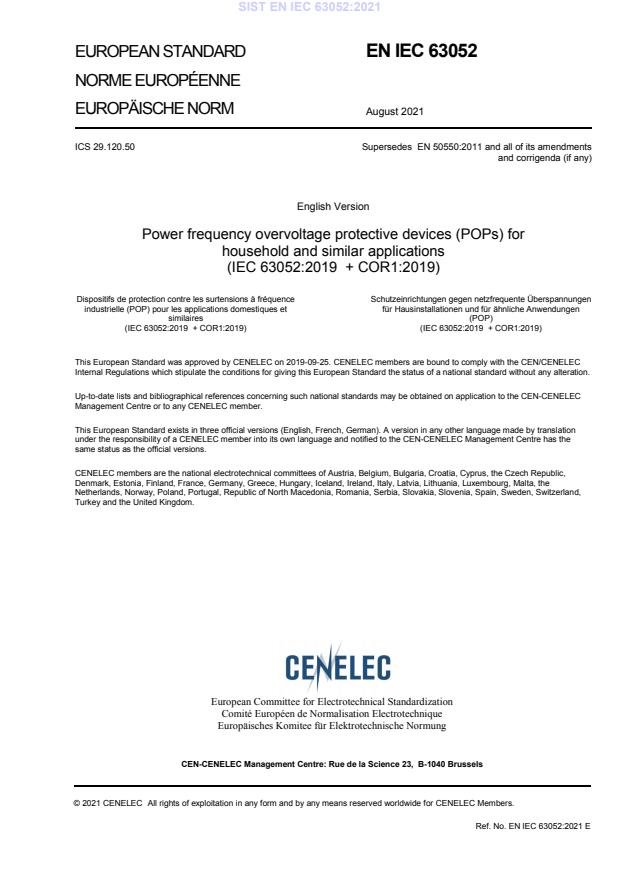
EUROPEAN STANDARD EN IEC 63052
NORME EUROPÉENNE
EUROPÄISCHE NORM
August 2021
ICS 29.120.50 Supersedes EN 50550:2011 and all of its amendments
and corrigenda (if any)
English Version
Power frequency overvoltage protective devices (POPs) for
household and similar applications
(IEC 63052:2019 + COR1:2019)
Dispositifs de protection contre les surtensions à fréquence Schutzeinrichtungen gegen netzfrequente Überspannungen
industrielle (POP) pour les applications domestiques et für Hausinstallationen und für ähnliche Anwendungen
similaires (POP)
(IEC 63052:2019 + COR1:2019) (IEC 63052:2019 + COR1:2019)
This European Standard was approved by CENELEC on 2019-09-25. CENELEC members are bound to comply with the CEN/CENELEC
Internal Regulations which stipulate the conditions for giving this European Standard the status of a national standard without any alteration.
Up-to-date lists and bibliographical references concerning such national standards may be obtained on application to the CEN-CENELEC
Management Centre or to any CENELEC member.
This European Standard exists in three official versions (English, French, German). A version in any other language made by translation
under the responsibility of a CENELEC member into its own language and notified to the CEN-CENELEC Management Centre has the
same status as the official versions.
CENELEC members are the national electrotechnical committees of Austria, Belgium, Bulgaria, Croatia, Cyprus, the Czech Republic,
Denmark, Estonia, Finland, France, Germany, Greece, Hungary, Iceland, Ireland, Italy, Latvia, Lithuania, Luxembourg, Malta, the
Netherlands, Norway, Poland, Portugal, Republic of North Macedonia, Romania, Serbia, Slovakia, Slovenia, Spain, Sweden, Switzerland,
Turkey and the United Kingdom.
European Committee for Electrotechnical Standardization
Comité Européen de Normalisation Electrotechnique
Europäisches Komitee für Elektrotechnische Normung
CEN-CENELEC Management Centre: Rue de la Science 23, B-1040 Brussels
© 2021 CENELEC All rights of exploitation in any form and by any means reserved worldwide for CENELEC Members.
Ref. No. EN IEC 63052:2021 E
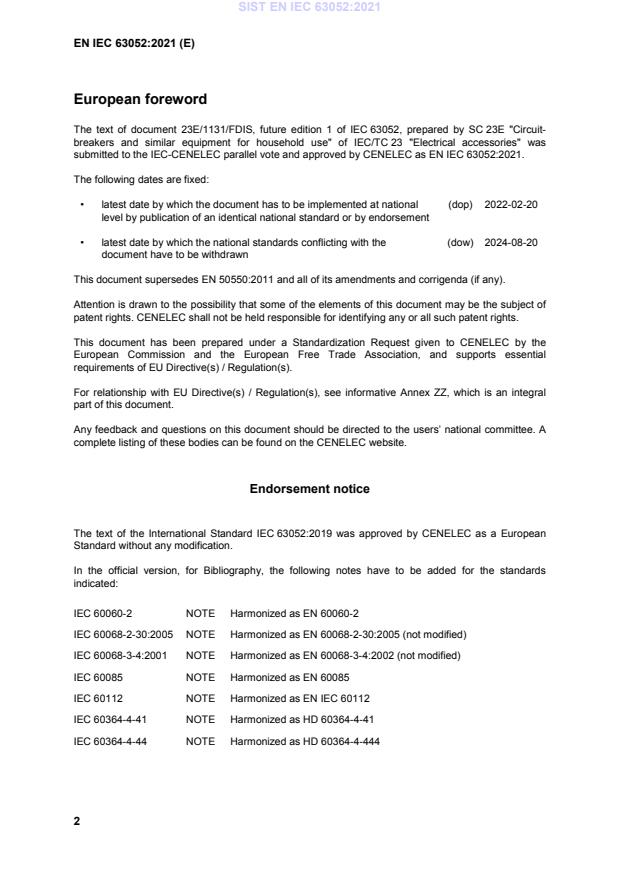
European foreword
The text of document 23E/1131/FDIS, future edition 1 of IEC 63052, prepared by SC 23E "Circuit-
breakers and similar equipment for household use" of IEC/TC 23 "Electrical accessories" was
submitted to the IEC-CENELEC parallel vote and approved by CENELEC as EN IEC 63052:2021.
The following dates are fixed:
• latest date by which the document has to be implemented at national (dop) 2022-02-20
level by publication of an identical national standard or by endorsement
• latest date by which the national standards conflicting with the (dow) 2024-08-20
document have to be withdrawn
This document supersedes EN 50550:2011 and all of its amendments and corrigenda (if any).
Attention is drawn to the possibility that some of the elements of this document may be the subject of
patent rights. CENELEC shall not be held responsible for identifying any or all such patent rights.
This document has been prepared under a Standardization Request given to CENELEC by the
European Commission and the European Free Trade Association, and supports essential
requirements of EU Directive(s) / Regulation(s).
For relationship with EU Directive(s) / Regulation(s), see informative Annex ZZ, which is an integral
part of this document.
Any feedback and questions on this document should be directed to the users’ national committee. A
complete listing of these bodies can be found on the CENELEC website.
Endorsement notice
The text of the International Standard IEC 63052:2019 was approved by CENELEC as a European
Standard without any modification.
In the official version, for Bibliography, the following notes have to be added for the standards
indicated:
IEC 60060-2 NOTE Harmonized as EN 60060-2
IEC 60068-2-30:2005 NOTE Harmonized as EN 60068-2-30:2005 (not modified)
IEC 60068-3-4:2001 NOTE Harmonized as EN 60068-3-4:2002 (not modified)
IEC 60085 NOTE Harmonized as EN 60085
IEC 60112 NOTE Harmonized as EN IEC 60112
IEC 60364-4-41 NOTE Harmonized as HD 60364-4-41
IEC 60364-4-44 NOTE Harmonized as HD 60364-4-444
Annex ZA
(normative)
Normative references to international publications
with their corresponding European publications
The following documents are referred to in the text in such a way that some or all of their content
constitutes requirements of this document. For dated references, only the edition cited applies. For
undated references, the latest edition of the referenced document (including any amendments)
applies.
NOTE 1 Where an International Publication has been modified by common modifications, indicated by (mod),
the relevant EN/HD applies.
NOTE 2 Up-to-date information on the latest versions of the European Standards listed in this annex is available
here: www.cenelec.eu.
Publication Year Title EN/HD Year
IEC 60065 (mod) 2014 Audio, video and similar electronic EN 60065 2014
apparatus - Safety requirements
- - + A11 2017
IEC 60269 series Low-voltage fuses EN 60269 series
IEC 60364 series Low-voltage electrical installations HD 60364 series
IEC 60384-14 2013 Fixed capacitors for use in electronic EN 60384-14 2013
equipment - Part 14: Sectional
specification - Fixed capacitors for
electromagnetic interference suppression
and connection to the supply mains
+ A1 2016 + A1 2016
IEC 60417 - Graphical symbols for use on equipment -
IEC 60529 1989 Degrees of protection provided by EN 60529 1991
enclosures (IP Code)
+ A1 1999 + A1 2000
+ A2 2013 + A2 2013
IEC 60664-1 2007 Insulation coordination for equipment EN 60664-1 2007
within low-voltage systems - Part 1:
Principles, requirements and tests
IEC 60664-3 2016 Insulation coordination for equipment EN 60664-3 2017
within low-voltage systems - Part 3: Use of
coating, potting or moulding for protection
against pollution
IEC 60695-2-10 2013 Fire hazard testing - Part 2-10: EN 60695-2-10 2013
Glowing/hot-wire based test methods -
Glow-wire apparatus and common test
procedure
IEC 60695-2-11 2014 Fire hazard testing - Part 2-11: EN 60695-2-11 2014
Glowing/hot-wire based test methods -
Glow-wire flammability test method for
end-products (GWEPT)
Publication Year Title EN/HD Year
IEC 60898-1 (mod) 2015 Electrical accessories - Circuit-breakers EN 60898-1 2019
for overcurrent protection for household
and similar installations - Part 1: Circuit-
breakers for a.c. operation
IEC 60898-2 2016 Electrical accessories - Circuit-breakers EN 60898-2 2006
for overcurrent protection for household
and similar installations - Part 2: Circuit-
breakers for AC and DC operation
IEC 61000-4-2 2008 Electromagnetic compatibility (EMC) - Part EN 61000-4-2 2009
4-2: Testing and measurement techniques
- Electrostatic discharge immunity test
IEC 61000-4-3 2020 Electromagnetic compatibility (EMC) - Part EN 61004-4-3 2020
4-3: Testing and measurement techniques
- Radiated, radio-frequency,
electromagnetic field immunity test
IEC 61000-4-4 2012 Electromagnetic compatibility (EMC) - Part EN 61000-4-4 2012
4-4: Testing and measurement techniques
- Electrical fast transient/burst immunity
test
IEC 61000-4-5 2014 Electromagnetic compatibility (EMC) - Part EN 61000-4-5 2014
4-5: Testing and measurement techniques
- Surge immunity test
+ A1 2017 + A1 2017
IEC 61000-4-6 2013 Electromagnetic compatibility (EMC) - Part EN 61000-4-6 2014
4-6: Testing and measurement techniques
- Immunity to conducted disturbances,
induced by radio-frequency fields
IEC 61000-4-16 2015 Electromagnetic compatibility (EMC) - Part EN 61000-4-16 2016
4-16: Testing and measurement
techniques - Test for immunity to
conducted, common mode disturbances in
the frequency range 0 Hz to 150 kHz
IEC 61000-6-3 2020 Electromagnetic compatibility (EMC) - Part EN 61000-6-3 2007
6-3: Generic standards - Emission
standard for residential, commercial and
light-industrial environments
- - + A1 2011
IEC 61008-1 (mod) 2010 Residual current operated circuit-breakers EN 61008-1 2012
without integral overcurrent protection for
household and similar uses (RCCBs) -
Part 1: General rules
+ A1 (mod) 2012 + A1 2014
+ A2 (mod) 2013 + A2 2014
- - + A11 2015
- - + A12 2017
Publication Year Title EN/HD Year
IEC 61009-1 (mod) 2010 Residual current operated circuit-breakers EN 61009-1 2012
with integral overcurrent protection for
household and similar uses (RCBOs) -
Part 1: General rules
+ A1 (mod) 2012 + A1 2014
+ A2 (mod) 2013 + A2 2014
- - + A11 2015
- - + A12 2016
IEC 61249-2 series Materials for printed boards and other EN 61249-2 series
interconnecting structures
IEC 61543 1995 Residual current-operated protective EN 61543 1995
devices (RCDs) for household and similar
use - Electromagnetic compatibility
+ A1 2004 - -
- - + corrigendum 1997
Dec.
- - + A11 2003
- - + A12 2005
+ A2 2005 + A2 2006
IEC 61558-1 2017 EN IEC 61558-1 2019
IEC 61558-2 series Safety of power transformers, power EN 61558-2 series
supplies, reactors and similar products
IEC 62423 2009 Type F and type B residual current EN 62423 2012
operated circuit-breakers with and without
integral overcurrent protection for
household and similar uses
IEC 62873-2 2016 Residual current operated circuit-breakers - -
for household and similar use – Part 2:
Residual current devices (RCDs) –
Vocabulary
IEC 62873-3-1 2016 Residual current operated circuit-breakers - -
for household and similar use – Part 3-1:
Particular requirements for RCDs with
screwless-type terminals for external
copper conductors
IEC 62873-3-2 2016 Residual current operated circuit-breakers - -
for household and similar use – Part 3-2:
Particular requirements for RCDs with flat
quick-connect terminations
IEC 62873-3-3 2016 Residual current operated circuit-breakers - -
for household and similar use – Part 3-3:
Specific requirements for RCDs with
screw-type terminals for external untreated
aluminium conductors and with aluminium
screw-type terminals for use with copper
or with aluminium conductors
Publication Year Title EN/HD Year
ISO 306 2014 Plastics - Thermoplastic materials - EN ISO 306 2014
Determination of Vicat softening
temperature (VST)
CISPR 14-1 2016 Electromagnetic compatibility - EN 55014-1 2017
Requirements for household appliances,
electric tools and similar apparatus - Part
1: Emission
CISPR 32 2015 Electromagnetic compatibility of EN 55032 2015
multimedia equipment - Emission
requirements
+ A1 2019 - -
- - + A11 2020
Annex ZZ
(informative)
Relationship between this European standard and the safety
objectives of Directive 2014/35/EU [2014 OJ L96] aimed to be
covered
This European Standard has been prepared under a Commission’s standardization request relating to
harmonized standards in the field of the Low Voltage Directive, M/511, to provide one voluntary means
of conforming to safety objectives of Directive 2014/35/EU of the European Parliament and of the
Council of 26 February 2014 on the harmonisation of the laws of the Member States relating to the
making available on the market of electrical equipment designed for use within certain voltage limits
[2014 OJ L96].
Once this standard is cited in the Official Journal of the European Union under that Directive,
compliance with the normative clauses of this standard given in Table ZZ.1 confers, within the limits of
the scope of this standard, a presumption of conformity with the corresponding safety objectives of
that Directive, and associated EFTA regulations.
Table ZZ.1 — Correspondence between this European standard and Annex I of Directive
2014/35/EU [2014 OJ L96]
Clause(s) / sub-clause(s)
Safety objectives of Directive
Remarks / Notes
2014/35/EU
of this EN
(1)(a) 1, 2, 3, 4, 5, 6, 9.3
(1)(b) 8.1, 8.2, 9.4, 9.5
(1)(c) 7, 8.6, 8.12, 8.13, 9.1, 9.2, 9.9,
9.15, 9.16
(2) (a) 8.3, 8.7, 8.13, 9.6, 9.10, 9.16
(2) (b) 8.5, 8.6, 8.7, 8.8, , 8.14, 9.8,
9.9, 9.10, 9.11, 9.17, Annex A,
Annex C
(2) (c) 8.2.2, 9.1.1
(2) (d) 8.2.3, 8.4, 9.7, 9.19, 9.20, 9.7,
Annex B
(3) (a) 8.9, 9.12
(3) (b) 8.10, 8.11, 8.15, 9.13, 9.14,
9.18
(3) (c) 8.8, 9.11, Annex C
WARNING 1 — Presumption of conformity stays valid only as long as a reference to this European
standard is maintained in the list published in the Official Journal of the European Union. Users of this
standard should consult frequently the latest list published in the Official Journal of the European
Union.
WARNING 2 — Other Union legislation may be applicable to the product(s) falling within the scope of
this standard.
IEC 63052 ®
Edition 1.0 2019-08
INTERNATIONAL
STANDARD
NORME
INTERNATIONALE
colour
inside
Power frequency overvoltage protection devices (POPs) for household and
similar applications
Dispositifs de protection contre les surtensions à fréquence industrielle (POP)
pour les applications domestiques et similaires
INTERNATIONAL
ELECTROTECHNICAL
COMMISSION
COMMISSION
ELECTROTECHNIQUE
INTERNATIONALE
ICS 29.120.50 ISBN 978-2-8322-7268-8
– 2 – IEC 63052:2019 © IEC 2019
CONTENTS
FOREWORD . 8
1 Scope . 10
2 Normative references . 10
3 Terms, definitions and abbreviated terms . 12
3.1 Terms and definitions. 12
3.2 Abbreviated terms . 14
4 Classification . 15
4.1 According to the method of construction . 15
4.2 According to the number of monitored line-to-neutral conductor voltages . 15
4.3 According to the method of mounting . 15
5 Characteristics of POPs . 15
5.1 Summary of characteristics . 15
5.2 Rated quantities and other characteristics. 16
5.2.1 Rated voltage . 16
5.2.2 Rated current (I ) . 16
n
5.2.3 Rated frequency . 16
5.2.4 Rated making and breaking capacity (I ) . 16
m
5.2.5 Rated making and breaking capacity on one pole (I ) . 16
m1
5.3 Standard and preferred values . 16
5.3.1 Preferred values of rated voltage (U ) . 16
n
5.3.2 Preferred values of rated current (I ) . 17
n
5.3.3 Preferred values of rated frequency . 17
5.3.4 Minimum value of the rated making and breaking capacity (I ) . 17
m
5.3.5 Minimum value of the rated making and breaking capacity on one pole
(I ) . 17
m1
5.3.6 Standard and preferred values of the rated conditional short-circuit
current (I ) and standard and preferred values of the rated conditional
nc
short-circuit current for one pole (I ) . 17
nc1
5.3.7 Limit values of the break times and non-actuating times . 18
5.3.8 Standard value of rated impulse withstand voltage (U ) . 18
imp
5.4 Coordination with short-circuit protective devices (SCPDs) . 18
5.4.1 General . 18
5.4.2 Rated conditional short-circuit current (I ) and rated conditional short-
nc
circuit on one pole (I ) . 19
nc1
5.4.3 Operating characteristics of opening means for POPs according to 4.1.4. 19
6 Marking and other product information . 19
6.1 Marking . 19
6.2 Additional marking for POPs according to 4.1.4 . 22
6.2.1 Marking of POPs . 22
6.2.2 Instructions for wiring and operation . 22
7 Standard conditions for operation in service and for installation . 22
7.1 Standard conditions . 22
7.2 Conditions of installation . 23
7.3 Pollution degree . 23
8 Requirements for construction and operation . 23
8.1 General . 23
IEC 63052:2019 © IEC 2019 – 3 –
8.2 Mechanical design . 24
8.2.1 General . 24
8.2.2 Mechanism . 25
8.2.3 Clearances and creepage distances . 26
8.2.4 Screws, current-carrying parts and connections . 29
8.2.5 Terminals for external conductors . 30
8.3 Protection against electric shock . 32
8.4 Dielectric properties and isolating capability. 33
8.5 Temperature-rise . 33
8.5.1 Temperature-rise limits . 33
8.5.2 Ambient air temperature . 34
8.6 Operating characteristics . 34
8.6.1 Operating characteristics of the MPD part . 34
8.6.2 Operating characteristics of the POP . 34
8.7 Mechanical and electrical endurance . 34
8.8 Performance at short-circuit currents . 35
8.9 Resistance to mechanical shock and impact . 35
8.10 Resistance to heat . 35
8.11 Resistance to abnormal heat and to fire . 35
8.12 Safety performance of overstressed POPs . 35
8.13 Behaviour of POPs in case of current surges caused by impulse voltages . 35
8.14 Reliability . 35
8.15 Electromagnetic compatibility (EMC) . 35
9 Testing procedure. 36
9.1 General . 36
9.1.1 General testing procedure for the different type of POPs . 36
9.1.2 Characteristics of POPs are checked by means of type tests . 37
9.1.3 For certification purposes, type tests are carried out in test sequences . 38
9.2 Test conditions . 38
9.3 Test of indelibility of marking . 39
9.4 Test of reliability of screws, current-carrying parts and connections . 39
9.5 Test of reliability of terminals for external conductors . 41
9.6 Verification of protection against electric shock . 42
9.7 Test of dielectric properties . 42
9.7.1 Resistance to humidity. 42
9.7.2 Insulation resistance of the main circuit . 43
9.7.3 Dielectric strength of the main circuit . 44
9.7.4 Insulation resistance and dielectric strength of auxiliary circuits . 44
9.7.5 Capability of control circuits connected to the main circuit withstanding
high DC voltages due to insulation measurements . 45
9.7.6 Verification of impulse withstand voltages and of leakage current across
open contacts . 46
9.8 Test of temperature-rise . 48
9.8.1 Ambient air temperature . 48
9.8.2 Test procedure . 48
9.8.3 Measurement of the temperature of parts . 49
9.8.4 Temperature-rise of a part . 49
9.9 Verification of the operating characteristics . 49
9.9.1 Test circuit . 49
– 4 – IEC 63052:2019 © IEC 2019
9.9.2 Off-load characteristic tests with sinusoidal alternating voltages at the
reference temperature of 20 °C ± 5 °C . 49
9.9.3 Test of the effect of the ambient air temperature on the operating
characteristics . 50
9.10 Verification of mechanical and electrical endurance . 50
9.10.1 General test conditions . 50
9.10.2 Test procedure . 50
9.10.3 Additional test for POP according to 4.1.4 . 51
9.10.4 Condition of the POP after the test . 51
9.11 Verification of the behaviour of the POP under short-circuit conditions . 52
9.11.1 General . 52
9.11.2 Short-circuit tests for POPs according to 4.1.4 . 52
9.12 Verification of resistance to mechanical shock and impact . 59
9.12.1 Mechanical shock . 59
9.12.2 Mechanical impact . 60
9.13 Test of resistance to heat . 62
9.13.1 Test on complete product . 62
9.13.2 Ball pressure test. 63
9.14 Test of resistance to abnormal heat and to fire . 64
9.15 Test of safety performance of overstressed POPs . 65
9.16 Verification of behaviour of POPs in case of current surges caused by
impulse voltages . 65
9.16.1 General . 65
9.16.2 Verification of behaviour at surge currents up to 3 000 A (8/20 µs surge
current test) . 66
9.17 Verification of ageing of electronic components . 66
9.18 Electromagnetic compatibility (EMC) . 67
9.18.1 General . 67
9.18.2 EMC tests covered by other clauses/subclauses of the present
document . 67
9.18.3 EMC tests to be performed . 67
9.18.4 POPs performance criteria . 69
9.18.5 Emission tests . 70
9.19 Tests of creepage distances and clearances for electronic circuits (abnormal
conditions) . 71
9.19.1 General . 71
9.19.2 Abnormal conditions . 71
9.19.3 Test procedure . 71
9.20 Requirements for capacitors and specific resistors and inductors used in
electronic circuits . 73
9.20.1 General . 73
9.20.2 Capacitors . 73
9.20.3 Resistors . 74
9.20.4 Inductors and windings . 74
Annex A (normative) Test sequences and number of samples to be submitted for
certification purposes . 91
A.1 Test sequences . 91
A.2 Number of samples to be submitted for full test procedure . 96
A.3 Number of samples to be submitted for simplified test procedures in case of
simultaneous submission of a range of POPs of the same fundamental
design . 96
IEC 63052:2019 © IEC 2019 – 5 –
Annex B (normative) Determination of clearances and creepage distances . 98
B.1 General . 98
B.2 Orientation and location of a creepage distance . 98
B.3 Creepage distances where more than one material is used . 98
B.4 Creepage distances split by floating conductive part . 98
B.5 Measurement of creepage distances and clearances . 98
Annex C (normative) Arrangement for the detection of the emission of ionized gases
during short-circuit tests . 102
Annex D (informative) Methods of determination of short-circuit power factor . 105
D.1 General . 105
D.2 Method I – Determination from DC components . 105
D.3 Method II – Determination with pilot generator . 105
Annex E (informative) Examples of terminal designs . 106
Annex F (informative) Correspondence between ISO and AWG copper conductors . 109
Annex G (informative) SCPDs for short-circuit tests . 110
G.1 General . 110
G.2 Silver wires . 110
G.3 Declared protective devices . 110
G.4 Other means . 111
Annex H (informative) POP configurations according to classification in 4.1 . 112
Bibliography . 113
Figure 1 – Thread forming tapping screw . 74
Figure 2 – Thread cutting tapping screw . 74
Figure 3 – Standard test finger (see 9.6) . 75
Figure 4 – Typical diagram for all short circuit tests except for the verification of the
suitability in IT systems . 76
Figure 5 – Typical diagram for the verification of the suitability in IT systems . 77
Figure 6 – Detail of impedance Z, Z and Z in Figure 4 and Figure 5 . 77
1 2
Figure 7 – Example of calibration record for short-circuit test (see 9.11.2.2 j)) . 79
Figure 8 – Mechanical shock test apparatus (see 9.12.1) . 80
Figure 9 – Mechanical impact test apparatus (see 9.12.2). 81
Figure 10 – Striking element for pendulum impact test apparatus (see 9.12.2) . 82
Figure 11 – Mounting support for sample for mechanical impact test (see 9.12.2) . 83
Figure 12 – Example of mounting of unenclosed POPs for mechanical impact test (see
9.12.2) . 84
Figure 13 – Example of mounting of panel mounting type POPs for mechanical impact
test (see 9.12.2) . 85
Figure 14 – Application of force for mechanical test of rail mounted POPs (see 9.12.2) . 86
Figure 15 – Ball-pressure test apparatus (see 9.13.2) . 86
Figure 16 – Surge current impulse 8/20 µs . 87
Figure 17 – Test circuit for the surge current test . 87
Figure 18 – Example of test circuit for verification of ageing of electronic components
(see 9.17) . 88
Figure 19 – Minimum creepage distances and clearances measured in millimetres . 89
– 6 – IEC 63052:2019 © IEC 2019
Figure 20 – Minimum creepage distances and clearances as a function of peak value
of operating voltage . 90
Figure C.1 – Test arrangement . 103
Figure C.2 – Grid . 104
Figure C.3 – Grid circuit . 104
Figure E.1 – Examples of pillar terminals . 106
Figure E.2 – Examples of screw terminals and stud terminals . 107
Figure E.3 – Examples of saddle terminals . 108
Figure E.4 – Examples of lug terminals . 108
Figure G.1 – Test apparatus for the verification of the minimum I t and I values to be
p
withstood by the POP . 111
Figure H.1 – POP according to classification in 4.1 . 112
Table 1 – Limit values of break times and non-actuating times . 18
Table 2 – Rated impulse withstand voltage as a function of the nominal voltage of the
installation . 18
Table 3 – Marking and position of marking . 20
Table 4 – Standard conditions for operation in service . 23
Table 5 – Minimum clearances and creepage distances . 27
Table 6 – Connectable cross-sections of copper conductors for screw-type terminals . 31
Table 7 – Temperature-rise values . 33
Table 8 – List of type tests . 38
Table 9 – Test copper conductors corresponding to the rated currents . 39
Table 10 – Screw thread diameters and applied torques . 40
Table 11 – Pulling forces . 41
Table 12 – Test voltage of auxiliary circuits . 45
Table 13 – Test voltage for verification of impulse withstand voltage . 47
Table 14 – Test voltage for verifying the suitability for isolation, in reference to the
rated impulse withstand voltage of the POP and the altitude at which the test is
carried out . 48
Table 15 – Tests to be made to verify the behaviour of POPs under short-circuit
conditions . 52
Table 16 – Minimum values of l t and l . 54
p
Table 17 – Power factors for short-circuit tests . 55
Table 18 – Tests already covered in this document . 67
Table 19 – Tests to be applied for EMC . 68
Table 20 – Emission test conditions . 70
Table 21 – Maximum permissible temperatures under abnormal conditions . 72
Table A.1 – Test sequences for POPs classified according to 4.1.1 . 92
Table A.2 – Test sequences for POPs classified according to 4.1.2 . 93
Table A.3 – Test sequences for POPs classified according to 4.1.3 . 94
Table A.4 – Test sequences for POPs classified according to 4.1.4 . 95
Table A.5 – Number of samples for full test procedure . 96
Table A.6 – Number of samples for simplified test procedure . 97
Table F.1 – ISO and AWG copper conductor correspondence . 109
IEC 63052:2019 © IEC 2019 – 7 –
Table G.1 – Indication of silver wire diameters as a function of rated currents and
short-circuit currents . 110
– 8 – IEC 63052:2019 © IEC 2019
INTERNATIONAL ELECTROTECHNICAL COMMISSION
____________
POWER FREQUENCY OVERVOLTAGE PROTECTION DEVICES (POPs)
FOR HOUSEHOLD AND SIMILAR APPLICATIONS
FOREWORD
1) The International Electrotechnical Commission (IEC) is a worldwide organization for standardization comprising
all national electrotechnical committees (IEC National Committees). The object of IEC is to promote
international co-operation on all questions concerning standardization in the electrical and electronic fields. To
this end and in addition to other activities, IEC publishes International Standards, Technical Specifications,
Technical Reports, Publicly Available Specifications (PAS) and Guides (hereafter referred to as "IEC
Publication(s)"). Their preparation is entrusted to technical committees; any IEC National Committee interested
in the subject dealt with may participate in this preparatory work. International, governmental and non-
governmental organizations liaising with the IEC also participate in this preparation. IEC collaborates closely
with the International Organization for Standardization (ISO) in accordance with conditions determined by
agreement between the two organizations.
2) The formal decisions or agreements of IEC on technical matters express, as nearly as possible, an international
consensus of opinion on the relevant subjects since each technical committee has representation from all
interested IEC National Committees.
3) IEC Publications have the form of recommendations for international use and are accepted by IEC National
Committees in that sense. While all reasonable efforts are made to ensure that the technical content of IEC
Publications is accurate, IEC cannot be held responsible for the way in which they are used or for any
misinterpretation by any end user.
4) In order to promote international uniformity, IEC National Comm
...