

EN 933-1:2026
(Main)Tests for geometrical properties of aggregates - Part 1: Determination of particle size distribution - Sieving method
- Abstract
This document specifies the reference method used for type testing and in case of dispute, for determination of the particle size distribution of aggregates, by washing and dry sieving. Other methods can be used for other purposes, such as factory production control, provided that an appropriate working relationship with the reference method has been established.
This document applies to all aggregates, with an upper aggregate size D up to 90 mm, but excluding added filler aggregates.
NOTE The determination of the grading of fillers is specified in EN 933-10 [1].
Annex A specifies a test method for aggregates unsuitable for oven-drying.
Annex B specifies additional steps for preparation of the test portion for all-in aggregates with D ≥ 31,5 mm, without washing size fractions greater than 16 mm.
Annex C provides guidance for maximum mass on sieves to avoid overloading.
Annex D provides an example of test data sheet.
Annex E provides a sheet for graphical presentation of test results.
Annex F gives precision data.
Annex A is normative and Annexes B, C, D, E and F are informative.
WARNING - The use of this part of EN 933 can involve hazardous materials, operations and equipment (such as dust, noise and heavy lifts). It does not purport to address all of the safety or environmental problems associated with its use. It is the responsibility of users of this document to take appropriate measures to ensure the safety and health of personnel and the environment prior to application of the standard, and fulfil statutory and regulatory requirements for this purpose.
- Status
- Not Published
- Publication Date
- 24-Nov-2026
- Technical Committee
- CEN/TC 154 - Aggregates
- Drafting Committee
- CEN/TC 154/SC 6/WG 2 - Physical Testing
- Current Stage
- 6055 - CEN Ratification completed (DOR) - Publishing
- Start Date
- 28-Apr-2025
- Due Date
- 28-Apr-2023
- Completion Date
- 28-Apr-2023

EN 933-1:2026 is a CEN European Standard for determining the particle size distribution of aggregates by washing and dry sieving. EN 933-1:2026 specifies the reference method for type testing and for cases of dispute, so laboratories and other users can obtain comparable grading results for aggregates with an upper aggregate size D up to 90 mm, excluding added filler aggregates.
What does EN 933-1:2026 specify?
EN 933-1:2026 specifies the scope, the reference method, and the reportable results for sieve analysis of aggregates. It is organized into clauses on scope, references, terms, principle, apparatus, test portion preparation, procedure, calculations, and test reporting, followed by six annexes.
The document applies to all aggregates up to D 90 mm, but not to added filler aggregates. For fillers, the scope points to EN 933-10 for grading, which keeps this standard focused on aggregate grading by washing and sieving.
| Annex | What it covers |
|---|---|
| Annex A | Test method without pre-drying |
| Annex B | Alternative preparation for all-in aggregate with D ≥ 31,5 mm |
| Annex C | Recommended maximum mass to avoid overloading |
| Annex D | Example of test data sheet |
| Annex E | Example of graphical presentation of results |
| Annex F | Precision |
What are the key requirements of EN 933-1:2026?
EN 933-1:2026 is built around a reference workflow: prepare the test portion, wash out the fines, dry the residue, sieve it through a selected sieve series, weigh each retained fraction, and calculate the cumulative passing percentages. In practice, that means the method is not just a single sieve step - it is a controlled sequence that separates fines, limits damage to the particles, and makes the final grading traceable.
Test portion preparation and drying
- Clause 6 requires sample reduction in accordance with EN 932-2 and sets minimum test portion sizes in Table 1. This matters because the amount tested affects precision and comparability.
- Clause 6 requires drying to constant mass, normally at (110 ± 5) °C for natural and manufactured aggregates, and at (40 ± 5) °C for recycled aggregates or other temperature-sensitive materials. If the sample is smaller than the minimum mass, the report has to state that fact.
- Clause 6 also gives special handling for aggregates with particle density higher than 3,00 Mg/m³ and for lightweight aggregates complying with EN 13055. In practice, the test portion has to represent the right volume or mass for the material being tested.
Washing and sieving
- Clause 7.1 requires washing before dry sieving to remove fines, using a 0,063 mm sieve with a guard sieve. This is important because the fine fraction is part of the grading result, and water-soluble constituents or fragile lightweight aggregates may need special handling.
- Clause 7.2 requires a sieve series that includes a 0,063 mm sieve, and sieving must continue until additional sieving changes retained mass by no more than 1,0 %. For lightweight aggregates, no more than one layer of particles may remain on each sieve, which helps avoid biased results.
- Clause 7.2 also gives the response to overload conditions: split the fraction and sieve it in portions, or reduce the sample and correct the calculations. This keeps the method usable when large masses would otherwise block the sieves or reduce precision.
Calculations, validation and reporting
- Clause 8 requires mass-retained calculations, cumulative passing percentages, and fines content. The document also separates the calculation for dry sieving of lightweight aggregates, so users must apply the correct equation for the material type.
- Clause 8.2 requires the test to be repeated if the sum of the retained masses and pan mass differs by more than 1 % from the dry test portion mass. This is a basic quality check on the test balance and the completeness of the procedure.
- Clause 9 requires the report to include the standard reference, sample identification, laboratory identification, test date, cumulative passing percentages, drying temperature, deviations from the reference method, and any unusual features. The report can also include sampling and reduction details, test portion size, and a graph of the results.
What terms does EN 933-1:2026 define?
EN 933-1:2026 defines the key terms used to describe the test and its outputs.
- Aggregate - granular construction material that may be natural, manufactured, or recycled.
- Aggregate size d/D - the size designation of an aggregate using the lower sieve size d and upper sieve size D, including some undersize and oversize particles.
- Test portion - the sample used as a whole in a single test.
- Constant mass - a mass reached by successive weighings at least 1 h apart with a difference of no more than 0,1 %.
- Fines content - the fine fraction calculated from the masses after washing and sieving, reported from the 0,063 mm sieve and the pan material.
Who uses EN 933-1:2026?
EN 933-1:2026 is used by testing laboratories, aggregate producers, and quality control staff who need a standard grading method for aggregates. It is also relevant to buyers, specifiers, and dispute-resolution work where a reference method is needed for particle size distribution.
The standard fits factory production control when a user has established a suitable working relationship with the reference method. In practice, that means the method can support routine control as long as the site method is calibrated against the reference procedure.
What changed in EN 933-1:2026 from the previous edition?
EN 933-1:2026 replaces EN 933-1:2012. The document states these technical changes compared with the previous edition:
- the European foreword, scope, terms and definitions, and test report content were updated to current rules
- references to ISO 3310-1 and ISO 3310-2 were deleted because those standards are referenced in EN 933-2
- Clause 3 and Clause 5 were extended
- Clause 6 was clarified, with notes moved into the main text and recycled aggregate text added
- Clause 7 was clarified, with added text on dry sieving of lightweight aggregates and moved guidance on recommended masses
- Clause 8 was clarified, including the dry-sieving formula limited to lightweight aggregates and masses expressed in grams instead of kilograms
- the former precision text was moved to an annex, and a new informative Annex F was added
- Clause 9 gained drying temperature as required report data
- Annex A was revised and moved from normative Annex A to informative Annex B, while the former Annex B became the new normative Annex A
- Clause 4, Annex D, and the bibliography were adjusted
Which standards are used with EN 933-1:2026?
EN 933-1:2026 depends on a small set of related standards for sample preparation, equipment, sieves, and related aggregate properties.
| Standard | What it contributes |
|---|---|
| EN 932-2 | Methods for reducing laboratory samples before test portions are prepared |
| EN 932-5 | Common equipment and calibration requirements |
| EN 933-2 | Test sieves and nominal aperture sizes for the sieve series used in this method |
| EN 933-10 | Grading of filler aggregates, which is outside this standard’s scope |
| EN 1097-5 | Water content by drying in a ventilated oven, used in Annex B and the bibliography |
| EN 1097-6 | Particle density and water absorption, used for density correction in Clause 6 |
| EN 13055 | Lightweight aggregates, used as a material reference in Clause 6 |
What does the EN 933-1:2026 document contain?
EN 933-1:2026 contains the full test sequence, from sample reduction to final reporting. Clause 5 lists the apparatus, Clause 6 sets the minimum test portion sizes and drying conditions, and Clause 7 gives the washing and sieving procedure in detail.
The document also includes Table 1 for minimum test portion size and Annex C with recommended maximum retained masses to avoid overloading. Annex D provides an example test data sheet, Annex E gives an example graph layout for results, and Annex F gives precision data for fine and coarse aggregate cases.
Annex A provides the alternative method without pre-drying, and Annex B gives the alternative preparation route for all-in aggregate with D ≥ 31,5 mm. Together these parts support routine grading, method selection for difficult materials, and the recording of results for testing, comparison, or dispute work.
Relations
- Effective Date
- 19-Jan-2023
Get Certified
Connect with accredited certification bodies for this standard

DIBt (Deutsches Institut für Bautechnik)
German Institute for Building Technology.

DIN CERTCO
DIN Group product certification.

Aboma Certification B.V.
Specialized in construction, metal, and transport sectors.
Sponsored listings
Frequently Asked Questions
EN 933-1:2026 is a draft published by the European Committee for Standardization (CEN). Its full title is "Tests for geometrical properties of aggregates - Part 1: Determination of particle size distribution - Sieving method". This standard covers: This document specifies the reference method used for type testing and in case of dispute, for determination of the particle size distribution of aggregates, by washing and dry sieving. Other methods can be used for other purposes, such as factory production control, provided that an appropriate working relationship with the reference method has been established. This document applies to all aggregates, with an upper aggregate size D up to 90 mm, but excluding added filler aggregates. NOTE The determination of the grading of fillers is specified in EN 933-10 [1]. Annex A specifies a test method for aggregates unsuitable for oven-drying. Annex B specifies additional steps for preparation of the test portion for all-in aggregates with D ≥ 31,5 mm, without washing size fractions greater than 16 mm. Annex C provides guidance for maximum mass on sieves to avoid overloading. Annex D provides an example of test data sheet. Annex E provides a sheet for graphical presentation of test results. Annex F gives precision data. Annex A is normative and Annexes B, C, D, E and F are informative. WARNING - The use of this part of EN 933 can involve hazardous materials, operations and equipment (such as dust, noise and heavy lifts). It does not purport to address all of the safety or environmental problems associated with its use. It is the responsibility of users of this document to take appropriate measures to ensure the safety and health of personnel and the environment prior to application of the standard, and fulfil statutory and regulatory requirements for this purpose.
This document specifies the reference method used for type testing and in case of dispute, for determination of the particle size distribution of aggregates, by washing and dry sieving. Other methods can be used for other purposes, such as factory production control, provided that an appropriate working relationship with the reference method has been established. This document applies to all aggregates, with an upper aggregate size D up to 90 mm, but excluding added filler aggregates. NOTE The determination of the grading of fillers is specified in EN 933-10 [1]. Annex A specifies a test method for aggregates unsuitable for oven-drying. Annex B specifies additional steps for preparation of the test portion for all-in aggregates with D ≥ 31,5 mm, without washing size fractions greater than 16 mm. Annex C provides guidance for maximum mass on sieves to avoid overloading. Annex D provides an example of test data sheet. Annex E provides a sheet for graphical presentation of test results. Annex F gives precision data. Annex A is normative and Annexes B, C, D, E and F are informative. WARNING - The use of this part of EN 933 can involve hazardous materials, operations and equipment (such as dust, noise and heavy lifts). It does not purport to address all of the safety or environmental problems associated with its use. It is the responsibility of users of this document to take appropriate measures to ensure the safety and health of personnel and the environment prior to application of the standard, and fulfil statutory and regulatory requirements for this purpose.
EN 933-1:2026 is classified under the following ICS (International Classification for Standards) categories: 91.100.15 - Mineral materials and products. The ICS classification helps identify the subject area and facilitates finding related standards.
EN 933-1:2026 has the following relationships with other standards: It is inter standard links to EN 933-1:2012. Understanding these relationships helps ensure you are using the most current and applicable version of the standard.
EN 933-1:2026 is associated with the following European legislation: EU Directives/Regulations: 305/2011; Standardization Mandates: M/125 rev1. When a standard is cited in the Official Journal of the European Union, products manufactured in conformity with it benefit from a presumption of conformity with the essential requirements of the corresponding EU directive or regulation.
EN 933-1:2026 is available in PDF format for immediate download after purchase. The document can be added to your cart and obtained through the secure checkout process. Digital delivery ensures instant access to the complete standard document.
Standards Content (Sample)
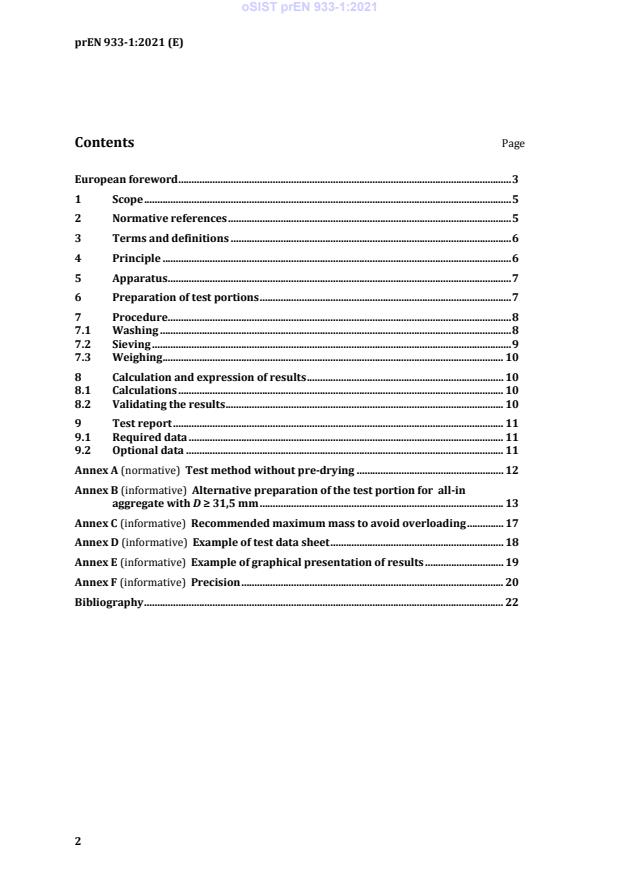
Contents
- 1 Scope
- 2 Normative references
- 3 Terms and definitions
- 3.1 aggregate
- 3.2 aggregate size
- 3.3 test portion
- 3.4 constant mass
- 4 Principle
- 5 Apparatus
- 5.3 Ventilated oven, capable of maintaining a temperature of (110 ± 5) °C or (40 ± 5) °C, or
- 6 Preparation of test portions
- 7 Procedure
- 7.1 Washing
- 7.2 Sieving
- 7.3 Weighing
- 8 Calculation and expression of results
- 8.1 Calculations
- 8.2 Validating the results
- 9 Test report
- 9.1 Required data
- 9.2 Optional data
- Annex A
- Annex B
- Annex C
- Annex D
- Annex E
- Annex F
- Bibliography
1 Scope
This document specifies the reference method used for type testing and in case of dispute, for determination of the particle size distribution of aggregates, by washing and dry sieving. Other methods can be used for other purposes, such as factory production control, provided that an appropriate working relationship with the reference method has been established. This document applies to all aggregates, with an upper aggregate size D up to 90 mm, but excluding added filler aggregates.
NOTE The determination of the grading of fillers is specified in EN 933-10 [1]. Annex A specifies a test method for aggregates unsuitable for oven-drying. Annex B specifies additional steps for preparation of the test portion for all-in aggregates with D ≥ 31,5 mm, without washing size fractions greater than 16 mm. Annex C provides guidance for maximum mass on sieves to avoid overloading. Annex D provides an example of test data sheet.
Annex E provides a sheet for graphical presentation of test results. Annex F gives precision data.
Annex A is normative and Annexes B, C, D, E and F are informative. WARNING – The use of this part of EN 933 can involve hazardous materials, operations and equipment (such as dust, noise and heavy lifts). It does not purport to address all of the safety or environmental problems associated with its use. It is the responsibility of users of this document to take appropriate measures to ensure the safety and health of personnel and the environment prior to application of the standard, and fulfil statutory and regulatory requirements for this purpose.
2 Normative references
The following documents are referred to in the text in such a way that some or all of their content constitutes requirements of this document. For dated references, only the edition cited applies. For undated references, the latest edition of the referenced document (including any amendments) applies.
EN 932-2, Tests for general properties of aggregates — Part 2: Methods for reducing laboratory samples EN 932-5, Tests for general properties of aggregates — Part 5: Common equipment and calibration EN 933-2, Tests for geometrical properties of aggregates — Part 2: Determination of particle size distribution — Test sieves, nominal size of apertures
oSIST prEN 933-1:2021 prEN 933-1:2021 (E)
3 Terms and definitions
For the purposes of this document, the following terms and definitions apply. ISO and IEC maintain terminological databases for use in standardization at the following addresses:
- IEC Electropedia: available at https://www.electropedia.org/
- ISO Online browsing platform: available at https://www.iso.org/obp
3.1 aggregate
granular material used in construction which may be natural, manufactured or recycled
3.2 aggregate size
d/D designation of aggregate in terms of lower (d) and upper (D) sieve sizes Note 1 to entry: This designation accepts the presence of some particles which will be retained on the upper sieve (oversize) and some which will pass the lower sieve (undersize).
3.3 test portion
d /D 0 0 sample used as a whole in a single test
3.4 constant mass
mass determined by successive weighings during drying performed at least 1 h apart and not differing by more than 0,1 % Note 1 to entry: In many cases, constant mass can be achieved after a test portion has been dried for a pre-determined period in a specified oven (see 5.3) at (110 ± 5) °C. Test laboratories can determine the time required to achieve constant mass for specific types and sizes of sample dependent upon the drying capacity of the oven used.
4 Principle
The test consists of washing, dividing and separating a material into several particle size classifications of decreasing sizes by means of a series of sieves. Successive steps are: initial washing to remove most of the fines in the test sample, drying, and dry sieving to separate the test sample into several size fractions of decreasing sizes. This is done by means of a series of selected sieves.
The mass of the particles retained on the various sieves is related to the initial dry mass of the test sample. The cumulative percentages passing each sieve are then calculated.
oSIST prEN 933-1:2021 prEN 933-1:2021 (E)
5 Apparatus
Unless otherwise stated, all apparatus shall conform to the general requirements of EN 932-5. 5.1 Test sieves, conforming to EN 933-2.
NOTE In the following parts of the standard, sieve is used as a short form of test sieve. 5.2 Tightly fitting pan and lid, for the sieves.
5.3 Ventilated oven, capable of maintaining a temperature of (110 ± 5) °C or (40 ± 5) °C, or
other suitable equipment for drying the aggregates, which does not cause any particle size breakdown.
5.4 Washing equipment.
5.5 Balances or scales, accurate to ± 0,1 % of the test portion mass. 5.6 Trays, brushes.
5.7 Sieve shaker, with such sieving action that the criterion for adequate separation of the test portion in 7.2 is met in a reasonable time, (optional).
5.8 Equipment for reducing laboratory samples, as specified in EN 932-2.
6 Preparation of test portions
Reduce samples in accordance with EN 932-2 to produce the required number of test portions. Samples containing substantial amounts of fines shall be moistened before reduction, to minimize segregation and loss of dust.
The size of each test portion shall be not less than specified in Table 1.
oSIST prEN 933-1:2021 prEN 933-1:2021 (E) Table 1 — Minimum size of test portions Upper aggregate size D Normal weight aggregates Lightweight aggregates mm kg litres 90 80 - 32 10 2,1 16 2,6 1,7 8 0,6 0,8 ≤ 4 0,2 0,3 For other D values below 90 mm, the minimum test portion mass may be interpolated from the masses,
using the following formula: M = (D/10) where M = minimum mass of test portion, in kg D = upper aggregate size, in mm
For aggregates with particle density higher than 3,00 Mg/m (see EN 1097-6), the minimum test portion masses shall be corrected. The correction shall be based on the density ratio, in order to produce a test portion of approximately the same volume as those for aggregates of normal density. For lightweight aggregates complying with EN 13055 [4], the volume column shall be used to choose the appropriate minimum size of test portions. The volumes for other aggregate sizes may be interpolated. The precision of the test method can be reduced if the test portion size is less than the minimum value specified. In such a case, the test portion size shall be stated in the test report (9.1). Sample reduction shall yield a test portion size which is larger than the minimum, but not of an exact predetermined value.
Dry the test portion to constant mass at (110 ± 5) °C in the case of natural and manufactured aggregates and at (40 ± 5) °C in the case of laboratory samples containing recycled aggregates. Where necessary, the drying procedure at (40 ± 5) °C may be generalized to all types of aggregates that are sensitive to drying at 110 °C.
Allow to cool, weigh and record the mass as M .
For some types of aggregate, drying at 110 °C binds particles together sufficiently strongly to prevent separation of single particles during subsequent washing and/or sieving procedures. For such aggregates the procedure given in Annex A shall be adopted. For all-in aggregates with D equal to 31,5 mm or larger, the procedure described in Annex B may be used.
7 Procedure
7.1 Washing
Washing and subsequent dry sieving is necessary to ensure an accurate determination of the fines content of the test portion.
NOTE 1 Significant amounts of water-soluble constituents can influence the results when washing the test portion.
When washing can alter the physical properties of a lightweight aggregate, only dry sieving shall be used.
Place the test portion in a container and add sufficient water to cover the test portion.
oSIST prEN 933-1:2021 prEN 933-1:2021 (E) NOTE 2 A storage period of 24 h under water is helpful in breaking down lumps. The use of a dispersion agent can improve the disintegration of lumps.
Agitate the sample with sufficient vigour to result in complete separation and suspension of the fines.
Wet both sides of a 0,063 mm sieve reserved for use in this test only, and fit a guard sieve (e.g. 1 mm or 2 mm) on top. Mount the sieves in such a way that the suspension passing the sieve can be run to waste or, when required, collected in a suitable vessel. Pour the contents of the container on to the top sieve. Continue washing until the water passing the 0,063 mm sieve is clear.
Care shall be taken to prevent overloading, overflowing or damaging the 0,063 mm sieve or the guard sieve. For some aggregates, it will be necessary to pour only the suspended fines from the container onto the 0,063 mm guarded sieve, continuing to wash the coarse residue in the container and decanting the suspended fines onto the guard sieve until the water passing the 0,063 mm sieve is clear.
Dry the residue retained on the 0,063 mm sieve to constant mass, at (110 ± 5) °C in the case of natural and manufactured aggregates and at (40 ± 5) °C in the case of recycled aggregates or other aggregates that are sensitive to drying at 110 °C. Allow to cool, weigh and record as M .
7.2 Sieving
Select appropriate sieves in accordance with the aggregate size d/D. Pour the washed and dried material into the sieving column. In case of a lightweight aggregate with water sensitive physical properties, pour the dry sample directly into the sieving column. The column comprises a number of sieves fitted together and arranged, from top to bottom, in order of decreasing aperture sizes with the pan and lid.
...