

EN 14256:2007
(Main)Adhesives for non-structural wood applications - Test method and requirements for resistance to static load
- Abstract
This European Standard specifies a method for determining the ability of a test piece bonded with a thermoplastic adhesive, to support a given load for a specified time without fracture or excessive distortion, and specifies performance requirements for mean survival time.
It should be used in conjunction with EN 204 and EN 205, which describe durability classes and corresponding test methods for non-structural wood adhesives based on their ability to withstand various water treatments and relatively rapidly applied loads. The test described in this standard may be used to assess joints made with thin glue line, as defined in EN 205.
NOTE The test described in this standard is not a mandatory requirement for the classification of adhesives into the classes D1, D2, D3 and D4 given in EN 204. It is an additional test that can be specified by a purchaser if required.
- Status
- Published
- Publication Date
- 31-Jul-2007
- Withdrawal Date
- 28-Feb-2008
- Technical Committee
- CEN/TC 193 - Adhesives
- Drafting Committee
- CEN/TC 193/SC 1/WG 12 - Adhesives for non-loadbearing timber structures
- Current Stage
- 9093 - Decision to confirm - Review Enquiry
- Start Date
- 12-Mar-2025
- Completion Date
- 07-Oct-2026

Overview
EN 14256:2007 is a European Standard developed by CEN that specifies a reliable test method for assessing the resistance of adhesives used in non-structural wood applications to static load. This standard is designed for thermoplastic adhesives and evaluates their ability to maintain joint integrity under sustained loading without fracture or excessive distortion over a specified period. EN 14256 is an optional, add-on test and is most effective when used alongside EN 204 and EN 205, which address durability classes and shear strength testing for wood adhesives. The goal is to help manufacturers, laboratories, and specifiers confirm the long-term stability and performance of adhesive bonds in non-structural wood assemblies.
Key Topics
- Test Method: The standard outlines a procedure involving the bonding of specific wood test pieces with the adhesive under test, conditioning these specimens, and then subjecting the bonded joints to a static load for up to 21 days in controlled temperature and humidity conditions.
- Performance Requirement: The main criterion is that the mean survival time of the bonded assemblies under load should be at least 14 days, ascertaining the adhesive's resistance to prolonged static stress.
- Sample Preparation: Detailed instructions are provided for preparing the test specimens, including the dimensions, bonding parameters, conditioning period, and environmental controls during the test phase.
- Result Reporting: The document prescribes comprehensive reporting-covering adhesive details, wood properties, bonding and testing conditions, survival times, and any test deviations for traceability and comparison.
- Scope and Limitations: EN 14256 is not a mandatory requirement for adhesive classification into durability classes D1-D4 (as per EN 204) but can be specified by purchasers for added assurance.
Applications
EN 14256:2007 is highly relevant for:
- Adhesive Manufacturers: Facilitates quality assurance by verifying product performance claims regarding long-term static load resistance.
- Testing Laboratories: Provides a standardized, reproducible protocol for assessing and comparing thermoplastic adhesives in non-structural wood applications.
- Procurement and Specification: Enables architects, engineers, and buyers to specify higher reliability for joinery, furniture, interior woodworks, and non-load-bearing wooden constructions where adhesive longevity is a concern.
- Regulatory and Certification Bodies: Supports product certification and benchmarking in the European and international wood adhesives market.
Related Standards
- EN 204: Classification of thermoplastic wood adhesives for non-structural applications - Defines the durability classes (D1, D2, D3, D4) based on resistance to varying water exposure.
- EN 205: Wood adhesives for non-structural applications - Specifies the method for determining the tensile shear strength of lap joints and details the preparation of test specimens, including thin glue line joints referenced in EN 14256.
- EN 923: Standard definitions for adhesives terminology, referenced for clarity and consistency.
- EN 13183-1 & EN 13183-2: Specify methods to determine moisture content in sawn timber, important for sample preparation and test validity.
By implementing EN 14256:2007 for your non-structural wood adhesives, you ensure a robust assessment of static load resistance, contributing to enhanced product reliability and customer confidence. For optimal results and coherent quality management, always use EN 14256 in conjunction with the related European standards for wood adhesives.
Relations
- Effective Date
- 12-Feb-2026
- Effective Date
- 22-Jul-2026
- Effective Date
- 28-Jan-2026
- Effective Date
- 28-Jan-2026
- Effective Date
- 28-Jan-2026
- Referred By
EN 1012-2:1996+A1:2009 - Compressors and vacuum pumps - Safety requirements - Part 2: Vacuum pumps - Effective Date
- 28-Jan-2026
Get Certified
Connect with accredited certification bodies for this standard

DIN CERTCO
DIN Group product certification.

Smithers Quality Assessments
US management systems and product certification.
Sponsored listings
Frequently Asked Questions
EN 14256:2007 is a standard published by the European Committee for Standardization (CEN). Its full title is "Adhesives for non-structural wood applications - Test method and requirements for resistance to static load". This standard covers: This European Standard specifies a method for determining the ability of a test piece bonded with a thermoplastic adhesive, to support a given load for a specified time without fracture or excessive distortion, and specifies performance requirements for mean survival time. It should be used in conjunction with EN 204 and EN 205, which describe durability classes and corresponding test methods for non-structural wood adhesives based on their ability to withstand various water treatments and relatively rapidly applied loads. The test described in this standard may be used to assess joints made with thin glue line, as defined in EN 205. NOTE The test described in this standard is not a mandatory requirement for the classification of adhesives into the classes D1, D2, D3 and D4 given in EN 204. It is an additional test that can be specified by a purchaser if required.
This European Standard specifies a method for determining the ability of a test piece bonded with a thermoplastic adhesive, to support a given load for a specified time without fracture or excessive distortion, and specifies performance requirements for mean survival time. It should be used in conjunction with EN 204 and EN 205, which describe durability classes and corresponding test methods for non-structural wood adhesives based on their ability to withstand various water treatments and relatively rapidly applied loads. The test described in this standard may be used to assess joints made with thin glue line, as defined in EN 205. NOTE The test described in this standard is not a mandatory requirement for the classification of adhesives into the classes D1, D2, D3 and D4 given in EN 204. It is an additional test that can be specified by a purchaser if required.
EN 14256:2007 is classified under the following ICS (International Classification for Standards) categories: 83.180 - Adhesives. The ICS classification helps identify the subject area and facilitates finding related standards.
EN 14256:2007 has the following relationships with other standards: It is inter standard links to ISO 34256:2024, EN 13183-2:2002, EN 923:2005, EN 205:2003, EN 13183-1:2002, EN 1012-2:1996+A1:2009. Understanding these relationships helps ensure you are using the most current and applicable version of the standard.
EN 14256:2007 is available in PDF format for immediate download after purchase. The document can be added to your cart and obtained through the secure checkout process. Digital delivery ensures instant access to the complete standard document.
Standards Content (Sample)
2003-01.Slovenski inštitut za standardizacijo. Razmnoževanje celote ali delov tega standarda ni dovoljeno.Adhesives for non-structural wood applications - Test method and requirements for resistance to static loadAdhésifs pour bois a usages non structuraux - Méthode d'essai et exigences pour la résistance a la charge statiqueHolzklebstoffe für nicht tragende Anwendungen - Prüfverfahren und Anforderungen an die Beständigkeit gegen statische BelastungTa slovenski standard je istoveten z:EN 14256:2007SIST EN 14256:2007en,fr,de83.180LepilaAdhesivesICS:SLOVENSKI
STANDARDSIST EN 14256:200701-november-2007
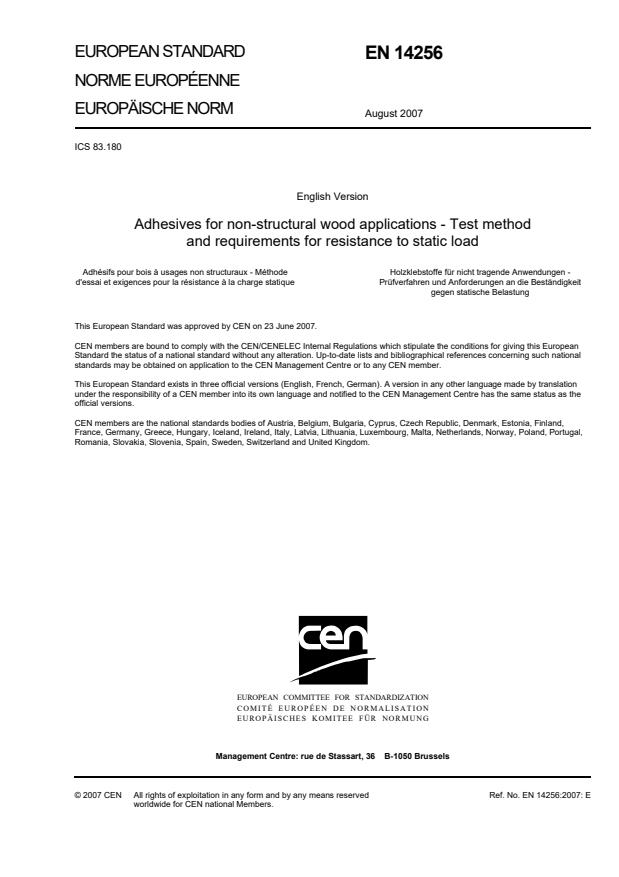
EUROPEAN STANDARDNORME EUROPÉENNEEUROPÄISCHE NORMEN 14256August 2007ICS 83.180 English VersionAdhesives for non-structural wood applications - Test methodand requirements for resistance to static loadAdhésifs pour bois à usages non structuraux - Méthoded'essai et exigences pour la résistance à la charge statiqueHolzklebstoffe für nicht tragende Anwendungen -Prüfverfahren und Anforderungen an die Beständigkeitgegen statische BelastungThis European Standard was approved by CEN on 23 June 2007.CEN members are bound to comply with the CEN/CENELEC Internal Regulations which stipulate the conditions for giving this EuropeanStandard the status of a national standard without any alteration. Up-to-date lists and bibliographical references concerning such nationalstandards may be obtained on application to the CEN Management Centre or to any CEN member.This European Standard exists in three official versions (English, French, German). A version in any other language made by translationunder the responsibility of a CEN member into its own language and notified to the CEN Management Centre has the same status as theofficial versions.CEN members are the national standards bodies of Austria, Belgium, Bulgaria, Cyprus, Czech Republic, Denmark, Estonia, Finland,France, Germany, Greece, Hungary, Iceland, Ireland, Italy, Latvia, Lithuania, Luxembourg, Malta, Netherlands, Norway, Poland, Portugal,Romania, Slovakia, Slovenia, Spain, Sweden, Switzerland and United Kingdom.EUROPEAN COMMITTEE FOR STANDARDIZATIONCOMITÉ EUROPÉEN DE NORMALISATIONEUROPÄISCHES KOMITEE FÜR NORMUNGManagement Centre: rue de Stassart, 36
B-1050 Brussels© 2007 CENAll rights of exploitation in any form and by any means reservedworldwide for CEN national Members.Ref. No. EN 14256:2007: E
...