

EN 1434-4:2007
(Main)Heat meters - Part 4: Pattern approval tests
- Abstract
This European Standard specifies pattern approval tests applies to heat meters, that is to instruments intended for measur¬ing the heat which, in a heat-exchange circuit, is absorbed or given up by a liquid called the heat-conveying liquid. The heat meter indicates the quantity of heat in legal units.
Electrical safety requirements are not covered by this European Standard.
Pressure safety requirements are not covered by this European Standard.
Surface mounted temperature sensors are not covered by this European Standard.
- Status
- Withdrawn
- Publication Date
- 27-Feb-2007
- Withdrawal Date
- 06-Oct-2026
- Technical Committee
- CEN/TC 176 - Heat meters
- Current Stage
- 9960 - Withdrawal effective - Withdrawal
- Start Date
- 04-Nov-2015
- Completion Date
- 07-Oct-2026
- Directive
- 2004/22/EC - Measuring instrumentsOJ Ref: C, C 162 OJ Date: 14-Jul-2007

Relations
- Effective Date
- 22-Dec-2008
- Effective Date
- 22-Dec-2008
- Effective Date
- 11-Nov-2015
- Effective Date
- 25-Aug-2026
- Effective Date
- 09-Feb-2026
- Effective Date
- 09-Feb-2026
- Effective Date
- 09-Feb-2026
- Effective Date
- 09-Feb-2026
- Effective Date
- 09-Feb-2026
- Effective Date
- 09-Feb-2026
- Effective Date
- 09-Feb-2026
- Effective Date
- 09-Feb-2026
- Effective Date
- 09-Feb-2026
- Effective Date
- 09-Feb-2026
- Effective Date
- 28-Jan-2026
Get Certified
Connect with accredited certification bodies for this standard

BSMI (Bureau of Standards, Metrology and Inspection)
Taiwan's standards and inspection authority.
Sponsored listings
Frequently Asked Questions
EN 1434-4:2007 is a standard published by the European Committee for Standardization (CEN). Its full title is "Heat meters - Part 4: Pattern approval tests". This standard covers: This European Standard specifies pattern approval tests applies to heat meters, that is to instruments intended for measur¬ing the heat which, in a heat-exchange circuit, is absorbed or given up by a liquid called the heat-conveying liquid. The heat meter indicates the quantity of heat in legal units. Electrical safety requirements are not covered by this European Standard. Pressure safety requirements are not covered by this European Standard. Surface mounted temperature sensors are not covered by this European Standard.
This European Standard specifies pattern approval tests applies to heat meters, that is to instruments intended for measur¬ing the heat which, in a heat-exchange circuit, is absorbed or given up by a liquid called the heat-conveying liquid. The heat meter indicates the quantity of heat in legal units. Electrical safety requirements are not covered by this European Standard. Pressure safety requirements are not covered by this European Standard. Surface mounted temperature sensors are not covered by this European Standard.
EN 1434-4:2007 is classified under the following ICS (International Classification for Standards) categories: 17.200.10 - Heat. Calorimetry. The ICS classification helps identify the subject area and facilitates finding related standards.
EN 1434-4:2007 has the following relationships with other standards: It is inter standard links to EN 1434-4:1997, EN 1434-4:1997/A1:2002, EN 1434-4:2015, ISO 4064-3:2005, EN IEC 60068-2-2:2025, EN IEC 61000-4-6:2023, EN IEC 61000-4-11:2020, EN IEC 60068-2-30:2025, EN 61000-4-5:2014, EN 61000-4-8:2010, EN IEC 60068-2-1:2025, EN 60751:1995, ISO 8986-1:1993, EN 61000-4-4:2012, EN 14154-3:2005. Understanding these relationships helps ensure you are using the most current and applicable version of the standard.
EN 1434-4:2007 is associated with the following European legislation: EU Directives/Regulations: 2004/22/EC; Standardization Mandates: M/374. When a standard is cited in the Official Journal of the European Union, products manufactured in conformity with it benefit from a presumption of conformity with the essential requirements of the corresponding EU directive or regulation.
EN 1434-4:2007 is available in PDF format for immediate download after purchase. The document can be added to your cart and obtained through the secure checkout process. Digital delivery ensures instant access to the complete standard document.
Standards Content (Sample)
2003-01.Slovenski inštitut za standardizacijo. Razmnoževanje celote ali delov tega standarda ni dovoljeno.Heat meters - Part 4: Pattern approval testsToplotni števci - 4. del: Preskusi za odobritev tipaCompteurs d'énergie thermique - Partie 4: Essais en vue de l'approbation de modeleWärmezähler - Teil 4: Prüfungen für die BauartzulassungTa slovenski standard je istoveten z:EN 1434-4:2007SIST EN 1434-4:2007en17.200.10Toplota. KalorimetrijaHeat. CalorimetryICS:SIST EN 1434-4:1997/A1:2002SIST EN 1434-4:19971DGRPHãþDSLOVENSKI
STANDARDSIST EN 1434-4:200701-maj-2007
EUROPEAN STANDARDNORME EUROPÉENNEEUROPÄISCHE NORMEN 1434-4February 2007ICS 17.200.10Supersedes EN 1434-4:1997
English VersionHeat meters - Part 4: Pattern approval testsCompteurs d'énergie thermique - Partie 4: Essais en vuede l'approbation de modèleWärmezähler - Teil 4: Prüfungen für die BauartzulassungThis European Standard was approved by CEN on 7 January 2007.CEN members are bound to comply with the CEN/CENELEC Internal Regulations which stipulate the conditions for giving this EuropeanStandard the status of a national standard without any alteration. Up-to-date lists and bibliographical references concerning such nationalstandards may be obtained on application to the CEN Management Centre or to any CEN member.This European Standard exists in three official versions (English, French, German). A version in any other language made by translationunder the responsibility of a CEN member into its own language and notified to the CEN Management Centre has the same status as theofficial versions.CEN members are the national standards bodies of Austria, Belgium, Bulgaria, Cyprus, Czech Republic, Denmark, Estonia, Finland,France, Germany, Greece, Hungary, Iceland, Ireland, Italy, Latvia, Lithuania, Luxembourg, Malta, Netherlands, Norway, Poland, Portugal,Romania, Slovakia, Slovenia, Spain, Sweden, Switzerland and United Kingdom.EUROPEAN COMMITTEE FOR STANDARDIZATIONCOMITÉ EUROPÉEN DE NORMALISATIONEUROPÄISCHES KOMITEE FÜR NORMUNGManagement Centre: rue de Stassart, 36
B-1050 Brussels© 2007 CENAll rights of exploitation in any form and by any means reservedworldwide for CEN national Members.Ref. No. EN 1434-4:2007: E
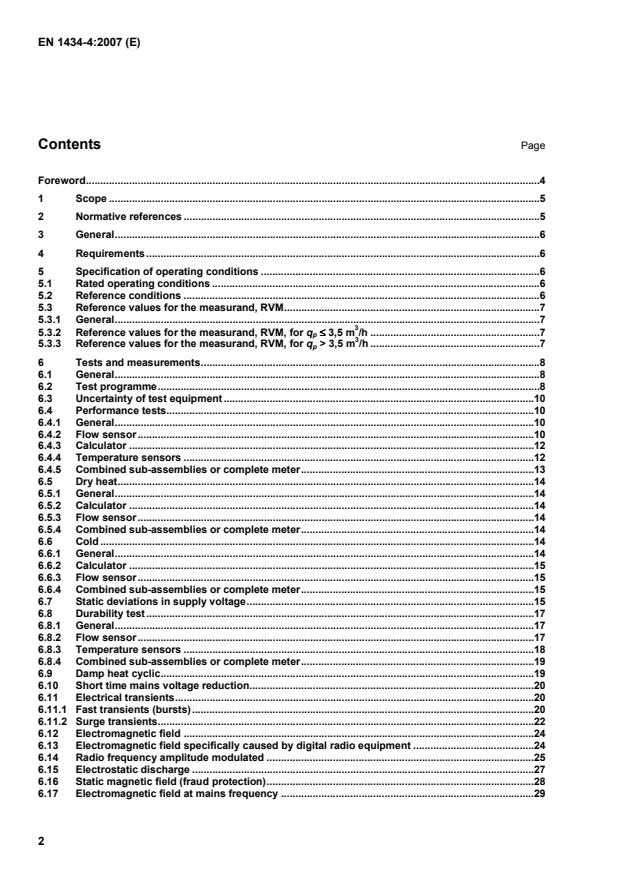
Testing procedure for temperature sensor pairs
with or without pockets.33 A.1 Test set-up.33 A.2 Test sequence.35 A.3 Calculations.35 Annex B (informative)
Checklist for type approvals of heat meters according to EN 1434.36 Annex ZA (informative)
Relationship between this European Standard and the Essential Requirements of
EU Directive 2004/22/EC, MID.46 Bibliography.47
disturbance characteristics - Limits and methods
of measurement (CISPR 22:2005, modified) EN 60068-2-1, Environmental testing — Part 2: Tests — Test A: Cold (IEC 60068-2-1:1990) EN 60068-2-2, Basic environmental testing procedures — Part 2-2: Tests — Tests B: Dry heat (IEC 60068-2-2:1974 +
IEC 60068-2-2A:1976) EN 60068-2-30, Environmental testing — Part 2-30: Tests — Test Db: Damp heat, cyclic (12 h + 12 h cycle) (IEC
60068-2-30:2005) EN 60751:1995, Industrial platinum resistance thermometer sensors (IEC 60751:1983 + A1:1986) EN 61000-4-2, Electromagnetic compatibility (EMC) — Part 4: Testing and measurement techniques — Section 2: Electrostatic discharge immunity test — Basic EMC publication (IEC 61000-4-2:1995) EN 61000-4-3, Electromagnetic compatibility (EMC) — Part 4-3: Testing and measurement techniques — Radiated, radio-frequency, electromagnetic field immunity test (IEC 61000-4-3:2006) EN 61000-4-4, Electromagnetic compatibility (EMC) — Part 4-4: Testing and measurement techniques — Electrical fast transient/burst immunity test (IEC 61000-4-4:2004) EN 61000-4-5, Electromagnetic compatibility (EMC) — Part 4: Testing and measurement techniques — Section 5: Surge immunity test (IEC 61000-4-5:1995) EN 61000-4-6:1996, Electromagnetic compatibility (EMC) — Part 4-6: Testing and measurement techniques — Section 6: Immunity to conducted disturbances, induced by radio-frequency fields (IEC 61000-4-6:1996) EN 61000-4-8, Electromagnetic compatibility (EMC) — Part 4: Testing and measurement techniques — Section 8: Power frequency magnetic field immunity test — Basic EMC publication (IEC 61000-4-8:1993)
5.2 Reference conditions Range of ambient temperature: + 15 ºC to + 35 ºC Range of relative humidity: 25 % to 75 % Range of ambient air pressure: 86 kPa to 106 kPa
± 2,5 K and ± 5 percentage points respectively during the period of one measurement. The reference conditions for a sub-assembly shall be the conditions under which it would operate if it was a part of a combined heat meter. 5.3 Reference values for the measurand, RVM 5.3.1 General For heating/cooling meters the RVM shall be based on the values for the heating range. 5.3.2 Reference values for the measurand, RVM, for qp ≤≤≤≤ 3,5 m3/h
Table 2 — Reference values for heating and cooling
Heating applications Cooling applications Range of temperature difference
(40 ± 2) K
or K02max−∆Θ
if
max∆Θ is less than 40 K (10 ± 2) K Range of flow-rate: (0,7 to 0,75) qp in m3/h
(0,7 to 0,75) qp in m3/h
Return temperature: (50 ± 5) ºC or
the upper limit of the return temperature, if it is less than 50 ºC (50 ± 5) ºC or the upper limit of the temperature range, if it is less than 50 ºC
The conditions, mentioned in Table 2, are reference values for a complete heat meter. Reference values for sub-assemblies are the relevant parts of the conditions mentioned in Table 2. 5.3.3 Reference values for the measurand, RVM, for qp > 3,5 m3/h Flow-rate simulation for the flow sensor electronics is allowed, but testing with water is always preferred and carried out in accordance with 5.3.2. If flow-rate simulation is used, the following RVM values apply: Range of temperature differences:
For heating applications: (40 ± 2) K
or
K02max−∆Θ
if
max∆Θ is less than 40 K For cooling applications: (10 ± 2) K
The power and signal wires shall be connected. The flow sensor including flow sensor electronics shall be operated at zero flow rate (without low flow cut off device). 6 Tests and measurements 6.1 General Unless otherwise stated in the test specification, the test requirements apply irrespective of the heat meter's environmental class. See Clause 10 of EN 1434-1:2007. All measurements shall be carried out under the installation conditions stipulated by the supplier for his type of meter (e.g. straight sections of piping upstream and downstream of the meter). For all tests the heat conveying liquid shall be water, unless otherwise specified. If so, the performance test shall be carried out with the specified liquid and the type approval certificate shall include the specification of the liquid to be used for initial verification. If a temperature sensor can be installed in the flow sensor, this shall be done during the performance tests of the flow sensor. Where a filter or strainer is an integral part of the flow sensor, it shall be included in all the tests. If the error determined lies outside the MPE, the test shall be repeated twice unless otherwise stated. The test is then declared satisfactory if both the arithmetic mean of the result of the three tests and at least two of the test results are within or at the MPE. Depending on the flow sensor size the tests and measurements to be carried out are described below: For each meter model the test in 6.4, 6.18 and 6.19 can be carried out on a limited number of sizes according to an evaluation by the testing laboratory. This evaluation shall be included in the type testing report. The test in 6.8 shall be carried out only for those sizes of a type for which the highest wear is expected. For dimensions > DN 200, 6.19 shall be carried out at Θmin. For each meter model the following tests shall be carried out on one size only: 6.5, 6.6, 6.7, 6.9, 6.10, 6.11, 6.12, 6.13, 6.14, 6.15, 6.16, 6.17, 6.20 and 6.21. 6.2 Test programme Samples of a heat meter, or its sub-assemblies, submitted for pattern approval, shall be subject to tests to verify their conformity with Clause 4. Unless otherwise stated, the tests shall be carried out at reference con-ditions and the samples shall be exposed to the influence factors or disturbances specified for the respective tests, as stated in Table 3. The test sequence and the number of items used shall be either as described in Table 2 or as agreed between the supplier and the testing laboratory (assuming four samples, numbered by the testing laboratory). Only one influence quantity shall be applied at a time. If the meter under test (complete, combined or sub-assemblies) has test outputs for quantity of water, temperature difference and/or energy, these outputs can be used to test such parameters.
sensor Calcula-ting dev-ice
Compl-ete meter Sample no.
INFLUENCE FAC-TORS
MPE
6.4 Performance test
X
X
X
X
MPE
6.5 Dry heat
X(a)
X
X
MPE
6.6 Cold
X(a)
X
X
MPE
6.7 Static deviations in supply voltage
X(a)
X
X
DISTURBANCES
NSFa
6.8 Durability
X
X
X
NSFd
6.9 Damp heat, cyclic
X(a)
X
X
NSFd
6.10 Short time reduction in supply voltage
X(a)
X
X
NSFa
6.11 Electrical transients
X(a)(b)
X(b)
X
NSFd
6.12 Electromagnetic field
X(a)(b)
X(b)
X
3 NSFd 6.13 Electromagnetic field - digital radio equipm.
X(a)(b) X(b) X
3 NSFd 6.14 Radio frequency, amplitude modulated
X(a)(b) X(b) X
NSFa
6.15 Electrostatic discharge
X(a)
X
X
NSFd
6.16 Static magnetic field
X
X
X
NSFd
6.17 Electromagnetic field at mains frequency
X(a)
X
X
NSFa
6.18 Internal pressure
X
X
6.19 Pressure loss
X
X
6.20 Electromagnetic emis-sion
X(a)
X(b)
X
6.21 24 hrs interruption in supply voltage
X X
3 NSFd 6.22 Flow disturbances
X
X 1
MPE
-
Maximum permissible error according to Clause 9 of EN 1434-1:2007
NSFd -
No significant fault shall occur during the test
NSFa -
No significant fault shall occur after the test
X
-
Test to be performed
a
-
Only for flow sensors with electronic devices
b
-
This test shall be done with connected cables
where q1 = qs and q5 = qi,
q1/q2 = q2/q3 = q3/q4 = q4/q5 = K where
Applications
Heating Cooling
Type of flow sensor All Mechanical with qp/qi ≤ 10 Static with qp/qi ≤ 25 Mechanical with qp/qi > 10 Static with qp/qi > 25 a Θmin to (Θmin + 5) °C (but not less than 10 °C) (15 ± 5) °C (15 ± 5) °C b (50 ± 5) °C
(5 ± 1) °C
c (85 ± 5) °C
The water temperature at the heat meter shall not vary by more than 2 K during a measurement. For flow sensors larger than DN250, testing at water temperature a) only, is considered sufficient if the following conditions are satisfied: • the test results for smaller flow sensors of the same model are inside MPE for all water temperatures; • documentary evidence is given that technological similarity exists between the models tested and the larger sizes applied for. 6.4.2.3 Electromagnetic type flow sensors shall be tested with water having an electrical conductivity higher than 200 µS/cm. If the supplier has stated a lower permitted conductivity, tests shall also be performed at that conductivity at the flow rates q1 and q5, and at the water temperature a). The conductivity shall be noted in the certificate. If the electronic part of the flow sensor is separated from the sensor head, the type and the maximum length of the connecting cable to the electrodes shall be stated by the supplier, be used for the above mentioned low conductivity test and noted in the certificate. 6.4.2.4 For fast response meters the transient behaviour of the flow sensors of size qp ≤ 2,5 m;/h shall be investigated by measuring the total quantity of water delivered in 10 to 15 cycles, consisting of a 10 s period at a flow rate of qs and a 30 s period at zero flow rate. The total quantity of water measured shall be twice the quantity used for the test at qs in 6.4.2.2. The duration of start and stop shall be (1 ± 0,2) s. The water temperature shall be as a) in 6.4.2.2. The error shall not exceed the MPE. For a complete or combined meter, the water temperature specified above is the return temperature. The
ºC Temperature difference
K
a)
Θreturn = (Θmin +5
0 )
∆Θmin, 5, 20, ∆ΘRVM
b)
Θreturn = (ΘRVM ± 5)
∆Θmin, 5, 20, ∆ΘRVM, ∆Θmax
a
c)
Θflow =
(Θmax
0 -5
)
20, ∆ΘRVM, ∆Θmax
a
The level corresponding to ∆Θmax shall be reduced if needed to be within Θmax
Table 6 — Testing temperatures for cooling applications Temperature
ºC Temperature difference
K
a)
Θflow = (Θmin +5
0 )
∆Θmin, 5, ∆ΘRVM , ∆Θmax
b)
Θflow = (15 ±5)
∆Θmin
c)
Θreturn =
(Θmax
-5
)
∆ΘRVM, ∆Θmax
The maximum temperature for these tests shall not exceed Θmax Tolerances: For all temperature differences:
± 20%, except for ∆Θmin: +20
0 %
and ∆Θmax:
-20 %
For all test points, the simulated flow rate shall not create a signal exceeding the maximum signal acceptable by the calculator. 6.4.4 Temperature sensors 6.4.4.1 Qualifying immersion depth It shall be verified in a thermostatic bath with a temperature of (90 ± 5) ºC at an ambient temperature of
(23 ± 3) ºC, that a deeper immersion than the qualifying immersion depth changes the resistance value by an amount corresponding to < 0,1 K.
(40 ± 5) ºC
(70 ± 5) ºC
(90 ± 5) ºC
(130 ± 5) ºC
(160
± 10) ºC chosen to optimize the spread of temperature over the temperature range specified by the supplier. The immersion depth of the sensor under test shall be 90 % to 99 % of the total length. The determined resistance values shall be used in a system of three equations to calculate the three constants of the temperature/resistance equation of EN 60751 and a curve shall be drawn through the three test points. Thereby the characteristic curve for the temperature sensor is known. The "ideal" curve using the standard constants of EN 60751 shall be generated. To give the error at any temperature, the "ideal" curve shall be subtracted from the characteristic curve for each temperature sensor. As a further step the worst-case error of the pair shall be determined over the temperature range and over the temperature difference range specified for the temperature sensors. For return temperatures above 80 ºC, only temperature differences over 10 K shall be taken into account. If the temperature sensor pair and calculator form an inseparable sub-assembly, or a complete meter is to be approved, the test conditions for the sub-assembly or complete meter shall apply. The error determined as described above shall be within the limits stated in 9.2.2.2 of EN 1434-1:2007. 6.4.4.4 Testing of the influence of pockets The supplier shall deliver four sets consisting of; • one sensor with pocket selected so that the gap between pocket and sensor is the minimum gap according to the specification; • one sensor with pocket selected so that the gap between pocket and sensor is the maximum gap according to the specification. Only the shortest pocket length in a family shall be tested, provided that thread, material etc. are identical for all pockets in the family. The two sensors shall be tested without pockets according to 6.4.4.4. The test described in 6.4.4.4 shall be repeated with the sensors mounted in the pockets and this test (including the mounting of the sensors in the pockets) shall be repeated once. To get the best reproducibility it is strongly recommended that the tests with and without pockets are both carried out following the procedure in Annex A. The calculated difference between the results with and without pockets shall be within 1/3 of the MPE. 6.4.5 Combined sub-assemblies or complete meter The relevant tests for flow-rate (6.4.2), temperatures and temperature differences (6.4.3) shall be carried out.
(55 ± 2) ºC Duration:
2 h The duration of the test commences, after the heat meter or the sub-assemblies has reached temperature sta-bility. The rate of change of temperature shall not exceed 1K/min during heating up and cooling down. The relative humidity of the test atmosphere shall not exceed 20 %. After temperature stability of the heat meter or the sub-assemblies has been attained, the tests of 6.5.2, 6.5.3 and 6.5.4 shall be carried out without exceeding the MPE. 6.5.2 Calculator Simulated return temperatures: Θmin and ΘRVM Simulated rate: The flow-rate producing the maximum input signal acceptable by the calculator Simulated temperature differences: ∆Θmin and ∆ΘRVM 6.5.3 Flow sensor Water temperature: (50 ± 5) ºC for heating applications and (15 ± 5) ºC for cooling applications Flow rates a) (1 to 1,1)qi
only to be carried out where qi ≤ 3 m3/h b) (0,7 to 0,75)qp if qp > 3,5 m3/h the test shall be carried out according to 5.3.3 6.5.4 Combined sub-assemblies or complete meter The relevant tests as described (see Table 3) for calculator and flow sensor shall be carried out. 6.6 Cold 6.6.1 General The heat meters or their sub-assemblies shall be exposed to cold air under the test conditions in Table 7. Reference to standard: EN 60068-2-1, Part 2-1: Tests. Test Ad: Cold, for heat dissipating heat meter or the sub-assemblies with gradual change of temperature.
A
B
C Temperature - ºC
5 ± 3
- 25 ± 3
5 ± 3 Duration - h
The duration of the test commences, after the heat meter or the sub-assemblies has reached temperature stability. The rate of change of temperature shall not exceed 1 K/min during heating up and cooling down. After temperature stability of the heat meter or the sub-assemblies has been attained, the tests of 6.6.2, 6.6.3 and 6.6.4 shall be carried out without exceeding the MPE. 6.6.2 Calculator Simulated return temperatures: Θmin and ΘRVM Simulated flow rate:
The flow-rate producing the maximum input signal acceptable by the calculator Simulated temperature differences: ∆Θmin and ∆ΘRVM 6.6.3 Flow sensor Water temperature: (50 ± 5) ºC for heating applications and (15 ± 5) ºC for cooling applications Flow rates a) (1 to 1,1)qi
only to be carried out where qi ≤ 3 m3/h; b) (0,7 to 0,75)qp if qp > 3,5 m3/h the test shall be carried out according to 5.3.3. 6.6.4 Combined sub-assemblies or complete meter The relevant tests as described for calculator and flow sensor shall be carried out. 6.7 Static deviations in supply voltage The heat meters or their sub-assemblies shall be subjected to static deviations from the rated supply voltage Un under the following test conditions: Upper limit: Umax Lower limit: Umin Supply mode: defined in a), b), c), d), e) and f) below Duration: as needed for determination of RVM conditions The duration of each test, which shall be at normal reference conditions, shall be sufficient to determine the error of the heat meter or the sub-assemblies. Supply modes:
Umax = 36 V Umin = 12 V
e) Remote DC supply voltage Umax = 42 V
Umin = 12 V f)
Local external DC supply voltage Umax as specified by the supplier Umin
as specified by the supplier
qp ± 5 %
qs 0
-5
%
The basic wear test shall be carried out at the upper limit of the temperature range. After the test the error of indication shall be determined at the flow rates stated in 6.4.2 (for the flow sensor) at: For heating applications (50 ± 5) ºC or at (Θmax
-5 ) ºC
if Θmax < 50 ºC.
For cooling applications (15 ± 5) ºC
No significant error shall occur.
Figure 1 — Basic wear test cycles with magnification of the first cycle 6.8.2.3 Additional test The additional endurance test for long-life flow sensors shall have a duration of 300 h at a continuous flow rate equal to qs and at the upper limit of the temperature range. Tolerance: qs
-5
% After the test the error of indication shall be determined at the flow rates stated in 6.4.2 (for the flow sensor) at: For heating applications (50 ± 5) ºC or at (Θmax
-5 ) ºC if
Θmax < 50 ºC. For cooling applications (15 ± 5) ºC No significant error shall occur. 6.8.3 Temperature sensors The temperature sensor shall be brought slowly to its upper temperature limit, then exposed to air at room temperature and then brought slowly to its lower temperature limit. This procedure shall be repeated 10 times. At each limit the temperature sensor shall be immersed to an immersion depth of 90 % to 99 % of the total length and shall be maintained at the temperature for sufficient time to reach thermal equilibrium (according to
10 VDC. The polarity of the voltage shall be reversed. The measured resistance shall in no case be less than 10 MΩ. 6.8.4 Combined sub-assemblies or complete meter The relevant tests according to test for each sub-assembly shall be carried out. Before and after the test, measurements shall be carried out as for each sub-assembly. One exception is the insulation resistance for temperature sensors. This measurement shall not be carried out when the temperature sensor is a part of the heat meter or the sub-assemblies. 6.9 Damp heat cyclic The heat meters or their sub-assemblies shall be exposed to cyclic damp heat (condensing) under the conditions given in Table 8. Reference to standard: EN 60068-2-30, Test Db: test variant 1. Table 8 — Test conditions Environmental class
A
B C Lower temperature
(25 ± 3) ºC
(25 ± 3) ºC (25 ± 3) ºC Upper temperature
(40 ± 2) ºC
(55 ± 2) ºC (55 ± 2) ºC Relative humidity
≥ 93 %
≥ 93 % ≥ 93 % Period of cycle
12 h + 12 h
12 h + 12 h 12 h + 12 h Number of cycles
2 2 Recovery period before proceeding to the next test
min. 1 h
max. 2 h
min. 1 h
max. 2 h min. 1 h max. 2 h
The test consists of exposure to a cyclic temperature variation between the lower and the upper temperature, maintaining the relative humidity above 95 % during the temperature changes and low temperature phases, and at 93 % at the upper temperature phases. Condensation shall occur on the heat meter or the sub-assemblies during the temperature rise. The heat meter or the sub-assemblies shall be switched on during the test and operate according to the conditions for RVM measurements, except that the liquid temperature shall be 15 ºC ± 5 ºC for cooling and
increase of the temperature from
the lower to the upper temperature; - after recovery. On completion of the damp heat cyclic test, comparison of intrinsic error test results at RVM conditions with initial intrinsic error test results shall show no significant fault. 6.10 Short time mains voltage reduction NOTE 1 This clause is valid only for electronic devices or instruments for mains and low voltage AC supply operation. The heat meter or the sub-assemblies shall be subjected to repetitive brief reductions in the supply voltage under the following test conditions: Reference to standard: EN 61000-4-11, Voltage dips, short interruptions and voltage variations immunity test. The test levels shall be voltage dips of 100 % in 10 half cycles. NOTE 2 With 50 Hz mains this means interruptions of 100 ms. Each individual voltage reduction shall be initiated, terminated and repeated at a zero crossing of the supply voltage. The interval of time between two successive reductions shall be (10 ±1) s and 10 reductions shall be carried out. Initial intrinsic error determinations at RVM conditions shall be made and the above test sequence started. Intrinsic error determinations shall be made and the measurement ended after (15 ± 1) min. With reference to the initial intrinsic error determination, no significant faults shall occur. 6.11 Electrical transients 6.11.1 Fast transients (bursts) For signal and DC lines the following applies: Each cable, interconnecting
sub-assemblies or external cables for permanent installation longer than 1,2 m, connected to the heat meters or their parts shall be subjected to a repetitive series of electrical spikes during a fixed interval of time (i.e. electrical bursts) under the conditions given in Table 9. Reference to standard: EN 61000-4-4
Table 9 — Test conditions
Test voltage
1,0 kV ± 10 %
Spike rise time
5 ns
Spike duration
50 ns
Spike repetition frequency
5 kHz
Burst length
15 ms
Burst period
300 ms
Duration of test
60 s for negative bursts and 60 s for positive bursts
Bursts are coupled to the terminals only as common-mode interference with ground (earth) as reference. Bursts are obtained by a transient generator having an output impedance of 50 Ω. The spikes in bursts can have positive or negative polarity. The decay time is defined as the interval of time between the half amplitude points of the transient. The heat meter or the sub-assemblies shall be switched on during the test with a flow rate of zero and
∆Θ
= ∆ΘRVM. Initial intrinsic error determination at RVM conditions shall be made. Examination of the heat meter or the sub-assemblies after the tests shall show that no information or readings have changed due to the exposure, but the figure of the lowest significance of the readings for the water or heat quantity may alter by one unit at most. After the tests, intrinsic error determinations at RVM conditions shall be carried out and no significant fau
...