

EN 15188:2007
(Main)Determination of the spontaneous ignition behaviour of dust accumulations
- Abstract
This European Standard specifies analysis and evaluation procedures for determining self-ignition temperatures (TSI) of combustible dusts or granular materials as a function of volume by hot storage experiments in ovens of constant temperature. The specified test method is applicable to any solid material for which the linear correlation of lg (V/A) versus the reciprocal self-ignition temperature 1/TSI (with TSI in K) holds (i.e. not limited to only oxidatively unstable materials).
This European Standard is not applicable to the ignition of dust layers or bulk solids under aerated conditions (e.g. as in fluid bed dryer).
This European Standard shall not be applied to dusts like recognised explosives that do not require atmospheric oxygen for combustion, nor to pyrophoric materials.
NOTE Because of regulatory and safety reasons "recognised explosives" are not in the scope of this European Standard. In spite of that, substances which undergo thermal decomposition reactions and which are not "recognised explosives" but behave very similarly to self-ignition processes when they decompose are in the scope. If there are any doubts as to whether the dust is an explosive or not, experts should be consulted.
- Status
- Withdrawn
- Publication Date
- 21-Aug-2007
- Withdrawal Date
- 06-Oct-2026
- Current Stage
- 9960 - Withdrawal effective - Withdrawal
- Start Date
- 23-Dec-2020
- Completion Date
- 07-Oct-2026
- Directive
- 2014/34/EU - Directive 2014/34/EU Of The European Parliament And Of The Council of 26 February 2014 on the harmonisation of the laws of the Member States relating to equipment and protective systems intended for use in potentially explosive atmospheres (recast)OJ Ref: C, C 126, HARMONIZIRAN OJ Date: 08-Apr-2016
94/9/EC - Equipment and protective systems intended for use in potentially explosive atmospheres (ATEX)OJ Ref: C, C 20 OJ Date: 27-Jan-2009


Relations
- Replaced By
EN 15188:2020 - Determination of the spontaneous ignition behaviour of dust accumulations - Effective Date
- 31-Jan-2018
Get Certified
Connect with accredited certification bodies for this standard

CIS Institut d.o.o.
Personal Protective Equipment (PPE) certification body. Notified Body NB-2890 for EU Regulation 2016/425 PPE.

Kiwa BDA Testing
Building and construction product certification.
Kmetijski inštitut Slovenije
Agricultural Institute of Slovenia. Soil testing, plant health, agricultural product analysis.
Sponsored listings
Frequently Asked Questions
EN 15188:2007 is a standard published by the European Committee for Standardization (CEN). Its full title is "Determination of the spontaneous ignition behaviour of dust accumulations". This standard covers: This European Standard specifies analysis and evaluation procedures for determining self-ignition temperatures (TSI) of combustible dusts or granular materials as a function of volume by hot storage experiments in ovens of constant temperature. The specified test method is applicable to any solid material for which the linear correlation of lg (V/A) versus the reciprocal self-ignition temperature 1/TSI (with TSI in K) holds (i.e. not limited to only oxidatively unstable materials). This European Standard is not applicable to the ignition of dust layers or bulk solids under aerated conditions (e.g. as in fluid bed dryer). This European Standard shall not be applied to dusts like recognised explosives that do not require atmospheric oxygen for combustion, nor to pyrophoric materials. NOTE Because of regulatory and safety reasons "recognised explosives" are not in the scope of this European Standard. In spite of that, substances which undergo thermal decomposition reactions and which are not "recognised explosives" but behave very similarly to self-ignition processes when they decompose are in the scope. If there are any doubts as to whether the dust is an explosive or not, experts should be consulted.
This European Standard specifies analysis and evaluation procedures for determining self-ignition temperatures (TSI) of combustible dusts or granular materials as a function of volume by hot storage experiments in ovens of constant temperature. The specified test method is applicable to any solid material for which the linear correlation of lg (V/A) versus the reciprocal self-ignition temperature 1/TSI (with TSI in K) holds (i.e. not limited to only oxidatively unstable materials). This European Standard is not applicable to the ignition of dust layers or bulk solids under aerated conditions (e.g. as in fluid bed dryer). This European Standard shall not be applied to dusts like recognised explosives that do not require atmospheric oxygen for combustion, nor to pyrophoric materials. NOTE Because of regulatory and safety reasons "recognised explosives" are not in the scope of this European Standard. In spite of that, substances which undergo thermal decomposition reactions and which are not "recognised explosives" but behave very similarly to self-ignition processes when they decompose are in the scope. If there are any doubts as to whether the dust is an explosive or not, experts should be consulted.
EN 15188:2007 is classified under the following ICS (International Classification for Standards) categories: 13.230 - Explosion protection. The ICS classification helps identify the subject area and facilitates finding related standards.
EN 15188:2007 has the following relationships with other standards: It is inter standard links to EN 15188:2020. Understanding these relationships helps ensure you are using the most current and applicable version of the standard.
EN 15188:2007 is associated with the following European legislation: EU Directives/Regulations: 2014/34/EU, 94/9/EC; Standardization Mandates: M/BC/CEN/92/46. When a standard is cited in the Official Journal of the European Union, products manufactured in conformity with it benefit from a presumption of conformity with the essential requirements of the corresponding EU directive or regulation.
EN 15188:2007 is available in PDF format for immediate download after purchase. The document can be added to your cart and obtained through the secure checkout process. Digital delivery ensures instant access to the complete standard document.
Standards Content (Sample)
2003-01.Slovenski inštitut za standardizacijo. Razmnoževanje celote ali delov tega standarda ni dovoljeno.Bestimmung des Selbstentzündungsverhaltens von StaubschüttungenDétermination de l'aptitude a l'auto-inflammation des accumulations de poussieresDetermination of the spontaneous ignition behaviour of dust accumulations13.230Varstvo pred eksplozijoExplosion protection13.220.40Sposobnost vžiga in obnašanje materialov in proizvodov pri gorenjuIgnitability and burning behaviour of materials and productsICS:Ta slovenski standard je istoveten z:EN 15188:2007SIST EN 15188:2007en,fr,de01-oktober-2007SIST EN 15188:2007SLOVENSKI
STANDARD
EUROPEAN STANDARDNORME EUROPÉENNEEUROPÄISCHE NORMEN 15188August 2007ICS 13.230 English VersionDetermination of the spontaneous ignition behaviour of dustaccumulationsDétermination de l'aptitude à l'auto-inflammation desaccumulations de poussièresBestimmung des Selbstentzündungsverhaltens vonStaubschüttungenThis European Standard was approved by CEN on 13 July 2007.CEN members are bound to comply with the CEN/CENELEC Internal Regulations which stipulate the conditions for giving this EuropeanStandard the status of a national standard without any alteration. Up-to-date lists and bibliographical references concerning such nationalstandards may be obtained on application to the CEN Management Centre or to any CEN member.This European Standard exists in three official versions (English, French, German). A version in any other language made by translationunder the responsibility of a CEN member into its own language and notified to the CEN Management Centre has the same status as theofficial versions.CEN members are the national standards bodies of Austria, Belgium, Bulgaria, Cyprus, Czech Republic, Denmark, Estonia, Finland,France, Germany, Greece, Hungary, Iceland, Ireland, Italy, Latvia, Lithuania, Luxembourg, Malta, Netherlands, Norway, Poland, Portugal,Romania, Slovakia, Slovenia, Spain, Sweden, Switzerland and United Kingdom.EUROPEAN COMMITTEE FOR STANDARDIZATIONCOMITÉ EUROPÉEN DE NORMALISATIONEUROPÄISCHES KOMITEE FÜR NORMUNGManagement Centre: rue de Stassart, 36
B-1050 Brussels© 2007 CENAll rights of exploitation in any form and by any means reservedworldwide for CEN national Members.Ref. No. EN 15188:2007: ESIST EN 15188:2007
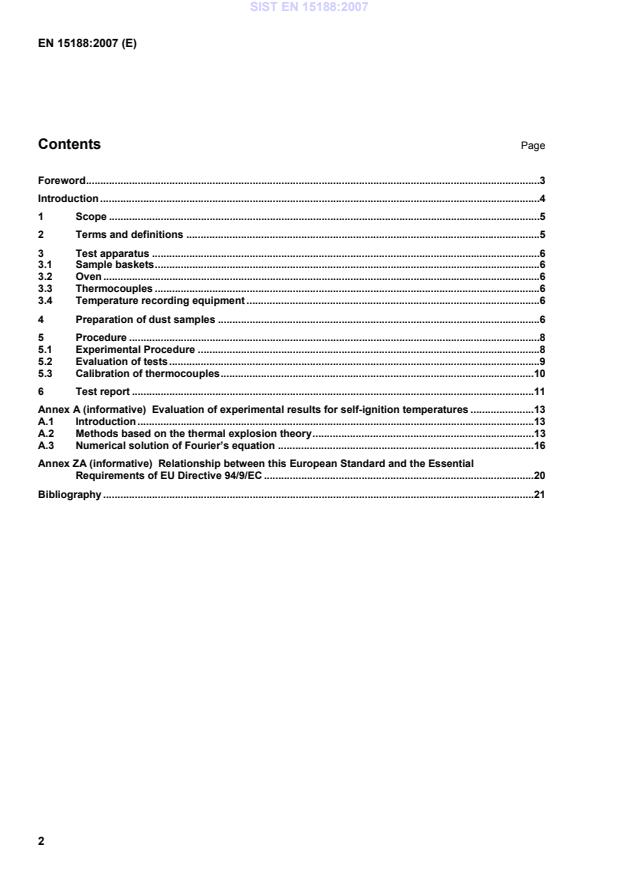
Evaluation of experimental results for self-ignition temperatures.13 A.1 Introduction.13 A.2 Methods based on the thermal explosion theory.13 A.3 Numerical solution of Fourier’s equation.16 Annex ZA (informative)
Relationship between this European Standard and the Essential Requirements of EU Directive 94/9/EC.20 Bibliography.21
For relationship with EU Directive 94/9/EC, see informative Annex ZA, which is an integral part of this document.
According to the CEN/CENELEC Internal Regulations, the national standards organizations of the following countries are bound to implement this European Standard: Austria, Belgium, Bulgaria, Cyprus, Czech Republic, Denmark, Estonia, Finland, France, Germany, Greece, Hungary, Iceland, Ireland, Italy, Latvia, Lithuania, Luxembourg, Malta, Netherlands, Norway, Poland, Portugal, Romania, Slovakia, Slovenia, Spain, Sweden, Switzerland and the United Kingdom. SIST EN 15188:2007
Mechanically ventilated ovens can also be used provided the test basket is shielded (e.g. by using an inner chamber or an additional mesh wire basket). 3.3 Thermocouples Both for measuring the sample temperature as well as for measuring the oven temperature, sheathed thermocouples with an external diameter of e.g. 1 mm are recommended. 3.4 Temperature recording equipment Appropriate data acquisition may be used for measuring and recording signals of the thermocouples. 4 Preparation of dust samples To investigate situations occurring in practice a representative sample should be used (produced by the operating conditions of the process). The sample characteristics shall be recorded in the test report. The bulk density of the dust for each experiment is determined by weighing the baskets as well as the moisture content of the dust before and after filling. SIST EN 15188:2007
Key 1 heating oven 5 thermocouple for measuring sample temperature 2 inner chamber (volume ≈ 50 l) 6 wire gauze cylinder with dust sample 3 air outlet, diameter ≈ 10 mm 7 deflector 4 thermocouple for measuring oven temperature 8 air inlet (preheated air, adjustable flow rate),
diameter ≈ 8 mm Figure 1 — Suggested experimental setup for hot storage tests If the results are required to compare different dusts with each other (for the purpose of tabular data compilations), tests shall to be carried out with the dust having passed through a sieve of 250 µm mesh aperture and dried to constant weight at 50° C in a vacuum drying chamber. If necessary, the substance may be ground and/or sieved. All preparation procedures shall be recorded and included in the report, especially when altering the grain size, quoting the grain size distribution of the sample tested. SIST EN 15188:2007
...