

EN 1998-3:2025/prA1
(Amendment)Eurocode 8 - Design of structures for earthquake resistance - Part 3: Assessment and retrofitting of buildings and bridges
- Abstract
1.1 Scope of EN 1998-3
(1) This document is applicable to the assessment and retrofitting of buildings and bridges in seismic regions, namely as given in a) to c):
a) to provide criteria for the assessment of the seismic performance of existing individual buildings and bridges;
b) to describe the procedure to be followed in selecting necessary corrective measures;
c) to set forth criteria for the design of retrofitting measures (i.e. design, structural analysis including intervention measures, final dimensioning of structural parts and their connections to existing structural members).
NOTE 1 For the purposes of this document, retrofitting covers both the seismic upgrading (e.g. strengthening or adding a passive system) of undamaged structures and the repair and possible upgrading of earthquake-damaged structures.
NOTE 2 Only the most common retrofit techniques are covered in this document. This does not exclude the use of other techniques, which can be developed in each country, based on the strengthening principles of this document.
NOTE 3 Annex D gives flowcharts for the application of this document.
(2) Unless specifically stated, EN 1998-1-1 and EN 1998-5 apply.
(3) Reflecting the performance requirements of EN 1998-1-1:2024, 4.1, this document covers the seismic assessment and retrofitting of buildings and bridges made of the more commonly used structural materials: concrete, steel and composite, timber and masonry.
NOTE Annexes B and C contain additional guidance related to the assessment of timber and masonry structures, respectively, and to their retrofitting when necessary.
(4) This document is intended for the assessment of individual structures, to decide on the need for structural intervention and to design the retrofitting measures that may be necessary. It is not intended for the vulnerability assessment of populations or groups of structures in seismic risk evaluations for various purposes (e.g. for determining insurance risk, for setting risk mitigation priorities, etc.).
(5) This document provides (in its material-specific Clauses 8 to 11) criteria for the verification of the more common retrofitting techniques currently in use.
(6) This document gives specific rules for the assessment and retrofitting relevant to existing buildings and bridges of consequence classes CC1, CC2 and CC3, as defined in EN 1990:2023, 4.3.
(7) Although the provisions of this document are applicable to all common categories of buildings and bridges, the seismic assessment and retrofitting of monuments and heritage structures often requires different types of provisions and approaches, depending on the nature of the monuments and heritage structures.
1.2 Assumptions
(1) The assumptions of EN 1998-1-1 apply to this document.
(2) The provisions of this document assume that the data collection and tests are performed by experienced personnel and that the engineer responsible for the assessment, the possible design of the retrofitting and the execution of work has appropriate experience of the type of structures being upgraded or repaired.
(3) It is assumed that inspection procedures, checklists and other data-collection procedures will be documented and filed and referred to in the assessment/design documents.
- Status
- Not Published
- Publication Date
- 12-Mar-2028
- Technical Committee
- CEN/TC 250 - Structural Eurocodes
- Drafting Committee
- CEN/TC 250/SC 8/WG 7 - Evolution of Eurocode 8
- Current Stage
- 4060 - Closure of enquiry - Enquiry
- Start Date
- 03-Sep-2026
- Due Date
- 22-Feb-2027
- Completion Date
- 03-Sep-2026

EN 1998-3:2025/prA1 is a CEN draft amendment to Eurocode 8, Part 3. It updates the rules for assessing and retrofitting existing buildings and bridges in seismic regions, including how to judge seismic performance, select corrective measures, and design retrofit interventions. It is aimed at structural engineers and others responsible for assessment, design, testing and execution of retrofit work.
What does EN 1998-3:2025/prA1 specify?
EN 1998-3:2025/prA1 amends the European Standard for the seismic assessment and retrofitting of buildings and bridges. The base document applies to individual structures in seismic regions and covers assessment of existing buildings and bridges, selection of corrective measures, and design of retrofitting measures.
The scope covers common structural materials - concrete, steel and composite, timber and masonry - and the rules apply to consequence classes CC1, CC2 and CC3. It is written for individual structures, not for population-level vulnerability studies or groups of structures used in seismic risk evaluations.
| Annex | What it covers |
|---|---|
| Annex A | Preliminary analysis |
| Annex B | Additional guidance for timber structures |
| Annex C | Supplementary information for masonry buildings |
| Annex D | Flowcharts for applying the document |
The amendment itself modifies the foreword, introduction, clauses 1 to 12, Annex A, Annex C and the bibliography.
What are the key requirements of EN 1998-3:2025/prA1?
EN 1998-3:2025/prA1 mainly clarifies how assessment and retrofit work is set up, what data are needed, and how material-specific checks are carried out. In practice, it tightens the links between inspection, analysis, and the design of intervention measures.
Assessment basis and supporting data
The amendment keeps the document tied to the assumptions of EN 1998-1-1 and states that, unless specifically noted otherwise, EN 1998-1-1 and EN 1998-5 apply. It also reinforces that data collection and tests are to be done by experienced personnel, and that inspection procedures, checklists and other records should be documented and filed. For a project team, that means the assessment must be traceable, not just calculated.
Clause 5 updates how information for structural assessment is handled, including references to in situ and/or laboratory testing. This matters because the quality of the retrofit design depends on the quality of the structural information gathered first.
Modelling and verification
Clause 6 updates modelling, structural analysis and verification wording, including the treatment of masonry buildings without rigid diaphragms or with a modal participating mass ratio below 70% in the dominant direction. It also clarifies how the overstrength factor is used. In practice, this affects how conservative the analysis needs to be and which structural idealisation is acceptable.
Structural intervention and retrofit design
Clause 7 keeps the focus on the design of structural intervention. The document is intended to help decide whether intervention is needed and then design the retrofit measures, including the structural analysis and final sizing of the added or modified parts and their connections to the existing structure. For a designer, this means the connection between old and new structural members is part of the design task, not an afterthought.
Material-specific rules
Clauses 8 to 11 provide the main material-specific rules for reinforced concrete, steel and composite structures, and masonry buildings. The amendment revises several checks and formulas for anchorage, lap splices, confinement, joint types and resistance criteria. It also updates the treatment of floor system identification, beam and column dimensions, and the verification of common retrofit techniques.
For masonry buildings, Annex A and Clause 11 give added guidance on preliminary analysis and spandrel-related checks. That is useful when an existing masonry building has openings and irregular wall behaviour, because the analysis needs to identify the critical wall and the critical storey.
Bridges
Clause 12 updates the bridge provisions, including how shear action effects are determined for nonlinear and linear analysis, and how retrofitting interventions are described. It also keeps the focus on techniques that increase ductility or strength without substantially increasing stiffness, because added stiffness can increase seismic action effects.
What terms does EN 1998-3:2025/prA1 define?
- Retrofitting - structural intervention to upgrade an undamaged structure or repair and possibly upgrade earthquake-damaged parts.
- Structural intervention - the corrective work designed after assessment, including analysis, dimensioning and connection details.
- Consequence classes (CC1, CC2, CC3) - the classes of structures for which the document gives specific seismic assessment and retrofit rules.
- Primary seismic member - a member whose action is treated as part of the main seismic-resisting system.
- Secondary seismic member - a member that is not part of the main seismic-resisting system but still needs seismic checks.
- Ultimate limit state (ULS) - the limit state used to verify that the structure does not reach unacceptable failure conditions.
- Fibre-reinforced polymer (FRP) - a material used in wrapping or jacketing retrofit techniques, especially for confinement and ductility improvement.
- Actual testing - testing carried out on the existing structure or materials to support assessment and design.
Who uses EN 1998-3:2025/prA1?
EN 1998-3:2025/prA1 is used by structural engineers, seismic retrofit designers, assessment engineers, bridge engineers, and professionals responsible for inspection and testing. It is also relevant to asset owners, buyers, and quality managers who need to judge whether an existing building or bridge needs structural intervention.
In practice, users apply it when they need to assess seismic performance, decide on corrective measures, choose retrofit techniques, and document the basis for design and verification. It is particularly relevant for projects involving existing concrete, steel, composite, timber, or masonry structures in seismic regions.
What changed in EN 1998-3:2025/prA1 from the previous edition?
EN 1998-3:2025/prA1 is a draft amendment to EN 1998-3:2025. The foreword states three main changes: clarification of terms, symbols and definitions for consistency across Eurocode 8, improvements and clarifications on resistance criteria for different materials, and an amended method for determining floor spectral acceleration.
The amendment also updates several references and technical expressions, including references to EN 1990-1 and EN 1990-2, wording around testing, and multiple formulas, tables and figures in the material-specific clauses and annexes.
Which standards are used with EN 1998-3:2025/prA1?
- EN 1998-1-1 - provides the general seismic design framework and performance requirements used with this part.
- EN 1998-5 - applies to aspects of geotechnical and foundation-related seismic design unless stated otherwise.
- EN 1990-1:2023+A1:2026 - gives the basis of structural and geotechnical design for new structures and is referenced in updated wording.
- EN 1990-2 - provides the basis for assessment of existing structures.
- EN 1992-1-1:2023 - contributes rules used in reinforced concrete anchorage and lap-splice checks.
- EN 1993-1-8:2024 - contributes connection and joint rules used in steel and composite structural checks.
- EN 1998-2:2024 - is used for bridge-related seismic provisions and sacrificial members.
- EN 1998-1-2:2026 - is referenced for several seismic terms, floor-system description, and masonry-related checks.
What does the EN 1998-3:2025/prA1 document contain?
The document contains revised clause text, replacement formulas, updated figures and replacement tables for assessment and retrofit design. Clause 8 includes updated rules for reinforced concrete details such as anchorage, lap splices, confinement and FRP-related retrofit checks; Clause 9 updates steel and composite joint types and resistance expressions; Clause 11 updates masonry checks and spandrel-related formulas; and Clause 12 updates bridge retrofit and action-effect rules.
Annex A gives a procedure for preliminary analysis, including how to identify critical walls and critical storeys. Annex C gives supplementary masonry information, including an updated formula for masonry-related checks.
Relations
- Effective Date
- 07-Jan-2026
Get Certified
Connect with accredited certification bodies for this standard

DIBt (Deutsches Institut für Bautechnik)
German Institute for Building Technology.
DIN CERTCO
DIN Group product certification.

Aboma Certification B.V.
Specialized in construction, metal, and transport sectors.
Sponsored listings
Frequently Asked Questions
EN 1998-3:2025/prA1 is a draft published by the European Committee for Standardization (CEN). Its full title is "Eurocode 8 - Design of structures for earthquake resistance - Part 3: Assessment and retrofitting of buildings and bridges". This standard covers: 1.1 Scope of EN 1998-3 (1) This document is applicable to the assessment and retrofitting of buildings and bridges in seismic regions, namely as given in a) to c): a) to provide criteria for the assessment of the seismic performance of existing individual buildings and bridges; b) to describe the procedure to be followed in selecting necessary corrective measures; c) to set forth criteria for the design of retrofitting measures (i.e. design, structural analysis including intervention measures, final dimensioning of structural parts and their connections to existing structural members). NOTE 1 For the purposes of this document, retrofitting covers both the seismic upgrading (e.g. strengthening or adding a passive system) of undamaged structures and the repair and possible upgrading of earthquake-damaged structures. NOTE 2 Only the most common retrofit techniques are covered in this document. This does not exclude the use of other techniques, which can be developed in each country, based on the strengthening principles of this document. NOTE 3 Annex D gives flowcharts for the application of this document. (2) Unless specifically stated, EN 1998-1-1 and EN 1998-5 apply. (3) Reflecting the performance requirements of EN 1998-1-1:2024, 4.1, this document covers the seismic assessment and retrofitting of buildings and bridges made of the more commonly used structural materials: concrete, steel and composite, timber and masonry. NOTE Annexes B and C contain additional guidance related to the assessment of timber and masonry structures, respectively, and to their retrofitting when necessary. (4) This document is intended for the assessment of individual structures, to decide on the need for structural intervention and to design the retrofitting measures that may be necessary. It is not intended for the vulnerability assessment of populations or groups of structures in seismic risk evaluations for various purposes (e.g. for determining insurance risk, for setting risk mitigation priorities, etc.). (5) This document provides (in its material-specific Clauses 8 to 11) criteria for the verification of the more common retrofitting techniques currently in use. (6) This document gives specific rules for the assessment and retrofitting relevant to existing buildings and bridges of consequence classes CC1, CC2 and CC3, as defined in EN 1990:2023, 4.3. (7) Although the provisions of this document are applicable to all common categories of buildings and bridges, the seismic assessment and retrofitting of monuments and heritage structures often requires different types of provisions and approaches, depending on the nature of the monuments and heritage structures. 1.2 Assumptions (1) The assumptions of EN 1998-1-1 apply to this document. (2) The provisions of this document assume that the data collection and tests are performed by experienced personnel and that the engineer responsible for the assessment, the possible design of the retrofitting and the execution of work has appropriate experience of the type of structures being upgraded or repaired. (3) It is assumed that inspection procedures, checklists and other data-collection procedures will be documented and filed and referred to in the assessment/design documents.
1.1 Scope of EN 1998-3 (1) This document is applicable to the assessment and retrofitting of buildings and bridges in seismic regions, namely as given in a) to c): a) to provide criteria for the assessment of the seismic performance of existing individual buildings and bridges; b) to describe the procedure to be followed in selecting necessary corrective measures; c) to set forth criteria for the design of retrofitting measures (i.e. design, structural analysis including intervention measures, final dimensioning of structural parts and their connections to existing structural members). NOTE 1 For the purposes of this document, retrofitting covers both the seismic upgrading (e.g. strengthening or adding a passive system) of undamaged structures and the repair and possible upgrading of earthquake-damaged structures. NOTE 2 Only the most common retrofit techniques are covered in this document. This does not exclude the use of other techniques, which can be developed in each country, based on the strengthening principles of this document. NOTE 3 Annex D gives flowcharts for the application of this document. (2) Unless specifically stated, EN 1998-1-1 and EN 1998-5 apply. (3) Reflecting the performance requirements of EN 1998-1-1:2024, 4.1, this document covers the seismic assessment and retrofitting of buildings and bridges made of the more commonly used structural materials: concrete, steel and composite, timber and masonry. NOTE Annexes B and C contain additional guidance related to the assessment of timber and masonry structures, respectively, and to their retrofitting when necessary. (4) This document is intended for the assessment of individual structures, to decide on the need for structural intervention and to design the retrofitting measures that may be necessary. It is not intended for the vulnerability assessment of populations or groups of structures in seismic risk evaluations for various purposes (e.g. for determining insurance risk, for setting risk mitigation priorities, etc.). (5) This document provides (in its material-specific Clauses 8 to 11) criteria for the verification of the more common retrofitting techniques currently in use. (6) This document gives specific rules for the assessment and retrofitting relevant to existing buildings and bridges of consequence classes CC1, CC2 and CC3, as defined in EN 1990:2023, 4.3. (7) Although the provisions of this document are applicable to all common categories of buildings and bridges, the seismic assessment and retrofitting of monuments and heritage structures often requires different types of provisions and approaches, depending on the nature of the monuments and heritage structures. 1.2 Assumptions (1) The assumptions of EN 1998-1-1 apply to this document. (2) The provisions of this document assume that the data collection and tests are performed by experienced personnel and that the engineer responsible for the assessment, the possible design of the retrofitting and the execution of work has appropriate experience of the type of structures being upgraded or repaired. (3) It is assumed that inspection procedures, checklists and other data-collection procedures will be documented and filed and referred to in the assessment/design documents.
EN 1998-3:2025/prA1 is classified under the following ICS (International Classification for Standards) categories: 91.010.30 - Technical aspects; 91.120.25 - Seismic and vibration protection. The ICS classification helps identify the subject area and facilitates finding related standards.
EN 1998-3:2025/prA1 has the following relationships with other standards: It is inter standard links to EN 1998-3:2025. Understanding these relationships helps ensure you are using the most current and applicable version of the standard.
EN 1998-3:2025/prA1 is available in PDF format for immediate download after purchase. The document can be added to your cart and obtained through the secure checkout process. Digital delivery ensures instant access to the complete standard document.
Standards Content (Sample)
SLOVENSKI STANDARD
01-julij-2026
Evrokod 8 - Projektiranje potresnoodpornih konstrukcij - 3. del: Ocena in prenova
stavb in mostov
Eurocode 8 - Design of structures for earthquake resistance - Part 3: Assessment and
retrofitting of buildings and bridges
Eurocode 8 - Auslegung von Bauwerken gegen Erdbeben - Teil 3: Beurteilung und
Ertüchtigung von Gebäuden und Brücken
Eurocode 8 - Calcul des structures pour leur résistance au séisme - Partie 3 : Évaluation
et renforcement des bâtiments et des ponts
Ta slovenski standard je istoveten z: EN 1998-3:2025/prA1
ICS:
91.010.30 Tehnični vidiki Technical aspects
91.120.25 Zaščita pred potresi in Seismic and vibration
vibracijami protection
2003-01.Slovenski inštitut za standardizacijo. Razmnoževanje celote ali delov tega standarda ni dovoljeno.
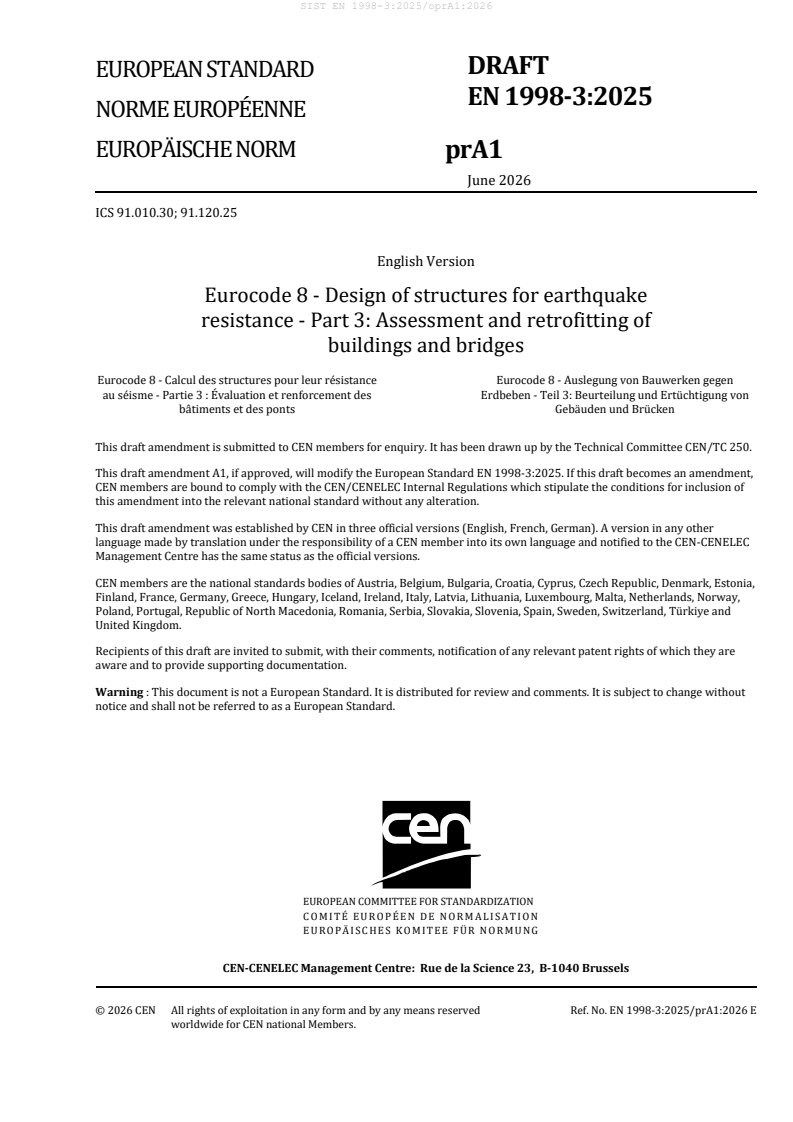
DRAFT
EUROPEAN STANDARD
EN 1998-3:2025
NORME EUROPÉENNE
EUROPÄISCHE NORM
prA1
June 2026
ICS 91.010.30; 91.120.25
English Version
Eurocode 8 - Design of structures for earthquake
resistance - Part 3: Assessment and retrofitting of
buildings and bridges
Eurocode 8 - Calcul des structures pour leur résistance Eurocode 8 - Auslegung von Bauwerken gegen
au séisme - Partie 3 : Évaluation et renforcement des Erdbeben - Teil 3: Beurteilung und Ertüchtigung von
bâtiments et des ponts Gebäuden und Brücken
This draft amendment is submitted to CEN members for enquiry. It has been drawn up by the Technical Committee CEN/TC 250.
This draft amendment A1, if approved, will modify the European Standard EN 1998-3:2025. If this draft becomes an amendment,
CEN members are bound to comply with the CEN/CENELEC Internal Regulations which stipulate the conditions for inclusion of
this amendment into the relevant national standard without any alteration.
This draft amendment was established by CEN in three official versions (English, French, German). A version in any other
language made by translation under the responsibility of a CEN member into its own language and notified to the CEN-CENELEC
Management Centre has the same status as the official versions.
CEN members are the national standards bodies of Austria, Belgium, Bulgaria, Croatia, Cyprus, Czech Republic, Denmark, Estonia,
Finland, France, Germany, Greece, Hungary, Iceland, Ireland, Italy, Latvia, Lithuania, Luxembourg, Malta, Netherlands, Norway,
Poland, Portugal, Republic of North Macedonia, Romania, Serbia, Slovakia, Slovenia, Spain, Sweden, Switzerland, Türkiye and
United Kingdom.
Recipients of this draft are invited to submit, with their comments, notification of any relevant patent rights of which they are
aware and to provide supporting documentation.
Warning : This document is not a European Standard. It is distributed for review and comments. It is subject to change without
notice and shall not be referred to as a European Standard.
EUROPEAN COMMITTEE FOR STANDARDIZATION
COMITÉ EUROPÉEN DE NORMALISATION
EUROPÄISCHES KOMITEE FÜR NORMUNG
CEN-CENELEC Management Centre: Rue de la Science 23, B-1040 Brussels
© 2026 CEN All rights of exploitation in any form and by any means reserved Ref. No. EN 1998-3:2025/prA1:2026 E
worldwide for CEN national Members.
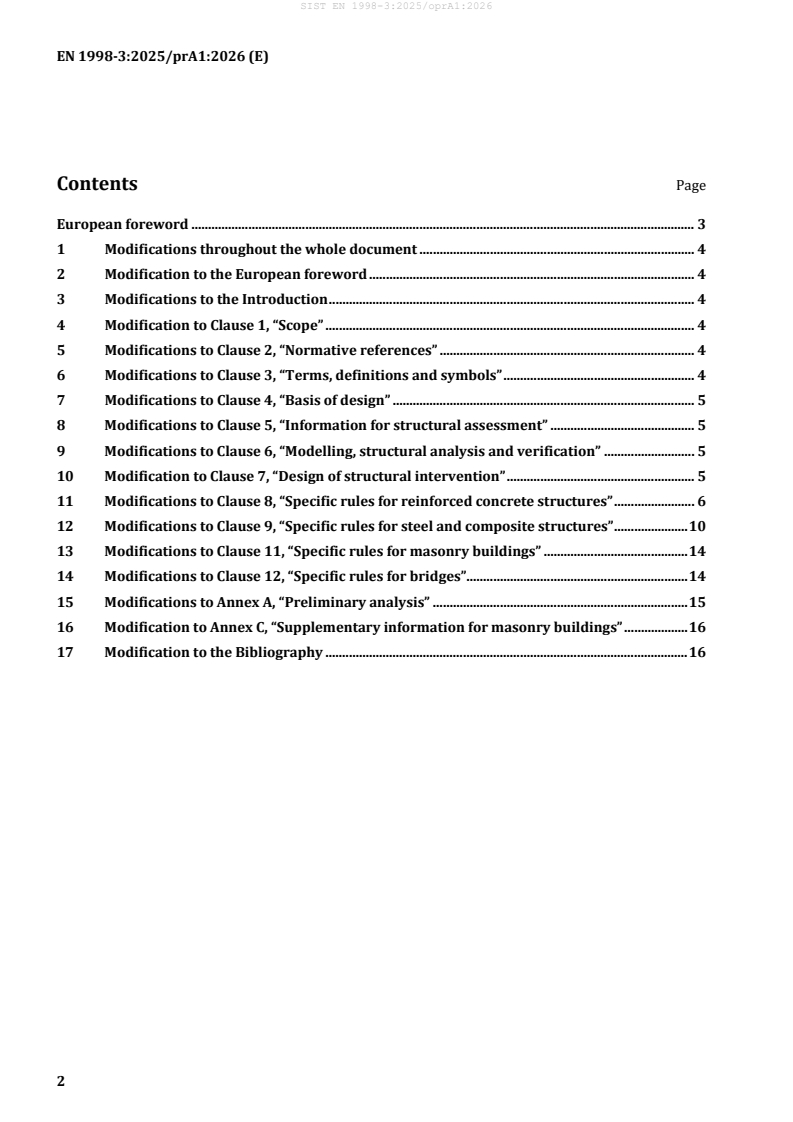
Contents Page
European foreword . 3
1 Modifications throughout the whole document . 4
2 Modification to the European foreword . 4
3 Modifications to the Introduction . 4
4 Modification to Clause 1, “Scope” . 4
5 Modifications to Clause 2, “Normative references” . 4
6 Modifications to Clause 3, “Terms, definitions and symbols” . 4
7 Modifications to Clause 4, “Basis of design” . 5
8 Modifications to Clause 5, “Information for structural assessment” . 5
9 Modifications to Clause 6, “Modelling, structural analysis and verification” . 5
10 Modification to Clause 7, “Design of structural intervention” . 5
11 Modifications to Clause 8, “Specific rules for reinforced concrete structures” . 6
12 Modifications to Clause 9, “Specific rules for steel and composite structures” . 10
13 Modifications to Clause 11, “Specific rules for masonry buildings” . 14
14 Modifications to Clause 12, “Specific rules for bridges”. 14
15 Modifications to Annex A, “Preliminary analysis” . 15
16 Modification to Annex C, “Supplementary information for masonry buildings” . 16
17 Modification to the Bibliography . 16
European foreword
This document (EN 1998-3:2025/prA1:2026) has been prepared by Technical Committee CEN/TC 250
“Structural Eurocodes”, the secretariat of which is held by BSI. CEN/TC 250 is responsible for all
Structural Eurocodes and has been assigned responsibility for structural and geotechnical design matters
by CEN.
This document is currently submitted to the CEN Enquiry.
This document will amend EN 1998-3:2025.
The following main changes to EN 1998-3:2025 are included in the amendment:
— clarification of terms, symbols and definitions for consistency in this document and with other
Eurocode 8 parts;
— improvements and clarifications on resistance criteria for different materials;
— amendment to the floor spectral acceleration determination.
The first generation of EN Eurocodes was published between 2002 and 2007. This document forms part
of the second generation of the Eurocodes, which have been prepared under Mandate M/515 issued to
CEN by the European Commission and the European Free Trade Association.
The Eurocodes have been drafted to be used in conjunction with relevant execution, material, product
and test standards, and to identify requirements for execution, materials, products and testing that are
relied upon by the Eurocodes.
The Eurocodes recognize the responsibility of each Member State and have safeguarded their right to
determine values related to regulatory safety matters at national level through the use of National
Annexes.
1 Modifications throughout the whole document
Replace “EN 1990:2023” with “EN 1990-1:2023+A1:2026”
Replace “EN 1998-1-2:—” with “EN 1998-1-2:2026”
Replace “direct testing” with “actual testing”
Replace “primary structural” with “primary seismic”
Replace “secondary structural” with “secondary seismic”
Replace “primary members” with “primary seismic members”
Replace “secondary members” with “secondary seismic members”
Replace “non-linear static pushover analysis” with “non-linear static analysis”
Replace “180°” with “180 degrees”
Replace “90°” with “90 degrees”
2 Modification to the European foreword
Replace “with respect to EN 1998-5:2025” with “with respect to EN 1998-3:2025”
3 Modifications to the Introduction
0.2 Replace “as defined in EN 1990” with “as defined in EN 1990 (all parts)”
0.3 Replace “consequently suffer from inherent uncertainty and there remains a low probability of
failure” with “suffer from inherent uncertainty. Therefore, a low probability of failure remains”
0.5 Add “8.5.3.1(7) – 2 choices” to the list allowed national choices
4 Modification to Clause 1, “Scope”
1.1(1) Note 2 Replace “strengthening” with “retrofitting”
5 Modifications to Clause 2, “Normative references”
Replace “EN 1990, Eurocode — Basis of structural and geotechnical design” with “EN 1990-1, Eurocode —
Basis of structural and geotechnical design — Part 1: New structures”
Add “EN 1990-2, Eurocode — Basis of structural and geotechnical design — Part 2: Assessment of existing
structures”
Delete footnote “ Under preparation. Stage at the time of publication: FprEN 1998-1-2:2025.”
6 Modifications to Clause 3, “Terms, definitions and symbols”
3.1 Replace “given in EN 1990” with “given in EN 1990 (all parts)”
3.1.7 Delete “(see 12.4)”
3.2 Replace “given in EN 1990” with “given in EN 1990 (all parts)”
3.2.1.2 Remove the italic from the subscript in “ε ”
cu,c
3.2.1.2 Delete the symbol and definition “l Length of the smooth starter bar connecting the column to
b,0
the foundation”
3.2.1.2 Delete the symbol and definition “l Lap length of vertical bars at the base of a column in storey
o,i
i”
3.2.1.2 Delete the symbol and definition “ξ Ratio of the neutral axis depth to the effective depth d, at
u
ultimate condition”
3.2.1.3 Replace “y-y” with “z-z” in the definition of W
el,z
3.2.1.3 Replace “beam” with “beam or column” in the definition of i
z
3.2.1.5 Replace “N Number of direct tests” with “n Number of direct tests” in the lower case Latin
symbols list
7 Modifications to Clause 4, “Basis of design”
4.1(3) Note 1 Replace “Since existing structures in general do not possess the adequate ductility ensured
in new ones by means of capacity design and detailing” with “Since existing structures designed to older
codes do not possess the adequate ductility ensured in new ones by means of detailing”
4.2.1(1) Note Replace “Repairing and retrofitting or upgrading” with “Retrofitting”
4.2.2(3) Replace “In bridges, a certain number of the secondary seismic members may be designated as
“sacrificial”.” with “In bridges, a certain number of the secondary seismic members may be designated as
sacrificial, as defined in EN 1998-2:2025, 3.1.12.”
8 Modifications to Clause 5, “Information for structural assessment”
5.2(1)a) Note Replace “as specified” with “if specified”
5.4.1(5)a) Replace “through the intersection with basic axes of the structural system (i.e. a pair of
perpendicular axes passing through the mass centre of the floor)” with “by a grid of lines associated with
the structural system and parallel to the two principal directions, as defined in EN 1998-1-2:2026,
4.4.1(5)”
5.4.1(5)a) Note Replace “into four parts (the four quadrants of the orthogonal axes system); for complex
floor shapes” with “into four basic units (the four quadrants determined by the principal axes); for non-
rectangular floor shapes,”
5.4.1(5)b) Replace “large walls, extending over more basic axes, wall segments may be further subdivided
into smaller units determined through the intersection with basic axes” with “large walls, wall segments
may be further subdivided into smaller units, delimited by segments in two or more directions”
5.4.4(1) Replace six instances of “in situ testing” with “in situ and/or laboratory testing”
9 Modifications to Clause 6, “Modelling, structural analysis and verification”
6.4.2(3) Replace “masonry buildings with stiff diaphragms (see 11.3.2.2) or when the modal participating
mass ratio of the predominant mode of vibration in the considered direction is lower than 70 %” with
“masonry buildings without rigid diaphragms (see 11.3.2.2) or having a modal participating mass ratio
of the predominant mode of vibration in the considered direction lower than 70 %”
6.4.2(5) Note Replace “does not correspond” with “is possibly not corresponding”
6.5.2.3(3) Replace “for the overstrength factor” with “by the overstrength factor”
10 Modification to Clause 7, “Design of structural intervention”
7.1.3(1)e) Delete “possible ”
11 Modifications to Clause 8, “Specific rules for reinforced concrete structures”
8.2.2(1) Replace c) and d) to read as follows:
“c) identification of the floor system and its geometric characteristics;
d) depth and width of beams, columns and walls;”
8.2.3(2) Replace “taking l equal” with “taking l equal”
0 o
Table 8.1, 3rd row, 1st column Replace “Design specifications” with “Design documents”
8.2.4.3(6) Replace the whole paragraph to read as follows:
“(6) When it is not possible due to practical constraints or safety reasons to replace the bars, non-
destructive (hardness) tests may be performed instead.
NOTE Non-destructive (hardness) tests can always be used to identify where each grade has been used, in the
case of the presence of different steel grades according to (4).”
8.3(1)b) Delete “For preliminary analysis the stiffness of a member may be taken as specified in Annex A.”
and add a note 4 to read as follows:
“NOTE 4 For preliminary analysis, the stiffness of a member can be assumed as specified in Annex A.”
8.4.1(3)b) Replace the list item to read as follows:
“b) anchoring and laps of ribbed and indented bars are justified by complying to one of i) to iii):
i) compliance with EN 1992-1-1:2023, 11.4 and 11.5;
ii) length of anchoring or lap is not lower than l , given by Formula (8.2);
ou,min
iii) yield stress in the bars is limited according to Formula (8.3);”
Replace Figure 8.3 with the following figure:
“
Key
A Straight lengths of plain bars between end section(s) and hook(s) at beam top
B Straight lengths of plain bars between end section(s) and hook(s) at beam bottom
C Steel stress in column’s starter bar at connection of lowermost storey’s column to foundation element
D Base section of column at lowermost storey, with plain bars lap-spliced at floor level
E Plain bars continuous across top section of intermediate storey column
F Column top section top storey
Figure 8.3 — Examples of embedment depth of smooth bars with hooked ends beyond the
member’s length and of anchorage or lap-splice length within the member
”
8.4.2.4.2(3) Replace “vertical” with “longitudinal”
Formula (8.11) Replace the formula and definition of variables to read as follows:
l l
b o
“ f=min ff;++min 1;;ff min 1; f (8.11)
eff y o,,b y o b0 y
ll
oy,,min oy min
where
f is the maximum tensile stress of the bar which can be transferred by the hook,
o,b
according to Formula (8.7), on the side with the lap-spliced bar;
f is the maximum tensile stress of the bar which can be transferred by the hook,
o,b0
according to Formula (8.7), on the other side.
”
8.4.2.4.2(5) Replace the whole paragraph to read as follows:
“(5) For straight end(s) of the bar(s) on the lap-splice or the anchorage side of the section, f or f ,
o,b o,b0
respectively, should be taken equal to zero in Formula (8.11).”
Formula (8.13) Replace the formula and definition of variables to read as follows:
ϕ ff
y,eff ob, ob, 0
“θ min l ;;l 1+ H l−+l min l l 1+ H l− l
( ) ( ) ( ) ( )
y,slip b oy,,min oy min b o oy,min oy,min o
2 ff
eff eff
(8.1
...