

EN 16437:2014
(Main)Chemical disinfectants and antiseptics - Quantitative surface test for the evaluation of bactericidal activity of chemical disinfectants and antiseptics used in veterinary area on porous surfaces without mechanical action - Test method and requirements (phase 2, step 2)
- Abstract
This European Standard specifies a test method and the minimum requirements for bactericidal activity of chemical disinfectants and antiseptic products that form a homogeneous, physically stable preparation when diluted with hard water - or in the case of ready-to-use products - with water.
This European Standard applies to products that are used in the veterinary area on porous surfaces without mechanical action i.e. in the breeding, husbandry, production, transport and disposal of all animals except when in the food chain following death and entry to the processing industry.
EN 14885 specifies in detail the relationship of the various tests to one another and to use recommendations.
NOTE 1 The method described is intended to determine the activity of commercial formulations or active substances under the conditions in which they are used.
NOTE 2 This method corresponds to a phase 2 step 2 test.
NOTE 3 This method cannot be used to evaluate the activity of products against mycobacteria or bacterial spores.
- Status
- Withdrawn
- Publication Date
- 25-Feb-2014
- Withdrawal Date
- 06-Oct-2026
- Technical Committee
- CEN/TC 216 - Chemical disinfectants and antiseptics
- Drafting Committee
- CEN/TC 216/WG 2 - Veterinary use
- Current Stage
- 9960 - Withdrawal effective - Withdrawal
- Start Date
- 16-Oct-2019
- Completion Date
- 07-Oct-2026

Relations
- Effective Date
- 19-Jan-2023
- Effective Date
- 28-Jan-2026
- Effective Date
- 28-Jan-2026
- Effective Date
- 09-Nov-2016
Get Certified
Connect with accredited certification bodies for this standard

ECOCERT
Organic and sustainability certification.

Eurofins Food Testing Global
Global leader in food, environment, and pharmaceutical product testing.

Intertek Bangladesh
Intertek certification and testing services in Bangladesh.
Sponsored listings
Frequently Asked Questions
EN 16437:2014 is a standard published by the European Committee for Standardization (CEN). Its full title is "Chemical disinfectants and antiseptics - Quantitative surface test for the evaluation of bactericidal activity of chemical disinfectants and antiseptics used in veterinary area on porous surfaces without mechanical action - Test method and requirements (phase 2, step 2)". This standard covers: This European Standard specifies a test method and the minimum requirements for bactericidal activity of chemical disinfectants and antiseptic products that form a homogeneous, physically stable preparation when diluted with hard water - or in the case of ready-to-use products - with water. This European Standard applies to products that are used in the veterinary area on porous surfaces without mechanical action i.e. in the breeding, husbandry, production, transport and disposal of all animals except when in the food chain following death and entry to the processing industry. EN 14885 specifies in detail the relationship of the various tests to one another and to use recommendations. NOTE 1 The method described is intended to determine the activity of commercial formulations or active substances under the conditions in which they are used. NOTE 2 This method corresponds to a phase 2 step 2 test. NOTE 3 This method cannot be used to evaluate the activity of products against mycobacteria or bacterial spores.
This European Standard specifies a test method and the minimum requirements for bactericidal activity of chemical disinfectants and antiseptic products that form a homogeneous, physically stable preparation when diluted with hard water - or in the case of ready-to-use products - with water. This European Standard applies to products that are used in the veterinary area on porous surfaces without mechanical action i.e. in the breeding, husbandry, production, transport and disposal of all animals except when in the food chain following death and entry to the processing industry. EN 14885 specifies in detail the relationship of the various tests to one another and to use recommendations. NOTE 1 The method described is intended to determine the activity of commercial formulations or active substances under the conditions in which they are used. NOTE 2 This method corresponds to a phase 2 step 2 test. NOTE 3 This method cannot be used to evaluate the activity of products against mycobacteria or bacterial spores.
EN 16437:2014 is classified under the following ICS (International Classification for Standards) categories: 71.100.35 - Chemicals for industrial and domestic disinfection purposes. The ICS classification helps identify the subject area and facilitates finding related standards.
EN 16437:2014 has the following relationships with other standards: It is inter standard links to EN 16437:2014+A1:2019, EN 14885:2022, EN 12353:2021, EN 16437:2014/FprA1. Understanding these relationships helps ensure you are using the most current and applicable version of the standard.
EN 16437:2014 is available in PDF format for immediate download after purchase. The document can be added to your cart and obtained through the secure checkout process. Digital delivery ensures instant access to the complete standard document.
Standards Content (Sample)
2003-01.Slovenski inštitut za standardizacijo. Razmnoževanje celote ali delov tega standarda ni dovoljeno.Chemische Desinfektionsmittel und Antiseptika - Quantitativer Oberflächenversuch zur Bestimmung der bakteriziden Wirkung chemischer Desinfektionsmittel und Antiseptika für den Veterinärbereich auf porösen Oberflächen ohne mechanische Wirkung - Prüfverfahren und Anforderungen (Phase 2, Stufe 2)Antiseptiques et désinfectants chimiques - Essai quantitatif de surface pour l'évaluation de l'activité bactéricide des antiseptiques et des désinfectants chimiques utilisés dans le domaine vétérinaire sur des surfaces poreuses sans action mécanique - Méthode d'essai et prescriptions (phase 2, étape 2)Chemical disinfectants and antiseptics - Quantitative surface test for the evaluation of bactericidal activity of chemical disinfectants and antiseptics used in veterinary area on porous surfaces without mechanical action - Test method and requirements (phase 2, step2)71.100.35Kemikalije za dezinfekcijo v industriji in domaChemicals for industrial and domestic disinfection purposes11.220VeterinarstvoVeterinary medicineICS:Ta slovenski standard je istoveten z:EN 16437:2014SIST EN 16437:2014en,fr,de01-julij-2014SIST EN 16437:2014SLOVENSKI
STANDARD
EUROPEAN STANDARD NORME EUROPÉENNE EUROPÄISCHE NORM
EN 16437
February 2014 ICS 71.100.35 English Version
Chemical disinfectants and antiseptics - Quantitative surface test for the evaluation of bactericidal activity of chemical disinfectants and antiseptics used in veterinary area on porous surfaces without mechanical action - Test method and requirements (phase 2, step 2)
Antiseptiques et désinfectants chimiques - Essai quantitatif de surface pour l'évaluation de l'activité bactéricide des antiseptiques et des désinfectants chimiques utilisés dans le domaine vétérinaire sur des surfaces poreuses sans action mécanique - Méthode d'essai et prescriptions (phase 2, étape 2)
Chemische Desinfektionsmittel und Antiseptika - Quantitativer Oberflächenversuch zur Bestimmung der bakteriziden Wirkung chemischer Desinfektionsmittel und Antiseptika für den Veterinärbereich auf porösen Oberflächen ohne mechanische Wirkung - Prüfverfahren und Anforderungen (Phase 2, Stufe 2) This European Standard was approved by CEN on 30 November 2013.
CEN members are bound to comply with the CEN/CENELEC Internal Regulations which stipulate the conditions for giving this European Standard the status of a national standard without any alteration. Up-to-date lists and bibliographical references concerning such national standards may be obtained on application to the CEN-CENELEC Management Centre or to any CEN member.
This European Standard exists in three official versions (English, French, German). A version in any other language made by translation under the responsibility of a CEN member into its own language and notified to the CEN-CENELEC Management Centre has the same status as the official versions.
CEN members are the national standards bodies of Austria, Belgium, Bulgaria, Croatia, Cyprus, Czech Republic, Denmark, Estonia, Finland, Former Yugoslav Republic of Macedonia, France, Germany, Greece, Hungary, Iceland, Ireland, Italy, Latvia, Lithuania, Luxembourg, Malta, Netherlands, Norway, Poland, Portugal, Romania, Slovakia, Slovenia, Spain, Sweden, Switzerland, Turkey and United Kingdom.
EUROPEAN COMMITTEE FOR STANDARDIZATION
COMITÉ EUROPÉEN DE NORMALISATION EUROPÄISCHES KOMITEE FÜR NORMUNG
CEN-CENELEC Management Centre:
Avenue Marnix 17,
B-1000 Brussels © 2014 CEN All rights of exploitation in any form and by any means reserved worldwide for CEN national Members. Ref. No. EN 16437:2014 ESIST EN 16437:2014
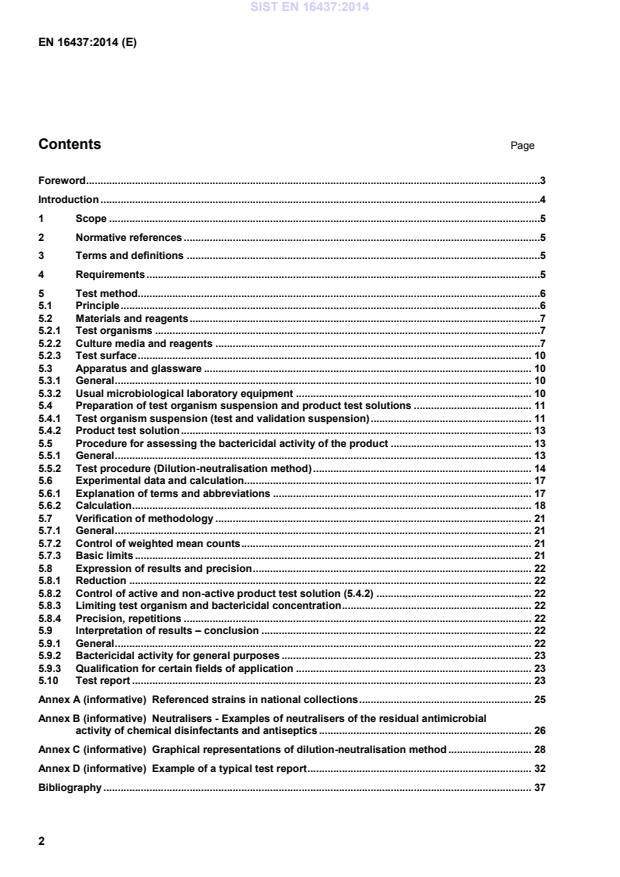
Referenced strains in national collections . 25 Annex B (informative)
Neutralisers - Examples of neutralisers of the residual antimicrobial activity of chemical disinfectants and antiseptics . 26 Annex C (informative)
Graphical representations of dilution-neutralisation method . 28 Annex D (informative)
Example of a typical test report . 32 Bibliography . 37 SIST EN 16437:2014
Foreword This document (EN 16437:2014) has been prepared by Technical Committee CEN/TC 216 “Chemical disinfectants and antiseptics”, the secretariat of which is held by AFNOR. This European Standard shall be given the status of a national standard, either by publication of an identical text or by endorsement, at the latest by August 2014 and conflicting national standards shall be withdrawn at the latest by August 2014. Attention is drawn to the possibility that some of the elements of this document may be the subject of patent rights. CEN [and/or CENELEC] shall not be held responsible for identifying any or all such patent rights. According to the CEN/CENELEC Internal Regulations, the national standards organisations of the following countries are bound to implement this European Standard: Austria, Belgium, Bulgaria, Croatia, Cyprus, Czech Republic, Denmark, Estonia, Finland, Former Yugoslav Republic of Macedonia, France, Germany, Greece, Hungary, Iceland, Ireland, Italy, Latvia, Lithuania, Luxembourg, Malta, Netherlands, Norway, Poland, Portugal, Romania, Slovakia, Slovenia, Spain, Sweden, Switzerland, Turkey and the United Kingdom. SIST EN 16437:2014
This method cannot be used to evaluate the activity of products against mycobacteria or bacterial spores. 2 Normative references The following documents, in whole or in part, are normatively referenced in this document and are indispensable for its application. For dated references, only the edition cited applies. For undated references, the latest edition of the referenced document (including any amendments) applies. EN 12353, Chemical disinfectants and antiseptics - Preservation of test organisms used for the determination of bactericidal (including Legionella), mycobactericidal, sporicidal, fungicidal and virucidal (including bacteriophages) activity EN 14885, Chemical disinfectants and antiseptics - Application of European Standards for chemical disinfectants and antiseptics 3 Terms and definitions For the purposes of this document, the terms and definitions given in EN 14885 apply. 4 Requirements The product shall demonstrate at least a 4 decimal log (lg) reduction from a water control, when tested in accordance with Table 1 and Clause 5 under simulated soiling (3,0 g/l bovine albumin). SIST EN 16437:2014
Bactericidal activity on porous surfaces without mechanical action in the veterinary area Test organism a) obligatory Enterococcus hirae Proteus vulgaris Pseudomonas aeruginosa Staphylococcus aureus b) additional any relevant test organism Test temperature a) obligatory 10 °C ± 1 °C b) additional 4 °C ± 1 °C; 20 °C ± 1 °C; 40 °C ± 1 °C Contact time a) obligatory 60 min ± 10 s b) additional 1 min ± 5 s, 5 min ± 10 s, 15 min + 10 s, 30 min ± 10 s; 120 min ± 10 s Interfering substance a) obligatory
3,0 g/l bovine albumin b) additional any relevant substance NOTE 1 The obligatory contact times for surface disinfectants stated in Table 1 were chosen to enable comparison of standard conditions. The recommended contact time for the use of the product is within the responsibility of the manufacturer. NOTE 2 For the additional conditions, the concentration defined as a result can be lower than the one obtained under the obligatory test conditions. Any additional specific bactericidal activity shall be determined in accordance with 5.2.1 and 5.5.1.1 in order to take into account intended specific use conditions. 5 Test method 5.1 Principle A test suspension of bacteria mixed with interfering substance is inoculated onto the test surface and dried. After the drying time the test surface is immersed into a sample of the product as delivered and/or diluted with hard water (for ready to use products: water) ensuring that the test surface is totally covered for one minute. The test surface is removed from the product solution and maintained at a specified temperature for a defined period of time specified in Clause 4 and 5.5.1.1. At the end of that contact time, the test surface is transferred to a neutraliser so that the action of the disinfectant is immediately neutralised. The bacteria are removed from the surface by ultrasound treatment. The numbers of surviving bacteria which can be recovered from the surface is determined quantitatively. The number of bacteria on a surface treated with water in place of the disinfectant is also determined and the reduction is calculated. The test is performed using Enterococcus hirae, Proteus vulgaris, Pseudomonas aeruginosa and Staphylococcus aureus as test organisms (Clause 4, Table 1). SIST EN 16437:2014
ATCC 15442; Staphylococcus aureus ATCC 6538. NOTE See Annex A for strain references in some other culture collections. The required incubation temperature for these organisms is 36 °C + 1 °C or 37 °C + 1 °C (5.3.2.3). The same temperature (either 36 °C or 37 °C) shall be used for all incubations performed during a test and its control and validation. If additional test organisms are used, they shall be incubated under optimum growth conditions (temperature, time, atmosphere, media) noted in the test report. If the additional test organisms selected do not correspond to the specified strains, their suitability for supplying the required inocula shall be verified. If these additional test organisms are not classified at a reference centre, their identification characteristics shall be stated. In addition, they shall be held by the testing laboratory or national culture collection under a reference for five years. 5.2.2 Culture media and reagents 5.2.2.1 General All weights of chemical substances given in this European Standard refer to the anhydrous salts. Hydrated forms may be used as an alternative, but the weights required shall be adjusted to allow for consequent molecular weight differences. The reagents shall be of analytical grade and/or appropriate for microbiological purposes. They shall be free from substances that are toxic or inhibitory to the test organisms. If additional strains do not grow on the media (5.2.2.3) or cannot be used with diluent (5.2.2.4) additional media shall be used and shall be reported as well as additional incubation conditions. To improve reproducibility, it is recommended that commercially available dehydrated material is used for the preparation of culture media. The manufacturer's instructions relating to the preparation of these products should be rigorously followed. Ready-to-use media may be used if it complies with the required specification. For each culture medium and reagent a time limitation for use should be fixed.
1) The ATCC numbers are the collection numbers of strains supplied by the American Type Culture Collections (ATCC). This information is given for the convenience of users of this European Standard and does not constitute an endorsement by CEN of this product. SIST EN 16437:2014
When preparing the product test solutions (5.4.2), the addition of the product to the hard water produces a different final water hardness in each test tube. In any case the final hardness expressed as calcium carbonate (CaC03) is in the test tube lower than 375 mg/l. 5.2.2.7 Interfering substances 5.2.2.7.1 General The interfering substance shall be chosen according to the conditions of use laid down for the product. The interfering substance shall be sterile and prepared at 2 times its final concentration in the test. For the additional interfering substances, the ionic composition (e.g. pH, calcium and/or magnesium hardness) and chemical composition (e.g. mineral substances, protein, carbohydrates, lipids, detergents) shall be defined. NOTE The term “interfering substance” is used even if it contains more than one substance. 5.2.2.7.2 Soiling (bovine albumin solution) Dissolve 0,6 g of bovine albumin V (suitable for microbiological purposes) in 90 ml of water (5.2.2.2) in a 100 ml volumetric flask. Make up to the mark with water (5.2.2.2). Sterilise by membrane filtration (5.3.2.7), keep in a refrigerator (5.3.2.8) and use within one month. The final concentration of the bovine albumin in the test procedure (5.5) is 3 g/l. 5.2.2.8 Tryptone Soya Broth (TSB) with neutraliser Tryptone Soya broth, consisting of: Tryptone, pancreatic digest of casein 17,0 g Soya peptone, papaic digest of soybean meal 3,0 g Sodium chloride (NaCl) 5,0 g Dipotassiumhydrogenphosphate (K2HPO4) 2,5 g Water (5.2.2.2) to 1 000 ml Sterilise in the autoclave [5.3.2.1 a)]. After sterilisation the pH of the medium shall be equivalent to 7,3 ± 0,2 when measured at 20 °C ± 1 °C. SIST EN 16437:2014
2) DES-IN-TEST Supply Walbrunnenstrasse D-70599 Stuttgart Tel. ++49 (0) 711 45 54 06. This information is given for the convenience of the users of this European Standard and does not constitute an endorsement by CEN of this product. 3) Disposable sterile equipment is an acceptable alternative to reusable glassware. SIST EN 16437:2014
4) Vortex® is an example of a suitable product available commercially. This information is given for the convenience of users of this European Standard and does not constitute an endorsement by CEN of this product. SIST EN 16437:2014
5) cfu/ml = colony forming unit per milliliter SIST EN 16437:2014
6) For a graphical representation of this method see Annex C. SIST EN 16437:2014
d) At the end of t, transfer each of the surfaces (Na) to a separate vessel containing 10 ml of TSB with neutraliser (5.2.2.8): Mix for 15 s [5.3.2.6 a)]. Place the vessels in a water bath controlled at 20 °C ± 1 °C. After 25 min ± 10 s mix [5.3.2.6 a)] again and place the vessels in an ultrasonic bath (5.3.2.14) with ice to maintain the temperature between at 0 °C and 4 °C. Treat the vessels with ultrasound for 5 min ± 10 s to remove bacterial cells from the test surface. Prepare a series of 10-fold dilutions from 10−1 to 10−6 of the neutralised mixture in diluent (5.2.2.4). Take a 1,0 ml sample of the neutralised mixture and each of the dilutions in duplicate and inoculate using the pour plate or spread plate technique. 1) When using the pour plate technique, pipette each 1,0 ml sample into separate Petri dishes and add 15 ml – 20 ml melted TSA (5.2.2.3), cooled to 45 °C ± 1 °C. 2) When using the spread plate technique, spread each 1,0 ml sample – divided into portions of approximately equal size – on an appropriate number (at least two) of surface dried plates containing TSA (5.2.2.3). For Incubation and counting see 5.5.2.6. e) Perform the procedure a) to d) using the other product test solutions at the same time. f) Perform the procedures a) to e) applying the other obligatory and - if appropriate - other additional experimental conditions (5.5.1.1). 5.5.2.3 Water control “Nw” The procedure for determining the water control is as follows: NOTE The control A - Experimental conditions control (Validation of the selected experimental conditions or verification of the absence of any lethal effect in the test conditions) differs from other standards due to the fact it is directly determined in the water control “Nw”. a) Place one test surface (5.2.3) in a sterile Petri dish (5.3.2.10) and ensure that the dish is in a horizontal position. Inoculate 0,1 ml of the microbial test suspension [5.5.2.2 a)] on to the test surface. Dry the surface at 37 °C until it is visibly dry [5.5.2.2 b)]. See Figure 1. SIST EN 16437:2014
Figure 1 b) For the water control (Nw) pipette 20 ml of hard water (5.2.2.6) into a sterile Petri dish. Immerse the inoculated and dried test surface. Ensure that the test surface is completely covered by the hard water. Start the stopwatch immediately and after 1 min ± 5 s transfer the surface into a sterile Petri dish and place it on its edge against the side of the dish. Place the surface in a temperature controlled cabinet (5.3.2.13) a c) At the end of the longest chosen t in the test, transfer the surface (Nw) into a vessel containing 10 ml of TSB with neutraliser (5.2.2.8): Mix for 15 s [5.3.2.6 a)]. Place the vessel in a water bath controlled at 20 °C ± 1 °C. After 25 min ± 10 s mix [5.3.2.6 a)] again and place the vessel in an ultrasonic bath (5.3.2.14) with ice to maintain the temperature between at 0 and 4 °C. Treat the vessel with ultrasound for 5 min ± 10 s. Prepare a series of 10-fold dilutions from 10−1 to 10−6 of the neutralised mixture in diluent (5.2.2.4). Take 1,0 ml samples of the 10−4 to 10−6 dilutions in duplicate and inoculate using the pour plate or spread plate technique [5.5.2.2 d)]. For Incubation and counting see 5.5.2.6. 5.5.2.4 Neutraliser control “B” - verification of the absence of toxicity of the neutraliser To verify the absence of toxicity of the neutraliser, the procedure is as follows: a) Prepare one inoculated test surface [5.5.2.2 a) and b)]. b) Pipette 10 ml of TSB with neutraliser (5.2.2.8) into a vessel, add an inoculated and dried test surface, mix [5.3.2.6 a)] and place the tube in a water bath controlled at 20 °C ± 1 °C for 25 min ± 10 s. Just before the end of this time, mix [5.3.2.6 a)] again and place the tube in an ultrasonic bath (5.3.2.14) (maintaining the temperature in the ultrasonic bath at 0 °C – 4 °C by addition of ice) and treat it with ultrasound for 5 min ± 10 s. At the end of this time prepare a series of 10-fold dilutions from 10−1 to 10−6 of this mixture “B” in 9,0 ml diluent (5.2.2.4). Take a sample of 1,0 ml of the dilutions 10−4 to 10−6 in duplicate and inoculate using the pour plate or the spread plate technique [5.5.2.2 d)]. For incubation and counting, see 5.5.2.6. 5.5.2.5 Method validation “C” - dilution-neutralisation validation To validate the dilution neutralisation method, the procedure is as follows: SIST EN 16437:2014
c) At the end of t, transfer the surface into a tube containing 10 ml TSB with neutraliser (5.2.2.8) mix [5.3.2.6 a)] and place the tube in a water bath controlled at 20 °C ± 1 °C for 25 min ± 10 s. Just before the end of this time add the inoculated test surface [5.5.2.2 a)], mix [5.3.2.6 a)] and place the tube in an ultrasonic bath (maintaining the temperature in the ultrasonic bath at 0 °C – 4 °C by addition of ice) and treat it with ultrasound for 5 min ± 10 s. At the end of this time prepare a series of 10-fold dilutions of the mixture in diluent (5.2.2.4) to produce 10−1 to 10−6 dilutions. Take a 1,0 ml sample of the 10−4 to 10−6 dilutions in duplicate and inoculate using the pour plate or the spread plate technique [5.5.2.2 d)]. For incubation and counting, see 5.5.2.6. 5.5.2.6 Incubation and counting of the test mixture and the control and validation mixtures For incubation and counting of the test mixture and the control and validation mixtures, the procedure is as follows. a) Incubate (5.3.2.3) the plates for 20 h to 24 h at 37 °C ± 1 °C. Discard any plates which are not countable (for any reason). Count the plates and determine the total number of cfu for each plate. Incubate the p
...