

EN 12159:2000+A1:2009
(Main)Builders hoists for persons and materials with vertically guided cages
- Abstract
1.1 This standard deals with power operated temporarily installed builders hoists (referred to as "hoists" in this standard) intended for use by persons who are permitted to enter sites of engineering and construction, serving landing levels, having a carrier
- designed for the transportation of persons or of persons and materials;
- guided;
- travelling vertically or along a path within 15 degrees max. of the vertical;
- supported or sustained by drum driven wire rope, rack and pinion, hydraulic jack (direct or indirect), or an expanding linkage mechanism;
- where masts, when erected, may or may not require support from separate structures.
1.2 The standard identifies hazards as listed in clause 4 which arise during the various phases in the life of such equipment and describes methods for the elimination or reduction of these hazards when used as intended by the manufacturer.
1.3 This European standard does not specify the additional requirements for
- operation in severe conditions (e.g. extreme climates, strong magnetic fields);
- lightning protection;
- operation subject to special rules (e.g. potentially explosive atmospheres);
- electromagnetic compatibility (emission, immunity);
- handling of loads the nature of which could lead to dangerous situations (e.g. molten metal, acids/bases, radiating materials, fragile loads);
- the use of combustion engines;
- the use of remote controls;
- hazards occurring during manufacture;
- hazards occurring as a result of mobility;
- hazards occurring as a result of being erected over a public road;
- earthquakes.
- !deleted text".
1.4 This standard is not applicable to
- builders hoists for the transport of goods only !; EN 12158-1:2000 and EN 12158-2:2000";
- lifts according to EN 81-1:1998, EN 81-2:1998 and !EN 81-3:2000";
- work cages suspended from lifting appliances;
- work platforms carried on the forks of fork trucks;
- work platforms !; EN 1495:1997";
- funiculars;
(....)
- Status
- Withdrawn
- Publication Date
- 07-Jul-2009
- Withdrawal Date
- 13-Nov-2012
- Technical Committee
- CEN/TC 10 - Passenger, goods and service lifts
- Drafting Committee
- CEN/TC 10/SC 1/WG 1 - Building hoists for persons and/or goods
- Current Stage
- 9960 - Withdrawal effective - Withdrawal
- Start Date
- 14-Nov-2012
- Completion Date
- 14-Nov-2012
- Directive
- 2006/42/EC - Directive 2006/42/EC of the European Parliament and of the Council of 17 May 2006 on machinery, and amending Directive 95/16/EC (recast)OJ Ref: C, C 309 OJ Date: 18-Dec-2009

Relations
- Effective Date
- 19-Jan-2023
- Effective Date
- 21-Nov-2009
Get Certified
Connect with accredited certification bodies for this standard

DIBt (Deutsches Institut für Bautechnik)
German Institute for Building Technology.
DIN CERTCO
DIN Group product certification.

Aboma Certification B.V.
Specialized in construction, metal, and transport sectors.
Sponsored listings
Frequently Asked Questions
EN 12159:2000+A1:2009 is a standard published by the European Committee for Standardization (CEN). Its full title is "Builders hoists for persons and materials with vertically guided cages". This standard covers: 1.1 This standard deals with power operated temporarily installed builders hoists (referred to as "hoists" in this standard) intended for use by persons who are permitted to enter sites of engineering and construction, serving landing levels, having a carrier - designed for the transportation of persons or of persons and materials; - guided; - travelling vertically or along a path within 15 degrees max. of the vertical; - supported or sustained by drum driven wire rope, rack and pinion, hydraulic jack (direct or indirect), or an expanding linkage mechanism; - where masts, when erected, may or may not require support from separate structures. 1.2 The standard identifies hazards as listed in clause 4 which arise during the various phases in the life of such equipment and describes methods for the elimination or reduction of these hazards when used as intended by the manufacturer. 1.3 This European standard does not specify the additional requirements for - operation in severe conditions (e.g. extreme climates, strong magnetic fields); - lightning protection; - operation subject to special rules (e.g. potentially explosive atmospheres); - electromagnetic compatibility (emission, immunity); - handling of loads the nature of which could lead to dangerous situations (e.g. molten metal, acids/bases, radiating materials, fragile loads); - the use of combustion engines; - the use of remote controls; - hazards occurring during manufacture; - hazards occurring as a result of mobility; - hazards occurring as a result of being erected over a public road; - earthquakes. - !deleted text". 1.4 This standard is not applicable to - builders hoists for the transport of goods only !; EN 12158-1:2000 and EN 12158-2:2000"; - lifts according to EN 81-1:1998, EN 81-2:1998 and !EN 81-3:2000"; - work cages suspended from lifting appliances; - work platforms carried on the forks of fork trucks; - work platforms !; EN 1495:1997"; - funiculars; (....)
1.1 This standard deals with power operated temporarily installed builders hoists (referred to as "hoists" in this standard) intended for use by persons who are permitted to enter sites of engineering and construction, serving landing levels, having a carrier - designed for the transportation of persons or of persons and materials; - guided; - travelling vertically or along a path within 15 degrees max. of the vertical; - supported or sustained by drum driven wire rope, rack and pinion, hydraulic jack (direct or indirect), or an expanding linkage mechanism; - where masts, when erected, may or may not require support from separate structures. 1.2 The standard identifies hazards as listed in clause 4 which arise during the various phases in the life of such equipment and describes methods for the elimination or reduction of these hazards when used as intended by the manufacturer. 1.3 This European standard does not specify the additional requirements for - operation in severe conditions (e.g. extreme climates, strong magnetic fields); - lightning protection; - operation subject to special rules (e.g. potentially explosive atmospheres); - electromagnetic compatibility (emission, immunity); - handling of loads the nature of which could lead to dangerous situations (e.g. molten metal, acids/bases, radiating materials, fragile loads); - the use of combustion engines; - the use of remote controls; - hazards occurring during manufacture; - hazards occurring as a result of mobility; - hazards occurring as a result of being erected over a public road; - earthquakes. - !deleted text". 1.4 This standard is not applicable to - builders hoists for the transport of goods only !; EN 12158-1:2000 and EN 12158-2:2000"; - lifts according to EN 81-1:1998, EN 81-2:1998 and !EN 81-3:2000"; - work cages suspended from lifting appliances; - work platforms carried on the forks of fork trucks; - work platforms !; EN 1495:1997"; - funiculars; (....)
EN 12159:2000+A1:2009 is classified under the following ICS (International Classification for Standards) categories: 91.140.90 - Lifts. Escalators. The ICS classification helps identify the subject area and facilitates finding related standards.
EN 12159:2000+A1:2009 has the following relationships with other standards: It is inter standard links to EN 12159:2000, EN 12159:2012. Understanding these relationships helps ensure you are using the most current and applicable version of the standard.
EN 12159:2000+A1:2009 is associated with the following European legislation: EU Directives/Regulations: 2006/42/EC, 98/37/EC; Standardization Mandates: M/008, M/396. When a standard is cited in the Official Journal of the European Union, products manufactured in conformity with it benefit from a presumption of conformity with the essential requirements of the corresponding EU directive or regulation.
EN 12159:2000+A1:2009 is available in PDF format for immediate download after purchase. The document can be added to your cart and obtained through the secure checkout process. Digital delivery ensures instant access to the complete standard document.
Standards Content (Sample)
2003-01.Slovenski inštitut za standardizacijo. Razmnoževanje celote ali delov tega standarda ni dovoljeno.Bauaufzüge zur Personen- und Materialbeförderung mit senkrecht geführten FahrkörbenAscenseurs de chantier pour personnes et matériaux avec cages guidées verticalementBuilders hoists for persons and materials with vertically guided cages91.220Gradbena opremaConstruction equipment53.020.99Druga dvigalna opremaOther lifting equipmentICS:Ta slovenski standard je istoveten z:EN 12159:2000+A1:2009SIST EN 12159:2002+A1:2009en,fr01-november-2009SIST EN 12159:2002+A1:2009SLOVENSKI
STANDARDSIST EN 12159:20021DGRPHãþD
EUROPEAN STANDARD NORME EUROPÉENNE EUROPÄISCHE NORM
EN 12159:2000+A1
July 2009 ICS 91.140.90 Supersedes EN 12159:2000English Version
Builders hoists for persons and materials with vertically guided cages
Ascenseurs de chantier pour personnes et matériaux avec cages guidées verticalement
Bauaufzüge zur Personen- und Materialbeförderung mit senkrecht geführten Fahrkörben This European Standard was approved by CEN on 20 August 2000 and includes Amendment 1 approved by CEN on 28 May 2009.
CEN members are bound to comply with the CEN/CENELEC Internal Regulations which stipulate the conditions for giving this European Standard the status of a national standard without any alteration. Up-to-date lists and bibliographical references concerning such national standards may be obtained on application to the CEN Management Centre or to any CEN member.
This European Standard exists in three official versions (English, French, German). A version in any other language made by translation under the responsibility of a CEN member into its own language and notified to the CEN Management Centre has the same status as the official versions.
CEN members are the national standards bodies of Austria, Belgium, Bulgaria, Cyprus, Czech Republic, Denmark, Estonia, Finland, France, Germany, Greece, Hungary, Iceland, Ireland, Italy, Latvia, Lithuania, Luxembourg, Malta, Netherlands, Norway, Poland, Portugal, Romania, Slovakia, Slovenia, Spain, Sweden, Switzerland and United Kingdom.
EUROPEAN COMMITTEE FOR STANDARDIZATION
COMITÉ EUROPÉEN DE NORMALISATION EUROPÄISCHES KOMITEE FÜR NORMUNG
Management Centre:
Avenue Marnix 17,
B-1000 Brussels © 2009 CEN All rights of exploitation in any form and by any means reserved worldwide for CEN national Members. Ref. No. EN 12159:2000+A1:2009: ESIST EN 12159:2002+A1:2009
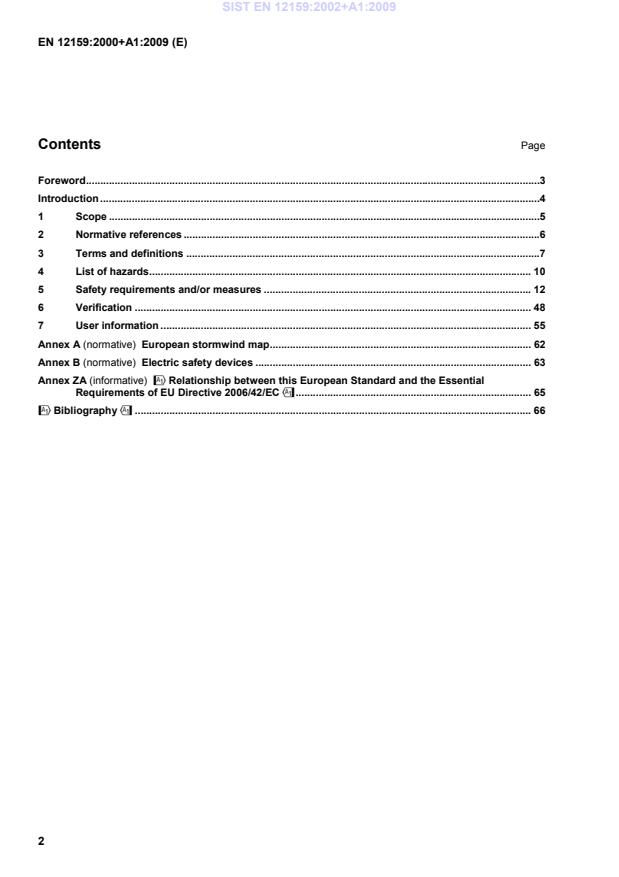
Page Foreword .3Introduction .41Scope .52Normative references .63Terms and definitions .74List of hazards . 105Safety requirements and/or measures . 126Verification . 487User information . 55Annex A (normative)
European stormwind map . 62Annex B (normative)
Electric safety devices . 63Annex ZA (informative)
!Relationship between this European Standard and the Essential Requirements of EU Directive 2006/42/EC" . 65!Bibliography" . 66 SIST EN 12159:2002+A1:2009
(ISO 9000:2005)" !EN ISO 11201:1995, Acoustics — Noise emitted by machinery and equipment — Measurement of emission sound pressure levels at the work station and at other specified positions — Engineering method in an essentially free field over a reflecting plane (ISO 11201:1995)" !EN ISO 11688-1:1998, Acoustics — Recommended practice for the design of low-noise machinery and equipment — Part 1: Planning (ISO/TR 11688-1:1995)" !EN ISO 12100-1:2003, Safety of machinery — Basic concepts, general principles for design — Part 1: Basic terminology, methodology (ISO 12100-1:2003) " !EN ISO 12100-2:2003, Safety of machinery — Basic concepts, general principles for design — Part 2: Technical principles (ISO 12100-2:2003)" !EN ISO 13849-1:2008, Safety of machinery — Safety-related parts of control systems — Part 1: General principles for design (ISO 13849-1:2006)" !EN ISO 13850:2006, Safety of machinery — Emergency stop — Principles for design (ISO 13850:2006)" !ISO 2408:2004, Steel wire ropes for general purposes — Minimum requirements" !ISO 3864-1:2002, Safety colours and safety signs — Part 1: Design principles for safety signs in workplaces and public areas" ISO 4302:1981, Cranes — Wind load assessment !ISO 4309:2004, Cranes — Wire ropes — Care, maintenance, installation, examination and discard" !ISO 6336-1:2006, Calculation of load capacity of spur and helical gears — Part 1: Basic principles, introduction and general influence factors" !ISO 6336-2:1996, Calculation of load capacity of spur and helical gears — Part 2: Calculation of surface durability (pitting)" !ISO 6336-3:2006, Calculation of load capacity of spur and helical gears — Part 3: Calculation of tooth bending strength" !ISO 6336-5:2003, Calculation of load capacity of spur and helical gears — Part 5: Strength and quality of materials" 3 Terms and definitions !For the purposes of this document, the terms and definitions given in EN ISO 12100-1:2003 and the following apply." SIST EN 12159:2002+A1:2009
Hazards Relevant clauses in this standard 1 Mechanical hazards 1.1 Crushing 5.5.2, 5.5.3, 5.5.6, 5.7.2, 7.1.2.7, 7.1.2.8 1.2 Shearing 5.5, 5.6.1.2, 5.7.2, 7.1.2.7, 7.1.2.8 1.3 Cutting or severing 5.5, 5.6.1.2, 5.7.2, 7.1.2.7, 7.1.2.8 1.4 Entanglement 5.7.2 1.5 Drawing-in or trapping 5.5.2, 5.5.3, 5.6.1.2, 5.7.2, 7.1.2.7 1.6 Impact 5.4.3, 5.6.2, 7.1.2.7, 7.1.2.8 1.7 Stabbing or puncture n.a. 1.8 Friction or abrasion 5.5.2, 5.5.3, 7.1.2 1.9 High pressure fluid ejection 5.7.3.3, 5.8
1.10 Ejection of parts 5.6.1.2 1.11 Loss of stability 5.2, 5.3, 5.4.1, 5.4.2, 5.6.3, 7.1.2.7.3 1.12 Slip, trip and fall 5.5, 5.6.1, 5.6.2, 5.7.3.3.8, 7.1.2.7.3 2 Electrical hazards 2.1 Electrical contact 5.9, 7.1.2.7.3 2.2 Electrostatic phenomena n.a. 2.3 Thermal radiation n.a. 2.4 External influences 5.7.4.11, 5.9.3 3 Thermal hazards 3.1 Burns and scalds n.a. 3.2 Health-damaging effects n.a. 4 Hazards generated by noise 4.1 Hearing losses !5.12, 7.1.2.2" 4.2 Interference with speech !5.12, 7.1.2.2" 5 Hazards generated by vibrationn.a. 6 Hazards generated by radiation6.1 Electrical arcs n.a. 6.2 Lasers n.a. SIST EN 12159:2002+A1:2009
HazardsRelevant clauses in this standard 6.3 Ionising radiation sources n.a. 6.4 Use of H F electromagnetic fields Not dealt with 7 Hazards generated by materials and substances processed, used or exhausted by machinery 7.1 Contact with or inhalation of harmful fluids, gases, mists, fumes and dusts n.a. 7.2 Fire or explosion n.a. 7.3 Biological and microbiological n.a. 8 Hazards generated by neglecting ergonomic principles in machine design 8.1 Unhealthy postures or excessive effort 5.1, 5.6.1.3.2, 7.1.2.7.3 8.2 Inadequate consideration of human hand/arm or foot/leg anatomy 5.5, 5.7.2, 7.1.2.7 8.3 Neglected use of personal protection equipment n.a. 8.4 Inadequate area lighting 5.9.8, 7.1.2.7.3 8.5 Mental overload or underload, stress 5.10 8.6 Human error 5.6.3, 5.10, 7.1.2.7, 7.1.2.8, 7.2, 7.3 9 Hazard combinations Not dealt with 10 Hazards caused by failure of energy supply, breaking down of machinery parts and other functional disorders 10.1 Failure of energy supply 5.7.4.1, 5.9.2, 5.11, 7.1.2.4.1, 7.1.2.5 10.2 Unexpected ejection of machine parts or fluids 5.7.2.3, 5.7.3.3, 5.8 10.3 Failure or malfunction of control system 5.10.2.2, 5.10.3, 5.10.6 10.4 Errors of fitting 5.4.1, 7.1.2.7 10.5 Overturn, unexpected loss of machine stability 5.2, 5.3, 5.4, 7.1.2.7 11 Hazards caused by missing and / or incorrectly positioned safety related measures / means 11.1 Guards 5.5, 5.6.1.2, 7.1.2.7, 7.1.2.10 11.2 Safety related (protection) devices 5.5.1, 5.6.1.2, 7.1.2.7, 7.1.2.10 11.3 Starting and stopping devices 5.10.5, 5.10.7, 7.1.2.7, 7.1.2.8 11.4 Safety signs and signals 7.2 11.5 Information or warning devices 5.6.3, 7.2 11.6 Energy supply disconnecting devices 5.10.6 11.7 Emergency devices 5.6.2, 5.11, 7.1.2.5, 7.1.2.7, 7.1.2.10 11.8 Feeding/removal means of work pieces n.a. 11.9 Essential equipment and accessories for safe adjusting and/or maintaining 7.1.2.5, 7.1.2.7, 7.1.2.10 11.10 Equipment evacuating gases n.a. SIST EN 12159:2002+A1:2009
load lifting ability of hoists for persons and materials
Hazards Relevant clauses in this standard
Hazards due to mobility
12 Inadequate lighting of moving / working areaNot dealt with, see 1.3 13 Hazards due to sudden movement instability etc. during handling Not dealt with, see 1.3 14 Inadequate/non-ergonomic design of operating position Not dealt with, see 1.3 15 Mechanical hazards Not dealt with, see 1.3 16 Hazards due to lifting operations16.1 Lack of stability 5.2.5, 5.3, 5.4.1, 5.4.2, 7.1.2.7 16.2 Derailment of the cage 5.4.1, 5.6.1, 5.10.7.2.2 16.3 Loss of mechanical strength of machinery and lifting accessories 5.2, 5.3, 5.5.4, 5.6, 5.7, 7.1.2.10 16.4 Hazards caused by uncontrolled movement 5.5.3, 5.6.2, 7.1.2.8 17 Inadequate view of trajectories of the moving parts5.5, 5.6.1, 7.1.2.8 18 Hazards caused by lightning Not dealt with, see 1.3 19 Hazards due to loading / overloading5.2, 5.6, 7.1.2.8
Table 1.3 — Particular hazards involving the lifting of persons by hoists for persons and materials
Hazards to persons lifted by the hoistRelevant clauses in this standard 20 Overloading or overcrowding of the cage5.6, 5.7.3, 7.1.2.8 21 Unexpected movement of the cage in response to external controls or other movements of the machine 5.7, 5.10.7.1.2, !deleted text", 5.10.7.2.3, 5.11.4 22 Excess speed 5.4.3, 5.6.2, 5.7 23 Persons falling from the cage5.6.1 24 The cage falling or overturning5.4.1, 5.6.2, 5.7, 5.10.7.2.2 25 Excess acceleration or braking of the cage5.4.3, 5.6.2, 5.7.4.5, 7.1.2.10 26 Due to imprecise markings 7.3
5 Safety requirements and/or measures 5.1 General The design of the hoist shall consider safe use, erection, dismantling and maintenance. It shall be possible to erect the hoist using safe access methods such as those offered by the roof of the cage or equivalent facilities. The design of all components that have to be handled during erection e.g. mast sections, shall have their weight assessed against manual handling. Where the permissible weight for manual handling is exceeded, the manufacturer shall give recommendations in the instruction handbook concerning suitable lifting equipment. !All removable and detachable covers shall be retained by captive fastenings." SIST EN 12159:2002+A1:2009
²m/kN0,48,0xAF< where F = rated load [kN] and
A = total floor area [m²] then the rated load shall be assumed to be distributed over a reduced area (A1) which results in a distribution of 4,0 kN/m2. The format and the location of this area shall be taken as that which gives the least favourable stress for the mast and also for the cage. One example is shown in Figure 1.
Key A total floor area [m²] A1 = F [kN] / 4 [kN/m²] Figure 1 — One example of loading according to 5.2.2.4 a) b) if
²m/kN0,48,0xAF≥ then the rated load shall be assumed to be distributed over an area (A2) equivalent to 80 % of the total floor area of the cage. The format and the location of this area shall be taken as that which gives the least favourable stress for the mast and also for the cage. One example is shown in Figure 2.
Key A2 = 0,8 A Figure 2 — One example of loading according to 5.2.2.4 b) 5.2.2.5 Where the uniform distribution of the rated load over the full area of the cage floor is less than 4,0 kN/m2 then, for calculation purposes a minimum of 4,0 kN/m2 shall be placed over the whole area (A3)of the cage floor. See Figure 3. SIST EN 12159:2002+A1:2009
Figure 3 — Evenly distributed load case 5.2.2.6 Forces during loading and unloading (see Figure 4) shall be considered as the concurrent effect of a vertical force and a horizontal force, each calculated as follows: − a vertical force FV of 50 % of the rated load but not less than 2,0 kN, or, for rated loads greater than
20 kN, calculated from the equation
FV = 4 + 0,3 F where
FV = vertical force [kN] F = rated load [kN] − a horizontal force FH of 20 % of the rated load, but not less than 0,5 kN and not more than 2,5 kN, both forces acting at 1/3 of the width of the cage entrance, at floor level, in the least favourable direction and location. The stresses in the mast and also in the cage shall be calculated for at least the following application points of the loading and unloading forces: − the cage threshold; − the leading edge of any ramp or other extension, which is not supported by the landing.
At the same time any remaining part of the rated load shall be applied in the centre of the cage floor (FV1). Equivalent forces shall be used to design the landing threshold and all relevant supporting structures. Information shall be given in the instruction handbook with regard to these forces.
Figure 4 — One example of forces during loading and unloading 5.2.2.7 The effect of moving loads shall be determined by taking the weight of all actual loads (cage, rated load, counterweight, wire ropes etc.) and multiplying them by an impact factor µ = (1,1 + 0,264v) where v is the rated speed in m/s. Alternative factors may be used if they can be proved to be more accurate.5.2.2.8 To determine the forces produced by an operation of the overspeed safety device, the sum total of the travelling load shall be multiplied by the factor 2,5. A lower factor, but not less than 1,2 can be used if it can be verified by test under all conditions of loading up to 1,3 times rated load including any inertia effects of the drive system. 5.2.2.9 The cage roof, if intended to be accessible for erection, dismantling, maintenance or emergency escape, shall be designed to withstand a load of at least 3,0 kN placed on the least favourable square area of 1,0 m2. The roof shall also withstand a load of 1,2 kN applied on any area of 0,1 x 0,1 m. 5.2.2.10 The cage roof intended not to be used as support for persons shall be designed for a load of
1,0 kN applied on any point of 0,1 x 0,1 m. 5.2.2.11 The cage floor surface shall be designed to withstand without permanent deformation a static force of 1,5 kN or 25 % of the rated load, whichever is the greater, but in no case more than 3 kN, the force applied on the least favourable square area of 0,1 m x 0,1 m. 5.2.2.12 Design wind conditions The aerodynamic pressure q is given by the general equation: 6,1vq2w= where q is the pressure in N/m² and vW the wind velocity in m/s. In all cases it shall be assumed that the wind can blow horizontally in any direction and the least favourable direction shall be taken into account. The calculation shall be done according to ISO 4302 with the exception of the following: 5.2.2.12.1 Action of the wind on the cage When calculating wind pressure on the cage it shall be assumed that the cage walls are solid and an aerodynamic coefficient of c =1,2 shall be applied. The factor 1,2 covers both the shape factor and the shielding factor. SIST EN 12159:2002+A1:2009
A to E [N/m²] [m] A/B C D E 0
The regions A - E are taken from the European Stormwind Map (see Annex A). 5.2.2.12.2.3 Erection and dismantling wind Irrespective of height, the minimum value for wind pressure shall be q = 100 N/m2, which corresponds to a wind velocity of vw = 12,5 m/s. 5.2.2.13 The calculation shall take into account errors of erection of at least 0,5 degrees. 5.2.2.14 During erection and dismantling the advantage of a counterweight is not permitted to be taken into account. 5.2.2.15 Forces created by the buffers shall be calculated allowing for a retardation of 1 g unless a lower value of retardation can be verified. 5.2.3 Safety factors 5.2.3.1 Steel structures a) Permissible stresses yySf0=σ SIST EN 12159:2002+A1:2009
− fy = yield strength [N/mm2] − Sy = safety factor on yield strength b) Calculations according to the theory of the second order The deflection of a structure shall be taken into account when calculating stresses. This is very important when calculating a slender design or using materials with a low modulus of elasticity. This can be done by using the theory of the 2nd order. yyyyS'for
Sf0=σ
whichever is the least favourable
where
− fy’ =
apparent yield strength [N/mm2] The safety factors against fy and fy’ shall be at least equal to those given in the following table 3, which is related to table 5 - load cases. Table 3 — Safety factors for steel structures Load Case Safety Factor (Sy) A 1,5 B 1,33 C 1,25 5.2.3.2 Aluminium structures a) Permissible stresses uuyySforSf
0=σ
whichever gives the lowest value where − fu = tensile strength [N/mm²] − Su = safety factor on tensile strength b) Calculations according to the theory of the second order The deflection of a structure shall be taken into account when calculating stresses. This is very important when calculating a slender design or using materials with a low modulus of elasticity. This can be done by using the theory of the 2nd order. uuyySforSf
0=σ
whichever gives the lowest value The safety factors against fy and fu shall be at least equal to those given in the following table 4, which is related to table 5 - load cases. SIST EN 12159:2002+A1:2009
(2) multiplied by (7)
(4) multiplied by (7) A Ib Normal use: cage (12.2.1)
(2) multiplied by( 7)
(4) multiplied by (7) A IIa Normal cage loading: masts (1), (2), (3)
(6), (12.2.1) A IIb Normal cage loading: cage (2), (6)
(12.2.1) A IIIa Exceptional forces: mast (1) 3), (3), (12.2.1), (13)
(2) multiplied by (7)
(5) multiplied by (7) C IIIb Exceptional forces: cage (12.2.1)
(2) multiplied by( 7)
(5) multiplied by (7) C IVa Exceptional safety device effects: mast (1) 3), (3), (12.2.1), (13)
(2) multiplied by (8)
(4) multiplied by (8) C IVb Exceptional safety device effects: cage (12.2.1) (2) multiplied by (8)
(4) multiplied by (8) C IVc Exceptional safety device effects: safety device (2) multiplied by (8)
(4) multiplied by (8) C Va Occasional use: cage roof for persons (9) multiplied by (7) B Vb Exceptional use: cage roof not for persons (10) C VI Occasional out of service: mast (1), (3), (12.2.2), (13) B VII Exceptional buffer forces: Effects of the lower buffers on the cage.
(2), (4), (15) C VIII Separate supporting structure
for the landings
normal
occasional
(3), (6), (12.2.1)
(3), (12.2.2)
A B IX Erection (structural parts, including mast, mast ties, base frame and all other static parts of the structure) (1) 3), (3), (12.2.3), (13)
(2) multiplied by (7)
(4) multiplied by (7) B 1) X refers to the relevant subsection of subclause 5.2.2. For example, for load case II b (normal cage loading, cage) the following forces and loads shall be taken into account: 5.2.2.20, 5.2.2.6 and 5.2.2.12.2.1. These are thus referred to in the table in the abbreviated form (2), (6), (12.2.1) 2) see table 3 and table 4. 3) if the cage is guided by an expanding linkage mechanism, the dead load of the linkage mechanism has to be multiplied by the impact factor according to 5.2.2.7
5.2.5 Stability For hoists whilst they are in a free-standing condition during erection, and for hoists which are in service in a free-standing condition, the load cases and safety factors in table 6 shall be used. SIST EN 12159:2002+A1:2009
Dead loads, moving (2) 1,5 Rated loads (4), (5), (6) 1,5
In service wind forces (12.2.1)
1,2 Out of service wind forces (12.2.2)
1,2 Erection and dismantling wind forces (12.2.3) 1,2 Errors of erection (13)
1,0 1) see note 1) of table 5.
∑ Stabilising moments ≥ ∑ Overturning moments multiplied by So 5.2.6 Fatigue stress analysis of drive and braking system components 5.2.6.1 A fatigue stress analysis shall be made for all load bearing components and joints which are critical to fatigue, such as shafts and gearing. This analysis shall take into account the degree of stress fluctuation and the number of stress cycles, which can be a multiple of the number of load cycles. To determine the number of stress cycles, the manufacturer shall take the following into account: − 80.000 movements with 50 % of the rated load in the cage; − 80.000 movements with empty cage; − For the calculation of the drives a travel length of 20 m for each movement (acceleration from rest to rated speed – travel at rated speed – deceleration to full stop) shall be taken into account (see also 7.1.2.10). For each component the least favourable combination of upwards and downwards movements shall be taken into account. NOTE The number of movements for a passenger hoist is based on 1,6 x 10⁵ – intermittent duty (e.g. 10 years,
40 weeks per year, 40 hours per week, 10 movements per hour). 5.2.6.2 Each shaft shall possess a minimum safety factor of 2,0 against the appropriate endurance limit, taking into account all notch effects.
5.3 Base frame 5.3.1 The base frame shall be designed to accommodate all forces acting on it generated by the hoist and be able to transfer them onto the supporting surface. 5.3.2 Devices to transfer the forces onto the supporting surface shall not rely on any spring supported or pneumatic wheels. 5.3.3 Where adjustable means are provided to transfer the forces into the ground, the feet shall be free to pivot in all planes to an angle of at least 15 degrees from the horizontal in order to prevent bending stresses in the structure. If the foot does not pivot, the worst resulting bending stress shall be taken into account. SIST EN 12159:2002+A1:2009
5.4.1.5 Attachments of drive elements (e.g. rack) to the guide/mast shall ensure that the drive element is kept in correct position so that the stipulated loads can be transferred to the mast and that the fixings are ensured from coming loose, e.g. use of a lock nut. 5.4.2 Mast ties The ties shall withstand the load cases according to 5.2. Special attention shall be paid to forces generated during erection and dismantling. 5.4.3 Buffers5.4.3.1 The travel of the cage and any counterweight shall be limited at the bottom of their travel by buffers.
5.4.3.2 With rated load in the cage and at a speed equal to rated speed plus 0,2 m/s the average retardation of the cage during action of the buffers shall not exceed 1 g, with no peak exceeding 2,5 g for more than 0,04 seconds (see 5.2.2.15). 5.4.3.3 Oil buffers shall be provided with a means for checking the oil level. An electrical safety switch shall monitor the stroke of the oil buffer so that the cage cannot be driven by the normal operating means if the buffer is depressed. 5.5 Hoistway protection and landing access 5.5.1 General A hoist, when installed for use, shall have:
− base enclosure;
− hoistway protection; − landing gates at every point of access. These shall prevent persons from being struck by moving parts, and from falling down the hoistway. The design of these elements is dealt with in this subclause 5.5. Instructions for the correct application of the elements are contained in the user information clause 7, and unit verification is dealt with in clause 6. 5.5.2 Hoist base enclosure 5.5.2.1 The hoist base enclosure shall protect all sides to a height of at least 2,0 m and shall conform to 5.5.4 and EN 294:1992, Table 1. SIST EN 12159:2002+A1:2009
50 mm during loading and unloading. 5.5.3.8.4 The horizontal distance between the closed cage gate and the closed landing gates or the access distance between the gates during the whole of their normal operation shall not exceed 200 mm. 5.5.3.8.5 When closed, the landing gates shall fill the hoistway openings. SIST EN 12159:2002+A1:2009
EN 294:1992, Table 4 except for under the gate where the clearance shall not exceed 35 mm. Dimensions in millimetres
Key 1 door min. 2 m 2 protection min. 2,5 m Figure 5 — One example of a full height landing gate 5.5.3.9 Reduced height gates (see figure 6 and figure 7) Except for the base enclosure a reduced height gate is permissible and 5.5.3.8 does not apply provided that the following measures are fulfilled. 5.5.3.9.1
The gate is between 1,1 m and 1,2 m in height. 5.5.3.9.2 The safety distance (A, see figure 6 and 7) between the landing side of the top of the gate and any travelling part of the hoist in normal operation is not less than 0,85 m, if the rated speed exceeds 0,7 m/s) or 0,5 m if the rated speed is not more than 0,7 m/s. The safety distance (B, see figure 6 and 7) between the hoistway side of the top of the gate and any travelling part of the hoist in normal operation is not less than 0,75 m, if the rated speed exceeds 0,7 m/s or 0,4 m if the rated speed is not more than
0,7 m/s. SIST EN 12159:2002+A1:2009
...