


EN 4611-009:2012
(Main)Aerospace series - Cables, electrical, for general purpose, single and multicore assembly - XLETFE Family - Part 009: BJ - Nickel plated copper - Operating temperatures, between –65 °C and 150 °C - Single extruded wall for use as cable cores or within equipment in areas of high vibration, cable flexing and fluid contamination - UV laser printable - Product standard
General Information
- Abstract
This European Standard specifies the characteristics of UV laser printable, nickel plated copper conductor, electrical cables Crosslinked Ethylene Tetra Fluoro Ethylene co-polymer XLETFE family for use in the on-board electrical systems of aircraft at operating temperatures between -65 ºC and 150 ºC, operating at voltages not exceeding 600 V r.m.s and frequencies not exceeding 2 000 Hz. These cables are intended for use as cores for jacketed cables or within equipment in areas where combinations of high vibration, cable flexing and fluid contamination are normal. In case of conflict between this European Standard and other referenced documents the requirements of this European Standard should take precedence.
- Status
- Published
- Publication Date
- 07-Feb-2012
- Withdrawal Date
- 30-Aug-2012
- Technical Committee
- ASD-STAN - Aerospace
- Drafting Committee
- ASD-STAN/D 2 - Electrical
- Current Stage
- 6060 - Definitive text made available (DAV) - Publishing
- Start Date
- 08-Feb-2012
- Completion Date
- 08-Feb-2012

Overview
EN 4611-009:2012 is a European Standard developed by CEN, specifying the requirements for aerospace electrical cables within the XLETFE family. This part 009 standard focuses on nickel-plated copper conductor cables with a single extruded XLETFE insulation wall. Designed for operation in demanding aerospace environments, these cables are suited for temperatures ranging from -65 °C to 150 °C and operate at voltages up to 600 V r.m.s. and frequencies not exceeding 2000 Hz.
Notably, these cables offer UV laser printability and are optimized for use as cable cores or internal wiring in aircraft equipment exposed to high vibration, repeated cable flexing, and fluid contamination. This makes EN 4611-009:2012 essential for ensuring reliable onboard electrical connectivity in harsh aerospace conditions.
Key Topics
- Materials and Construction: Utilizes nickel-plated copper conductors for enhanced corrosion resistance, combined with crosslinked Ethylene Tetra Fluoro Ethylene (XLETFE) insulation that withstands high mechanical and chemical stresses.
- Operating Conditions: Suitable for continuous operation between -65 °C and 150 °C, withstanding cable flexing, intense vibration, and exposure to fluids common in aerospace environments.
- Electrical Characteristics: Operating at voltages up to 600 V r.m.s. and frequencies not exceeding 2000 Hz, these cables maintain consistent performance and safety.
- UV Laser Marking: The single extruded XLETFE insulation enables permanent, high-contrast UV laser marking, ideal for traceability and identification in complex aerospace systems.
- Compliance Testing: Includes rigorous tests such as ohmic resistance, insulation resistance, bending, cold bend, fluid contamination resistance, thermal shock, and abrasion to confirm cable durability as per EN 3475 series test methods.
- Quality Assurance: Adheres to aerospace-specific quality management standards (EN 9133) for qualification of components and materials.
- Cable Variants: Covers multiple nominal conductor sections (0.25 – 1.0 mm²) and color coding compliant with EN 4611-002 for simplified identification and integration.
Applications
- Onboard Aircraft Electrical Systems: These cables are ideal for wiring harnesses and electrical assemblies directly within aircraft where environmental conditions are severe.
- High Vibration Zones: Used in areas susceptible to strong and continuous mechanical vibration, such as near engines, landing gear, or control surfaces.
- Cable Flexing Environments: Suitable for applications demanding repeated bending and flexing, potentially in moving or dynamic aircraft parts and equipment.
- Fluid Contamination Exposure: Resistant to various hydraulic and fuel fluids, ensuring reliable performance even in contaminated environments.
- Electronics and Equipment Internal Wiring: Used inside avionics and aerospace equipment where space constraints and environmental resistance are critical.
- Marking and Traceability: With UV laser printability, these cables support easy identification aiding maintenance, inspection, and lifecycle management of aerospace wiring networks.
Related Standards
- EN 4611-002: General requirements for the XLETFE family of cables, including core color coding and construction guidelines.
- EN 2083 & EN 2084: Cover conductor material specifications and technical requirements for copper-based aerospace cables.
- EN 3475 Series: Specifies test methods for electrical cables used in aircraft to verify performance under a wide range of environmental and electrical stresses.
- EN 2235: Details requirements for single and multicore cables, including screened and jacketed variants suitable for aerospace applications.
- EN 9133: Quality management system for qualification procedures of aerospace standard parts, ensuring manufacturing and process control.
EN 4611-009:2012 is a critical standard for aerospace electrical cables intended for high-performance and reliability in demanding aircraft environments. It ensures cable products meet strict material, mechanical, chemical, and electrical criteria vital for flight safety and systems longevity. Its scope includes UV laser printability-a key feature enhancing maintenance efficiency and lifecycle traceability in modern aerospace operations.
Relations
- Effective Date
- 28-Jan-2026
- Effective Date
- 28-Jan-2026
- Effective Date
- 28-Jan-2026
- Effective Date
- 28-Jan-2026
- Effective Date
- 28-Jan-2026
- Effective Date
- 28-Jan-2026
- Effective Date
- 28-Jan-2026
- Effective Date
- 28-Jan-2026
- Effective Date
- 28-Jan-2026
- Effective Date
- 28-Jan-2026
- Effective Date
- 28-Jan-2026
- Effective Date
- 28-Jan-2026
- Effective Date
- 28-Jan-2026
- Effective Date
- 28-Jan-2026
- Effective Date
- 28-Jan-2026
Get Certified
Connect with accredited certification bodies for this standard

BUREAU VERITAS Certification Germany
Bureau Veritas certification in Germany.

Element Materials Technology
Materials testing and product certification.

AQMS Ltd.
AQMS provides ISO certification to SMEs across the UK.
Sponsored listings
Frequently Asked Questions
EN 4611-009:2012 is a standard published by the European Committee for Standardization (CEN). Its full title is "Aerospace series - Cables, electrical, for general purpose, single and multicore assembly - XLETFE Family - Part 009: BJ - Nickel plated copper - Operating temperatures, between –65 °C and 150 °C - Single extruded wall for use as cable cores or within equipment in areas of high vibration, cable flexing and fluid contamination - UV laser printable - Product standard". This standard covers: This European Standard specifies the characteristics of UV laser printable, nickel plated copper conductor, electrical cables Crosslinked Ethylene Tetra Fluoro Ethylene co-polymer XLETFE family for use in the on-board electrical systems of aircraft at operating temperatures between -65 ºC and 150 ºC, operating at voltages not exceeding 600 V r.m.s and frequencies not exceeding 2 000 Hz. These cables are intended for use as cores for jacketed cables or within equipment in areas where combinations of high vibration, cable flexing and fluid contamination are normal. In case of conflict between this European Standard and other referenced documents the requirements of this European Standard should take precedence.
This European Standard specifies the characteristics of UV laser printable, nickel plated copper conductor, electrical cables Crosslinked Ethylene Tetra Fluoro Ethylene co-polymer XLETFE family for use in the on-board electrical systems of aircraft at operating temperatures between -65 ºC and 150 ºC, operating at voltages not exceeding 600 V r.m.s and frequencies not exceeding 2 000 Hz. These cables are intended for use as cores for jacketed cables or within equipment in areas where combinations of high vibration, cable flexing and fluid contamination are normal. In case of conflict between this European Standard and other referenced documents the requirements of this European Standard should take precedence.
EN 4611-009:2012 is classified under the following ICS (International Classification for Standards) categories: 49.060 - Aerospace electric equipment and systems. The ICS classification helps identify the subject area and facilitates finding related standards.
EN 4611-009:2012 has the following relationships with other standards: It is inter standard links to EN 3475-808:2002, EN 3475-408:2025, EN 3475-403:2002, EN 3475-508:2007, EN 3475-411:2018, EN 3475-404:2025, EN 3475-418:2019, EN 3475-811:2009, EN 3475-306:2005, EN 3475-505:2023, EN 3475-407:2009, EN 3475-406:2002, EN 3475-203:2006, EN 3475-801:2002, EN 3475-504:2002. Understanding these relationships helps ensure you are using the most current and applicable version of the standard.
EN 4611-009:2012 is available in PDF format for immediate download after purchase. The document can be added to your cart and obtained through the secure checkout process. Digital delivery ensures instant access to the complete standard document.
Standards Content (Sample)
2003-01.Slovenski inštitut za standardizacijo. Razmnoževanje celote ali delov tega standarda ni dovoljeno.Luft- und Raumfahrt - Ein- und mehradrige elektrische Leitungen für allgemeine Verwendung - XLETFE Familie - Teil 009: BJ - Kupfer vernickelt - Betriebstemperaturen zwischen – 65 °C und 150 °C - Einfach extrudierte Isolierung, Verwendung in Verseilungen oder in Geräten, in Gebieten mit hoher Vibration (Schwingung), bei Bewegung und bei Kontakt mit Flüssigkeiten - UV-Laser bedruckbar - ProduktnormSérie aérospatiale - Câbles, électriques, d'usage général, mono et multiconducteurs - Famille XLETFE - Partie 009 : BJ - Cuivre nickelé - Températures de fonctionnement comprises entre – 65 °C et 150 °C - Fil simple isolé utilisé comme âme de câbles ou dans les équipements dans les zones à hautes vibrations, flexion de câbles et pollution des fluides - Marquable au laser UV - Norme de produitAerospace series - Cables, electrical, for general purpose, single and multicore assembly - XLETFE Family - Part 009: BJ - Nickel plated copper - Operating temperatures, between – 65 °C and 150 °C - Single extruded wall for use as cable cores or within equipment in areas of high vibration, cable flexing and fluid contamination - UV laser printable - Product standard49.060Aerospace electric equipment and systemsICS:Ta slovenski standard je istoveten z:EN 4611-009:2012SIST EN 4611-009:2012en01-maj-2012SIST EN 4611-009:2012SLOVENSKI
STANDARD
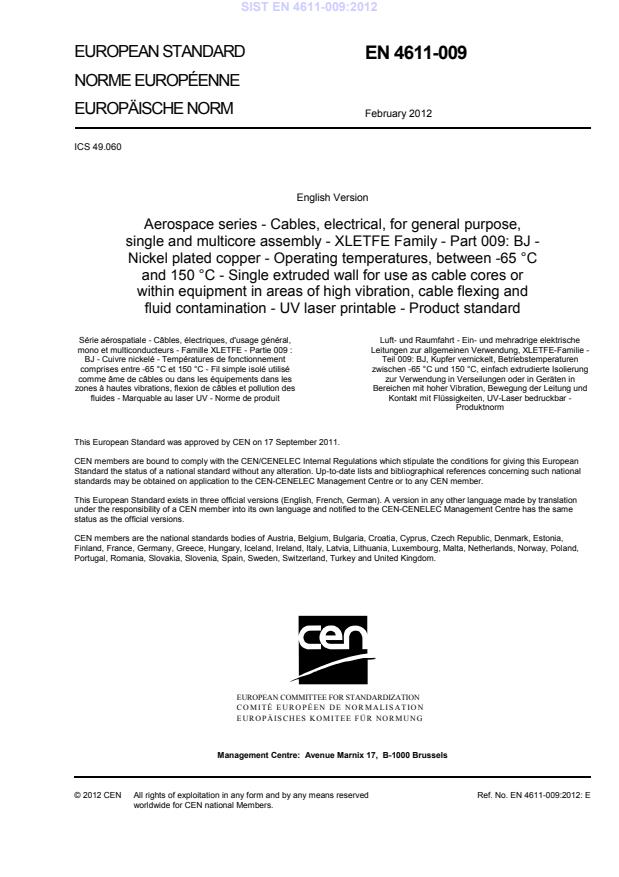
EUROPEAN STANDARD NORME EUROPÉENNE EUROPÄISCHE NORM
EN 4611-009
February 2012 ICS 49.060 English Version
Aerospace series - Cables, electrical, for general purpose, single and multicore assembly - XLETFE Family - Part 009: BJ -Nickel plated copper - Operating temperatures, between -65 °C and 150 °C - Single extruded wall for use as cable cores or within equipment in areas of high vibration, cable flexing and fluid contamination - UV laser printable - Product standard
Série aérospatiale - Câbles, électriques, d'usage général, mono et multiconducteurs - Famille XLETFE - Partie 009 : BJ - Cuivre nickelé - Températures de fonctionnement comprises entre -65 °C et 150 °C - Fil simple isolé utilisé comme âme de câbles ou dans les équipements dans les zones à hautes vibrations, flexion de câbles et pollution des fluides - Marquable au laser UV - Norme de produit
Luft- und Raumfahrt - Ein- und mehradrige elektrische Leitungen zur allgemeinen Verwendung, XLETFE-Familie -Teil 009: BJ, Kupfer vernickelt, Betriebstemperaturen zwischen -65 °C und 150 °C, einfach extrudierte Isolierung zur Verwendung in Verseilungen oder in Geräten in Bereichen mit hoher Vibration, Bewegung der Leitung und Kontakt mit Flüssigkeiten, UV-Laser bedruckbar - Produktnorm This European Standard was approved by CEN on 17 September 2011.
CEN members are bound to comply with the CEN/CENELEC Internal Regulations which stipulate the conditions for giving this European Standard the status of a national standard without any alteration. Up-to-date lists and bibliographical references concerning such national standards may be obtained on application to the CEN-CENELEC Management Centre or to any CEN member.
This European Standard exists in three official versions (English, French, German). A version in any other language made by translation under the responsibility of a CEN member into its own language and notified to the CEN-CENELEC Management Centre has the same status as the official versions.
CEN members are the national standards bodies of Austria, Belgium, Bulgaria, Croatia, Cyprus, Czech Republic, Denmark, Estonia, Finland, France, Germany, Greece, Hungary, Iceland, Ireland, Italy, Latvia, Lithuania, Luxembourg, Malta, Netherlands, Norway, Poland, Portugal, Romania, Slovakia, Slovenia, Spain, Sweden, Switzerland, Turkey and United Kingdom.
EUROPEAN COMMITTEE FOR STANDARDIZATION
COMITÉ EUROPÉEN DE NORMALISATION EUROPÄISCHES KOMITEE FÜR NORMUNG
Management Centre:
Avenue Marnix 17,
B-1000 Brussels © 2012 CEN All rights of exploitation in any form and by any means reserved worldwide for CEN national Members. Ref. No. EN 4611-009:2012: ESIST EN 4611-009:2012
...